
Key Insights
Generative AI software development saves money, enhances work efficiency, and increases innovation. It allows launching products faster, automates repetitive codifying processes, better DevOps processes and also better collaboration among international teams. Companies enjoy quality codes, scalable acquisition of talent, and enhanced ability of retaining developers, as well as receiving data-based information to make strategic decisions. Nevertheless, the adoption should be responsible, and solid governance and ethical practices should be used to provide secure and bias-free AI solutions. Employing Generative AI today will see the companies acquire sustainable competitive advantage within the digital economy.

Firms that adopt generative AI in software development are positioning themselves to be at the frontline by 2025 and beyond and those that fail to do so are likely to end up being left behind.
According to a latest survey on the use of AI,
“Organizations are beginning to take actions that directly affect their profitability. For example, they are redesigning their work processes as they implement generative AI and appointing senior leaders to handle important areas such as AI governance.”
The emergence of generative AI such as GitHub Copilot and GPT-4 is changing the code development, testing, and documentation process of software teams by automating software development and utilization.
According to the recent statistics, 25 per cent of its code is now AI-assisted which demonstrates the effect of artificial intelligence on the development of software and minimization of manual labor. To business leaders, this translates to accelerated product deliveries, reduced cost of operation and responsiveness to the market.
The software development teams in 2025 are much different as compared to the teams that existed a few years ago. More integrated workflows are being provided by AI to personalities, thus traditional front-end, back-end, and QA are converging. Nowadays, developers are utilizing AI as a virtual team member, writing code using natural language or fixing bugs, and product managers and designers are using AI as a rapid prototyping tool.
Here, in this blog we will discuss team transformations, the use of generative AI in DevOps, and how it is resulting in measurable productivity. We will also discuss the risks and best practices to make the AI integration secure, ethical, and business-oriented.
To explore a complete implementation roadmap — from AI strategy and data preparation to scaling responsibly — read our 9 Step Guide on How to Use Generative AI for Your Business.
Generative AI in Software Development
- Enterprises with over $500 million in annual revenue are adopting generative AI more broadly across their organizations compared to smaller companies.
- 40% faster coding and 50% faster documentation with generative AI tools like GitHub Copilot and GPT-4.
- EY India Survey reported that GenAI could boost productivity in India’s IT industry by 43-45% over the next 5 years.
The Role of Generative AI in Software Development for Improving Teamwork

1. Accelerating Development Cycles for Faster Market Delivery
AI-powered software development reduces time taken to code, and teams can provide products amid a shorter time. Such tools as GitHub Copilot are able to create code snippets within seconds, reducing development time to as little as 90 percent depending on the complexity of the project. When applied to business, it creates accelerated launches and this is equivalent to millions of dollars in revenue since it becomes early entrants to the market. By enabling AI to automate repetitive work, the teams will stay on track as team members will now be able to focus on strategic matters like feature innovation.
2. Improving Junior Developer Productivity
Junior developers are empowered by AI for software teams, which lowers the onboarding expenses and decreases the speed of contribution. Juniors can generate 46% of their code on their own with the help of tools such as Tabnine which offer real-time suggestions and explanations of code. Companies enjoy rapid scaling of teams and new employees make a difference in just a few weeks, not months. This also reduces training expenses, since AI becomes a 24/7 mentor, and it is in line with business requirements of cost efficiency and agility.
3. Making the Code Reviews Smoother
AI for software teams identifies mistakes and proposes code optimizations in real-time, like Amazon CodeWhisperer which reduces the time needed to review code by almost 50 percent. Not only does this guarantee code of a higher quality but also enables software developers to do more high-impact, strategic work. For businesses, streamlined reviews mean fewer bugs in production, saving crucial time on post-release fixes. It also fosters collaborative discussions, aligning teams on quality standards without delays.
4. Bridging Remote and Hybrid Team Gaps
With one third of dev teams operating remotely, AI bridges communication gaps. Tools like Notion AI summarize async standups and generate shared documentation, reducing misalignments. Businesses see smoother global operations AI’s contextual suggestions ensure continuity across time zones, cutting project delays. This enhances stakeholder confidence in distributed delivery models.
5. Democratizing Expertise for Inclusive Teams
AI-powered software development reduces technical barriers, and lets different hires work more quickly. To businesses, this leads to inclusivity, and this accesses larger pools of talent and saves hiring expenses. Multicultural teams also enhance innovation, which is aligned with market pressures to come up with creative solutions.
6. Making DevOps Cost-Effective
As observed in the case of generative AI in DevOps with Spotify whereby new infrastructure tests and anomalies prediction were automated, thus reducing the infrastructure cost by 60 percent. Such tools as SonarQube contribute to better CI/CD pipelines, which guarantee quality releases. This reduces downtime and speed of iteration, which have direct impacts on customer satisfaction and other key customer retention metrics used to position businesses competitively.
7. Enabling Cross-Functional Teamwork
AI builds synergy between the requirements, developers, and QA through the generation of UI prototypes and test cases based on the requirements. This helps cut friction and has reduced misalignment in cross-functional projects. In the case of businesses, this can be seen to mean coordinated development of products such that features are based on the needs of customers and the rework costs are minimized.
8. Mitigating Burnout to Sustainable Performance
AI increases the satisfaction of developers as it automates tedious activities such as documentation. This leads to lower turnover which is a sensitive business issue because it takes 1.5 times to replace a competent employee. Companies with happier employees can provide a stable output and this helps in ensuring long term stability as well as predictability of the projects.
9. Mitigating Risks with Ethical AI Governance
Security and IP risks are real because most of the AI-generated code contains vulnerabilities. Governance frameworks, adopted teams mandate human reviews and ethical training, minimizing liabilities. To businesses, this guarantees that they abide by the regulations such as the EU AI Act, avoid fines and develop trust with stakeholders.
10. Introducing Agents to Drive Innovation
Autonomous AI agents, coming into existence in 2025, process end-to-end workflows, including coding to deployment. This liberates teams to high-value innovation, and the uplift in revenues of AI-enhanced products. Businesses gain a first-mover advantage, as teams pivot to strategic experimentation, aligning with C-suite goals of market leadership.
The AI Tools Software Teams Must Have in 2025
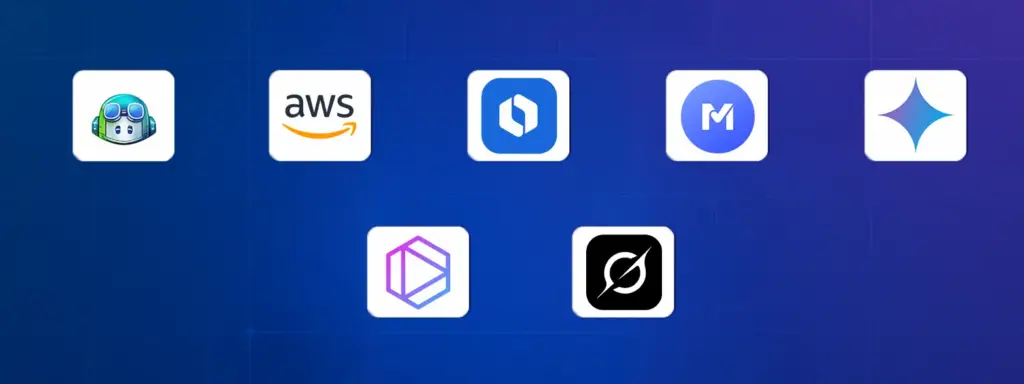
With generative AI in software development becoming mainstream, a sample of the correct tools can be used to give your team an objective advantage. Training talent, enhancing quality, and speeding up delivery? These AI based systems are changing the way development teams work.
Below is a breakdown of the most influential AI applications that are expected to influence software processes in 2025:
1. GitHub Copilot
GitHub Copilot is a code assistant developed by GitHub and OpenAI and is powered by AI. It ideally completes code, writes entire functions, and interprets logic in real-time all in your preferred IDEs such as VS Code or JetBrains.
Why It Matters for Teams:
- Contextual suggestions allow new developers to give their contributions in a meaningful way just within a few days.
- The senior devs also save time on repetitive code and are able to work on architecture and on complex problems.
- Produces snippets for languages like Python, JavaScript, and Java, with 46% of Java developers’ code generated autonomously.
Use Case:
The fast-onboarding of junior developers and ensuring that the code of a growing team is always written in a similar way.
How to Implement?
Teach your staff about the fundamentals of instant software development. In addition, combine it with GitHub Action to make the CI/CD pipelines more smooth.
2. Amazon CodeWhisperer
Amazon CodeWhisperer specializes in generating secure, AWS-optimized code. It flags potential vulnerabilities as developers type, promoting safe coding practices.
Why It Matters for Teams:
- Builds IAM policies, Lambda functions, and other AWS components with security-first design.
- Early preparation of problems in the dev lifecycle- minimizes the price of post-release bug fixing.
- Integrates smoothly with AWS Cloud9 and any other IDE such as IntelliJ or VS Code.
Use Case:
Enterprise development teams operating in the cloud-native setting with a high level of compliance and security.
How to Implement?
CodeWhisperer should be used together with AWS CodePipeline or CloudFormation as an Infrastructure as Code (IaC) tool. Set up role-based access to control where AI-suggested code gets deployed.
3. Tabnine
Tabnine is a privacy-first AI assistant that generates intelligent code completions using models trained on your team’s private repositories.
Why It Matters for Teams:
- On-site makes team-related recommendations, and traditionalizes to internal nomenclature and coding formats.
- Stores all data in-premise or in a secret cloud, which suits controlled industries.
- Accelerates code production without sacrificing team preferences or exposing sensitive logic.
Use Case:
Startups, fintech companies, and enterprise teams that require tight control over proprietary code and data privacy.
How to Implement?
Train Tabnine on your internal codebase and pair it with Slack or Microsoft Teams for real-time discussions and mentorship around code logic.
4. Atlassian Rovo
Rovo is a generative AI tool within the Atlassian ecosystem that automates user story generation, sprint planning, and retrospective summaries.
Why It Matters for Teams:
- Turn vague requests of clients into structured backlog.
- Helps scrum masters and product managers cut back on preparation of sprints.
- Produces well-structured recaps of sprint retrospectives having actionable insights.
Use Case:
Agile product teams with fast iteration cycles who need to stay aligned on goals and execution.
How to Implement?
Enable automatic sharing of Rovo’s outputs in Jira, Trello, or Confluence so that developers, designers, and business stakeholders are always on the same page. Rovo helps eliminate ambiguity between “what’s required” and “what gets built.”
5. Testim
Testim uses generative AI to create automated test cases based on user stories or UI flows. It also enables continuous regression testing with smart updates.
Why It Matters for Teams:
- QA engineers spend less time writing manual scripts and more time on exploratory testing.
- Test cases evolve alongside your product, reducing the risk of stale automation.
- Facilitates the adoption of a culture of testing early in the cycle catching bugs.
Use Case:
QA and Dev Ops teams who desire to cover wider, however less manual work and post release failures.
How to Implement?
TIE Testim to your CI/CD stack (e.g., Jenkins, GitHub Actions) to have real-time feedback loops. Detect flaky tests using the inbuilt analytics and maximize the reliability of the tests across sprints.
6. Google Gemini 2.5
Google Gemini 2.5 is a multimodal, code-first AI that builds backend services, handles data integration, and explains complex logic using natural language.
Why It Matters for Teams:
- Generates scalable RESTful APIs and database connectors.
- Easy to use in teams that require bridging between different systems and streamline the back-end infrastructure.
- Explains things in simple English- ideal with cross-functional teams.
Use Case:
Mid-size to enterprise-level engineering teams managing real-time data pipelines or scalable APIs.
How to Implement?
Combine Gemini with Google Cloud platform (GCP) to deploy in high performance mode. Test your staff by training them to prove and document the logic of the AI with the help of postman or swagger to facilitate the process of handing over the API.
7. Grok by xAI
Grok is a conversational, multimodal AI developed by xAI (Elon Musk’s AI venture) that supports text, code, and UI generation. It’s available via web, Slack, and mobile apps.
Why It Matters for Teams:
- Converts Figma files directly into React, Vue, or HTML/CSS code.
- Summarizes product requirements and pushes updates across channels.
- Enables async discussions via voice mode, supporting distributed teams.
Use Case
Cross-functional teams working on tight design-to-dev handoffs, especially in UX-heavy or startup environments.
How to Implement?
Use Grok alongside Figma, Notion, and Slack for a seamless product design–to–code pipeline. The voice mode is especially useful for async product updates in remote settings.
10 Risks of Generative AI in Software Development

Here, we identify 10 of the most significant issues and threats of generative AI application to software development teams and detail them in relation to business outcomes and the impact they have on the team-building process.
1. Automation of Expertise Making Teams Obsolete: Excessive dependence on artificial intelligence tools such as GitHub Copilot is the risk of losing skills and undermining the major principles of writing and coding. This undermines the capability of teams in the long term and raises the cost of hiring highly skilled talent. It makes innovation less productive as the teams cannot solve complex challenges without AI assistance.
2. Loss of Trust in AI Performance: 46 percent of developers do not trust the accuracy of the outputs of AI tools in any way. Its burdensome reviews increase the project timelines and the team lacks cohesiveness as it also loses trust over the capacity to deliver together to them affecting time-to-market.
3. Ethical and Bias Risks Dangerous Reputation: Biased AI trained on biased data may cause inequities to code or ability, which may result in consumer backlash or regulatory penalties under laws such as the EU AI Act. Such instances may negatively affect brand loyalty of customers, who are not interested to cooperate with such corporations, which practice unethical artificial intelligence. Moral conflicts within the team are likely to destroy the culture of collaboration.
4. Workflow Integration Cost and Disruptions: Integrating AI into legacy systems may be expensive and take a long time to up to $500,000 to set up and results in workflow disruptions. These technical reflexes lower team performance at the adoption stages and slows ROI and friction in cross-functional teamwork.
5. Weak Security: AI code-generation may have vulnerabilities and will need corrections. This requires the expensive industry audits, increased post-release fix costs, as well as compromising the momentum and collaboration focus on innovation with the damage control, and putting businesses at risk of cyber attacks.
6. Shortage of Talent: The lack of AI-skilled developers makes developers reliant on a small number of specialists, and raises salaries. Even distribution of skill in teams forms bottlenecks and reduces the output of collaborations and further increases the project costs as the businesses compete to employ or train them at the expense of strategic projects.
7. Absence of AI Transparency to Prevent Accountability: AI operations are not visible, and thus, it might be difficult to track and trace errors or hold someone responsible, and hence blame-shifting will occur within the team and demoralize. This kind of ambiguity is dangerous to the project delays and loss of stakeholder confidence, which has implications to business credibility and schedules.
8. Cultural Resistance Impacting Adoption ROI: Resistance to AI, driven by unclear roles, creates silos and power struggles of teams reporting adoption hesitancy. This reduces the speed of integration, latency of productivity increases, and businesses can lose up to 10 percent of the estimated AI ROI as teams fail to agree on common objectives.
9. Technical Debt Accumulating Hidden Costs: Technical debt is created through AI rapid coding that is not carefully validated. This diverts team resources from innovation to rework, raising long-term costs and stifling collaborative creativity critical for market differentiation.
10. Workforce Training Gaps Raising Turnover: Inadequate AI training leaves teams unprepared, with higher turnover in undertrained groups. Replacing developers strain budgets and disrupts team synergy, as businesses lose collaborative expertise and face delays in project execution.
Business Mitigation Strategies
In order to realize the full potential of generative AI in the software development process and overcome its obstacles, companies will need to take a strategic solution so that their teams can be efficient, compliant, and innovative. Use the following main mitigation measures:
Invest in Full AI Literacy Programs.
Invest in AI literacy as a competitive strategy to avoid skill loss, reduce turnover, and continue innovation by investing 5-10% IT budgets.
Introduce Human-in-the-Loop Governance Structures
Implement human-level reviews of AI code, vulnerability reduction, compliance and post-release fix cost reductions (20-30).
Pilot Programs of Low-Risk AI Integration
Implement AI tools through pilot projects to minimize the resistance to adoption, workflow exacerbation, and 25% cut integration costs.
Carry Out Periodical Ethical Reviews and Prejudice Tests
Carry out quarterly audits to reduce bias, adhere to the ethics, safeguard reputation, and avoid consumer backlash or even regulatory fines.
Create Standards of Analogous AI Ownership and Role
Role and responsibility definition in the context of AI to reduce cultural resistance, minimize silos, and enhance collaboration by 15 percent.
Top 5 AI Development Trends for 2025

- Domain-specific foundation models are emerging to deliver higher accuracy and compliance in specialized industries.
- Multimodal Gen AI is enabling seamless input and output across text, image, audio, and video.
- RAG pipelines are reducing hallucinations by grounding AI outputs in real-time, company-specific data.
- Autonomous AI agents are automating complex tasks through reasoning, planning and acting with tools on their own.
- On-device and privacy friendly AI is on the rise, which allows fast, secure and offline smartness without access to the cloud.
Final Thoughts
Generative AI in software development is not necessarily concerned with writing better and faster code, but also with changing the way teams work. Whether it is involving the streamfitting of DevOps, providing power to junior developers, or preventing burnout, AI is turning out to be a trusted co-worker that inspires productivity, collaboration, and creativity.
Those businesses that thrive in 2025 and above will be those who strike a balance between the speed of AI and human control. This implies using the appropriate tools, implementing a system of governance, and investing in upskilling such that teams are not intimidated by the implementation of AI. The future is not about humans or AI, it is about human and AI collaborating to produce superior products, improved teams, and impactful business.
FAQs
Q1: In what way does Generative AI help software teams to save money?
Repetitive work, e.g., boilerplate code, documentation, and testing, is automated by generative AI, and developers are able to put their effort into higher-value work. This saves up to 30% of operation expenses per annum.
Q2: Will AI fully replace developers in the future?
No. AI is a productivity partner and not a replacement. Strategies, system design and supervision are vital in human beings. AI copes with monotonous tasks allowing the teams to work on innovation.
Q3: What methods do businesses implement to quantify ROI of AI adoption?
Key metrics include:
- Shorter time-to-market
- Reduced rates of defects and support
- Greater availability of developers
- Increased retention and satisfaction of employees
Q4: What are some security issues of AI-generated code?
- Risk of potential vulnerabilities
- Intellectual property and licensing
- Risks of data privacy compliance
Q5: What are the methods a company can begin to use Generative AI?
- Single out the areas with high impact such as testing, documentation and DevOps.
- Begin with small pilot projects.
- Educate the use of AI and best practices by the train teams.
How BrainX Technologies Empowers Businesses?
At BrainX Technologies, we partner with organizations to strategically integrate Generative AI in software development.
Our services include:
- AI-Enhanced Development: Incorporating AI assistants in code development.
- Integrating Generative AI in DevOps: Automating CI/CD, infrastructure and monitoring.
- Custom AI Solutions: Developing business-specific models.
- Governance, Compliance & Consulting: Establishing safe, ethical AI practices.
Our implementation does not merely put the tools to work, but changes the very culture of your team so that Generative AI software development becomes a steady ally that is going to bring tangible business growth.
Ready to future-proof your software teams?