
- AI app development cost ranges from $30,000 for simple apps to $500,000+ for advanced enterprise solutions.
- Project scope, data readiness, and AI model complexity are the biggest factors that drive total cost.
- A phase-by-phase AI app development cost estimate helps budget clearly across discovery, design, build, AI work, QA, and deployment.
- Ongoing costs like cloud, API usage, model tuning, and 15%–25% annual maintenance can significantly increase the total spend.
AI app development cost is a major concern for many businesses that are looking to leverage artificial intelligence. The brief answer is: it depends. Developing an AI-based application can cost you between tens of thousands of dollars and easily into the six or seven figures range.
For example, the industry data indicate that the total AI app development budgets vary between approximately $30,000 for a simple AI app and a complex, advanced solution with a budget of up to half a million dollars or above.
Why such a broad range? The final price tag is driven by multiple factors – from the sophistication of AI models and amount of data needed to the development approach and post-launch requirements.
In this guide, we’ll break down how much AI app development costs by examining the key cost factors and providing phase-by-phase estimates. You will also observe actual cost examples of various forms of AI applications, understand about the unseen recurrent expenses, and get insight on how to save money on your AI app. Armed with all this insight, you can plan and maximize the value of your AI investment with confidence.
Why Should You Invest in AI App Development
Investing in AI app development pays off when it turns slow, manual workflows into fast, repeatable systems. For example, customer support apps can use AI to auto-tag tickets, route them to the right queue, and generate a first-draft response based on your help docs. That alone reduces handling time and improves SLA performance. In internal operations, AI can read invoices, contracts, and PDFs, extract key fields, and push them into your CRM or ERP, which cuts data entry errors and speeds up approvals.
AI is also valuable when decisions depend on patterns humans miss. A product analytics app can detect churn signals from user behavior, then trigger retention plays automatically. A logistics or retail app can forecast demand and recommend reorder quantities using seasonality and historical data. In regulated industries, AI can support reviews by highlighting anomalies or missing documentation, while keeping a human in the loop for final decisions.
The goal is not “adding AI.” It’s building features that create measurable outcomes like fewer hours spent per task, faster turnaround time, higher conversion, or reduced risk. When you tie use cases to KPIs early, your AI app development cost estimate becomes easier to defend, and you avoid spending on AI features that don’t move the business forward.
Factors Influencing AI App Development Cost
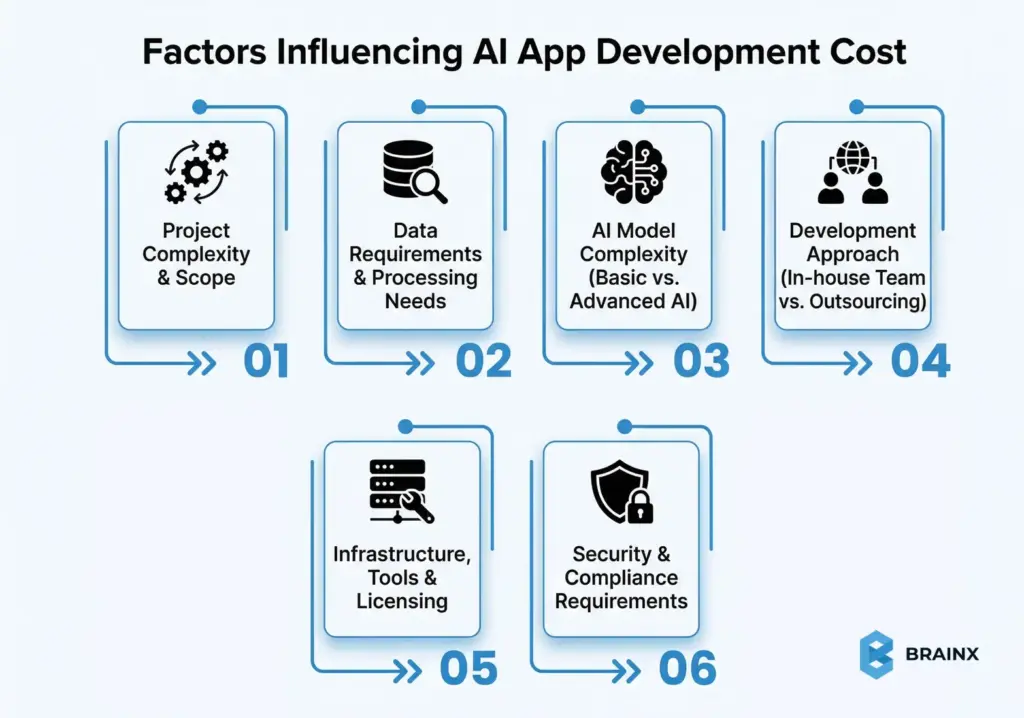
Several primary factors drive the cost of developing an AI app. Learning about these will make you understand why AI app development costs may differ so much. Some of the most influential elements are listed below:
Project Complexity & Scope
One of the largest cost drivers is its overall scope and complexity of the project. A simple application with a limited feature set (such as a basic AI chatbot with FAQs) is much cheaper than a platform with a wide range of AI features and integrations. The greater the features, user role, and use cases your application needs to accommodate, the more development hours and skills you will need to hire.
As an example, a basic AI customer support chatbot can be developed at fairly low cost and speed, but a more sophisticated AI solution (such as a predictive analytics application or a medical diagnostic application) that requires the use of several AI models and big streams of data will inherently come at a much higher price. Put simply, the wider and more sophisticated the functionality of your app, the more expensive it is to develop.
Data Requirements & Processing Needs
AI runs on data, and data requirements of your application can be a substantial cost factor. Take into account questions such as: How much data do you need to train and run your AI models? Is there a requirement to gather or otherwise acquire vast data sets? Will it work with real-time data or work with sensitive information that needs to be stored securely?
In case your AI application will need a lot of data collected, cleaned, and labeled, this preliminary work can become quite costly. Similarly, applications that constantly use high amounts of data (e.g. real-time analytics or image recognition feeds) might result in increased cloud computing and storage expenses. As an example, one guide estimates data collection alone may go as high as 1000 to 30,000 dollars a year and big data processing infrastructure might further cost tens of thousands per year.
In simple words, AI applications that are data-intensive require additional resources to control data pipelines, storage, and processing power.
AI Model Complexity (Basic vs. Advanced AI)
Not every AI is made equal, the complexity of the AI models that you use is another significant cost factor. There is a big difference between integrating an existing basic AI feature and creating an advanced AI system from th
e ground up. The more complex and personalized your AI models are, the more time and expertise the creation, training process, and optimization of the models require.
As a crude estimate, the simplest AI applications (such as simple chatbots or recommendation engines) could add tens of thousands of dollars to the cost, and more complex AI applications (such as multi-model predictive analytics or generative AI systems) can go into the six figures. As a matter of fact, one of the industry breakdowns indicates that basic AI applications can be affordable with about 15,000-35,000 dollars, whereas complex or multiple models of AI applications can cost 250,000-500,000+.
Advanced AI is more expensive due to the increased size of the datasets required, the greater amount of computation, and specialized AI research and development.
Remember that the decision between off-the-shelf AI models and custom models is a huge one because custom models will provide greater control and distinctiveness but will be more expensive, whereas using the existing AI models can save time and money (you’ll find more about this in the cost-saving tips section).
Development Approach (In-house Team vs. Outsourcing)
The way you organize your development team will directly influence your budget. You can develop an AI application with an inhouse team, outsource to an agency or offshore developers or use a mixed approach. All the options have different impacts on cost, control and scalability.
- In-house teams involve the recruitment of developers, data scientists and AI engineers, who are usually charged higher per hour. Payrolls, allowances, and infrastructure become part of recurrent costs. Although such an approach has the benefit of direct control it typically requires greater initial investment, especially for specialized AI talent.
- Outsourcing to an AI development agency or offshore team is usually cheaper. It reduces costs by utilizing available expertise and regional rates benefits without having to hire long-term or permanent staff. You only pay for the skills on demand and do not have to pay continuous overhead on employment.
Budget, timeline and control requirements determine the most appropriate approach. Many teams outsource at the beginning (to create an MVP), and scale their in-house team afterwards, or use a mix between the two. Team structure and location should always be included when you’re cost planning.
Infrastructure, Tools & Licensing
Other than the cost of people, infrastructure and tools are also relevant to your AI app budget, both initial and continued. Such technical demands tend to be underestimated and can expand rapidly as the usage increases.
- Cloud infrastructure facilitates hosting and training AI models. Platforms like AWS, Azure, and GCP bill you on compute, storage, and data transfer basis. The workloads that require the heavy use of GPUs can be very expensive and cost up to hundreds or thousands monthly, whereas cloud pricing can offer the prices to be as flexible as possible because there are no initial hardware costs.
- APIs and third-party services introduce usage-based fees. While they speed up development, costs rise with scale. Small per-request charges can become significant as user activity increases, making usage forecasting essential.
- Software licenses and DevOps tools may add recurring costs. Annual subscription fees are common with enterprise AI systems, data labeling systems and MLOps systems. Even though minor as compared to development costs but must be factored into the budgeting.
Overall, monitor infrastructure usage closely. Cloud services lower capital costs, but actively tracking costs and usage alerts can help prevent sudden spikes.
Security & Compliance Requirements
AI apps that work with sensitive data or in a regulated sector, will need additional security and compliance investments. Applications that deal with personal, health, or financial information should comply with regulations such as GDPR or HIPAA, which directly affects the scope of development and its budget.
The security efforts involve encryption, safe data storage, penetration testing, and continuous monitoring. Law and consent forms, as well as formal evaluations, may be necessary to ensure compliance and incur both development time and external costs.
For example, even simple GDPR compliance may cost a bunch of thousands of dollars, and more rigorous audits and monitoring can cost even more. Although these measures increase the AI app development cost, they are necessary for minimizing risks, preventing penalties, and securing long-term business value.
A Comprehensive View of the Cost Involved in AI App Development (Phase-by-Phase Breakdown)
Here’s a cost estimate of AI app development that helps you plan for every phase.
Phase-wise AI App Development Cost Estimate Table
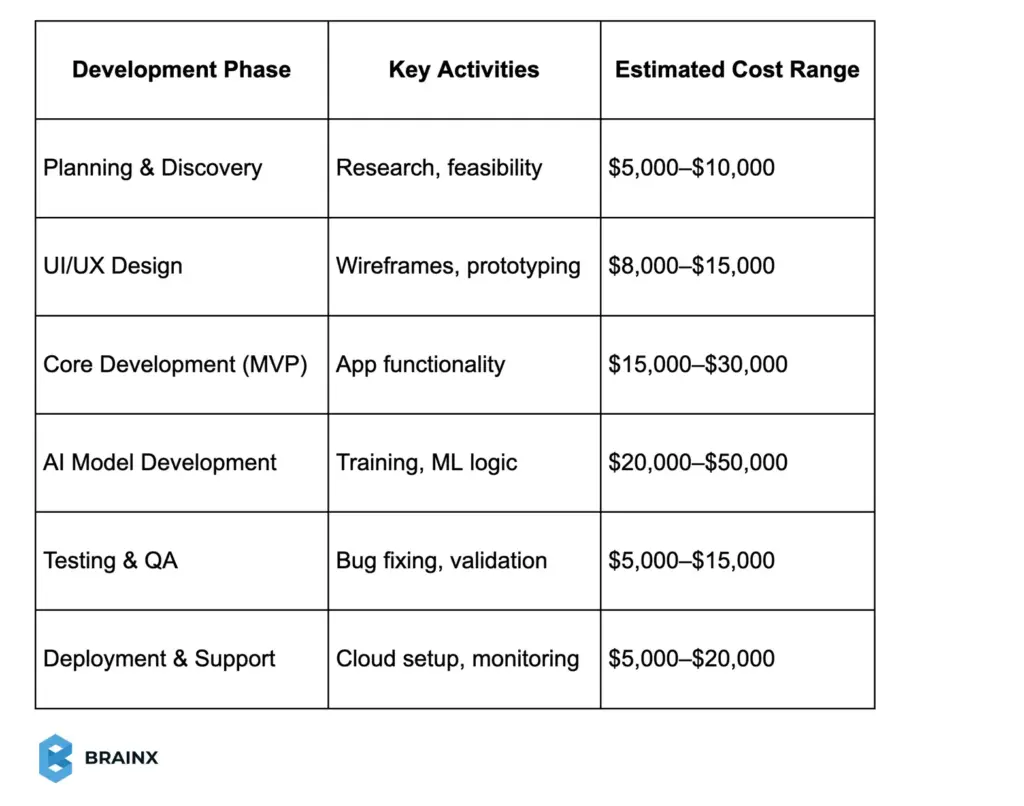
You may use the above given AI app development cost estimate to align scope with your budget.
Having discussed the reasons why pricing may differ, now we will discuss how much AI app development can cost you throughout an average development lifecycle.
How Much Does AI App Development Cost? (Breakdown by Stages)
The division of an AI project into distinct stages simplifies budgeting and allows decision-makers to know how time and money are used.
Although actual figures vary depending upon scope and complexity, the following ranges give a viable starting point on which to base a plan on how much does AI app development cost and will it be within your budget.
Planning & Discovery ($5,000–$10,000)
It’s the initial phase concerned with research, requirements gathering, and feasibility analysis. Teams establish the scope of the project, find target users, describe the use cases, and determine the technical and commercial feasibility of the proposed AI solution before the actual development.
Some of the activities involve discovery workshops, interviews with stakeholders, data audits, and, occasionally, a proof of concept or technical feasibility study. During this stage an AI road map is generated, which can be used to make development decisions. Making such an investment saves uncertainty and avoids the painful rework in the future, so it is one of the most useful steps and especially worth it given the comparatively low cost.
UI/UX Design ($8,000–$15,000)
UI/UX design shapes how users engage with AI features and perceive AI-generated outputs. The designers develop wireframes, prototypes, and user flows which facilitate interactions like chatbots conversations, dashboards, recommendations, or visual insights.
A good AI UX design simplifies complex logic and creates trust, since the outputs are easy to understand. The prices vary according to the size of the screens and platforms, as well as the complexity of the interaction, although the majority of AI applications cost between the middle four and lower five figures in terms of design.
Good UX leads to a decrease in friction, increase in adoption, and decrease in future support costs.
Core Development (MVP Build) ($15,000–$30,000)
This stage focuses on building the core application without advanced AI logic. A minimum viable product contains the basic front-end and back-end functionality including authentication, data flows, APIs and basic workflows.
As a case in point, an AI-based eCommerce application MVP can have user accounts, product listing, and checkout with place holders where AI suggestions will appear. The cost depends on platform and architecture, while agile development and strict focus on must-have features keep the costs in control.
Postponement of non-essential functionality makes this phase lean and in line with initial validation objectives.
AI Model Development & Training ($20,000–$50,000)
This is what is at the heart of an AI app and may be the costliest step. Prices will vary based on the pre-built AI APIs or the creation of specific models you need. Ready-to-use services save time and money but have minimal customization. On the other hand, custom models involve data preparation, experimentation, training runs, tuning and integration.
It’s the phase that covers model coding, training infrastructure, validation, and early AI testing. Although the simpler AI use cases can be cheaper, more advanced applications of AI can drive the prices up like computer vision or predictive analytics.Investing here has a direct influence on accuracy, reliability, and value in the long run.
Testing & Quality Assurance ($5,000–$15,000)
Testing has to go beyond traditional software QA. Besides functional checks, performance and security checks, teams have to verify AI behavior and output accuracy. QA engineers test edge cases, bias risks, and model reliability under real-world conditions. It is highly risky to omit or minimize this step because AI errors can cause bad decisions or mistrust of users. Even though testing is an added cost, it saves the company a lot of post-launch fixes. Tested AI applications are more reliable, scalable, and can be trusted by the users.
Deployment & Post-Launch Support ($5,000–$20,000)
Deployment entails installation of cloud infrastructure, databases, model hosting, monitoring, and scaling. It can also include the publication of apps to stores or distribution among internal teams. Expenses include performance tuning, logging, integration of analytics and readiness of real world traffic. Short-term post-launch support is typical immediately after launch so that developers can fix urgent problems and ensure stability of the system. Most contracts contain a short support window, so as to provide a smooth transition into production.
Such statistics are not absolute. Small projects may fall below these ranges, while enterprise AI systems often exceed them. Breaking costs down into phases assists in teams to be more strategic with budget allocations. One such approach is to allocate an average of 10 percent to discovery, 10 percent to design, 30 to 40 percent to development and AI modeling, and the rest to testing and deployment.
The resulting structured view from understanding how much does AI app development cost and why allows for better planning, clearer expectations, and more informed investment decisions.
Breakdown of Costs by Levels of Complexity
Cost ranges shift most when you move from “API-based AI” to “custom-trained AI,” and when your app needs deeper integrations, stricter security, or multi-role workflows. Use this table as a practical AI app development cost estimate by complexity level.
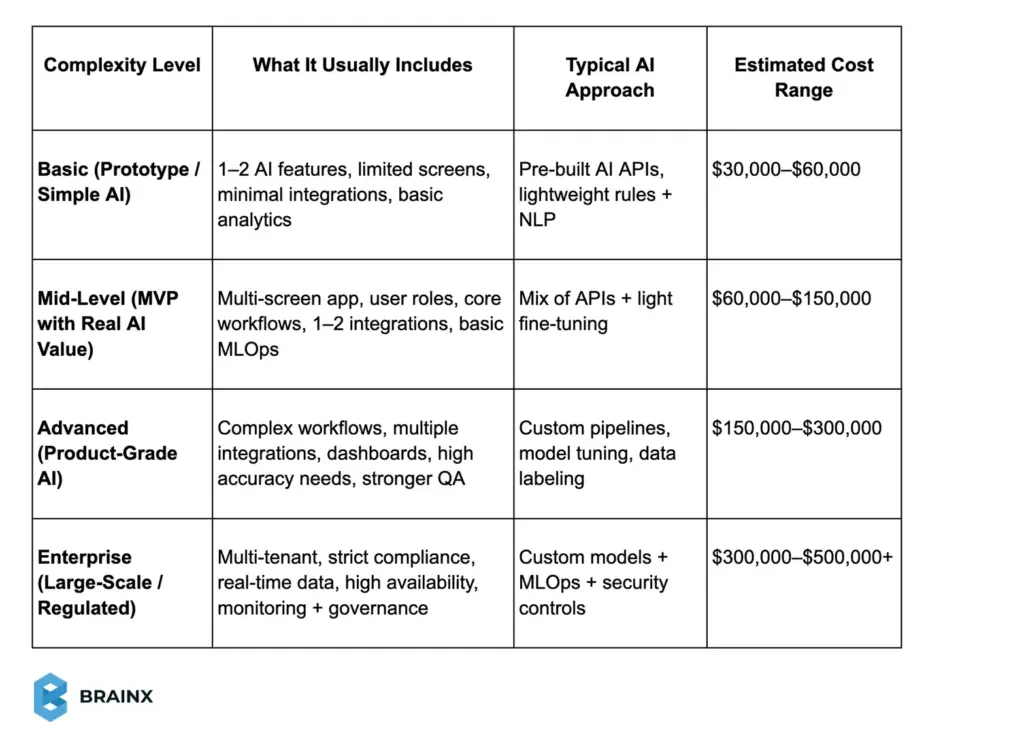
These ranges work best when you already know whether you’re building a focused MVP or a platform that needs enterprise reliability from day one.
Time and Efforts Required
Time is not just about “how fast the developers code.” AI apps take longer when your data is messy, labeling is required, or your team needs repeated model iterations to hit accuracy targets. The table below shows typical effort ranges that influence how much does AI app development cost in real projects.
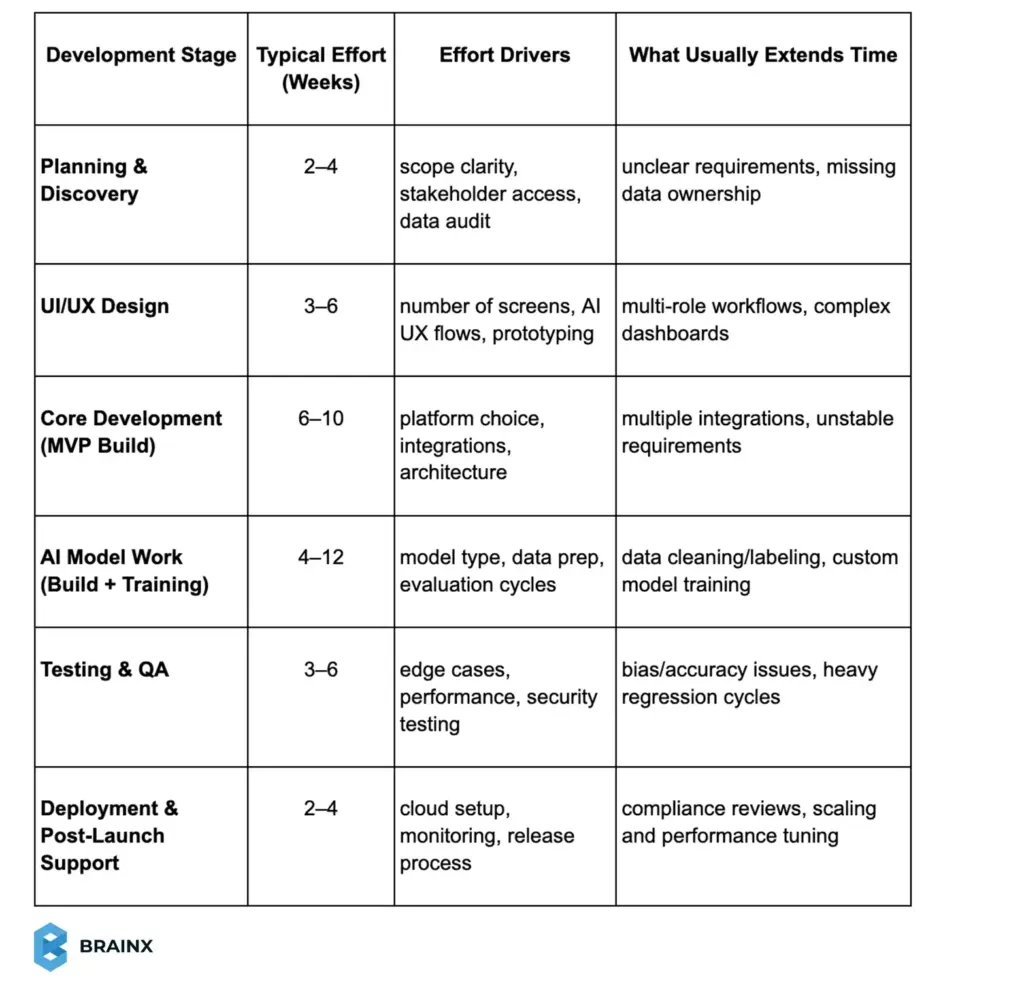
In most cases, an MVP-level AI app lands in the 10–16 week range. Product-grade AI often takes 4–6 months, especially when model tuning and data work are serious parts of the build. The more time you spend validating data and outputs early, the fewer expensive surprises you’ll face after launch.
AI App Cost Examples by Application Type
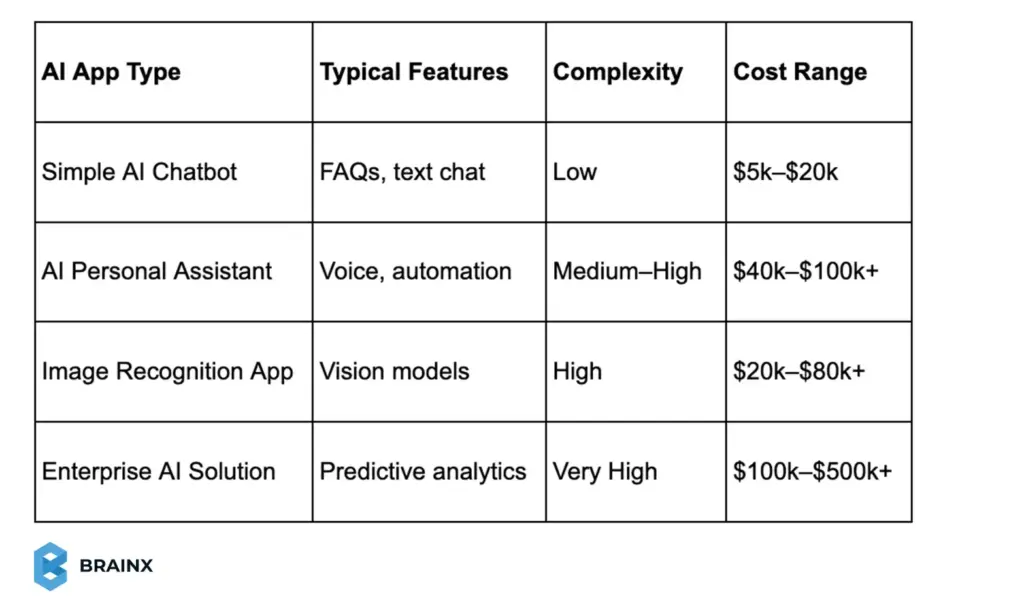
To narrow down the cost discussion, we will examine some examples of AI applications and how their cost may vary based on their development. Various AI apps are of different complexity, and comparing them can be used to clarify what you should be expecting with your specific AI idea.
AI App Cost by Use Case
Simple AI Chatbot – Features & Cost Range
One of the most readily available AI applications is a simple AI chatbot. These bots are either rule-based or have simple NLP services to identify the user intent and serve based on a predefined knowledge base. They do not learn dynamically but handle straightforward queries efficiently.
- Features often consist of a simple chat interface, built-in question answer flows, or decision trees. Integration with websites or messaging platforms is possible along with the use of lightweight NLP tools for intent detection. The scope of conversation is restricted to FAQs or simple commands.
- The approximate cost of a simple chatbot is comparatively low. Basic integrations can begin at approximately $5,000-$10,000, whereas more sophisticated chatbots using machine learning and integrations can cost as much as $20,000 or above. Moderately complex custom chatbots can be priced reasonably between $15,000-$50,000, and this is still one of the most affordable AI app types.
AI Personal Assistant App Development Cost - Features & Price Range

AI personal assistant apps are, in comparison, far more complicated than chatbots. These systems rely on voice recognition, natural language understanding and task automation to perform tasks on behalf of users. They are required to deal with context, flow of conversation and integrations with other services or devices.
- Features usually comprise voice command processing, intent recognition, task execution like reminders or searches, and personalized responses. Most of the assistants work across platforms, adapt to user preferences over time, and work with both text and voice inputs.
- Approximate AI personal assistant app development cost can typically range from $40,000 to $100,000 for a basic version. More intelligent assistants with advanced voice AI, natural language generation and wide integrations may cost over $300,000-$500,000. As a result of this complexity, most teams begin with a team assistant focused on handling only a few tasks in order to keep costs manageable .
AI-Based Image Recognition or Vision App – Specialized & Data-Intensive
AI vision apps analyze images or a video feed to identify objects, patterns, or certain conditions. Common examples are product recognition, facial recognition, medical imaging, and augmented reality applications.
- Features focus on a computer vision model that is trained to recognize specific image classes. The users upload or take pictures, and the artificial intelligence interprets them to provide answers. Other features can be image annotation, editing, or real-time detection.
- Approximate cost depends on the usage of the pre-built APIs or custom models. Basic applications using already available APIs can begin at approximately 20,000 dollars, and custom vision applications will cost anywhere from $20,000–$100,000+. Prices increase depending on data labeling requirements, the complexity of model training and hardware, including GPUs. The overall cost of vision apps usually lies between chatbots and enterprise AI.
Enterprise AI Solution (e.g., Predictive Analytics) – Large-Scale & High Cost
Enterprise AI solutions are developed to be used in challenging business environments with huge volumes of data. Examples are predictive analytics platforms, demand forecasting systems, or AI embedded within CRM or ERP software.
- Features offered are deep data integration, multiple AI models, analytics dashboards, robust security controls, and ability to manage high data-volumes or real-time processing.
- Approximate cost for enterprise AI projects usually begins at $100,000 to $200,000 and sometimes goes beyond $500,000 in case of deployments at a larger scale. Such solutions are typically developed in phases and need continuous investment for model tuning, system expansion and maintenance. The overall cost of the initial development is only a portion of the total cost with optimization playing a significant part in the long term.
Hidden and Ongoing Costs of AI App Development that you Should’t Ignore
The budgeting of an AI app should not focus on the initial build only. Numerous costs arise post-launch and they persist throughout the lifecycle of the app. These hidden and ongoing costs can significantly affect the total AI app development cost if they are not taken into account at the initial stage
Post-launch Maintenance and Updates are a Major Ongoing Expense
After release, teams need to fix production bugs or other similar issues, upgrade libraries or operating systems, and improve features. In the case of AI apps, retraining or fine-tuning models also fall under maintenance since data will evolve over time.
A common guideline is to budget 15–25 percent of the initial development cost annually for maintenance. It usually includes support of the developer, regular updates of the model, and small improvements that may be necessary to maintain the app’s reliability and accuracy.
Data Storage, APIs & Cloud Service Fees Contribute to Long-term Costs
AI applications are typically hosted in the cloud, which is billed per storage, compute, and transfer data. Archiving user data, logs, and the training data might be cheap per gigabyte at the initial stages, however, the expenses will rise as more data is gathered,
Adding to all this, AI APIs and model inference are often charged on a per-use or per-request basis. Small per-call charges can grow rapidly as usage grows, particularly when it is time-intensive computational work such as image recognition or natural language processing.
Compute Usage and Bandwidth are Another Consideration
The cost of hosting AI models can be expensive since the CPU or GPU resources needed for the job will cost hundreds or thousands of dollars per month at scale. The transfer of data, notification and third-party services can introduce smaller, yet recurring fees.
All in all, AI apps need continuous investment to be effective. Cloud usage, maintenance, and model update cost are budgeted to prevent the instability, ensure scalability, and preserve cost-effectiveness of your app in the post-launch period.
Model Tuning and Continuous Improvement
AI models are not supposed to be the “set and forget” type. In order to remain precise and useful, they need to be tuned or retrained as the user behavior or data changes and new use cases are introduced. The AI lifecycle includes continuous improvement as one of its core components, and it has a direct impact on the long-term costs.
Ongoing expenses usually include:
- Periodic retraining, where models are updated with fresh data to improve performance. It entails data preparation, training runs, computational usage and deployment.
- Fine-tuning third-party models that add to the costs, particularly when acclimating large language models with domain-specific data.
- Feature improvements, driven by user feedback, which require further development and testing cycles.
It is often included in a yearly maintenance budget of many teams, and is generally about 15–25 percent of the initial development cost. Others set aside a special budget on continuous data science and AI optimization. Unless AI models are updated regularly, they may grow obsolete, making them less accurate and leading to distrust among users and making critical repairs more expensive.
Licensing, Security Monitoring & Compliance Costs
In addition to updating models, AI apps have supporting costs.
- Licensing fees for datasets, models, or enterprise tools that are often paid annually.
- Security monitoring that may involve audits, threat detection, and penetration testing, especially for apps handling sensitive data.
- Compliance maintenance that can also require periodic reviews, legal support, or certifications as regulations evolve.
One-Time vs Ongoing AI Costs
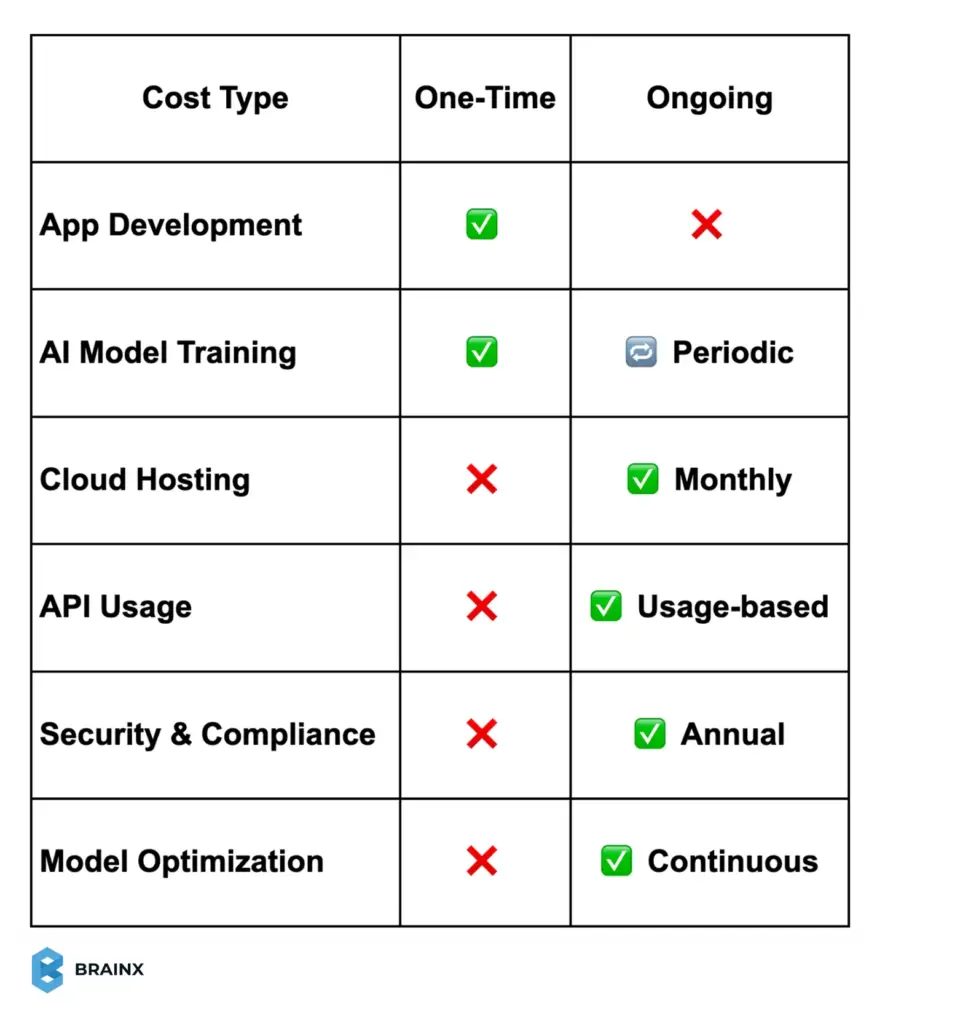
Simply put, recurring expenditures on an AI app generally involve cloud charges, ongoing development/improvement, and professional security and compliance services. An effective solution is to budget your AI app operations every year to accommodate all of these items. By doing so, the initial development cost is insured and the app will be able to keep on providing value without facing a sudden funding crisis in the future.
5 Tips to Reduce AI App Development Cost
Cost optimization is paramount, even more so when budgets are tight. The good news is that you can save money on the development of AI apps without compromising quality by making intelligent technical and process decisions. The following are some of the best-tested methods to ensure you get to keep the costs in check, and at the same time come up with a trustworthy AI application.
1. Leverage Pre-Built AI Models and APIs
When it is not required, avoiding custom AI development is one of the most effective methods of reducing costs. Image recognition, speech-to-text, and conversational AI are some of the many functions of AI that are already offered using mature APIs and pre-trained models.
When your AI needs are not that unique, pre-built API can save a lot of time in development. Your team doesn’t need to train models from scratch, instead, it gets busy with integration and product logic. This transforms high upfront expenses into scaling demand-based expenses.
Although API-based services have recurrent charges, they tend to be cost-effective at small to middle scale. The cloud providers also deal with updates, performance optimization, and scalability which minimizes the effort in maintaining them over the long run.
Open-source models offer another middle ground. They are free of cost and customizable but still need integration and tuning.
In short, build custom models only when differentiation demands it. Existing AI services can deliver faster results at a lower cost for most use cases.
2. Start with an MVP and Scale Gradually
An attempt to roll out a fully functioning AI application on the first day is likely to result in excessive spending. Instead, a more effective solution is to create a minimum viable product which provides essential value using the minimum number of features.
An MVP keeps initial costs down, accelerates time to market, and allows real users to validate assumptions. With early user feedback, the next round of investments is channeled into features that are actually important and not mere speculations of functionality required.
Suppose that an AI assistant can be launched with the ability to schedule and remind only, and advanced features will be launched in later releases. After the MVP demonstrates its worth, you can reinvest the revenue or funding in the growth of its features. It’s a phased approach that spreads cost over time and reduces financial risk.
3. Use Cloud Infrastructure Instead of On-Prem Hardware
Cloud infrastructure prevents massive initial expenditures of servers, GPUs and network devices. You don't have to spend on capital expenses, instead, you pay regular operating expenses every month and scale the resources on demand.
To optimize cloud spending:
- Use managed services that help reduce DevOps overhead
- Deploy the right-size compute resources and shut them down when not in use
- Keep track of what is being used and get rid of services that are idle
Although cloud may be costly on big data scale, it is the least expensive choice for most small-scale and medium-sized AI apps. It also enables experimentation without any long term commitments.
4. Adopt Agile and Iterative Development Models
Development methodology can directly impact cost. The Agile and iterative methods minimize waste by promoting continuous feedback, early testing, and periodic prioritization.
Agile teams aim to develop the most valued features initially. Plans can be modified easily without significant re-designs even if requirements change or superior solutions are found. This is particularly crucial when it comes to AI projects, in which feasibility may feel unclear until one experiments with things early.
Building small prototypes to test AI techniques before carrying out a large scale implementation lowers risk and avoids costly failure. Effective communication and documentation among product and engineering teams also reduce the number of misunderstandings that can result in wastage of effort.
5. Invest in Quality Testing Early
Reduction of testing can appear a cost saving measure, but it nearly always ends up costing more in the future. Bugs found subsequently after launch are much more costly to remedy and can incite mistrust in the user.
In the case of AI apps, testing should not be restricted to regular QA. Models must be validated on diverse data, edge cases, and real-world scenarios. Fault-tolerance (feedback loops where the user can label the wrong outputs) are useful in enhancing the accuracy over time.
Security testing is equally crucial, specifically when handling sensitive data or using third-party AI services. Comprehensive upfront testing is a protection of your product image and budget in the long term.
With existing AI tools, MVP-based development, cloud computing, agile development, and good testing practices you can save a lot of money in the cost of AI applications yet provide a high-quality, scalable solution.
Conclusion - Maximize Value from Your AI Investment
Understanding the AI app development cost enables you to plan better and make an investment without any hesitations. The costs depend on complexity, data, team organization, and other ongoing needs, which can be difficult to manage without a phased process. With the help of an MVP, focused on quality, and continuous optimization, you can manage your expenditures and get the maximum ROI out of your AI application.
Build Your AI App with BrainX Experts
Estimating AI app development cost is usually the first hard step. At BrainX, we make it easier by turning your idea into a clear scope, a phase-by-phase budget, and an execution plan you can trust. We handle the full journey, from discovery and UX to development, AI integration, QA, and launch.
Whether you’re building a focused MVP using proven AI APIs or a larger product with custom workflows, we align every feature with ROI. Our teams work across machine learning, NLP, and generative AI to automate operations, improve decision-making, and deliver personalization that actually moves KPIs.
A good example is Ponder, an AI-powered mental wellness app we helped evolve into a more complete, mobile-first experience. The platform supports voice and text journaling, guided wellness flows, and GPT-based recommendations that adapt to user intent and emotional triggers. We focused heavily on “emotional UX,” so the AI feels supportive without crossing comfort or safety boundaries.
Frequently Asked Questions About AI App Development Cost
Q1. How much does an AI personal assistant app cost to develop?
An AI personal assistant app typically costs $40,000–$100,000 for a basic version with core voice or chat features. Advanced assistants with multi-platform support and deeper AI capabilities can exceed $300,000–$500,000. Many businesses reduce costs by starting with a focused feature set or customizing existing AI platforms.
Q2. What is the cheapest way to build an AI application?
The most affordable approach is using pre-built AI models or APIs, limiting scope to an MVP, and avoiding custom model training. No-code or low-code platforms and cloud AI services can help launch simple AI apps for a few thousand dollars, though functionality will be limited.
Q3. Do AI apps have ongoing maintenance costs after launch?
Yes. AI apps require continuous maintenance, including bug fixes, updates, cloud hosting, and model retraining. Ongoing costs typically range from 15–25% of the initial development cost per year, depending on usage and complexity.
Q4. Can a small business afford AI app development on a limited budget?
Yes, with careful planning. Small businesses can build affordable AI apps by focusing on a narrow use case, using third-party AI services, or starting with a lightweight MVP. Many successful AI projects begin at a modest scale and expand as ROI grows.