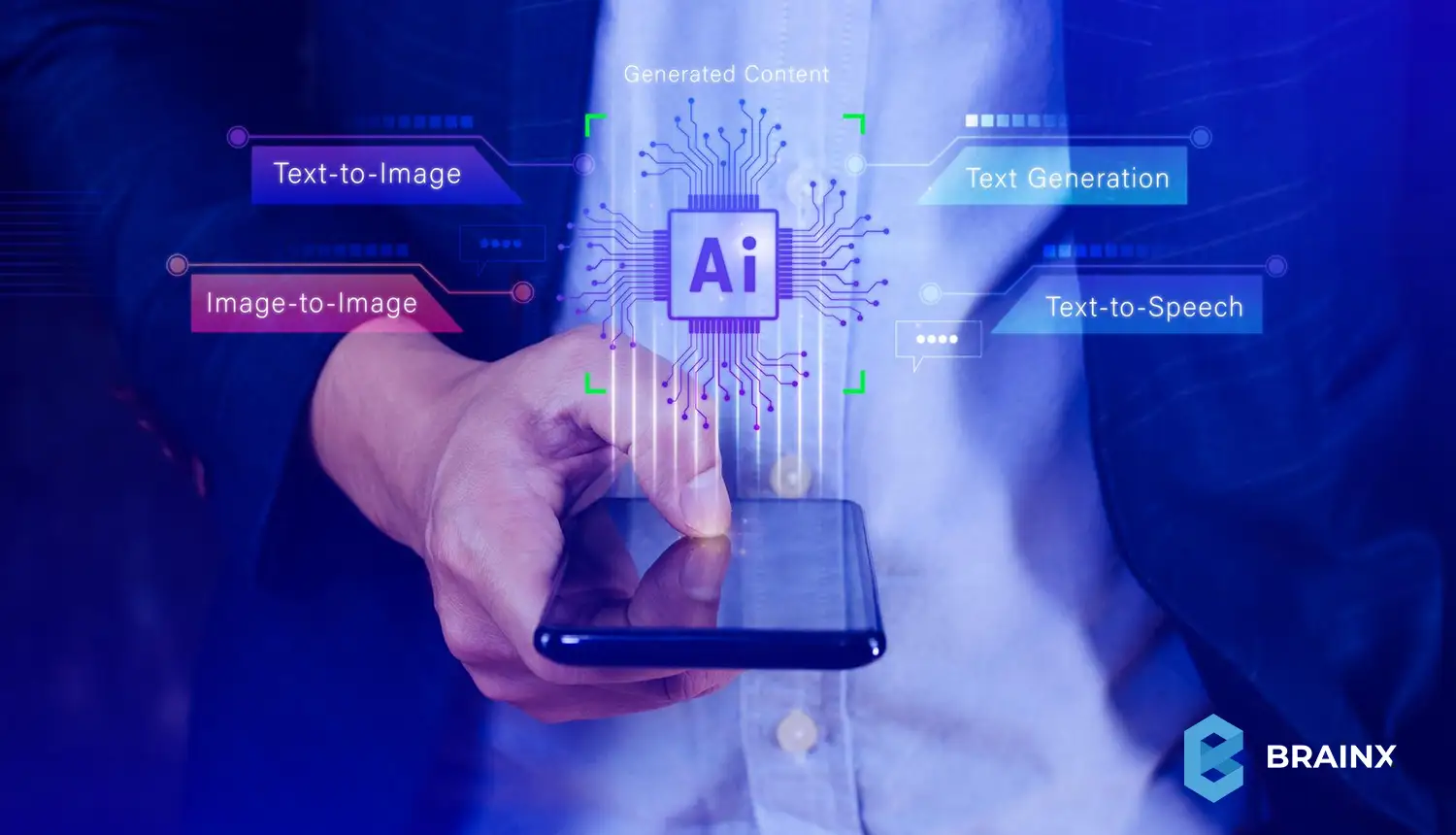

Your customers use their phones daily, swiping across their apps that already know what they need and what their problems may be and how these apps can help them and improve their life. However in the current world where there are over 8.93 million mobile apps competing to get the attention of the audience, a design alone is not sufficient to cut through the competition, intelligence is needed. Branded by artificial intelligence (AI), mobile apps are becoming the most useful tools ever as they attract users in a new way.
Whether it be real-time support through chat bots or hyper-personalization that is like a personal concierge, artificial intelligence can be found supporting businesses like yours in becoming even more interactive, efficient in their operations, and of developing long term loyalty. This blog will talk about the revolutionary aspect of AI in mobile applications and how it is time that business owners adopt this technology.
The Rise of AI in Mobile Apps: Why It Matters to You

The mobile app market is a very competitive one, and Google Play and the App Store have millions of apps on it. Customers demand a flawless, easy-to-grasp, and personalized experience, and AI is the solution to achieving such a behavior.
According to a recent report, it has been estimated that the worldwide AI market is worth about 391 billion dollars. To all the entrepreneurs, this is not a disclosure, it is a strategic advantage that allows you to stand out and stimulate your growth.
AI in mobile apps enables them to think, learn, and adapt as it adopts tools like natural language processing (NLP) to make smarter conversations, machine learning (ML) to make predictions by offering an understanding, and computer vision, which is used to make visual innovations.
Why is AI in mobile apps the key to staying ahead in 2026? Let us have a look.
1. Chatbots
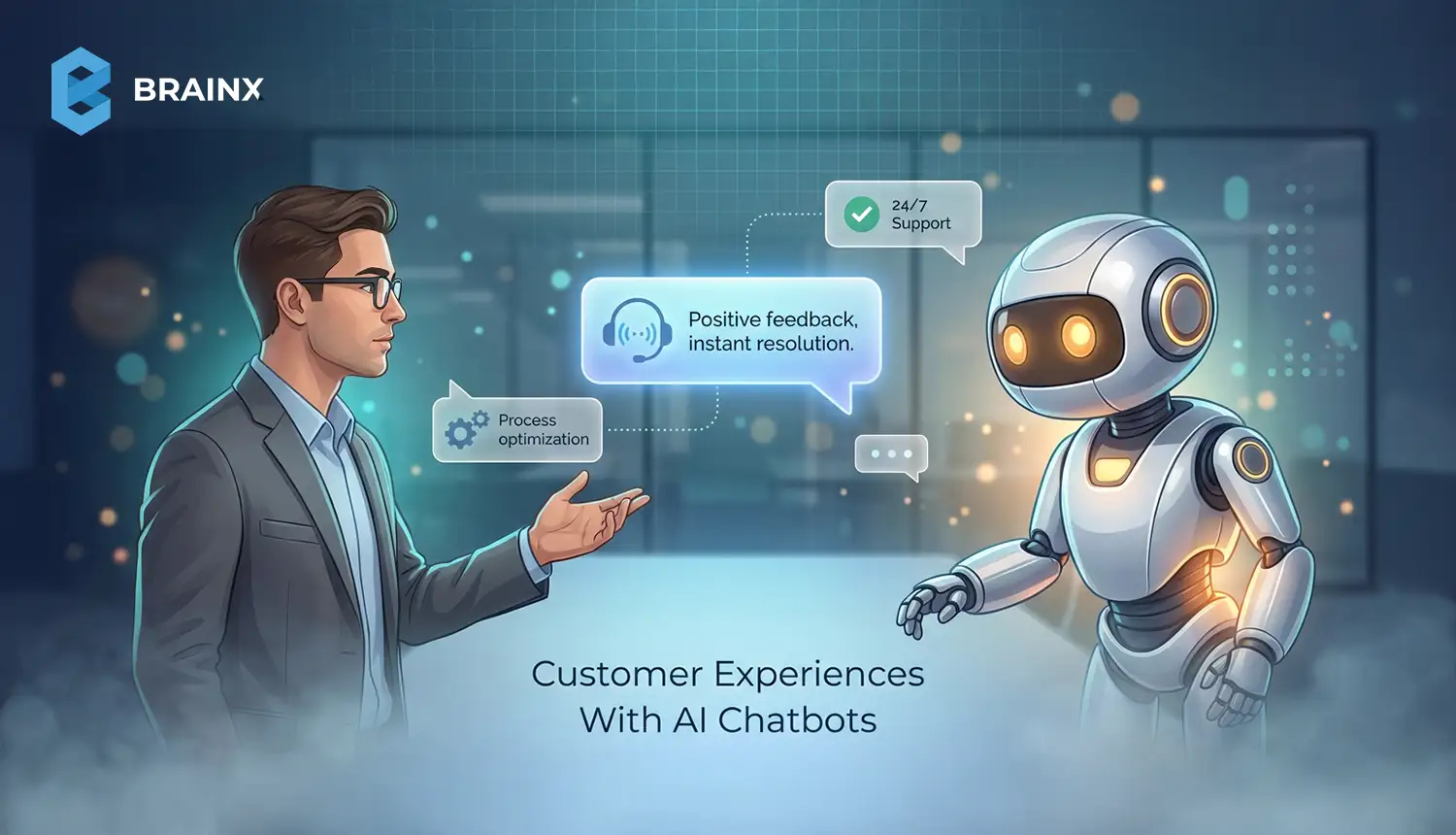
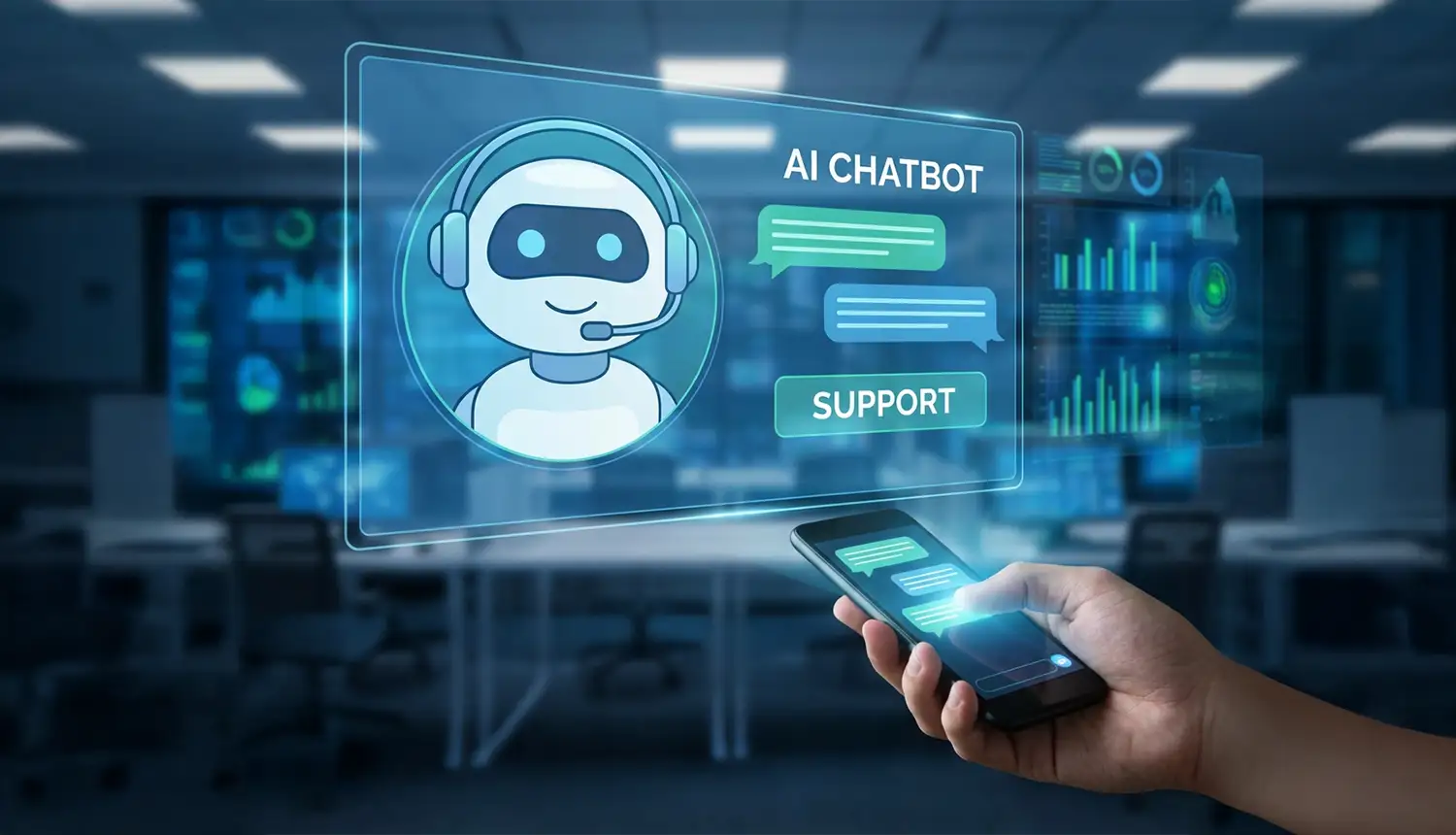
Traditional chatbots that used to lag and frustrate the customers have become a thing of the past. The already present AI-powered chatbots are powered by NLP and ML, which comprehend the contextual meaning, identify emotions, and offer immediate, personalized assistance. To the entrepreneurs this implies the ability to give the customer outstanding customer service that you do not have at the expense of an in-house team.
The Significance of Chatbots
Interesting fact: In the modern world, the number of individuals who refer to AI chatbots exceeds 987 million.
These chatbots respond to FAQs, place orders, and do all the other simple tasks, leaving the complex tasks to human agents and promising 24-hours service.
Case Study: Sephora's Virtual Assistant
The mobile application of Sephora will include an AI-based chatbot, which is combined with NLP and provides customers with personal product and beauty talk that aligns with their preferences and buying habits. It even appoints meetings in a store. The result? Demonstrating that chatbots can be used to generate anything up to 20 percent growth when it comes to engagement with customers along with 15 percent increase in conversion rates.
There is more to Customer Service
Chatbots have taken businesses by storm. There is also use of AI in the healthcare industry, with applications such as Ada Health helping to evaluate symptoms and offer individual guidance, with the help of the former offloading part of the workload of personnel. Banking uses chatbots in apps, such as Chase Mobile, and provides information quickly to answer transaction questions. A chatbot may shorten response times, raise satisfaction and lower operation costs to your business.
2. Hyper-Personalisation
Hyper-personalization is the further step of personalization, relying on AI to individualize experience on an app as per user behavior and preferences in real-time. It is equivalent to a digital assistant that knows perfectly what your customers need.
Power of Hyper-Personalization
According to the study conducted by the Harvard Business Review in 2024, personalized user experience can have a five to eightfold effect on the number of marketing investments. Such apps as Netflix and Spotify lead by example: the Netflix recommendation engine designed around ML and Spotify Discover Weekly playlists have contributed to 80 percent of Netflix watch time, and have improved Spotify retention 30 percent by recommending appropriate songs.
Case Study: Starbucks Mobile App
The Starbucks application relies on AI that examines the previous buying history, location, and even weather to recommend drinks and meals. It may suggest a hot latte drink to a user who would only want to drink warm drinks on a cold morning. This hyper-personalization has resulted in a 25 percent rise in app-based orders and a 10 percent increment in the determination of loyalty programs.
The Advantage It Has to Your Business
Hyper-personalization greatly adds to customer engagement and retention. Using predictive analytics, your app can meet the customer demands by recommending products, publishing content, or providing notification that comes at the right time. It can be a fitness app that suggests exercises to do or an e-commerce app that mentions deals: regardless of the industry, the personalized experience will make users return.
3. Predictive Analytics
With predictive analytics driven by ML, developers can use the past data to predict user actions so that apps can provide them with proactive solutions. In this, business owners end up making smarter marketing and decisions.
Real-World Impact
According to a survey done by Qualtrics in 2025, predictive analytics results in a 15 percent growth in customer retention for businesses. Another example is Amazon positioning their mobile app so it guesses what users are likely to purchase next, generating a 35 percent growth in average order size based on recommendations.
Case Study: MyFitnessPal
MyFitnessPal employs predictive analytics to provide their users custom workout programs, and meal recommendations depending on activity rates and objectives. As a result of this, there has been a 28 percent increased usage and 20 percent more premium memberships, which demonstrates how AI enhances satisfaction and revenue.
How Does It Matter to You?
Predictive analytics will allow your company to understand what is soon to come and be ahead of it. A shopping app may remind customers of an item they need to buy again, or a travel app may suggest a place, depending on their previous travels. These qualities are not only less abrasive but also turn your application into a must have.
4. Computer Vision
With computer vision, applications can process visual data, anything as basic as determining the object in front of them to understand gestures which would change the face of retailing, medical care, and entertainment.
The Example of Google Lens
The Google app includes Google Lens, which can scan objects with computer vision and display details about the object immediately, such as the names of plants or translation of menus. It has stimulated an increment on the use of apps by 40 percent. Computer vision technology empowers businesses with capabilities such as virtual try-ons for retail and automated document capture for finance or logistics.
Case study: IKEA Place
The Place app of IKEA incorporates computer vision, augmented reality (AR) to allow users to create home visualizations with furniture. It also guarantees proper placements with its ability to analyze the dimensions of the room and lighting in order to boost online furniture sales by 30%.
The Reason It Is a Game-changer
Computer vision brings in a new source of revenue. A fashion application may allow trial room usage with the aim of reducing returns or a property application may allow virtual tours with the aim of saving time. These functionalities make your brand easy to implement and customer oriented.
5. Voice Assistants
NLP-based voice assistants enable wider access and ease in using apps to accommodate a hands-free multi-task environment or visually impaired users.
Story in Numbers
According to a survey conducted by Emerline in 2025, applications that have voice recognition have a 25 percent heightened engagement. Such assistants can perform various activities like setting reminders or ordering something, which makes apps user-friendly.
Case Study: Domino Case Study
Domino has an app with a voice assistant named Dom that takes orders of pizza through natural speech. This has shown a 15 percent growth in app order, 10 percent decline in phone calls to customer services.
Why Should You Care?
Voice assistants make communication easier and increase the number of people who can use your app. A food delivery app may accept voice orders or a work aids application may enable dictation of notes, thereby making it more inclusive and friendly to its users.
6. Security and Fraud Detection
As the threats to data privacy are on the increase, AI can improve app security with fraud identification using machine learning and biometric logins by face recognition or voice.
Case Study: PayPal
PayPal app is powered by AI, as it tracks transactions in real-time, and notices suspicious activities. It has decreased fraudulent transactions by 25 percent and made users more trusting since 70 percent of users regard this application as being secure.
The Significance to Your Business
Artificial intelligent security instigates trust and loyalty. Protecting the data of the users whether you own a fintech or an e-commerce app will save millions in possible fraudulent expenses.
Examples of Businesses That Integrated AI in Mobile Apps
Many mobile apps that were not originally built around artificial intelligence have started integrating AI in mobile apps to enhance user experience, improve functionality, and stay competitive. Some of the examples of these apps, whose existence is discussed based on information available, are listed below that have integrated AI in their existing models:
1. WhatsApp
AI Functionality Introduced: In 2025, WhatsApp started experimenting with AI product recommendations and introduced an AI-powered business voice calling feature, which allowed more dynamic and dynamic customer care experience. As an illustration, AI helps businesses recommend products depending on user activities.
2. The Premier League App
The app included AI-based tools based on Microsoft Copilot, including match analysis functions, individualized guidance, or recounting an occurrence of game play. The tools allow the user to experience the game in a better way through interaction with match statistics and predictions.
3. Snapchat
Snapchat has intimated their iconic filters into the AI-powered image recognition technology, to add effects to their iconic filters through facial recognition in real-time. Also, it launched My AI chatbot that enabled the user to communicate naturally through the app and get questions answered or help in something.
4. Netflix
Netflix takes advantage of AI-powered personalization enabling it to recommend programmes and movies depending on previous viewings of a user. Its algorithm studies how its users consume it to recommend it, and about 80 percent of users end up watching suggested titles. Also, Netflix has been considering AI voice-activated search and content categorization.
5. Google Photos
Deep Scan App also uses the AI in image recognition to classify photos automatically and identify the people, places, or things it sees. The AI is used to provide such features as automatic tagging, facial recognition, and search (e.g. searching by "beach" to find photos related to this search query).
6. Hootsuite
Hootsuite insights is an AI technology that reads social media sentiment and trends and provides content suggestions based on how the user interacted with their stories. Automated post-scheduling is also fuelled by AI to maximize their impact in their timings.
What Can the AI Future of Mobile Apps Be?
Creating an AI-based app has turned into a very efficient measure keeping up with the modern dynamic app market. Yet, it is not a short-term enthusiasm and there are good rationales why it should be given a thought. To decide whether you should still go on to develop or design an AI-based app, the truth is further ahead to help you realize why it should be a good idea.
- By 2034, the AI in mobile apps industry is expected to grow to nearly USD 354.09 billion.
- As AI adoption accelerates, 92% of businesses are preparing to boost their investment in the coming years.
- AI adoption is well underway, with 77% of companies already using it or evaluating its potential.
Challenges of Integrating AI in Mobile Apps
So let us now have a complete summary of the main concerns related to the implementation of AI in mobile apps in 2025:
1. Compliance and Privacy of Data
AI works on data, and high standards of data privacy, such as GDPR and CCPA, and recent global standards, complicate data gathering and utilization. Getting compliance and offering individual experiences is one of the critical areas.
2. Bias and Model Accuracy
Without well diversified and representative data used in training the AI models, bias or inaccurate results can be produced. In the case of mobile apps with an international user base, this may result in bad user experiences or ethical issues.
3. High Resource Spending
Real-time processing, on-device inference, and other Advanced AI capabilities require abundant computing capabilities and memory. It may hurt the battery life, performance and user experience of lower-end devices.
4. Integration Complexity
The strategy of subsuming AI within current mobile infrastructure would involve compliance with backend systems, and cloud services and third-party APIs. One of the issues that developers can encounter is making AI workflows adhere to the legacy architecture.
5. Real-Time Performance
The chatbots, voice assistants, or object recognition as an AI-based feature have to provide feedback in a few seconds. Because it is latency sensitive, particularly in low-bandwidth environments, the performance may be impaired and the user may get frustrated.
6. Use of Explainability and Transparency
Users want to understand how decisions are made, especially when those decisions seem unreliable. In particular, sensitive applications will require some explanation, such as finance or health. Making black-box AI decisions understandable, particularly on mobile devices, is a complex blend of technical and UX hurdles
7. Model Updates and Maintenance
To remain precise, AI models have to be frequently retrained and updated. Lifecycle management of models is operationally as well as technically challenging, especially when dealing with a large user base that exists in varying versions of the app.
8. Security Vulnerabilities
Adversarial attack or data poisoning can be directed at AI systems. Strong protective measures are essential to uphold AI integrity and user privacy.
9. Development and Scaling Cost
Building and implementing AI models, especially a custom model, is an investment-heavy process. It is a delicate balance that needs to be achieved in scaling such models to millions of users without out-of-control cloud and computing expenses.
10. In-House AI Non-Expertise
Not every team of application development is equipped with its own data scientists or ML engineers. This lack of talent tends to stagnate innovation or produce less than the ideal implementation.
FAQs
Q1. Are AI apps more successful in terms of revenue?
Answer: Yes. The exponential rate of revenue growth of AI apps has been as high as 37x over a two-year period and consumers spent over 1.4B in 2024.
Q2. Is this difficult to add to already existing mobile apps, in terms of AI?
Answer: The use of mobile apps with AI is becoming more feasible with the circulation of AI APIs and SDKs which allows the incorporation of AI features regularly on the chatbots, recommendations, and analytics functions.
Q3. What are the dangers of AI in mobile apps?
Answer: Risk factors are data privacy, unethical use related to artificial intelligence, bias of the algorithms and the quality of real-time data. Governance and testing should be done thoroughly.
Why BrainX is The Ideal Partner for Your AI App Development Journey
BrainX specializes in integrating AI in mobile apps effectively for better engagement and scalability. Custom chatbots with hyper-personalization, computer vision, and predictive analytics, we have it all to suit your business.
Are you ready to turn your app into an innovation powerhouse now?
Get in touch with BrainX to learn what our AI development service can do to streamline your customer interactions and increase your chances to lead in 2025.