

Are you unable to take action because your enterprise data is held in spreadsheets and old systems, where it is identified as a problem?
To business owners, the tech enthusiasts, and investors, this wasted potential is a bedeviling issue costing time, money, and opportunities. AI tools for enterprise data step in to transform raw data into your greatest resource.
One research study by the IDC in 2023 shows that 60 percent of businesses around the world will use AI to make decisions by 2026 because it will unlock billions of value.
Are you looking to increase efficiency, bring joy to customers, or identify the next ticket to ride?
AI tools give you the whole picture and the power to operate successfully in the data-driven world as generative AI is reshaping industries and driving large-scale transformations across business functions.
The following guide will provide you with practical knowledge to utilize AI tools for enterprise data and make your business a leader in the era of data-based tools.
Why AI Tools for Enterprise Data Matter?
Enterprise data that includes customer data, financial data, operation records, and others, will be a treasure trove to any organization. Nevertheless, it is so massive and intriguing that it can choke traditional analytics. This is covered by AI tools on enterprise data that allow companies to compute big data and unstructured data at scale, provide real-world knowledge, and automation. A 2023 study by Grand View Research estimates the worldwide market of AI is anticipated to develop at a compounded yearly growth rate (CAGR) of 35.9% between 2025 and 2030.
Compared to the approach of traditional analytics, the AI technologies have a better possibility to apply pattern recognition, predicting, and decision automation. To business owners, this means a saving in costs and more customer experiences. These tools attract tech enthusiasts with its ground-breaking algorithms and investors are keen to invest in scalable AI solutions.
Key Applications of AI Tools for Enterprise Data
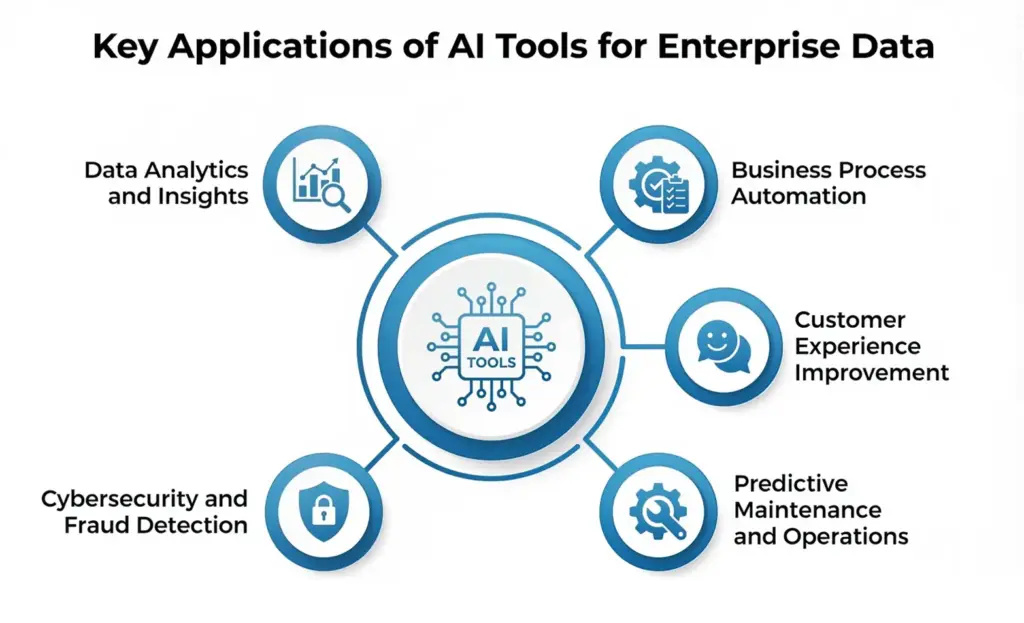
AI tools for enterprise data are versatile, addressing diverse business needs. Below are the primary applications.
1. Data Analytics and Insights
Databricks’ AI-driven analytics tools and Google Cloud help process vast amounts of data to identify patterns and forecast future trends. As an example, Google Cloud offers the AutoML that helps companies to create customized machine learning models without extensive technical knowledge, thus democratizing analytics to non-technical people. What makes us different compared to many other blogs is that we focus on the technical implementation but at the same time, we also highlight the possibility of using these tools to make sales forecasting, inventory optimisation, or personalised marketing campaigns. Considering a business case of a retail store, the use of AI would help it to understand the purchase histories of clients and make forecasts to determine how they would make further purchases to increase sales.
2. Business Process automation
AI also automates repetitive duties enabling human resources to work strategically. The products offering AI services of Microsoft Azure, such as Azure Machine Learning, enable automation of the data processing services, for example invoice categorization or answering the customer queries. Telstra also employed the use of the Azure OpenAI Service to cut customer-related follow-up calls by 20% using automated support infrastructures. What is less mentioned is using automation to simplify compliance procedures, track changes in regulations in the financial arena or healthcare to make sure that businesses are up to date with their compliance without human supervision.
3. Customer Experience Improvement
AI tools foster positive experiences with clients by making the experience one-on-one.
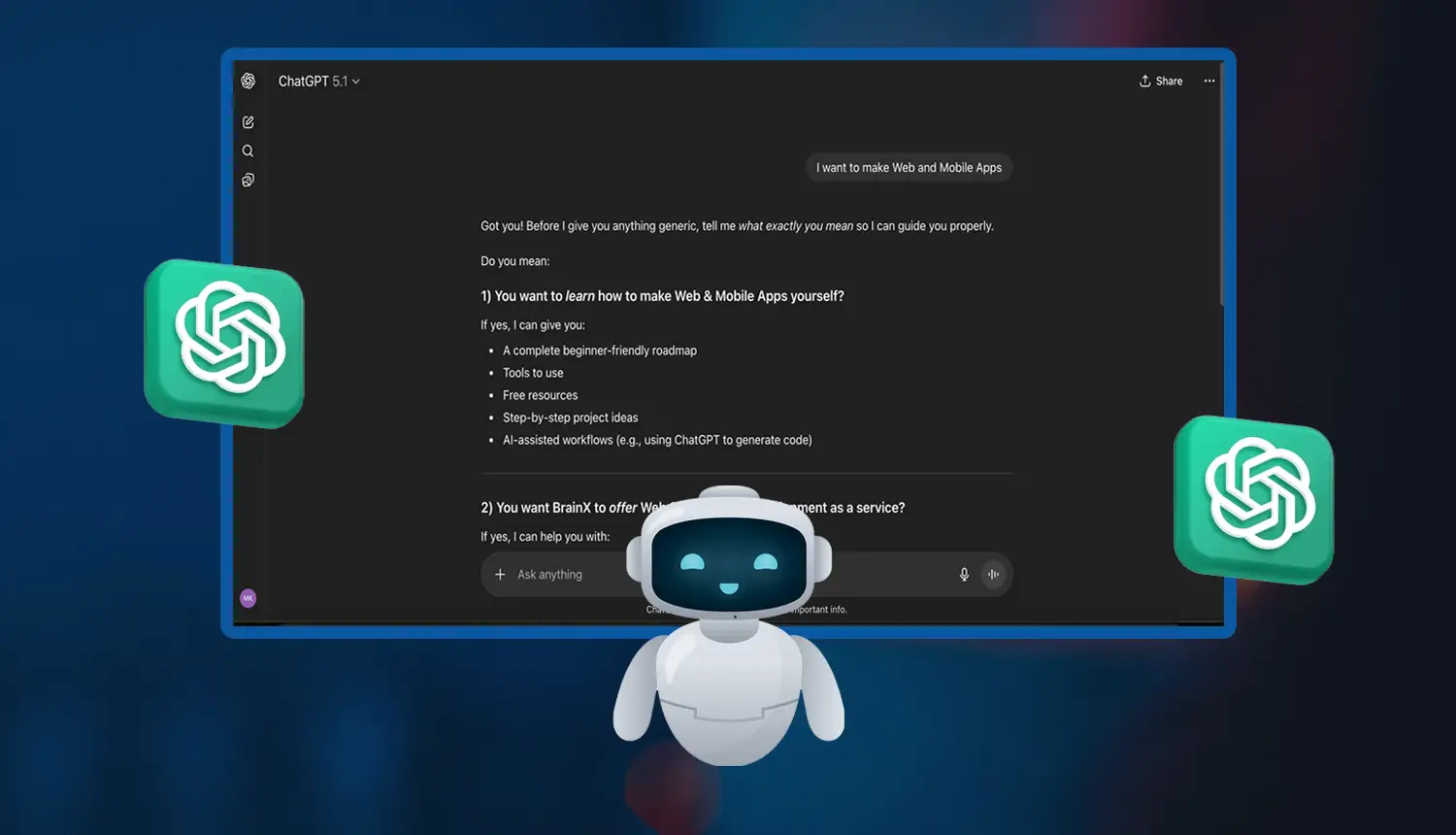
For teams building personalised AI-driven features, here’s how to build AI-powered web and mobile apps with the ChatGPT API.
Such tools as Einstein AI of Salesforce can process data about the customers to attach marketing messages to them or suggest the products. Nevertheless, leading blogs tend to overlook the possibility of generative AI, including the DBRX model developed by Databricks, to develop dynamic customer support chatbots that can adjust to enterprise-specific situations, which enhances accuracy in responses. The benefits of being able to customize these models using their own data will be a game changer to the tech enthusiasts, and the investors may consider the fact that such solutions can scale across various industries.
4. Predictive Maintenance and Operations
In manufacturing or other logistics companies, AI tools are used to see and prevent breakages on equipment, reducing downtime. Partnership of Databricks with Chevron Phillips Chemical Company applies time-series analytics to track data on IoT, and predict maintenance requirements with high precision. One of the aspects that have not been explored is ways in which the small and medium enterprises (SMEs) can use these tools effectively at a relatively low cost through the use of clouds, which help them compete with the big names.
5. Cybersecurity and Fraud Detection
AI strengthens cybersecurity by detecting irregular patterns in enterprise data. Rivian’s cybersecurity lakehouse on Databricks proactively addresses threats to reduce operational risks. In addition to threat detection, AI can actively train itself by simulating cyberattacks and strengthening its defenses. This capability is rarely highlighted in current literature but is crucial for businesses and organizations handling sensitive data.
Selecting the Appropriate AI Solutions of Enterprise Data
The success of the alignment of the right AI tools depends on the alignment with the business objectives, data infrastructure and expertise of the users. This is a step-by-step method:
1. Business Needs Assessment
Find points of pain like employees making decisions slowly or working inefficiently. For example, a logistics company may opt for predictive maintenance, while a retail business might focus on customer analytics. As compared to most blogs, however, we emphasize the need to engage non-technical stakeholders in such a process in order to harmonize it with strategic objectives.
2. Scalability
Select scalable tools as well as the tools that integrate with the existing systems. The example of Unity Catalog in Databricks is the platform that integrated data governance across the cloud platforms, so there is no issue with the smooth correlation with Azure, AWS, or Google Cloud. An important point to keep in mind by any investor is that platforms containing open-source components as in the case of Databricks with Delta Lake are cost-efficiently scalable.
3. Make it Easy to Use
To the non-technical user, there are easy to use tools, such as Tableau or the Smart Analytics platform offered by Google Cloud. Other benefits include low-code/no-code applications such as the Lakeflow Designer in Databricks that allows business owners to create data pipelines without coding-related skills.
4. Data Governance
Data governance is great especially when there is a need to ensure compliance and security. Unity Catalog offers roles-based access controls and lineage tracking to make sensitive data safe. One of the omissions is the ability of AI to automate governance related functions like marking data quality problems which is critical to regulated industries like the finance industry or the healthcare sector.
5. Cost & ROI
Although some platforms such as Azure databricks support consumption-based pricing, companies have to balance costs and ROIs. As an example, Lexmark International increased its insights speed by 25% with Databricks, and this is a good reason to invest.
Step-by-Step Guide Plan on Implementing AI Tools
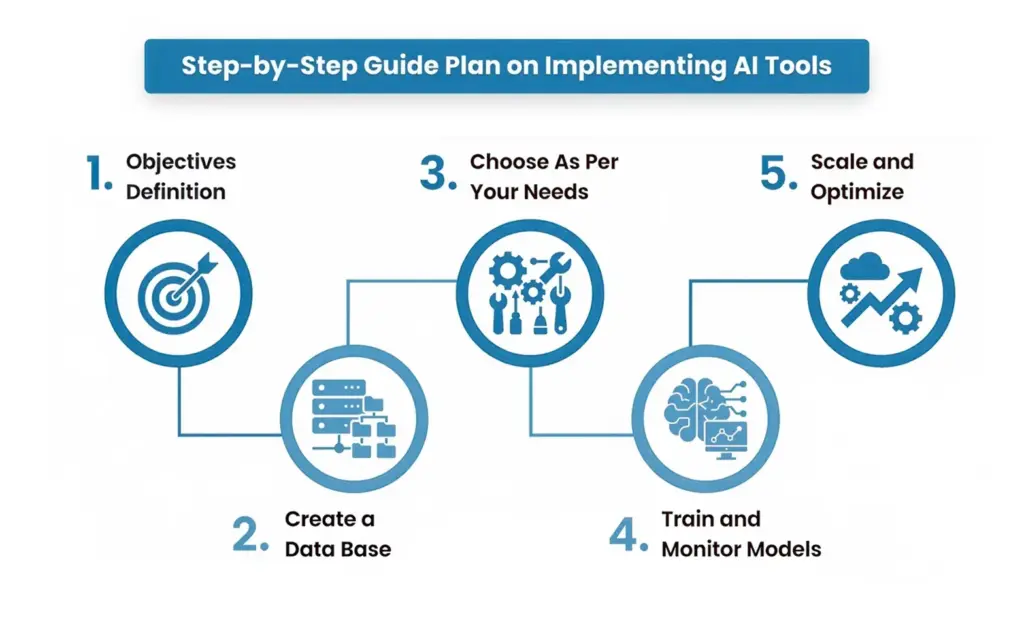
Business owners, technology enthusiasts, and investors can implement AI tools to manage enterprise data successfully, referring to the following steps:
Step 1: Objectives Definition
Formulate specific objectives, e.g. cut down costs of operations or enhance customer retention. Another example would be a healthcare provider who wants to simplify the process of analyzing patient data in order to issue faster diagnoses.
Step 2: Create a Data Base
Ensure data quality through thorough cleaning and organization of datasets. The Intelligent Data Management Cloud connects with Databricks to share data consisting of different sources such as Salesforce or Oracle. In contrast to other blogs, we emphasize the necessity to relate structured data (databases) and unstructured (PDFs, emails) data to have full AI analysis.
Step 3: Choose As Per Your Needs
Choose tools based on your needs. For instance, MindsDB’s open-source platform allows querying enterprise data with natural language, ideal for non-technical users. Deploy tools in phases, starting with a minimum viable product (MVP) to test functionality, as Artkai did for Quantum Energy’s HR solution.
Step 4: Train and Monitor Models
Machine learning models require training on enterprise data. Google Cloud’s AutoML simplifies this for non-experts, while Databricks’ Mosaic AI supports advanced model tuning., Monitor performance to prevent issues like model drift, where predictions degrade over time due to changing data patterns.
Steps 5: Scale and Optimize
After the success, scale AI deployment to departments. Databricks Apps can support the accelerated development, deployment and scaling of AI-based applications, including unique dashboards that give marketing groups fast insights into customer behavior. Automate with human-in-the-loop feedback to control AI outputs and be accurate and trustworthy.
You can also explore how generative AI improves software team collaboration and productivity during scaling.
Rising Trends to Look Before You Choose!
Here are key areas to enhance your enterprise AI strategy:
1. Agentic AI and Autonomy
Agentic AI enables autonomous decision-making, such as automating supply chain adjustments. This is critical for real-time operations but requires robust governance to mitigate risks, a topic underexplored in existing blogs.
Explore how modern AI agents transform enterprise support and enable autonomy across workflows.
2. Data Mesh for Decentralized Data Management
Data mesh, as discussed by CIO, organizes data by domain, enabling AI tools to access high-quality, context-specific data. This approach is ideal for large enterprises but less discussed for SMEs, which can adopt simplified versions via cloud platforms.
3. Ethical Artificial Intelligence and Bias Reduction
Ethical AI promotes ethical and transparent results. Such tools as the Unity Catalog with Databricks, can provide guardrails against AI models being biased but the number of blogs discussing how businesses may audit AI results in terms of fairness is limited and that is a major issue as regulated businesses will need to demonstrate fairness of their results.
4. A1 Democratization
Tools such as Databricks One are used to democratize AI and enable non-specialists to interact with AI with no need to write code. This development enables the owners of businesses to directly query the data and thus there is an increased pace of decision-making involving less dependency on data scientists.With new ChatGPT features emerging , AI democratization is becoming easier across enterprises.
5. Data-Intelligence in Real-Time
Streaming data can be used in real-time through the analytics that can provide instant insights, e.g., using Databricks with a Lakeflow designer. It is critical to such industries as e-commerce, where sales success depends on the analysis of customer behavior in real-time.
Common Challenges and Their Solutions
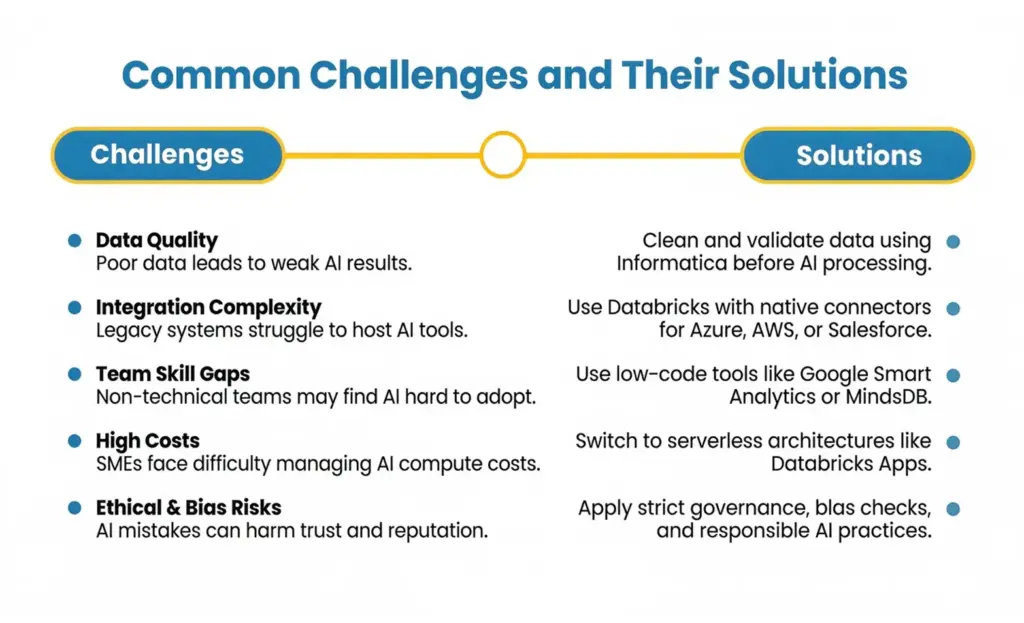
There are difficulties in implementing AI tools to enterprise data:
Data Quality: Inaccurate or low-quality data leads to unreliable AI outcomes.
- Solution: Clean and validate data by applying tools of data quality offered by Informatica prior to the processing by AI.
Complexity of Integration: The older systems might not be able to host AI tools.
- Fix: Use databases such as Databricks that have native connectors to Azure or AWS or Salesforce.
Skill Gaps: all the non-technical teams might have a hard time learning how to implement AI.
- Solution: Opt for low-code platforms like Google Cloud’s Smart Analytics or MindsDB.
Cost Management: High computational costs can deter SMEs.
- Solution: Leverage serverless based architectures such as Databricks Apps to optimize the cost around.
Ethical Risks: There is the risk of causing damage to the reputation due to prejudice or breached privacy.
- Remedy: Put in place governance structures such as Unity Catalog and run AI audits.
Best 10 Enterprise Data AI Tools in 2025
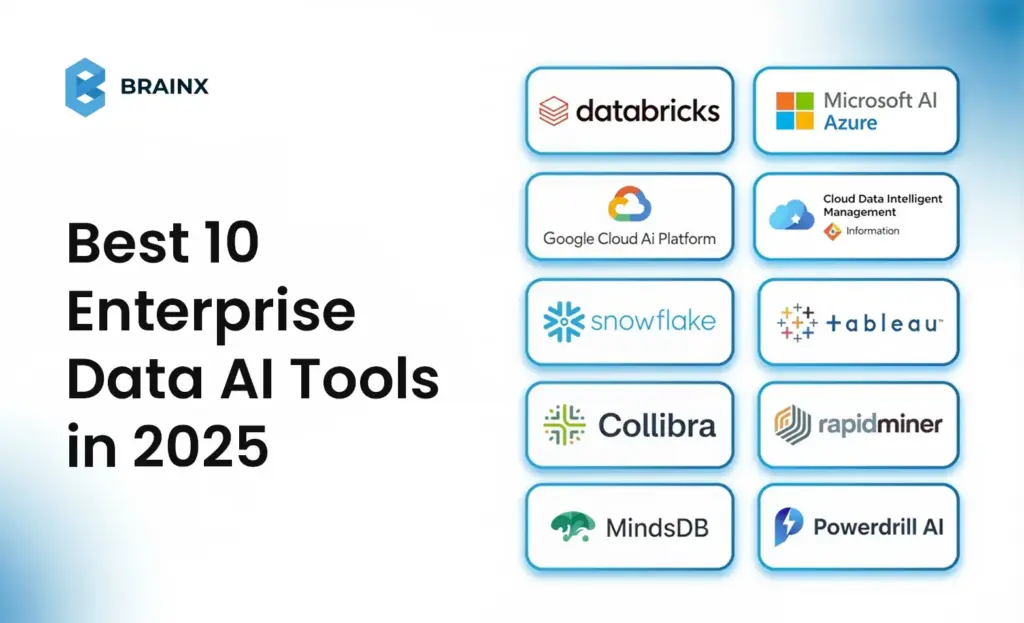
Next, we discuss the most promising 10 AI-tools that might work with enterprise data in 2025, their most important features, application, and unusual advantages.
1. Databricks
Databricks is an integrated analytics platform on Apache Spark which has the capabilities to support end-to-end data pipelines.
Notable Features:
- Lakehouse Architecture: Joins together data lakes and warehouses to be governed and analyzed in unison.
- Mosaic AI: Helps in developing generative AI and Machine learning models.
- Delta Lake: Guarantees data reliability, and it supports ACID compliance.
What Makes It Unique?
Unlike other blogs, its low-code interfaces such as Lakeflow Designer with an open-source foundation allow it to be used by those who are not very technical.
- Pricing: By consumption, and a free trial can be found on databricks.com.
- Best Fit: Companies that require scalability, cloud agnostic solutions that have good governance.
2. Microsoft AI Azure
Azure AI is a collection of AI-model construction, deployment, and management tools that are easily integrated into the enterprise's system.
Key Features:
- Azure Machine Learning: Results in automation of model training as well as deployment.
- Azure Cognitive Search: Increases the efficiency of data discovery by providing AI powered search to get results that are smarter and more relevant.
- Copilot Integration: reads the data in excel and creates meeting insights.
- Use Cases: T-Mobile uses Azure to share information securely as well as cut IT time to find a solution.
What Makes it Distinct?
It is very well integrated with Microsoft 365, meaning businesses that are already in the Microsoft circle will find Microsoft Viva of great use and value, as they will enjoy easy access to the giant company and technical components such as Copilot.
- Pricing: Resource based pricing that is on-demand through Azure.
- Suited to: Companies that use Microsoft to do data analytics and automation.
3. The Google Cloud AI Platform
Google Cloud AI includes a complete data analytics/natural language processing (NLP) and machine-learning offering.
- Key Features:
- AutoML: Helps ordinary users to develop their highly customized machine learning models with limited technical knowledge.
- Big Query: Allows one to process large information and perform real-time analytics.
- Tableau Pulse: Provides AI-focused, customized insights inside the workflows.
- Use Cases: It can be used to predict customer behavior, analyze the market and study images/videos.
What Makes It Special?
It uses no-code AutoML and Tableau, making it an essential tool to business owners and users who do not have a technical background, which many tech blogs fail to do.
- Pricing: Pay-as-you-go.
- Suitable for: The best business to use this product is that which focuses on usability and integrated use with Google workspace.
4. Cloud Data Intelligent Management Informatica
Informatica simplifies integration, governance, and analysis of information with its CLAIRE AI-based data integration and governance and analytics that can be deployed on a hybrid condition.
Key Features:
- Data Integration: Integration of data of different sources such as Salesforce and Oracle.
- Data Governance: GDPR, HIPAA and CCPA compliance.
- Automated Data Quality: Data cleans and makes standard to be ready for AI.
- Walgreen and Informatics: Walgreens has employed Informatica to conduct real-time analytics, generating a two-fold productivity.
Why Does It Stand Out?
Its area of interest is compliance and automated governance, which eliminates the ethical AI issue, which lacks in most blogs, making it entirely reliable in industries that are regulated.
- Pricing: There are consumption-based prices and a free trial at informatica.com.
- Appropriate to: Companies with severe compliance needs.
5. Snowflake
Snowflake is a cloud-based data platform that can be reputed to perform well regarding ETL/ELT operations and analytics with the help of AI.
Key Features:
- Automated Scaling: Efficiently handles both structured and semi-structured data for optimal performance.
- Snowpark: Lets you process machine learning workloads using Python, R, and Scala.
- Data Sharing: It enables safe cooperation of data with teams.
Use Cases: Include real-time analytics, predictive maintenance, and customer segmentation.
What Makes It Comprehensive?
It has the pay-as-you-go model which makes it affordable to regular users and supports SME, alleviating smaller companies that would not be served by blogs which cater only to major enterprises.
- Pricing: Usage, Find it at snowflake.com.
- Ideal for: Scale-able, Cloud based Data Management for Business.
6. Tableau
Tableau is one of the most popular analytics and data visualization tools that can be used in Salesforce and include AI analytics built on Einstein.
Key Features:
- Tableau Pulse: Creates bespoke-generated knowledge-based on generative AI.
- No-Code Interface: Allows the drag-and-drop analytics capability to non-technical audience.
- Einstein Analytics: Foresees trend and customer behaviors.
Use Cases: Marketing analytics, sales forecasting and Embedded BI.
What Makes It Special?
It is certified to work with Salesforce CRM and is geared towards business intelligence, which is a good fit to enterprise-focused organizations, unlike most sources that emphasize its voice capabilities.
- Price: Visit their website for the latest subscription price.
- Investors: Tableau has high growth prospects as evidenced by adoption in business.
- Best For: Small-to-Medium sized businesses in Marketing and Sales departments that want easy to use analytics.
7. Collibra
Collibra is an industry strength data governance solution which provides assurance over data quality and AI data usage.
Key Features:
- Data Catalog: improves data visibility and accessibility within business departments.
- Policy Management:Incorporates and enforces rules in order to govern the access and secure data.
- Lineage Tracking: Ensures clear visibility into how data is sourced, transformed, and used.
Use Cases: Auditing of compliance, cross-department cooperation and data stewardship.
What Makes it Stand Out?
It is a governance framework oriented on AI-driven analytics that targets an existing fragile area of ethical AI, which is crucial to areas, such as financial sectors and healthcare.
- Pricing: Get to know about their custom pricing on the official website.
- Best Suited: Market with regulatory businesses where data governance is the priority.
8. RapidMiner
RapidMiner provides end-to-end utilizing data science with analytic and machine learning abilities.
Key Features:
- Visual Workflow Designer: drag and drop model building.
- AutoML: Automates the model creation in order to get insights faster.
- Model Operations: Supports the entire machine learning process.
Applications: Anti-fraud, sentiment analysis and predictive maintenance.
Why Does It Stand Out?
It is available to both a layman and a professional, which can fill a professional gap in other products, often overlooked because of its practical focus.
- Pricing: Free plan and paid plans.
- Best For: Teams with mixed technical expertise.
9. MindsDB
An open-source environment, MindsDB allows querying enterprise data using natural language in order to gain AI-based insights.
Key Features:
- Natural Language Queries: Gives you the option of asking data questions using natural language with non technical users.
- Integration: It is linked with approximately 200 platforms of data.
- Explainable AI: It is easy to know how and why a model has made its decision as they are transparent and explainable.
Applications: Customer service automation, sales predictors and text analytics.
Why Is It Unique?
An open-source format and non-technical user emphasis makes it suitable to SMEs which is not always fulfilled in the leading blogs.
- Price: Free with paid business grade plans here at mindsdb.com.
- Best For: SMEs and non-technical teams.
10. Powerdrill AI
Powerdrill AI is a SaaS platform designed for natural language interaction with enterprise datasets.
Key Features:
- Conversational AI: Allows to query data sets using plain English.
- Scalable Pricing: Cost effective cost using billing by usage.
- BI Analysis: Facilitates Business intelligence processes.
Applications: Market analysis, ad-hoc reporting and operational insight.
What Makes It Great?
It specializes in conversational AI, and the opportunity is the varied pricing, which has made it accessible to smaller companies as well.
- Pricing: Free trial with price tiered plans.
- Its Strengths: Affordable and easy to use AI analytics that can be deployed across the business.
Why Are These Tools Special?
These enterprise data AI tools focus on the most essential needs such as data integration, analytics, governance and automation and serve a wide audience. As compared to many of the blogs in the top ranking that lay more emphasis on technical attributes, this list focuses more on usability by laymen, cost effectiveness to the SMEs and ethical governance and thus addresses some of the most important gaps in the literature.
For instance:
- Non-Technical Accessibility: Tableau, MindsDB, and Powerdrill platforms have no-code/low-code platforms, and they empower business owners without knowledge of data science.
- SME Focus: such platforms as Snowflake, MindsDB, Powerdrill offer cost-effective solutions that will help smaller businesses compete and expand.
- Ethical AI: Informatica and Collibra focus on governance that matters in a regulated industry and highlights any bias and compliance issues.
- The Future: Tools such as Databricks allow agentic AI, which allows autonomous decision-making, an upcoming feature that is yet to be emphasized as a speculative characteristic.
Data Gridlock Stalling Your Vision? Ignite Progress with BrainX!
Is your enterprise data stuck in a web of complexity, preventing you from reaching your most ambitious goals?
BrainX is an innovative startup in developing AI software as a service and redefines the state of the art by applying innovative AI technology to enterprise data. We are a platform that enables business owners to access effortless enterprise AI that combines advanced machine learning and business intelligence to unleash potential, simplify and accelerate growth. BrainX is easy-to-use and intuitive but with maximum results; it helps you to turn data into your edge on the battlefield with no tech skills needed.
Daring to lead in the data-driven era? Visit BrainX for a free trial and unleash your business’s true potential today.