


Agile methodology has become the gold standard in custom software development, enabling faster delivery, improved collaboration, higher product quality, and real-time customer feedback. This blog breaks down 9 core benefits of Agile methodology in custom software development, explains different Agile methods like Scrum and Kanban, compares Agile with traditional approaches like Waterfall, and outlines when it’s the best choice for your project. Discover why companies like BrainX prefer Agile to meet evolving client demands and create future-ready software solutions.
The software industry is in the fast lane of moving towards innovations every day. As a result, businesses face increasing pressure to stay competitive by adapting to the changing industry trends. Custom software development has emerged as a crucial tool amidst this hustle for organizations to streamline operations while enhancing ROI and customer satisfaction. Due to this reason, Agile methodologies have gained widespread recognition within this dynamic industry as an effective approach to software development.
According to Zippia, at least 71% of U.S. companies have embraced the Agile methodology, which boasts a commendable 64% success rate compared to the 49% success rate of projects under the competing waterfall methodology. With Agile projects proving nearly 1.5 times more successful than their waterfall counterparts, it's evident that this method is driving remarkable outcomes.
Statistics prove it is feasible to pursue the conventional software development methods, but it may result in low speed, quality, and more by neglecting an effective alternative. So, what are the benefits of Agile methodology in custom software development that make it stand out? Read this blog to discover them all!
What is Agile Methodology?
As per the Association for Project Management, Agile methodologies are an approach to project delivery that involves iteration throughout its life cycle. Software developers preferred this approach for its ability to enhance speed and adaptability. Unlike linear processes, which present challenges in making adjustments during the project, this approach brings improved outcomes in less time. Such approaches ensure that the final project aligns with the client’s requirements.
Initially, software development teams were the pioneers in exploring the potential advantages of Agile solutions, leveraging them to expedite their projects and minimize the duration between product launches. An increasing number of companies across various sectors are adopting this method to hasten their workflows and align with the swiftly evolving working patterns. A recent study by Organize Agile revealed that almost half of all organizations have implemented Agile methodology for three years or more.
Types of Agile Methodologies
The benefits of Agile methodology in custom software development depend on the method that you are using and its appropriateness with the specific project needs and objectives. Some of the most prominent types of Agile methodologies are discussed below;
Kanban
Kanban methodology focuses on day-to-day workflows, using visual management to track progress and upcoming tasks. Utilizing a Kanban board with columns like "To Do," "Doing," and "Done," teams manage projects efficiently. Integrated into many project management software solutions, Kanban enhances transparency, enabling clear task assignments and progress tracking. This Agile development method prioritizes workflow, emphasizes visualization, and limits work in progress to boost productivity.
Scrum
Scrum, a leading Agile methodology, fosters team collaboration and focus through sprint-based project management. Utilizing a Scrum board akin to Kanban, tasks progress through defined columns. With designated leadership roles like Scrum leader and product owner, projects are completed through short-term sprints, typically lasting one to four weeks. It emphasizes a quick delivery to the clientele that is guided by sprint planning and product backlog prioritization principles.
Extreme Programming (XP)
Extreme programming is client-centric and focuses on continuous software delivery. It incorporates 12 specific processes like planning games, small releases, test-driven development, and collective code ownership. XP prioritizes customer involvement and feedback to optimize product delivery.
Feature-Driven Development (FDD)
Feature-driven development (FDD) is a software-specific Agile framework that focuses on creating software models every two weeks, with a detailed development and design plan for each feature. Unlike XP, this method focuses on rigorous documentation by making it suitable for teams with advanced design and planning skills. The FDD approach to project management involves multiple phases including, model development, feature list creation, step-by-step planning & designing, and building by feature.
Dynamic Systems Development Method (DSDM)
The Dynamic Systems Development Method (DSDM) addresses the need for standardized frameworks in software delivery, emphasizing adaptability and reversible development changes. Like Scrum, XP, and FDD, DSDM utilizes sprints to organize project timelines. Built on eight core principles, DSDM prioritizes business needs, timely delivery, collaboration, quality, incremental construction, iterative development, communication, and control throughout the process.
Crystal
Crystal encompasses various Agile methodologies for custom software development like Crystal Clear, Crystal Yellow, Crystal Orange, and Crystal Red, each tailored to specific project needs based on factors like team size, priorities, and criticality.
Lean
Lean development, while often associated with Agile development, is a distinct methodology with shared values. Knowledge distribution, quality enhancement, commitment, prompt delivery, optimization, waste reduction, and respecting people are
Waste elimination, quality assurance, knowledge building, commitment, fast delivery, and overall optimization of the working environment are the key principles of Lean.
Adaptive Project Framework (APF)
Adaptive Project Framework Agile methodology is designed for adaptability and flexibility during project management. It enables teams to regularly assess the progress and adapt to changing circumstances by dividing the project into iterative cycles. This approach ensures both alignment with the client’s goals and timelines.
9 Benefits of Agile Methodology in Custom Software Development
The benefits of Agile methodology in custom software development enable the project teams to address stumbling blocks in a more manageable environment. Agile project management has become the preferred choice for clients and developers due to the discussed perks it offers.
Customer Satisfaction
Agile development prioritizes customer satisfaction by focusing on end-user needs. Features are determined through customer stories, and frequent testing ensures software functionality. Customer-centricity drives the entire approach to assure user satisfaction and software adoption.
Higher-Quality
The Agile methodology prioritizes continuous improvement in software development, achieved through collaboration, meticulous planning, and adaptability to customer demands. Regular testing and reviews occur every few weeks to promptly address bugs and enhance product quality, ensuring customer satisfaction with each iteration.
Transparency
Another advantage of Agile development is the continuous involvement of both customers and clients throughout the process. This transparency fosters trust and loyalty as customers are aware of what to expect and can provide feedback along the way.
On-Time Delivery
Timely delivery of user-focused software is one of the biggest benefits of Agile methodology in custom software development. Furthermore, the incorporation of customer feedback into the development process leads to refined, customer-centric software, demonstrating responsiveness and enhancing customer satisfaction.
Better Cost Control
Agile methodology's fixed-schedule approach ensures better cost control, aligning expenses with each sprint's work capacity. It simplifies budgeting, enabling informed decisions on feature priorities and iteration needs.
Reprioritization
In software development, agility is crucial for adapting to changes. Agile development allows teams to continuously enhance and reprioritize the product backlog, ensuring effectiveness and efficiency. Changes are seamlessly integrated into the next iteration, preventing overwhelm.
Client Collaboration
Close collaboration between clients and developers is essential for project success. Strong client-team collaboration is among those benefits of Agile methodology that ensure a shared understanding of the project vision, motivating all stakeholders for optimal results.
Better Team Performance
Agile teams, self-organized and autonomous, take control of their work, fostering higher morale and a sense of value for members' opinions. Their cross-functional nature facilitates skill-sharing, enhancing performance, and enabling continuous improvement.
Efficient Risk Mitigation
The benefits of Agile methodology in custom software development include addressing common project challenges like scope creep and dependencies through regular meetings and data-driven decision-making. This proactive approach predicts and mitigates project risks, maximizing success rates. Such projects are typically 1.5 times more successful than those using traditional methods.
Agile Methodologies vs. Other Project Management Methods
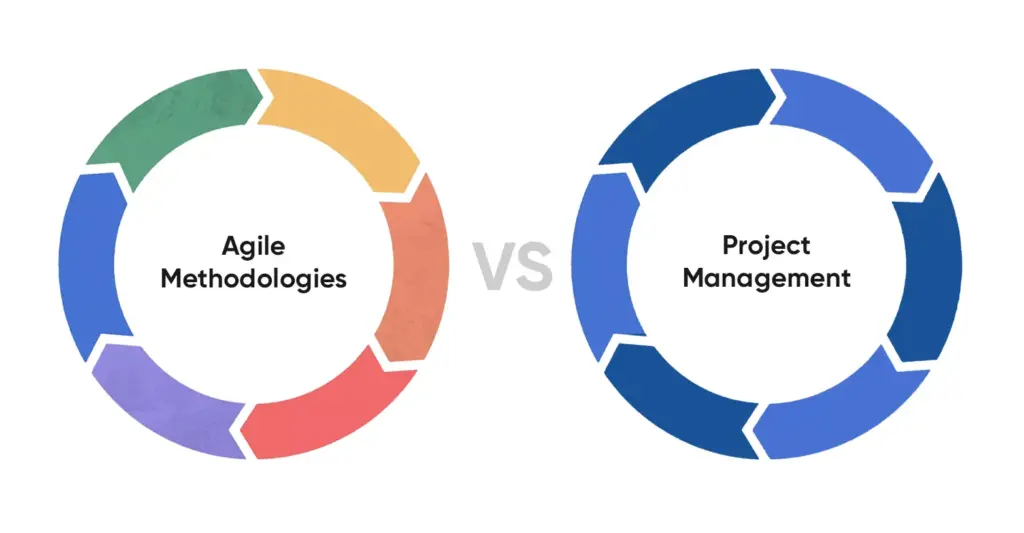
Many teams evaluate different frameworks, but the benefits of Agile methodology in custom software development make it especially well-suited for today’s fast-paced, client-driven environments.
By breaking projects into smaller, manageable increments and emphasizing continuous feedback and iteration, Agile enables teams to respond swiftly to changing requirements and market dynamics. It contrasts with traditional methods, where requirements are defined upfront, and changes are challenging to accommodate once development begins. Proof of this can be seen below in the detailed comparison of this approach with its contenders.
Agile vs. Waterfall
Another renowned traditional project management methodology, the waterfall approach operates in a structured, linear fashion, requiring the completion of each task before proceeding to the next. It can be ideal for long-term projects like construction but not dynamic software development environments. The reason is that such projects require prompt solutions for the client like frequent evolving, necessitating flexibility in deliverables.
Agile vs. Lean
One of the common purposes of the Lean method is to streamline the approach by eliminating waste. Whereas, Agile provides a structured organization with defined roles and regular meetings, making it easier to implement. In comparison to Lean, it fastens the delivery time without focusing on cultural change within an organization.
Agile vs. PRINCE2
PRINCE2 (Projects In Controlled Environments) is known for its product-based planning methodology, featuring a structured project board for overarching tasks, overseen by a project manager handling daily operations. While beneficial for higher management, PRINCE2 lacks Agile's focus on delivery.
When Is Agile Methodology Applicable?
The quality of execution relies heavily on method selection. There are multiple scenarios where you can seek the benefits of Agile methodology for custom software development to ace a project, but it cannot happen every time.
These are the cases when using the Agile project management approach will highly benefit you:
- The customer wants a product like iinputs (reverse marketplace) that he can launch and commercialize immediately.
- If the final product functionality is in the finalization stage.
- Estimation and limitation of time and budget are impossible.
- Your team is efficient enough to face new challenges and work independently.
- The client wants to communicate with your development team throughout the process.
- Your client wants changes to be made throughout the development process.
- The client does not want to follow a rigid budgeting and task schedule.
In such scenarios, the benefits of Agile methodology in custom software development become even more apparent, as adaptability and real-time feedback drive the project’s success.
Why Choose BrainX for Custom Software Development?
We at BrainX Technologies focus on providing custom software development services for web/mobile, blockchain, IoT, and AI. We help you harness the benefits of Agile methodology in custom software development to bring your ideas to life faster, with precision and scalability. Our team is committed and experienced in diverse industries such as healthcare, e-commerce, edtech, real estate, lifestyle, social networking, travel & transformation, etc. We go beyond the one-size-fits-all approach and provide solutions tailored to your specific needs.
The BrainX team has excelled at delivering comprehensive results from ideation to launch for some of the biggest projects like Baritastic, Kustomer, etc. Our services encompass consulting, development, design, and testing to guarantee top-notch outcomes. Trust us to provide dependable support throughout your project, from its inception to its implementation. Get in touch with BrainX now and turn your software development vision into a reality.