

AI chatbot development is taking off in the business sector and more than three-quarters of businesses are now using AI chatbots in one business operation or another. Indeed, it is projected that AI will do up to 95 percent of customer interactions by the end of 2025. Corporations are adopting a conversational AI to automate customer service, improve business processes and connect with their clients 24/7.
However, the difference between one chatbot to serve a small application and enterprise chatbots to serve a multinational corporation?
That is a different ball game altogether, and has its own challenges and enormous opportunities.
Firms are allocating resources to AI-based conversational bots to automate customer care and internal processes, but the scaling of such systems cannot be achieved without a well-thought out and strong architecture.
If you’re still exploring the fundamentals, read our AI chatbots for business growth guide to understand types, benefits, and real-world use cases before diving into enterprise-scale development.
Why Scaling Enterprise Chatbots Is a Different Game

When you have tried simple chatbots, you can guess that they are able to respond to simple questions on a website. However, to take that to the level of virtual assistants is like trying to take a small restaurant and turn it into a fast-food chain country-wide. Users multiply, queries become more complex and integration and compliance requirements become out of this world. A bot which had been well behaved with a few hundred chats may crumble under tens of thousands.
Majority of the teams begin with off-the-shelf natural language processing (NLP) products or a basic rule-based bot. It is equivalent to constructing with LEGO blocks that are fast to boot but you bang on a wall when there is a traffic spike or when decoupling with the legacy systems.
Some of the frequent problems businesses face include slow response time, bots not understanding subtle questions or failure to transition to human agents where necessary.
Sound familiar?
In case a bot cannot scale gracefully, you may have wasted opportunities, customers who become frustrated, and support that is overwhelmed with tickets.
Basic Building Blocks of Scalable AI Chatbots
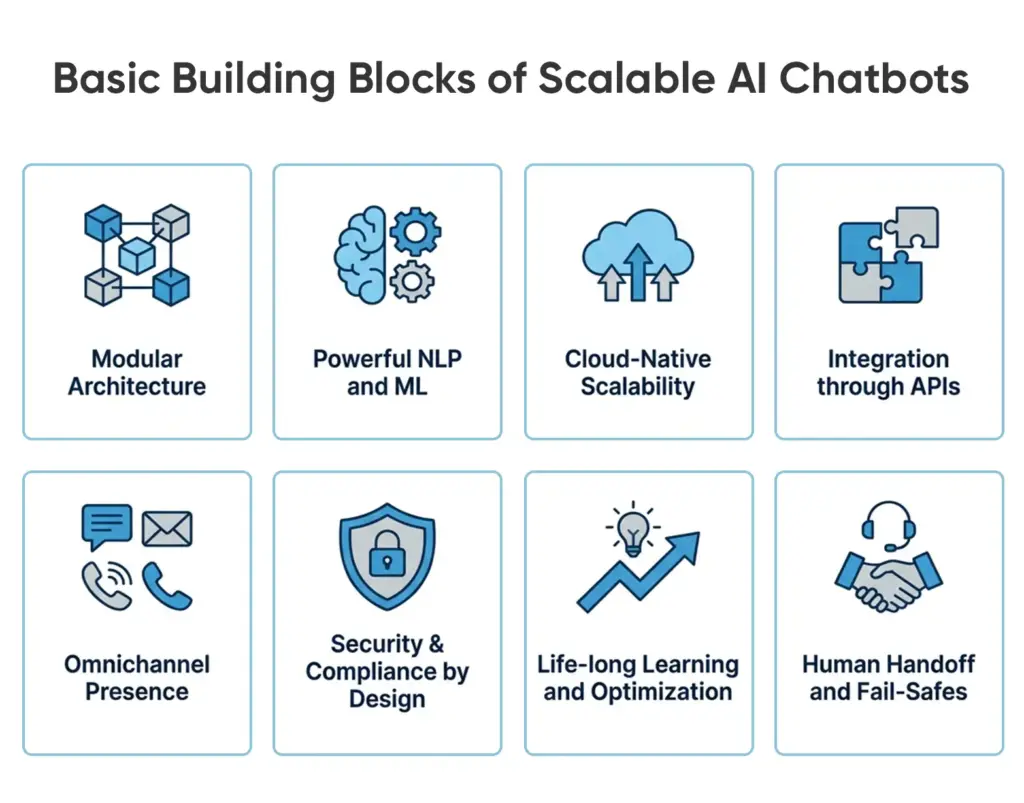
As we have learned enterprise AI chatbot development, it depends on a combination of good architecture and intelligent technology. The following are the major pillars that distinguish a scalable bot:
- Modular Architecture: Develop the chatbot in separate modules, intent recognition, dialog management, integrations, analytics such that each part can develop independently without interfering with the rest.
- Powerful NLP and ML: Process the domain-specific language using strong Natural Language Processing, and also teach your own machine learning and continually increase the accuracy.
- Cloud-Native Scalability: Run on elastic cloud architecture (AWS, Azure, GCP) on Docker and Kubernetes to support millions of interactions without problem.
- Integration through APIs: Integrate the chatbot with CRMs, ERPs, and databases using secure REST or GraphQL API to carry out real time business activities.
- Omnichannel Presence: Have uniform user experiences through web, mobile, messaging apps, and voice interfaces, using the same backend AI engine.
- Security & Compliance by Design: Use encryption, role-based access, and GDPR/CCPA/HIPAA Compliance to protect enterprise data, starting at day one.
- Life-long Learning and Optimization: Feed the live chat data into the analytics loops to make responses more refined, increase knowledge, and get long-term ROI.
- Human Handoff and Fail-Safes: facilitate the process of the transfer to live agents and have fallback messages in the event of unresolved queries (or complex queries).
Pro Tip: Don’t forget performance tricks like caching frequent answers and using asynchronous processing for external API calls. These ensure your bot stays snappy even as workload grows.
Real Benefits Beyond the Chatbot Hype
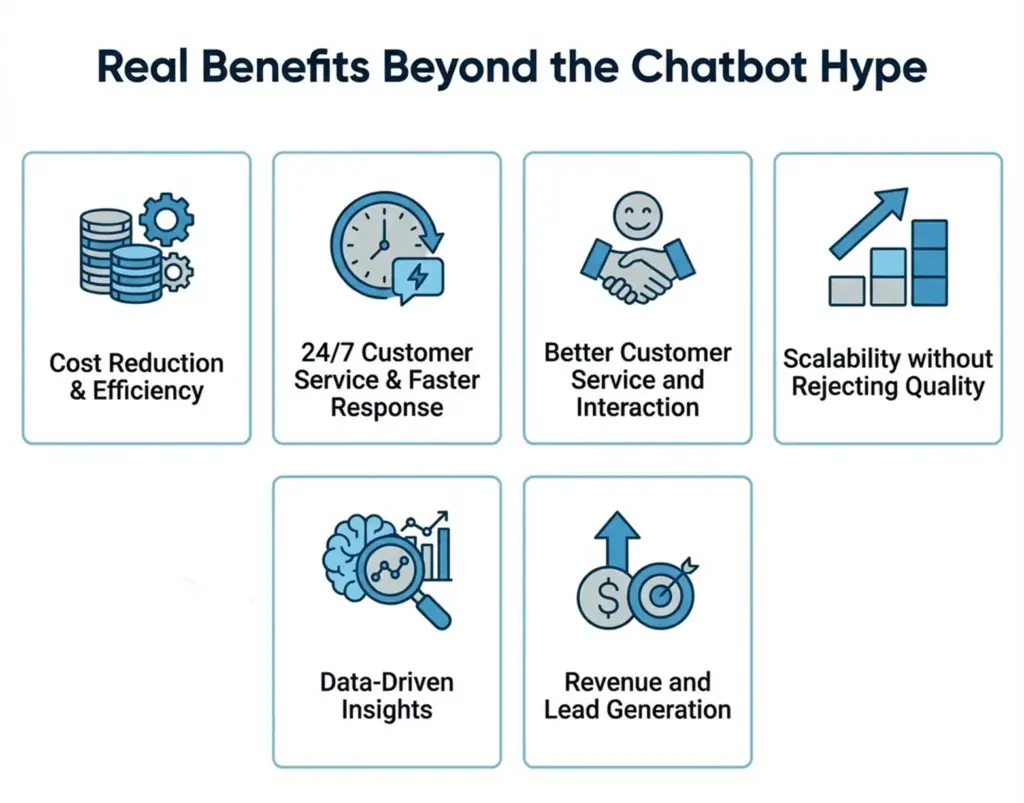
You’ve probably heard the generic promises like “chatbots cut costs and boost CX!”. Let’s dig into what that really means, especially at enterprise scale, and back it with some numbers:
- Cost Reduction & Efficiency: AI-powered chatbots can resolve up to 80% common questions, cutting support costs by 30%. Vodafone saw a 70% reduction in cost-per-chat for support. The efficiency gains free time for your human agents to focus on high-value complex issues instead of answering “Where is my order?” for the 100th time.
- 24/7 Customer Service & Faster Response: Bots are on-demand virtual agents that don't need coffee breaks to be productive. Over 51 percent of the customers desire a response to be less than 5 seconds and the majority of them would rather receive an immediate response with a bot than a response after 15 minutes with a human agent. Customers have been able to get what they expected in the business, and this makes them satisfied.
- Better Customer Service and Interaction: A chatbot AI will be consistent, and a friendly and helpful personality can be trained. Customers receive on-demand and interactive customer support on everything, including basic queries and one-on-one suggestions. Indeed, when the chatbot is designed properly, 80 per cent of consumers mention having positive experiences with it.
- Scalability without Rejecting Quality: It becomes much easier to scale AI bots to serve more customers or other markets. Spike in demand can be easily managed by adding more server capacity instead of having to panic and add headcount. The scale-out or elastic scalability will ensure that your support quality does not suffer during high traffic periods or unforeseen periods of rapid growth.
- Data-Driven Insights: Enterprise chatbots are accompanied by analytics dashboards, which monitor the customer questions, most frequent pain points, and customer satisfaction. Summation of these chat logs would give you access to real-time customer insights, which would be difficult to obtain otherwise.
- Revenue and Lead Generation: By engaging website visitors proactively (“Can I help you find something or get a demo?”) and guiding them through product information, bots can increase conversion rates. Business leaders have observed that deploying chatbots for sales inquiries led to a 67% surge in sales in some cases. Chatbots can qualify leads by asking a few questions and then route hot leads to your sales reps instantly. They can also upsell and cross-sell by recommending products based on what the customer is asking (“You’re looking at smartphones; do you need a case as well?”).
Example Use Cases of Scalable Bots
It’s easy to talk about the theory behind AI chatbot development. We can see what is happening in the real world of enterprise chatbots usage, and impressive outcomes that are achieved:
- Telecom Customer Support (Vodafone):
Telecom companies such as Vodafone have millions of customers who always have billing questions, technology problems, and service questions. Vodafone has introduced an AI chatbot known as TOBi on its sites and applications in order to do customer support.
TOBi turned out to be a game-changer and it now successfully resolves about 70% of all customer inquiries on its own (everything from “What’s my data usage?” to troubleshooting device settings). This deflected a huge volume of calls away from human call centers.
The payoff? Customer wait times dropped, and Vodafone saw a 70% reduction in support cost per chat after rolling out the chatbot. TOBi’s success led Vodafone to develop an even more advanced version called “Super TOBi” using deeper NLP; in one market, first-contact resolution went from 15% to 60%, and online customer satisfaction (NPS) jumped by 14 points. These are massive improvements in an industry where quick, efficient service is key to reducing churn.
- E-commerce & Retail (Alibaba):
E-commerce giants deal with enormous query volumes, especially during peak shopping seasons. Alibaba, for instance, handles millions of customer questions during Singles’ Day sales. They built a highly scalable AI chatbot system that integrates with their product database and order systems.
The result: Alibaba’s bots can field over 2 million customer messages per day and handle 75% of all online customer questions without human help. These bots assist with order tracking, product info, returns, and more across both chat interfaces and even voice hotlines. By offloading repetitive queries to AI, Alibaba saves an estimated ¥1 billion RMB annually (≈$150 million) in customer service costs.
Even more impressive, their analysis found that automating chats didn’t hurt customer experience. On the contrary, customer satisfaction rose by about 25% after the chatbot rollout, likely because customers got faster service. To retailers, a scalable chatbot would be comparable to employing an army of super-efficient store clerks who can serve all shoppers at the same time.
- Financial Services (Bank of America):
Banks in this sector require customers to receive immediate answers regarding their accounts and internal departments have to be able to access information fast. Bank of America’s Erica chatbot is a famous example in this space. Erica serves over 50 million users and has handled 3+ billion interactions to date, offering help with everything from balance checks to budgeting advice.
98% of users get the info they need from Erica, which significantly reduces calls to the bank’s support lines. In other words, almost all routine banking questions are answered by AI, freeing up human bankers to focus on more complex client needs.
Bank of America also deployed “Erica for Employees” internally, over 90% of BoA’s staff now use an AI assistant at work, which cut IT helpdesk calls by half. It is a massive productivity improvement at an enterprise level. These findings demonstrate how chatbots with scalable features can be subjected to an industry that is highly regulated and sensitive to security yet offer fast service and consistent verification and precision.
- Healthcare & Insurance:
AI chatbot development is leveraged by most of the health providers and insurance companies to process patient requests, booking appointments, and claims. To illustrate, a healthcare chatbot will be able to check the symptoms, locate clinics, and handle simple questions (What is my co-payment in regards to X?) without violating privacy.
During the COVID-19 pandemic, AI chatbots were deployed by organizations like the CDC and hospital networks to answer millions of queries about symptoms and guidelines, taking enormous pressure off call centers. On the insurance side, bots are helping customers file claims or get policy info instantly.
A scalable bot in this sector needs to integrate with patient databases or policy management systems, but when it does, it dramatically cuts down response times for anxious patients and customers. While specific stats vary, companies have reported double-digit percentage drops in call volume after introducing chat assistants, and higher customer satisfaction because people get answers faster during stressful situations.
- HR and Internal Helpdesks:
It’s not just customer-facing use cases, enterprises are also turning to chatbots for internal support. IT helpdesk bots for example can troubleshoot common tech issues for employees (“How do I reset my VPN password?”) or route tickets to the right team, all through a chat interface on Slack or MS Teams.Opting for this option can save thousands of man-hours.
One national retailer implemented an HR chatbot for its employees to get instant answers on PTO balance, payroll dates, and company policies; the bot handled ~40% of inquiries without HR staff involvement in the first year, speeding up responses for employees and letting the HR team focus on strategic work. Scalable bots for internal use need to be highly secure and integrated with company databases, but payoff is a more productive workforce and reduced internal support costs.
How to Avoid The Difficulties and Traps of Scaling Chatbots
Alongside success stories, it should be made clear that there is no painless way of developing a scalable enterprise chatbot. Quite a number of projects fail or come to a halt due to pitfalls. Here are the top challenges we’ve seen, and how to avoid them:
1. The “Messy” Integration: One of the hardest parts of scaling isn’t the AI itself, but connecting the chatbot to all your enterprise systems. Legacy IT infrastructure can be a nightmare to integrate with outdated databases, closed-off CRM systems, etc. If your chatbot can’t pull up order details or update a ticket because systems don’t talk, it will frustrate users with half-baked answers.
Solution: Use middleware or integration platforms to bridge legacy systems with modern APIs. In one ecommerce project, a company’s chatbot worked fine during small trials but froze and started giving generic errors when Black Friday traffic hit, because it was trying to query an old order management system that couldn’t scale. After the crisis, they re-architected with an API layer decoupling the bot from the legacy system and containerized the backend services.
2. Performance and Latency Problems: Users expect instant answers – a few seconds delay can feel like an eternity in a chat. A major challenge as you scale is ensuring the bot stays fast when handling many requests or pulling data from multiple sources. We’ve seen bots that worked fine in testing become painfully slow in production because of unoptimized code or server overload.
Solution: Test your chatbot with high load capacities before rolling it out with high volumes. Introduce query caching, asynchronous calls to third party APIs and ensure that your cloud infrastructure is auto-scaling according to the CPU/memory load. Also, monitoring is prudent to put in place, once response times are beginning to creep under load, you receive warnings, and before response times get too long, you can add resources or optimizations. The speed is not only the luxury of scale but also a precondition of good UX.
3. NLP Accuracy and Maintenance: A chatbot used by an enterprise is sensitive to complicated and evolving questions. A trap is to set the bot and forget about the NLP models. The bot may eventually begin to misinterpret user intentions, particularly when you add more services to it, or the language changes (consider all the new slang or emerging trendy words and phrases that appear every year).
Solution: Continuously update its training data with real conversations. Leverage active learning: have a system to review when the bot says “I don’t know” or when user satisfaction dips, and use those cases to retrain. Also, don’t oversell the bot’s abilities initially – start with a focused scope of what it can handle and expand as the AI gets smarter. A large bank had its chatbot gradually grow its knowledge base of 100 FAQs to more than 700 in a few years, and the models were retrained 75,000+ times in the process. This was done through an iterative process that helped in keeping the bot accurate and useful with an increase in its scope.
4. Data Privacy and Compliance Risks: Minimal focus when it comes to using AI is to work with customer data (or any other sensitive information). Any non-conforming scalable chatbot can lead to the violation or huge fines. Potential pitfalls are: the bot spills top secret data onto the wrong person, or logs of the dialog are stored in an unsecure location, or one has not gotten appropriate user consent.
Solution: Mask or omit any personal identifiers in bot logs, encrypt data in transit and at rest, and implement user verification for account-specific queries (“Please log in to view your order status”). Also, configure the AI to refuse certain queries if they would violate policies (e.g. a medical bot should not give unapproved medical advice, a finance bot shouldn’t divulge account details without authentication). In highly regulated industries, involve your compliance officers early to sign off on the chatbot’s functionality. It’s much easier to build compliance into the chatbot from the start than to retrofit it after a violation has occurred.
5. Shortage of AI Talent: Many enterprises find that building a sophisticated AI chatbot requires skills their team might not fully have – like conversational UX design, NLP model tuning, and cloud DevOps for AI. Hiring unskilled developers may result in low quality results or the creation of a bot that fails to scale.
Solution: Invest in your team (training, hiring) or collaborate with one of the successful AI chatbot development companies. Enterprise AI solutions firms that can bring in expertise are also available. This will save time and expensive mistakes particularly with first-time projects. The good news is that AI frameworks are improving, and even “no-code” or “low-code” chatbot platforms are emerging for simpler use cases – but for a truly custom, scalable bot, you still need professionals who know what they’re doing. Consider a hybrid AI development approach: your internal IT or product team works alongside an AI specialist agency to get the best of both domain knowledge and technical know-how. This addresses the skill gap while also transferring knowledge to your team for future maintenance.
6. Setting Unrealistic Expectations: Finally, an insidious yet prevalent trap, which is to hope the chatbot is going to perform flawlessly within two or three days. The ideas of an all-knowing human-like AI (particularly with the hype of such tools as ChatGPT) can turn into a dream of stakeholders and disappointment when the first version turns out to have its limit. This detachment can kill the project support.
Solution: Teach internally that the development of chatbots is iterative. Establish clear and attainable targets of Phase 1 (e.g., top 20 customer questions will be automated with accuracy of 90-percent). Add capabilities in phases, get feedback and then launch. Manage expectations that the bot will handle routine stuff well but isn’t a magic brain that can answer any question under the sun (not yet, anyway!). By demonstrating quick wins – say your Phase 1 bot deflects 30% of live chat volume – you build confidence and buy-in for expanding it further. In our experience, the most successful enterprise chatbot rollouts start small, nail the basics, and then earn the right to take on bigger workloads over time.
The Future of Enterprise Chatbots Trends
The AI chatbot environment is changing at a high rate. Meaningful things are happening in the field of chatbot within the enterprise, and CTOs and product leaders should look forward to the following trends over the next few years:
- Advanced LLMs such as GPT-4 will be used in future chatbots to produce natural and human-like replies and enrich and support complex multi-turn dialogues in context-sensitive manners.
- Bots that understand emotions will respond to user emotion and will adjust tone or behavior to offer emotional support and better experiences as scale.
- Predictive chatbots will give suggestions or help to the users even before they request aid through behavioral analytics that will actively interact with users by being proactive.
- Bots in the enterprise will go beyond Q&A to make business transactions to a comprehensive extent as they are deeply integrated with RPA and workflows.
- Multimodal chatbots will integrate voice, text and visual interface to provide cross-channel interactions on any device.
- The AI governance systems will make sure that the bots are clear, abiding, impartial, and in accordance with the company ethics and laws.
Conclusion
Introducing an AI chatbot to your business is not a trend, but a way to solve the real business problems with smart yet scalable solutions. The development of AI Chatbot cannot be achieved without strategic planning, clear goals, and ROI. CTOs and product executives ought to see it as a long-term investment, which must be supported by scalability of architecture to the cloud, strong NLP, and scalability.
Integrate safely with the end of the enterprise systems and optimize on the user experience continuously. Having both a strong technical foundation and profound understanding of customer needs, companies are able to develop chatbots which are efficient and cost-effective, but also involving and have the potential to make customer care and inner processes so smart and future-oriented that they are digitalized intelligent systems.
Want Long-Term Stability? Create AI Chatbots at Scale using BrainX!
We are BrainX Technologies and we are experts in creating business-scale AI chatbots. Our team of developers, NLP professionals, and LLM experts can build bots to overcome workflow, customer, and ROI automation challenges, and provide bots with reliable returns. Looking to optimize the customer service process, enable staff, or customize customer experience, BrainX creates solutions that fit your objectives, are secure and scalable, and future-proof. Collaborate with us and turn your business into a smart, 24/7 and AI-driven organization.
Let’s build your next-generation chatbot. Contact BrainX Today!
FAQs
1. Why should AI chatbots be relevant to businesses?
With the help of the AI chatbots, the enterprises can automatize repetitive tasks and provide 24/7 support and enhance customer satisfaction. It reduces the expenses of the operations and of course, efficiently scaling the communication.
2. What is the difference between an enterprise chatbot and a basic chatbot?
Scalability, complex workflows, system integrations (such as CRM or ERP) are designed to be performed by enterprise chatbots as opposed to the simple queries that are limited and predefined to simple bots.
3. Do AI chatbots support multiple languages?
Yes. Multilingual chatbots can understand and respond in several languages and this allows business organizations to serve the maximum number of customers worldwide without difficulties.
4. What is the integration of chatbots with current business systems?
They are linked by APIs and microservices to provide real-time access to the data in CRMs and ERPs and other enterprise platforms in order to automate the tasks and workflows.
5. Why would I prefer BrainX to develop an AI chatbot?
BrainX Technologies is an enterprise-grade architecture, strong security, and LLM-driven intelligence AI solutions, focused on assisting businesses to achieve long-term stability, innovation, and quantifiable ROI.