

Customer support is changing with the use of AI chatbots:
- Allowing real-time, 24/7 customer service without additional staff.
- Improving CSAT through faster responses and consistent service.
- Reducing support costs by automating repetitive queries.
- Freeing human agents to focus on complex, high-value issues.
- Delivering personalized, context-aware interactions at scale.
- Creating a scalable hybrid support model that balances efficiency and empathy.
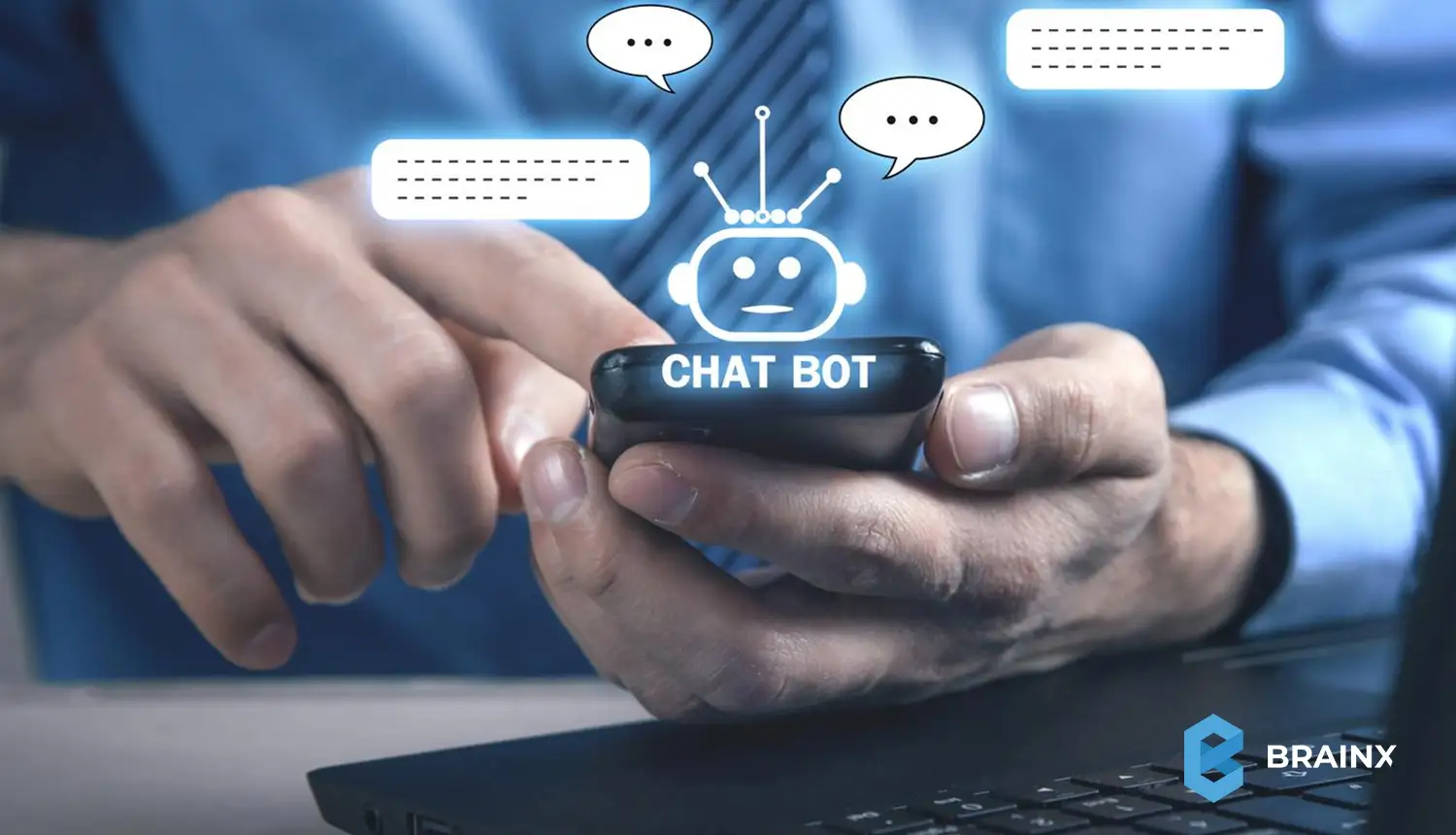
Customer support AI chatbots are changing customer support forever, offering real-time, 24/7 customer support services, and some businesses report customer satisfaction scores (CSAT) increased by up to 25 percent after implementing AI-powered customer support.
The modern day AI chatbots apply complex technologies such as Natural Language Processing (NLP) and machine learning in comprehending queries, personalizing answers, and solving simple tasks without human intervention. With the automation of repetitive processes, they reduced response times and operating costs drastically and relieved human agents of complex issues.
Practically, the firms adopting AI chatbots experience a positive response rate, increased CSAT, and reduced support costs, which can be faster than a conventional support model.
AI chatbots use neural network-based NLP and machine learning to “read” customer messages and instantly provide relevant answers. This means chatbots can handle thousands of simultaneous chats with consistent, accurate replies. Because they never “clock out,” they answer questions in seconds (e.g. “where’s my order?”) at any hour, eliminating long queues. As a result, businesses see dramatically reduced wait times and happier customers. For example, IBM notes that AI adopters enjoy 17% higher satisfaction scores and 38% shorter call handling times. Similarly, one UK bank’s use of an AI support agent increased satisfaction for certain queries by 150%. These gains underscore how instant, 24/7 chatbot support turns frustrated callers into satisfied users.
Round-the-Clock Support and Faster Response
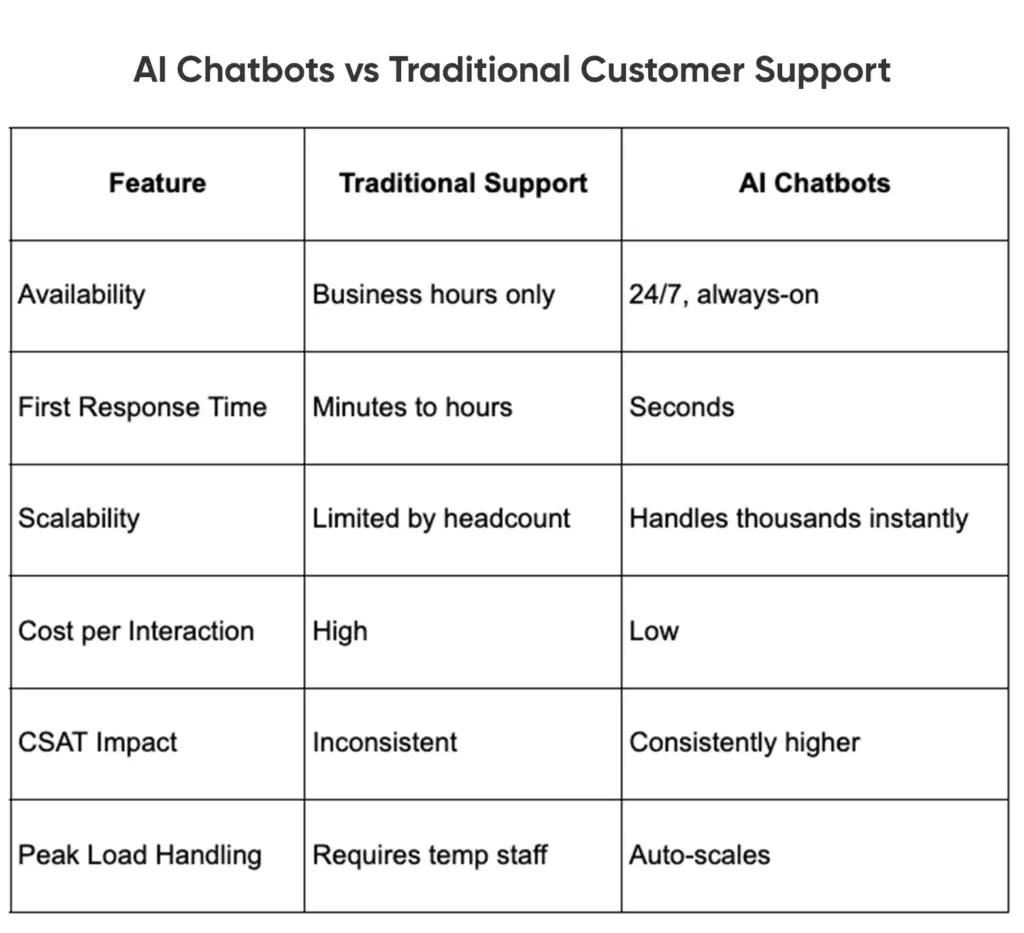
Availability of chatbots 24/7 is one of the most obvious advantages of AI chatbots. In contrast to human teams which have shifts and holidays, chatbots operate 24 hours. A survey discovered that 90% of customers want their questions answered within 10 minutes, but the response rate of support is more than 84 hours average. AI chatbots eliminate such gaps and offer fast help 24/7.
As an example, non-profit CALM has a chatbot that responds to mental health questions within 1.3 seconds to prioritize human responders to urgent situations. Chatbots increase the speed of first response by ensuring that a customer does not have to wait, which increases the level of CSAT directly. To support this finding, Zendesk reports that 51 percent of consumers choose bots when quick service is required.
- One-second responses: Chatbots will respond to frequently asked questions and common problems in seconds, eliminating the misery of customers on hold. In a different instance, after installing a trained chatbot, an e-commerce firm reduced its first-response time to approximately 4 minutes that was previously 12 hours.
- Various channels: Chatbots can be deployed on the web chat, mobile apps, SMS or social media, where they will meet the customers at their favorite channel. This “omnicanal” presence means no matter where a customer asks a question, AI can answer immediately, keeping satisfaction high.
- Load spikes: Chatbots can easily handle the load spikes when demand is high e.g. in times of sales, outages, holidays etc. Firms do not need to employ expensive temp workers, AI bots respond to generic inquiries and allow human employees to work on the queue of complicated cases. This scalability is essential because volumes of support become more and more unstable with each passing day. To illustrate, customer complaints in telecoms have increased by 38% in one year alone, yet AI chatbots have the potential to handle the increased demand without any decline in customer satisfaction.
In short, continuous availability and rapid answers convert impatient customers into satisfied ones. By making “support now” a reality, AI chatbots turn long waits into delightful instant resolutions, lifting CSAT scores across industries.
AI Chatbots vs Traditional Customer Support
Reducing Expenses and Increasing Productivity
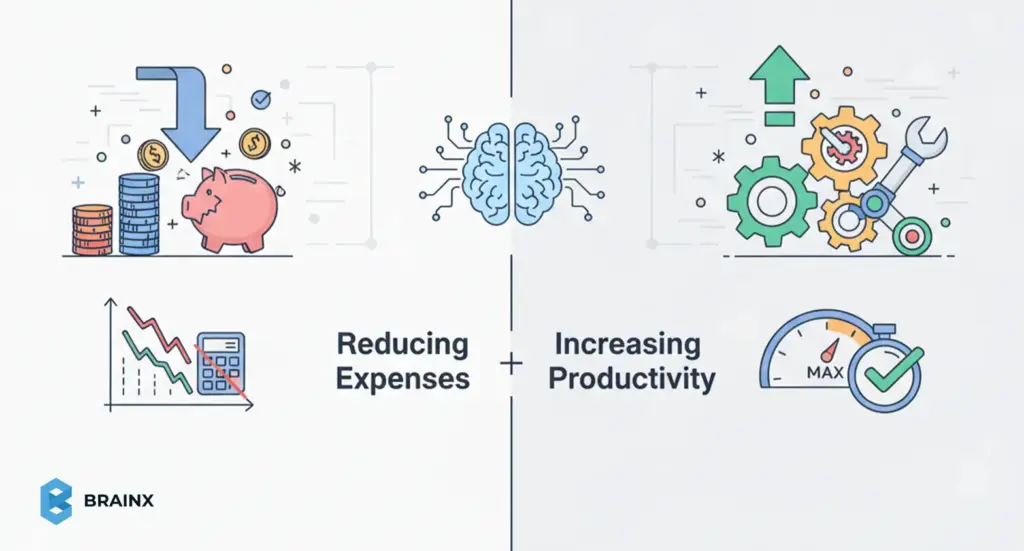
In addition to happier clients, AI chatbots lead to major cost reductions and efficiency improvements. Since chatbots automate repetitive processes, companies are able to serve more clients without corresponding to the increase in staffing requirements..
According to a Smartsupp report, chatbots reduced support expenses in companies by up to 30 percent. Similarly, Nutshell notes AI customer service typically lowers expenses by roughly 30%. These savings come from having one chatbot manage thousands of chats simultaneously, which is something no human team can match.
Internally, chatbots free human agents for high-value work. By handling password resets, order status questions, and other repetitive requests, bots reduce agent workload. Agents spend less time on “tier-1” tickets and more time solving complex problems or building customer relationships.
IBM observes that giving agents AI assistance raises their productivity by 14%. Likewise, Kommunicate highlights that telecoms saw 30–45% higher support productivity after adding generative AI chatbots.
Key efficiency boosts include:
- Lower headcount needs: Automation means support centers can handle growth without hiring extra staff. Companies no longer scramble to bring on-temp agents during busy seasons; AI chatbots pick up the slack.
- Faster handle times: AI agents do not need breaks. Convin reports its AI agent solution cuts average handling time by 40%, quickly resolving queries that would stall human staff. In practice, this leads to dozens fewer abandoned calls or delayed tickets.
- Better knowledge use: AI chatbots are connected to product databases and FAQs. They instantly fetch accurate information (order status, billing info, troubleshooting guides), eliminating time wasted on searching or manual data pulls.
Even beyond chat, AI tools boost contact center efficiency. For example, a 30–45% jump in support productivity has been documented in industries adopting AI chatbots. Instead of spinning up new teams for a surge, companies use AI to serve more inquiries per agent. This efficiency correlates strongly with CSAT: faster resolution and lower wait times mean more satisfied customers.
Personalization, Context Awareness and Sentiment Analysis
Contemporary chatbots based on AI go much beyond pre-written question-answers. With the help of NLP and embedded data, they provide highly personalized, context-sensitive help. As an example, a chatbot can welcome a repeat customer with his or her name, recall previous purchases or recommend products based on profile information. The personal touch in the interactions makes it seem more human. According to Gartner, 75% of CX leaders expect chatbots to mirror their brand’s tone and values.
Importantly, sentiment analysis, or the capability to identify the mood of a user, is present in many AI chatbots. When the words or tones of a customer reveal frustration or anger, an advanced chatbot can notice it and redirect to a human agent. This means angry or complex issues are handled by empathetic staff, while calm, routine questions stay with the bot. By steering conversations appropriately, chatbots help prevent negative experiences from festering.
One way of examining further why AI-powered chatbots provide a more human and adaptive support experience is to compare them with the traditional rule-based chatbots.
AI Chatbots vs Rule-Based Chatbots
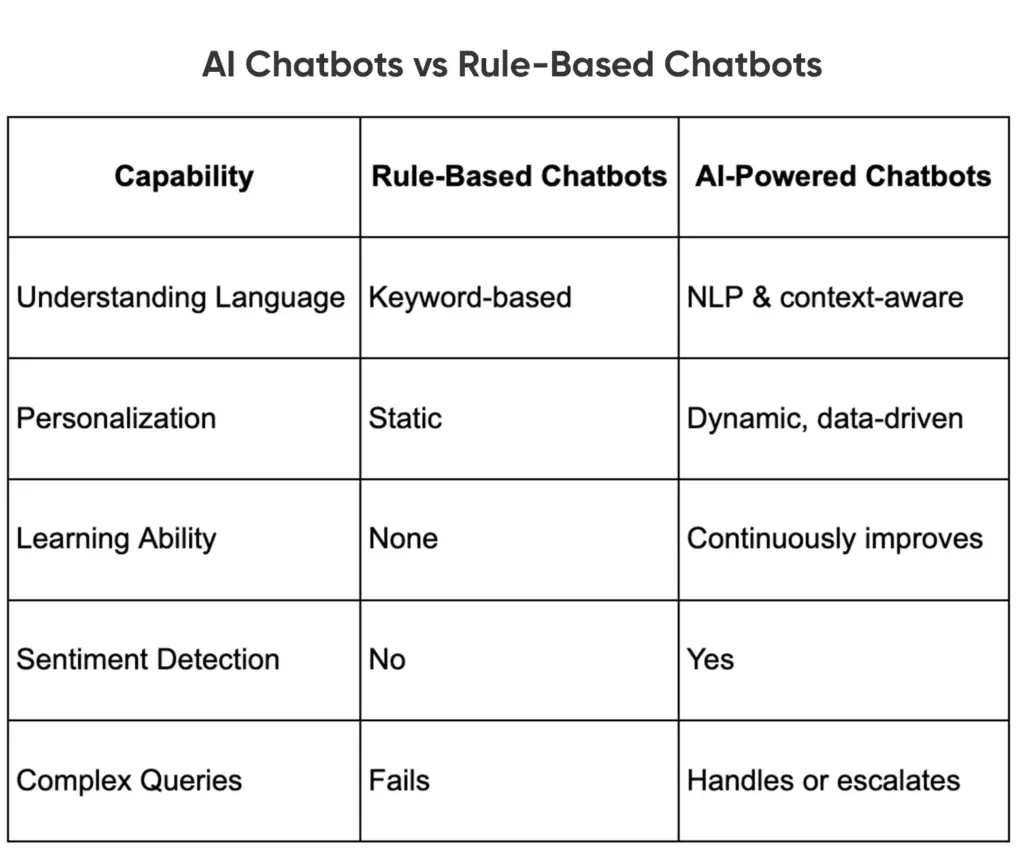
Examples of AI-driven personalization and sentiment use:
- Tailored responses: IBM notes generative AI assistants can analyze customer data to provide custom product suggestions, resulting in about a 15% lift in CSAT.
- Emotion-aware handoff: Advanced bots “know” when to call in a human. SuaveSol explains that sentiment-aware chatbots will empathize with an angry user or immediately route them to live support if needed. Automatically, minimizing customer frustration and maximizing satisfaction.
- Omnichannel context: An integrated AI engine makes sure that a customer context is transferred between channels. In case a customer joins the chat and makes a call, an agent can view the chat history. Unity between chat, email or voice ensures the customer does not need to repeat themselves, further supporting a seamless support experience.
Altogether, these AI capabilities personalize interactions at scale. Customers get relevant, human-like help instantly, which fosters trust. One survey found 70% of CX leaders believe generative AI enables highly personalized customer journeys. As bots refine their responses, they not only reduce errors but also make each conversation feel more custom – an engagement style that naturally boosts CSAT.
Uniting AI and Human Strengths for Hybrid Support
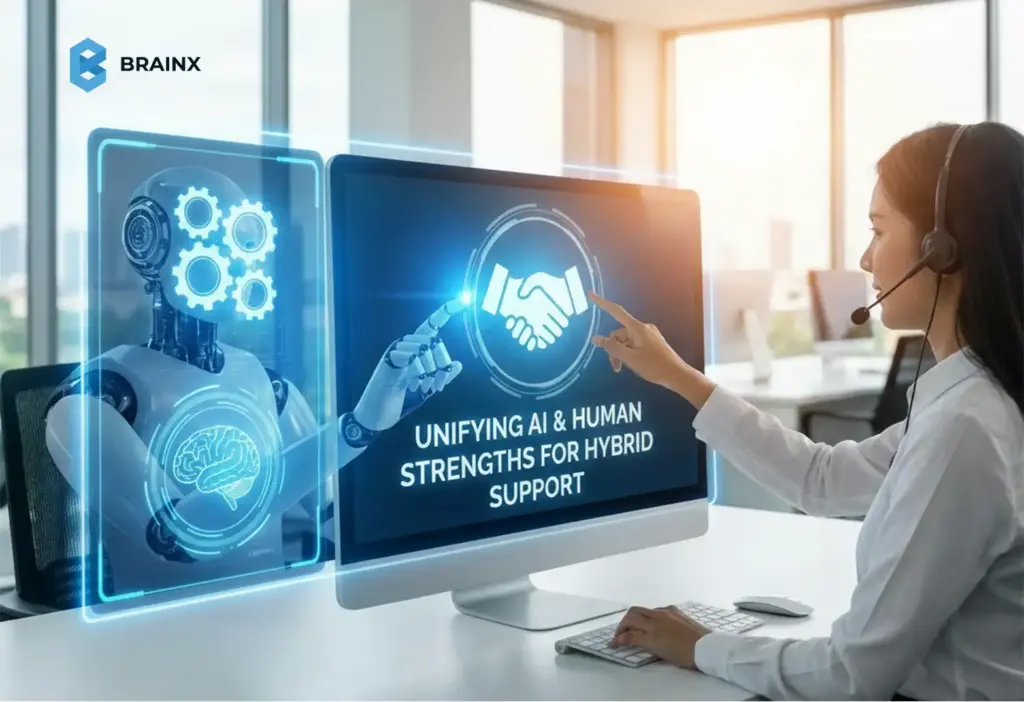
AI chatbots are very effective at monotonous, high volume work, but human agents cannot be replaced in matters that are complicated and sensitive. A hybrid model is the most appropriate way to support since it takes advantage of the strengths of either side.
As InvoZone notes, bots are “team-mates, not magic” so they should be working alongside humans rather than supplanting them. In this model, chatbots handle 70–80% of common queries, while smooth handoffs ensure tough problems get expert care.
Key elements of a hybrid approach:
- Seamless escalations: AI chatbots should be engineered to recognize their limits. If a customer’s issue is too complex or emotional, the chatbot signals for human assistance without losing context. Customers thus experience a fluid transfer rather than repeating themselves.
- Agent enablement: When live agents take over, AI can still help in the background. Tools can suggest next-best actions, pull up relevant data, or summarize the conversation so far. This “agent assist” capability further improves resolution speed and consistency. In fact, Zendesk reports 75% of CX leaders see AI as amplifying human intelligence, not replacing it.
- Balanced work: Chatbots lighten agent workloads, reducing burnout. SuaveSol points out that by automating FAQs, AI “minimizes burnout” and helps maintain a healthy workplace. When agents feel happier, they would serve customers much better and hence the CSAT would be indirectly raised.
The overall result: A more efficient, predictable and compassionate hybrid support team. Customers enjoy quick automated help most of the time, but still have empathy when they need it. The balance drives both efficiency and loyalty. Indeed, studies show customers actually prefer this combination: about 43% of people favor an integrated bot-human support experience.
Key Metrics and ROI of AI Chatbots
To justify investment, leaders track hard numbers. AI chatbots move the needle on several key support metrics:
- First Response Time: With bots answering instantly, first-response times often fall by 50–70%. In one case study, an ecommerce client’s response time shrank from 12 hours to under 4 minutes. Such speed directly correlates to higher CSAT and lower churn.
- Resolution Rate and CSAT: Improved speed and accuracy mean more issues are resolved in one go. For example, Convin reports its AI agent improved CSAT by 27% thanks to faster, more precise replies. Telecoms saw 97% of companies reporting CSAT gains after adding AI support. In short, chatbot usage typically boosts CSAT by eliminating delays and errors.
- Cost per Ticket: Automating lower-tier tickets drives down cost per contact. InvoZone’s client cut ticket costs by over half – from $6.00 to $2.50 – after deploying AI. These savings accumulate rapidly as chatbots handle more traffic.
- Deflection Rate: A key metric is how many chats the bot can handle entirely on its own. High deflection (e.g. 60–80% of routine inquiries solved by AI) means less strain on help desks. Chatbot ROI comes in when support teams can do more with fewer people.
- Agent Efficiency: AI tools free agents to resolve higher-tier cases. IBM noted a 33% increase in agent efficiency in a company using AI ticketing. Such gains mean support teams can scale without proportional headcount.
AI Chatbots ROI Metrics (Before vs After)
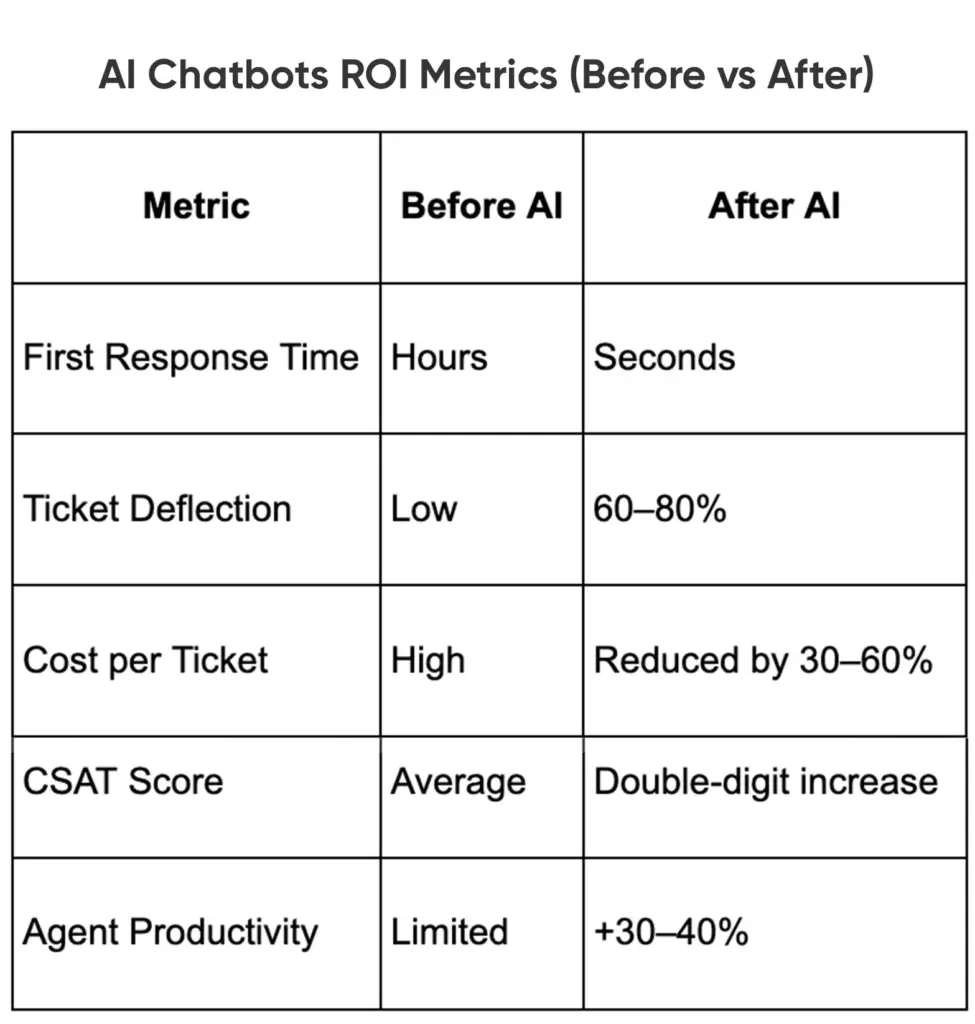
Metrics matter. For example, 46% of telecom customers left their provider after a bad support experience – a glaring business impact. By contrast, successful chatbot use can prevent such churn. Every stat improvement – faster replies, higher CSAT, lower costs – boosts the bottom line. As an AI industry leader puts it, companies using AI-first support see “real revenue and productivity gains”. Over 80% of leaders plan increased AI investment because it tangibly amplifies customer happiness and efficiency.
Real-World Case Studies
Trilogy (IT services) experienced impressive outcomes with chatbots: two-thirds of their queries were satisfied via AI, and the level of customer satisfaction was 96 percent, while half of the support costs were reduced.
Tiger of Sweden (fashion retailer) incorporated an AI chatbot: It helped them resolve 30% of their tickets. After implementation, CSAT increased by 73% to 96% as customers received timely and correct responses.
Banking: A major UK bank used an AI agent to answer natural-language chat queries and saw satisfaction for those answers soar 150%.
Telecom: AI is proving critical. In Canada, telecom complaints spiked by 38% in one year, but telco companies using chatbots reported CSAT gains. IBM found 97% of telecom execs saw CSAT improvements with AI-powered support. Generative chatbots provide customers with happier service and also streamline it, which may result in up to $100 billion of supplementary revenue to telecoms around the world by the year 2030.
Retail & Others: Companies, such as Klarna and DHL, rely on AI assistants to notify customers about their orders and deliveries. Klarna’s chatbot virtually eliminated chat wait times, which allowed agents to focus on sales and resulted in an indirect CSAT win. German Media firm: implementing a generative AI assistant for personalized recommendations increased CSAT by ~15%.
These are just a few examples of a definite trend: AI chatbots lead to a quantifiable CSAT boost. Satisfied customers are more loyal and less expensive to serve, so even a single-digit CSAT increase will have a payoff in recurring business and referrals.
Future Trends Involving Chatbots & AI Assistants
The AI customer support environment is changing by the day. Generative AI and natural language models are making chatbots even smarter. The chatbots we have today are based on NLP to help them understand requests, however the AI agents of tomorrow will be able to anticipate our needs better and will be nearly human-like in their conversations. Gartner anticipates that approximately 25 percent of businesses are going to have chatbots as their main support system in 2027.
Key trends to watch:
- AI agents: The new generation of bots, capable of autonomously resolving complex problems, and trained on large data sets, is coming up. They continuously learn from all interactions, improving “with every chat”.
- Voice and multilingual bots: Support via spoken conversation is growing; voice-activated AI assistants will further broaden 24/7 help (communicating in the customer’s language too). More than 62% of CX leaders predict the use of AI in voice support in the coming years.
- Proactive service: AI will not react to questions, but it will preempt them, notifying the customer about problems or upsells. Predictive analytics will be able to determine when a customer is likely experiencing a problem and automatically reach out to them turning support into a retention engine.
- Deeper analytics: Chatbots create a massive amount of data. Advanced AI will mine that data to continually refine scripts and detect pain points. Real-time sentiment tracking can flag dips in satisfaction as they happen.
These innovations promise even higher CSAT and efficiency. Early adopters of advanced AI (whether chatbots or broader support AI) are gaining a competitive edge in loyalty and cost – a lead that grows as technology matures.
Conclusion (It’s A Competitive Advantage)
Speed and quality of support are the distinguishing features of business in the modern competitive environment, which AI chatbots provide. They deliver instant, correct answers along with fluid hybrid experience, resulting in increased CSAT, reduced waiting times, and reduced support cost.
The use of AI chatbots is no longer an option but a strategic requirement to founders, product managers, and IT leaders. Chatbots can improve efficiency and empower human agents to work on complex problems when prioritized as frontline team members and optimized regularly. The outcome is a more scaled-back support operation and a more dedicated customer base that appreciates fast 24/7 service-time, which provides visionary enterprises with a sustainable advantage.
BrainX Develops Smarter Customer Support using AI Chatbots
Make customer support a competitive edge using AI chatbots that are fast, scale to large, and bring customer satisfaction. At BrainX Technologies, we build and implement custom AI chatbot systems that will work well with your current support stack, are able to auto-serve high-volume queries, and can improve CSAT by providing smart and human-like experiences.
Whether you’re a startup scaling support or an enterprise modernizing CX operations, our AI experts tailor chatbots to your workflows, data, and customers—so your teams resolve faster, your costs stay lean, and your customers stay loyal.
AI Chatbots & Customer Support (CSAT) FAQs
1. What types of customer queries should AI chatbots handle first?
High frequency, low complexity queries, like order status, account access, refunds, and onboarding steps, and product FAQs, tend to be best handled with AI chatbots. These use cases provide a quicker ROI and avoid frustrating customers when adopting it initially.
2. How do AI chatbots affect customer trust and brand perception?
AI chatbots can improve trust when designed properly with the appropriate tone, accuracy, and logic of escalation. Untrained bots will damage brand reputation and that’s why continuous training and human fallback is essential.
3. What data do AI chatbots need to deliver accurate support responses?
The quality of AI chatbots depends on knowledge bases, frequently asked questions, customer relationship management, order systems, and previous conversation. The accuracy of chatbots and the experience of the customer depend on the quality of these data sources.
4. How can companies ensure AI chatbots do not provide wrong or misleading responses?
Reducing errors in companies is achieved through controlled training data, retrieval based response, confidence thresholds and human in the loop escalation. A lot of businesses implement guardrails and ongoing control to ensure reliability of answers.
5. What industries are AI chatbots most effective for when it comes to customer support?
The fastest growth is achieved in industries having large support volumes, including SaaS, eCommerce, fintech, telecom, healthcare, and logistics. These industries enjoy a shorter response time, scale better and customer satisfaction in peak times.