
Gen AI has transcended from being a hype to a necessity for today's businesses. It is driving trillions in economic value through AI automation, creativity and decision support. From protein decoding in health to supply chain optimization in retail, it is driving productivity and personalization at scale. While quality of data, hallucinations and regulation remain issues in transition, companies that have taken a thoughtful approach to AI are driving strong ROI and differentiation.
How generative AI is reshaping industries is no longer a theoretical discussion, it’s a visible reality transforming how businesses innovate, operate, and grow. Once treated as a hype cycle novelty, today it is delivering real business value.
For example, leading analysts estimate it could add between $2.6 and $4.4 trillion to the global economy each year. Indeed, one report predicts a potential $20 trillion impact on global GDP by 2030 and an annual 300 billion work hours saved. These eye-popping statistics illustrate why organizations worldwide are racing to a cadence of action that takes gen AI from the realm of hype and into practice. If you want to learn how to bring these innovations into your own organization, read our Guide on How to Use Generative AI for Your Business, a detailed roadmap from strategy to deployment.
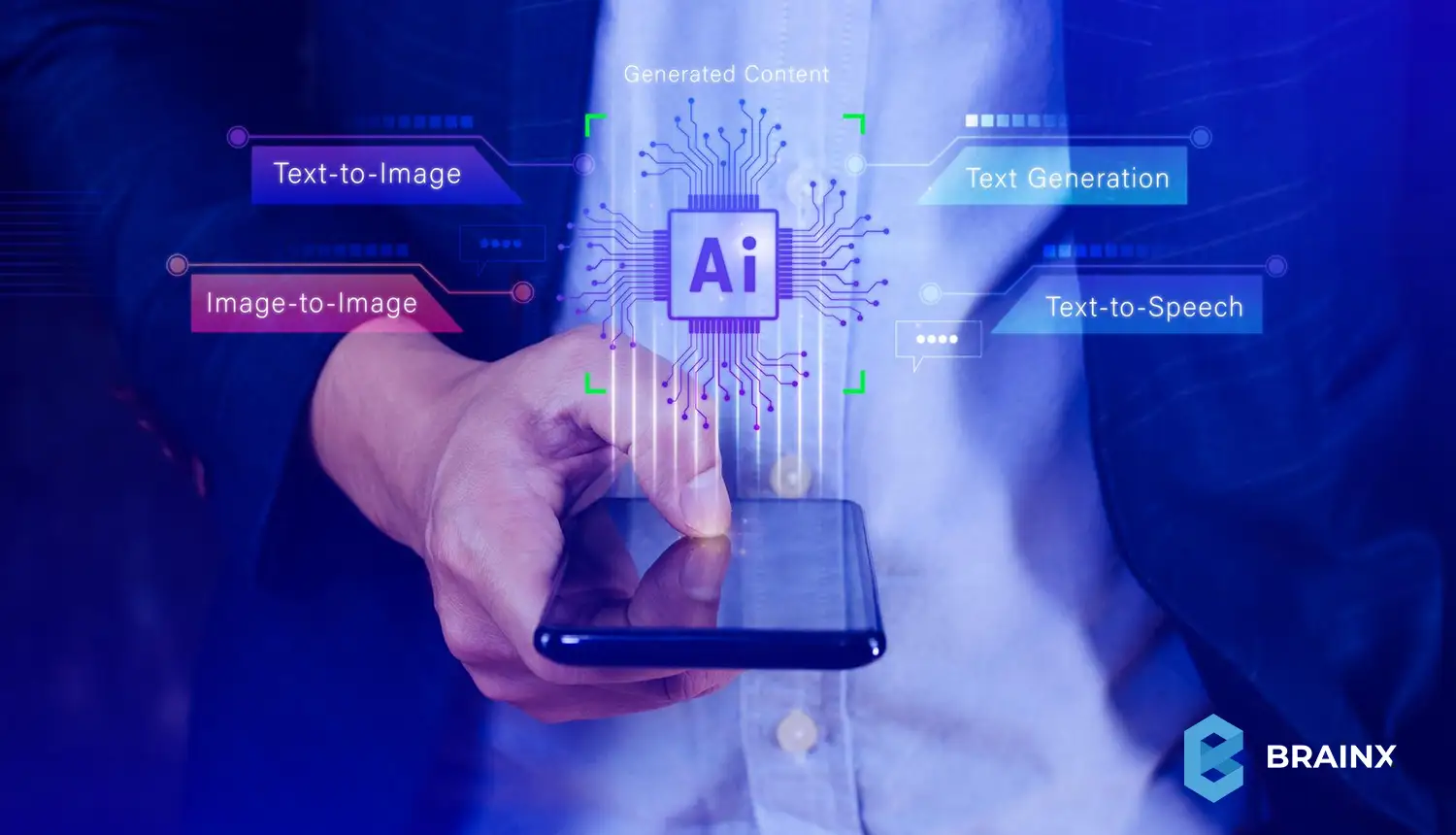
They are deep learning models (typically base models or LLMs) that generate new content (text, code, images, audio and more) in response to prompts. ChatGPT, Bard, DALL·E and Stable Diffusion have captured the imagination of people because they can be employed by anyone to write, design or brainstorm.
These applications are based on giant neural networks that are trained on large amounts of data. Contrary to conventional predictive artificial intelligence, generative models are particularly good at generation and exploration they can;
- Draft a marketing email
- Generate website layouts
- Propose chemical compounds
Let’s explore how generative AI is reshaping industries is evident in its broad range of capabilities in more detail.
Generative AI Adoption Trends of the Economy
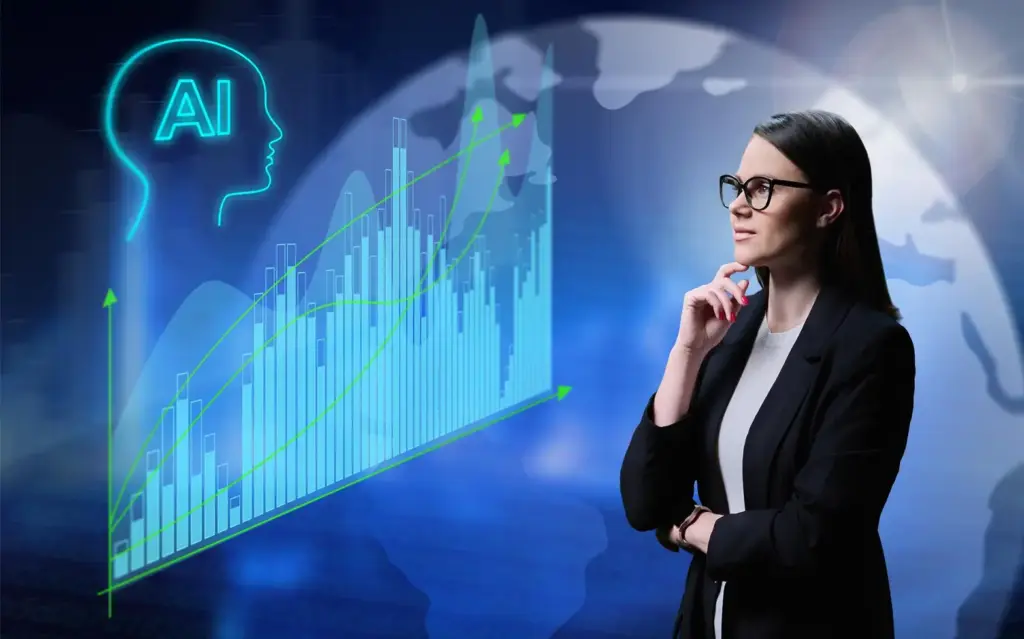
The practical outcomes of real use cases are already going on in businesses all over the world. What was once experimental is now driving measurable returns across industries.
According to a recent survey, 71 percent of organizations currently apply GenAI to at least one business operation, an increase of approximately 33 percent in one year. The transformation clearly reflects how generative AI is reshaping industries.
The returns on the investments are high in companies. Firms claim an average ROI of 3.7x on each dollar on initiatives. The level of private investment is also increasing rapidly, with $33.9 billion of startups being invested around the world in 2024, a 18.7% year-over-year growth.
McKinsey’s research highlights where the real value lies:
“Almost 75% of Gen AI’s potential value falls within four domains i.e. customer service and operations, marketing and sales, software development, and R&D. Within these, banks, tech companies, and life-sciences firms stand to benefit the most.”
Their analysis further estimates that it could create $200–$340 billion of additional annual value in banking and $400–$660 billion in retail and consumer goods.
The technology’s impact extends beyond profits, it’s redefining how people work. Current tools can automate 60–70% of routine knowledge-work activities, compared to about 50% for traditional AI automation technologies.
Employees recognize the advantages too:
More than 96 percent of employees are convinced that generative AI can assist them in doing their jobs better.
However, 50% of them fear that they will be replaced by robotization.
As of 2025, it is estimated by the analysts that the world will lose around 85 million jobs, but new AI-based jobs are going to be introduced.
Concisely, this technology has transformed pilot projects to a strategic engine of innovation, productivity and competitive advantage.
How Generative AI Works?
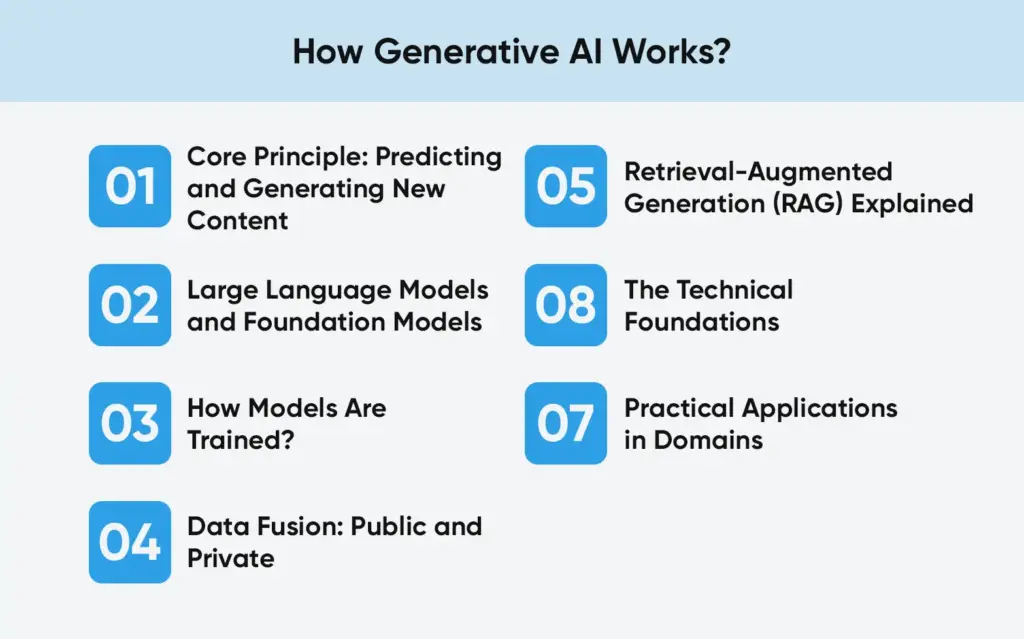
Gen AI works through learning habits on big data and replicating these habits to produce fresh and original work. Understanding how generative AI is reshaping industries begins with recognizing the architecture, training processes, and integration methods that make this technology so adaptable across domains.
1. Core Principle: Predicting and Generating New Content
Generative AI models are based on the principle of predicting the next element of a sequence - it could be a word, a pixel, a note, or a line of code.
Proprobabilistic modeling is used to produce new, coherent, contextual content.
By doing so, AI can write articles, create products, create visuals or can even compose music that would seem human.
2. Large Language Models and Foundation Models
The best developed type is the Large Language Model (LLM).
GPT-4, Claude, Gemini, and LLaMA are trained on trillions of words obtained by accessing books, websites, code repositories and research papers.
Its objective is to learn grammar, context, logic and semantics at scale to be able to answer queries in an intelligent way in almost any query.
Other generative models utilize other modalities besides language:
- Image Generation: Stable Diffusion, Midjourney and DALL-E.
- CodeGeneration: Amazon CodeWhisperer and GitHub Copilot.
- Audio & Video Generation: Suno, Runway ML, Synthesia.
3. How Models Are Trained?
Training is a method that involves being exposed to extensive data sets, and it is even being trained to identify statistical associations among inputs and outputs.
The model is trained with the help of transformer architecture, which teaches contextual dependencies (e.g., the relationship between words or pixels).
The model is self-refined over several training processes:
- Pre-training: Trains on the general knowledge of big datasets.
- Fine-tuning: Industry or task conformity.
- Reinforcement Learning with Human Feedback (RLHF): Improves the quality of the output depending on the human judgment.
4. Data Fusion: Public and Private
The merging of foundation models with the internal data of many enterprises is now done to ensure that it is accurate and relevant.
It will enable firms to develop custom AI copilots, which know about the world as well as the firms.
Example Use Cases:
- A chatbot that will respond to an employee query by referring to company policies.
- An engineering assistant that provides solutions using proprietary technical documentation.
5. Retrieval-Augmented Generation (RAG) Explained
Retrieval-Augmented Generation (RAG) is a method that combines a public LLM (like GPT-4) with a company’s private database.
The process:
- The system retrieves relevant information from internal sources (like documents or knowledge bases).
- The LLM uses that information to generate grounded, accurate answers.
- RAG helps overcome “hallucination” by anchoring responses to verified data.
- This makes it ideal for enterprise chatbots, knowledge assistants, and AI documentation tools.
6. The Technical Foundations
- Neural Network Architecture: Advanced transformers make it possible to use large sequences of data in models.
- Compute Power: GPUs and TPUs of modern time can train on trillions of parameters in sensible time.
- Data Availability: AI has an abundance and variety of material to study due to the explosion of digital content.
- Optimization Algorithms: Algorithms such as gradient descent, attention mechanisms and fine-tuning have significantly enhanced the performance of a model.
7. Practical Applications in Domains
Following are the real examples of how generative AI is reshaping industries:
- Writing: Writing summaries of reports, writing emails, blogs and documentation.
- Design: Creation of product prototypes, UX and creative work.
- Code: Debugging bugs, compiling functions and optimization of old systems.
- Language Translation: Overcoming the language barrier in international businesses.
- Analysis: A summary of research, financial analysis, or market analysis of raw data.
Why Does It Matters?
The flexibility allows automating complex, creative, and repetitive operations. It does not eliminate human knowledge, it enhances it, making knowledge workers AI-enhanced professionals who can do more within a shorter period of time.
Industry Transformations

Generative AI is not a universal technology. It has an impact on all key industries, including healthcare and financial, manufacturing, educational, and governmental sectors. Let’s find out how generative AI is reshaping industries to create value.
1. Healthcare & Life Sciences
AI in healthcare has accelerated drug discovery, predictive diagnosis, and medical adherence.It can further enable clinicians to spend more time with patients and less time in paperwork, whether it involves consultation transcription, modeling molecular interactions, and so on.
Examples: Medical summaries: AI-based scribers produce doctor-patient conversations in real time.
Important Figures: AI spend in 2025 is projected to 1.4B (3 times growth); 22 percent of health organizations are using domain-specific AI; saves three hours/day per doctor.
2. Finance & Banking
Optimizes risk modeling, fraud detection, and customer personalization. It also speeds up the compliance reporting and automates the tasks that have a lot of data to enhance accuracy and decision-making.
Example: Virtual AI advisors identify irregularities, prepare reports, and suggest changes in the portfolio.
Critical Statistics: 78 percent of financial institutions mention greater efficiency; value added of $200-340 B/yr in banking.
3. Retail & Ecommerce
Personalizes the shopping experience, predicts inventory demand, and it simplifies marketing campaigns. Retailers use AI to make their ads dynamic, have virtual try-on, and smarter supply-chain predictions.
Case Study: The AI agents of a multinational electronic company saved 25% of live calls and increased query accuracy up to 95%.
Major Statistics: GenAI will add more annual retail value of 310 B; conversion rates will increase significantly.
4. Manufacturing & Supply Chain
Generative design, predictive maintenance, and digital twins are the changes that are undergoing in factories. AI is used to produce optimal part geometries, predict equipment failures and it lowers the logistical waste.
Example: EV manufacturers use AI to make their components lighter and to plan assembly.
Key Stats: 30% increased material efficiency; up to 40% cost of maintenance decreased.
5. Marketing, Media and Creative Industries
Redefines creativity by enabling companies to create ad scripts, visuals, and videos in a few minutes. It allows campaigns to be hyper-personalized, and the production pipelines can be automated so that the go-to-market outcomes can be even faster.
Sample: DALL·E and Midjourney are utilized by creative teams in visualizing ideas to be utilized in advertisements in real time.
Critical Metrics: 70 percent. faster rate of content generation; decreased the cost of creativity by 40%.
6. Education & Training
Online tutors give instructions to students according to their personal progress and teachers generate content that is used in lessons, quizzes and grading in an automated manner.
Example: GPT-4 tutor at Khan Academy designs specific exercises and immediate feedback.
Important statistics: 35 percent improved retention of learning; AI uses 2 times faster than the majority of industries.
7. Energy & Utilities
AI is utilized in grid optimization, predictive equipment maintenance, and forecasting of renewable-energy. Generative models imitate power demand and design smarter storage systems and minimize the downtime in utilities.
Example: AI is utilized by energy providers to model the output of the sun and predicting consumption.
Key Stats: Predictive AI is capable of reducing grid outages by 30 percent; increasing renewable power efficiency by 20.
8. Transportation & Logistics
Improves mobility, starting with autonomous routing, and all the way to vehicle design. It models logistics networks, forecasts delay during delivery and produces optimal transport plans to save on fuel and time.
Example: AI is applied by logistics companies to map the current traffic and change routes independently.
Significant Statistics: Saves up to 15-25 in delivery expenses; up to 20 emission reductions.
9. Agriculture & Food Tech
Assists farmers in prediction of yields, crop diseases, as well as developing sustainable farming plans. It is a combination of satellite and sensor imagery data to produce actionable intelligence to implement precision agriculture.
Example: The AI creates treatment plans of crops using data on soil and weather forecasting.
Significant Facts: Increment of the farm productivity by 30 percent; cutting the resource consumption by up to 40 percent.
10. Real Estate & Construction
Gen AI can speed up the process of building architectures, provide automated descriptions of property, and render building layouts. The AI is used by developers to predict market trends and facilitate the planning of the project.
Example: AI has been used to create 3-D models and energy-efficient building plans within minutes by the architects.
Major Stats: (Design) - 50% faster design time; (Construction) - overrun cost in construction.
11. Public Sector & Government
Governments use GenAI to improve the services offered to people, understand the consequences of their policies, and make communication with citizens easier. AI chatbots are useful in tax-related inquiries, licensing, and benefiting claims.
Example: AI assistants are used by public agencies to automate the process of document review and servicing citizens.
Important Statistics: Decreases the time of service response by 40 percent; decreases administrative expenses by 35 percent.
Major Generative AI Benefits
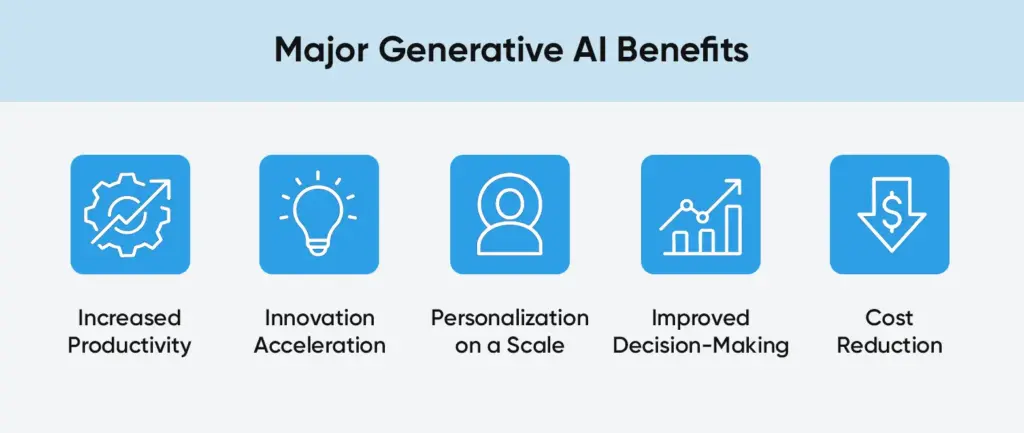
Now that we have discussed how generative AI is reshaping industries, it’s time to learn about all the generative AI benefits.
- Increased Productivity
Routine activities (writing reports, summarizing data, etc.) are automated, and experts can perform high-value jobs. GenAI has the potential to automate 60-70 percent of activities of many jobs in McKinsey. There are also high time savings by the early adopters such as businesses that deployed AI to code have reduced the developer labor by more than 25%.
- Innovation Acceleration
It is able to come up with new drug candidates, develop prototype products or even pursue other avenues of marketing that the human mind may not readily consider. The teams are able to go through design or texts and come up with designs or texts very quickly; this sets them on the way to execution.
- Personalization on a Scale
AI has the ability to study the behavior of a customer and create something or suggestions that are unique to that customer. Such hyper-personalization (in emails, offers, interfaces) is more likely to make people interact more and even sell more. Indeed, the companies that rely on AI-based recommendation systems record high increases in conversion rates.
- Improved Decision-Making
Generative AI models have the ability to consume and generate large volumes of data to provide answers to complex queries. Scenario models, financial forecasts, risk assessments of AI-generated analyses are used by executives to make better decisions. According to Gartner, the AI-based analytics tools are becoming a center of global decision support by the executive.
- Cost Reduction
Frequently reduce operational costs by eliminating manual work, as well as by minimizing the number of mistakes (e.g. by helping to identify bugs in either coding or fraudulent transactions through AI analysis). As an example, AI assistance in customer service can lower the overhead of the call-centers.
Implementation Challenges
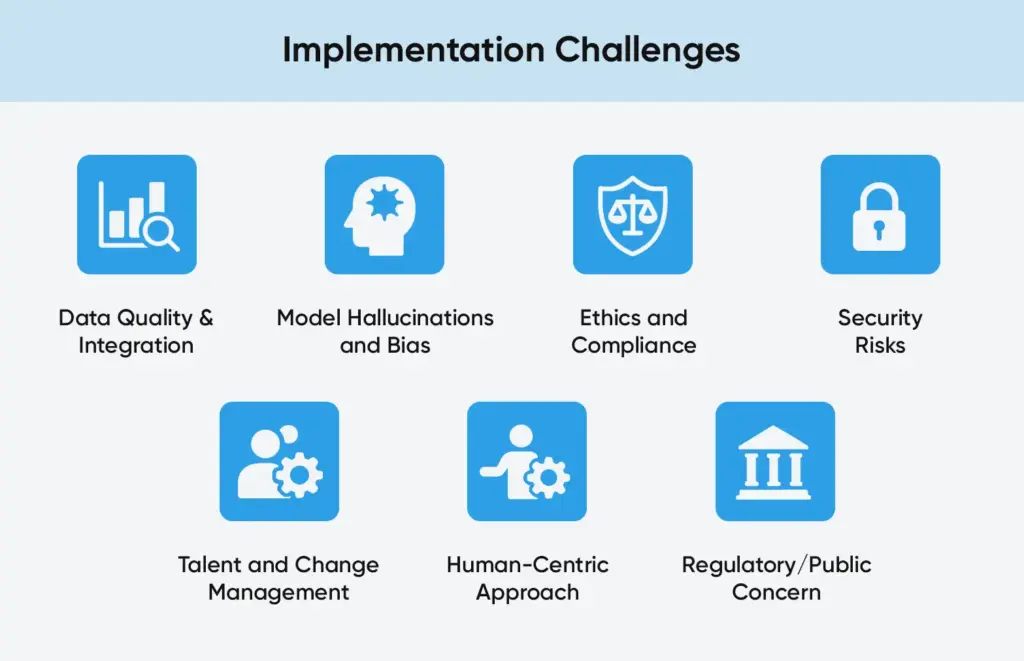
It is not that easy to transform AI potential into reality. Organizations are challenged with a number of obstacles:
- Data Quality & Integration
Generative models require training data of high quality. Poor or rushed data is a challenge facing many enterprises. Gartner is estimating up to 30 percent of projects will fail or be stopped by 2025 because of lack of data management or poor risk management. Before deployment, companies have to spend on data clean-up, integration pipelines, and governance.
- Model Hallucinations and Bias
Models can sometimes produce incorrect or biased outputs (“hallucinations”), which is unacceptable in fields like healthcare or law. Ensuring accuracy requires human oversight and domain constraints. As one review notes, AI’s “potential for hallucination and black-box logic” means organizations must proceed with caution.
- Ethics and Compliance
There is intellectual property and privacy issues when an AI is trained on proprietary data or data that is copyrighted. Organizations have to maneuver the legislation (GDPR, copyright regulations, etc.) and stay trusted by the users.
- Security Risks
GenAI systems may be victims of new attacks (e.g., poisoned training data or adversarial queries). This vulnerability is noted in organizations where three-quarters stated that they would increase cybersecurity solely in AI programs.
- Talent and Change Management
The skilled professionals in AI are lacking. The firms require human resources despite the tools, as they require individuals with an awareness of AI working processes. Besides, AI can be opposed or abused by workers when not trained adequately.
- Human-Centric Approach
Retraining staff and placing them in tasks that are more valuable than the technology itself is not any less important than the latter.
- Regulatory/Public Concern
As generative AI permeates the mainstream, the governments are considering new laws (such as the EU AI Act) on its usage. Firms have to keep on the run of changing regulations and popular opinion.
The Road Ahead!
GenAI is still developing, shifting towards commercial implementation. The following chapter offers further integration, and more human-like relationships between industries.
Rise of Agentic AI Systems
The second embrace of AI will be agentic AI systems that can perform complex workflows on their own.
Examples: Data collection, report writing, email, and follow-ups are tasks on which an AI analyst requires minimum input.
➤ Gartner estimates that agentic AI will evolve out of pilot projects to enterprise-deployments by the end of 2025.
Greater Human-Artificial Intelligence Cooperation
GenAI will be a creative co-pilot in all industries. The AI will be used in real time to brainstorm, visualize and refine the ideas with authors, architects, and designers.
➤ AI-assisted storytelling will bring forth more opulent, repetitive creation to instant architecture design models.
Development of Multimodal Capabilities
With the growth of models, AI will combine text, image, and video generation in one system.
➤ This development will make AI avatars to serve customers with emotion and superior creative features to media, marketing, and entertainment.
Domain-Specific AI Models
Businesses are moving towards proprietary foundation models that are being trained on their data.
Example: Banks, retailers, or healthcare companies that build their own LLMs in which the models are trained using their own data to be more accurate and competitive.
Finding the Gold Mean between Hype and Real Value
AI does not have the same benefit in all processes. Human intelligence is needed to be creative in strategy, provide leadership, and make decisions in a subtle way.
➤ High-impact generative AI use cases should be the priority of the business, ROI should be carefully measured, and the process of scaling should be repeated to concentrate on the value that is actually important.
Conclusion
The ideas around how generative AI is reshaping industries are now solidly entering the reality stage after a frenzied bout of hype. In healthcare, finance, retail, and in most other fields, we observe tangible examples when AI enhances human work, not entirely replacing it.
- Augmentation: with AI-powered tools in the hands of employees, they have a lot more than they could have previously, and the routine work is robotized.
- Supporting Data: the potential productivity in trillions of dollars, high rates of generative AI adoption, and quantifiable ROI.
Finally, the transformations are taking various shapes, yet all the examples revolve around accelerated innovations and AI automation. It is all because as businesses start to incorporate AI into products, services and processes, they will discover new levels of efficiency and experiences. The transition between hype and reality is in progress and it is transforming operations throughout the global economy.
How BrainX Helps Businesses Innovate with AI Solutions?
At BrainX Technologies, we help companies move from concept to measurable impact through practical implementation.
Here’s how we support your digital evolution:
- AI Strategy and Consulting - Learn how AI can be used to optimize operations and improve the business performance.
- AI Model Development Custom: Develop intelligent systems capable of learning, adapting and solving actual business challenges.
- AI-Powered Automation - Implement smart assistants and automation of the processes to achieve efficiency and customer experience.
- Integration & Deployment - Stream integration of AI with your apps, CRMs and enterprise platforms.
- Performance Optimization- Improve, refine and scale AI solutions to provide long-term value.
Bring your AI change now! Ready to apply these steps to your own project? Book a Free Consultation ”
FAQs
1. What is the difference between traditional AI and GenAI?
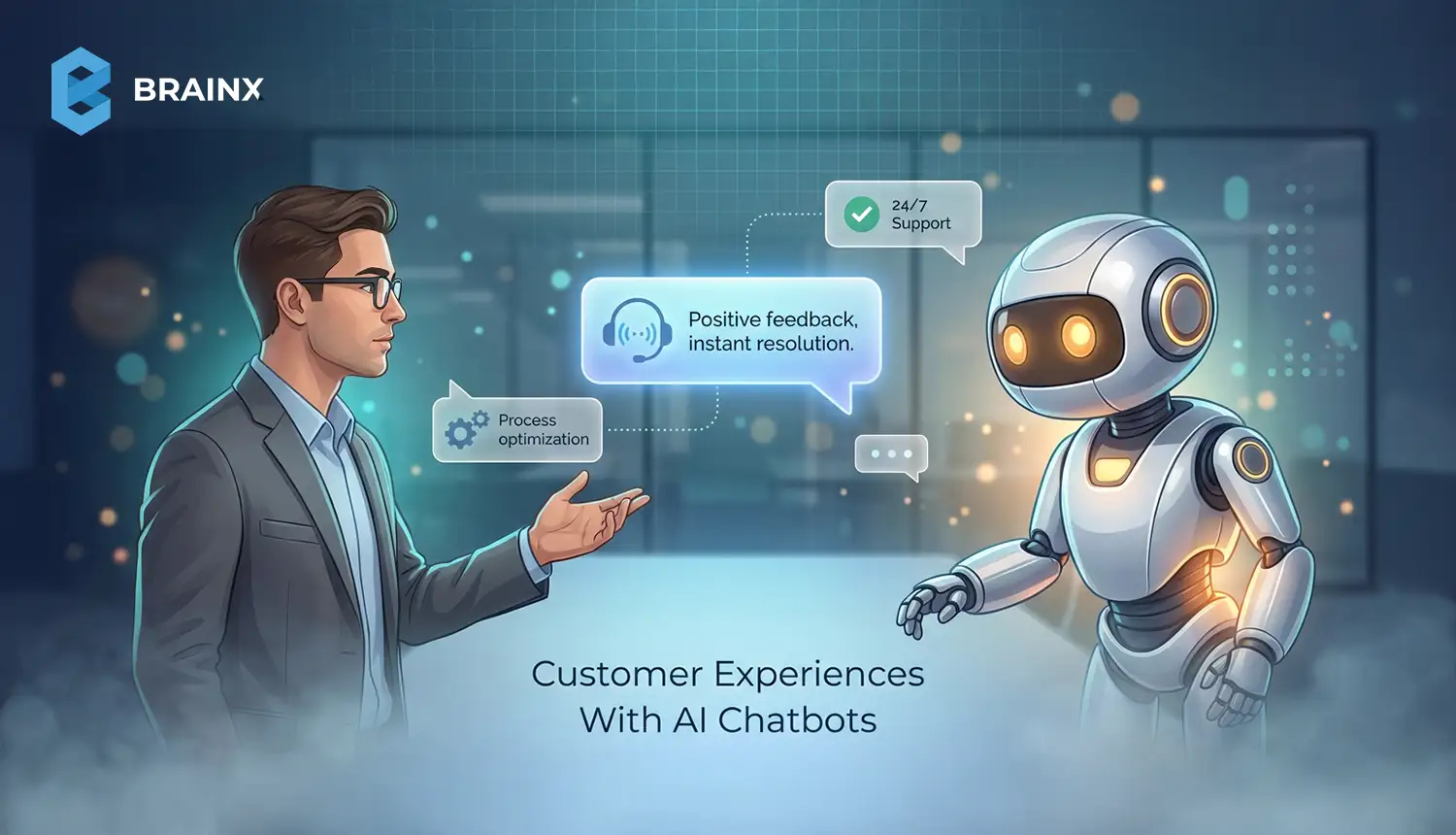
The classic AI is based on data analysis and forecasting, whereas gen AI generates something original like a text, code, picture, or design, by taking into account the previously learned patterns. It allows creativity and automation in aspects that the older AI systems did not.
2. What industries does it benefit most?
The main pioneers are healthcare, finance, retail, manufacturing and marketing. GenAI is used to find new drugs, automate reports, personalized shopping experiences, design parts, and create creative content all of which are redefining the way these industries work.
3. What are the chief advantages of genAI to businesses?
The main generative AI benefits involve increased productivity, accelerated innovation process, tailored customer experiences, better decision-making and lower cost. A significant number of companies claim to make more than 3 times ROI on their investments in AI.
4. What are the pitfalls involved?
Some of these pitfalls are poor data quality, bias or hallucination in the model, ethical and privacy concerns, cybersecurity risks, and unavailable skilled AI talent. Success is pegged on effective data management, human control and well defined change management.
5. What is the future of generative AI?
The second advancement is the agentic AI one. Such systems are used to perform tasks autonomously, like to collect data, write reports, and share findings. AI is expected to be a reliable, daily business partner as refined domain models and more powerful regulations appear instead of just being a new thing.