
Revamping customer experiences with AI chatbots means delivering instant, personalized, and scalable support across every customer touchpoint. The blog addresses the ways businesses can use AI to increase satisfaction, reduce expenses, and improve engagement. Uncover practical examples, trends, and policies to implement AI chatbots in real-world scenarios and transform customer experiences to enhance brand loyalty in 2026 and beyond.
Revamping customer experiences with AI chatbots does not only involve the enhancement, but reinvention as well. Chatbots are going to reshape support from a responsive function into a proactive and intelligent customer journey in 2026.
Chatbots that utilize AI have become popular with over 85% of companies using AI to automate the customer service process. Over 60 percent of the consumers want to use the bots to get immediate and 24/7 service.
These intelligent assistants are changing the customer experience (CX) by providing real-time response, hyper-personalized interaction, and channel consistency.
Progressive brands are already getting quantifiable outcomes, such as higher cost-savings or better customer satisfaction. AI chatbots are rapidly becoming a vital part of the support ecosystem in the present time.
In this guide, we’ll explore how AI chatbots are revolutionizing CX in 2026. You’ll discover key benefits, future or latest trends, real-world case studies, and actionable strategies to implement them successfully.
Why AI Chatbots Are Changing the Customer Experience Landscape
Customers today demand quick, convenient and customized service, and they demand it 24/7. Traditional channels such as phone and email are not always effective, which leads to delays and frustrations.
AI chatbots solve this by offering instant engagement across websites, apps, and messaging platforms. They satisfy current requirements of speed and self-service, where and when the customers ask for them.
Increasing Self-Service Expectations
About 88% of customers want companies to offer self-service options such as chatbots as fast service providers. Many, especially younger users, prefer solving issues themselves via chat instead of waiting on a call.
Multi-Channel Convenience
Modern consumers constantly switch platforms, from web, apps, social to SMS, and want to have a consistent, reliable customer experience everywhere. AI chatbots can work on all of these channels and offer a smooth experience that does not involve any repetitive steps.
Scalability During Peak Demand
Bots do not require breaks as humans do. During surges, like product launches or outages, they scale instantly. This gets rid of the queues and holds messages which ensure that service remains quick and frustration-free.
Businesses are catching on. According to a survey conducted recently, 64% of CX leaders indicated that they intend to invest more in AI and chatbots in 2026.
What used to be a novelty once has turned out to be a strategic advantage, which is a must in meeting increasing expectations and remaining competitive.
Key Benefits of AI Chatbots for Customer Experience
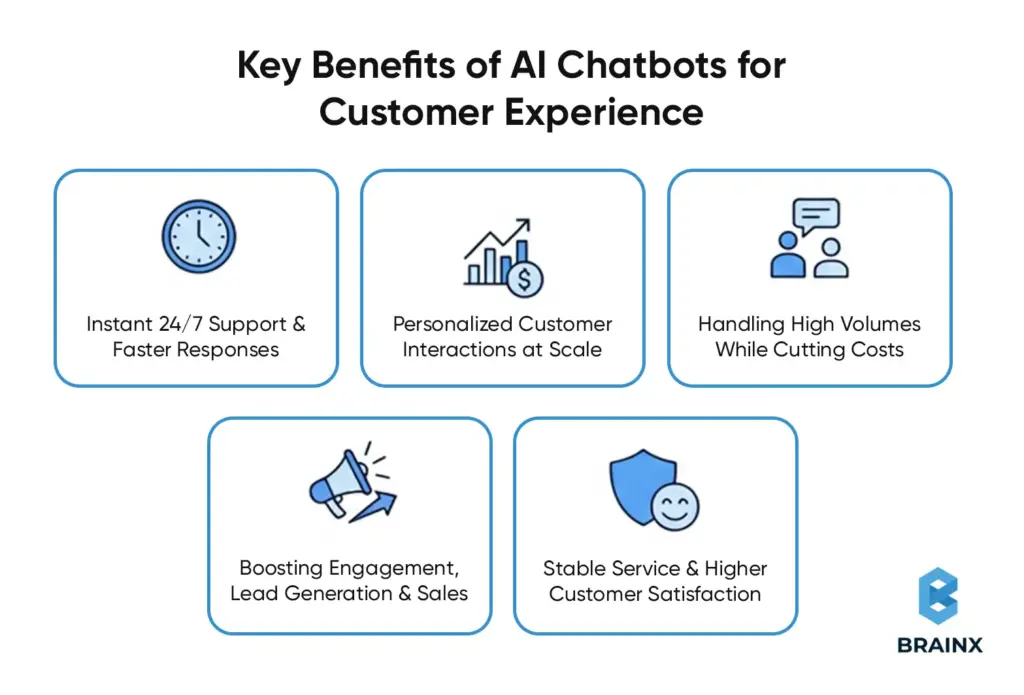
AI chatbots improve CX and provide a real business value. These are the most effective ways that they are changing customer interactions:
1. Instant 24/7 Support & Faster Responses
In the modern on-demand economy, speed is vital. AI chatbots offer real-time services 24/7, and they are able to solve routine questions, even challenging ones, in real time without involving a human agent.
In 2024, chatbots were projected to be in control of 85 percent of customer interactions. That number still continues to grow.
For example, one global retailer saw a 38% reduction in call volume after deploying chatbots across its support channels. Order tracking, return questions, and product questions were solved in minutes, and human agents were free to look into more urgent cases.
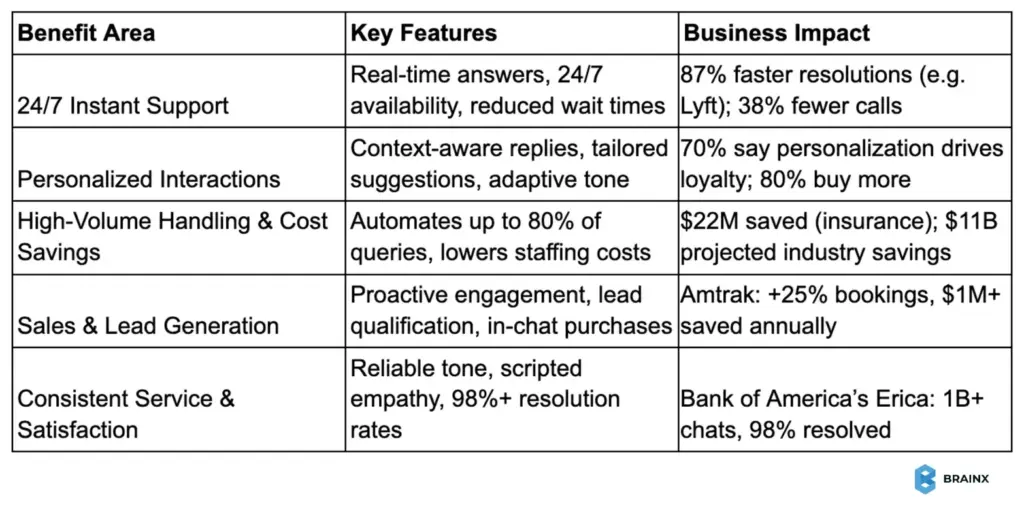
Stat Spotlight: After integrating AI, Lyft reduced average customer resolution time by 87% that dramatically improved user satisfaction and operational speed.
2. Personalized Customer Interactions at Scale
Personalization gets customers to feel that they are heard, and that is scalable with AI chatbots.
They have a memory of the context (past orders, preferences) and can customize product recommendations in real-time and even change their tone according to the mood or profile of the customer.
Example: A chatbot might say, “I see you ordered running shoes. Are you looking for similar gear?” Such interactions feel personal and not automated.
Surveys indicate that 70 percent of customers believe that personalization affects brand loyalty. And 80% have a higher chance of purchasing from brands that provide it.
3. Handling High Volumes While Cutting Costs
AI chatbots have the ability to manage thousands of conversations simultaneously, which human agents simply cannot match.
They sort out more than 80 percent of basic support cases, which helps cut manpower and accelerate resolutions for all users.
Cost Savings: Chatbot automation saved one insurance company 22 million in a year. The support cost saved through AI will be up to 11 billion every year, industry-wide.
Agent Productivity: Human agents are able to concentrate on high-value issues rather than responding to repetitive questions. It enhances employment satisfaction and lets them provide better support to customers.
Consistency and Accuracy: Chatbots do not get tired or distracted like human beings. They give straight forward answers that are repeatable in every case and reduce the chances of mistakes so the service quality stays consistent.
4. Boosting Engagement, Lead Generation & Sales
AI chatbots are not only tools of support but also sales assistants.
They are able to take the initiative of welcoming visitors to the website, responding to questions about products and steering users to make purchases.
All of which helps reduce bounce rates and improve conversions.
Proactive Assistance: Bots are able to provide help such as a store associate (e.g., Looking for something specific?). This makes it a more interactive and personalized shopping experience.
Lead Qualification: In B2B, bots can ask qualifying questions (“Team size?” “Pain points?”) and pass warm leads to your sales team automatically.
This happens 24/7—no forms, no delays.
Seamless Transactions: Chatbots can also handle full checkouts. Customers can book a service, place an order, or renew a subscription—all within the chat.
Case Example: Amtrak’s AI assistant “Julie” handled 5 million questions per year, boosting bookings by 25% and saving $1M+ in support costs.
Julie’s smart guidance didn’t just improve service—it drove serious revenue growth.
5. Stable Service & Higher Customer Satisfaction
Chatbots provide high-quality, consistent service at all times, which is difficult to ensure with large human teams.
They are always responsive, stick to the brand tone and never forget to be polite or empathetic. The unparalleled consistency builds long-term trust and sets clear service expectations.
For example, Bank of America’s chatbot Erica has handled 1 billion+ interactions since launch.
With a 98% resolution rate, Erica has elevated customer satisfaction and helped the bank lead in digital service ratings.
AI Chatbot CX Benefits Summary
Real-World Examples of AI Chatbots Revamping CX in Action
In order to fully understand the role of the AI chatbots in revolutionizing the customer experience, we can consider the following real-life success stories of companies in different sectors from 2025 and beyond.
Healthcare – Virtual Patient Assistants
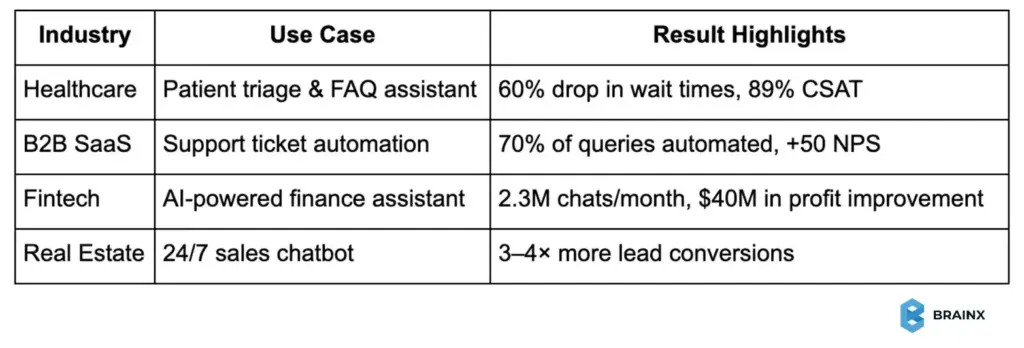
There was a case of an AI-driven virtual assistant that was implemented in a healthcare network in a particular region to receive and process the inquiries of patients and triage their symptoms. Patients were no longer held on waiting lists to ask a routine question, and cases of emergency were expedited quicker.
The bot dealt with scheduling appointments, insurance questions and prescription questions, and the human staff was only left to deal with complex cases. Wait times were reduced by more than 60 percent and the number of callers who abandoned calls reduced by almost half.
The assistant achieved an 89% satisfaction score. Patients praised the speed and clarity, while healthcare staff could focus more on critical care, improving overall service quality.
B2B SaaS – Streamlining Customer Support
A growing SaaS provider company integrated a chatbot powered by AI to handle its increasing support tickets. The chatbot, with help of generative AI, now answers approximately 70% of the queries without involving a human agent.
The levels of resolving conflicts on the first contact increased by almost 30 percent, and the support team relied on AI recommendations to process the remaining cases faster and precisely.
The Net Promoter Score (NPS) of the bot also increased significantly and turned from negative to +50. While, the customer support NPS was at an all-time high of 70 and response times were reduced by almost half.
Fintech – Personal Banking at Scale
A digital finance platform introduced an AI chatbot powered through a large language model. The assistant served 2.3 million chats within the first month, which is similar to the effort of approximately 700 agents.
It responded to questions 24/7 regarding accounts and payments and shortened the average time to respond to 11 minutes to just 2.
The bot also offered proactive financial tips, like saving suggestions or spending alerts.
Customers appreciated the fast help, while the company reported $40 million in annual profit improvement linked to faster resolution and increased conversions.
Real Estate – Always-On Sales Concierge
One of the real estate brokers incorporated AI chatbots on its property listing pages. These bots answered questions of the visitors in real-time, booked tours and gathered contact information to nurture leads.
The chatbot increased lead conversion by 1-2 percent to approximately 7 percent producing more than 75 further qualified leads in a month. It replaced outdated contact forms with real-time conversations that felt human.
The firm’s conversion rates increased 3–4× above market averages. Potential buyers and sellers received assistance at any hour, while agents were busy closing deals and not pursuing enquiries.
Industry Comparison Chart
Human-AI Collaboration at Work
Such cases demonstrate how effectively chatbots are used to improve customer experience, which includes quicker service, personalization, and 24-hour support among various industries.
AI manages bulk processing of routine jobs and refers difficult or emotional cases to human operators with complete information. It is a hybrid model that provides the best of both worlds.
Harvard research shows that AI-augmented support teams respond 20 percent faster and are more empathetic. It resulted in an efficient, humanized service that drives satisfaction and loyalty.
Top Trends in AI Chatbots Shaping the Future of CX
AI chatbot technology is evolving at a high rate. Companies that wish to really revamp customer experience need to remain in the forefront of emerging trends in 2026. The following are five paradigm shifts in chatbot capabilities and how they will change CX.
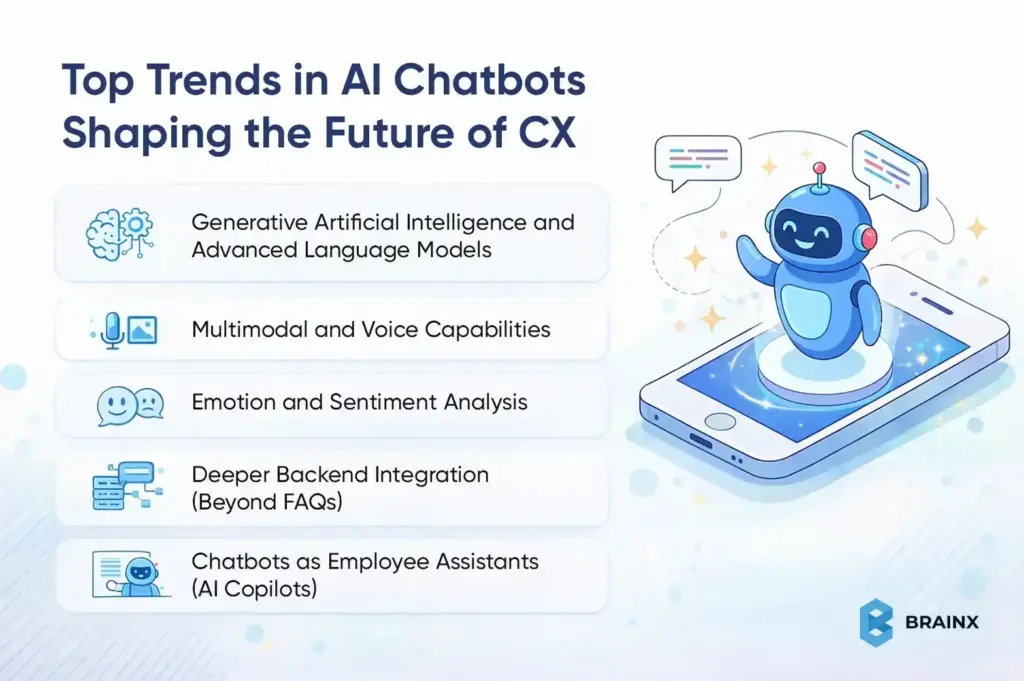
1. Generative Artificial Intelligence and Advanced Language Models
Powerful language models like GPT-5 have enabled AI chatbots to be much more conversational.and context-aware.
The bots are now capable of comprehending natural, human-like sentences and can respond to multi-step and subtle requests without any difficulty. Generative AI allows them to go beyond scripted responses and answer unexpected queries with fluency.
The result? A human-like, intelligent, and interactive chatbot experience that is less robotic and more natural.
Companies are incorporating these models to improve CX at scale. Chatbots are currently able to conduct coherent conversations, emulate human empathy, and provide quicker resolutions, which makes them invaluable to customer service in 2026.
2. Multimodal and Voice Capabilities
Chatbots, which were originally text-based, are now evolving into voice- and image-enabled assistants.
Voice AI enables customers to communicate in natural language (Pay my bill), and the bot reacts immediately, usually, much more quickly than going through complex phone menus.
In the meantime, multimodal bots have the ability to send buttons, carousels, images, or interactive forms within the chat, so conversations are more user-friendly and accessible for all users.
When voice and visual interfaces are combined, the businesses will be able to serve the customers in their preferred manner; particularly the customers who enjoy talking or require a visual orientation when making a purchase or when troubleshooting.
3. Emotion and Sentiment Analysis
The new chatbots are now capable of analyzing customer feelings and mood based on their tone, keywords and wording.
Should the user become angry or frustrated (e.g. “This is the third time this happened!”), the bot can change its tone, empathize, or refer to a human agent instantly.
It helps chatbot communication to become more caring and human-like, which is essential in maintaining trust under frustrating circumstances.
One of the studies found that human agents with bots proposing more empathetic responses significantly elevated the customer sentiment scores. As this trend grows, AI chatbots will create deeper emotional connections with users.
4. Deeper Backend Integration (Beyond FAQs)
The high performing chatbots of today do much more than just answer questions.
They are able to extract real-time information in CRMs, inventory systems or booking platforms. For instance, a client requesting a refund can be taken through the entire process, including creating a shipping label, without leaving the chat window.
Such a level of integration makes bots complete-fledged support agents with the capability to solve issues end-to-end. Although it means you’ll need to invest in connectivity of the systems, the pay-off will be an experience with no friction and less load on the human teams.
5. Chatbots as Employee Assistants (AI Copilots)
AI chatbots are not only used for customers but are now also changing the work experience of the employees.
The agent-assist bots monitor live chats or conversations and propose real time responses, articles or follow-ups. It helps even junior agents in resolving issues like experienced pros.
Harvard research found that agents supported by AI saw a 70% drop in response times and higher sentiment scores. The AI copilots assist teams in providing smarter, quicker and more compassionate service, which ultimately improves the customer experience.
Best Practices for Implementing AI Chatbots in Customer Service
AI chatbots are extremely valuable, except when used without any proper planning. Badly implemented bots can be annoying to the users, particularly when they are unable to comprehend questions or provide a means of communication with a human support agent.
To truly revamp customer experience with AI chatbots, follow these essential best practices:
1. Start by Defining Clear Objectives & Use Cases
Before launching a chatbot, clearly define what you want it to achieve.
Is it supposed to deflect simple support tickets? Help convert leads? Onboard new users?
Begin with a narrow, high-impact use case, e.g. order tracking or FAQ responses. It will simplify testing, refining, and proving its value.
When that works, you can expand it to support more elaborate and large-scale customer journeys in the future.
2. Leverage Existing Knowledge and Systems
Your chatbot is only as smart as the data it has access to.
Integrate it with your CRM, knowledge base, help desk, or order management system. This enables the bot to provide personalized and real-time responses rather than generic ones.
In case you are using platforms such as Salesforce or Zendesk, integrate the chatbot to have a unified support experience.
For example, a well-integrated chatbot can retrieve shipping details, access customer profiles, and respond to billing-related queries instantly that will save time for both users and agents.
3. Create a Conversational Flow with AI Flexibility
Visualize major purposes and flows your chatbot should be able to handle. Apply natural language processing (NLP) to learn about different phrase variations that users may use to make a request.
Write the responses with a friendly, on-brand tone.
At the same time, let AI adapt based on learning. Integrate the designed flow and the capability of AI to personalize and perfect responses as time goes by.
Such a balance will result in customers to have human-like conversations easily without the bot going off-script or losing context.
4. Ensure Smooth Handoff to Human Agents
A bot should not deal with every problem. The construction of a smooth escalation path to live agents is one of the most important best practices.
When a customer includes in his or her message, “agent, please” or the bot does not have the necessary response to give to the customer with high certainty, it should hand over the chat right away.
Pass along all the context, conversation history, user data, intent, etc., so that the customer does not have to repeat themselves. It makes the experience smooth and does not infringe on their time.
A helpful example: certain banks apply AI to redirect the user to a live agent with the full chat history so that the transition is warm and frictionless.
5. Test, Monitor & Continuously Improve
Your chatbot should never stop evolving. Prior to launch, test it with real-world situations and beta users.
Follow up on important metrics such as the rate of resolutions, frequency of fallback, and customer satisfaction after the deployment.
Look through the chat transcripts to understand what is missing, and revise the bot on a regular basis. You will need to add new intents, rephrase the confusing responses, and refine the language.
Most firms plan monthly or quarterly updates depending on the feedback and support trends. This will make your chatbot sharp, relevant and focused on fulfilling customer needs.
6. Be Open & Set Clear Expectations
Never conceal the fact that users are talking to a bot.
The majority of customers do not mind AI, provided they are not misled. Start with a clear intro (e.g. “Hi, I’m Friday, your virtual assistant”) and explain what the bot can and can’t do.
In case the chatbot cannot cover something, it should acknowledge that and provide an alternative like giving a contact form or escalation to a human.
Such sincerity creates trust and assists in managing the expectations of users, which translates into smoother interactions and increased satisfaction.
Chatbots are highly appreciated when implemented correctly. Your customers will like the speed and convenience while your staff will appreciate the decreased load, which will improve concentration.
Remember: AI is a support enhancer, not a replacement. Bots should be utilized in areas where they provide value and human beings in situations where it is necessary to be subtle, empathetic, or creative.
The combination of the two will give the best customer experience.
Conclusion - Embrace the AI Chatbot Revolution in CX
In 2026, AI chatbots are a must-have for delivering fast, personalized, and scalable customer service. They are no longer optional, leading to loyalty, customer satisfaction, cost savings and altering the way businesses create proactive and on-demand experience designs. For leaders and founders, it is now mission-critical to combine AI chatbots with human teams. The businesses that embrace this shift will build deeper customer relationships and gain a lasting edge in the evolving CX landscape.
AI Chatbots Can Revolutionize Your Customer Experience
The development of an AI-based chatbot involves a specific level of skills in machine learning, natural language processing, and artificial intelligence. It is not just that these chatbots should be able to comprehend user input but should also be able to give relevant, personalized responses which can only be achieved through a team of skilled personnel who are able to develop AI systems that are context sensitive, language sensitive as well as emotion sensitive. With the growing role of AI chatbots in customer service, companies must keep up with the trend to keep up with competition.
Although it might be difficult to find the appropriate talent to create such complex systems, AI-based chatbots can be of great benefit to improve customer satisfaction, cut down operational costs, and offer 24/7 support systems. If you're looking to transform your customer experience with cutting-edge AI, partnering with the right team will make all the difference.
Ask us today how BrainX can assist you in staying ahead of your competitors by deploying AI chatbots to revamp your customer experience and business processes.
FAQs About Revamping Customer Experience With AI Chatbots
1. What are the main benefits of using AI chatbots for customer experience?
AI chatbots improve customer experience by offering 24/7 instant support, reducing response times, personalizing interactions, cutting operational costs, and handling high volumes of queries without compromising service quality.
2. Can AI chatbots fully replace human customer service agents?
Not entirely. AI chatbots excel at handling routine, repetitive tasks, but complex or emotionally sensitive issues still require human intervention. The best approach is a hybrid model that combines both.
3. How do I integrate an AI chatbot with my existing customer service system?
Most modern AI chatbot platforms offer easy integration with CRMs, help desks, and communication tools like Zendesk, Salesforce, and Slack. APIs and plug-ins enable seamless backend connections for unified support.
4. Are AI chatbots suitable for small businesses or just enterprises?
AI chatbots are scalable and cost-effective, making them suitable for both small businesses and large enterprises. Many affordable, low-code solutions are available that require minimal technical expertise to deploy.
5. How can I measure the ROI of implementing an AI chatbot?
Track metrics like reduced support costs, faster resolution times, CSAT scores, chatbot containment rates (queries handled without escalation), and revenue influence through conversions or lead generation.