
Both Ruby and Elixir are powerful programming languages but, in 2025, they have different applications. Ruby (with Ruby on Rails) is the ideal choice in the context of rapid development, an enormous ecosystem of gems, SaaS or marketplace applications. Elixir (and Phoenix Framework) is good at real-time and concurrent systems, as well as at fault-tolerant ones like chat applications, financial technology, and data-intensive ones. It is up to you whether you appreciate developer productivity and ecosystem (Ruby) or performance and scalability (Elixir).
Choosing the right programming language for a business involves tough trade-offs. Many business owners find themselves switching to understand what works best. If you're experiencing the same between Elixir vs Ruby, you are not alone! Both work equally well for specific niches in the IT industry but serve different purposes.
Elixir is widely celebrated for its ability to scale seamlessly and handle faults gracefully, making it a go-to choice for building real-time applications and managing high levels of concurrency. On the other hand, Ruby has charmed developers for decades with its clean and intuitive syntax, paired with the game-changing Ruby on Rails framework. Together, they’ve become synonymous with rapid development and code that’s both easy to maintain and a joy to work with. These are different strengths between them, but their distinct differences need to be comprehended if you plan on harmonizing your tech stack to the long-term success of your SaaS objectives.
But how do you choose the best programming language for SaaS in 2025? Fret not, read this guide to make an informed decision. Let's navigate the Elixir vs Ruby debate with a detailed breakdown of the pros and cons.
Background of Ruby vs Elixir
Ruby and Ruby on Rails have long been synonymous with efficient and enjoyable web application development. Since its creation in 1995 by Yukihiro Matsumoto, Ruby has prioritized a human-friendly programming experience. When paired with the Ruby on Rails (RoR) framework, developers gain access to a vast ecosystem of gems—libraries that supercharge development speed and functionality. As a result, Ruby on Rails has redefined web development by emphasizing rapid iteration and developer happiness. Even today, companies rely on Ruby on Rails to build scalable, feature-rich applications quickly.
Interestingly, Ruby programming language inspired the creation of Elixir. José Valim, a former core team member of Rails, admired Ruby's elegance but identified limitations in its concurrency and throughput capabilities. Determined to improve upon these aspects, he designed Elixir atop the Erlang VM, leveraging its exceptional concurrency and fault tolerance. Elixir has since become a favorite for handling high-traffic, real-time applications. Similarly, Phoenix, an Elixir programming language, mirrors Ruby on Rails in usability but excels in performance and scalability.
Both languages cater to distinct business needs. Understanding their origins and strengths sets the stage for a deeper comparison, helping companies choose the right from Elixir vs Ruby to future-proof their tech stack.
Pros of Ruby

Ruby offers impressive benefits, making it a top choice for developers and businesses. From its expansive ecosystem to its developer-first philosophy, here’s what makes Ruby stand out:
1. Expansive Library Ecosystem
Ruby’s ecosystem comprises thousands of gems—pre-built libraries that simplify and accelerate development. There's probably a gem for implementing authentication, handling payments, or adding real-time features. Such an eco-system saves developers from reinventing the wheel, enabling them to innovate more solutions.
2. Developer-Friendly and Productive
Ruby programming language was built to make coding enjoyable. Its clean and straightforward syntax ensures developers can express their ideas clearly and efficiently, leading to fewer errors and faster development cycles. This ease of use is why Ruby remains a favorite for beginners and seasoned professionals.
3. Vibrant and Supportive Community
Ruby's community is renowned for its inclusivity and helpfulness. With countless tutorials, active forums, and regularly updated solutions, developers at all levels can easily find guidance and inspiration. This collaborative environment ensures that even complex problems can be tackled efficiently.
4. Commitment to Best Practices
Ruby emphasizes strong software development principles like “coding by convention” and “don’t repeat yourself” (DRY). These practices make the codebase cleaner and enhance maintainability, reducing technical debt over time.
5. High Scalability Potential
While Ruby is already known for its ease of use, it also boasts scalability, making it suitable for applications that handle growing user bases and data demands. Properly designed Ruby applications can grow alongside your business without significant rework.
6. Strong Focus on Web Standards
Ruby ensures compliance with web standards at every level, from front-end development to back-end data handling. This alignment guarantees smoother integrations with third-party systems and a consistent platform user experience.
Cons of Ruby

While Ruby excels in several areas, it also lacks in many, especially if compared to languages like Elixir. Here are the main drawbacks when choosing Ruby for your SaaS application:
1. Limited Concurrency Support
It is one of the most important features of most modern web applications, especially for those involving high-traffic or real-time applications. Ruby has a Global Interpreter Lock, which does not allow more than one thread at a time; thus, using a concurrent process is not too effective. Though tools like Concurrent Ruby could mitigate this limitation, they add a bit of complexity that is not as smooth as Elixir's concurrency built into the language.
2. Slower Performance Compared to Elixir
Ruby isn’t inherently slow, but its performance lags behind Elixir, particularly in high-traffic or computation-heavy applications. While measured in microseconds, Ruby apps’ response rates are generally slower than those built with Elixir. While experienced developers can optimize Ruby applications, performance remains a potential bottleneck for scaling.
3. Challenges with Long-Term Maintenance
Ruby’s extensive gem ecosystem, while a strength, can become a double-edged sword in the long term. Gems abstract much of the functionality, which is convenient but can obscure the inner workings of the code. For less experienced developers, maintaining or debugging an application built with many gems can be challenging, leading to productivity issues and potential technical debt.
4. Higher Resource Consumption
Ruby applications often require more server resources compared to leaner, more efficient languages like Elixir. This can increase hosting costs and infrastructure requirements, especially for large-scale SaaS platforms with high user activity.
5. Learning Curve for Scaling Applications
While Ruby is beginner-friendly for small-scale projects, scaling an application requires a deep understanding of its nuances and limitations. For instance, optimizing for concurrency and performance can be complex without significant experience, making it less ideal for traffic-intensive applications without a skilled team.
6. Dependency on Gems for Core Features
Ruby’s reliance on gems for functionality can lead to dependency management issues over time. As the application grows, keeping track of gem compatibility, updates, and security vulnerabilities becomes increasingly difficult, adding an extra layer of complexity to development and maintenance.
Pros and Cons of Elixir

It's no wonder Elixir quickly became developers' favorite technology to build high-performance, scalable web applications. Its paradigm of functional programming and heavy reliance on the robust Erlang VM give it a cutting-edge feature in modern SaaS applications.
Here’s why the Elixir programming language stands out:
1. Immutable Data for Debugging and Stability
Elixir’s use of immutable data ensures that variables remain unchanged once assigned, enabling local reasoning and easier debugging. Unlike mutable data in languages like Java, Elixir’s approach reduces the likelihood of unexpected behavior, making applications more stable and predictable.
2. Superior Performance
Elixir's performance is outstanding, especially when it is used with its Phoenix framework. The response times are always in microseconds, so it is a perfect solution for high-traffic or latency-sensitive applications. Although Ruby-developed apps is also fast, the concurrency model of Elixir gives it the upper hand for performance-critical projects.
3. Concise Code and Easy Testability
As a functional language, Elixir promotes concise, purpose-driven functions. This clarity not only simplifies development but also enhances testability. Developers can easily predict outputs based on inputs, facilitating faster iteration and more reliable testing processes.
4. Quick and Safe Refactoring
Refactoring code in Elixir is significantly easier compared to other languages. Its functional and immutable nature minimizes unintended side effects, allowing developers to make changes confidently without disrupting external behaviors.
5. Built for Concurrency and Parallelism
Elixir’s intelligent process scheduler leverages concurrency to the fullest. By preemptively managing processes, Elixir ensures low latency even under extreme load. This capability makes it perfect for applications requiring real-time responsiveness or handling multiple simultaneous tasks.
6. High Fault Tolerance
Unlike many languages where a single bug can crash the entire application, Elixir isolates faults to individual processes. This design keeps the application running smoothly by limiting failures to specific areas, ensuring high availability and reliability.
7. Scalability Without Compromise
Elixir’s ability to maximize resource utilization on a single machine means businesses can scale effectively without immediately adding servers. This makes it a cost-efficient option for scaling SaaS applications as traffic grows.
8. Thoughtful Language Design
Elixir’s syntax and design are clean, intuitive, and optimized for developer productivity. Even complex functional programming concepts are made accessible, easing the learning curve and improving overall development efficiency.
9. Fault-Tolerant Systems
Elixir's concurrency is driven by lightweight processes that use less memory and CPU resources. It comes with Erlang's Open-Telecom Platform, a set of tools for building strong concurrent applications. This enables it to run hundreds of thousands of processes in parallel. OTP allows the development of distributed and fault-tolerant systems without much effort.
10. Documentation and Community Support
Elixir’s extensive documentation and active community make it easy for developers to get started and find support. From official guides to terminal-based documentation, resources are readily accessible to help teams build high-quality applications.
11. Full Access to Erlang Libraries
Elixir offers seamless interoperability with Erlang libraries, expanding its capabilities and allowing developers to leverage decades of proven solutions.
Cons of Elixir

While Elixir has its merits, it is certainly fraught with many challenges businesses must consider before implementing the stack.
1. Narrow Talent Pool
Despite its popularity since its origin in 2011, Elixir is still more of a niche language. This makes finding experienced Elixir developers challenging. Although Ruby developers might find it easier to transition into Elixir development because of the shared ancestry, this scarcity of specialists slows down hiring processes and inflates costs.
2. Functional Programming Paradigm
Elixir's functional programming paradigm can be difficult for developers habitual of using object-oriented languages i.e. Ruby, Python, or Java. Functional programming requires a mindset shift: immutability and declarative patterns of coding.
3. Smaller Ecosystem Compared to Competitors
Elixir's ecosystem is smaller compared to the established ones like Ruby or JavaScript. Although it benefits from interoperability with Erlang libraries, developers may still find themselves building features from scratch more frequently. This lack of ready-made solutions can increase development time for some projects.
4. Limited Resources and Community Size
Elixir’s relatively small community means fewer learning resources, tutorials, and third-party libraries, compared to mainstream languages. While its documentation is excellent and accessible, developers may face challenges when troubleshooting issues without the same level of community-generated solutions available in larger ecosystems.
5. Challenges with Adoption
Since Elixir is still a new language, most organizations are not eager to embrace it, considering questions regarding the long-term sustainability and language support. Businesses should weigh this risk if they are thinking of using Elixir for mission-critical projects.
Best Use Cases of Elixir
Here are the updated descriptions that specifically highlight why Elixir was chosen for these use cases:
1. Discord
Discord depends on Elixir to maintain its real-time messaging system because Elixir can easily handle millions of concurrent connections. Its light processes and fault-tolerant nature ensure seamless communication and fast message delivery are not affected even by heavy traffic.
2. Pinterest
Pinterest adopted Elixir for its notification system to enhance scalability and real-time delivery. Elixir’s concurrency model allows Pinterest to send millions of updates simultaneously while optimizing server performance and ensuring notifications reach users quickly and reliably.
3. PepsiCo
PepsiCo uses Elixir to process massive datasets for marketing and sales intelligence. Elixir's ability in concurrency enables it to handle real-time data analysis for PepsiCo to extract actionable insights faster, which makes decision-making efficient and fast, even in such a business environment.
4. FarmBot
Elixir is incorporated into FarmBot automated systems of farming due to its fault tolerance features and ability to process and run code in real-time; Elixir maintains strict control of all agricultural equipment, a critical activity such as seeding and watering.
5. Moz
Moz employs Elixir for processing vast amounts of SEO data because Elixir can handle concurrent tasks with exceptional performance. This makes it possible for Moz to deliver accurate and timely analytics to its clients, ensuring data processing is both scalable and reliable.
6. Axle Payments
Axle Payments chose Elixir to automate invoicing, collections, and financial transactions due to its ability to manage high transaction volumes efficiently. Elixir’s reliability ensures smooth operations while supporting the platform’s rapid growth in the financial services sector.
7. Ulysse
Ulysse uses Elixir to manage complex flight search queries and bookings. Elixir’s fault tolerance and concurrency allow Ulysse to provide users with a seamless and responsive booking experience, even during peak traffic ensuring high performance and reliability.
8. GoodsID
GoodsID utilizes Elixir for its blockchain-based tracking platform because of the language’s concurrency and fault tolerance. Elixir ensures secure authentication and transaction management, providing real-time reliability and protecting data integrity for luxury goods tracking.
Best Use Cases of Ruby
Here are updated descriptions, focusing on why Ruby was specifically chosen for each use case:
1. NASA Langley Research Center
NASA employs Ruby for simulations due to its flexibility and ease of handling complex computational tasks. Ruby's dynamic nature allows scientists to prototype, iterate, and run simulations quickly without compromising accuracy, making it a reliable choice for scientific research workflows.
2. Google SketchUp
Google SketchUp uses Ruby for its scripting API to empower users with customization capabilities. Ruby's intuitive syntax and dynamic features enable the creation of plugins and automation scripts, enhancing SketchUp's usability and adaptability for designers, architects, and engineers.
3. BioRuby
BioRuby relies on Ruby to manage and analyze biological data because of its simple syntax and robust libraries. The language allows researchers to easily handle complex bioinformatics workflows, including genetic sequence analysis, making it an efficient tool for molecular biology.
4. Capistrano
Capistrano is built with Ruby to automate deployments because of Ruby's ability to handle scripting tasks effectively. Its concise syntax and ease of writing automation scripts make Ruby the perfect choice for managing server configurations and streamlining application rollouts.
5. EventMachine
EventMachine uses Ruby to build event-driven applications due to the language’s support for concurrent processes. Ruby’s versatility and the simplicity of implementing asynchronous I/O operations allow developers to create high-performance systems, such as chat servers and proxies, with minimal complexity.
6. Sidekiq
Sidekiq processes background jobs using Ruby because the language simplifies task management. Its ability to handle multithreading efficiently within a dynamic environment enables smooth handling of asynchronous processes like sending emails or processing large datasets.
7. Capybara
Capybara utilizes Ruby for automated web application testing because of Ruby’s readable syntax and flexibility in simulating user actions. Its integration capabilities with behavior-driven development tools like RSpec make Ruby a natural fit for ensuring application functionality.
8. Sinatra
Sinatra is built on Ruby because of its lightweight and expressive syntax. Ruby’s simplicity enables developers to quickly create and deploy small-scale web applications and services, making it ideal for prototyping or projects that don’t require the overhead of larger frameworks.
How to Choose between Ruby and Elixir: Similarities & Differences
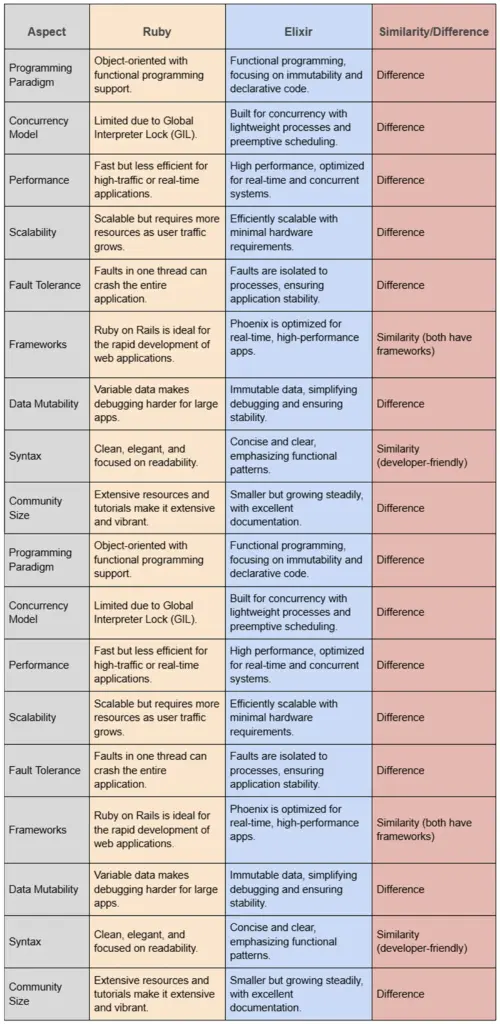
Ruby and Elixir Talent Pool
The talent pool for Ruby is expansive and well-established as it has been around for many years in the tech world. The adoption of Ruby on Rails was widespread, which allowed any business to find reasonably paid experienced developers. In contrast, Elixir has a smaller but growing talent pool, reflecting its status as a newer, niche language. While Ruby developers often transition to Elixir due to shared syntactical influences, the functional programming paradigm can be a learning curve. Companies seeking Elixir expertise may face higher costs and longer hiring timelines but benefit from developers skilled in building scalable, concurrent systems.
Final Verdict
The Ruby vs. Elixir ruling in 2025 is a matter of business priorities. Ruby is the realistic one in case you require expedited development of MVP, huge community, and proven frameworks such as Ruby on Rails. However, when your project requires real-time responsiveness, concurrency and fault tolerance, Elixir and the Phoenix framework are your solution of the future.
Ruby vs. Elixir- BrainX Provides the Expert Insights You Need!
BrainX Technologies is a leading SaaS development company specializing in delivering tailored solutions. We take pride in innovating solutions for industries like Healthcare, Education, e-commerce, Real Estate, Beauty, etc. With a team of 100+ experts and 7+ years of experience, we can create scalable, high-performance SaaS applications. Our process begins with in-depth client consultations to understand project needs, scalability goals, and performance requirements. Based on these insights, we recommend the most suitable technologies, whether Ruby for rapid development or Elixir for real-time and concurrent systems. We leverage our extensive experience to ensure each project aligns with clients’ long-term business strategies, delivering robust and future-proof solutions.
FAQs
Q1. Ruby or Elixir: Which is the best fit of SaaS in 2026?
Ruby would work best when SaaS products require rapid prototyping, rich feature development and massive community support. Elixir is more suitable with SaaS applications that need concurrency, live updates and fault tolerance at scale.
Q2. Does that mean that Ruby is no longer relevant to Elixir?
Yes. Ruby on Rails is used by such applications as Shopify, GitHub, and Basecamp, and it is still very relevant. Elixir is however picking up in popularity regarding high performance systems, thus making it relevant depending on your project scale requirements.
Q3. What are the applications that should use Elixir?
Elixir works better with real-time applications, e.g. chat applications, live streaming, messaging services, fintech services, and IoT applications, where it is essential to have low latency and high fault tolerance.
Q4. Whatever are the key disadvantages of Elixir over Ruby?
Elixir contains less talent pool, the learning curve is steep because of functional programming and the ecosystem is relatively smaller when compared to Ruby. Companies can be exposed to increased expenses of hiring and reduced off-the-shelf solutions.
Q5. What is the comparison between Ruby and Elixir as regards to scalability?
Ruby applications are scaled well but need to be optimized in most cases and have higher resource requirements. Due to lightweight processes, concurrency models, and the Erlang VM, Elixir can scale more easily, and it is very cost-effective in heavy load.