
Companies sometimes need to hire additional talent to fill organizational gaps, manage major projects, and avoid overburdening their staff with tasks beyond their expertise. Various models are available to help companies effectively address these talent shortages.
IT companies often provide technical staffing services to lower expenses, accelerate project schedules, and enhance internal capacities. To leverage external knowledge and skills, IT service providers may suggest various approaches, including staff augmentation, project redistribution, or managed services.
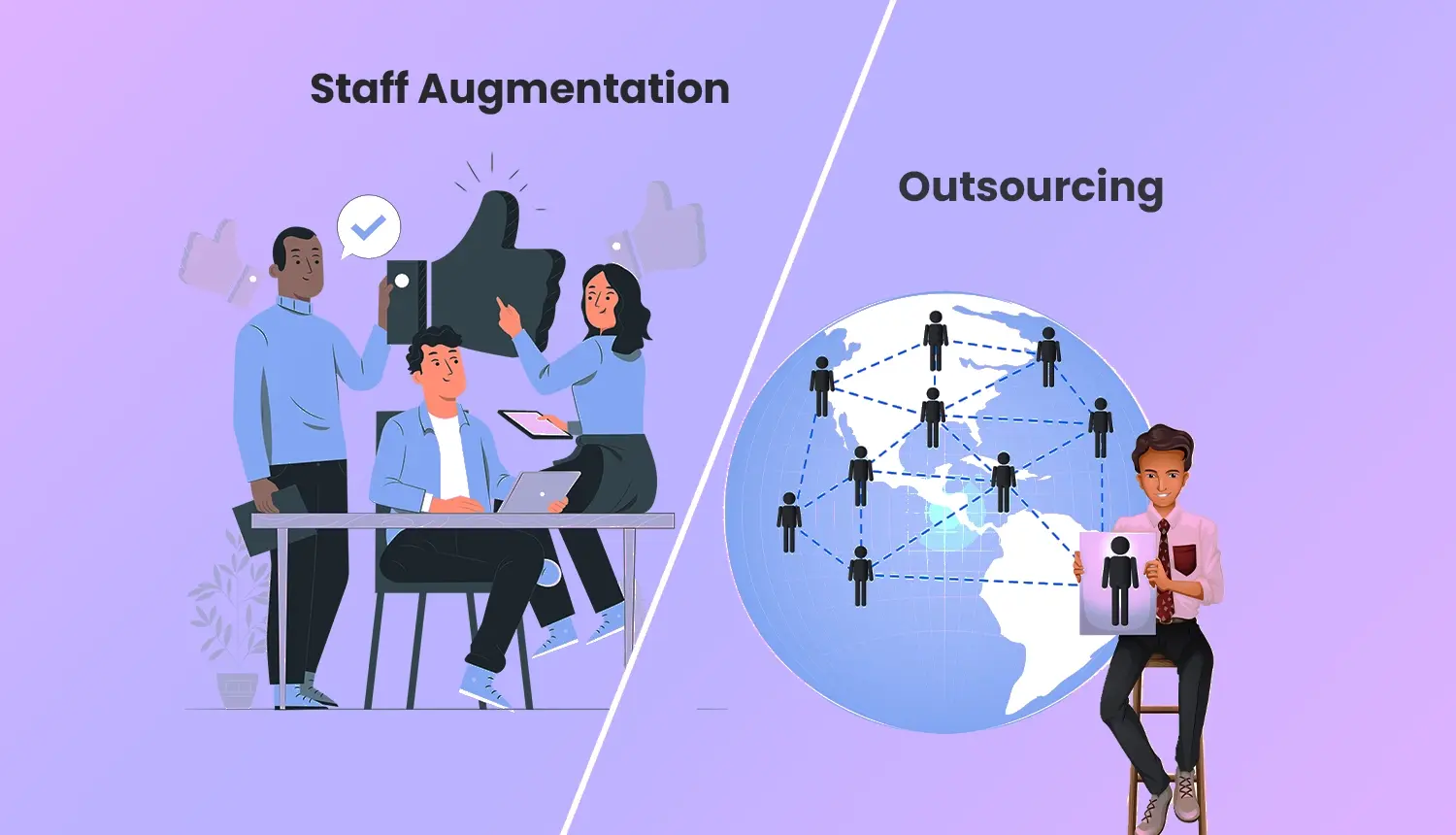
Both are two common strategies adopted presently by businesses. Although they may appear similar, they involve distinct approaches to resource management. Let us help you conclude this debate of staff augmentation vs outsourcing and find the major and minor differences between both in more detail.
Why Do Leading Companies Prefer On-Demand Hiring?

On-demand recruitment showcases adaptability, enabling companies to tailor their hiring strategies based on present requirements. Additionally, it eliminates the need for extended commitments or additional expenses associated with sustaining a permanent recruitment staff. Here are some other reasons why leading companies opt for on-demand hiring;
1. Temporary Requirements
Only some tasks require a full-time employee. On-demand hiring addresses short-term needs like covering for extended employee absence or managing limited-time projects, with talent transitioning after fulfilling the requirement.
2. Niche Specific Skills
Don't fret if your company lacks all the required skills in-house. Consider augmenting your team with specialists, like tax or equity experts, for expansion into new regions.
3. Additional Resources
As a deadline approaches and it becomes evident that additional manpower is necessary, on-demand hiring enables you to swiftly and seamlessly increase the workforce. It ensures that the task is completed on schedule without sacrificing quality.
4. Effortless Onboarding
Onboarding professionals can take longer than desired, especially when faced with a pressing project requiring additional manpower. Opting for on-demand hiring alleviates the need for enduring multiple interview rounds and lengthy onboarding processes.
What is Staff Augmentation?
Augmenting staff involves hiring temporary workers to address specific skill gaps within your company. Despite being temporary, these workers are still considered employees of your business. Depending on the requirements of the short-term project or contract, you enlist employees with specialized expertise to join your team.
Augmented employees may be necessary at different stages of project development, aiming to propel your project forward with their skill set. It expands your talent pool and allows quick scaling for varying demands, keeping your core team focused on primary objectives. Staff augmentation delegates additional tasks efficiently, preventing overload and maintaining productivity.
Types of Staff Augmentation
Let's explore the 5 primary types of staff augmentation your company can benefit from;
1. Project-Based
Companies engage external resources for particular projects and release them upon project completion. Project-based approach enables rapid team scaling for project execution without enduring long-term overhead costs.
2. Short-Term
Short-term external talent is enlisted to fulfill immediate resource needs. This model provides flexibility and agility in managing workforce requirements.
3. Long-Term
External resources are brought on board for an extended duration to support core teams or address skill deficiencies. The long-term method facilitates access to specialized expertise, cost reduction, and effective management of workload fluctuations.
4. Onshore Onboarding
Engaging external talent from the company's local geographic area offers cultural alignment and timezone compatibility benefits. Onshore onboarding approach is favored for projects that demand close collaboration.
5. Offshore Staff Augmentation
Companies enlist external talent from diverse geographic regions with lower labor costs. Offshore strategy grants access to a global talent pool and expertise that may not be readily accessible locally, making it suitable for remotely managing tasks or projects.
Want to dive deeper into how to implement these models effectively? Read our comprehensive staff augmentation handbook for a complete process breakdown, benefits, and scaling tips.
Pros and Cons of Staff Augmentation

Pros of Staff Augmentation
1. No Long-Term Commitments
With staff augmentation services, long-term commitments are not a concern. When demand is high, you can hire developers from various service providers and let them go once your needs are met. This approach optimizes resource utilization over time. Businesses offering such services can provide developers who are ready to collaborate with your in-house team within a few hours.
2. Workforce Expansion
As your organization grows, the demand for skilled developers for software projects increases. Staff augmentation offers a solution by facilitating the hiring of additional developers. These augmented staff members work alongside your full-time employees, enhancing your company's overall productivity without significantly increasing costs.
3. Enhanced Project Control
Staff augmentation models give you greater control over your project's development. Although the team will be executing your plan, you won't feel excluded. You can ensure they follow your company's coding standards and working hours, allowing you to collaborate with them while maintaining direct control over the resources.
4. Remote Resource Utilization
In case of a scarcity of local experts, you can leverage skilled resources from anywhere to work on your project remotely. Remote resource utilization arrangement typically entails remote work, communication with an on-site team, and adaptation to time zone differences.
5. Cost-Effectiveness
Supplementing your staff with additional resources can bypass the costs of hiring full-time employees and save on training and onboarding expenses.
6. Improved Retention Rate
By supplementing your current staff with extra resources, you can circumvent the expenses linked to recruiting new full-time employees. Additionally, this approach can assist in saving costs on training and onboarding.
Cons of Staff Augmentation
1. High Training Costs
Although an augmented team may seem integrated with your internal team, there are differences to consider. Initially, you must introduce them to your company's mission. Once they understand this, you'll need to train the team to help achieve your objectives, often requiring significant resource investment.
2. Time-Consuming Onboarding
Onboarding and training can take time, potentially delaying your project's progress. Additionally, the extra effort might seem daunting if your augmented employees are only there temporarily.
3. Poor-Quality Risks
Although augmented teams often include highly experienced professionals, adding more IT employees carries some risks. Familiarizing augmented employees with the project can be challenging if it requires a lot of context. In such cases, hiring a dedicated employee might be more beneficial.
4. Long-Term Costs
If your project takes longer than expected, staff augmentation might not be cost-effective. Augmented staff costs more per hour than regular in-house employees, and hiring long-term augmented professionals can strain your budget.
Definition of Outsourcing

Outsourcing means assigning a project or delegating a phase of the project to a third-party team, taking responsibility for its quality and outcome. Building such relations relies on mutual trust. Even though these tasks can also be handled by the existing internal staff, freelancers allow businesses to save costs and explore talent from across borders.
Considering outsourcing? Avoid common pitfalls by reviewing these outsourcing software development mistakes most businesses overlook.
6 Types Of Outsourcing
1. Process Outsourcing
Utilizing process-specific outsourcing can help your business cut costs, allowing you to focus more on core operations and expedite customer order fulfillment.
2. Project Outsourcing
Amid numerous unfinished software projects and tight deadlines, contracting with project management firms can streamline operations. Project outsourcing can be beneficial particularly for tasks beyond in-house expertise, saving time and costs.
3. Professional Outsourcing
Professional outsourcing is popular for its cost-saving advantages and skill enhancement. It allows businesses to access top resources and skilled professionals, reducing overhead costs.
4. Onshore Outsourcing
In onshore outsourcing, a company engages a vendor from the same country to assist with project development, management, or both business processes. This closeness results in better communication, team monitoring, evaluation and supervision of operations.
5. Offshore Outsourcing
Offshore outsourcing involves hiring foreign service providers from outside the country to operate business. It offers cost savings, flexibility, and access to worldwide diverse talent.
6. Nearshore Outsourcing
Nearshore outsourcing alludes to the most common way of designating tasks to specialists in neighboring nations on the same continent. This approach offers benefits like social arrangement and shared time regions, developing efficiency and coordination.
Pros of Outsourcing
1. Access to Global Talent
Opting for this method grants access to top global talent. It facilitates connections with individuals possessing core competencies worldwide, a feat not achievable within office confines.
2. Cost Saving
IT experts can significantly save hiring, onboarding, training, and retention costs.
3. Internal Team’s Work Offload
Enables your in-house employees to focus on other pending tasks, providing flexibility to assign dedicated teams to essential projects.
Cons of Outsourcing
1. Risk of Data Breach
When choosing an offshore vendor or development team, it's vital to be cautious and ensure they sign a non-disclosure agreement (NDA) due to the substantial risks of data breaches and code leaks to your business. This safeguards your source codes, business models, and sensitive information entrusted to the external vendor during the process.
2. Low-Quality Work
Engaging an offshore vendor for your project can compromise quality if you're not careful in selecting a partner. Technical issues from the outsourced development team, deviations from your company's development standards, and undisclosed technical debt can be difficult to rectify.
3. Prolonged Launch Times
Comprehensive planning and legal paperwork completion are essential before project commencement. Inadequate planning prolongs product launch timelines.
Staff Augmentation vs. Outsourcing: Let’s Identify The Similarities!
Staff augmentation and IT outsourcing are prevalent models for acquiring skilled labor to fulfill projects or goals. The similarities between them include:
Connects with External Talent
Both help you explore external talent in the industry. They entail hiring skilled external workers and offering benefits to companies lacking internal project-completion resources.
Saves Cost
Both models help companies save costs by paying only for the required labor, ensuring budget management on large projects. This approach optimizes resource use and maintains financial efficiency.
Flexible Staffing
Both methods offer staffing adaptability, permitting organizations to increase their labor force or decrease it according to business requirements. They also ensure quick adaptation of solutions that can cater to changing needs.
Staff Augmentation vs Outsourcing; Key Differences to Consider!
Organizations favor staff increase to attain expertise, improve proficiency, and comply with project time constraints.
In contrast to that, it is picked for cost investment funds, adaptability, and spotlight on center skills.
The key differences will help you get insights to resolve this staff augmentation vs outsourcing quest.
1. Costs & Responsibilities
When hiring an entire team, the vendor covers costs such as utilities, benefits, hardware, office space, software licenses, and employee training. Additionally, they are responsible for the well-being of software professionals. While outsourcing can be costly for immediate needs, it's ideal for long-term project requirements.
Conversely, extending augmented staff contracts for longer-than-expected projects can lead to increased costs for your company. However, effective short-term staff augmentation can result in lower expenses, greater employee loyalty, and improved retention rates.
2. Project Management
With staff augmentation, you oversee your project internally while receiving assistance from external contractors. In contrast, hiring a dedicated team involves appointing a project manager, and shifting project management responsibilities to the vendor, who assumes a complete management role for the project requirements.
3. Training Requirements
Outsourcing projects minimizes training requirements as hired experts adhere to specified terms and conditions. In contrast, staff augmentation entails guiding, onboarding, and training recruits to familiarize them with the company's culture, objectives, and goals before they commence work on a project.
4. Client Relationships
A project's success relies on the favorable relationship between the company and the vendor, with active vendor participation throughout the outsourced project's lifecycle. Clear terms and conditions are essential for fostering a strong partnership between both parties. Whereas, in staff augmentation, the vendor's involvement is significantly reduced, as companies hire experts after the vendor has finalized the sale.
5. Operational Model Insights
One drawback of employing augmented developers is their lack of familiarity with your company, internal processes, or industry insights due to the temporary nature of their employment. Consequently, their performance may not be as proactive or innovative as that of a regular employee.
On the other hand, outsourcing a dedicated team offers the advantage of personalized handling of your requirements. Operational model insights allows the team to gain insight into your company and fully understand your genuine needs over time.
10 Tips to Implement Staff Augmentation in Your Organization
- Establish realistic and achievable goals for successful staff augmentation.
- Identify specific objectives, timelines, workflows, tasks, and outcomes.
- Recognize existing workforce skills and areas lacking.
- Hire resources to fill skill gaps without duplicating existing skills.
- Find a vendor aligning with your company's values and culture.
- Consider each vendor's unique hiring strategy to meet your requirements effectively.
- Build good working relationships among team members, including remote staff.
- Ensure remote employees feel integrated and motivated within the team.
- Provide guidance, support, and positive feedback to all staff, including external hires.
- Focus on effective leadership rather than micromanagement for optimal results.
5 Tips for Successful Partnerships
- Establish a governance model with your provider, covering tactical, analytical, and functional departments.
- Collaborate with your partner to leverage AI for better customer experience.
- Assess your partnership for mutual improvement opportunities through feedback.
- Set high but reasonable expectations for your provider, understanding their skills and limits to develop realistic objectives.
- Consult your partner if aspects of your plan prove unfeasible due to external factors.
Factors to Consider When Making a Final Decision

Staff augmentation offers undeniable advantages. It's particularly effective for handling short projects when quick results are needed on a small budget. However, as a project extends, the benefits of this approach tend to wane.
In contrast, working with a remote software house becomes more efficient and beneficial as the length and complexity of the IT project increase. Some firms excel in both, providing trustworthy and knowledgeable management of IT projects.
Choosing the best digital delivery approach isn't straightforward. The "one size fits all" concept doesn’t apply here, requiring consideration of several factors, including:
- The project's timeline and product launch deadline
- The technical expertise and availability of your in-house team
- The project requirements and necessary technical skills
- The budget allocated for software development
Staff Augmentation vs. Outsourcing: Key Comparison
1. Best For:
-
Staff Augmentation: Ideal for short projects that require quick results on a limited budget.
-
Outsourcing: Best suited for long-term, complex IT projects.
2. Efficiency Over Time:
-
Staff Augmentation: Efficiency tends to diminish as the project extends.
-
Outsourcing: Becomes increasingly efficient and cost-effective over longer project durations.
3. Management:
-
Staff Augmentation: Requires in-house management of resources.
-
Outsourcing: Provides expert and reliable management of the entire project.
4. Key Factors to Consider:
Staff Augmentation:
- Timeline and launch deadlines.
- In-house team expertise and availability.
- Project requirements and skill needs.
- Budget constraints.
Outsourcing
- Includes all factors of staff augmentation.
- Adds strong support for managing complex projects.
5. Flexibility:
-
Staff Augmentation: Allows for flexible scaling of teams up or down as needed.
-
Outsourcing: Offers a full-service approach including team management for a smoother development process.
6. Cost:
-
Staff Augmentation: Typically lower upfront costs but can become expensive for long-term projects.
-
Outsourcing: Higher initial cost but often more cost-effective for complex, long-duration projects.
Common Questions to Ask Before Choosing Staff Augmentation or Outsourcing

Your choice between staff augmentation and IT outsourcing depends on your business needs, financial limitations, and the mentioned factors. Your responses to these questions will help determine the best model for your business or if a combination of both methods is ideal.
- Is your project expected to become long-term?
- Is the project related to the core activities of the business?
- How much control do you want over project and team management?
- Does the project already have a team in place, with only a few specialists needed?
Staff Augmentation vs. Outsourcing: Tips for Choosing the Right Software Project Partner
Tracking down the right software engineers is crucial while opting for either outsourcing or staff augmentation. This challenge is especially pronounced in project outsourcing, where clients often prioritize the vendor's collective attributes over individual team members.
Finding the right contractor involves two stages:
1. Pre-Search Stage
This stage sets the direction for the entire project. Clarity is crucial not only for budgeting but also for simplifying decision-making.
As previously mentioned, projects with minor skills gaps and an existing management team are best suited for staff augmentation. For projects needing an entire team or additional resources, outsourcing is typically the better option.
Therefore, carefully consider the nature of the project, its purpose, and the required skills. These answers will guide you in finding the right contractors, whether temporary staff or a dedicated team.
2. Search Stage
This is a common oversight for many companies. As you know, cost shouldn't be the primary reason for choosing a contractor. Whether opting for staff augmentation or software outsourcing, the focus should be on quality. If you can secure that quality affordably, that's a bonus.
This process involves two more procedures that are mentioned below:
3. Project Portfolio
A portfolio of previous projects is crucial. When assessing their quality, consider the nature of the projects to ensure they align with your industry. This enhances adaptability, especially if the vendor is experienced in your specific field.
4. Reviews & Ratings
Authentic feedback from past clients can provide valuable insights beyond a contractor's portfolio. In addition to expertise, assess the contractor's rapport with clients and the work ethic of team members. The goal here is to determine if you'll enjoy collaborating with this vendor.
4 Future Trends in Staff Augmentation and Outsourcing
As innovation keeps on propelling, we can expect an ascent in remote staff expansion and the utilization of artificial intelligence-driven solutions. Organizations should adjust to these patterns to get updated in the advancing industry.
Emerging Trends in Staff Augmentation
The way you adopt an approach and make the right use of it creates a big difference. But first, you need to check out the updated versions of that approach to stand out in the competition. Keep reading to discover the latest trends in team augmentation for 2024 and beyond.
Trend#1 Offshore Staff Augmentation
This staffing model has become popular among organizations as it gives them a chance to explore global talent. It gives them an advantage to make more informed decisions. Offshore staffing means hiring someone from outside your country to work on your IT project(s).
Trend#2 Multi-Sourcing
Multisourcing has become a recent trend that involves engaging with multiple staff augmentation companies. This strategy enables businesses to undertake various projects and embrace agile methodologies concurrently.
Trend#3 Demand for Hiring Chief Information Security Officers (CISOs)
The rising trend for Chief Information Security Officers (CISOs) to address cybersecurity threats has made it a key trend in staff augmentation. Hiring CISOs also necessitates Compliance Officers to ensure seamless team operations.
Trend#4 AI-Based Recruitment
Technology, including AI-based recruitment tools and chatbots, is significantly improving IT staff augmentation services. These tools enhance onboarding for temporary staff and increase productivity through resource optimization and scheduling.
Significant Trends to Look for in Outsourcing

According to Outsourcing Insight statistics, more than 31.5% of IT services will be outsourced by organizations in 2024.
Trend #1 Cloud-Based
Organizations utilizing cloud-based computing services benefit from easily outsourcing specialists for IT management, information storage, and software development. They can also maintain a flexible model by hiring international experts to manage their core functions.
Trend #2 Knowledge Process Outsourcing (KPO)
Oftentimes businesses, specifically startups most of their time in research and development, and their operations lag. Knowledge process outsourcing makes it easier for them to manage other tasks and hire a team with analytical and technical skills to take care of R&D, data analysis, and decision-making tasks. This method is becoming a trend due to the increasing demand for experts who can efficiently perform complex business tasks.
Trend #3 Robotic Process Automation (RPA)
Robotic process automation (RPA) marks a significant shift in the industry as it has altered the pattern of performing hectic tasks. RPA utilizes software bots to emulate human actions, streamlining structured, rule-driven processes to enhance operational efficiency and diminish reliance on human labor.
The Final Verdict on Staff Augmentation vs Outsourcing
The decision to outsource or augment staff entirely depends on your business goals, project requirements, and resource availability. You should carefully evaluate your organization's key differences and factors to make an informed decision that aligns with your strategy.
Staff Augmentation vs Outsourcing; BrainX Can Be Your Reliable Project Contractor!

At BrainX, our extensive experience and proven track record make us reliable project contractors for outsourcing and staff augmentation. With over 250 successful projects completed by our team of 120+ skilled professionals, we offer expertise across various industries. Specializing in custom software development, mobile and web app development, UI/UX design, QA, and IT consulting, we ensure precision and efficiency. Whether clients choose to outsource for end-to-end solutions or staff augmentation for seamless team integration, BrainX guarantees excellence and commitment to client satisfaction.