


In software development, a Proof of Concept (PoC) is a low-cost rapid test, which helps to understand whether an idea is technically feasible and useful to users. It is risk-averse, time and cost-efficient and provides the stakeholders with the confidence to proceed to prototypes, MVPs, or even full development. Therefore, a smart first step in developing a new product.
Proof of Concept (PoC) in software development is an initial test to validate a proposed idea in the real world. Testing ideas beforehand is important since many of the 66% of software projects that fail are because of unproven assumptions or technical difficulties. A PoC is generally a small and inexpensive exercise, typically a document, a presentation or a demo with little or no code, to help prove that the main idea has commercial worth.
PoCs are useful in ensuring that teams do not waste resources on projects that may not be successful by asking key questions at the beginning. It is also an early confirmation that allows stakeholders to believe that the idea is based on reality, and that gives them a strong motivation to move forward. Finally, a successful PoC enhances the possibility of transitioning a project into the 10 percent of projects that are successful as opposed to the 90 percent that fail.
What Proof of Concept Means in Software Development
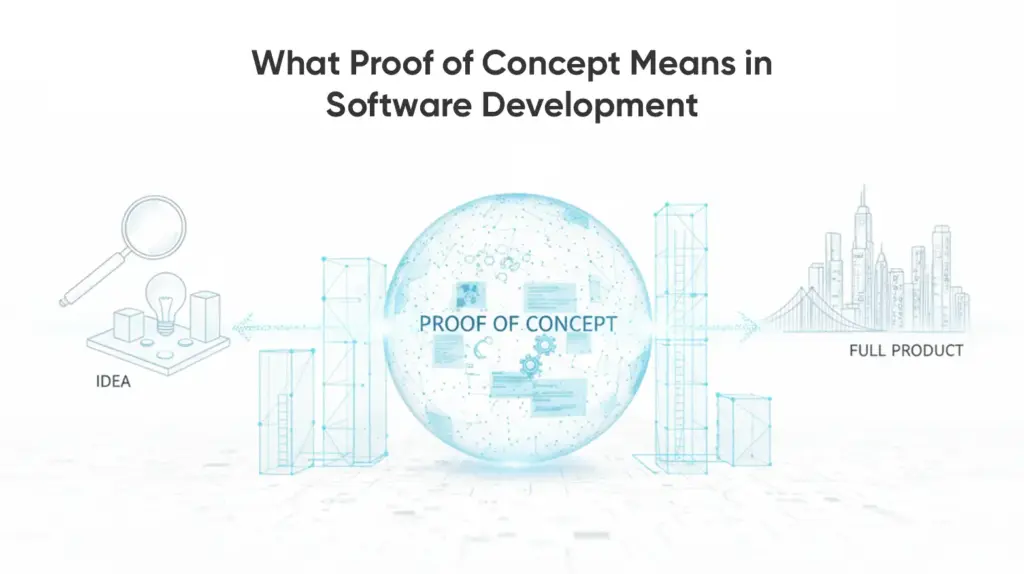
The Proof of Concept (PoC) in software development is in fact a miniature trial or demonstration to determine whether any given idea or approach is technically and commercially feasible. It provides the answer to a question: Will this software idea be used in real life? The PoC is done prior to you spending large amounts of resources in developing it. It has the objectives of demonstrating that the core functionality can be deployed using the technology available as well as demonstrating that the concept will solve a real user need or business problem.
More importantly, PoC is not concerned with a refined product. As a matter of fact, no code can be written in any form which is production-ready. A PoC may instead consist of throwaway code, simulations or even a simple mock-up or storyboard to test a single or two major assumptions.
To illustrate, a team can develop a barebones backend script to make sure that an AI algorithm can work with data in the way it should, or write a low-fidelity UX flow to make sure people have grasped a new concept. It focuses on the fast and low cost learning of whether the idea is worth pursuing or not.
A PoC is typically done internally or within a small group of stakeholders. Because it’s an initial validation, it’s usually low-cost and quick to produce – think of it as “a business plan for your product’s foundation”. It describes what the product is trying to accomplish, who the intended users are, whether the product can be constructed using existing technology and what challenges can be expected.
Assuming that the PoC is effective, it provides the green light to pass to more concrete phases such as prototyping and development. In case it reveals significant weaknesses, it is an indicator to rethink the concept or to redesign it prior to any critical investment.
A PoC will not be necessary in all projects - when you are introducing a well-known feature or are operating with an established technology, you may use prior art instead. Yet, when it comes to mapping an unfamiliar ground, whether it is a new product concept or an innovative technology deployment, a PoC comes in very handy. It offers concrete proof that your idea is good and can address the needs of the user, which is essential since when a product does not address a real need, then it will never be able to take off.
In short, a PoC is concerned with proving viability and possibility in the first place, to ensure that you and your stakeholders can go on with confidence.
Why Is a PoC Important? Its Benefits and Purpose
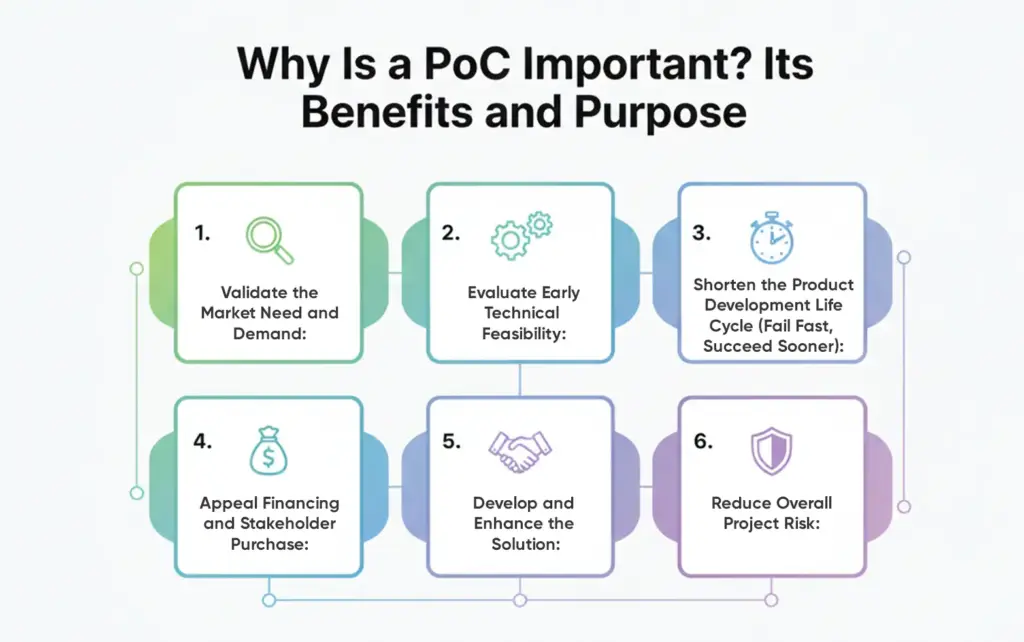
In a crowded industry where few ideas succeed, a PoC helps prevent costly failure. Since “no market need” and “running out of cash” are top causes of startup failure, a PoC ensures the idea has demand and prevents large investments in unviable products. Here are key benefits of running a PoC:
Validate the Market Need and Demand:
A PoC confirms whether your idea solves a real problem. It drives premature market validation such that you do not end up creating something the users do not desire. The more you research pain points and experiment with how people will react to initial ideas, the higher your chances are likely to be of your product being market fit.
Evaluate Early Technical Feasibility:
A PoC is a reply to the question, “Will we be able to construct it using our existing tools?” It reveals technical risks at an early stage - be it system integrations, emerging technologies or performance constraints. Early discovery of these issues enables the team to make changes to architecture or scope prior to significant resources being bound.
Shorten the Product Development Life Cycle (Fail Fast, Succeed Sooner):
It is costly to develop complete products. A PoC will allow testing the idea inexpensively prior to spending a lot of money. In case it fails, you save time and budget, and in case it works, then it demonstrates where resources should be directed. This initial gateway is useful in preventing expensive errors made by teams and allocating resources only to those ideas with potential.
Appeal Financing and Stakeholder Purchase:
A good PoC will show an argument not only in theory but also in action that the concept is functioning. Investors and executives do not react to rough pitches as well as to the proven ones. A PoC provides physical evidence, which enhances the confidence and higher chances of securing a grant or successful full development.
Develop and Enhance the Solution:
A PoC shows holes in your concept, and what people actually are interested in. It assists in product refinement, simplification and defining the value core. Poc experiences can influence the team to change their roadmap or strategy, which will provide them with a more robust basis of development.
Reduce Overall Project Risk:
A PoC minimizes a failure by ensuring that the need in the market, as well as the technical feasibility, are proven early. A positive PoC is one that creates confidence whereas a negative one alerts problems early before they have invested heavily. PoC documentation as well gives direction to future work as teams can work in a more directed and less uncertain way.
A PoC brings your idea into reality in a low-risk way, offering evidence to guide your next move. Because most startups fail due to poor market alignment or flawed execution, a PoC is a strategic step that increases your chance of building something successful.
PoC vs. Prototype vs. MVP: What’s the Difference?
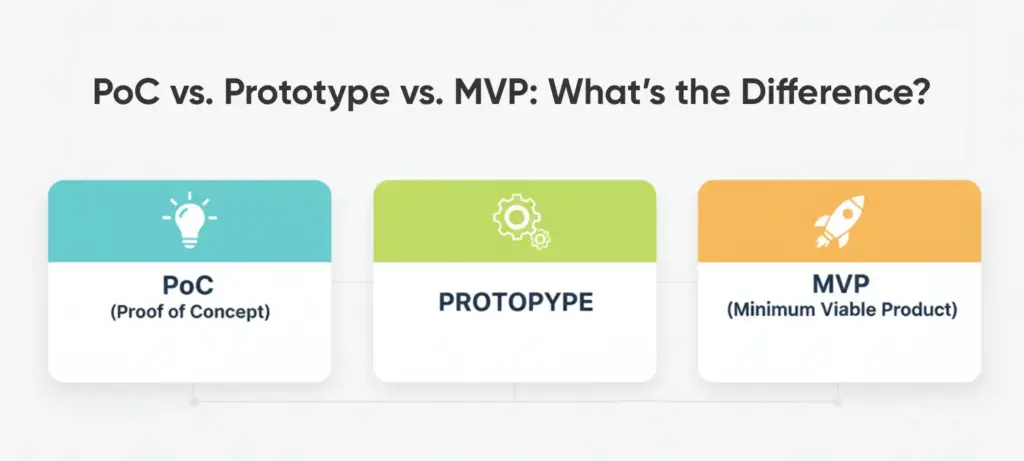
A Proof of Concept, Prototype, and MVP are so similar as they all may be seen at the beginning of the development. Yet, they are both used with different purposes. The knowledge of such differences is used to select the proper move based on viability, utility, or market acceptance by teams.
Proof of Concept (PoC):
A PoC is used to determine the feasibility of an idea or technology. It tends to be an internal experiment that seeks to answer the following question: Will this work? A PoC can be a simulation, mock up or a small test that can demonstrate viability to stakeholders. It occurs at the initial phases of development and can most of the time be a determining factor in the continuity of the project.
Prototype:
A prototype transforms the concept to reality. It follows a PoC and is concerned with user experience and design and simple interactions. Prototypes may be drawings or wireframes or bare bones. They make teams test usability and correct the way in which the product should look and work. Prototypes are interactive and user-facing as opposed to PoCs.
Minimum Viable Product (MVP):
MVP is a barebones yet workable variant of the product that is shipped to actual customers. It contains the bare minimal features. The aim is to experiment, verify assumptions and receive feedback on the market with minimum investment. In contrast to prototypes, an MVP allows the user to perform real work and gives them a way to understand how to build on that.
Comparison Table
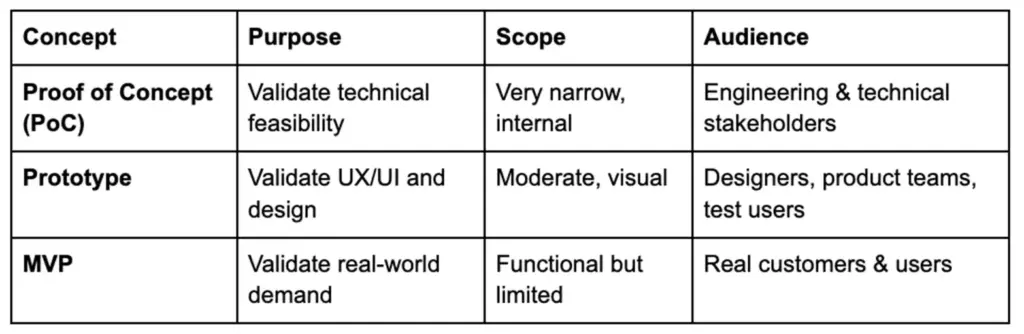
A typical sequence of the new products is PoC - Prototype - MVP. A PoC makes it possible, a prototype forms the experience, and a prototype MVP is testable to the actual market demand. These stages can overlap one another, but the application of each tool at the appropriate time minimizes the circumstances of frustrating mistakes caused in the development.
Types of Proof of Concept in Software
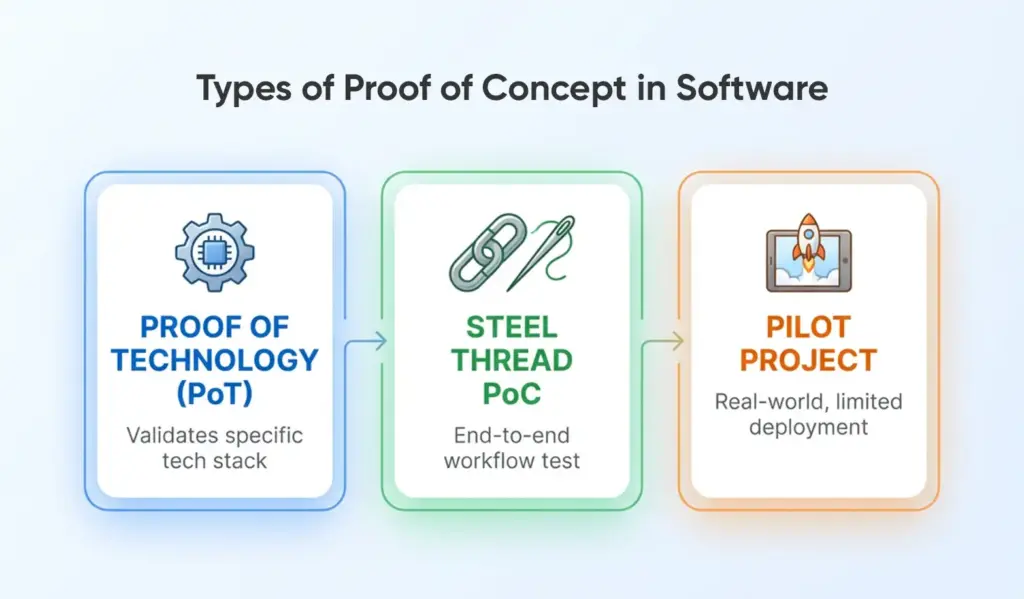
Not all PoCs are identical. In software development, they focus on different feasibility aspects. Let’s explore a few widely used types:
- Proof of Technology (PoT): This PoC tests if specific technologies or integrations can meet technical requirements. For example, it might check whether a database handles expected traffic or if an AI model is accurate enough. PoTs isolate technical components and help detect risks early. If a PoT fails, it signals a need to change the tech stack or adjust your approach.
- Steel Thread PoC: A steel thread PoC implements a minimal, end-to-end version of the system. It runs a simple use-case across core layers like UI, backend, and database. This helps confirm that the components integrate and function together.It provides prior understanding of the software architecture and reveals the workflow or design vulnerabilities before scaling.
- Pilot Project: A pilot PoC is a mini scale implementation to verify actual performance. Normally one team or department is involved in the introduction of the product. It helps gather user feedback and validate adoption in a controlled setting. Pilots are common in B2B and enterprise scenarios. A strong result boosts confidence in value delivery and operational fit.
Depending on the project, teams often use more than one PoC type. Startups may run a PoT first, follow with a steel thread, and end with a pilot to verify adoption. This phased approach reduces risk from technical, architectural, and market perspectives.
Each PoC type follows one principle: validate small before scaling. Decide depending on what you have to prove. Not sure if your tech works? Try a PoT. Want to test flow? Go with a steel thread. Need real user input? Run a pilot.
How to Develop a PoC: Major PoC Steps to a Successful Proof of Concept
The development of a Proof of Concept is a process in software development. Although the methods vary, the majority of PoCs are similar in the number of steps. The following is a brief outline on how to construct an effective PoC.
Step 1: Define the Need or Problem
A strong PoC starts with a clearly defined problem. Determine what problem your software will address and prove that this is a true problem. Discuss with users, research problems in the industry, and eliminate assumptions. A PoC that is constructed on a weak problem is doomed at an early stage.
Establish measures of success- measurable objectives that establish the answer to whether the PoC was successful. Be flexible, conversations with users can help you to better understand the problem.
Step 2: Brainstorming and Selecting the Most Effective Strategy
After becoming sure that the problem is real, brainstorm possible solutions. Engage product, design and engineering in order to test various ideas. Assess alternatives on the basis of feasibility, effectiveness, cost, time and risks. Choose the most feasible method and show the reason why it was selected.
Select an appropriate tech stack of the PoC and describe a limited scope. Make the PoC as bare as possible, just cover what makes the idea work.
Step 3: Develop a Prototype of the Idea
Make a simple prototype, which shows the main concept. It may be a plain-UI mockup, wireframe or a small model written in code. Test what you actually want to do- not on creating a complete product.
Use shortcuts: mock data, hard-coded flows, or simple scripts. The prototype must be fast, dispensable and able to reveal the key problems in time.
Step 4: Test the Prototype and Gather Feedback
Evaluate the prototype on target users or a limited group of stakeholders. Watch their personal reaction towards the concept and enquire whether it answers their problem. Get feedback on clarity, usefulness and lack of functionality.
Apply the knowledge to perfect the idea. Normal iteration is the rule - PoCs tend to go through iterative loops of build-test-improve. It is okay to fail as long as you will save big mistakes in the future.
Step 5: Document Findings and Plan Next Steps
After testing gives sufficient understanding, make a PoC report. Provide the problem, solution strategy, results, limitations, success criteria, and future plans. Record the achievement of goals and the next course of action.
Develop a plan of activities that will achieve a prototype or MVP in terms of timing, resources, and milestones. This documentation generates trust among the stakeholders and steers the team along.
Assess the PoC based on your standards and have an explicit recommendation on whether to proceed, pivot or stop. Being frank will instill trust and make sure that the decisions are evidence-based rather than assumption-based.
PoC Exit Checklist
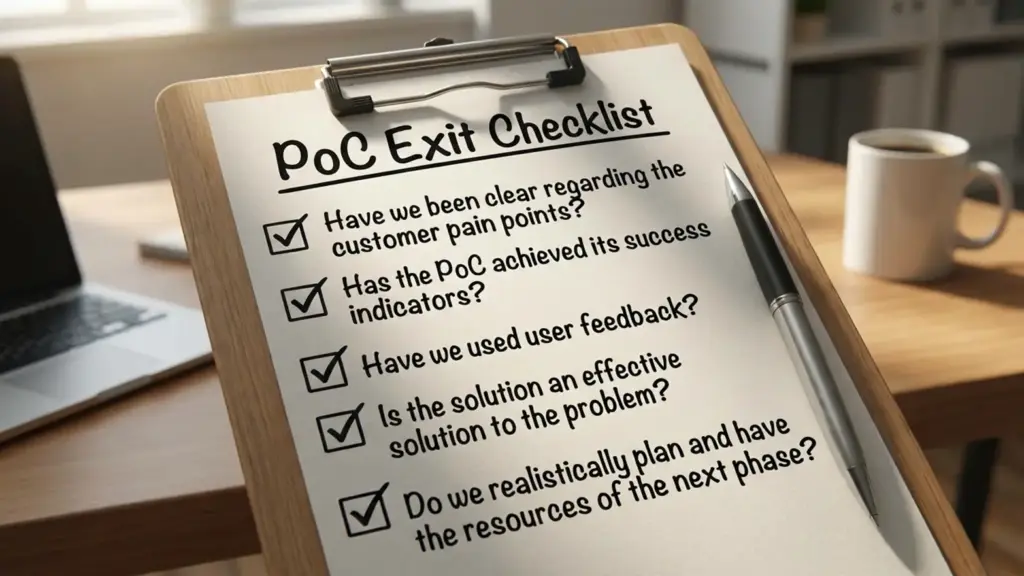
Before proceeding, are you able to respond to:
- Have we been clear regarding the customer pain points?
- Has the PoC achieved its success indicators?
- Have we used user feedback?
- Is the solution an effective solution to the problem?
- Do we realistically plan and have the resources of the next phase?
In case yes, then your PoC is vibrant and prepared to move on.
The Pitfalls and Mistakes to Avoid
Although a PoC has the potential of making a project successful to a significant extent, there are errors that teams make to lower its effectiveness. Knowing these pitfalls helps you avoid them and keep your PoC on track.
Skipping Market Research
A major mistake is skipping market validation. Building a PoC without confirming that users actually have the problem leads to solutions no one needs. Since lack of market demand is the top reason products fail, start with real user input. Use interviews and surveys—not assumptions—to guide your PoC.
Over-engineering the PoC
A PoC is meant to be a quick, simple test and not a full product. Other teams do excessive work, making their work overly complicated. This is time wasting and pivoting becomes more difficult. Keep your PoC lean and focused on proving core assumptions. If you’re building too much, step back and reset the scope.
Unclear Success Criteria
It is futile without identified success metrics, a PoC is directionless. Teams can complete the work and not be aware whether it worked or not. Establish quantifiable targets at the beginning, e.g. performance metrics or user feedback goals. These serve as your North Star and help to keep things on track and avoid wasted extensions and biased decision-making.
Lack of Team Collaboration and Communication
A small PoC must have a high level of alignment. Poor communication among the engineers, designers, and product managers may put a stop to the progress. Have set objectives and roles and provide regular updates. Issue shares as they come so that the team can evolve fast. A close feedback loop will make the PoC move along without any issues.
Ignoring User Feedback
The feedback is half the battle but taking action on it is what is more important. Negative remarks are dismissed at times by teams due to preference of the initial idea. This is risky. When the PoC does not seem helpful or confusing to the users, make it different. The neglect to pay attention to the insights today will only cause the product to grow larger in future.
Not Planning Beyond the PoC
Most teams neglect to think about what to do when a PoC succeeds. Lack of a roadmap on the next step results in loss of momentum. Make a rudimentary plan in advance- resources, target users, budget requirements, and next milestones. Make the choice on what you will do in the event of a failure of the PoC. The ability to prepare both results is a time-saving factor in the future.
Avoiding such traps makes your PoC relevant, effective and useful. A PoC is not supposed to make things less certain. Remaining user-focused, intentional, and highly responsive, you make sure that your PoC has your product moving in the correct direction.
Real-World Examples of PoC Wins
To get some examples, we can consider some of the case studies where creating a proof of concept made a real difference:
- Walmart Food Safety POC with Blockchain: Walmart and IBM collaborated to enhance food traceability through the use of blockchain technology. They ran a PoC to track produce like mangoes in the US and pork in China. Tracing food origin once took days—blockchain reduced that time to seconds. This demonstrated the tech's speed and viability. Although data entry concerns were noted, the PoC gave Walmart the confidence to implement blockchain in their supply chain.
- AI Legal Research Assistant PoC (Law Firm): A tax law firm tested if AI could streamline legal research. They created a simple PoC web tool in just 6–8 weeks. The result? It reduced case analysis time from 8 hours to just 40 seconds. This massive efficiency boost proved technical feasibility and ROI. The success encouraged investment in a full AI solution and showed how a focused PoC can guide decisions.

- Dropbox’s Explainer Video as a PoC for Demand: Before building their product, Dropbox created a 3-minute explainer video to show their idea. It acted as a PoC for market interest. They increased their waitlist by 5,000 and 75,000 users in one night. This answer certified the demand without coding. The team utilized the momentum to take up the funding and produce the product. It is a good illustration of a marketing PoC at work.

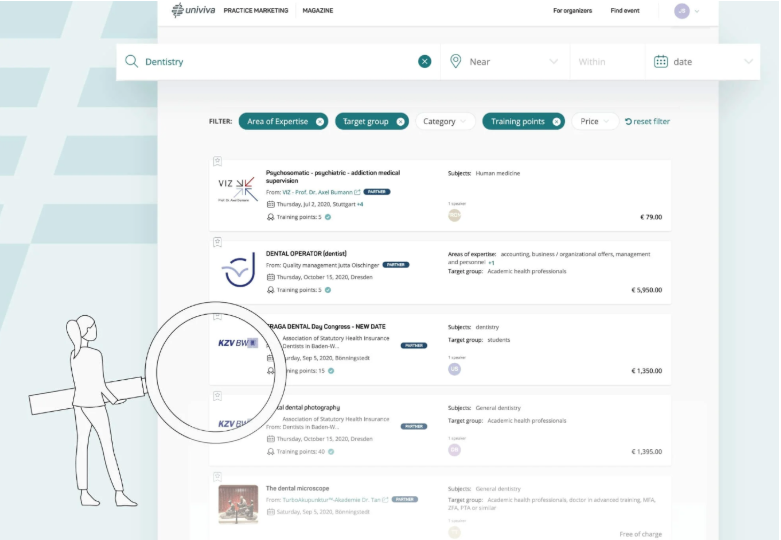
- Naontek Digital Health Platform PoC: Naontek is a German startup and the development of Univiva is a digital health care professional learning platform. In order to handle the complexity, they conducted an elaborate PoC that was user need-based, business-oriented, and technically viable. Getting the stakeholders involved at an early stage contributed to a focused product. The outcome: more than 20,000 users and 6000 courses within the first-year. Their process of PoC resulted into high adoption and product-market fit.
Conclusion
In software development, a Proof of Concept (PoC) does not merely represent a technical test run - it is a strategic test run. PoC allows you to take the right steps in the right place at the right time to save costly mistakes and get all your team, stakeholders, and roadmap aligned.
It does not matter whether you are a startup to impress investors, a product manager planning features, or an enterprise leader running a PoC test, you will know that you are proceeding with evidence, and not assumptions.
Even when a PoC reveals weaknesses, it is a good result- it demonstrates that you have saved time, money and momentum before making bigger investments. Success, in its turn, offers a solid ground and confidence to develop.
A PoC is useful in an industry where two-thirds of projects fail because of a lack of clarity in planning or a lack of market fit. When the question comes up of what a Proof of Concept (PoC) is in software development, there is a simple answer, namely, it is your best bet to create something that actually works.
Thinking About Turning Your Concept Into a Winning Product? Partner with BrainX!
A Proof of Concept is only the first step but what is actually important is to convert that confirmed idea into a software solution that is high-performing and scaled. At BrainX, we are in the business of assisting startups and enterprises to make a smooth transition between PoC, MVP and full-fledged product development. Mobile, web engineering and AI Our highly skilled teams are able to deliver on your vision with accuracy, speed and industry best quality. Be it technical validation, product-level strategy, or end to end development; BrainX makes sure that each next step will be based on evidence and will be a success.
Let’s turn your proven concept into a real-world success story. Book a consultation today!
Frequently Asked Questions about PoC
1. How much time is normally spent in a Proof of Concept?
The duration needed by most PoCs is between 2-6 weeks, depending on complexity. The target is speed and not excellence. The longer timelines can be the pointer of scope creep or over-engineering.
2. How much does it cost to build a PoC?
Prices can be very expensive. However, a PoC is specifically low-cost and normally should only amount to 5-10 percent of the entire project budget. It is meant to be used to prove viability before big investment.
3. Who should be involved in creating a PoC?
A PoC usually features software engineers, software architects, product managers and stakeholders who are conversant with both the technical and business needs. The collaboration will help to make sure that both the feasibility and strategic goals are considered by the PoC.
4. What happens if a PoC fails?
In case a PoC doesn’t work, then it is still worth having since it helps avoid the team spending money on an achievable solution. A failed PoC assists in redirecting the work, altering the scope, or selecting other approaches without significant losses.
5. Is a PoC always required before building an MVP?
Not always. In case the technology becomes proven and the issue is well perceived, the teams can jump directly to a prototype or MVP. A PoC is highly advocated but in the case of proving new ideas or having uncertain feasibility.