

Software development life cycle refers to the method of developing and delivering software. The software development life cycle (SDLC) defines various tasks crucial for creating a software application. In this article, we will disclose all about software development life cycle stages and models as well as the importance of this process.
Most advancements in the tech industry have been brought about to save time, and effort and make tasks error-free. Software development automates repetitive tasks and saves time for task completion. It removes errors, enhances efficiency, and saves investments time and money for businesses. Based on the figures, there will be a value of $1039 million growth in the software development market by 2027.
What Is A Software Development Life Cycle?

The SDLC is a systematic method to design, develop, and test high-quality software efficiently, aiming for cost-effectiveness and on-time delivery. They prepare in advance so that the chances of things going wrong during and after production are lessened even, surpassing anything we thought possible or imaginable. The development life cycle involves planning, analysis, designing, construction, testing, deployment, and maintenance. It provides a structured way to track every task, ensuring that all the steps are clearly defined from the initial workflow using an application until completion.
This enables developers to log and history each task, thus avoiding any missed or unordered mandatory phases resulting in a bug-free end product. It speeds up development and reduces costs by providing an extensive blueprint with well-defined stages, each having its process and deliverables. Ultimately, this structured way of working assists organizations in efficiently delivering great software through a pipeline—from development to testing into production. Adherence to the SDLC enables software projects to be completed quickly and efficiently at minimal risk compared to other production methods. In summary, the SDLC is a model for creating successful software solutions, ensuring an organized process, and making it efficient and productive.
History of SDLC
The rapid advances in computer science during the 1950s and 1960s led to the development of a production framework that later transformed into the software development life cycle. Before the 1950s, computing's simplicity didn't require a detailed approach like this life cycle. However, as programming complexity increased, structured programming emerged, necessitating more tactical development models, leading to the SDLC. Initially called the "systems development life cycle" in the 1960s, it was developed by large corporations to manage complex business systems needing extensive data processing and analysis. Over time, this framework has been adapted for hardware, software, and other complex project development.
Why is SDLC important?
Steps, activities, and deliverables in the software development life cycle (SDLC) process help in planning, estimating, and scheduling all your projects, easing tracking, and controlling projects. The SDLC increases visibility at every stage of the life cycle so that all stakeholders are informed and participate in the development. This transparency is vital to remain customer-centric and fulfill client expectations, as it guarantees that both parties fully understand the goals they are aiming for from a software perspective.
This systematic approach decreases project risks and management expenses, leading to a lower overall cost of production. Different software development life cycle stages and models provide a framework for managing changing requirements, staying on top of new technology, and fostering cross-functional collaboration. These are common struggles for product teams and this life cycle lays out a roadmap of what to deliver at each stage and when. Through the SDLC, product teams can clarify all expectations at a fundamental level among stakeholders before embarking on software development.
This agreement, combined with a systematic plan to achieve these goals, enhances the project's overall success. The SDLC offers product teams several advantages, such as enhanced visibility into the development process, more efficient estimation, planning, and scheduling, better risk management, and more precise cost estimation. Additionally, a systematic approach to delivering software that meets customer expectations leads to higher satisfaction rates.
Models of Software Development Life Cycle
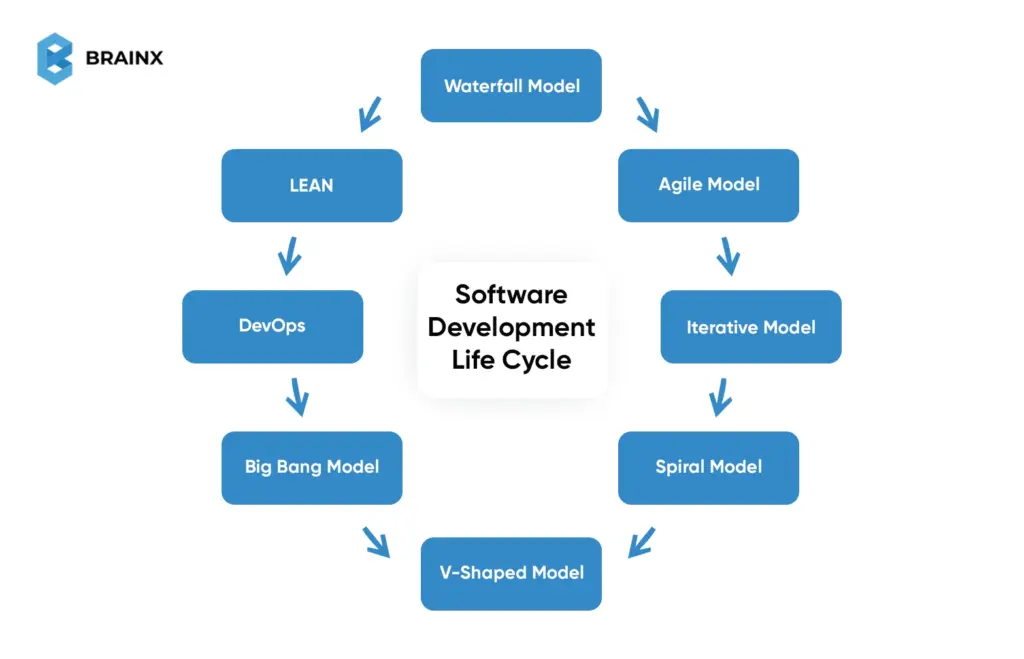
Currently, over 50 acknowledged software development life cycle models are being utilized, each with its advantages and drawbacks for different software development projects or teams. Here we have discussed 8 common software development life cycle models.
1. Waterfall Model
The Waterfall model is the oldest and most fundamental SDLC model. It is the first and basic model on which other SDLC models are based. Every phase must be executed in sequence, and it is not possible to move out of order or go back. It traces the path of a linear progression since each phase builds on data from the previous stage and follows its project plan, delivering something concrete at every step.
Its straightforward, user-friendly nature does come at the cost of it being unforgiving; meaning one early shortfall in time has ripple effects across the entire course. As there is a longer gap between stages, bugs identified after this stage will be recorded and not fixed until the end of the project.
It is inconvenient for dynamic/adaptive projects as well as long-term development. These are the constraints due to which the Waterfall model method is no longer used these days, yet found in multiple software development life cycle stages and models.
However, it remains a very good example of SDLC. Although some consider that the Waterfall model was never created with a mind to be used in a real project, it is still one of the cornerstones keeping memory about those structured SDLC methodologies. It is simple by design, but where there has been a shift in software development to more flexible models, it lacks the flexibility.
2. Agile Model
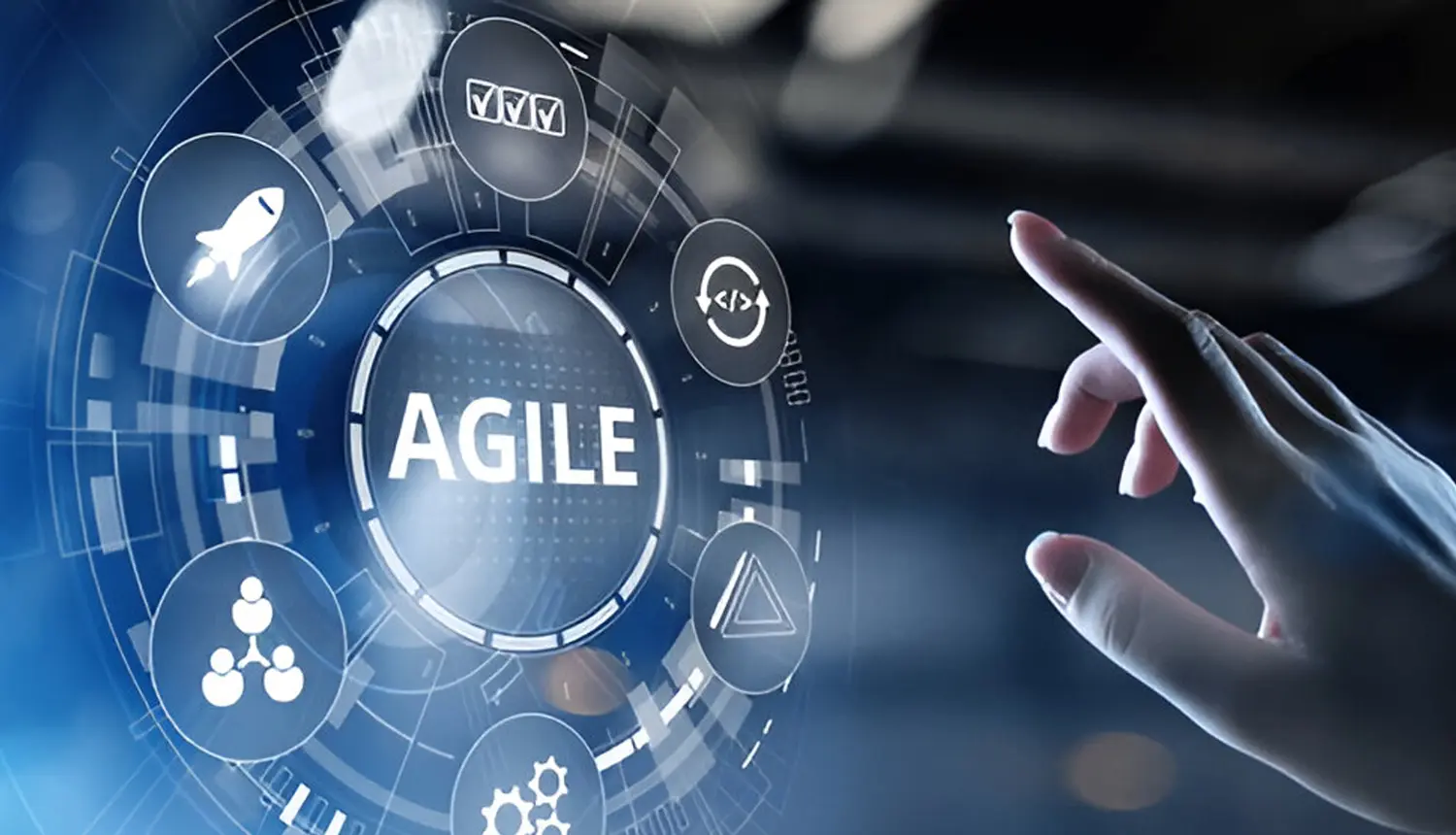
The SDLC can successfully adapt with less customization, and because the Agile model is proposed, its implementation will be much faster. Agile was born out in 2001 and is now quite literally the law for software development - it has even crept into non-tech projects. The Agile methodology resounds with the principle of fast implementations, focusing on working in short iterations at publishing small features continuously.
Every version is tested, and feedback from stakeholders is taken all the way down so that developers can find it before regression occurs. Agile is the name of various development processes with slight deviations from each other. Agile incorporates two well-known methodologies:
- Scrum
- Kanban
While Kanban is all about the visualization of dependencies and bottlenecks, the Scrum method organizes work into sprints (the most usual rhythm is 2-4 weeks) with two other events happening on a Scrum day: daily check-ins to make sure everything's moving along fine! What is a Scrum Master doing - making sure that the team stays focused. On the other hand, Kanban takes a page from Japanese manufacturing techniques and focuses on using visual elements to show changes between your tasks.
Kanban utilizes a board where tasks progress through columns representing various stages of development, providing a real-time view that is invaluable for identifying bottlenecks. Unlike Scrum, Kanban’s pull-based task flow promotes a balanced, predictable work tempo, allowing teams to take on new tasks incrementally based on their capacity and deliver continuously. In sum, Agile being a flexible and iterative approach makes it easier to adapt quickly to the changing circumstances, leading you towards efficient project management.
3. Iterative Model
The Iterative model in software engineering can generate an almost developed, ready-to-deploy version with each cycle and progressively add new requirements to the solution until it becomes 100% finalized. Iterations work in a cycle: the project team runs multiple iterations to implement, test, and evaluate software requirements.
Every phase generates a new version, and the process ends when the complete system is developed. Early working prototypes, improved documentation, stronger control, and flexibility on changes are some of the pros of the iterative model. However subsequent cycles are very resource-intensive.
There are 4 development phases of the iterative model:
- Inception: The project concept is initiated.
- Elaboration: The project details are developed, and resources are evaluated.
- Construction: The software development takes place.
- Transition: The final product is deployed.
4. Spiral Model
Software Development Life Cycle employs the Spiral model, a technique that is undefeated in risk handling and adaptability. The Spiral is used to show a series of spirals, and each spiral means a phase in the design. It contains multi-spirals where they are based on the kind of project, so the count of spirals is very fluctuating as it is established on the project. It is, therefore, stimulated by the Iterative model; thus the Spiral employs the cycle through the subsequent four levels or phases continually: Setting, Risk Evaluation, Design, and Assessment.
This type lets the creation be used continually to be further perfected over and over till it is completed. The Spiral model is particularly well-suited for large-scale projects and is often preferred for its suitability. It allows crew members to design whatever they desire for the product the consumer desires very quickly. It is achieved by having users’ feedback throughout the method. Spiral models in risk handling, it is where the implementation will commence from the 1st period to obtain the products. Then at the start of the 1st phase of the spiral, the risk examination starts where they will accept the risks wherever they will start in the evaluation process.
5. V-Shaped Model
The V-shaped model in SDLC is a sequential process similar to the waterfall, but it tests at every stage. During each stage of this model, a specific testing phase is associated with the system which is nothing but Verification and Validation. The integration of development activities with quality assurance/testing for each phase can be done immediately after the completion of that. The phased approach means each phase moves to the next one only after completing its prior iteration, and it emphasizes verification & validation of integration throughout all steps in development.
V-Model Design
- Requirements Gathering & Analysis: This is the first phase where our business team discovers and analyzes customers' requirements and vision for desired software, and finally defines the project scope.
- Design: During this phase, software architecture and design (both high-level and detailed designs) are created.
- Implementation: In this phase, the product is developed using design specifications.
- Testing: The software is thoroughly tested in this phase to ensure that it will work according to customer requirements and high-quality standards.
- Deployment: After being tested, the software is then deployed and run officially.
- Maintenance: It becomes necessary to maintain the software over its lifespan such that it remains in line with customer requirements and functions correctly.
6. Big Bang Model
The Big Bang model in SDLC is the informal and ad-hoc approach to software development where little planning or documentation accompanies coding, with no formal stages of design-based engineering. This means that we only start implementing what is needed at the point of time, and often without a strict roadmap.
Therefore, changes are expensive and likely require that a large part of the software be rewritten. Although not appropriate for bigger projects, the Big Bang model can be used for academic or practice projects as well as smaller projects involving one or two developers. This works especially well in scenarios where the requirements are not very clear and there is no defined release deadline.
7. DevOps
On the other hand, it is a modern concept involving SDLC influenced by Agile and Lean thinking which comes with its title to replace "Operations" representing collaborative dev (Development Team) operations across teams. DevOps is a merger of Developers and Operations more likely to be viewed as developers-as-operations or vice versa than traditional silos. It enables fast innovation, smaller and more frequent software update releases, with higher quality firmware.
Discipline, continual feedback loops, and success in configuration management have made DevOps a way of doing things that encompasses an unwavering focus on improvement stemming from automation and streamlining processes. Though selecting the right SDLC methodology is important, it should be noted that a proper procedure serves as only one part of an overall framework. There is no replacement for a great team of people working closely together to solve tough problems and deliver high-quality software.
8. LEAN
Derived from the 'lean' manufacturing efficacy method, Lean involves seven fundamental principles for improving software development: wastage elimination; facilitating continuous learning; delaying decisions until the last responsible moment (LRM); delivery in speed prioritization with teams being empowered autonomously and responsibly as a unit entity within integrity voids understanding of explicit wholes.
Lean teams center on those few critical tasks that will move the project forward, avoiding too much multitasking and constantly minimizing waste. This strategy includes reducing non-essential meetings and streamlining documentation activities across the software development life cycle (SDLC).
Like Lean, Agile is all about efficiency in the SDLC, but it's a whole lot customer-centric. Agile values customer feedback over other types of inputs and deploys requirements through the process giving greater opportunities for adaptation. Lean, in contrast, is all about eliminating wasteful practices to improve the customer experience well-being and by extension increased delight.
Software Development Life Cycle Stages
1. Planning & Analysis
In the initial phase of software development, project planning sets the stage by gathering business requirements from clients or stakeholders. This step is crucial for evaluating whether the project is feasible and aligns with goals like revenue potential, production costs, and meeting end-user needs. To guide decisions on which features to prioritize and when a framework for feature prioritization proves invaluable.
This framework weighs the value of software features or updates against factors like development time, costs, and other relevant considerations. Once it's clear the software project meets business and stakeholder objectives, is feasible to develop, and satisfies user requirements, it's ready to advance to the next phase.
2. Define Requirements
This phase converts information from the planning and analysis stage into clear requirements for the development team. It begins with gathering and refining high-level requirements and defining key functions and processes. Essential documents, such as a software requirement specification (SRS), Use Case document, and Requirement Traceability Matrix, are created.
Requirements definition includes gathering and analyzing business, end-user, functionalities, and technical needs. It involves an "as is" assessment of current processes and a "to be" analysis for future improvements. The resulting gap analysis identifies necessary changes, impacting software, IT infrastructure, business processes, and roles, ensuring comprehensive system development.
3. Design
The design phase elaborates the initial plan and vision into a detailed software design document (SDD), which includes system design, programming languages, templates, platform choices, and security measures.
This phase often involves creating flowcharts to illustrate software responses to user actions. Typically, a prototype model is also developed during this stage. The prototype is a pre-production version, allowing the team to visualize the product and make necessary changes without extensive code rewrites.
4. Development
In the development phase, the team breaks the project into software modules and converts requirements into code. This phase can be time-consuming and requires specialized tools. Setting a timeline with milestones is essential to ensure developers understand expectations and that progress is tracked effectively.
At times, development overlaps with testing, enabling early detection of critical bugs. It's important to choose development software that aligns with your project needs, as different tools offer various specialties.
5. Testing
The quality assurance team must conduct validation testing before releasing the software to the production environment. This step is necessary to ensure that all functions are working as intended.
This testing phase can also identify significant user experience and security issues. Software testing can sometimes be performed in a simulated environment, and simpler tests can be automated.
Types of Testing
- Performance testing assesses the speed and scalability of software under various conditions.
- Functional testing ensures that the software meets client/project requirements.
- Security testing aims to analyze and detect potential vulnerabilities within the software.
- Unit testing examines each unit and component of the software individually.
- Usability testing assesses the user interface and user experience of a software.
- Acceptance testing refers to end-user testing, beta testing, application testing, or field testing. It is the final testing stage that checks if the software delivers the intended outcomes.
6. Deployment
The deployment phase is among the most critical stages to manage in the software development life cycle (SDLC). A robust deployment process is crucial as it can have a significant impact on your business operations.
During the deployment phase, the final product is delivered to the intended user, with the option to automate and schedule this process based on its type.
Deployment Strategies
- Basic Deployment
Basic deployment is a fast and cost-effective strategy for updating all target environments simultaneously. However, it can be vulnerable and risky due to being completed in a non-controlled environment.
- Rolling Deployment
A rolling deployment is a slow, gradual update of your applications. It adds flexibility as it first scales up a new version and then scales down the old one which means no downtime.
- Blue/Green Deployment
Blue/Green Deployment is a technique where two application versions, blue (current/active) and green (new/upgraded) run simultaneously. Traffic initially flows to the blue (current) version, then switches to green (new) after testing. It minimizes downtime but involves higher costs due to resource duplication.
- Canary Deployment
Canary deployment gradually releases updates to a small user group before expanding to all users, minimizing risks by testing changes incrementally rather than deploying to everyone simultaneously.
- A/B Testing
Unlike canary deployment, A/B testing works by sending traffic and running the software’s functionality tests in a small sector of users. It helps recognize the most efficient approach for increased conversation and the one that can help in further development or improvement.
- Shadow Deployment
In a shadow deployment, two software versions run in parallel, with incoming requests routed to both. This tests the new version under production load to ensure performance requirements are met.
7. Maintenance
In the traditional waterfall software development process, the maintenance phase marks the concluding stage of the SDLC. However, the industry is increasingly adopting agile software development approaches, where maintenance serves as a stage for ongoing enhancement.
Fixing these bugs is essential for enhancing user experience and retention. In certain instances, addressing them may require revisiting the initial stages of the software development life cycle.
How BrainX Can Optimize Your Software Development Process?
BrainX emphasizes a collaborative approach, working closely with clients to ideate, develop, and deploy tailored solutions that address specific industry challenges. Our dedication to quality and innovation is demonstrated by our thorough software development life cycle.
- We start with collaborative ideation leveraging diverse expertise to innovate.
- Through strategic insights and market research, we ensure a unique value proposition.
- Our planning phase includes risk evaluation and timeline setting, aligning with your approval.
- Our UI/UX designers craft engaging prototypes, emphasizing aesthetics and usability.
- Agile-based development ensures transparency and alignment with objectives.
- Rigorous testing guarantees quality, minimizing issues post-launch.
- We continue refining post-launch with customer feedback and updates, ensuring your product remains competitive and relevant.