 April 10, 2026 -
  19 minutes read

Key Takeaways
- Enterprise IoT solutions help businesses connect assets, data, and operations to improve visibility, automation, and decision making at scale.
- The most important value is the quantifiable results such as reduced downtime, improved efficiency, enhanced compliance, and new service based revenue models.
- The best deployments succeed when companies start with one high impact business problem instead of trying to digitize everything at once.
- The selection of the appropriate platform is based on the aspects of scalability, security, integration, total cost of ownership and long term support of the ecosystem.
- Future growth will be shaped by edge computing, 5G, AI, digital twins, and stronger interoperability and governance standards.
Enterprise Internet of Things (IoT)
The Internet of Things has gone way beyond smart home devices. In 2026, enterprise IoT solutions are helping organizations connect machines, facilities, vehicles, and infrastructure into one operational ecosystem.
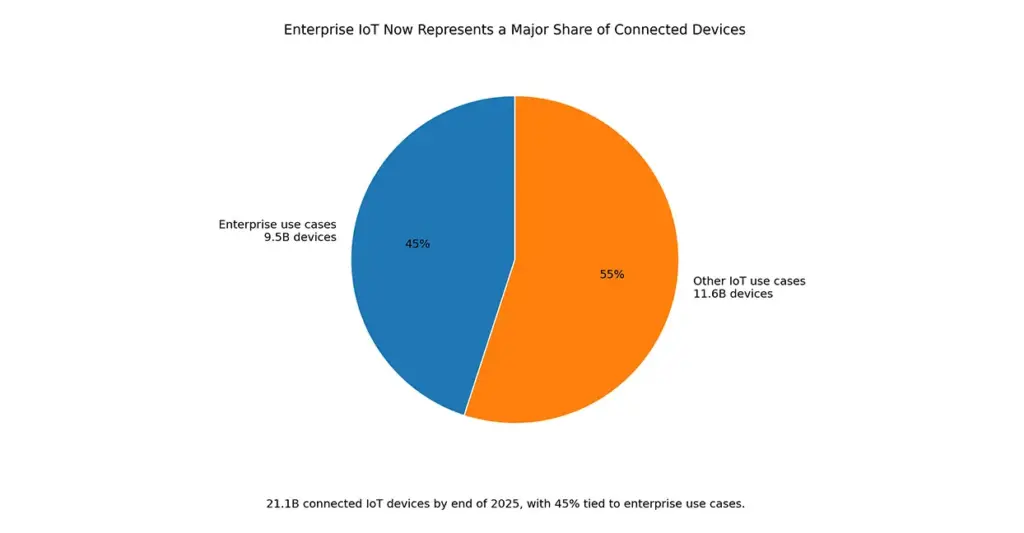
The enterprise IoT market grew 13% year over year in 2025 to reach $324 billion, while total connected IoT devices climbed to 21.1 billion by the end of 2025, with 45% of those connections tied to enterprise use cases as shown below.
The said growth is happening because the biggest IoT value is no longer in consumer gadgets. McKinsey estimates IoT could generate $5.5 trillion to $12.6 trillion in global value by 2030, with factories alone accounting for up to $3.3 trillion and B2B environments producing roughly 62% to 65% of total value.
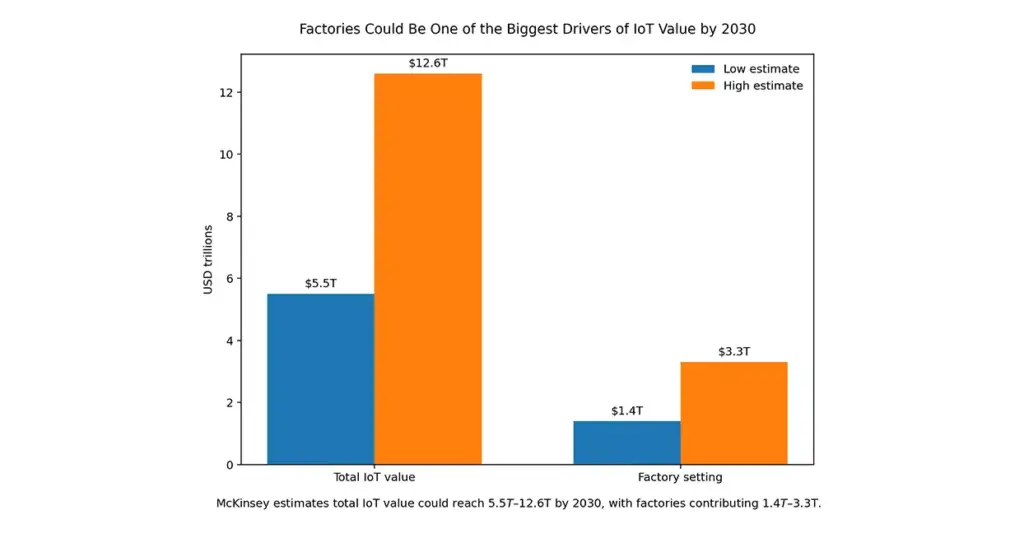
The graph above shows enterprise IoT solutions are becoming a core modernization layer for factories, fleets, buildings, and critical infrastructure. It’s where cloud-to-edge architecture, industrial connectivity, and real-time analytics help organizations reduce downtime, unify operational data, and make faster decisions at scale.
While today’s guide describes what these systems consist of, the value creation points, the most important platforms in 2026, and how to select a solution that leads to business achievement instead of a failed pilot. It is written for founders, product leaders, IT teams, and enterprise decision makers evaluating connected operations at scale.
What Are Enterprise IoT Solutions?
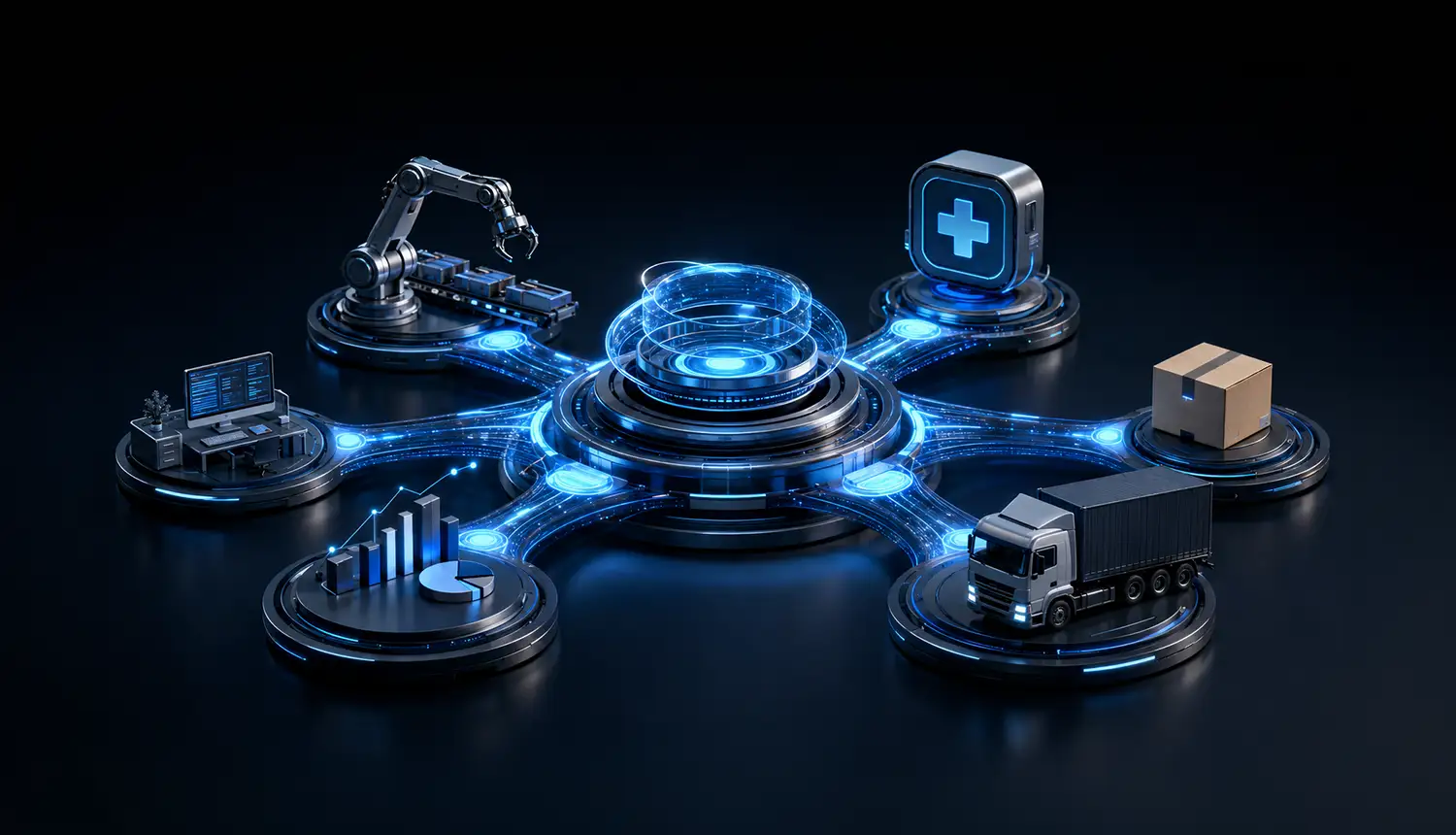
At a practical level, enterprise IoT solutions combine connected devices, secure networking, data ingestion, cloud or edge processing, analytics, and business applications into one operating model. The goal is not just to collect telemetry, but to turn physical operations into measurable, manageable digital workflows.
A typical enterprise deployment includes:
- Sensors and actuators for equipment, facilities, and field assets
- Connectivity across Ethernet, cellular, Wi-Fi, LoRaWAN, or industrial protocols
- Gateways and middleware for protocol translation and device management
- Cloud or hybrid infrastructure for ingestion, storage, rules, and orchestration
- Monitoring, prediction, automation, reporting analytics applications
That scope is what makes these systems different from isolated device projects. When the full stack works together, the real value is achieved.
Enterprise IoT vs. Consumer IoT
The consumer IoT is constructed on the basis of convenience. Enterprise IoT is built around uptime, scale, security, integration, and accountability. A smart speaker or lightbulb can fail without much consequence. A connected production line, cold chain network, or substation cannot.
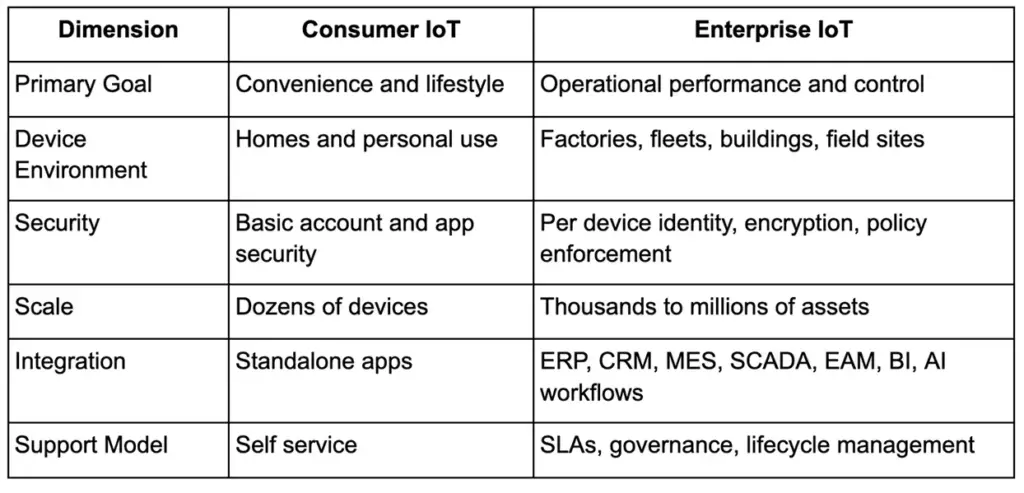
Another key difference is ownership of operational data. Enterprise buyers care about residency, permissions, auditability, and long term interoperability. That is why private cloud, hybrid models, edge processing, and policy based access control matter so much in enterprise design.
Key Benefits of Enterprise IoT Solutions
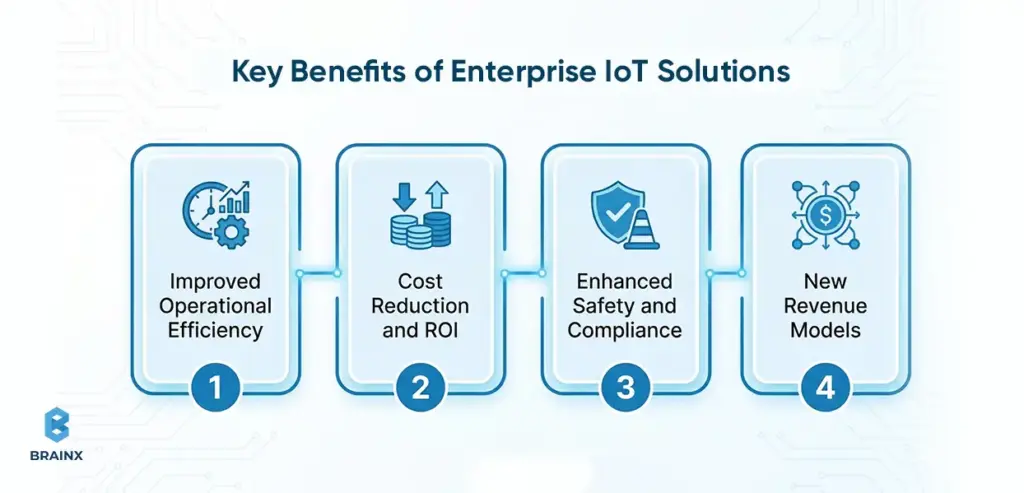
Enterprise IoT solutions deliver measurable benefits by digitizing operations. They vastly improve efficiency through real-time monitoring and predictive analytics.
Improved Operational Efficiency
The clearest benefit is visibility. Hidden inefficiencies are measurable when operators are able to view machine health, asset location, environmental conditions and process exceptions in real time. Teams stop relying on manual rounds, delayed reports, and reactive fixes.
That visibility changes how work gets done. A food processor can catch a temperature excursion before spoilage. A manufacturer can detect abnormal vibration before a motor fails. A warehouse can route labor and replenishment based on live location data instead of static schedules. The result is fewer surprises and better daily execution.
Cost Reduction and ROI
There are four typical sources of cost savings that include reduced unplanned downtime, improved maintenance planning, improved energy utilization, and inventory or asset waste. These programs offer the most effective ROI when companies ensure that one high-cost issue is resolved initially rather than attempting to digitize everything simultaneously.
Good enterprise programs also improve capital efficiency. When connected data shows how assets are actually used, leaders can retire underused equipment, delay replacements, or shift from calendar based maintenance to condition based maintenance. That is where connected operations start moving from cost center to investment case.
Enhanced Safety and Compliance
Safety and compliance are often the fastest board level justifications for enterprise deployments. Connected gas detection, worker wearables, asset monitoring, and audit trails reduce response time and strengthen documentation in regulated environments.
In the case of organizations in healthcare, utilities, manufacturing or logistics, this is not just about risk reduction. It also improves operational trust. When temperature records, access logs, firmware status, and device events are automatically captured, compliance becomes part of the workflow instead of a separate cleanup exercise.
New Revenue Models
Connected products do more than optimize internal operations. They also enable service based business models. Manufacturers are able to provide uptime guarantees, usage based pricing, remote diagnostics, premium monitoring or subscriptions over physical products.
That shift is strategically important because it turns telemetry into customer value. Instead of selling only equipment, businesses can sell outcomes, responsiveness, and performance. In many sectors, that creates stickier revenue than the original hardware sale.
Common Enterprise IoT Use Cases
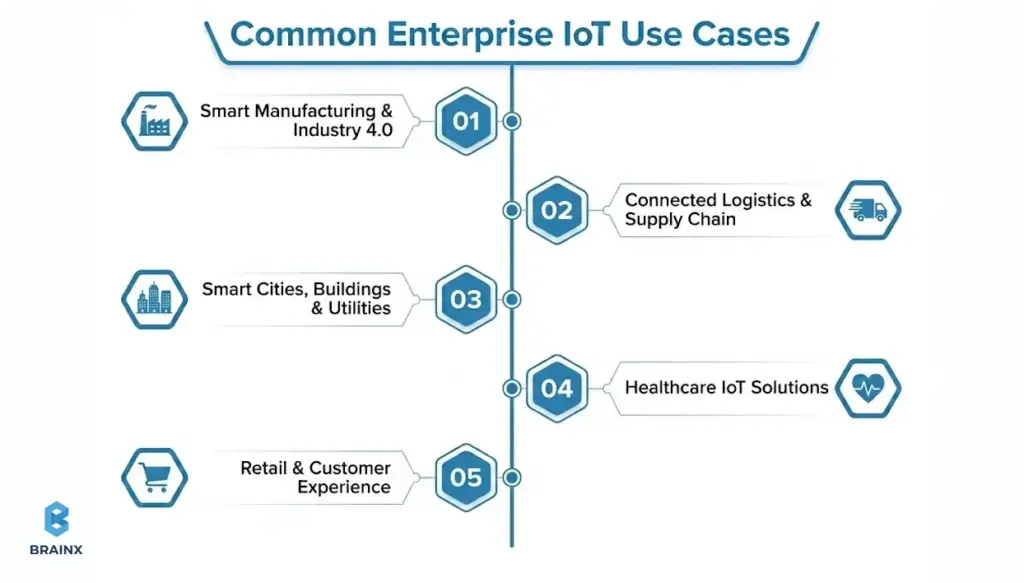
Enterprises are applying IoT across many industries as stated below.
Smart Manufacturing & Industry 4.0
The most mature connected operations environment is manufacturing. Plants use IoT to monitor equipment, model production flow, standardize quality control, and connect shop floor data with enterprise systems. Google Cloud’s Manufacturing Data Engine and Manufacturing Connect, for example, are specifically positioned to bridge OT and IT data in the cloud.
Connected Logistics & Supply Chain
In logistics, the winning use cases are visibility and exception management. Organizations get to track vehicles, containers, pallets and temperature sensitive products across transport modes and utilize such data to enhance routing, claims handling, service levels, and utilization. The use of real time movement data is particularly useful in combination with workflow automation and alerting.
Smart Cities, Buildings & Utilities
Connected infrastructure is used to enhance energy efficiency, reliability and remote visibility of buildings, campuses and utilities. Common examples include smart metering, occupancy aware HVAC control, leak detection, connected lighting, elevator monitoring, and distributed asset management.
Healthcare IoT Solutions
The IoT is used by healthcare teams to track assets, assist remote patient workflows, secure environments, and minimize manual searches of essential equipment. In these settings, device trust, auditability, and privacy are just as important as connectivity.
Retail & Customer Experience
Retailers use connected shelves, labels, cameras, and streaming data pipelines to improve stock accuracy, pricing agility, fulfillment speed, and store intelligence. This is also where analytics heavy stacks can shine because inventory, shopper behavior, and event data often need to flow quickly into dashboards and AI models.
Challenges and Considerations in Enterprise IoT
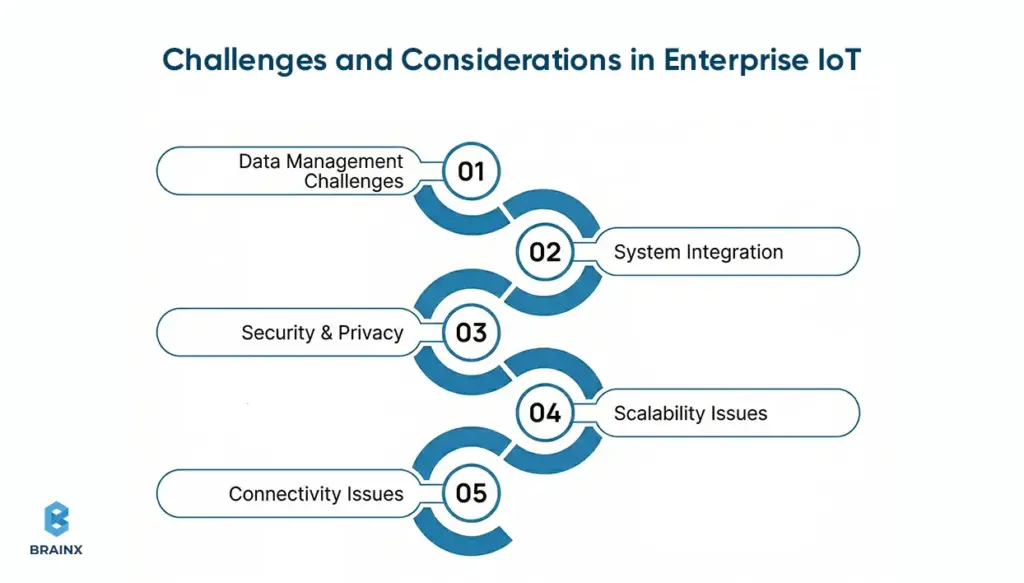
Although it is promising, large-scale IoT projects do have a number of challenges. Let’s explore some below.
Data Management & Analytics Challenges
Hooking up a sensor is not tricky at all. The tricky bit is to convert the raw streams of events into operational decisions that are trustworthy. Enterprises need data models, retention policies, alert logic, normalization, and ownership rules before dashboards become useful.
Legacy System Integration
Most organizations are not starting from zero. They are overlaying current connectivity on PLCs, SCADA, EAM, MES, and custom infrastructure, which might be decades old. That makes protocol translation, gateway design, and phased modernization critical.
Security & Privacy Concerns
Security cannot be treated as an add on. AWS IoT Core places emphasis on mutual authentication and end to end encryption whereas Azure IoT Hub puts its emphasis on per device identities, provisioning, and secure cloud to edge communication. Those are baseline expectations, not premium extras.
Scalability & Interoperability Issues
Many projects fail in the gap between pilot success and enterprise rollout. A proof of concept with fifty devices tells you very little about governance, cost control, fleet updates, or multi-site interoperability. The better question is not “Does the pilot work?” It is “Can this architecture survive growth?”
Architecture and Components of Enterprise IoT Solutions
Enterprise IoT architectures are typically layered systems spanning edge devices up to cloud apps. A common reference model includes:
Edge Devices & Connectivity
The first layer is the device layer: sensors, controllers, actuators, cameras, and machines. Connectivity then depends on the operating environment. Fixed industrial environments may favor Ethernet. Remote field assets may require cellular or satellite. LoRaWAN or NB-IoT can be used in low power, long range deployments..
IoT Gateways & Middleware
Gateways sit between devices and central platforms. They aggregate data, translate protocols, support local logic, and secure device communication. In mixed environments, they are also the bridge between old industrial systems and modern applications.
Cloud Platforms & Data Storage
Cloud platforms handle ingestion, routing, storage, identity, and rule execution. AWS IoT Core is compatible with MQTT, HTTPS, MQTT over WSS and LoRaWAN whereas Azure IoT Hub is designed around secure two way communication, built in device management and scaled provisioning. Google Cloud approaches the stack through services such as Pub/Sub, BigQuery, Manufacturing Data Engine, and Manufacturing Connect.
Analytics & Application Layer
The top layer is where data becomes action. That can mean operator dashboards, maintenance workflows, anomaly detection, digital twins, or event driven automation. The best architectures do not overwhelm users with raw telemetry. They bring forward context, priorities and decisions.
Learning about these layers enables IT departments to plan to be flexible and scaled. As an example, Cloud IoT Platforms can provide in-built analytics and device management solutions, whereas middleware can help in integrating with legacy systems.
Best Enterprise-Grade IoT Solutions in 2026
The best enterprise-grade IoT solutions in 2026 tend to be of three categories: hyperscale cloud platforms, industrial suites, and connectivity first vendors. The right fit depends less on brand recognition and more on your operating model, existing stack, regulatory requirements, and internal team maturity.
Leading Cloud IoT Platforms (AWS, Azure, Google, IBM Watson)
AWS and Azure are the most apparent places to start large scale deployments as they bundle up connectivity, identity, security, routing and ecosystem depth in one place. Google Cloud is particularly attractive in cases where the manufacturing data, streaming analytics, and AI are the main elements of the usage. IBM remains relevant in asset intensive industries through Maximo Application Suite and active Watson IoT Platform tooling within Maximo environments.
Industrial IoT Suites (Siemens MindSphere, PTC ThingWorx, GE Predix)
Industrial buyers typically shortlist suites that are more related to plant operations. Siemens MindSphere has long been associated with industrial monitoring and digitalization in Siemens heavy environments. PTC ThingWorx is stronger when teams need industrial connectivity, application building, analytics, and digital or AR driven experiences in one platform. GE Predix still appears most often in legacy GE centered industrial conversations and historical industrial internet evaluations.
Networking & Device Providers (Cisco IoT, Huawei IoT)
Cisco and Huawei matter when connectivity, rugged networking, and device access are core buying criteria. Cisco bases its industrial portfolio on the connection, protection, and automation of operations in OT environments. Huawei Cloud IoT Device Access also focuses on a wide range of network and protocol coverage, such as MQTT, LwM2M over CoAP, HTTPS, 4G, 5G, NB-IoT, and Wi-Fi.
Best IoT Cloud Solutions for Enterprise
The term best IoT cloud solutions for enterprise should not be treated as a popularity contest. In practice, the strongest option is the one that matches your data architecture, security model, deployment geography, and team capabilities. Nevertheless, there are a handful of platforms that are and will be standing out in 2026.
AWS IoT Core and Related Services
AWS IoT Core can be a good solution to companies that require scale of connectivity, configurable protocols, fine grained security and wide service integration. It supports MQTT, HTTPS, MQTT over WSS and LoRaWAN, and rules driven routing and fleet scale messaging.
Microsoft Azure IoT Hub & Suite
Azure IoT Hub is especially attractive for enterprises that are looking for strong device identity, secure bidirectional communication, inbuilt management, provisioning, and cloud to edge continuity. It also benefits from tight alignment with broader Microsoft enterprise tooling.
Google Cloud IoT & Data Tools
Google’s strongest story today is not a single monolithic IoT product. It is the combination of Manufacturing Data Engine, Manufacturing Connect, Pub/Sub, BigQuery, and Vertex AI oriented workflows for streaming, contextualizing, and analyzing operational data. That makes it a serious option for analytics heavy organizations.
Oracle IoT Cloud & Hybrid Models
Oracle’s newly introduced OCI IoT Platform is worth attention for enterprises that want a native Oracle path for secure ingestion, normalization, database integration, and AI oriented operational use cases. It is especially relevant for organizations already invested in OCI and Oracle data infrastructure.
These cloud IoT services provide device management, auto-scaling, and robust security. AWS and Azure are especially accomplished in terms of device provisioning and security certificates, and Google is the leader in terms of analytics integration. While Oracle provides value addition to database oriented businesses. It’s up to Enterprise IT leaders to evaluate how each platform’s features (edge support, multi-cloud options, compliance certifications) align with their needs.
Also Read: Mobile App Development for Enterprise Explained: From Planning to Deployment
Steps for Enterprise IoT Application Development
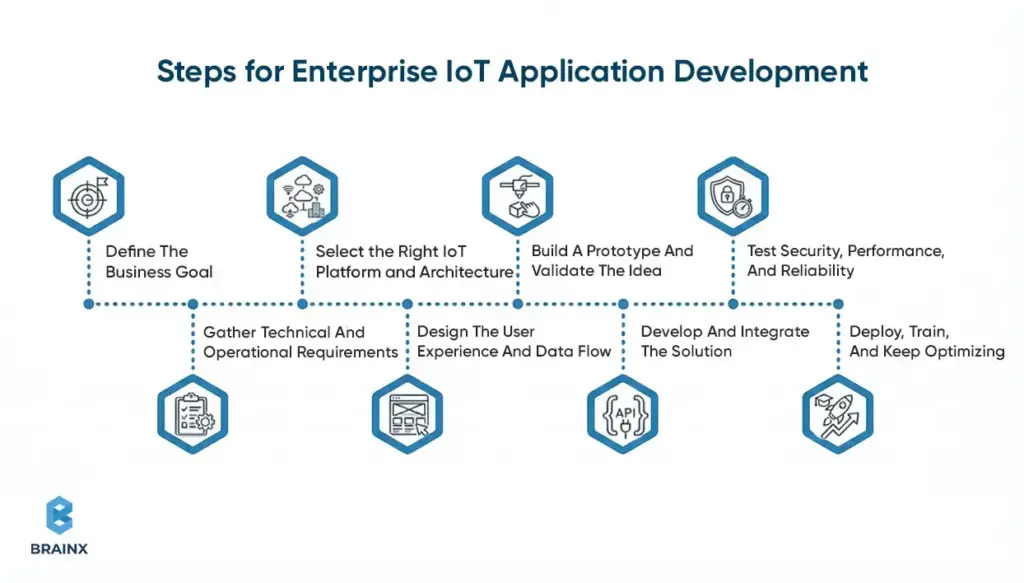
Developing an enterprise IoT application takes more than connecting devices to the internet. The process needs to align business goals, technical requirements, system integration, security, and long-term scalability from the start.
1. Define The Business Goal
Start with the problem the solution needs to solve. It could be reducing downtime, improving asset visibility, tracking equipment, or enabling faster decisions through live data.
A clear use case keeps the project focused and helps shape every decision that follows.
2. Gather Technical And Operational Requirements
Once the goal is clear, map the practical requirements. You have to include stakeholder needs, user expectations, device behavior, data volume, compliance needs, and the limits of your current systems.
This stage helps confirm whether the solution is technically and commercially feasible.
3. Select the Right IoT Platform and Architecture
The next step is choosing the platform and system design that best fit the project. You need to think about device compatibility, cloud or edge support, analytics capabilities, security controls, and how the new solution will work with existing enterprise tools.
A strong architecture makes future scaling much easier.
4. Design The User Experience And Data Flow
Enterprise IoT applications are not only about hardware. Users still need dashboards, alerts, workflows, and reports that are easy to understand and act on.
At the same time, the movement of data between devices, gateways, platforms, and business systems should be planned carefully to avoid confusion later.
5. Build A Prototype And Validate The Idea
Before full development begins, create a prototype or pilot version. This helps teams test the concept, validate assumptions, gather stakeholder feedback, and spot weak areas early.
It is a practical way to reduce risk before investing in a larger rollout.
6. Develop And Integrate The Solution
After validation, move into full development. This stage includes building the application, connecting devices, enabling communication between components, and integrating the solution with enterprise platforms such as ERP, CRM, or internal monitoring systems.
The goal is to create one connected ecosystem rather than a disconnected tool.
7. Test Security, Performance, And Reliability
Testing should cover much more than core functionality. An enterprise IoT application should be checked for system performance, data accuracy, device communication, security gaps, and integration issues before launch.
This step is essential because even small issues can create larger risks at scale.
8. Deploy, Train, And Keep Optimizing
Deployment should be controlled and carefully monitored.Once the system goes live, teams need training, support processes, and ongoing monitoring to keep performance strong.
Enterprise IoT is not a one-time launch. It usually improves over time through updates, feedback, and continuous optimization.
A structured development process helps enterprise IoT projects move from idea to implementation with less risk and better long-term value.
Understanding Enterprise IoT Software Development Cost
Enterprise IoT software development cost is shaped less by one fixed number and more by system complexity. The final budget depends on the use case, architecture, number of connected assets, integration depth, security requirements, and the level of ongoing operations the solution will need. This is an inference based on how major cloud vendors and architecture frameworks define IoT systems and lifecycle responsibilities.
1. Project Scope Affects The Total Budget
A focused deployment for one workflow or facility will usually cost less than a multi-site enterprise implementation. As the use case expands, the system needs more planning, more logic, more testing, and often more integration work. That makes scope one of the biggest cost drivers from the start.
2. Architecture Decisions Change Infrastructure Cost
Cloud, edge, and hybrid deployments do not cost the same. Cloud-heavy systems may involve more centralized storage and processing, while edge-based systems may require stronger local runtime environments, device-side compute, and additional operational setup.
Because each model shifts where processing happens, it also changes infrastructure and lifecycle costs.
3. Device Volume Increases Management Effort
The more devices, gateways, or assets you connect, the more work is required for provisioning, monitoring, indexing, troubleshooting, and updates. Even when platforms support scale, a larger fleet usually means more operational complexity and more engineering effort.
That is why device count directly influences long-term software cost, not just hardware cost.
4. Integrations Can Raise Development Time
Enterprise IoT platforms rarely operate on their own. They often need to exchange data with analytics platforms, cloud services, workflow tools, and internal business systems.
The more systems that need to be connected, the more custom logic, testing, and maintenance the project usually requires.
5. Security And Compliance Add Real Cost
Security is not an optional layer in enterprise IoT. Teams need to handle secure communication, device trust, access control, and protection of edge and cloud components.
If the project also needs industry-specific compliance controls, the cost typically rises further because validation, documentation, and hardening take additional effort.
6. Data Processing And Analytics Also Matter
IoT systems generate a continuous flow of telemetry.
That data often needs to be routed, stored, processed, visualized, and sometimes acted on in real time.
As reporting, automation, analytics, and AI features become more advanced, the software layer usually becomes more expensive to build and maintain.
7. Ongoing Support Is Part Of The Investment
The cost does not end accumulating at launch. Enterprise IoT systems usually need ongoing monitoring, OTA updates, troubleshooting, performance tuning, and platform improvements. It makes maintenance an important part of total cost of ownership, especially for large or business-critical deployments.
A practical way to frame enterprise IoT software cost is this: the price rises as the solution becomes more connected, more integrated, more secure, and more operationally demanding. A well-planned system may cost more upfront, but it is usually easier to scale and support over time. This concluding point is an inference from the architecture and lifecycle guidance in the cited sources.
Also Read: AI App Development Cost Guide: How Much Does AI App Development Cost
How to Choose the Right Enterprise IoT Solution
Selecting the right IoT solution is a strategic decision. Organizations should start by aligning the solution with clear business goals – what problems must IoT solve, and what KPIs will it improve? Solutions should be evaluated on how well they meet those specific needs. Key factors include:
Aligning Solutions With Business Goals
Start with an expensive business problem, not a technology wish list. Good first targets include unplanned downtime, cold chain failures, low asset utilization, energy waste, or slow incident response. That keeps the program accountable from day one.
Evaluating Scalability and Security
Ask vendors how they handle provisioning, updates, access control, certificate or credential management, segmentation, and edge to cloud resilience. Then ask what changes when your deployment grows ten times larger. Scale problems usually show up in operations, not in demos.
Calculating Total Cost of Ownership
TCO should include hardware, connectivity, cloud consumption, storage, integration work, device management, security operations, support, and internal change management. Cheap pilots often become expensive programs because buyers only model sensor costs and ignore the operating stack behind them.
Considering Vendor Support & Ecosystem
A strong ecosystem reduces deployment risk. Look at implementation partners, protocol libraries, industry accelerators, documentation quality, and integrations with the systems your teams already use. In enterprise buying, support quality is often as important as feature depth.
In practice, many companies build a short list of platforms and run real-world proofs of concept. Testing with actual devices and data ensures the solution meets performance and usability expectations. Ultimately, the best choice fits your technical requirements, budget, and long-term strategy.
Implementing Enterprise IoT Solutions: Best Practices
Successful IoT rollouts follow disciplined project management and continuous improvement.
Phased Rollout & Pilot Testing
Enterprise IoT solutions should rarely begin with a company wide rollout. Start with one process, one facility, or one asset class where success can be measured clearly. Then expand in phases after technical validation, business validation, and team learning are all proven.
Security by Design (Encryption, Authentication)
Encryption, device identity, segmentation, signed updates, and access governance need to be part of architecture from the start. AWS and Azure both emphasize secure device communication and identity controls, which is a useful baseline for what enterprise buyers should expect from any vendor.
Training & Change Management
New dashboards do not create change by themselves. Operators, maintenance teams, IT, OT, and business owners need shared workflows, clear escalation paths, and confidence in the data. Adoption fails when systems produce alerts that no one owns.
Continuous Monitoring & Optimization
Connected operations are never “finished.” Device health, data quality, cloud costs, security posture, and business impact should all be reviewed continuously. The highest performing programs treat connected infrastructure as an evolving capability, not a one time installation.
Future Trends in Enterprise IoT Solutions
Looking ahead, several trends will shape enterprise IoT:
5G & Edge Computing Integration
Enterprise IoT solutions are moving closer to the edge because latency, resilience, and bandwidth costs matter. 5G improves support for dense, mobile, and time sensitive deployments, while edge computing allows organizations to process and act on data locally instead of shipping every event to the cloud.
AI, Machine Learning & Digital Twins
AI has become the layer that turns sensor data into operational advantage. Digital twins, predictive models, anomaly detection, and AI guided maintenance are now part of mainstream industrial roadmaps, especially in manufacturing and asset intensive sectors.
Sustainability & Green IoT Initiatives
Sustainability is no longer a side benefit. Connected systems are increasingly used to measure energy consumption, reduce waste, improve routing, optimize maintenance, and create auditable environmental data across operations.
Standardization & Regulatory Trends
Interoperability, security baselines, and governance expectations are getting more rigorous. Buyers increasingly prefer platforms that support open protocols, strong policy controls, and clean integration with enterprise security models because lock-in and fragmented architectures are now seen as long term risks.
Conclusion
Enterprise IoT solutions offer transformational potential for organizations ready to innovate. By combining connected devices, robust networks, and advanced analytics, businesses can boost efficiency, reduce costs, and improve safety.
Leading enterprise-grade IoT platforms (from AWS, Azure, Google, IBM, and industrial vendors) now provide the tools to build scalable, secure solutions across industries. Success requires careful planning – from aligning solutions to business goals and securing every layer, to phased implementation and staff training. As edge computing, AI, and 5G mature, IoT projects will become more powerful and cost-effective.
For enterprises embarking on this journey, the next step is to evaluate needs against platform capabilities and develop a clear rollout roadmap – leveraging best practices in solution selection, security, and change management. With the right strategy, your organization can harness IoT to drive growth and innovation well into 2026 and beyond.
Partner With BrainX To Build Enterprise IoT Solutions
BrainX helps enterprises design and develop IoT platforms that go beyond pilots. We build the full product layer around connected devices, including dashboards, admin portals, real time monitoring, analytics workflows, and secure user experiences. From strategy to scalable delivery, BrainX helps turn operational data into usable systems that drive measurable business impact.
Frequently Asked Questions About Enterprise IoT Solutions
What Are Enterprise IoT Solutions?
Enterprise IoT solutions are connected systems built for business and industrial environments. They combine devices, networks, gateways, cloud or edge platforms, security controls, and applications so organizations can monitor, automate, and improve physical operations at scale.
How Are Enterprise IoT Solutions Different From Consumer IoT?
The main differences are scale, reliability, security, and integration. Consumer IoT focuses on convenience, while enterprise systems are built for operational continuity, policy control, compliance, and integration with business and industrial systems.
What Are The Best Enterprise-Grade IoT Solutions For Large Organizations?
The best enterprise-grade IoT solutions typically include hyperscale cloud platforms such as AWS and Azure, analytics oriented Google Cloud stacks, IBM for asset intensive environments, industrial suites such as ThingWorx and MindSphere, and networking focused portfolios from Cisco and Huawei. The best choice depends on existing systems, operating model, and deployment complexity.
How Do I Choose The Right Enterprise IoT Platform For My Business?
Start with a defined business outcome, then assess security, scalability, integration, operating cost, deployment model, and partner ecosystem. A strong proof of value matters, but so does the architecture that will support rollout after the pilot ends.
What Features Should An Enterprise IoT Platform Include?
A robust enterprise IoT platform typically includes:
- Device management: secure provisioning, firmware updates, and health monitoring.
- Connectivity support: ability to connect devices over various protocols (MQTT, HTTP, LoRaWAN, etc.).
- Security features: mutual authentication, end-to-end encryption, and adherence to standards.
- Data ingestion and storage: scalable pipelines and databases for large volumes of sensor data.
- Analytics and integrations: tools or APIs to analyze data (often with AI/ML) and integrate with existing systems (ERP, CRM).
- High availability and compliance: enterprise-grade uptime and compliance certifications (e.g. ISO, SOC).
In enterprise settings, those fundamentals matter more than flashy demo features.
How Long Does It Take To Deploy Enterprise IoT Solutions At Scale?
Deployment time varies widely by project complexity. A small pilot can take a few months, but an enterprise-wide rollout often spans one to two years. Large organizations typically adopt a phased approach (pilot → expand to multiple sites → full deployment). Complexity of integration with existing systems, regulatory approvals, and employee training also affect the timeline. Talk to our experts to know more about your project’s timeline.