
Key Takeaways
- The hardest coding language relies on whether you prioritize raw difficulty, practical use, or a major shift in mindset.
- Assembly and C++ are among the hardest useful languages because they demand deep control over memory, performance, and system behavior.
- Haskell, Prolog, and Lisp mainly feel difficult because they force you to think in completely different programming paradigms.
- Esoteric languages like Malbolge and Brainf*ck are extreme examples of difficulty but they offer little real-world value in the job market.
- Learning difficult languages can strengthen problem-solving, fundamentals of computer science, and mastery over easier languages with no headaches later on.
Introduction
In the world of programming, “hard” rarely means just one thing. A language can feel hard because it has complex syntax, because it exposes memory and hardware details, or because it forces a completely different way of thinking. For that reason, the hardest coding language for one software developer may not be the same for another.
Even so, difficult languages are often worth learning. They sharpen problem-solving, deepen software engineering fundamentals, and make mastering easier languages feel effortless later.
In this guide, you will see a practical ranking, a comparison table, and a decision framework that helps you judge which hard language is worth your time and which one is simply painful without much payoff.
What Is the Hardest Coding Language to Learn? Short Answer and How We Judge
There is no single answer that fits every programmer. If you mean the hardest language in absolute terms, esoteric languages like Malbolge sit at the extreme end. If you mean the hardest useful language for real software engineering, Assembly and C++ are usually the strongest contenders. That is because they combine low-level control, high risk of mistakes, and a steep learning curve.
What Is The Hardest Coding Language To Learn For Most Developers
For most developers, the hardest coding language is usually the one that removes the safety nets they are used to. A Python or JavaScript developer often struggles when moving into Assembly, C++, or Rust because the language suddenly demands precise control over memory, data flow, and performance.
C++ is especially tough because it mixes object oriented programming, low-level memory management, templates, concurrency, and decades of language evolution. Assembly is harder in a different way. It strips away abstraction and makes you think like the processor.
Why There Is No Universal Hardest Language
Difficulty is contextual. A game developer may find C++ natural but struggle with Haskell. A mathematically minded engineer may enjoy Haskell yet dislike pointer-heavy systems code. A researcher in AI may find Prolog intuitive while a web development specialist sees it as alien.
The hardest programming language depends on your background, your goals, and your mental model. Some difficult languages are hard because they are close to hardware. Others are hard because they are far from mainstream thinking.
The Scoring Method Used In This Comparison
To make the ranking fair, this article uses one consistent rubric:
- Syntax load: How dense, irregular, or mentally expensive the language syntax feels.
- Memory burden: How much manual control you need over memory, ownership, or lifetimes.
- Paradigm shift: How far the language moves away from mainstream imperative or object-oriented thinking.
- Concurrency burden: How difficult it is to reason about threads, shared state, or parallel execution.
- Tooling maturity: How much friction comes from compilers, debuggers, setup, and ecosystem complexity.
- Practical job relevance: How valuable the language is in real products and careers.
This approach keeps the article from turning into opinion alone. It also helps separate “hard but useful” from “hard just to be hard.”
Decoding Hard Coding Languages: Why They Feel So Difficult
Before ranking anything, it helps to understand why certain programming languages feel so much harder than others.
Syntax Complexity And Mental Overload
Some languages create friction before you even solve the problem. Dense punctuation, unusual grammar, verbose boilerplate, or overloaded features all increase mental load. C++ is a classic example. A beginner can write simple code, but complex syntax appears quickly once templates, references, and advanced standard library features enter the picture.
Hard syntax matters because your brain ends up tracking language rules instead of solving the business or engineering problem.
Memory Management And Low-Level Control
Languages become harder when they expose the machine directly. Manual allocation, pointers, lifetimes, raw memory access, and undefined behavior all add risk. In C and C++, one small mistake can lead to leaks, crashes, or corrupted data. Assembly is even closer to the metal, where every move is explicit.
Rust tries to solve this with ownership and borrowing, but that also creates a steep learning curve. The language is safer, but the rules are strict.
Paradigm Shifts And Abstraction Depth
Some languages are hard not because they are low-level, but because they force a new mindset. Haskell emphasizes pure functions and strong types. Prolog makes you describe logic and relationships instead of step-by-step instructions. Lisp family languages push symbolic thinking, recursion, and macros.
This kind of difficulty feels deep. You are not just learning syntax. You are relearning how to think.
Concurrency And Parallelism Complexity
Concurrency makes many programming languages harder. Once threads, async tasks, locks, shared memory, or distributed execution enter the picture, bugs become subtle and difficult to reproduce. Even strong developers can struggle here.
That is why languages designed for systems programming or distributed software engineering often feel difficult long after the basics are learned.
Tooling, Debugging, And Ecosystem Friction
A language is not experienced in isolation. Toolchains, compilers, package managers, debuggers, and error messages all shape difficulty. A language with decent syntax can still feel punishing if build systems are fragile or debugging is painful.
This is one reason some niche languages stay hard. The ecosystem around them never became smooth enough for mainstream adoption.
Hello World Difficulty Vs Real-World Difficulty
Many languages look easy in tutorials. Real-world difficulty appears later. Printing text is not the same as managing state across threads, debugging a memory issue, or building a production-ready service.
That is why this guide ranks languages based on practical complexity, not just how simple the first ten minutes feel.
Types of Programming Languages That Often Feel Harder to Learn
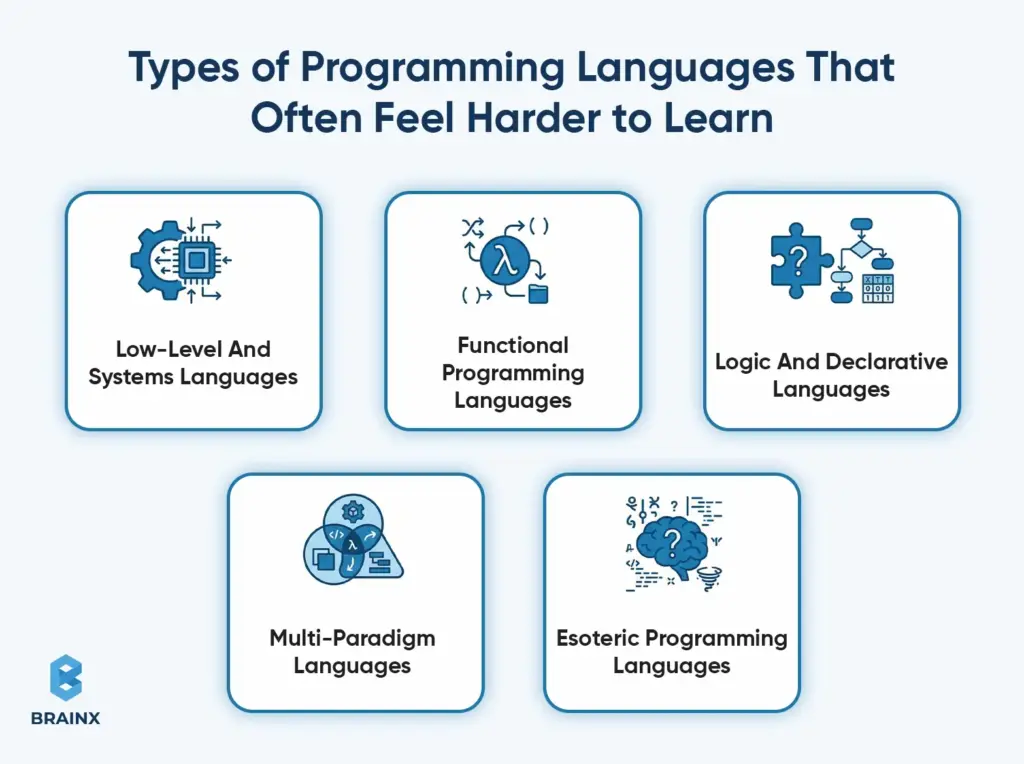
Not all difficult languages are difficult for the same reason. Different categories tend to create different forms of pain.
Low-Level And Systems Languages
These include Assembly, C, C++, and Rust. They often feel like the hardest programming language to learn because they force you to care about performance, memory, and machine behavior. They are common in operating systems, embedded systems, engines, and performance-heavy software.
Functional Programming Languages
Haskell and parts of the Lisp family fall here. These languages are difficult because they move away from mutation-heavy thinking and reward abstraction, recursion, and composable functions.
Logic And Declarative Languages
Prolog is the main example. It feels difficult because you stop telling the computer how to do something and instead describe rules and facts. That mental switch is powerful but unfamiliar.
Multi-Paradigm Languages
Scala and C++ are classic cases. They support many styles at once, which sounds flexible but increases complexity. A beginner may face functional concepts, object oriented programming, type-level thinking, and concurrency patterns in the same codebase.
Esoteric Programming Languages
Brainf*ck, Malbolge, and INTERCAL are hard by design. They are usually not practical languages to learn for work. They exist more as thought experiments, puzzles, or commentary on the world of programming.
Hardest Programming Language to Learn: Technical Drivers by Category
The hardest programming language to learn changes depending on where you are starting and what you want to do next.
Hardest Programming Language To Learn After Beginner-Friendly Languages
After Python, JavaScript, or other beginner friendly tools, the hardest jump is usually to a systems language. C++ and Rust feel brutal because you go from fast feedback and flexible syntax to strict rules, explicit types, and much greater responsibility.
Hardest Programming Language To Learn For Systems Programming
For systems programming, Assembly is usually the hardest. C++ sits right behind it because it gives huge power with very few guardrails. Rust is also difficult, but its safety model makes the difficulty feel more structured than chaotic.
Hardest Programming Language To Learn For Abstract Problem Solving
For abstract reasoning, Haskell and Prolog stand out. Haskell is difficult because of functional purity, type systems, and laziness. Prolog is difficult because declarative problem solving feels unnatural to many developers at first.
Hardest Programming Language To Learn When Debugging Is Already A Challenge
If debugging already frustrates you, C++ can feel like the most difficult programming language because bugs may not fail cleanly. Memory corruption, undefined behavior, or subtle template issues can waste hours. Esoteric languages are even worse because the debugging support is almost nonexistent.
Most Difficult Programming Language: Ranked List With Difficulty Scores
This ranking blends practical and extreme cases so readers can see both ends of the spectrum.
Most Difficult Programming Language Ranking Rules And Score Weights
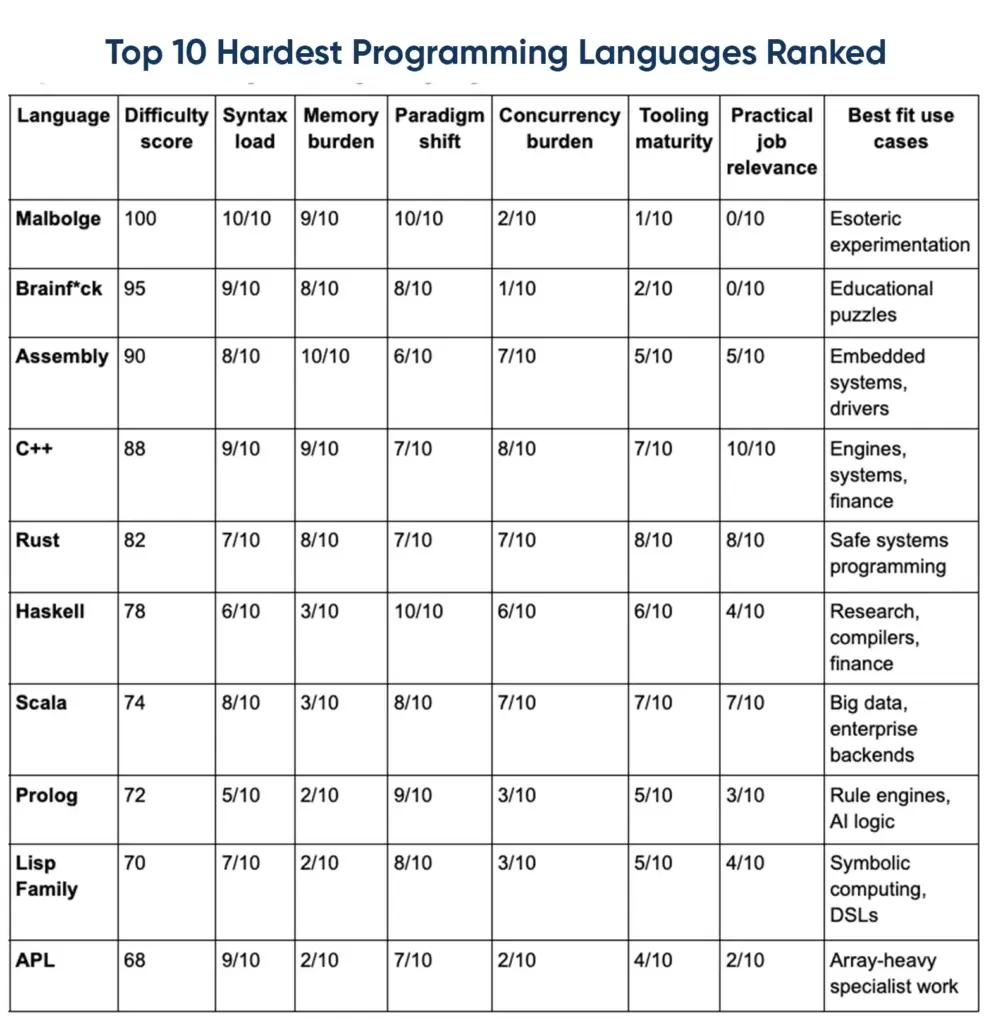
The scores below weigh syntax load, memory burden, paradigm shift, concurrency burden, tooling maturity, and practical job relevance. Higher scores mean the language is harder to learn and use well over time.
Top 10 Hardest Programming Languages Ranked
Difficulty Bands: Expert-only, Advanced, Niche & Esoteric
- Expert-only: Assembly, C++
- Advanced: Rust, Haskell
- Niche but valuable: Scala, Prolog, Lisp Family, APL
- Esoteric: Brainf*ck, Malbolge
The Top Contenders: Deep Dives Using One Consistent Template
We have analyzed every language with the same template so you can compare fairly. Comparison includes why it’s hard, its features and applications, who uses it, what beginners struggle with, and best ways to start learning.
Assembly

Why It Is Hard
Assembly is hard because it maps directly to a machine’s instruction set. You must manage registers, stack frames, memory addressing, and calling conventions yourself. The Intel manuals illustrate how much detail lies beneath high-level languages: dozens of instructions, manual memory layout, and low-level debugging constructs. One wrong register reference or stack misuse can crash the program.
Features And Applications
Assembly is used for “close to the metal” tasks: microcontrollers, boot loaders, device drivers, and performance-critical hot spots where every cycle counts. It gives maximum performance and minimal overhead, at the cost of huge code size and complexity.
Who Uses It
Embedded engineers, systems programmers, and reverse-engineers use Assembly, often alongside C or C++. Many security researchers and performance engineers learn Assembly to understand hardware-level behavior. It’s generally a specialized skill rather than a main application language.
What Beginners Struggle With
Beginners struggle with invisible state and lack of feedback. Assembly has no debugger telling you what the bug is; you step through instructions and examine registers or memory manually. Missing one increment or using the wrong register can crash, and symptoms may appear far from the root cause.
Best Way To Start Learning It
Start with a simulator or assembler for a single architecture (like x86-64 or ARM). Learn registers, the stack/heap difference, and calling conventions. Write very small programs (loops, math, string output) and step through them in a debugger so you build intuition about how instructions change machine state.
C++

Why It Is Hard
C++ is hard because it’s powerful and permissive. You can write code that compiles but still triggers undefined behavior, meaning the standard places no restrictions on what happens if you break key rules. It combines low-level memory control with high-level abstractions, so the same programmer can make errors at multiple layers.
Features And Applications
C++ remains dominant in performance-sensitive areas: game engines, simulation, graphics, large infrastructure, and system tools. It offers fine control over memory layout and resources, and a vast ecosystem (Standard Library, Boost, etc.). Its templates and zero-cost abstractions enable both low-level and high-level programming, which also contributes to its learning curve.
Who Uses C++
Any team where latency, throughput, or resource control matter uses C++. Its continued prominence shows up in popularity indexes (again, popularity ≠ difficulty, but it indicates relevance). Many large codebases in finance, engineering, and OS kernels use C++.
What Makes Mastery Different From Basic Use
Writing basic C++ code is easy – many beginners “get it to compile.” Mastery means “I can predict its behavior”: you must understand object lifetimes, copy vs move semantics, exception safety, and the memory model for threads. Sanity-checking bugs often requires compilers’ sanitizers and profilers. In short, “it compiles” is not enough – you must ensure correctness and performance.
Memory, Templates, And Undefined Behavior
Modern C++ emphasizes RAII (Resource Acquisition Is Initialization) to manage memory: tie each resource (file handle, memory) to an object’s lifetime. That reduces leaks, but you must learn how constructors/destructors work. Templates in C++ enable powerful generic code and even compile-time computation (template metaprogramming), but they add another layer of complexity. Misusing templates can lead to baffling compiler errors.
Where To Learn And How To Practice
Learn C++ progressively: (1) Basics (syntax, std::vector/string), (2) RAII and smart pointers, (3) Templates/generics, (4) Concurrency primitives (mutexes, atomics), (5) Tools (sanitizers, debuggers, profilers). Practice by writing incrementally more complex projects: start with a CLI tool, then a small multithreaded server, etc..
Rust
Why It Is Hard
Rust is hard because the compiler enforces memory and concurrency safety through strict rules, pushing complexity to compile-time. Beginners feel “blocked” early because the compiler requires you to reason about ownership, borrowing, and lifetimes before you can run the code.
Ownership And Borrowing
Ownership is a central concept: each piece of data has a single owner, and Rust’s borrowing rules let you reference data under conditions the compiler checks. This ensures memory safety without a garbage collector, but it means you have to learn Rust’s borrowing semantics and lifetime annotations, which many find non-intuitive at first.
How Rust Differs From C And C++
Safe Rust is designed to prevent most memory errors by construction. You can still write unsafe code to do things like call external functions or dereference raw pointers, but that’s explicitly marked and isolated. The Rust Book emphasizes that even unsafe blocks retain Rust’s core ownership checks elsewhere. Unlike C++, Rust does not have undefined behavior in safe code. In exchange, you must write more upfront, and the borrow checker can feel like an extra challenge.
Real-World Use Cases
Rust is increasingly popular in systems and security contexts. Open-source trends and developer surveys (GitHub, JetBrains) show high interest in Rust, even if industry adoption is still growing. Companies use Rust in performance-sensitive services, embedded devices, and tools where reliability is critical.
Best Learning Path
Learn Rust in layers: start with the official Rust Book for ownership and borrowing, then practice error handling with Result/Option. Learn about lifetimes after you’re comfortable with basics, and pick up concurrency with Mutex and async separately. Treat unsafe as an advanced topic you only explore after mastering the safe subset. Build small projects (a CLI parser, file reader) to solidify each concept.
Haskell
Why It Is Hard
Haskell is hard because it is purely functional and abstraction-heavy. It emphasizes immutability and lazy evaluation, which fundamentally change how you write and debug programs.
Functional Purity And Type Systems
Haskell’s purity means functions have no side effects by default; this leads to elegant code but requires a mindset shift (using monads or applicatives for I/O, for example). Its strong static type system catches many errors at compile time and encourages precise domain modeling. This yields very reliable code, but can increase upfront design work.
Where It Is Used
Haskell is mostly used in niche areas that reward correctness and abstraction: compilers, financial systems, research, and analytics tools. It’s not common in mainstream app stacks, but its influence appears in other languages (Monads, Algebraic Data Types, etc.).
Who Should Learn It
Learn Haskell if you want to boost your abstraction skills and “type-driven” thinking. It makes you a better problem solver by forcing clear separation of concerns and encoding invariants in types. Many learn Haskell to improve their programming “mindset” even if they won’t use it daily.
Where To Learn It
Use official community resources (the Haskell report, Haskell wiki) and functional programming books. Don’t just do toy exercises—write something with real I/O or parsing so you see lazy evaluation in action. Communities like /r/haskell or functional programming meetups can help when you get stuck.
Prolog

Why It Is Hard
Prolog is hard because it’s declarative: you define facts and rules instead of step-by-step commands. Execution relies on unification and backtracking, which can feel unintuitive if you expect procedural logic.
Declarative Problem Solving
This model is powerful for certain problems (search, constraint solving): you describe what is true, and Prolog’s engine explores possibilities. For example, instead of writing a loop to solve a maze, you state the maze layout and a goal, and Prolog finds the path via search.
Applications And Niche Use Cases
Prolog (e.g. SWI-Prolog) is often taught in AI courses and used in research. It’s used in some natural language processing, theorem proving, and configuration systems. The language’s standard libraries include backtracking and constraint libraries, but its ecosystem is much smaller than imperative languages.
What Makes The Mindset Shift Difficult
In Prolog, a variable starts “unbound” and can unify with values, then potentially backtrack. When backtracking, bindings revert to previous states. This reversibility and search-based flow is very different from languages with assignment. Beginners often find it hard that you don’t explicitly control the search.
Lisp Family

Why It Is Hard
Lisp (and its descendants like Common Lisp or Scheme) can be hard because of its unfamiliar syntax and powerful macros. Lisp code is made of lots of parentheses, and macros allow you to programmatically transform code. You have to reason about code that writes code, not just values.
Macros, Recursion, And Symbolic Thinking
In Lisp, defmacro lets you create new language constructs, blurring the line between language and program. This symbolic metaprogramming power comes at the cost of complexity: reading some Lisp code means mentally expanding macros. Lisp’s emphasis on recursion and lists also requires a shift from iterative thinking.
Historical Importance And Modern Relevance
Lisp pioneered many ideas (interactive development, garbage collection, symbolic AI). Today it’s mostly niche (AI research, some finance), but its concepts live on (e.g. Clojure on the JVM). Learning Lisp teaches “code-as-data” thinking, which can make you a better programmer in any language.
Who Benefits From Learning It
Lisp is valuable if you work on compilers, domain-specific languages, or any field that benefits from metaprogramming. Even in modern engineering, understanding Lisp macros can clarify how modern frameworks work under the hood.
Scala
Why It Is Hard
Scala can be hard because it fuses functional and object-oriented styles with an advanced type system. A Scala codebase might mix many paradigms, so reading others’ code can be challenging. It’s often cited in hardest language lists because of its rich feature set.
Multi-Paradigm Complexity
Scala was designed to unify Java’s OOP model with functional concepts (map/filter, pattern matching). While that’s powerful, it increases the number of concepts you need to master. Research papers note that Scala’s flexibility is both its strength and its complexity.
Big Data And Enterprise Relevance
Scala’s main relevance comes from the JVM ecosystem: it runs on Java’s platform and libraries. It’s popular in big data (Spark is written in Scala) and certain enterprise backends. That means its complexity often comes into play in domain-specific ways (e.g. streaming, distributed systems).
Common Learning Barriers
Learners often stumble on advanced type features (higher-kinded types, implicits in older versions / givens in newer Scala), and dense compiler error messages. In practice, Scala is usually learned within a specific tech stack, which can mitigate some complexity.
Brainf*ck

Why It Is Hard
Brainf*ck is hard because it removes almost all abstraction. It has a tiny set of commands (+ - < > . , [ ]) that manipulate a data tape and pointer. Its creator explicitly said it was not meant for serious use.
Minimal Commands And Extreme Verbosity
Without any variables or functions, even simple tasks become very long sequences of pointer moves and increments. That’s why Brainf*ck programs are extremely verbose. It’s technically Turing-complete, but writing anything nontrivial is arduous.
Educational Value Only
Its main value is educational: Brainf*ck forces you to see how higher-level constructs (like loops or variables) can be built from very primitive operations. It’s often used to teach or demonstrate how interpreters and compilers work.
Why It Matters In “Hardest” Discussions
Brainf*ck highlights an important distinction: a language can be “hard” because it’s low-level (like Assembly) or because it lacks abstraction. Brainf*ck is the extreme of the latter: it’s only “hard” because it provides virtually no abstractions at all.
Malbolge

Why It Is Hard
Malbolge is hard by design. Its specification defines a bizarre system: a ternary (base-3) virtual machine, encrypted instructions, and self-modifying code. It was created to be as confusing as possible.
Self-Altering Behavior At A High Level
In Malbolge, the instruction you execute can change its own code and the next instruction (through encryption). This breaks a fundamental assumption: the code does not stay the same as it runs. That makes reasoning and debugging essentially impossible.
Why It Has Almost No Practical Use
Because Malbolge’s difficulty is the point, it has no real jobs or mainstream uses. It’s purely a curiosity in esolang circles. Any work in Malbolge is academic or for fun puzzles.
Is It The Hardest Coding Language Or Just The Most Extreme?
Malbolge is the most extreme “hard by design” case. If you define hardest purely as “intended to be impossible,” Malbolge wins. But if you mean “hardest useful language,” Malbolge isn’t that, since it’s not used. The “hardest practical language” title stays with languages like Assembly/C++.
Other Hard Languages Worth Mentioning
Some other notable difficult languages (often cited by enthusiasts) include:
INTERCAL
INTERCAL was created as a parody language. Its manual jokes that it has “no sense,” deliberately using confusing constructs. It’s hard because it’s a satire of difficult languages, not because of practical features.
Erlang
Erlang can feel hard because it normalizes concurrency with lightweight processes and message passing. Its documentation emphasizes functions like spawn, send, and receive as core, which means you must think in terms of asynchronous message flows instead of shared state.
OCaml
OCaml has a concise syntax and powerful type system. It requires you to be precise: pattern matching and modules are common, so small mistakes lead to errors. The language encourages correctness (e.g. most values are immutable by default), which can feel strict but teaches rigor.
Java
Java is generally easier at the syntax level than C++, but it can still be challenging in concurrency. The Java Language Specification’s “happens-before” model is complex, and learning why volatile and synchronized work as they do requires time. But everyday Java writing is mostly straightforward.
APL
APL is often considered hard because its core primitives are unique symbols instead of words (e.g. ⍴). This let APL express array operations very concisely, but it raised the bar: early adopters needed special keyboard support. Reading APL code feels like learning a mathematical notation.
Why Bother Learning Them? The Benefits of Learning Hard Coding Languages
Choosing a hard language isn’t for bragging rights – it’s a lever for deeper understanding. The right hard choice can upgrade your mental models around correctness, performance, and abstraction.
Better Problem-Solving Ability
Hard languages train precision. They force you to reason clearly about state, structure, and tradeoffs.
Stronger Computer Science Fundamentals
They teach fundamentals that many easier languages hide. Memory, evaluation models, abstraction, concurrency, and computation become much more concrete.
More Confidence With Easier Languages Later
After difficult languages, high-level tools often feel far more approachable. You understand what the abstractions are saving you from.
Career Value In Specialized Domains
Some difficult languages are highly valuable in niches such as data science infrastructure, game development, compilers, distributed systems, and performance-heavy software engineering.
Hardest vs Easiest Coding Languages: What This Means for Your Learning Path
A smart learning path uses “bridge languages” and staged goals. Chasing difficulty too early can stall you, but picking up harder languages at the right time can accelerate your growth.
When The Hardest Coding Language Is The Wrong First Choice
If you are still learning basic programming logic, starting with the hardest coding language is usually the wrong move. It slows down feedback and raises frustration.
When A Hard Language Is The Right Move
A hard language is the right move when your goals demand it. Systems programming, performance-sensitive work, compilers, and certain research paths justify the extra effort.
Easiest Coding Language To Learn First Before Harder Ones
Python and JavaScript remain strong first languages because they are beginner friendly, have huge communities, and give fast visible results.
Bridge Languages That Make Harder Languages Easier Later
Good bridge languages include C before C++, or a typed but more approachable language before Rust or Scala. Bridge languages reduce the shock.
Things to Know Before Starting to Learn Any Programming Language
Before committing to a difficult language, build a foundation so you can spot true language difficulty vs missing fundamentals. If you need guidance, see our software development roadmap.
Should You Learn Algorithms And Data Structures First?
Learn them in parallel with a language. Algorithms and data structures only make sense when you implement them and see them run. Reading about them abstractly doesn’t stick as well as coding them and debugging their behavior.
Should You Directly Jump Into Coding?
Yes, and keep feedback loops short. Write small programs immediately (even while reading about the language). Surveys indicate many developers learn directly from documentation and trial (rather than from courses), so get used to reading docs and trying code examples from day one.
What Besides Programming Languages Should You Learn To Become A Strong Computer Science Engineer?
Learn debugging, Git, testing, system design basics, operating system concepts, and how software actually runs in real environments.
How Much Time Does It Take To Learn Coding Basics?
“Basics” means: variables, control flow (if/loops), functions, simple data structures, and debugging. Time varies widely, but consistent practice (even an hour a day) is more effective than all-nighters. Building small projects will solidify basics faster than mindless tutorials.
Factors That Make a Programming Language Easier or Harder to Learn
In general, difficulty depends on design and ecosystem factors: how predictable a language is, how many “invisible rules” it has, and how well-supported it is.
Factors Making A Programming Language Easier To Learn
A language gets easier when it has:
- Clear syntax
- Fast feedback loops
- Good documentation
- Helpful errors
- Strong community support
- Safe defaults
Factors Making A Programming Language Harder To Learn
A language gets harder when it has:
- Complex syntax
- Manual resource control
- Hidden runtime failure modes
- Weak tooling
- Major paradigm shifts
- Sparse learning material
Why Job Relevance And Difficulty Are Not The Same Thing
Popularity does not equate to difficulty. The TIOBE index is explicitly a popularity ranking, not a “best or easiest language” list. A language can be popular and easy (Python) or popular and hard (C++), or niche and hard (APL). So job market needs and learning curve are separate considerations. You want a learning plan that fits both your career goals and your tolerance for complexity.
Time to Learn: Milestones That Make Difficulty Measurable
To make “hard” concrete, define milestones. A language may look easy for “Hello World,” but become hard when you need to ship a service with concurrency and testing. Think in terms of “what can I do in X time.”
First Week Milestones
Can you install the tooling, run programs, understand variables, and write basic logic without constant confusion?
First Project Milestones
Can you finish a small tool, script, or mini-app that reads input, processes data, and handles mistakes?
Production-Readiness Milestones
Can you write maintainable code, debug issues, structure modules well, and handle performance or reliability concerns?
How Much Time Does It Take To Learn Coding At Different Levels?
A useful rule of thumb:
- Basics: 4 to 12 weeks
- Small independent projects: 2 to 6 months
- Comfortable professional use: 6 to 18 months
- Deep expertise in difficult languages: multiple years
Real Examples That Show Why These Languages Are Hard
Below are concrete patterns and debugging scenarios that expose difficulty: moving across abstraction levels, debugging edge cases, and concurrency reasoning.
One Task Across Three Abstraction Levels
Take the same task such as summing numbers from a file. In Python, it may take a few readable lines. In C++, it takes more structure and explicit handling. In Assembly, even file access and looping become much more manual.
Debugging Examples That Reveal True Difficulty
A simple crash in Python usually gives a helpful traceback. In C++, a memory issue may fail silently or far away from the root cause. In Brainf*ck or Malbolge, the debugging experience becomes almost absurd.
Concurrency Example At A Conceptual Level
Shared state with threads is hard because bugs may appear only under certain timings. This is why concurrency burden matters so much in systems languages.
What Is The Most Difficult Part Of Programming C++?
For many developers, the most difficult part of programming C++ is not syntax alone. It is the combination of memory, templates, undefined behavior, large codebases, and subtle concurrency rules.
Strategies for Success: Techniques to Master the Hardest Coding Languages
Hard languages require a methodical approach. The goal is to reduce cognitive load, get frequent feedback, and practice systematically.
How To Approach Learning A Difficult Language
Use short learn-write-debug cycles. Read about one concept (e.g. pointers, ownership, or a syntax construct), then immediately write a tiny piece of code and break it. Hard concepts only “click” when you encounter a problem and solve it.
Avoid long passive reading – the moment your code fails, you learn deeper.
How To Break Complex Concepts Into Milestones
Divide topics into small milestones tied to mini-projects: e.g. “I can explain stack vs. heap and allocate on each,” “I can write a thread-safe increment with mutexes,” “I can write a basic Prolog query.”
Each milestone should be testable (pass a unit test or build without errors). Doing all of this turns a steep learning curve into a series of weekly wins.
When To Use Projects Instead Of Theory
Switch to projects as soon as theory stalls you. For example: write a small CLI in Rust (learn parsing and error handling), implement a simple parser in Haskell (immediate feedback on types), or code a graph search in Prolog. Projects force you to handle I/O, errors, and real data, revealing issues you might not see in toy examples.
How To Avoid Quitting Too Early
Track visible progress: list bugs you’ve fixed, concepts you’ve conquered, and programs you’ve written. Hard languages often cause plateaus; seeing concrete achievements reminds you that progress is happening. Many quit only because success seems hidden.
Keeping a diary or a log of your learning milestones can keep motivation up.
Best Learning Resources And Communities To Use
Favor primary sources like language reference manuals and books (Rust Book, Rustonomicon, Haskell Report, SWI-Prolog manual, CPU ISA manuals). Such sources have authoritative explanations.
Use community resources (Stack Overflow, Reddit) for clarifying obscure issues once you have grasped the fundamentals. For example, read the official Rust Book first, then ask in forums about specific borrow-checker edge cases.
How to Know Which Programming Language to Use
Choosing a language to learn is different from choosing one for a product. In industry, decisions start from constraints: team skills, project goals, timelines, and maintenance plans. (For help, see our how to choose a programming language guide.)
Intention
Start with your goal. Are you learning for curiosity, employment, product performance, or long-term expertise?
Use Case
Choose based on what you want to build. Web development, backend systems, mobile apps, compilers, and data science all point to different languages to learn.
[Also Read : Title: How to Outsource Mobile App Development]
Difficulty Level
Match difficulty to timing. The best language is not always the hardest programming language. It is the one that fits your current growth stage.
Learning Resources And Community
A strong ecosystem lowers risk. Documentation and community support matter more than many beginners expect.
Long-Term Career Value
Think about where the language sits in your career path. Specialized hard languages can create leverage if they align with your goals.
Best Programming Languages for Specific Careers
Below we anchor difficulty to common career tracks so you see where hard languages fit in practice.
Web Development
JavaScript and TypeScript dominate. Python, PHP, and Java also matter on the backend. Very difficult languages are usually not the first choice here.
Data Science And Machine Learning
Python leads because of ecosystem strength. Harder languages may appear beneath the surface in performance-critical tooling.
Mobile Development
Swift and Kotlin are practical choices. Lower-level languages matter mainly for performance-heavy modules.
Systems Programming
C++, Rust, and Assembly are the most relevant here. This is where difficult languages have the clearest career value.
Game Development
C++ remains central because performance matters deeply. This is one of the best examples of a hard language still being commercially important.
Which Programming Language Should You Learn Next?
Use this as a decision guide. Your “next” language should give the best return on effort for your target role, not necessarily be the hardest coding language.
If You Want Strong Fundamentals
Pick a “fundamentals amplifier”: Rust (for systems and safety), Haskell (for pure functional abstraction), or Assembly (for machine-level insight). Any of these will deepen your understanding, though not every developer needs all of them.
If You Want Speed And Employability
Pick a mainstream language aligned with common jobs: TypeScript/JavaScript for web, Python for data, or Java/C# for enterprise. These languages aren’t the hardest, but they offer quick employability. Use job-market data (Stack Overflow surveys, job boards) as a signal for what skills are in demand.
If You Want Performance And Low-Level Control
Choose C++ or Rust, and use Assembly as a support tool (e.g. optimize hot loops, understand compiled output). These give you direct access to hardware. However, they require more time investment – so start small, build something real, and lean on community resources for help.
If You Want Niche Expertise
Consider Prolog (constraint solving, AI), Lisp (metaprogramming, AI), Erlang (concurrency, telecom), or APL (array computing). These domains are small but can be rewarding if you’re solving their specific problems. Niche expertise can be valuable, but it pays off only if it matches your domain challenges.
Final Verdict: Choosing Your Challenge For Your Career
If you want the absolute extreme, Malbolge is the hardest coding language in spirit. If you want the hardest useful path, Assembly and C++ are the strongest answers. Rust is close behind and may be the smartest modern choice for many technical teams.
The right answer is not just about which language is hardest. It is about which challenge gives you the most valuable growth for your career.
FAQs About the Hardest Coding Language
What is the hardest coding language to learn if I already know Python?
Usually C++, Rust, or Haskell. They either introduce low-level responsibility or a major paradigm shift.
Are hard programming languages still worth learning?
Yes, when they connect to your goals. They improve fundamentals and can unlock specialized roles.
Which is the most difficult programming language to learn and why?
Malbolge is the most difficult programming language in extreme terms because it was designed to be hostile. Among practical languages, Assembly and C++ are harder because of low-level complexity and error risk.
What is considered the most difficult computer programming language to learn?
That depends on whether you mean practical difficulty or esoteric difficulty. Malbolge wins the latter. Assembly and C++ dominate the former.
Hardest programming language to learn for beginners
For beginners, C++, Rust, Assembly, and Haskell are among the toughest because they combine conceptual difficulty with weak beginner feedback.
What is the hardest coding language to learn for game development?
C++ is the strongest answer because it is heavily used in engines and performance-critical game systems.
What is the hardest coding language to learn for AI and data work?
In AI and data science, the hardest languages are usually support-layer languages like C++ rather than the day-to-day scripting tools.
Most difficult programming language that is also useful in real jobs
C++ is usually the best answer here. It is difficult and still highly relevant.
Is C harder than C++?
C is smaller, but C++ is usually harder overall because of its larger feature set and deeper complexity.
Is Rust harder than C++?
Rust often feels harder at the start. C++ often feels harder to master fully.
Is Haskell harder than Python?
Yes, for most developers. The paradigm shift is much larger.
Is C++ the hardest programming language?
It is one of the hardest widely used languages, but not the hardest if esoteric languages are included.
Is Java the hardest programming language?
No. Java can be serious and enterprise-heavy, but it is not usually placed among the hardest languages.
What are the top 10 hardest programming languages?
A strong list includes Malbolge, Brainf*ck, Assembly, C++, Rust, Haskell, Scala, Prolog, Lisp Family, and APL.
What are the top 15 hardest programming languages?
Add INTERCAL, Erlang, OCaml, Java, and C to extend the list depending on context.
Which one is the most basic programming language to learn, and why is that?
Python is often considered the most basic language to learn because it is beginner friendly, readable, and supported by a massive learning ecosystem.