 March 27, 2026 -
  5 minutes read

Key Takeaways
- Python vs JavaScript for web development depends on project needs, where JavaScript dominates frontend development while Python is widely used for backend services.
- JavaScript runs natively in browsers, and it is a must have to power interactive web interfaces and single-page applications built using frameworks like React, Angular, and Vue.
- Python is usually used for backend APIs, automation, and AI-enhanced web features, whereas Django, Flask, and FastAPI are some of its supporting frameworks.
- JavaScript can be executed on the server via Node.js, which allows full-stack JavaScript development to be used in scalable web applications.
- Modern web applications often combine Python and JavaScript, using Python for backend logic and JavaScript frameworks for dynamic user interfaces.
Python vs JavaScript for Web Development
Python and JavaScript are two of the most popular languages powering modern web development. They both have their advantages. JavaScript is dominant in client-side interactivity (98% of websites or more are using it on their front end) whereas Python is strong at backend APIs, data processing and machine learning.
We will discuss the comparisons when it comes to python vs javascript for web development on the basis of use cases, ecosystem, performance, and real world scenario. We aim at assisting you in making the right choice on the type of language to use on your project.
What Is Python?
Python is a high-level, general-purpose programming language known for its clean syntax, readability, and fast development speed. In web development, Python is commonly used for backend logic, APIs, automation, and data-driven features. Its simple structure makes it beginner-friendly, while its strong ecosystem makes it a practical choice for startups, enterprises, and teams building scalable web applications.
What Is JavaScript?
JavaScript is a high-level programming language used to create interactive and dynamic web experiences. It runs natively in web browsers and plays a central role in modern front-end development. In web projects, JavaScript is also used on the server side through Node.js, which makes it a flexible choice for teams building full-stack web applications.
JavaScript vs Python: Key General Differences
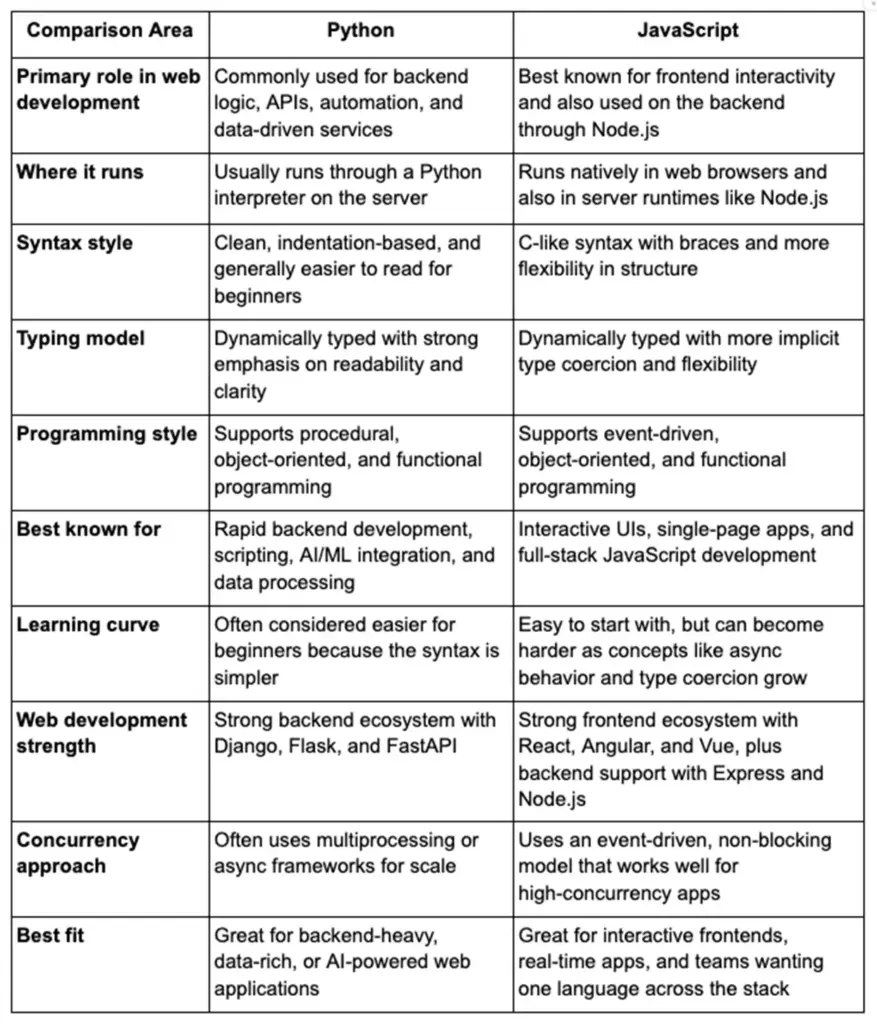
If you want a fast high-level view, this table summarizes the key general differences between Python and JavaScript before we move into frameworks, backend use cases, and performance.
Differentiating Factors in JavaScript and Python
After understanding what Python and JavaScript are, the next step is to compare the factors that usually influence real project decisions. These include developer adoption, speed under different workloads, scalability patterns, memory handling, and the overall range of use cases each language supports. Looking at these differences early helps readers understand why both languages remain strong choices for modern web development.
Popularity
JavaScript has long been a dominant language in web development because it runs in the browser and remains essential for modern front-end development. Python, however, continues to grow because of its simple syntax, strong backend ecosystem, and major role in data science, automation, and AI-powered applications. In practice, both languages are widely used, but their popularity is driven by different strengths and different types of projects.
Performance
When teams compare Python and JavaScript, performance usually depends on the type of workload rather than the language alone. JavaScript often performs well in highly interactive interfaces and I/O-heavy web applications, especially when used with Node.js. Python, on the other hand, is often preferred when backend services rely on data processing, scripting, or AI-related workloads. For most web projects, framework choice, architecture, and infrastructure matter as much as raw language speed.
Application Scalability
Scalability is not only about how fast an application runs but also about how well it handles growth in users, requests, and features. JavaScript is often appealing for scalable web applications because teams can use one language across both the frontend and backend. Python also scales well, especially in backend-heavy systems that rely on APIs, microservices, background jobs, or data pipelines. The better option depends on whether your application is more real-time and interface-driven or more logic-heavy and service-oriented.
Memory Management
Memory management affects how efficiently an application handles data during runtime. JavaScript uses automatic garbage collection, which helps developers avoid manual memory handling in most web projects. Python also manages memory automatically, using reference counting and garbage collection behind the scenes. For most development teams, this means both languages are productive to work with, but performance tuning still becomes important when applications grow more complex or data-heavy.
Scope
Both Python and JavaScript have wide scope, but they are known for different strengths. JavaScript is central to browser-based development and extends into backend, mobile, and even desktop applications. Python has broader visibility in backend development, automation, scripting, machine learning, and data engineering. This means JavaScript often offers a more unified web stack, while Python offers wider utility across backend and technical business workflows.
JavaScript vs Python for Web Development: Use Cases and Ecosystem
When comparing javascript vs python for web development, it is worth mentioning the difference in the roles that both languages play. JavaScript and Python are used in the web projects both significantly, but usually in different spheres.
JavaScript is the language that exclusively runs in web browsers and this makes it a crucial requirement for client side features. In comparison, Python is frequently used in server-side application, scripting and AI/ML services.
Nowadays, the typical configuration of web development is both: e.g. a Python backend may be serving data APIs, and JavaScript frameworks are being used to drive the front-end. Full-stack JavaScript development has also been made possible with JavaScript’s Node.js runtime.
- JavaScript Use Cases: Building dynamic single-page applications (SPAs) with React, Angular, or Vue. Fashioning interactive front-end features and real-time server apps with Node.js or Express. It’s also used for mobile and desktop apps through React Native, Electron, etc.
- Python Use Cases: Being used to power web services and APIs (with frameworks such as Django or Flask), analytics, ETL, machine learning, and workflow automation. A large number of AI/ML-based web features (e.g. recommendation engines) depend on the Python ecosystem (TensorFlow, PyTorch, Scikit-learn).
The two ecosystems consist of enormous communities and libraries. JavaScript is supported by corporations such as Google (Angular), Facebook (React), and the open source community. It even has the npm registry (with millions of packages). Python has PyPI and strong backing from organizations for AI and web (e.g. the Django Software Foundation).
JavaScript is the language most commonly used by developers according to surveys (approximately 62% of developers used it last year), and Python is also immensely popular (approximately 51% used it).
JavaScript: Frontend and Full-Stack Ecosystem
JavaScript’s main domain is front-end development. When comparing python vs javascript for web development, take into consideration that JavaScript is a (natively) supported language in all modern browsers. React, Angular, and Vue are frameworks that assist developers in creating complex UIs effectively.
In 2024, React was used by roughly 39% of developers, with Angular at 17% and Vue around 15%. These frameworks enable single-page apps, component-based UIs, and mobile cross-platform development (React Native).
On the back end, Node.js (built on the V8 engine) allows JavaScript to run on servers. The event loop architecture means a Node.js server can serve thousands of I/O-bound requests with low overhead.
For example, a typical full-stack JS project might use React for the front end, Express for the back end, and MongoDB for the database (the MERN stack). Tools like webpack, Babel, and VS Code (a top editor) round out the ecosystem, with extensive community support.
Python: Backend Ecosystem and Libraries
When it comes to backend development, often deciding between python vs javascript for web development depends on whether you need a feature-rich framework or an event-driven runtime. Python excels on the server side with its powerful frameworks and libraries.
Popular web frameworks like Django and Flask (and newer ones like FastAPI) make it easy to build robust web services.
Django is a “batteries-included” full-stack framework: it provides an ORM, authentication, an admin dashboard, and many security features out of the box.
Flask is a lightweight microframework that gives developers flexibility to choose components.
FastAPI (modern and async) uses Python type hints to validate data and is known for its high performance. These frameworks have large communities: for instance, Django powers sites like Instagram’s backend.
Python’s interpreter is multi-paradigm (supporting object-oriented, functional, and procedural styles) and is dynamically typed. Developers often appreciate its readable syntax and large standard library. The package manager pip (and tools like virtualenv or Poetry) handle libraries for web tasks.
On the server, Python apps commonly use WSGI/ASGI servers (Gunicorn, Uvicorn) and can scale via multiple worker processes or containers. Python also has excellent libraries for APIs and web services (e.g., Django REST Framework for RESTful APIs).
The Python community is very active (it became the top language on GitHub in 2024), especially in fields like data analytics, DevOps, and backend services.
Python vs JavaScript for Backend Web Development
Specifically, python vs javascript for backend web development often means choosing between frameworks like Flask/FastAPI (Python) and Node.js/Express (JavaScript) for your APIs and server logic. There are trade-offs:
- Concurrency Model: Node.js’s asynchronous event loop handles high concurrency well; it’s ideal for I/O-bound workloads (high-traffic APIs, streaming, real-time chat) because it doesn’t block on database or network calls. Python threads, on the other hand, are limited by the Global Interpreter Lock (GIL): only one thread executes Python bytecode at a time, making CPU-bound multi-threading ineffective. To scale Python servers, developers often use async frameworks (FastAPI with async/await) or multiple worker processes.
- Performance: In many benchmarks, Node.js outperforms Python frameworks in raw throughput. For example, one 2023 benchmark showed Express (Node) handling ~1932 requests/sec, compared to ~1478 for Flask and ~989 for FastAPI under similar conditions. This suggests Express was roughly 6× faster than FastAPI in that test. However, actual web app performance depends on factors like database speed and I/O. Ultimately, development speed and ecosystem support often outweigh raw benchmarks.
- Use Cases: Python frameworks excel in CPU-intensive or data-heavy tasks (using optimized libraries), while Node.js excels in serving large numbers of simultaneous connections with minimal overhead. If your team knows JavaScript and you want a unified stack, Node/Express may be appealing. If you need rapid data processing or AI integration, Python’s rich libraries and frameworks could be better. Many large applications combine both: e.g. using Django for robust backend APIs and Node/React for the frontend.
Syntax and Readability
Python is famous for clear, indentation-driven syntax, which many developers find easy to read and maintain. JavaScript’s syntax is C-like (using braces and semicolons by default), which some find more familiar; modern JS (ES6+) adds syntactic sugar (async/await, classes, destructuring) that improves readability. Both languages are dynamically typed, but Python’s consistency often leads to concise code. JavaScript’s flexibility (first-class functions, callbacks, prototypal inheritance) offers powerful patterns but can be complex for beginners.
Typing and Paradigms
Python is strongly typed (type checking at runtime) and multi-paradigm (OOP, functional, procedural). JavaScript is weakly typed (performs automatic type coercion in many operations) and prototype-based, though modern JavaScript also supports class syntax and modules. These typing and paradigm differences influence how you write code. For example, Python’s type annotations (PEP 484) are becoming popular for clarity and editor support, while JavaScript/TypeScript’s types catch many errors at compile-time.
Execution Models
JavaScript (Node.js) typically uses a single-threaded event loop, offloading I/O to the system kernel. This allows one process to handle many concurrent connections efficiently. Python’s main implementation (CPython) uses multiple OS threads but enforces the GIL, so multithreaded Python code does not run on multiple cores simultaneously. Python concurrency is often achieved via multiprocessing or async I/O (e.g. asyncio or FastAPI). Node’s model simplifies writing concurrent servers, whereas Python can run parallel tasks via separate processes or native async frameworks.
Performance and Scalability in Web Apps
For performance and scalability considerations, the python vs javascript for web development choice can influence how you build and optimize your app. In general:
- Python Performance: Python excels at CPU-bound tasks when using optimized native libraries (NumPy, Pandas, etc.), but its GIL can limit pure Python code. For web servers, Python frameworks often use asynchronous I/O (e.g. FastAPI with Uvicorn) or multiple worker processes to handle concurrency. This can make Python services quite responsive for I/O-heavy workloads. In benchmarks, async Python services (using asyncio) can approach high throughput, but raw single-process Python is usually slower than Node (as seen in the Express vs FastAPI example).
- JavaScript Performance: Node.js uses non-blocking I/O by default, so a single Node process can serve many requests with minimal context switching. This is especially effective for real-time applications (chat servers, live data feeds). Node can also use worker threads or clusters for CPU-bound work, but most Node apps rely on the event loop for I/O-bound tasks. Benchmarks often show Node handling more requests per second than similar Python setups.
- Scalability Considerations: JavaScript’s single-language stack can simplify scaling horizontally: teams can reuse code between frontend and backend, and deploy multiple Node instances behind a load balancer. Python services typically scale by adding more worker processes or containers and maybe using message queues for parallel processing. Both languages are used in large-scale architectures. For instance, cloud platforms fully support both (AWS Lambda has runtimes for Node.js and Python), so you can choose either for microservices or serverless functions depending on the job (e.g. image processing with Python, real-time API with Node).
Frameworks & Libraries Comparison
Choosing the right framework can accelerate development. Each language has standout tools:
Python Web Frameworks (Django, Flask, FastAPI)
- Django: A mature full-stack framework (released 2005) with “batteries included” features. Ideal for large, content-driven sites (e-commerce, CMS). It includes an ORM, admin interface, and authentication by default, speeding up development of complex apps.
- Flask: A minimalist microframework (released 2010). It doesn’t impose components, so developers choose their own ORM and libraries. Great for small to medium services or when maximum flexibility is needed.
- FastAPI: A modern async framework (released 2018). It’s built for building APIs quickly, using Python type hints for automatic input validation and documentation. FastAPI is optimized for high performance (built on Starlette/Uvicorn) and is popular for microservices and ML-powered endpoints.
These Python frameworks have large, active communities. Django’s documentation is extensive and it’s used by many companies (e.g. Instagram’s backend was Django). Flask and FastAPI have growing ecosystems of plugins and extensions. Python’s ecosystem also includes strong libraries for data (NumPy, Pandas), authentication (PyJWT), and cloud integration (Boto3 for AWS).
JavaScript Web Frameworks (React, Angular, Vue, Node.js/Express)
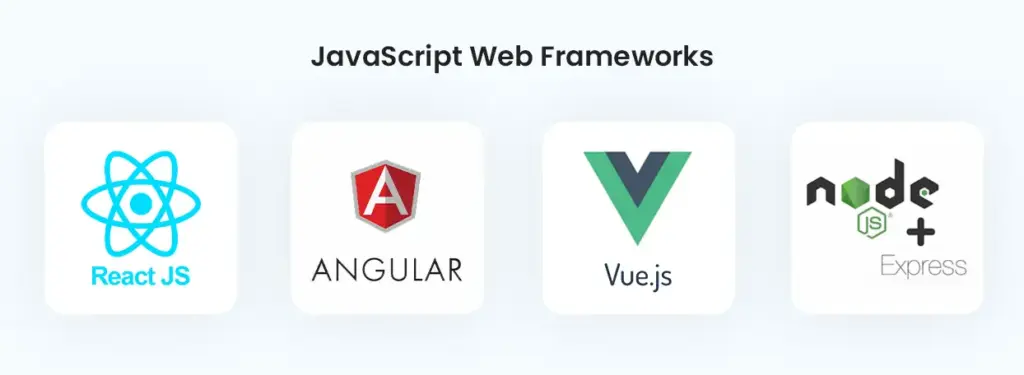
- React (Front-end): A library by Facebook for building UIs. It uses components and a virtual DOM for efficient rendering. React’s ecosystem includes Redux (state management) and Next.js (server-side rendering). With ~39% adoption, it’s often a top choice for new SPAs.
- Angular (Front-end): A full-featured framework by Google. It uses TypeScript, built-in routing, and RxJS. Angular is favored in large enterprise projects that need an all-in-one solution (form handling, HTTP, CLI).
- Vue.js (Front-end): A progressive framework that combines templating with component-based development. Vue is known for its gentle learning curve and has gained popularity (~15% in surveys), especially for small-to-medium projects.
- Node.js/Express (Back-end): Node.js (with Express) is the go-to for server-side JS. Express is a minimal framework for handling HTTP routing and middleware. For more structure, frameworks like NestJS build on Express with additional features. This enables full-stack JS apps, reusing libraries between client and server.
The JavaScript ecosystem is vast. npm (Node’s package registry) is the largest in the world, with millions of packages. Tools like Webpack, npm/Yarn, and Babel support development. Editors like Visual Studio Code have first-class support for JavaScript/TypeScript. In surveys, frameworks like React and Node consistently rank at the top. New tools (Next.js, Svelte, Deno) continue to emerge, illustrating JavaScript’s rapid evolution.
Ecosystem and Tooling
Comparing ecosystems, JavaScript’s npm and Python’s PyPI both host huge libraries. As of 2025, npm has over 2.5 million packages, and PyPI has over 450,000 (and growing). Tools for both languages are mature: bundlers and transpilers (webpack, Babel, TypeScript) for JS, and virtualenv/Poetry or Conda for Python. IDE support is strong on both sides (PyCharm, VS Code, WebStorm, etc.). Both communities contribute to StackOverflow, GitHub, and open-source projects.
Must Read: How To Choose a Web Development Technology Stack
Popularity, Demand, and Community
- Developer Adoption: According to Stack Overflow’s 2024 survey, ~62% of developers used JavaScript last year and ~51% used Python.
- Web Usage: JavaScript is ubiquitous in browsers (around 98% of websites use JS for client-side behavior), while Python is a common backend language.
- GitHub Popularity: GitHub’s 2024 report notes Python has become the most popular language on the platform, surpassing JavaScript.
- Job Market: Both languages are in high demand. Web developer roles frequently list JavaScript skills, and Python is especially sought for backend, data, and AI-related roles.
- Community Support: JavaScript has a massive ecosystem of libraries (npm) and front-end frameworks, and Python has strong communities in web (Django, Flask) and data science. Both have active Q&A forums and conferences (JSConf, PyCon, etc.).
Use Cases and Applications
The python vs javascript for web development choice often comes down to project needs and developer expertise. Here are typical scenarios:
When to Use JavaScript
- Rich Front-Ends: If you need a dynamic, responsive web interface (forms, animations, real-time updates), JavaScript (with a modern framework) is essential.
- Unified Stack: Using Node.js on the backend means your team can work in one language for both client and server. This simplifies code sharing and can speed up development.
- Real-time Apps: Applications like chat services, live dashboards, or games benefit from Node’s non-blocking I/O. JavaScript with WebSockets or WebRTC is commonly used for real-time features.
- Mobile/Web Hybrid: With React Native or Ionic, you can reuse JavaScript code for mobile apps, giving cross-platform reach.
When to Use Python
- Backend APIs & Services: Python’s frameworks (Django, Flask, FastAPI) allow quick development of RESTful APIs. Python’s readability accelerates building complex business logic.
- Data-Driven Features: If your app needs heavy data manipulation, machine learning, or analytics, Python is preferable. It has direct support for ML libraries (TensorFlow, Scikit-learn) and data processing (Pandas).
- Rapid Prototyping: Python enables fast prototyping of ideas (e.g. using Flask or Django’s built-in server) before scaling up.
- Serverless & Automation: Python is popular for serverless functions (AWS Lambda supports Python 3.12) and for writing automation scripts, ETL processes, and DevOps tasks.
Often, a hybrid approach is best: for example, using Python (Django/Flask) for backend logic and JavaScript (React/Vue) for interactive front-end. This is common in enterprise apps: a Python-powered API serving data to a JavaScript-powered client application.
Examples of What You Can Build With Each
One of the easiest ways to understand python vs javascript for web development is to look at what teams actually build with each language. While both are used in modern web projects, they often support different parts of the product.
Python is commonly chosen for backend-heavy and data-driven systems, while JavaScript is used to build interactive user experiences and full-stack web applications.
What You Can Build With Python
Python is often used to build web products that rely on backend logic, automation, APIs, and data processing. It works especially well when a project needs clean server-side architecture, fast development, or integration with AI and analytics tools.
Common examples include:
- REST APIs and backend services (more on them later)
- Admin dashboards and business portals
- Data dashboards and reporting platforms
- Automation tools and internal systems
- AI-powered web applications
[ Also Read: How to Build AI-Powered Web and Mobile Apps with ChatGPT API? ]
For example, a company might use Python to build a customer portal with a FastAPI backend, an analytics dashboard connected to business data, or a SaaS application that includes recommendation engines, reporting, or workflow automation.
What You Can Build With JavaScript
JavaScript is best known for building interactive and user-facing web experiences. Since it runs directly in the browser, it is essential for products that need dynamic interfaces, fast UI updates, and modern front-end behavior.
Common examples include:
- Interactive websites and landing pages
- Single-page applications (SPAs)
- Real-time chat apps and collaboration tools
- Web dashboards with live updates
- Cross-platform web and mobile apps
For example, a product team might use JavaScript to build a React-based SaaS dashboard, a booking platform with real-time updates, or a customer-facing web app that needs smooth navigation and responsive design.
What You Can Build With Both
In many real-world products, the strongest solution is not Python or JavaScript alone, but a combination of both. This is common in full-stack development, where Python handles backend logic and JavaScript powers the front end.
Examples of products built with both include:
- SaaS platforms
- Marketplaces
- Customer portals
- AI-enabled web apps
- Enterprise internal tools
Combining Python and JavaScript in Web Projects
Combining python vs javascript for web development is very common. A typical architecture is a Python backend (Django/Flask/FastAPI) with a JavaScript frontend (React/Angular/Vue). They communicate over JSON APIs or GraphQL. For example, Instagram’s web stack uses Django (Python) for its backend and React for parts of its frontend.
Integration tools include:
- REST/GraphQL APIs: Python services expose endpoints that JS frontends consume (via fetch, Axios, etc.).
- WebSockets: Real-time frameworks (e.g. Django Channels or Socket.IO on Node) enable live client updates.
- Server-Side Rendering (SSR): Frameworks like Next.js or Nuxt.js (JS) can consume data from Python APIs.
- Microservices: You can deploy separate microservices (some in Python, some in Node) that talk over HTTP or messaging queues.
- Hybrid Tools: Libraries like PyExecJS allow calling JS from Python (rare), and WebAssembly projects (Pyodide) let Python run in the browser, though these are niche.
This hybrid approach leverages each language’s strengths: Python for heavy lifting (data, ML) and JavaScript for interactivity. (For details, see our internal guide on full-stack development with Python and JavaScript.)
Future Trends in Web Development: Python vs JavaScript
- Python: Expect deeper integration with AI/ML in web services (embedding models in web apps). Serverless and edge computing platforms increasingly support Python, making it easier to run Python functions globally. Technologies like PyScript/Pyodide (Python in the browser via WebAssembly) are experimental but could eventually let developers run Python client-side.
- JavaScript: Will continue to lead in web innovations. Progressive Web Apps and modern front-end frameworks (like React 19 or Svelte) will enhance user experiences. Edge computing (Cloudflare Workers, Lambda@Edge) will expand JavaScript’s role outside the browser. WebAssembly will allow more languages to interoperate with JS on the web, but JS itself will remain the main “glue” language for new web APIs (like WebXR for VR/AR).
- Both: As the web evolves, both languages will collaborate. For instance, IoT systems often use Python on the server and JavaScript on the dashboard. Developer tools will increasingly include AI-assisted coding for both languages. We may see more microservices architectures where Python handles data/AI workloads and JavaScript handles interactive front-ends, reflecting a blended ecosystem.
Python Vs JavaScript: Which Programming Language to Choose in 2026?
When deciding between python vs javascript for web development, consider your project requirements and team expertise:
- Choose JavaScript if you need rich client-side interactivity, want a single-language stack, or are building SPAs and real-time apps. It’s ideal when you need many UI components or a large ecosystem of web libraries. If your team is strong in JS/TypeScript, using Node.js on the backend lets you reuse skills and code.
- Choose Python if you need rapid backend development, heavy data processing, or integration with AI/ML. Python’s readable syntax and robust frameworks (Django, FastAPI) accelerate building APIs and data services. If your project involves complex computations or you prefer Python’s ecosystem, Python is often the better fit.
Often the best solution is to use both: for example, Python for complex backend logic and JavaScript for the frontend interface. Both languages are free, cross-platform, and have large talent pools. Weigh factors like development speed, community support, and long-term maintainability. In many cases, python vs javascript for web development becomes less a contest and more a matter of using the right tool for each part of your stack.
Not Sure Whether to Use Python or JavaScript for Your Web Project?
Choosing between Python vs JavaScript for web development can be confusing. Each language has strengths depending on your project goals. BrainX Technologies helps businesses select the right technology stack and build scalable web applications. Whether you need a Python backend, a JavaScript frontend, or a full-stack solution, our team can guide you and deliver the right development approach. Connect with BrainX to turn your web development vision into a high-performing digital product.
Python vs JavaScript Web Development FAQs
Q: Is Python or JavaScript better for web development?
A: When comparing python vs javascript for web development, neither is strictly “better”; it depends on the use case. JavaScript is essential for front-end work (every browser uses it) and can run on the server (Node.js), making it great for full-stack development. Python excels on the backend, especially for data-heavy or AI features. For example, a highly interactive SPA would lean on JavaScript (React/Angular), while a data analysis dashboard might use Python for the API. Often, teams use both: Python powers the server/API and JavaScript handles the interactive UI.
Q: Can Python and JavaScript be used together in a web project?
A: Yes—almost all modern web projects use both. A common pattern is a Python framework (Django/Flask) serving JSON APIs, with a JavaScript framework (React/Vue) building the user interface. They communicate over HTTP/WebSockets. You can also mix at the tooling level (e.g. using templating with Django and enhancing pages with JS). Many companies run a Python backend with a JavaScript frontend; this leverages Python’s backend strength and JS’s front-end interactivity.
Q: What frameworks should I use for each language?
A: For JavaScript front-ends, React, Angular, or Vue are top choices. For JavaScript back-ends, Express (Node.js) is common, with alternatives like NestJS or Koa. For Python, Django is ideal for large, full-featured sites, while Flask/FastAPI are great for lightweight or microservice APIs. Django REST Framework is excellent for APIs. The “best” framework depends on project size and requirements (full-stack vs microservice, sync vs async, etc.).
Q: Which is faster, Python or Node.js?
A: In raw benchmarks, Node.js often has higher throughput than Python web frameworks due to its non-blocking I/O. However, “faster” depends on what you measure: Python can be very fast using C libraries (NumPy, etc.) for data tasks. In web apps, database or network latency usually dominate. For most projects, both are “fast enough.” It’s usually more important to choose the language and framework you develop in more productively than to optimize a small speed difference.
Q: Should I learn Python or JavaScript for web development?
A: Both are valuable. If you’re focused on front-end or full-stack web, start with JavaScript (and its frameworks). If you’re drawn to backend, data processing, or AI/ML, start with Python. In the long run, many developers learn both: JavaScript for client-side and Python for server-side. Your choice should align with your goals and the type of projects you want to build.