

 May 22, 2026 -
  22 minutes read

TL;DR / Key Takeaways
- The best ecommerce website development company has to be evaluated on set metrics such as conversion, speed, reliability, SEO readiness and post-launch growth.
- Choose the appropriate delivery model from the beginning: agency, dev shop, freelancer or in-house.
- Ask every vendor for proof artifacts, not just screenshots: discovery outputs, architecture diagrams, QA plans, and post-launch roadmaps.
- Performance, SEO, security, analytics, and integrations are essential requirements to build and should not be treated as add-ons.
- Be wary of red flags such as vague estimates, unspecified acceptance criteria, or some form of proprietary lock-in without a business case.
- Consider proposals on the basis of assumptions, scope drivers and ownership–not hourly rates.
- For U.S.-facing commerce, add accessibility, privacy, payment stack, and procurement readiness to your scorecard.

If you are building a shortlist right now, you have probably run into the same problem every buyer does: Vendor websites all sound the same: “full-service,” “conversion-focused,” “scalable,” and “secure.” But when all the vendors say they are the best ecommerce website development company, then buyers need something more to compare them than portfolio screenshots and uncertain promises.
The smarter approach is to assess partners by outcomes, like conversion, performance, reliability, search readiness, maintainability, and post-launch growth, and not by polished sales pages alone.
This guide gives you a practical evaluation framework. You will learn what “best” should mean, which proof signals matter most, what red flags to watch for, how scope really drives cost, and how to choose a partner without overpaying for buzzwords.
What Best Ecommerce Website Development Company Actually Means and What It Doesn’t
The best ecommerce website development company is not the one with the loudest branding. It is the partner most likely to help you launch a store that is fast, stable, discoverable, secure, easy to manage, and easier to improve after launch.
Google’s Core Web Vitals framework is a useful example of outcome-based evaluation because it measures loading, interactivity, and visual stability through LCP, INP, and CLS, with recommended thresholds of 2.5 seconds, 200 milliseconds, and 0.1 at the 75th percentile. Google also emphasizes that teams should pair broad field visibility with their own real-user monitoring so they can diagnose and react to regressions quickly.
In practice what “best” implies:
- Revenue impact: Improved conversion, increased AOV, increased merchandising control and reduced checkout failures.
- Performance and reliability: Fast product pages, stable checkout, and predictable scaling during traffic spikes.
- Operational efficiency: Less manual work along with better integrations and admin tooling.
- Risk management: Secure development, controlled releases, and SEO safeguards before launch.
What it does not mean:
- The biggest agency.
- The fanciest design portfolio.
- The most complex platform recommendation.
- A team that says yes to everything without explaining tradeoffs.
It does not mean “most custom,” “most expensive,” “largest headcount,” or “most advanced architecture diagram.” While a headless or composable build might be the right solution, it's only when it addresses an actual business need more effectively than a simpler platform-led solution. The best ecommerce partners will minimize the clutter while allowing merchandising, integrations, and experimentation. That is why the best ecommerce website development company for one organization can be the wrong fit for another.
Best for Your Context (Startup vs Enterprise)
For a startup, “best” usually means faster learning, tighter scope control, and enough flexibility to iterate without rebuilding the stack in six months. A partner who can get the basics right, such as catalog structure, mobile UX, analytics, SEO hygiene and launch discipline, can create more value for their client than the one who suggests an enterprise-grade architecture prematurely.
For an enterprise team, the checklist shifts. Procurement, accessibility, infosec review, governance, multi-team approvals, and systems integration become central. That's where the best ecommerce website development company comes into play. It’s the one that can fit into your operations without adding unnecessary overhead or slowing down the program down the road.
Before you compare vendors, write down three things:
- Your 12-month growth plan, including channels, catalogs, and regions.
- Your non-negotiables, like PCI scope, uptime, localization, accessibility, or headless architecture.
- Your integration landscape, including ERP, CRM, PIM, OMS, analytics, payments, and shipping tools.
Also Read: How to Create a Great Retail App: Main Features, Characteristics & Tips
Agency vs Dev Shop vs Freelancers vs In-House
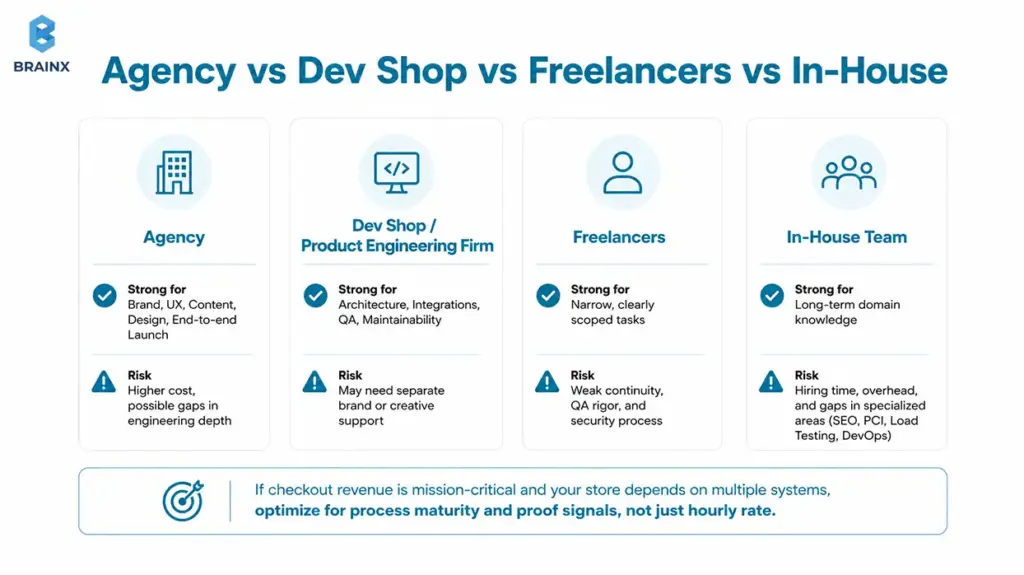
- Agency: Strong for brand, UX, content, design, and end-to-end launch. The risk is higher cost and possible gaps in engineering depth.
- Dev shop or product engineering firm: Strong for architecture, integrations, QA, and maintainability. The risk is that you may need separate brand or creative support.
- Freelancers: Useful for narrow, clearly scoped tasks. The risk is weak continuity, QA rigor, and security process.
- In-house team: Strong for long-term domain knowledge. The risk is hiring time, overhead, and gaps in specialized areas like SEO migration, PCI, load testing, or DevOps.
If checkout revenue is mission-critical and your store depends on multiple systems, optimize for process maturity and proof signals, not just hourly rate.
Ten Qualities That Define the Best Ecommerce Website Development Company With Proof Signals
If you want to evaluate the best ecommerce website development company objectively, ask for proof in three layers: what they planned, how they built, and what happened after launch.
A credible partner should be comfortable showing artifacts, technical rationale, and measurable outcomes—not just portfolio screenshots. If you want a reference point while comparing partners, BrainX’s public Ecommerce Website Development Services page is a good example of the kind of service detail serious buyers should expect to see before a proposal is even signed.
If you only do one thing after reading this article, do this: ask vendors for proof artifacts. Strong ecommerce partners usually welcome this because it makes expectations clear, reduces rework, and keeps both sides aligned before the build starts.
Strategy-First Discovery That Aligns Tech With Business Goals
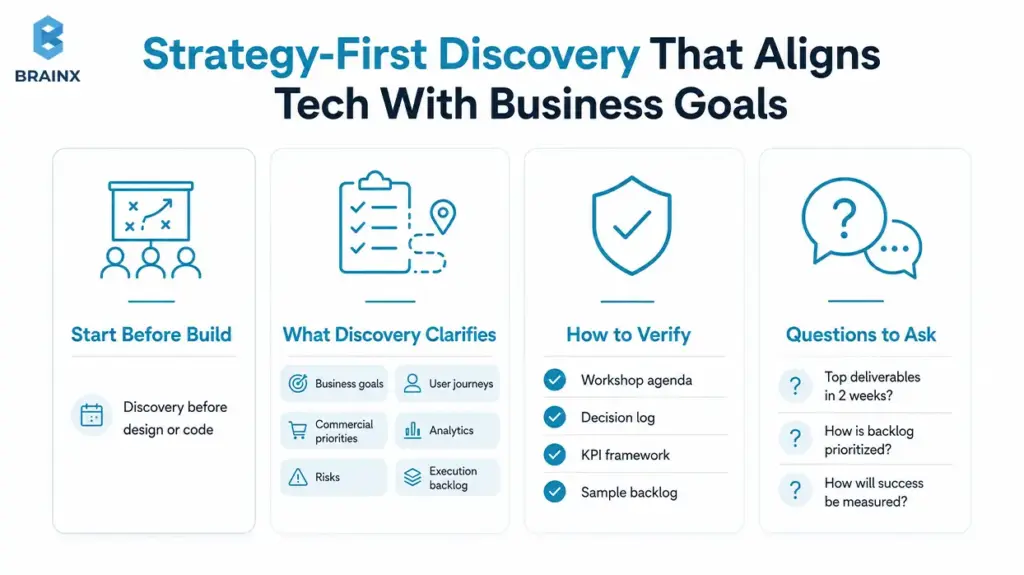
Strong ecommerce delivery starts before design or code. Discovery should clarify business goals, user journeys, commercial priorities, analytics requirements, risks, and the first execution backlog. If a vendor says it “understands the vision” but cannot show a workshop agenda, a decision log, or a measurable success framework, that is not strategic thinking. It is just a polished sales language.
How to verify: Ask for a sample discovery agenda, output deck, KPI framework, and example backlog.
Questions to ask:
- “What are your top discovery deliverables in the first two weeks?”
- “How do you prioritize backlog items: revenue impact, effort, risk, or dependencies?”
- “What metrics will we use to confirm the launch improved performance or conversion?”
Platform and Architecture Expertise for Custom, Headless, and Composable Decisions
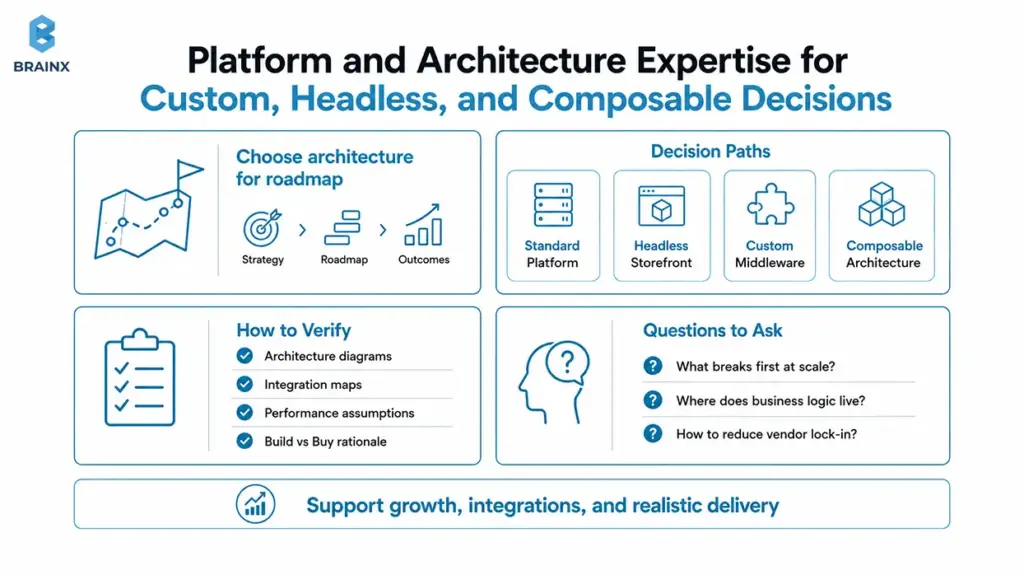
The right partner should be able to explain why a standard platform build is sufficient—or why a decoupled storefront, custom middleware, or composable architecture is justified. Architecture should be chosen because it supports your roadmap, not because it sounds sophisticated in a pitch.
How to verify: Request architecture diagrams, integration maps, performance assumptions, and a build-versus-buy rationale.
Questions to ask:
- “What breaks first when traffic doubles: frontend, backend, or integrations?”
- “Where will business logic live: storefront, backend, or a service layer?”
- “How do you avoid vendor lock-in while keeping delivery realistic?”
Conversion-Focused UX and Merchandising Understanding
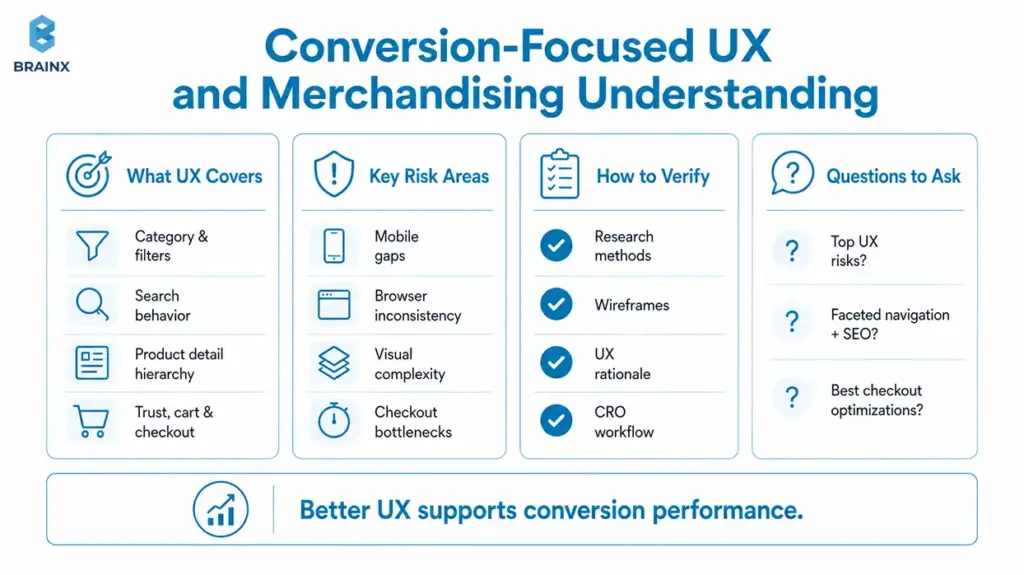
Ecommerce UX is not only visual design. It includes category structure, filters, search behavior, product detail hierarchy, trust signals, cart clarity, checkout friction, subscription logic, and merchandising rules. Recent ecommerce research points to the practical cost of getting this wrong: mobile optimization gaps, browser inconsistency, visual complexity, and checkout bottlenecks all influence exits, task completion, and conversion performance.
How to verify: Ask for research methods, wireframes, UX rationale, examples of merchandising-heavy templates, and a CRO workflow.
Questions to ask:
- “What are your top UX risks for our catalog and customer journey?”
- “How do you design faceted navigation without hurting SEO?”
- “Which checkout optimisations have you seen reliably lift conversion?”
Also Read: UX-First Engineering in Web Design and Development
Performance Engineering for Core Web Vitals, Load, and Scalability
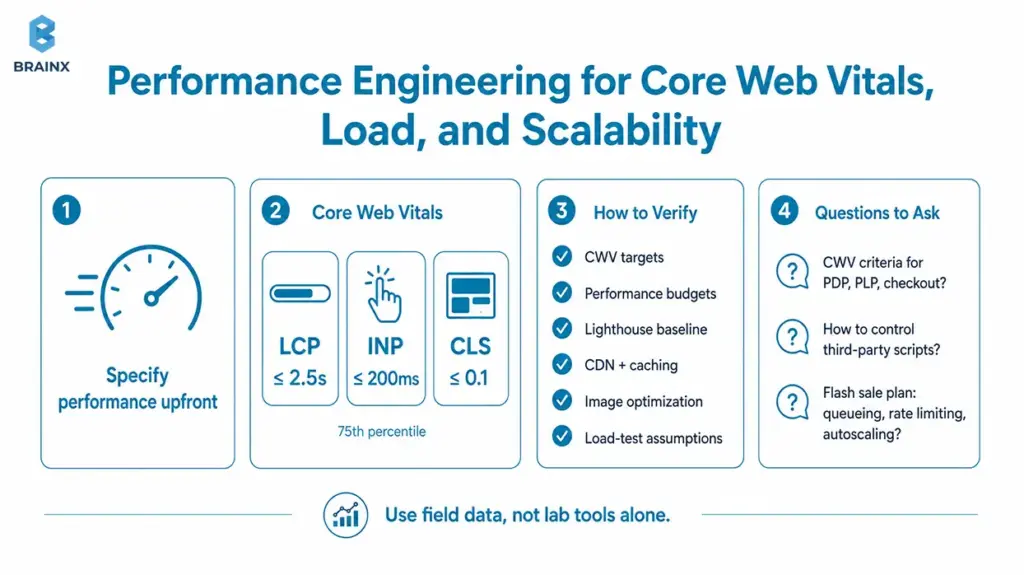
Performance should be specified early, not “optimized later.” Google’s recommended thresholds for the current Core Web Vitals are LCP at 2.5 seconds or less, INP at 200 milliseconds or less, and CLS at 0.1 or less, measured at the 75th percentile. Google also notes that lab tools matter during development, but they do not replace field measurement because real user experience varies by device, network, and interaction pattern. This is one of the clearest places where the best ecommerce website development company separates itself from a generic website vendor.
How to verify: Ask for template-level CWV targets, performance budgets, Lighthouse baselines, CDN and caching strategy, image optimization rules, and load-test assumptions.
Questions to ask:
- “What are your CWV acceptance criteria for PDP, PLP, and checkout?”
- “How do you prevent third-party scripts from degrading performance?”
- “What’s your plan for flash sales: queueing, rate limiting, or autoscaling?”
SEO and Structured Data Baked Into Development
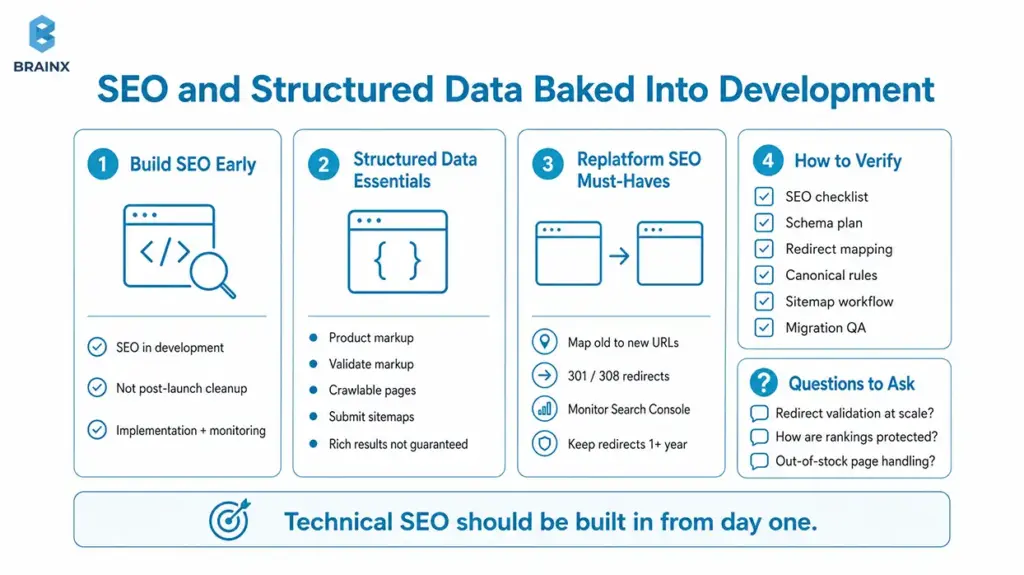
Technical SEO should be part of development, not a clean-up sprint after launch. Google documents that Product markup can make pages eligible for product snippets, recommends validating markup with testing tools, ensuring pages are crawlable, and submitting sitemaps to keep changes updated. Google also makes clear that structured data does not guarantee rich results, which is why implementation quality and monitoring matter.
This becomes even more important during replatforming. Google recommends mapping old URLs to new URLs, using permanent server-side redirects such as 301 and 308 when possible, monitoring Search Console during the move, and keeping redirects in place for as long as possible—generally at least one year.
How to verify: Ask for a technical SEO checklist, schema plan, redirect mapping approach, canonical rules, sitemap workflow, and migration QA process.
Questions to ask:
- “How do you validate redirects and prevent soft 404s at scale?”
- “What’s your process to protect rankings during a replatform?”
- “How do you handle out-of-stock pages and discontinued products?”
Secure-by-Design Development and Compliance Readiness
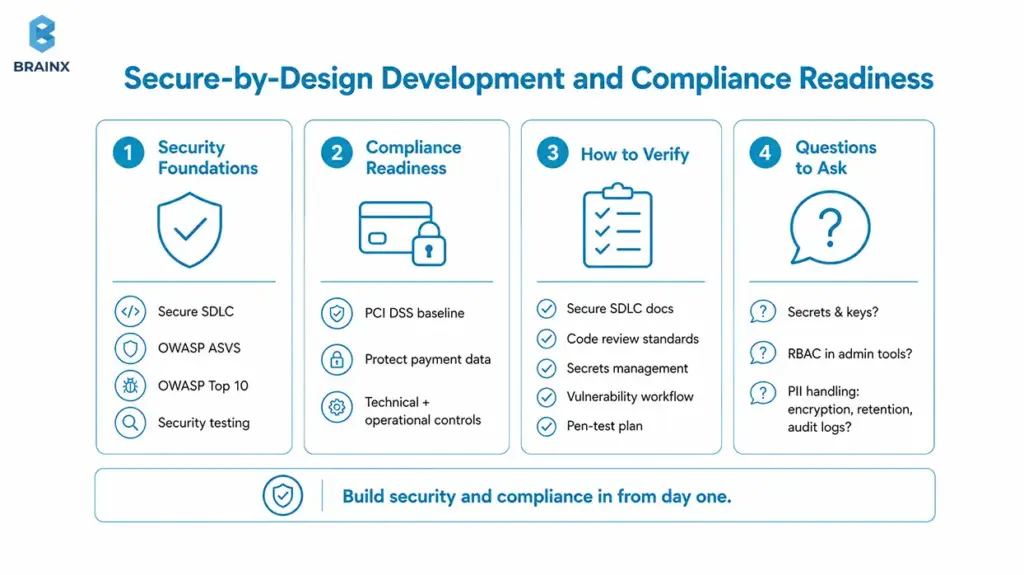
A commerce partner should be able to discuss application security in concrete terms. OWASP ASVS provides a basis for testing web application technical security controls and gives developers a requirements list for secure development. OWASP describes the Top Ten as a broad consensus on the most critical security risks to web applications, and its Web Security Testing Guide provides a framework of best practices used by penetration testers and organizations. PCI SSC states that PCI DSS provides a baseline of technical and operational requirements designed to protect payment account data and applies to entities that store, process, or transmit cardholder data, or that could affect the security of the cardholder data environment.
How to verify: Request secure SDLC documentation, code review standards, secrets-management approach, vulnerability workflow, and pen-testing or security testing plans.
Questions to ask:
- “How do you manage secrets, keys, and environment configs?”
- “What’s your approach to role-based access in admin tools?”
- “How do you handle PII: encryption, retention, and audit logs?”
Integration Depth Across Payments, ERP, CRM, PIM, OMS, and Analytics
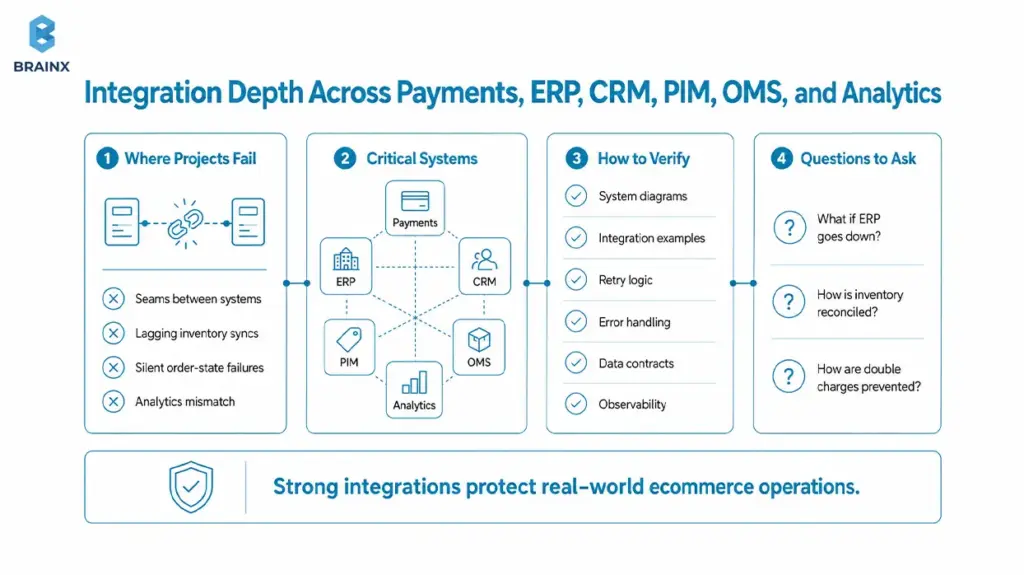
Many ecommerce projects fail in the seams between systems. A storefront can look polished and still break under real business conditions if inventory syncs lag, order states fail silently, refunds do not reconcile, or analytics events do not match reality.
How to verify: Ask for system diagrams, integration case examples, retry logic, error-handling plans, data contracts, and observability coverage.
Questions to ask:
- “What happens when ERP is down? Do we degrade gracefully?”
- “How do you reconcile inventory across channels?”
- “How do you prevent double-charging or order duplication?”
Transparent Delivery Process With Agile, QA, Staging, and Release Management
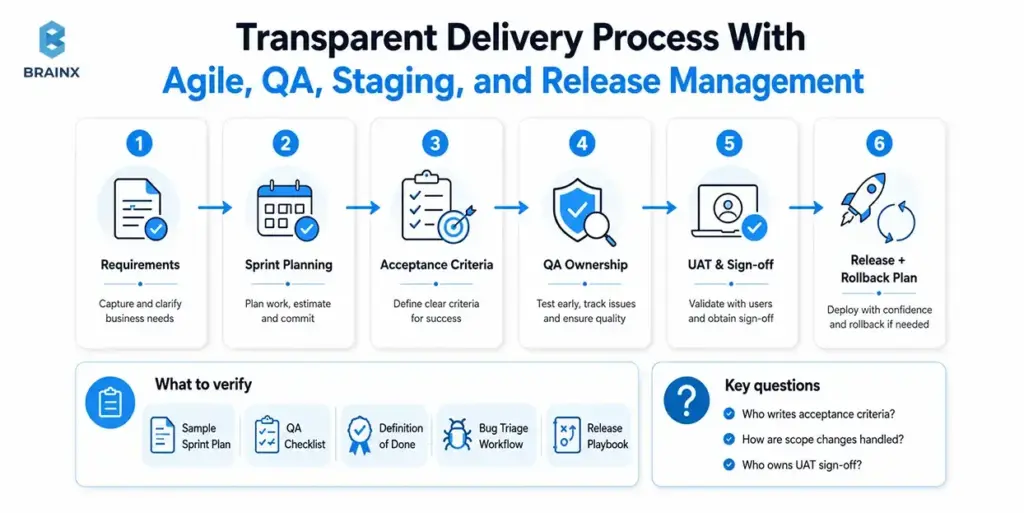
The best company for ecommerce website development should be able to show exactly how work moves from requirement to release. You want sprint planning, acceptance criteria, QA ownership, user acceptance testing, release notes, rollback plans, and clear sign-off routines—not “we are agile” as a standalone answer.
How to verify: Request a sample sprint plan, QA checklist, Definition of Done, bug triage workflow, and release playbook.
Questions to ask:
- “Who writes acceptance criteria: PM, QA, or engineers?”
- “How do you handle scope changes without surprises?”
- “What does UAT look like, and who is responsible for sign-off?”
Ownership Mindset Around Documentation, Handover, and Maintainability
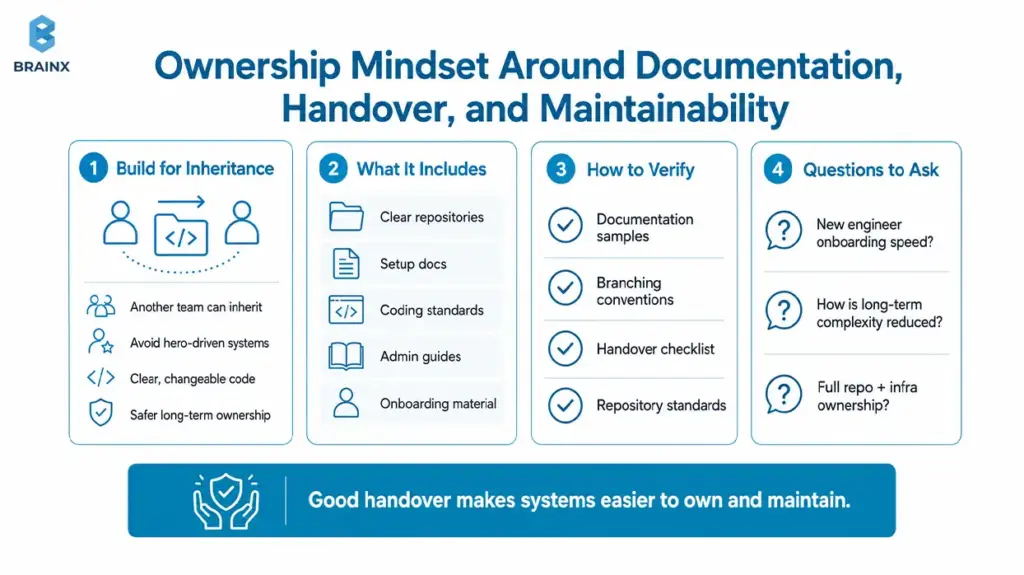
Strong vendors build as if another team may inherit the code later. That mindset leads to clearer repositories, environment setup docs, coding standards, admin guides, and onboarding material—not hero-driven systems that only the original team can change safely.
How to verify: Ask for documentation samples, branching conventions, handover checklist, and repository standards.
Questions to ask:
- “How quickly can a new engineer onboard this codebase?”
- “What’s your approach to reducing long-term complexity?”
- “Do we get full access and ownership of repos and infrastructure?”
Post-Launch Growth Support With Testing, Observability, and Iteration
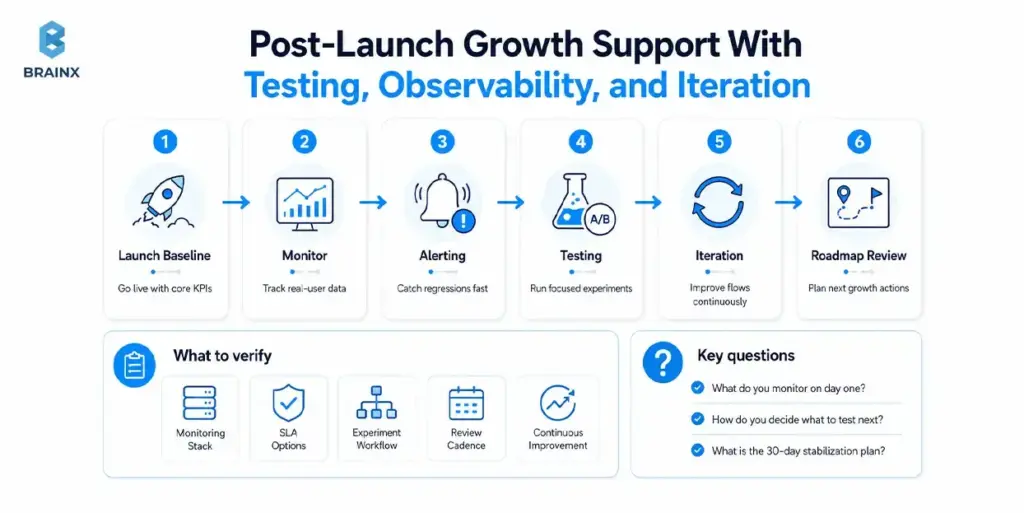
Launch is the beginning of optimization, not the finish line. Google recommends combining broader field visibility with your own real-user monitoring so teams can identify regressions and respond faster. That means a growth-minded partner should already be planning dashboards, alerting, experimentation, and roadmap review before launch day arrives. For many buyers, this is also where the best ecommerce website development company becomes obvious: strong teams do not hand over code and disappear.
How to verify: Ask about the monitoring stack, SLA options, experiment workflow, roadmap review cadence, and ownership of continuous improvement.
Questions to ask:
- “What do you monitor on day one: checkout errors, latency, payment declines?”
- “How do you decide what to test next: data, heuristics, or stakeholder requests?”
- “What’s your stabilization plan for the first 30 days post-launch?”
Red Flags When Choosing the Best Company for Ecommerce Website Development
If you’re searching for the best company for ecommerce website development, red flags matter as much as strengths. These signals predict schedule slips, SEO losses, and a site that’s hard to evolve.
Below are the most common traps—and what to ask instead.
Vague Estimates With No Assumptions
If an estimate doesn’t list assumptions, it isn’t an estimate—it’s a placeholder. A credible proposal ties cost to scope boundaries, risks, and what’s excluded.
What to look for:
- Explicit assumptions (platform chosen, number of templates, integration count)
- Line items for QA, SEO migration, analytics, and release management
- A change control process (how scope changes get priced and scheduled)
What to ask:
- “What must be true for this timeline to hold?”
- “What’s excluded that we’ll likely need later?”
No Performance/Security Acceptance Criteria
If vendors won’t commit to measurable performance and security checks, you’ll pay later in firefighting. “We optimize performance” should translate into targets, tooling, and gates.
Watch for:
- No CWV targets, no load test plan, no pen testing approach
- “We’ll handle security” without secure SDLC specifics
Ask for:
- Written acceptance criteria for CWV, API latency, and error rates
- Minimum security controls (dependency scanning, secrets management, OWASP testing)
No Analytics/Event Tracking Plan
Many ecommerce teams launch without reliable measurement, then guess what to optimize. Tracking should be designed with the user journey—not bolted on.
Red flag signals:
- No event taxonomy (view_item, add_to_cart, begin_checkout, purchase, etc.)
- No plan for deduplication, consent, or server-side tracking where needed
Ask:
- “Which events will we validate in staging before launch?”
- “How do you ensure marketing attribution isn’t broken by the rebuild?”
Proprietary Lock-In Without Clear Rationale
Sometimes proprietary frameworks are justified, but they must be transparent. If the vendor insists on black-box tooling that only they can maintain, you’re buying dependency.
Watch for:
- Limited repo access, unclear hosting ownership, custom CMS without export paths
- “You won’t need to touch it” as a reason to avoid documentation
Ask:
- “How would another team take over in 90 days if needed?”
- “What are our exit options, and what documentation will we receive?”
Cost, Timeline, and Scope: What Drives Ecommerce Website Development Estimates
When buyers compare proposals, they often compare sticker prices instead of assumptions. In practice, the best ecommerce website development company is often the one that makes scope transparent early, because transparent scoping prevents expensive surprises later.
Key cost drivers usually fall into three buckets:
- Experience scope: Number of templates, checkout flows, account pages, content pages, and responsive states.
- Systems scope: Integrations, data sync, admin workflows, and third-party dependencies.
- Risk scope: SEO migration, performance targets, security requirements, compliance needs, and launch-readiness testing.
Key Scope Drivers
Scope expands quickly with real-world commerce requirements. The biggest multipliers are usually:
- Catalog complexity: variants, bundles, subscriptions, custom attributes, multi-warehouse inventory
- Integrations: ERP/OMS/PIM/CRM, shipping carriers, tax engines, search, personalization
- Checkout customization: one-page checkout, custom payment flows, fraud tooling, split shipments
- Localization: multiple currencies, languages, tax rules, region-specific content and pricing
- Content and SEO: CMS needs, redirect mapping, canonical rules, faceted navigation handling
If two proposals differ by 2–3x, it’s often because one is assuming “standard platform capabilities” while the other is accounting for the integration and operational edge cases.
Typical Delivery Phases
A healthy ecommerce program usually moves through discovery, UX and scoping, design system work, engineering, QA, launch preparation, and post-launch stabilization. BrainX’s public ecommerce process includes requirement gathering, competitive analysis, UI/UX design, development, QA testing, launch, and maintenance. Its broader product-development process also highlights stakeholder alignment, functional scoping, sprint-based development, testing, and post-launch support. Those are exactly the kinds of phases serious buyers should expect a mature partner to make visible.
- Discovery: 1–3 weeks
- UX/UI design: 2–6+ weeks
- Build: 4–16+ weeks
- QA and hardening: 2–6 weeks
- Launch and stabilization: 1–4 weeks
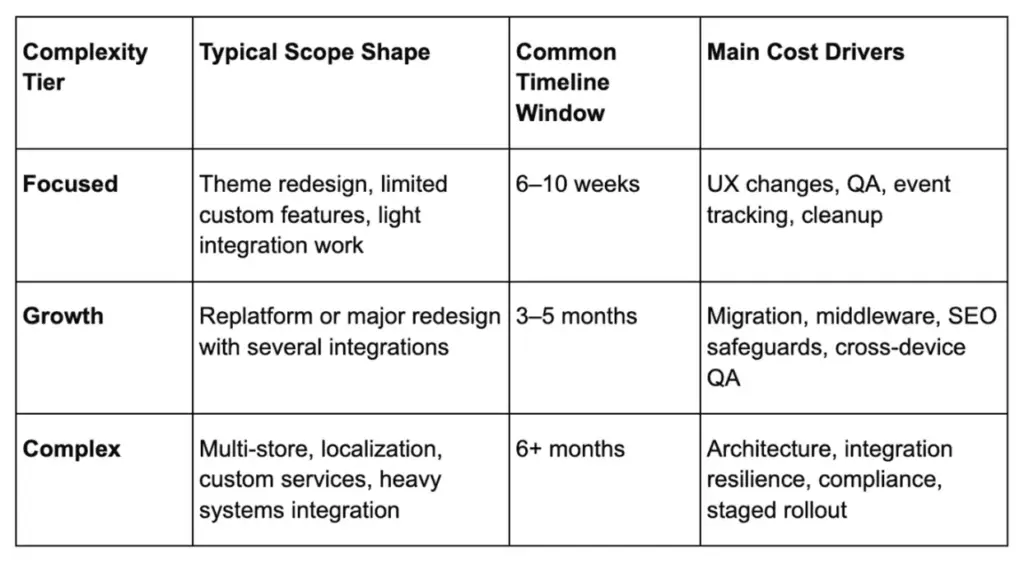
Engagement Models
Fixed-scope engagements work best when requirements are stable and the risk profile is low. Agile retainers usually work better when priorities may shift, unknowns remain, or optimization is part of the mandate.
A hybrid model is often the safest option for complex ecommerce builds: fixed discovery and architecture first, then Agile execution once scope, risks, and priorities are clearer.
How to Evaluate Best Ecommerce Website Development Company in USA Without Overpaying
If your shortlist includes the best ecommerce website development company in USA or a U.S.-facing delivery team, do not pay more simply for a postal address. Pay for communication quality, compliance readiness, delivery maturity, and decision speed.
Separate what you truly need in-country from what can be delivered globally without quality loss.
Also Read: How to Choose a Software Development Company: Fundamental Do’s and Don’ts
US-Market Expectations for Accessibility, Privacy, and Payments
In the U.S. market, accessibility and privacy cannot be treated as late-stage polish. W3C’s WCAG 2.2 is the current recommendation for web accessibility work, and W3C notes that following it makes content more accessible across devices and often more usable in general. California’s Attorney General states that the CCPA gives consumers more control over personal information and that CPRA amendments have been in effect since January 1, 2023.
That means vendors serving U.S. brands should be ready to discuss keyboard support, form behavior, privacy notices, data-handling expectations, and payment-stack implications—not just theme customization.
Hybrid Delivery Models With US-Facing PM and Global Engineering
The best ecommerce website development company in USA is not always the one with every contributor sitting in one U.S. office. Many buyers get better economics and wider technical depth from hybrid delivery models that combine U.S.-aligned leadership with globally distributed engineering.
What matters is whether decision ownership, overlap hours, escalation paths, and documentation are explicit. If those are vague, the model is risky no matter where the team is based.
Procurement-Friendly Proof
For larger organizations, procurement readiness matters almost as much as delivery capability. Ask for MSA and SOW examples, sample status reporting, security policies, referenceability, and warranty terms. BrainX publishes an Information Security Policy that states its ISMS is established in accordance with an ISO 27001 baseline, and it publicly lists a U.S. office in Newark, Delaware. Those are the kinds of proof signals many buyers want to see during early vendor review.
Buyer Toolkit: Scorecard + RFP Questions to Pick the Right Partner
When multiple vendors look similar, scoring discipline helps. This is the section that turns a subjective shortlist into a more defensible buying decision. It is also a practical way to compare each candidate for the best ecommerce website development company without relying on gut feel.
Best Ecommerce Website Development Company Ten-Point Scorecard
Rate each quality from 0 to 5, where 0 means “no evidence,” 3 means “adequate proof,” and 5 means “clear, credible, repeatable evidence.”
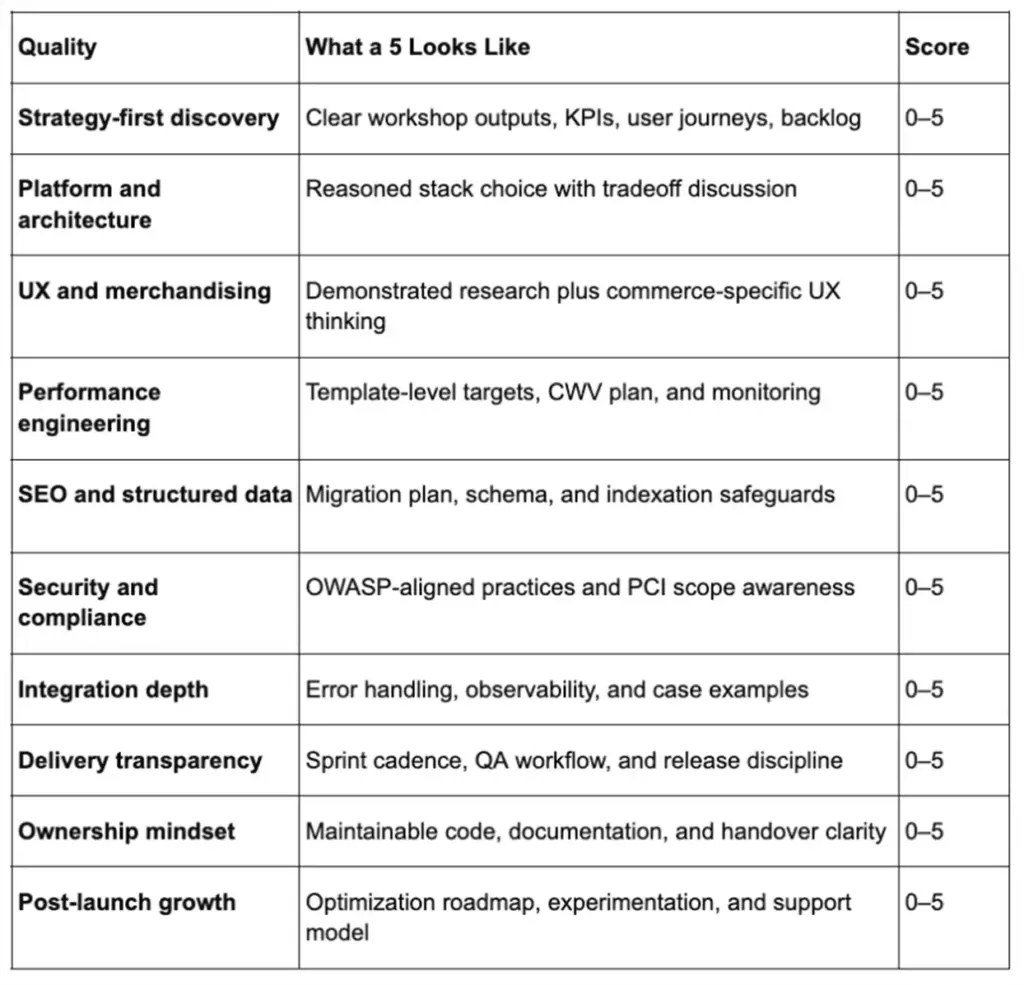
How to interpret totals:
- 40–50: Strong candidate for complex builds and long-term iteration.
- 30–39: Likely workable for moderate scope, but validate weak areas with paid discovery.
- Below 30: High risk unless the project is very simple and timeboxed.
It is also where a buyer can pressure-test whether the best ecommerce website development company on paper is actually the best fit in practice.
RFP Questions Mapped to Each Quality
Use one sharp question per quality:
- “What are your discovery deliverables in the first 10 business days?”
- “Show a redacted backlog you produced and how it mapped to goals.”
- “Explain your recommended architecture and why alternatives were rejected.”
- “Where is the source of truth for product, inventory, and customer data?”
- “What CWV targets will you commit to for mobile?”
- “How do you control third-party script impact?”
- “What’s your migration QA plan for redirects, canonicals, and indexation controls?”
- “How do you monitor integration failures and reconcile data?”
- “What is your Definition of Done?”
- “What is your 30-day stabilization plan?”
What Deliverables to Ask for in the First Two Weeks
In the first two weeks, ask for:
- Architecture decision record: Platform, hosting, deployment approach, and major tradeoffs.
- Measurement plan: Event taxonomy, funnel tracking, dashboard outline, and ownership.
- SEO migration plan: Redirects, canonical rules, sitemap handling, and indexation controls.
- Performance budget: CWV targets, image strategy, script rules, and testing approach.
- Integration map: Systems, owners, data contracts, failure modes, and monitoring needs.
- Release plan: Environments, feature flags, rollback strategy, and launch checklist.
If a vendor can’t produce these quickly, it’s a signal they’ll “figure it out later”—on your timeline and budget.
How BrainX Helps With Ecommerce Website Development
BrainX’s service and process pages map cleanly to the evaluation rubric above. The company documents ecommerce services that include store development, API integration, store migration, third-party integrations, theme development, custom templates, page-speed optimization, app development, QA, launch, and support.
Its product-development process also emphasizes requirement gathering, competitor research, UI/UX scoping, risk evaluation, sprint-based development, testing, and post-launch support. BrainX also publicly states 9+ years of experience, 120+ engineers, 250+ projects, and 130+ satisfied clients.
The more useful proof is outcome-level work. On BrainX’s public ecommerce case-study pages, Upgraded Formulas reports a 36% increase in total sales, a 10% lift in conversion rate, and a 16% increase in returning customer rate after work involving Shopify OS 2.0, theme customization, speed optimization, HubSpot integration, and cart improvements.
JustThrive reports a 56% increase in session conversions, a 16% increase in orders, and a 14% increase in total sales after UX work, custom app development, funnel optimization, speed improvements, and Shopify Plus customization. Wellnesse reports 37% growth in total sales and 17% growth in average order value after a UX/UI redesign focused on navigation, product browsing, and checkout usability.
If you are evaluating the best ecommerce website development company for a redesign, migration, or growth-stage ecommerce program, BrainX offers several relevant starting points. Our Ecommerce Website Development Services page, blog on UX-First Engineering in Web Design and Development, Web Application Development Process Guide, and a discovery call / estimate request.

Next Steps: Shortlist, Validate, and Kick Off
The next move can be simple.
- Shortlist 3–5 vendors
Choose based on scope fit, integration depth, compliance needs, and evidence quality. - Validate with the scorecard and artifacts
Ask for proof: architecture diagrams, QA approach, SEO migration plan, performance targets, and documentation samples. - Kick off with paid discovery or a defined Phase 1
The first phase should produce a backlog, risk register, timeline, acceptance criteria, and launch plan.
If you follow that path, you will not just hire a vendor that sounds confident. You will be much more likely to choose the best ecommerce website development company for your stage, risk tolerance, and growth plan.
FAQs about Defining the Best Ecommerce Website Development Company
What Makes the Best Ecommerce Website Development Company Different From a General Web Agency?
A general web agency can build attractive pages, but ecommerce requires deep expertise in checkout flows, catalog complexity, integrations, performance, SEO edge cases, and security. The best teams treat conversion, reliability, and operational workflows as first-class requirements.
They also provide proof artifacts—like CWV targets, migration plans, and integration failure handling—rather than vague promises. Finally, they build for maintainability so your team can iterate quickly after launch.
How Do I Compare Ecommerce Development Companies Beyond Portfolio Screenshots?
Ask for proof artifacts: discovery outputs, architecture diagrams, QA workflows, launch plans, documentation samples, and post-launch support details. Request a redacted Lighthouse report, an example backlog with acceptance criteria, and a sample release checklist.
Lastly, score each vendor using the same rubric across performance, SEO, security, and integrations. It will help turn subjective preferences into an objective comparison.
What Platform Should the Best Company for Ecommerce Website Development Recommend for My Business?
The right recommendation depends on your catalog complexity, integrations, and how quickly you need to change experiences. A credible partner will explain tradeoffs and provide a “why not” list for alternatives (not just push the stack they prefer).
They should also clarify where business logic will live and how data sync will work across systems. If the vendor can’t tie platform choice to measurable outcomes and constraints, treat it as a warning sign.
How Much Does It Cost to Hire an Ecommerce Website Development Company in the USA?
There is no universal benchmark, because scope changes everything. In practical buying discussions, budgets often range from focused five-figure projects to complex six-figure programs once design, engineering, QA, migration, integrations, and launch support are included. The more useful comparison is not agency rate alone. It is the assumptions behind the number: catalog structure, custom checkout needs, integrations, localization, data migration, and support coverage. A buyer looking for the best ecommerce website development company should compare pricing against execution risk, not against the lowest headline quote.
How Long Does Ecommerce Website Development Usually Take?
A focused redesign may take weeks, a replatform often takes a few months, and a complex multi-system rollout can take much longer. Timelines are driven less by code volume than by decisions, dependencies, migration quality, and QA discipline.
What Should Be Included in an Ecommerce Development Contract to Avoid Surprises?
A solid SOW should define deliverables, acceptance criteria, environments, and responsibilities across discovery, build, QA, and launch. Include performance targets (like CWV goals), security expectations (testing approach, vulnerability handling), and SEO migration requirements (redirects, indexation safeguards).
It should also specify change control (how scope changes affect cost/timeline), IP ownership, documentation/handover, and post-launch support terms. Clear assumptions and exclusions are just as important as the feature list.