 August 4, 2026 -
 37 minutes read


Predictive analytics in healthcare uses historical and real-time data to anticipate future events, which allows organizations to take proactive action and optimize resource allocation. Its value does not come from producing another score or dashboard. It originates from linking a credible prediction to a clinical, operational or financial action.
Adoption is widespread already. In 2024, 71% of non-federal acute care hospitals reported using predictive AI integrated with their electronic health records, up from 66% in 2023. Billing automation and scheduling were the fastest-growing applications, and inpatient risk prediction was among the most common ones.
This guide will outline the most impactful use cases, the ROI you can expect, the way leading companies tackle the market and how to implement predictive analytics without alert fatigue, privacy concerns or biased decisions.
Key Takeaways
- Start with an action, not a model. Establish who is to use the prediction, what they will do differently, and how fast they have to act on it.
- Operational use cases usually move faster. No-show prediction, scheduling, billing, call routing, and capacity forecasting often involve clearer data and lower clinical risk.
- Clinical use cases require stronger safeguards. Readmission, deterioration, sepsis, and ICU escalation models need local validation, silent testing, subgroup analysis, and clinical governance.
- Model accuracy is only one measure. Calibration, intervention completion, alert volume, subgroup performance, and measurable outcome improvements are equally important.
- Adoption is a result of integration, validation and clinician involvement. In the AMA’s 2026 survey, physicians said they valued strong safety and efficacy validation, data privacy, and partaking in decisions about AI adoption within their organization.
- Monitoring must begin at launch. Data distributions, calibration, workload, fairness, and outcomes can change after deployment.
- Select companies on the basis of evidence, rather than demonstrations. Check their interoperability, validation, monitoring, security, documentation and post-launch support.
What Is Predictive Analytics in Healthcare?
Predictive analytics in healthcare is the application of statistical techniques and machine learning to existing data to forecast the likelihood of future clinical, operational, or financial events.
Predictive modeling is the mathematical component. Predictive analytics is the wider system surrounding it, including data preparation, workflow integration, intervention design, monitoring, governance, and outcome measurement.
The strongest use cases have four characteristics:
- The event happens frequently enough to measure.
- Relevant data is available before the decision.
- Someone can take action based on the prediction.
- The result can be compared with a clear baseline.
Typical examples include readmissions, patient deterioration, appointment no-shows, bed demand, claim denials, and high-risk or high-cost populations.
A model should not be constructed simply because something can be predicted. The better question is: Will knowing the risk earlier change what the organization does?
Descriptive, Predictive, and Prescriptive Analytics in Healthcare
Healthcare analytics is often described as a progression from understanding past performance to anticipating future events and selecting an appropriate response.
| Analytics Type | Core Question | Typical Output | Healthcare Example | Primary Role |
| Descriptive analytics | What happened? | Reports, dashboards, trends, and baseline measures | Reviewing last quarter’s readmission, no-show, or denial rates | Establishes the current state and identifies patterns that need attention |
| Predictive analytics | What is likely to happen? | Risk scores, forecasts, probabilities, and prioritized lists | Estimating which patients may be readmitted or how many beds may be needed | Helps teams focus limited attention and resources before an event occurs |
| Prescriptive analytics | What action should be considered? | Recommended actions, optimized schedules, or decision pathways | Assigning a transitional-care review or adjusting staffing based on forecast demand | Connects the prediction to an intervention, often through rules, optimization, and human review |
In practice, the three approaches work together. Descriptive analytics establishes the baseline, predictive analytics estimates future risk or demand, and prescriptive logic helps determine what action should follow. The prediction creates value only when that action is safe, feasible, and measurable.
What “Prediction” Means in Clinical vs. Operational Workflows
In clinical workflows, prediction usually produces an individual risk score. It may estimate whether a patient is likely to deteriorate, require hospitalization, develop complications, return after discharge, or need a higher level of care.
The score must connect to a clearly defined response, such as:
- Rapid-response assessment
- Pharmacist review
- Transitional care support
- Medication reconciliation
- Earlier diagnostic testing
- Post-discharge follow-up
Operational predictions usually estimate demand or behavior. A hospital may forecast inpatient census, emergency department arrivals, imaging demand, staffing needs, appointment attendance, or claim-denial risk.
The practical difference is:
- Clinical prediction: Who may need an intervention?
- Operational prediction: What should the organization prepare for?
Clinical models typically require more rigorous validation because an incorrect prediction could affect patient treatment. Operational models can also create harm through inequitable scheduling, resource allocation, or access decisions, but their consequences and governance requirements are often different.
How Predictive Analytics Works in Healthcare
A predictive analytics workflow usually moves through four connected stages. Each stage must be designed around the decision the organization wants to improve.
- Data Aggregation and Preparation: Relevant data is collected from EHRs, claims systems, scheduling platforms, ADT feeds, monitoring devices, or other approved sources. Teams define the prediction point, clean and map the data, resolve patient identities, and confirm that each input was available before the outcome occurred.
- Feature Engineering and Model Training: The team converts raw data into usable predictors, defines the outcome label, selects an appropriate statistical or machine-learning method, and compares the model with a simple baseline. The goal is not maximum complexity; it is reliable performance for the intended decision.
- Validation and Deployment: The model is evaluated for calibration, discrimination, subgroup performance, data leakage, and workflow capacity. It may then move through retrospective validation, a silent trial, shadow mode, and a limited pilot before broader deployment.
- Action, Intervention, and Outcome Measurement: The prediction is delivered to a responsible team through an existing work queue, EHR view, or operational system. The organization records whether the intervention was completed and measures clinical, operational, and financial outcomes against the baseline.
Consider a hospital that wants to improve discharge planning.
The model uses recent utilization, diagnoses, medications, laboratory results, prior admissions, discharge destination, and selected social-risk information. It predicts the likelihood of each patient being readmitted within 30 days.
Instead of displaying the score to every clinician, the system adds higher-risk patients to a case-management work queue. A transitional care nurse then reviews medication access, transportation, follow-up appointments, home support, and other discharge barriers.
Patient data → Readmission risk → Prioritized work queue → Transitional intervention → Outcome measurement
The model does not prevent a readmission by itself. It helps the hospital allocate limited case-management capacity to patients who may benefit most from additional support.
What Data Does Predictive Analytics in Healthcare Use?
Most predictive programs begin with existing structured data in EHRs, claims platforms, scheduling systems, or other administrative applications.
CMS notes that EHRs may contain demographics, clinical notes, diagnoses, medications, vital signs, medical history, laboratory data, immunizations, and radiology reports.
| Data Source | Common Uses | Typical Priority |
| EHR demographics and encounters | Readmissions, utilization, and population risk | Core |
| Diagnoses and procedures | Clinical risk, cost prediction, and claims analysis | Core |
| Laboratory results and vital signs | Deterioration, sepsis, and ICU escalation | Core for acute-care models |
| Claims data | Longitudinal utilization, payer risk, and high-cost members | Core for payer use cases |
| ADT and scheduling data | Bed demand, no-shows, and patient flow | Core for operations |
| Clinical notes | Feature extraction, context, and social barriers | Optional for early projects |
| Imaging | Diagnostic and image-derived risk models | Use-case dependent |
| Social determinants of health data | Outreach targeting, access barriers, and equity review | Valuable but sensitive |
| Wearables and remote monitoring | Chronic care and continuous-risk prediction | Optional |
| Genomic data | Precision medicine and specialized risk models | Advanced |
FHIR provides a standard for exchanging healthcare data. However, supporting FHIR does not automatically resolve data-quality or workflow-integration challenges. Organizations must still map local codes, patient identities, timing, and business rules.
More data is not automatically better. Add a source only when it materially improves calibration, subgroup performance, timeliness, or intervention targeting.
Where Predictive Analytics Breaks Down
Predictive analytics breaks down when the development data, outcome definition, or workflow no longer represents the real decision environment.
Common failure modes include:
- Selection bias: Certain patients, facilities, or care settings are underrepresented.
- Historical bias: Past inequalities are encoded into outcomes, access patterns, or resource-use labels.
- Missingness: The absence of a test, diagnosis, or note carries hidden workflow meaning.
- Confounding: The model learns a proxy rather than the intended clinical relationship.
- Data leakage: Information created after the prediction point appears in the training inputs.
- Dataset shift: Patient populations, coding, policies, technology, or clinical practices change.
- Poor calibration: A predicted 30% risk does not correspond with an approximately 30% observed event rate.
- Workflow mismatch: The prediction arrives too late, reaches the wrong team, or creates more cases than staff can manage.
TRIPOD+AI recommends transparent reporting across data, predictors, outcomes, methods, performance, and intended use. PROBAST+AI provides a related framework for evaluating model quality, risk of bias, fairness, and applicability.
Why Predictive Analytics Matters in Healthcare: Benefits and ROI
Healthcare organizations are investing because predictive systems are moving from isolated experiments into routine clinical and administrative workflows.
According to a September 2025 ASTP data brief based on the 2024 AHA Information Technology Supplement, 71% of non-federal acute care hospitals reported using predictive AI integrated with their EHRs, up from 66% in 2023. Inpatient risk prediction remained one of the most common applications, while billing and scheduling were among the fastest-growing uses.
The return does not come from owning an advanced model. It comes from changing how clinical attention, labor, beds, appointment capacity, and financial resources are allocated.
Improving Patient Outcomes
Clinical predictive analytics can help teams identify deterioration, readmission risk, medication-related concerns, complications, or unmet follow-up needs earlier. However, the score must be paired with an intervention that a qualified team can deliver.
Potential benefits include:
- Earlier bedside assessment or escalation
- More targeted transitional care and follow-up
- Improved medication reconciliation
- Faster identification of discharge barriers
- Better prioritization of care-management capacity
- More consistent monitoring of high-risk patients
A 2025 multisite pragmatic cluster-randomized trial evaluated the CONCERN early warning system across 74 hospital units and 60,893 encounters. When integrated into the care team’s EHR workflow, the intervention was associated with a 35.6% lower instantaneous risk of in-hospital death and an 11.2% shorter length of stay.
However, a 2026 randomized trial involving 10,422 inpatient visits found that passively displaying AI-generated risk trajectories without requiring a specific clinical response did not improve the primary outcome.
Together, these studies reinforce an important lesson: predictive analytics is more likely to improve patient outcomes when the prediction reaches a responsible care team, triggers a defined response, and fits the existing clinical workflow.
Operational Efficiency and Resource Utilization
Operational ROI often appears earlier because the workflows are easier to measure and usually carry less direct clinical risk. These use cases can improve how organizations allocate staff time, appointment capacity, beds, and service-line resources.
Examples include:
- Recovering appointment slots through targeted reminders and easier rescheduling
- Forecasting bed demand and staffing requirements
- Prioritizing discharge planning
- Reducing avoidable overtime
- Smoothing elective surgery schedules
- Routing calls and patient messages to the correct team
- Identifying claims that require correction before submission
Operational benefits should still be evaluated for unintended consequences. A scheduling model, for example, should improve access rather than deprioritize patients who face transportation, language, financial, or digital barriers.
Cost Reduction and Value-Based Care
Financial value may come from:
- Preventing avoidable denials
- Detecting incomplete documentation before claim submission
- Improving risk-adjustment workflows
- Reducing missed appointment capacity
- Lowering unnecessary utilization
- Targeting care-management resources
- Improving discharge coordination
- Reducing exposure to readmission penalties
The Hospital Readmissions Reduction Program can reduce eligible Medicare hospital payments by up to 3% for excess readmissions.
However, ROI is often overstated when organizations:
- Attribute every improvement to the model
- Count alerts as successful interventions
- Treat reassigned labor as immediate cash savings
- Ignore licensing, integration, and training costs
- Exclude ongoing monitoring and support
- Compare post-launch performance with an unadjusted historical period
- Ignore other quality-improvement programs running at the same time
A credible business case should measure incremental improvement against a clear baseline or comparison group. It should also distinguish cost avoidance, recovered capacity, quality improvement, and realized cash savings.
What “Good” Looks Like: Adoption, Workflow Fit, and Measurable Improvement
A successful predictive analytics program performs well at three connected levels.
| Measurement Layer | Example Metrics |
| Model performance | Calibration, sensitivity, specificity, AUPRC, AUROC, and subgroup performance |
| Workflow performance | Alert acceptance, intervention completion, time to action, override rate, and staff workload |
| Outcome performance | Readmission rate, no-show rate, denial rate, length of stay, escalation rate, cost per case, and access measures |
AUROC measures how well a model separates higher-risk and lower-risk cases. It does not show whether predicted probabilities are accurate, whether the selected threshold is useful, or whether the organization can manage the resulting number of alerts.
A model can have strong discrimination and still fail because:
- It flags more patients than the team can manage.
- Its probabilities are poorly calibrated.
- It performs worse for a specific patient group.
- It arrives after the relevant decision has already been made.
- Users must open another application to see it.
- No one owns the intervention.
The AMA’s 2026 physician survey found that 88% of physicians considered robust safety and efficacy validation critical for broader AI adoption, 86% prioritized data privacy, and 85% wanted to be consulted or directly involved in organizational AI-adoption decisions.
8 Real-World Predictive Analytics Use Cases in Healthcare
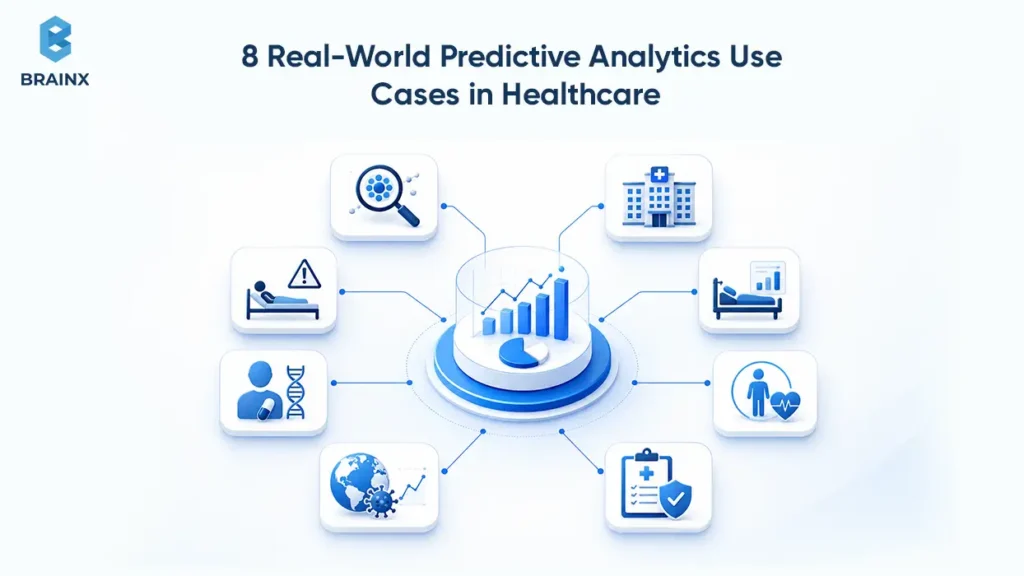
The most valuable applications connect inputs, predictions, actions, and measurable outcomes. The eight use cases below cover clinical, operational, and financial priorities, while showing what must happen after a risk score or forecast is generated.
1. Can We Reduce Avoidable Readmissions With Better Targeting?
Inputs: Prior utilization, diagnoses, medications, laboratory results, discharge disposition, follow-up history, and social-risk indicators.
Prediction: Likelihood of an unplanned readmission within a defined period.
Action: Assign higher-risk patients to transitional care, pharmacist review, home-health coordination, medication support, or earlier follow-up.
KPIs:
- Risk-adjusted readmission rate
- Percentage of flagged patients receiving an intervention
- Time from discharge to follow-up
- Case-manager workload
- Medication reconciliation completion
A 2026 prospective multicenter study comparing machine-learning and conventional risk scores for 30-day readmission among multimorbid patients found modest external-validation discrimination, with AUC values ranging from 0.52 to 0.59. The findings show why local validation and realistic expectations remain essential.
2. Can We Predict Patient Deterioration, Sepsis, or ICU Escalation Early Enough to Act?
Inputs: Vital signs, laboratory trends, nursing observations, medications, oxygen requirements, recent clinical changes, and relevant time-series data.
Prediction: Likelihood of ICU transfer, rapid-response activation, sepsis, cardiopulmonary arrest, or another deterioration event within a short time frame.
Action: Trigger a structured bedside assessment, physician review, escalation checklist, increased monitoring, or rapid-response evaluation.
KPIs:
- Alert-to-assessment time
- Unplanned ICU transfers
- Rapid-response activations
- Sepsis incidence or time to treatment
- Cardiopulmonary arrests outside intensive care
- False-alert burden
The workflow must define what happens when the model is wrong. False positives consume clinical capacity, while false negatives may delay intervention.
The CONCERN early warning trial provides a useful real-world example of a prediction embedded into an EHR workflow and evaluated through a multisite pragmatic trial rather than through retrospective accuracy alone.
3. Can We Prevent Missed Appointments and Improve Patient Access?
Inputs: Appointment history, booking lead time, appointment type, reminder engagement, travel distance, rescheduling history, and other ethically reviewed signals.
Prediction: Likelihood that an appointment will be missed or canceled late.
Action: Send tailored reminders, provide easier rescheduling, offer wait-list alternatives, coordinate transportation support, or conduct targeted human outreach.
KPIs:
- No-show rate
- Late-cancellation rate
- Slot utilization
- Days to the next available appointment
- Outreach conversion
- Performance across demographic groups
Avoid interventions that punish higher-risk patients. The goal is to remove barriers and improve access, not to automatically double-book, deprioritize, or restrict people based on demographic or payer-related features.
A related operational application is call-center and message routing. Models can classify the likely reason for a call or message and direct it to scheduling, billing, nursing, pharmacy, or another relevant queue. Useful metrics include first-contact resolution, response time, transfer rate, abandonment rate, and staff handling time.
4. Can We Forecast Demand for Beds, Staffing, Imaging, and Elective Surgeries?
Inputs: Current census, historical arrivals, scheduled procedures, expected discharges, seasonal patterns, service-line demand, staffing availability, and turnaround times.
Prediction: Expected demand by unit, modality, service line, or time period.
Action: Adjust staffing, coordinate discharges, smooth elective schedules, reserve capacity, or redistribute resources.
KPIs:
- Emergency department boarding time
- Bed turnaround time
- Overtime hours
- Imaging backlog
- Same-day cancellation rate
- Forecast error
Oracle Health, for example, describes using near-real-time data and predictive analytics to anticipate patient flow and resource needs.
5. Can We Predict Length of Stay and Identify Discharge Barriers Earlier?
Inputs: Diagnoses, procedures, laboratory trends, mobility, care intensity, discharge destination, prior utilization, social-risk information, and unresolved clinical or administrative tasks.
Prediction: Expected length of stay or likelihood of a delayed discharge.
Action: Prioritize case-management review, post-acute placement, home-health coordination, medication access, transportation, equipment, or other discharge requirements.
KPIs:
- Observed-to-expected length of stay
- Percentage of discharge barriers resolved before the planned discharge date
- Discharge-order-to-departure time
- Avoidable bed days
- Readmission and post-discharge follow-up rates
Length-of-stay predictions should support planning rather than pressure clinicians to discharge patients before it is safe.
6. Can We Improve Revenue Cycle and Claim-Denial Outcomes?
Inputs: Claim details, payer rules, diagnosis and procedure combinations, authorization status, documentation completeness, coding patterns, and historical denial reasons.
Prediction: Probability of denial, undercoding, missing documentation, authorization failure, or delayed payment.
Action: Route higher-risk claims to the appropriate billing, coding, authorization, or clinical-documentation team before submission.
KPIs:
- Initial denial rate
- Clean-claim rate
- Days in accounts receivable
- Rework volume
- Net collections
- Appeal success rate
The 2025 ASTP data brief identified billing and scheduling as two of the fastest-growing hospital uses of predictive AI, which helps explain why operational projects often become practical starting points.
7. Can Health Plans Identify High-Risk or High-Cost Members and Personalize Outreach?
Inputs: Claims, pharmacy data, utilization, diagnoses, care gaps, enrollment information, and approved social-risk information.
Prediction: Likelihood of hospitalization, high future costs, medication non-adherence, worsening chronic disease, or an unmet care need.
Action: Prioritize members for care management, pharmacy support, preventive care, chronic-disease outreach, or benefits navigation.
KPIs:
- Outreach completion
- Care-gap closure
- Avoidable utilization
- Medication adherence
- Cost trends
- Member engagement
- Equity of intervention access
Cost should not be used as a proxy for clinical need without validation. Historical spending can reflect unequal access rather than a person’s actual health status.
8. Can We Predict Emergency Department Returns and Near-Term Care Needs?
Inputs: Presenting complaint, diagnoses, vital signs, laboratory results, prior emergency visits, medications, discharge instructions, follow-up access, and selected social-risk indicators.
Prediction: Likelihood of an unplanned emergency department return, hospitalization, or another near-term care need after discharge.
Action: Provide more detailed discharge instructions, schedule follow-up, arrange pharmacy or care-management support, or escalate review before discharge.
KPIs:
- Risk-adjusted emergency department return rate
- Follow-up completion
- Medication-access issues resolved
- Time to post-discharge contact
- Percentage of flagged patients receiving an intervention
- Performance across patient groups
Outcome labels must distinguish avoidable returns from clinically appropriate revisits. A return visit is not automatically evidence of poor care.
Which Use Cases Offer the Fastest Wins or the Highest Clinical Impact?
The fastest wins usually come from administrative and operational predictions. The highest clinical impact often comes from models that influence urgent care decisions and therefore require stronger evidence, governance, and clinical ownership.
A first use case should score well across four dimensions:
- Data availability
- Action clarity
- Outcome measurability
- Implementation risk
| Use Case | Potential Impact | Implementation Risk | Suggested Sequence |
| No-show prediction | Medium | Low | Phase 1 |
| Scheduling, call routing, or message routing | Medium | Low | Phase 1 |
| Revenue-cycle or claim-denial prediction | Medium to high | Low to medium | Phase 1 |
| Bed-demand and capacity forecasting | Medium to high | Low to medium | Phase 1 |
| Readmission, ED-return, or length-of-stay prediction | Medium to high | Medium | Phase 2 |
| High-risk or high-cost member outreach | High | Medium | Phase 2 |
| Deterioration, sepsis, or ICU escalation | High | High | Phase 3 |
| Mortality, complication, or treatment-related risk | High | Very high | Phase 3 with formal governance |
Mortality, complication, and treatment-related predictions may support planning and shared decision-making, but they should not be used as unsupported reasons to deny treatment, reduce access, or replace clinical judgment.
How Do Leading Companies Approach Predictive Analytics, and How Should You Evaluate Them?
The market includes EHR vendors, specialized healthcare platforms, analytics companies, cloud and data platforms, and custom development partners.
The best choice depends on the use case, existing systems, internal capabilities, and level of customization required.
The company examples below are included for orientation and should not be interpreted as a definitive ranking.
Company Categories
| Category | Representative Examples | Strengths | Main Trade-Offs |
| EHR-native tools | Epic, Oracle Health | Strong workflow access, existing clinical context, fewer separate logins | Vendor dependency, customization limits, model transparency may vary |
| Healthcare analytics platforms | Health Catalyst, Innovaccer | Healthcare-specific data models, population health, and operational analytics | Integration effort, licensing, platform dependency |
| Specialized point solutions | Use-case-specific vendors | Faster setup for established problems | Additional interfaces, fragmented governance, limited expansion |
| General AI and data platforms | Cloud and enterprise data providers | Flexible infrastructure, scalable model development | More internal engineering and healthcare workflow design required |
| Custom services partners | BrainX and similar engineering partners | Tailored workflows, integrations, custom models, and flexible architecture | Requires disciplined discovery and ongoing ownership |
Epic describes forward-looking tools that estimate disease risk, length of stay, readmission, and other patient-journey outcomes. Oracle Health offers analytics across clinical, operational, financial, population-health, and patient-flow use cases.
Innovaccer and Health Catalyst position their platforms around unified healthcare data, predictive insights, and workflow improvement.
Evaluation Criteria
Data Access
Confirm which data sources are required and whether the organization can legally and technically provide them.
Ask whether the solution needs:
- Real-time feeds
- Batch extracts
- FHIR APIs
- HL7 v2 messages
- Claims files
- Clinical notes
- Imaging
- External data
- Patient-generated data
Interoperability
A vendor should explain how the prediction enters the existing workflow, not merely how data reaches the model.
Review:
- Supported integration standards
- Identity matching
- Update frequency
- Error handling
- Latency
- Downtime behavior
- EHR write-back
- User authentication
- Audit logging
Explainability
The explanation should help the intended user make a better decision.
A data scientist may need feature-contribution details. A clinician may need a concise explanation of the current risk drivers and the model’s limitations. Showing every technical feature can increase confusion rather than trust.
Validation
Request evidence for:
- Development performance
- Temporal validation
- External validation
- Local validation
- Calibration
- Sensitivity and specificity
- AUPRC and AUROC
- Subgroup performance
- Prospective testing
- Impact on workflows or outcomes
Monitoring
The vendor should monitor more than system uptime.
Expect visibility into:
- Data quality
- Input drift
- Prediction distributions
- Calibration
- Alert volume
- Subgroup performance
- User overrides
- Intervention completion
- Model and data versions
Security and Compliance
Review:
- Business Associate Agreement availability
- Role-based access
- Encryption
- Audit trails
- Data retention
- Subprocessor access
- Incident response
- Backup and recovery
- Deletion procedures
- Secure development practices
- Deployment options
Organizations that require custom EHR integrations, healthcare applications, or workflow-specific predictive systems can also review BrainX’s healthcare software development capabilities.
RFP Questions That Reveal Real Capability
Ask vendors and development partners:
- Which inputs are essential, and which are optional?
- How is the prediction delivered within our existing workflow?
- What happens when a required data feed is delayed or unavailable?
- What external validation has been completed?
- What local validation is required before use?
- How do you report calibration and subgroup performance?
- How is alert volume tested against available staff capacity?
- How do you detect input, concept, and calibration drift?
- Who approves threshold changes or retraining?
- Can users override recommendations, and are overrides recorded?
- How are incidents investigated and documented?
- Which party owns the model, derived data, features, and documentation?
- What ongoing services are included after deployment?
- Can you show a real monitoring dashboard rather than a presentation mockup?
- How do you support safe deactivation or rollback?
Red flags include claims that a model is permanently accurate, unsupported promises of full automation, and vendors that are unwilling to disclose their validation methods or monitoring responsibilities.
How to Use Predictive Analytics in Healthcare Without Creating Alert Fatigue or Biased Decisions
Safe implementation starts with the decision and intervention. Data selection and model development come afterward.
Start With the Decision
Write the proposed workflow before building the model.
Document:
- The decision being improved
- The person responsible for acting
- The prediction time window
- The action triggered
- The capacity available
- The acceptable false-positive burden
- The consequences of a false negative
- The override process
- The success metric
- The escalation and incident path
For example, “predict readmissions” is not a complete use case.
A more usable definition is:
Each morning, the model identifies up to 15 inpatients at an elevated risk of 30-day readmission. A transitional care nurse reviews the list before discharge and records which intervention was completed.
This definition clarifies the capacity, timing, ownership, and measurement requirements.
Data Readiness Checklist
Before development, confirm that:
- The target outcome is clearly defined.
- Labels are based on auditable rules.
- Predictors existed before the prediction time.
- Data leakage has been tested.
- Duplicate patients and encounters are handled.
- Patient identities are mapped across systems.
- Coding changes are documented.
- Missingness is measured and understood.
- Data access is approved.
- Training and evaluation populations are defined.
- Subgroup sizes are sufficient for analysis.
- Retention and deletion rules are documented.
- A clinical or operational owner has approved the use case.
Do not delay every project until all enterprise data is perfect. Use the smallest trustworthy dataset that can answer the initial question, then improve the data foundation during the pilot.
Pilot Design: Silent Trials, Shadow Mode, and Staged Rollouts
A silent trial scores live cases without exposing predictions to end users or changing care. It helps test latency, calibration, data quality, workload, and real-world performance before the model influences decisions.
A 2026 Nature Health scoping review identified 75 silent AI evaluations published between 2015 and 2025. The review found substantial variation in terminology, evaluation methods, verification against clinical ground truth, stakeholder involvement, and reporting practices.
The findings support silent trials as an important bridge between retrospective model validation and active clinical deployment. However, they also show that organizations must evaluate technical performance, workflow readiness, human interaction, and operational risks rather than relying on model accuracy alone.
A practical rollout can follow these stages:
- Retrospective validation: Test historical performance and define thresholds.
- Silent trial: Run the model on live data without affecting decisions.
- Shadow mode: Show predictions to a small group for structured feedback.
- Limited pilot: Enable the workflow for one unit or service line.
- Controlled expansion: Add sites or teams after safety and value criteria are met.
- Ongoing operation: Monitor performance, workload, equity, and outcomes.
Model Monitoring
Monitoring should include four layers.
Data Monitoring
- Missing values
- Mapping errors
- Delayed feeds
- Feature distributions
- Coding changes
- Population changes
Model Monitoring
- Calibration
- Sensitivity and specificity
- AUPRC and AUROC
- Prediction distribution
- Threshold performance
- Subgroup performance
Workflow Monitoring
- Alert volume
- Alert acceptance
- Intervention completion
- Time to action
- Override reasons
- Staff workload
Outcome Monitoring
- Clinical or operational results
- Unintended consequences
- Performance by population
- Cost and resource use
- Comparison with the baseline
NIST recommends continual monitoring of performance and trustworthiness, documented response plans, drift detection, feedback capture, and the ability to deactivate systems that exceed the organization’s risk tolerance.
Technologies Behind AI Predictive Analytics in Healthcare
AI predictive analytics in healthcare is not a single model or product. It is a connected technology stack that moves data from source systems into a validated model, delivers the output within a real workflow, and monitors performance after launch.
| Technology Layer | Common Components | Role in the Predictive Workflow |
| Healthcare data sources | EHRs, claims, scheduling, ADT feeds, laboratory systems, imaging, clinical notes, wearables, and remote-monitoring platforms | Provide the clinical, operational, and financial signals required by the use case |
| Interoperability layer | FHIR APIs, HL7 v2 messages, terminology mapping, identity matching, and data-validation rules | Moves data between systems and preserves timing, meaning, and patient context |
| Data engineering and storage | ETL/ELT pipelines, warehouses, lakehouses, feature stores, quality checks, and access controls | Creates reliable, reusable, and governed inputs for training and live prediction |
| Modeling layer | Logistic regression, survival analysis, gradient boosting, neural networks, time-series models, and established clinical scores | Estimates risk, demand, utilization, cost, or another future outcome |
| Workflow and application layer | EHR views, work queues, dashboards, APIs, alerts, scheduling tools, and care-management applications | Delivers the prediction to the person who can act on it |
| MLOps and governance | Versioning, calibration checks, drift monitoring, audit logs, subgroup analysis, incident response, and rollback controls | Keeps the system observable, accountable, and safe after deployment |
A technically strong model can still fail when data arrives late, patient identities are mismatched, the output appears in a separate application, or no team owns the intervention. Technology selection should therefore follow the use case and workflow rather than lead them.
When Classic Statistical Models Are Enough vs. When Machine Learning Helps
A classic statistical model may be the better choice when:
- The dataset is relatively small.
- Predictors and relationships are well understood.
- Interpretability is important.
- The decision requires stable probabilities.
- A simpler model performs almost as well.
- Maintenance capacity is limited.
Logistic regression, survival models, and established clinical scores can remain effective for structured problems.
Machine learning may help when:
- The dataset is large and high-dimensional.
- Relationships are nonlinear.
- Variables interact in complex ways.
- Time-series patterns matter.
- Text, images, or waveforms are used.
- Predictions must update frequently.
Always compare an advanced model with a simpler baseline. Added complexity should produce a meaningful improvement in calibration, clinical utility, subgroup performance, or operational results.
Where GenAI Fits and Where It Should Not
Generative AI can support predictive workflows by:
- Extracting structured information from clinical notes
- Summarizing longitudinal records
- Identifying documentation gaps
- Supporting annotation and labeling
- Explaining model outputs in user-friendly language
- Drafting outreach messages for human approval
- Organizing evidence used during review
It should not be used as an unsupported black-box risk score for high-stakes decisions. Large language models can produce inconsistent or unsupported content, and their explanations may sound convincing even when they are incorrect.
WHO’s 2025 guidance for large multimodal models emphasizes appropriate task design, human oversight, transparency, governance, and risk management in health applications.
How to Validate Performance Across Populations
Evaluation should answer more than, “What is the overall AUROC?”
Review:
- Calibration across the full risk range
- Performance at the selected decision threshold
- Sensitivity and false-negative rate
- Precision and false-alert burden
- AUPRC when the outcome is uncommon
- Performance by age, sex, race or ethnicity, language, insurance status, facility, and other relevant groups
- Temporal performance
- External-site performance
- Workload created at each threshold
- Net benefit or decision usefulness
A model can appear fair according to one metric and still produce unequal outcomes through workflow capacity, missing data, access barriers, or intervention design.
NIST identifies computational, human, and systemic sources of bias, while PROBAST+AI places greater emphasis on fairness throughout healthcare prediction-model development and evaluation.
What Does Implementation Cost, How Long Does It Take, and What Resources Are Required?
Implementation cost depends more on integration, validation, workflow redesign, security, and ongoing operation than on model training alone.
A vendor that offers a price before reviewing the data, use case, infrastructure, and risk level is providing an assumption rather than a reliable estimate.
Cost Drivers
Major cost areas include:
- Data access and integration
- Data cleaning and terminology mapping
- Outcome definition and labeling
- Model development or configuration
- User interface and workflow integration
- Retrospective and prospective validation
- Security and compliance
- Change management and training
- Monitoring infrastructure
- Documentation and governance
- Support, recalibration, and retraining
For planning purposes, a narrow readiness assessment or proof of concept may require a five-figure budget. A production pilot commonly moves into the low six figures once integration, validation, and security are included. A multi-site or high-risk clinical program can reach the high six figures or more.
These figures are illustrative planning ranges. Actual costs vary significantly according to the data environment, use case, deployment approach, compliance requirements, and implementation scope.
Typical Timelines by Approach
| Approach | Indicative Time to Initial Pilot | Main Assumptions |
| Existing vendor or EHR model configuration | 2 to 4 months | Data is available, the workflow is supported, and customization is limited |
| Specialized point solution | 3 to 6 months | The use case is standardized and vendor integrations are available |
| Custom operational model | 4 to 8 months | Structured data, clear labels, and moderate integration requirements |
| Custom clinical model | 6 to 12 months | Strong data quality, clinical ownership, and prospective validation |
| High-risk, multi-site clinical program | 12 to 18 months or more | Multiple integrations, formal governance, and extensive validation |
A simple operational pilot should not automatically take a year. A high-risk clinical system should not be rushed into production within a few weeks.
Team Roles You Actually Need
A typical project requires:
- Executive sponsor: Secures resources and removes organizational barriers.
- Clinical or operational champion: Owns the use case and intervention.
- Product or program manager: Coordinates scope, decisions, dependencies, and rollout.
- Data engineer: Builds and tests data pipelines.
- Data scientist or ML engineer: Develops, evaluates, and documents the model.
- Integration engineer: Connects the model with EHRs and workflow systems.
- Security and privacy lead: Reviews PHI, access, infrastructure, and vendor controls.
- QA engineer: Tests data, software, integrations, and failure scenarios.
- MLOps engineer: Handles deployment, observability, versioning, and retraining.
- Change-management lead: Supports training, feedback, adoption, and communication.
Smaller projects may combine roles. Accountability should not disappear simply because one person performs multiple functions.
What Are the Biggest Risks, and How Do You Mitigate Them?
The biggest risks involve privacy, security, clinical safety, poor accountability, and unequal performance.
HIPAA, PHI Handling, De-Identification, and Vendor Security
A cloud provider that creates, receives, maintains, or transmits electronic PHI on behalf of a covered entity is generally considered a business associate, even when it stores encrypted data without possessing the decryption key.
A HIPAA-compliant Business Associate Agreement is therefore required in applicable arrangements.
A security review should cover:
- Minimum necessary data access
- Role-based permissions
- Encryption at rest and in transit
- Key management
- Audit logging
- Data retention
- Backup and recovery
- Incident response
- Subprocessors
- Environment separation
- Secure development
- Vulnerability management
- Data deletion
- Model and feature-store access
- Whether data may be reused for vendor training
De-identification lowers some risks but does not automatically make a system safe. Linkage, rare combinations, free text, images, and external datasets may reintroduce identification risks.
Clinical Safety and Accountability
High-risk predictions should support qualified professionals rather than silently replace their judgment.
Define:
- Who receives the prediction
- Who reviews it
- Whether human approval is required
- How users override it
- How overrides are recorded
- Which events require investigation
- Who can change the threshold
- Who can pause the system
- When the model must be withdrawn
FDA’s January 2026 Clinical Decision Support Software guidance distinguishes certain non-device CDS functions from software functions that remain regulated as medical devices.
Intended use, user type, and whether the healthcare professional can independently review the basis of a recommendation are important considerations.
Regulatory classification should be evaluated with qualified legal and regulatory professionals for the specific product.
In June 2026, the AMA adopted policies stating that AI should support rather than replace physician judgment and that transparency, accountability, and physician oversight are essential when AI is used in patient care.
Bias and Equity
Bias mitigation requires more than balancing a training dataset.
Organizations should:
- Define the populations affected.
- Test relevant subgroups.
- Review missingness by subgroup.
- Examine whether labels encode inequalities in access or spending.
- Test separate thresholds where clinically justified.
- Measure intervention access, not only prediction performance.
- Involve clinical, operational, ethics, and patient representatives.
- Document limitations and prohibited uses.
- Monitor outcomes after deployment.
- Provide a method for reporting concerns.
WHO recommends placing ethics, human rights, accountability, transparency, inclusiveness, and sustainability at the center of healthcare AI design and use.
What Are the Most Common Mistakes That Cause Predictive Analytics Projects to Fail?
Most failures are not caused by selecting the wrong algorithm. They result from unclear ownership, poor labels, weak workflows, and missing post-launch plans.
Building a Model Without an Intervention Pathway
A model may be technically accurate but operationally useless.
Before development, answer:
- What changes when the score crosses the threshold?
- Who takes that action?
- How many cases can the team handle?
- Where will the task appear?
- How quickly must it be completed?
- What happens after the intervention?
- How will success be measured?
A separate dashboard that no one owns is not an intervention pathway.
Training on Messy Labels
Labels often change with:
- Coding rules
- Billing behavior
- Documentation quality
- Facility practices
- Care pathways
- Policy changes
- Outcome availability
Common mistakes include:
- Using planned readmissions as failures
- Treating missing follow-up data as evidence that no event occurred
- Including post-outcome information
- Mixing different outcome definitions
- Ignoring duplicate encounters
- Assuming claims reflect clinical need
- Randomly splitting repeated patient records across training and evaluation sets
TRIPOD+AI and PROBAST+AI should inform the development and evaluation plan, particularly around participants, predictors, outcomes, analysis, reporting, and applicability.
Not Planning for Drift and Ownership After Launch
Models can degrade when:
- Patient populations change.
- New facilities are added.
- Clinical policies change.
- EHR fields are modified.
- Coding practices shift.
- Treatment patterns change.
- A vendor updates an upstream system.
- Users respond differently to predictions.
Every deployment should assign responsibility for:
- Monitoring
- Incident response
- Threshold changes
- Recalibration
- Retraining
- Validation
- Documentation
- User communication
- Pausing or retiring the model
The Future of Predictive Analytics in Healthcare, 2026–2030
The next phase of predictive analytics in healthcare is likely to be defined less by isolated gains in model accuracy and more by real-time data, workflow integration, prospective evidence, and lifecycle governance. The following trends reflect the direction of current healthcare AI adoption and oversight rather than guaranteed outcomes.
Real-Time and Continuously Updated Risk Prediction
More predictive systems will move from periodic batch scoring toward risk estimates that update as new laboratory results, vital signs, ADT events, monitoring data, or clinical documentation becomes available.
This can improve timeliness for deterioration, capacity planning, and chronic-care monitoring, but it also increases dependence on reliable data pipelines. Organizations will need to monitor feed delays, missing values, mapping changes, and prediction latency as closely as model accuracy.
From Risk Scores to Workflow-Orchestrated Action
A stand-alone score or dashboard is unlikely to be enough. Predictive systems will increasingly be designed around work queues, escalation protocols, staffing rules, care-management pathways, and documented intervention capacity.
This shift moves the central question from “Can the model predict the event?” to “Can the organization complete a safe and useful action before the event occurs?” It also makes workflow metrics—such as time to action, intervention completion, overrides, and workload—central to evaluation.
Multimodal and Longitudinal Patient Models
Predictive models will increasingly combine structured EHR data with notes, images, waveforms, remote-monitoring signals, and longitudinal histories. Generative and multimodal models may assist with feature extraction, summarization, and contextual explanations around a separate validated prediction.
WHO’s guidance on large multimodal models reinforces the need for task-specific design, human oversight, transparency, and risk management as these systems enter healthcare workflows.
The additional data can improve context, but it also expands privacy, validation, provenance, and maintenance requirements. More modalities should be added only when they improve a clearly defined decision.
Prospective Evaluation Will Matter More Than Retrospective Accuracy
Retrospective model performance will remain necessary, but more organizations will be expected to test live data quality, workload, human interaction, and real-world outcomes before broad deployment.
Silent trials, shadow-mode evaluations, staged pilots, pragmatic trials, and post-launch outcome monitoring can help distinguish a model that performs well on historical data from a system that improves care or operations in practice.
Lifecycle Governance and Regulatory Clarity
FDA’s January 2026 Clinical Decision Support Software guidance clarifies how intended use, user type, and a healthcare professional’s ability to independently review the basis of a recommendation affect the regulatory analysis of clinical decision-support software.
NIST’s AI Risk Management Framework playbook emphasizes continual monitoring, documented response plans, feedback, drift detection, and the ability to deactivate systems that exceed the organization’s risk tolerance.
By 2030, mature programs are likely to treat predictive analytics as an operating capability with assigned owners, documented versions, local validation, threshold governance, incident response, recalibration, and rollback plans. Model development will remain important, but long-term trust will depend on what happens after launch.
How BrainX Helps Teams Build Predictive Analytics That Clinicians Actually Use
BrainX supports predictive analytics projects across strategy, data engineering, model development, system integration, deployment, and monitoring.
Our AI capabilities include readiness evaluation, value-based use-case prioritization, responsible AI frameworks, secure data pipelines, workflow integration, model monitoring, version control, and automated retraining.
BrainX has documented experience delivering healthcare applications, remote-monitoring solutions, EHR-related systems, and health and wellness platforms.
Discovery Workshops
BrainX can help stakeholders:
- Define the decision and intervention
- Prioritize use cases
- Identify data sources
- Assess data readiness
- Establish baseline KPIs
- Map clinical and operational workflows
- Identify privacy and security requirements
- Define pilot and governance plans
Typical discovery outputs may include a use-case charter, data inventory, architecture direction, validation plan, workflow map, risk register, and phased roadmap.
Delivery
The delivery scope can include:
- EHR, claims, scheduling, or operational data pipelines
- Data normalization and feature engineering
- Predictive model development
- Model evaluation and calibration
- Healthcare application development
- Dashboards and work queues
- API and middleware integration
- FHIR and HL7 connectivity
- Access control and audit logging
- Retrospective validation
- Silent-mode deployment
- QA and security testing
The goal is not simply to expose a model through an API. The prediction must reach the correct person, in the correct system, with enough context to support action.
Operate
Post-launch support may include:
- Input and output monitoring
- Drift detection
- Calibration reviews
- Performance dashboards
- Retraining workflows
- Model and data versioning
- Documentation updates
- Incident investigation
- Security maintenance
- User feedback analysis
- Threshold reviews
- Scaling to additional sites or use cases
Predictive analytics should be treated as an ongoing operating capability, not a one-time software feature. BrainX’s combination of AI development, healthcare software, system integration, and MLOps capabilities can support organizations throughout the complete implementation lifecycle.
Conclusion
Predictive analytics in healthcare creates value when it helps a real team make a better decision at the right time.
The most successful programs begin with a defined intervention, use the smallest trustworthy dataset, validate the model locally, test it prospectively, and monitor its behavior after launch.
Operational use cases such as scheduling, no-show prediction, billing, and capacity forecasting can create earlier wins. Clinical models for readmission, deterioration, sepsis, or ICU escalation may offer greater impact, but they require stronger evidence, tighter governance, and clearer accountability.
Company selection should therefore go beyond model accuracy and polished demonstrations. Evaluate integration, calibration, subgroup performance, security, workflow fit, monitoring, and post-launch ownership.
Start with one decision where prediction can genuinely change an outcome. Build the workflow around that decision, prove measurable improvement, and use the result as a foundation for responsible scaling.
FAQs for Predictive Analytics Usage in the Healthcare Industry
What Is Predictive Analytics in Healthcare?
Predictive analytics in healthcare uses historical and current data, statistical methods, and machine learning to estimate the likelihood of future clinical, operational, or financial events.
Examples include patient readmission, clinical deterioration, appointment no-shows, disease progression, and claim denials.
Unlike descriptive analytics, which explains what has already happened, predictive analytics helps healthcare teams identify where action may be needed next. Its value comes from connecting each prediction to a defined intervention, responsible team, and measurable outcome.
How Does Predictive Analytics Improve Patient Care?
Predictive analytics can improve patient care by identifying risks earlier and helping clinicians prioritize patients who may require additional assessment, monitoring, medication review, discharge support, or follow-up.
It can also help care teams allocate limited resources more effectively instead of applying the same intervention to every patient. However, a risk score alone does not improve outcomes.
The model must be locally validated, integrated into the clinical workflow, monitored after deployment, and used with appropriate professional judgment and human oversight.
What Data Sources Are Used for Predictive Analytics?
Healthcare predictive models commonly use EHR data such as demographics, diagnoses, progress notes, medications, vital signs, medical history, laboratory results, immunizations, and radiology reports.
Depending on the use case, organizations may also use claims and billing records, admission-discharge-transfer data, appointment schedules, pharmacy systems, medical imaging, registries, patient surveys, and data from remote-monitoring or wearable devices.
The most suitable sources are those available before the decision point and sufficiently accurate, consistent, timely, and representative of the target population.
What Are Common Predictive Analytics Use Cases in Hospitals?
Common hospital use cases include predicting inpatient deterioration, readmissions, length of stay, ICU escalation, appointment no-shows, and demand for beds or staffing.
Hospitals also use predictive analytics to identify high-risk outpatients, support scheduling, prioritize discharge planning, detect claims likely to be denied, and improve revenue-cycle workflows. The best use cases connect a prediction to a practical response, such as assigning a high-risk patient to transitional care or adjusting staffing before an expected increase in demand.
What Are the Challenges of Implementing Predictive Analytics?
Major challenges include incomplete or inconsistent data, poor integration between systems, biased training data, weak outcome definitions, data leakage, and performance differences across patient groups.
Models can also lose accuracy as populations, workflows, coding practices, or clinical policies change. Additional concerns include privacy, cybersecurity, alert fatigue, explainability, regulatory requirements, and unclear responsibility for acting on predictions.
Organizations therefore need local validation, subgroup testing, workflow ownership, ongoing monitoring, documented incident procedures, and the ability to recalibrate, pause, or retire an underperforming model.
What Is Predictive Analytics in Healthcare, and How Is It Different From Predictive Modeling?
Predictive analytics in healthcare is the end-to-end use of data, statistical techniques, and machine learning to estimate future events and support decisions.
Predictive modeling refers more narrowly to the development of the mathematical model.
Predictive analytics also includes data engineering, threshold selection, workflow integration, validation, monitoring, governance, and outcome measurement.
What Are the Best Predictive Analytics Use Cases for Hospitals vs. Health Plans?
Hospitals commonly use predictive analytics for readmissions, patient deterioration, length of stay, bed demand, appointment no-shows, staffing, and claim denials.
Health plans commonly focus on high-cost member identification, hospitalization risk, care gaps, medication adherence, risk adjustment, and personalized care-management outreach.
The best first use case is usually one with available data, a clear action owner, manageable risk, and a measurable outcome.
How Accurate Does a Healthcare Predictive Model Need to Be to Be Useful?
There is no universal accuracy threshold. The required level of performance depends on the event, intervention, baseline risk, and cost of false predictions.
Evaluate calibration, sensitivity, precision, AUPRC, subgroup performance, and alert volume alongside AUROC.
A moderately discriminative model may still be useful when it identifies a manageable group for a safe and effective intervention. A high-AUROC model may be unusable when its scores are poorly calibrated or users ignore its output.
What Data Do You Need to Start Predictive Analytics in Healthcare if Your EHR Data Is Messy?
Begin with the most reliable fields relevant to the decision. These may include encounters, appointment history, diagnoses, procedures, medications, demographics, laboratory results, vital signs, and prior utilization.
Do not add notes, images, wearables, or external data unless they improve the use case enough to justify the additional complexity.
Use the first project to establish stable definitions, patient matching, missing-data rules, access controls, and data-quality monitoring.
How Do You Monitor Predictive Models for Drift in Clinical Settings?
Monitor input distributions, missingness, data latency, prediction distributions, calibration, threshold performance, alert volume, subgroup performance, intervention completion, and observed outcomes.
Set review triggers rather than retraining automatically after every change. A shift may require correcting a data pipeline, adjusting a threshold, recalibrating the model, retraining it, limiting its use, or pausing deployment.
Every trigger should have an owner and a documented response process.
How Do You Choose Between Buying a Vendor Tool and Building a Custom Model?
Buy when the use case is standardized, the vendor integrates well with your systems, local validation is supported, and customization requirements are limited.
Build when the use case, workflow, data, or product experience creates meaningful differentiation that existing solutions cannot support.
A hybrid approach is often practical. An organization may use an established platform for data infrastructure or standard predictions while building custom workflows, integrations, monitoring, or specialized models around it.
Compare the total cost of ownership, integration requirements, transparency, data rights, validation, monitoring, vendor dependency, internal capacity, and long-term expansion needs before deciding.