
 July 16, 2026 -
  30 minutes read

Key Takeaways
- Software development staff augmentation is the addition of external engineers to your in-house team, without taking the project away from you, because they work within your sprint rituals, quality standards, and tools.
- It has the advantage of being fast, specialized and scalable when you need it, without outsourcing product, architecture or code.
- Project-based outsourcing is best for delivering projects where scope is defined, requirements are well understood, and the vendor is in charge.
- The most common failure points are vague ownership, weak onboarding, brittle access controls, and poor offboarding documentation.
- The quickest next step is to write a one-page gap brief before speaking to any provider. Make sure the missing skill is added, along with the expected time of the release, success criteria, overlap hours, and who handles product, code review, QA, security and releases from day one.
Miss a milestone on a roadmap because you don't have a sufficient number of hires, and then incur extra costs on reworking because an external vendor delivered something your team can’t easily own. That is exactly what software development staff augmentation is designed to solve as you're able to bring in proven engineers to your team in a timely fashion without losing your own architecture, priorities, and delivery control.
That tradeoff matters more in 2026 because hiring has slowed: Greenhouse reported average time-to-fill reaching 59.67 days in 2025, SmartRecruiters reported a 48-day median time-to-hire in technology, and the U.S. Bureau of Labor Statistics still projects 15% job growth for software developers, QA analysts, and testers from 2024 to 2034.
That is not the end of the discussion on outsourcing. It just helps the decision to be more specific. When your SaaS roadmap is changing frequently, there is a strong need for close collaboration to get timely releases, or your in-house lead wants additional capacity without it affecting your delivery control, augmentation is often preferable over fixed-scope outsourcing.
Outsourcing makes more sense if scope is not always changing and the desired result is to have the vendor own the outcome.
The right choice depends on who is the owner, the flow and the real cost of delay.
What Is Software Development Staff Augmentation?
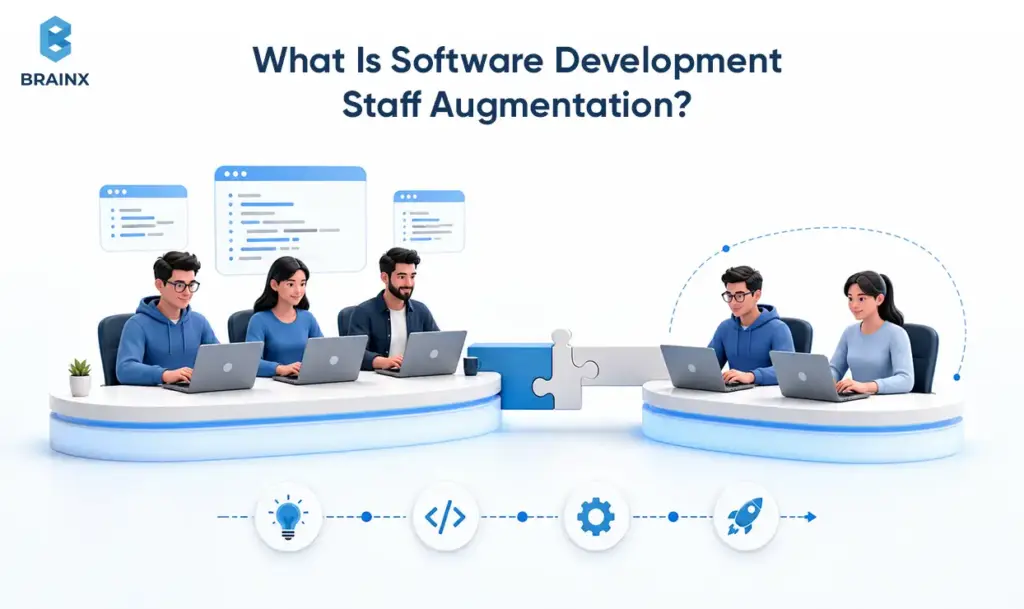
Software development staff augmentation is a delivery model that provides external engineers to a company for a temporary or strategic period, when there is a need for the missing skills, capacity or development timeline gaps. The client retains priorities, roadmap, architecture and working agreements; the engineers simply connect to the existing delivery system and contribute to the team in shipping faster. For a company that already has a product development process based on Agile, this structure is typically much better suited to their needs than having the work handed over to a different vendor queue.
In practice, it fits between full-time hiring and full project outsourcing. You are not buying “more resumes.” You are purchasing specific execution capacity that can operate within your backlog, repository, CI CD flow and sprint ceremonies. For a wider range of view on how this model fits into a product-led delivery model, refer to BrainX Software Development Services and the BrainX Product Development Process.
Staff Augmentation In Software Development (Simple Definition + What It Is Not)
In simple terms, staff augmentation in software development involves hiring additional staff, whether they are developers, QA testers, DevOps experts, or other technical professionals, to join your team on a specific project or task, typically for a short-term duration. It isn't the same as handing over a disconnected contractor with a list of tickets, nor is it the same as handing over the complete delivery outcome to an external company. The model works best when engineers contribute inside shared branches, pull requests, reviews, tests, ceremonies, and release workflows.
Just as importantly, it is not:
- A “throw requirements over the wall and wait” model. That is closer to project outsourcing.
- A shortcut that removes the need for internal leadership. Even strong engineers need product and architecture clarity.
- A guaranteed cost-saving model if your delivery process is already unclear. Augmentation accelerates a working engine; it does not replace one.
- A substitute for clear ownership.
DORA explicitly cautions against siloed ownership; and it demonstrates that delivery performance is better when there is a shared responsibility of build, release, and operations.
Staff Augmentation Software Development Vs Hiring Full-Time (Where It Fits)
Staff augmentation software development is typically the right approach for urgent projects, specific expertise requirements, or when the project has an indefinite timeline. Full-time hiring still makes sense for core leaders, permanent platform owners, or roles that must accumulate deep institutional context over years. But when the immediate problem is “we need a senior DevOps engineer this quarter” or “we need two backend engineers to hit a release window,” waiting for a standard hiring cycle can impose more delay than value.
It fits well when:
- You require a senior resource to step in for tasks like DevOps hardening, performance, data pipelines, integration with AI, etc., to meet your urgent requirements.
- You're validating a new initiative and you don't wish to commit to permanent staff until the results are tested.
- You have hiring underway, but delivery cannot pause while recruiting catches up.
Full-time hiring works better when the role is core to your long-term product differentiation and you have enough time to recruit, onboard, and mentor properly.
That is especially true in today’s market. Greenhouse showed time-to-fill rising to nearly 60 days on average. Meanwhile, BLS predicts that demand will persist, fueled in part by AI, IoT, robotics and security software. To put it simply, companies that can recruit more talent than their recruiting pipeline can close will still be rewarded by the market.
Common Roles You Augment
These are the roles that are most frequently augmented: frontend, backend, mobile, QA, DevOps, cloud, data, AI/ML, security and technical product or project. The reason is simple: these are the areas where demand spikes quickly, specialized experience matters, and capacity gaps can stall delivery. BLS specifically cites AI, security, and automation as ongoing demand drivers, while Google’s 2025 DORA research found AI adoption at 90% among software development professionals, making short-notice access to AI-capable engineers increasingly valuable.
The role mix is also representative of the way that modern software partners structure their products. BrainX publicly showcases its web, mobile, AI, and DevOps capabilities, including CI/CD, cloud-native DevOps, monitoring, and AI engineering support. That's important for buyers as the best augmentation partners tend to specialize in specific delivery constraints, rather than generic headcount needs.
How Staff Augmentation In Software Development Works (Step-By-Step)
The best software development staff augmentation engagements feel less like procurement and more like team design. There is a clear gap, a structured match process, disciplined onboarding, and an operating rhythm that makes the augmented engineers productive quickly. BrainX’s own product-development materials emphasize sprint-based Agile delivery, incremental builds, and transparent progress reviews; more broadly, DORA and Google Cloud guidance both reinforce that small batches, fast feedback, CI, and shared ownership are what make engineering capacity translate into shipping speed.
Step One — Define The Gap (Skills, Capacity, Timeframe, Ownership)
Start by defining the problem precisely: what skill is missing, how much capacity you need, how long you need it, and who owns the outcomes. If the actual issue is release bottlenecks, it might be time to look at DevOps or QA automation as a solution. If the problem is architecture drag, the answer may be a senior backend or platform engineer. If the problem is with product discovery, the need could be for a full-stack engineer who can collaborate with the PM and design team. Poorly defined gaps create bad matches, slow onboarding, and avoidable rework.
A useful template is: role, seniority, stack, business context, overlap hours, success metrics, and owner. The last item is an absolute must. Product scope, code review, QA sign-off, and deployment authority should all be named before the first interview. DORA specifically flags siloed ownership as a common pitfall because it creates friction and finger-pointing across delivery teams.
Step Two — Vetting & Matching (Screening, Technical Interviews, Culture Fit)
Once the gap is clear, move into structured evaluation. Good vetting covers technical depth, communication clarity, problem framing, and team fit, not just syntax trivia. Structured scorecards are popular in tech recruiting because they provide a more consistent method of evaluating. SmartRecruiters reports that the usage of hiring scorecards in tech is near universal.
Also ask how the provider identifies “good interview, weak delivery” profiles. A reliable signal is whether they evaluate real work artifacts: pull requests, debugging approach, test strategy, system design tradeoffs, and how the engineer communicates uncertainty.
A strong match process typically includes a resume or portfolio screen, a live technical interview, a practical discussion around architecture or troubleshooting, and a conversation about working style. For embedded SaaS work, culture fit does not mean “similar personalities.” It means the engineer can work asynchronously when needed, give and receive pull-request feedback, and communicate clearly with product and design.
Step Three — Onboarding (Access, Environments, Sprint Rituals, Documentation)
Onboarding is where many engagements either compound trust or start leaking time. Engineers need repository access, environment setup, product context, design references, engineering standards, and security boundaries early. NIST defines least privilege as limiting access to the minimum necessary to accomplish assigned tasks, and that principle is exactly what a mature onboarding flow should follow.
The essential items for a minimum onboarding checklist should consist of:
- Accounts and access: Git, CI, cloud, feature flags, analytics, ticketing, and communication tools.
- Local environment or remote development setup.
- Architecture walkthrough: services, data flows, dependencies, and release path.
- Security rules: PII handling, logging rules, environment separation, and production access limits.
- Sprint rhythm: definition of done, PR expectations, QA flow, and demo cadence.
Operationally, onboarding should include access to source control, test environments, ticketing, documentation, and communication channels, plus one clear walkthrough of the architecture and release workflow.
BrainX’s product process emphasizes incremental Agile development and regular progress review, while BrainX case studies such as Nutrition Tracker AI describe user research, iterative sprints, and continuous testing as part of early delivery readiness.
Step Four — Delivery Cadence (Standups, PR Reviews, QA, Demos, Reporting)
Once onboard, the engagement should continue to work on the same schedule as the core team members. That typically consists of daily standups, pull request reviews, automated testing, sprint planning, backlog refinement, demos and release reporting. While Google Cloud’s CI/CD guide suggests early testing and security checks in pipelines, and Atlassian talks about dedicated forums for reviewing and discussing code changes, all of them stress the need for speed in code validation.
This is also where metrics matter. DORA’s current metrics focus on throughput and instability, including change lead time, deployment frequency, failed deployment recovery time, change fail rate, and deployment rework rate. You do not need a perfect dashboard on day one, but you do need a shared definition of what “working” looks like in production.
Step Five — Scaling Up, Scaling Down, And Offboarding (Knowledge Transfer, Handover Plan)
Strong engagements make scaling and exit predictable. If the initiative expands, you add roles against the same operating model. If the initiative winds down, you document ownership, reassign open work, transfer environment knowledge, and remove access cleanly. Microsoft’s offboarding guidance emphasizes blocking access, securing data, reassigning mailbox or OneDrive content, and managing license removal; OWASP’s staff offboarding checklist similarly focuses on revoking access across repositories, shared drives, password tools, chat systems, and cloud services.
What good looks like in week 1–2:
Week 1
- Access is provisioned and the environment is running.
- The first small PR is merged.
- The engineer can explain service boundaries and the release process in plain language.
- One scoped ticket is completed end-to-end with review feedback incorporated.
Week 2
- The engineer owns a slightly larger slice, such as a feature, integration, or reliability improvement.
- They participate actively in reviews and planning, not just ticket execution.
- Standards, patterns, and expectations start getting clearly established so review back-and-forth starts to decline.
Staff Augmentation Vs Project-Based Outsourcing (Side-By-Side Comparison)
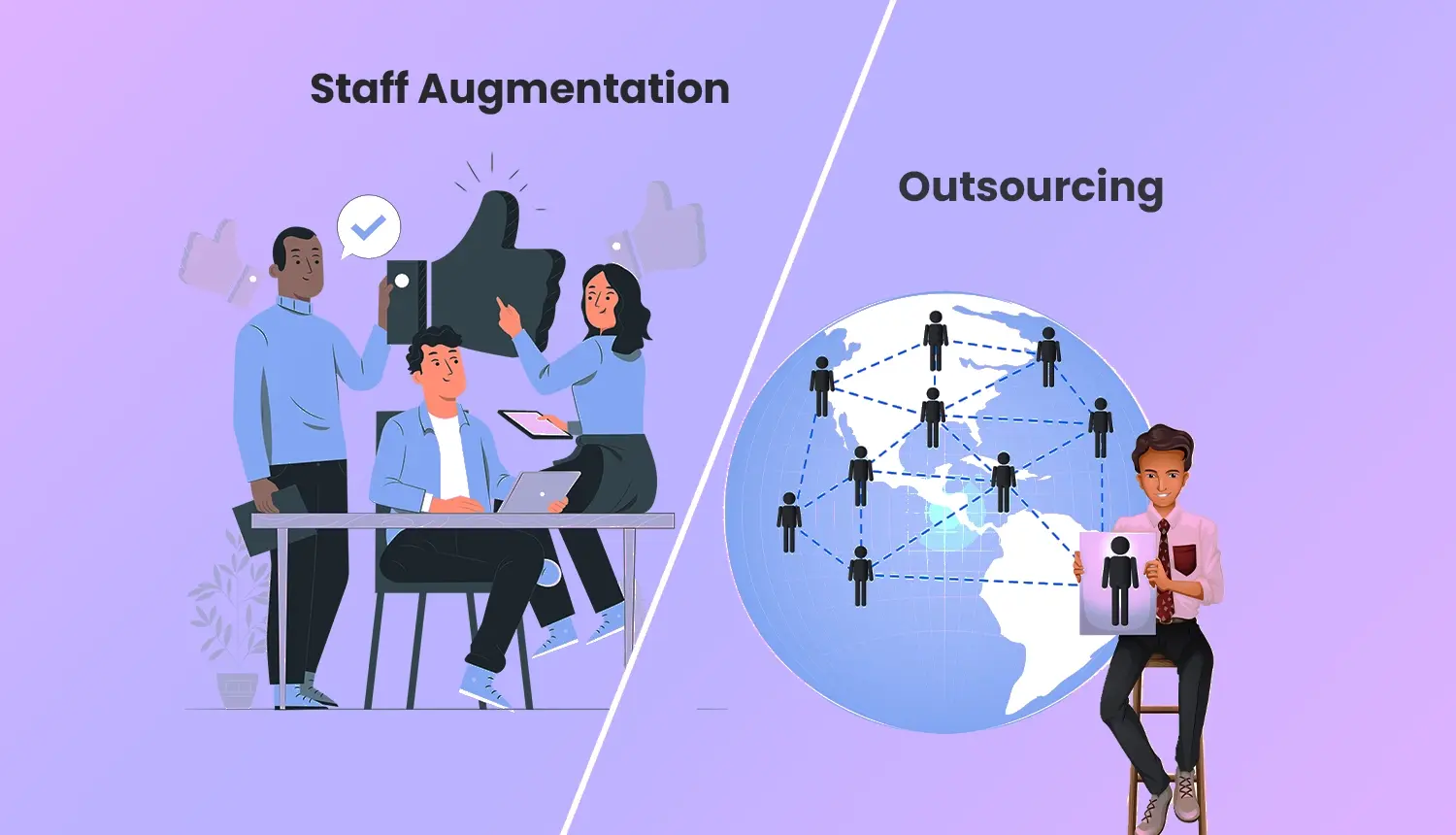
The core question in staff augmentation vs project-based outsourcing is whether you're purchasing team capacity or outsourcing a desired outcome. Augmentation extends your delivery system. Project outsourcing hands a deliverable, module, or scope package to a vendor-led team. Both can work. They just optimize for different types of control, speed and risk.
Staff Augmentation Vs Project-Based Outsourcing (Quick Comparison Before The Table)
The best way to determine is to ask yourself the question: do you want to expand your existing team or purchase the delivered project? If you want engineers working inside your roadmap, repos, rituals, and quality standards, augmentation usually fits better. Project-based outsourcing might be the cleaner alternative if you're seeking a vendor to own a well defined scope and provide you with an outcome.
| Dimension | Staff Augmentation | Project-Based Outsourcing |
| Delivery Ownership | Stays mostly in-house | Shifts more to vendor |
| Best For | Evolving roadmaps, live products, specialist gaps | Fixed scope, contained modules, well-defined outcomes |
| Start Friction | Matching + onboarding | Scoping + proposal + SOW alignment |
| Pricing Shape | Hourly or monthly capacity | Fixed bid or time-and-material by project |
| Scope Changes | Easier to absorb inside backlog | Often slower, priced separately, or contract-driven |
| Knowledge Retention | Higher when work stays in your repo and rituals | Lower unless handover is designed well |
| Hidden Cost Risk | Integration and management load | Change requests, handoffs, rework, context loss |
This tradeoff is consistent with current delivery research and practice: fast feedback, smaller batches, integrated CI, and shared metrics favor embedded teams, while contained outcome work fits vendor-led execution more naturally.
Control & Accountability (Who Owns Delivery, Architecture, Quality)
With augmentation, your team usually owns product decisions, architecture, and final quality accountability. The added engineers contribute inside your rules. With project outsourcing, the vendor typically owns more of the day-to-day delivery and is judged primarily on shipping the contracted scope. That can be powerful when you lack internal bandwidth, but it also means you need tighter alignment upfront on acceptance criteria and handoffs.
Speed To Start (Hiring Vs Vendor Ramp-Up Vs Scope Definition)
Augmentation often starts faster than full-time hiring because you are matching against near-ready talent instead of running a full recruiting cycle. SmartRecruiters’ 2025 benchmark shows 48 days median time-to-hire in technology, while Greenhouse reported average time-to-fill at 59.67 days in 2025. Outsourcing can sometimes mobilize quickly too, but only after scope definition is far enough along for the vendor to price and staff correctly.
Cost Model (Rate Vs Fixed Bid; Where “Cheap” Becomes Expensive)
Augmentation usually shows up as hourly or monthly capacity spend. Outsourcing usually appears as fixed bid or project-based commercial structure. The trap is assuming the lower sticker price is the cheaper option. In practice, the hidden cost is often integration and decision latency: unclear requirements, scope changes, extra review loops, and missed context can erase nominal savings. Atlassian’s 2025 developer research found that developers still lose major time to information-finding, context switching, and coordination friction even as AI saves time elsewhere.
Hidden costs often include PM overhead, duplicate QA, extra discovery, tool licenses, and handover meetings. Integration cost usually shows up when engineers are outside the core feedback loop and every ambiguity has to cross a contractual boundary before it becomes a code change. That is a reasoned inference from current DevEx and flow research, and it is one of the biggest decision errors buyers make.
Where “cheap” becomes expensive:
- Low rates that require heavy supervision.
- Poor code quality that increases QA time and production incidents.
- Missing tests and documentation that slow every future release.
- High rework from misunderstood requirements.
Total cost is rarely just labor. It is labor plus integration, rework, review time, and cost of delay.
Flexibility To Change Scope (Product Iteration Vs Fixed Requirements)
If your roadmap is still moving, augmentation is almost always easier to manage. IBM’s SAFe overview highlights economic decision-making, short learning cycles, and uninterrupted value flow; SAFe’s flow guidance likewise emphasizes faster feedback, fewer handoffs, and smaller batches. Those conditions align with embedded engineers who can pivot with the backlog.
Fixed-scope outsourcing is better when “done” is already knowable. If the work is a contained migration, internal admin tool, or standalone module with stable requirements, a vendor-led contract can reduce management load and simplify budgeting. BrainX’s own 2026 guidance makes a similar distinction: fixed price fits stable scope, while dedicated or time-and-material models fit evolving priorities.
Knowledge Retention (What Stays In-House Vs With Vendor)
Knowledge retention is where augmentation quietly compounds value. When engineers work in your repository, follow your pull-request rules, and document inside your systems, more knowledge stays with your organization after the engagement ends. By contrast, outsourced teams often accumulate operational context inside their own PM, QA, or architectural workflows unless handover is planned deliberately.
When Staff Augmentation Beats Outsourcing (Decision Framework)
Software development staff augmentation tends to beat outsourcing when speed, control, and learning matter at the same time. It is the stronger model when you already know how you want to build, but you do not have enough hands or enough specialist depth to execute on time. In that scenario, the real cost is rarely the hourly rate. It is the revenue, customer learning, or risk reduction you postpone while waiting. SAFe and IBM both frame this as an economic problem: cost of delay matters, and flow interruptions matter.
You Need Speed Without Giving Up Engineering Control
Choose augmentation when you have an in-house engineering lead, clear product ownership, and a release target that cannot wait for a full recruiting cycle. The added engineers can move inside your existing architecture and standards without forcing a handoff of technical authority. That is often the cleanest answer for growth-stage SaaS teams.
Your Roadmap Is Evolving (Product Discovery, Iterative Delivery)
If discovery is still active, you want team capacity that can shift with user feedback, not a contract that punishes change. IBM’s SAFe overview and Scaled Agile’s flow guidance both emphasize iterative learning, economic tradeoffs, fast feedback, and fewer dependencies. That is exactly the environment where augmentation outperforms fixed-scope outsourcing.
You Have An In-House Lead But Lack Specialists (DevOps, Mobile, AI, Security)
This is one of the clearest augmentation signals. Google’s 2025 DORA report shows AI is already a near-universal part of modern software work, and BLS expects strong developer demand partly because of AI, automation, and security. If your lead team knows the product but lacks cloud, data, AI, or reliability depth, augmenting those specialties is faster and often safer than redistributing the whole initiative to a vendor.
You Need To De-Risk A Critical Initiative (Reliability, Performance, Compliance)
Reliability fixes, platform migrations, security hardening, and compliance-sensitive releases are usually bad places to lose architectural ownership. ISO/IEC 27001 frames information security as a system of risk management across people, policies, and technology, while AICPA’s SOC suite exists specifically to help users assess and address risks associated with outsourcing services. When the initiative touches regulated data or core platform resilience, adding specialists under your governance can reduce coordination risk.
You Want Long-Term Capability Building (Process + Mentorship Transfer)
Augmentation also wins when you want the work to leave your team stronger than before. Embedded specialists can improve CI/CD, testing discipline, observability, review quality, and team habits while the knowledge remains in-house. DORA’s research on shared ownership and smaller-batch improvement supports that pattern: the gains are strongest when the team that ships is also the team that learns.
When Project-Based Outsourcing Is The Better Choice
Not every company should choose augmentation. There are real cases where project outsourcing is the smarter option, and saying so is part of good advisory content. If your core problem is not “we need more team capacity” but “we need someone else to deliver a contained outcome,” outsourcing can reduce management load and give you cleaner commercial boundaries.
Fixed Scope, Clear Requirements, And Minimal Internal Bandwidth
When requirements are already stable and your internal team does not have time to run daily delivery, project outsourcing is often the better fit. A fixed-scope module, migration, or internal tool can be specified, estimated, and delegated more efficiently than an embedded-engineer model.
You’re Buying An Outcome, Not Team Capacity
If what you want is a contained app, integration, or proof-of-concept delivered against a clear acceptance checklist, outsourcing may align better with how you want to buy. In that case, paying for a vendor-owned result can be simpler than integrating additional individuals into your internal squad.
You Need A Vendor-Led Delivery Org (PM, QA, DevOps Included)
Some organizations do not have the internal product, engineering, or QA leadership needed to run embedded contributors well. If you need a provider to bring project management, testing, release discipline, and operational coordination as a package, vendor-led delivery can be the better starting point. The key is being honest about whether you have enough internal leadership to make augmentation productive.
Costs, Timelines, And Engagement Models (What To Expect)
For budgeting, the most useful mental model is this: software development staff augmentation is not priced like a standalone app build. It is priced like access to specific capability and execution bandwidth. The start timeline depends on role scarcity, interview depth, time-zone overlap, security review, and how quickly your internal owners can onboard someone into the stack. That is why augmentation can begin in days or a few weeks, while direct hiring often takes much longer.
Typical Start Time (Days/Weeks) And What Drives It
The fastest starts happen when the role is narrow, the interview loop is short, and your onboarding path is already documented. The slowest starts happen when buyers are still deciding the role, ownership is fuzzy, or security and environment setup are treated as afterthoughts. The lesson from hiring benchmarks is not that augmentation is magically instant; it is that it can compress the wait compared with normal recruiting if you know what you need.
Billing Structures (Hourly, Monthly; Part-Time Vs Full-Time; Retainer)
Most engagements use hourly or monthly pricing, with part-time and full-time allocation depending on the need. Full-time tends to make sense for ongoing roadmap work; part-time works better for architecture, QA leadership, DevOps, or advisory-heavy specialist roles. BrainX also publicly positions its broader commercial options around evolving priorities, dedicated execution, and fixed-scope work depending on fit.
Total Cost Drivers (Seniority, Time Zone, Overlap Hours, Toolchain, Domain)
The main cost variables are seniority, stack rarity, expected overlap hours, domain complexity, and the toolchain you expect someone to plug into. A senior AI engineer or platform architect with fintech or healthcare experience will cost more than a generalist frontend engineer, not because of title inflation, but because the business risk of getting the role wrong is larger. BrainX’s public service mix across AI, web, mobile, and DevOps illustrates how different capabilities create different pricing logic.
How To Estimate ROI (Cost Of Delay, Quality, Reduced Rework, Faster Releases)
A practical ROI model is: value of earlier release + avoided hiring delay + reduced rework + improved delivery reliability - augmentation spend. SAFe’s economic framing makes cost of delay a central prioritization concept, while DORA’s metrics provide a delivery-side way to judge whether the added capacity actually improved throughput and stability. If the extra engineer helps you release sooner, reduce failed changes, or prevent architectural drift, ROI often shows up in time and risk before it shows up in a spreadsheet.
Risks & Common Mistakes (And How To Prevent Them)
Software development staff augmentation is not risky because outside engineers are inherently risky. It becomes risky when governance is weak. Most failures come from operating mistakes that are predictable: poor onboarding, unclear ownership, weak security boundaries, or treating the added engineers like isolated labor instead of integrated contributors.
Treating Augmented Engineers Like “Ticket Takers” (Low-Leverage Outcome)
The fastest way to waste the model is to reduce it to ticket throughput. Atlassian’s 2025 research shows developers lose substantial time to finding information, context switching, and coordination, not just coding delays. If added engineers do not get product context and decision access, you buy labor hours but leave the real bottlenecks untouched.
Prevention:
- Share product context and user impact, not just tasks.
- Invite augmented engineers into planning and technical discussions.
- Give ownership of a small area, such as a service, component, or integration.
High-performing augmented contributors behave like owners when they are allowed to.
No Clear Ownership (Tech Lead, Code Review Policy, QA Responsibility)
If nobody knows who approves architecture, who reviews PRs, or who signs off QA, the model will slow down instead of speed up. DORA explicitly lists siloed ownership as a pitfall because it generates friction between development, operations, and release responsibilities.
Prevention:
- Name one internal owner for the initiative, such as a tech lead, engineering manager, or product engineering lead.
- Define who approves architecture, reviews pull requests, signs off QA, and owns release readiness.
- Set clear PR review rules, including required reviewers, test expectations, and approval criteria.
- Document escalation paths so blockers do not sit unresolved across time zones or teams.
The goal is to remove ambiguity early. When ownership is clear, augmented engineers can move faster without creating quality, review, or release confusion.
Poor Onboarding (Access, Environments, Domain Context)
Poor onboarding shows up as delayed first commits, repeated setup questions, and engineers waiting on permissions instead of shipping. Least-privilege access is a plan not an ad hoc solution and documentation should be done prior to the first sprint including architecture, environments, coding rules and product context.
Prevention:
- Set up access, accounts and development environments in advance.
- Create a first-week plan with one small, safe task and clearly assigned reviewers.
- Share architecture diagrams, service maps, product context, and key decision records.
- Maintain onboarding documentation within the repo, wiki, or project workspace, which makes it easy to update.
Without documented onboarding, it's impossible to scale. A structured onboarding procedure ensures that new hires in the augmented engineering field can get up and running quickly and save on unnecessary back and forth.
IP/Security Gaps (Contracts, Access Controls, Data Handling)
This is the area buyers most often under-specify. AICPA's SOC materials have been developed to assist users in evaluating outsourcing risk, while ISO/IEC 27001 specifies the requirements for an ISMS that systemically manages information-security risk. At the working level, NIST’s least-privilege principle still applies: repository access, secrets, environments, and customer data should be role-based, minimal, and revocable.
Prevention:
- Use clear IP assignment, confidentiality, and data handling clauses in the contract.
- Implement least-privilege access to ensure that engineers have only the systems that they need.
- Utilize separate development, staging and production environments.
- Restrict production access unless it is absolutely required.
- Use MFA, audit logs, and role-based permissions across code, cloud, communication, and project tools.
- Establish guidelines for PII, regulated data, secrets, logs, and customer data before work begins.
Security should be built into the engagement from the start, not added after access has already been granted.
Knowledge Loss At Offboarding (Documentation + Handover Checklist)
Offboarding should be a handover event, not a disappearing act. Microsoft recommends blocking access, transferring needed data, and managing retained content correctly, while OWASP’s own process highlights removing access across code, collaboration, and cloud systems. If knowledge transfer is not documented before exit, you are paying for short-term velocity with long-term confusion.
Prevention:
- Require ADRs for major technical decisions.
- Keep runbooks updated for deployments, incidents, recurring issues, and operational workflows.
- Make sure tickets link to related PRs, tests, deployment notes, and open follow-up work.
- Schedule handover sessions before the engineer rolls off.
- Record walkthroughs for complex systems, environments, and unresolved risks.
- Revoke access immediately after offboarding is complete.
Offboarding is part of delivery, not an admin task. A proper handover protects product continuity and keeps knowledge inside your team.
Risk Controls Checklist
Use this as a lightweight governance checklist:
- Ownership: named internal lead, clear RACI for QA and releases.
- Access: least privilege, MFA, environment separation, audited permissions.
- Quality gates: PR reviews, CI checks, testing expectations, static analysis.
- Operational readiness: logging, metrics, alerts, rollback plan.
- Documentation: ADRs, runbooks, onboarding notes kept current.
- Continuity: backup engineer plan, offboarding checklist, knowledge transfer sessions.
Best Practices To Make Staff Augmentation Work (Playbook)
Staff augmentation in software development is supposed to be used as a delivery mechanism and not as a staffing transaction. That's about measuring outcomes, establishing rhythm and setting technical standards, and providing enough context to make good decisions without having to wait for a meeting about every detail.
Define Success Metrics (DORA, Cycle Time, Escaped Defects, Predictability)
DORA’s current framework gives teams five useful metrics: change lead time, deployment frequency, failed deployment recovery time, change fail rate, and deployment rework rate. Those are good engineering baselines. Then add product-level indicators such as escaped defects, release predictability, customer-facing incident load, or feature throughput if they reflect business goals more clearly.
Set Operating Rhythm (Ceremonies, Comms, Escalation Paths)
A good default operating rhythm is consistent standups, weekly planning or refinement, async status updates, clear reviewer expectations, and one escalation path when blockers sit too long. BrainX’s public product process emphasizes sprint-based iteration and regular progress reviews, which is a sensible pattern for embedded work too.
Define the rhythm explicitly:
- Standup expectations.
- Planning and refinement cadence.
- Demo format and stakeholder communication.
- Slack or Teams response norms.
- Escalation path for blockers and decisions.
Engineering Standards (Branching, PR Reviews, Testing, CI/CD)
Do not make standards optional for augmented contributors. Atlassian’s pull-request model and Bitbucket review guidance both reinforce the value of review forums, reviewer checks, and merged-code consistency. Google Cloud’s CI/CD guidance likewise emphasizes fast validation, testing, and early security practices. These are not “nice to have” practices in augmentation; they are the glue that makes shared code ownership safe.
Write down the standards that matter:
- Branching strategy.
- PR size guidelines and review SLAs.
- Testing expectations: unit, integration, and end-to-end.
- CI requirements: linting, security scans, and test gates.
- Release process: feature flags, staged rollout, and rollback policy.
Documentation + Product Context (Decision Logs, ADRs, Runbooks)
Documentation is one of the highest-leverage investments you can make because it reduces dependence on tribal memory. Atlassian’s 2025 research found that finding information and context switching are among the biggest time-wasters for developers. Decision logs, ADRs, runbooks, architecture maps, and release notes turn onboarding from scavenger hunt into execution.
Focus on a few useful artifacts:
- ADRs for important architecture choices.
- Runbooks for deployment, incidents, and common failures.
- Decision logs for product and technical tradeoffs.
- System maps for services, dependencies, and data flows.
Hybrid Model: Mixing Staff Augmentation With Outsourced Components
A hybrid model is often the best real-world answer. Keep the core product squad, architecture, and domain-heavy work inside your team with augmentation, and outsource narrow components such as a contained migration, design-system audit, or one-off internal tool when fixed scope is genuinely stable. That gives you control where learning matters and externalized execution where packaging the outcome is cleaner.
How BrainX Helps With Software Development Staff Augmentation
Software development staff augmentation works best when the provider behaves like a delivery partner, not a resume broker. BrainX supports teams with vetted engineers, structured onboarding, and delivery governance that reduces integration risk while preserving your control.
We position ourselves as an AI-powered software development company with public capabilities across web, mobile, AI, and DevOps. On site, BrainX is ISO/IEC 27001:2022 & ISO 9001:2015 certified and highlights 120+ engineers, 250+ projects, and 130+ satisfied clients, alongside a sprint-based Agile product-development process and portfolio examples across SaaS, AI, and operational systems. That combination matters because buyers usually need more than raw talent access; they need a partner with enough engineering breadth to match the role to the real delivery bottleneck.
Team Matching & Technical Vetting (How BrainX Ensures Fit)
In light of BrainX’s public materials, the company emphasizes role-based service depth in AI, DevOps, web, and mobile, which is the foundation you want for matching specialists to a live product environment. For buyers, the practical question is whether the partner can distinguish between “we need another developer” and “we need a release bottleneck removed.” BrainX’s service mix suggests it can staff against capability gaps, not just generic headcount.
Fast, Structured Onboarding (Access, Environments, Sprint Readiness)
BrainX’s public process describes sprint-based Agile development with incremental builds and regular progress assessments. Our Nutrition Tracker AI case study also highlights user research, iterative sprints, simplified onboarding, and continuous testing, which are good signs of a partner that thinks in integration terms rather than pure staffing terms.
Quality & Delivery Governance (Code Reviews, QA, Release Discipline)
BrainX’s DevOps services page specifically references CI/CD, cloud-native DevOps, monitoring, analytics, and security. That matters because quality governance in augmentation is not just about developer skill; it is about whether the partner understands release discipline, observability, and operational risk after code is merged.
Engagement Options (Single Specialist → Pod → Hybrid With Managed Delivery)
We publicly market both broad software delivery and dedicated-team style support across multiple services and engagement paths. That makes it a reasonable fit for buyers who may start with one specialist, expand into a small pod, or combine embedded engineers with managed delivery for a contained workstream.
Conclusion: Choose The Model That Protects Speed, Quality, And Control
The best choice is not the “cheapest” model on paper. It is the one that preserves flow, keeps ownership where it belongs, and reduces the real cost of delay. For evolving SaaS products, architecture-sensitive platforms, and teams with internal leadership already in place, software development staff augmentation is usually the strongest answer because it adds speed without forcing you to give up product and engineering control. For fixed-scope outcomes with limited internal bandwidth, vendor-led outsourcing can still be the smarter buy.
If you are deciding between the two, start with three questions: Is scope stable? Who will own architecture and quality? What does every month of delay cost the business? Once those answers are clear, the model tends to become obvious.
FAQs about Software Development Staff Augmentation in 2026
What Is Software Development Staff Augmentation?
Software development staff augmentation is a model where external engineers join your internal delivery team for a defined period, while your company keeps ownership of the roadmap, architecture, and delivery decisions. It is best understood as team extension rather than project handoff.
How Is Software Development Staff Augmentation Different From Project-Based Outsourcing?
The difference is ownership. In augmentation, the external engineers work inside your team and your processes; in project outsourcing, the vendor typically owns more of the execution and is contracted to deliver a defined outcome.
That is why staff augmentation vs project-based outsourcing is really a decision about control, scope stability, and where knowledge should live.
When Does Staff Augmentation In Software Development Make More Sense Than Hiring Full-Time?
It makes more sense when the need is urgent, specialized, or uncertain in duration. Hiring benchmarks still show tech hiring taking weeks, while developer demand remains strong, so augmentation is often the faster route when you need capacity this quarter rather than permanent headcount next quarter.
How Fast Can You Onboard Augmented Developers Into An Existing Team?
In a mature setup, onboarding can happen in days to a few weeks, depending on the role, access approvals, and how ready your documentation and environments are.
The biggest determinant is usually not the engineer’s availability but whether your team already has clear ownership, least-privilege access rules, and a repeatable onboarding path.
What Are The Main Risks Of Staff Augmentation Software Development, And How Do You Reduce Them?
The biggest risks in staff augmentation software development are unclear ownership, weak onboarding, poor security controls, and losing knowledge when people roll off.
You reduce them by keeping repo ownership in-house, enforcing PR and CI rules, granting only role-based access, and documenting handover before offboarding begins.
Can You Combine Staff Augmentation Vs Project-Based Outsourcing In A Hybrid Delivery Model?
Yes. Many teams use augmentation for core product velocity and outsource narrow, well-bounded workstreams where the outcome can be specified clearly. In practice, that hybrid often gives SaaS teams the best mix of control, speed, and predictable external execution.