
 July 9, 2026 -
  32 minutes read

Product teams should begin narrow to create AI in Edtech products that personalize learning at scale. Instrument learner events, define how mastery will be measured, and ship one high-value feedback loop before expanding the platform.
The strongest products can never be generic chatbots wrapped in school branding. They connect curriculum, learner data, recommendation logic, assessment, and safe AI assistance inside a measurable learning workflow.
That distinction matters as adoption accelerates. The global size of AI in EdTech is projected to reach USD 92.09 billion by 2033, at a 38.1% compound annual growth rate, as per Market.us research. According to Gallup, 6 out of 10 public K–12 teachers leveraged AI tools in the last school year (2024–2025), with 32% doing so at least once a week. Users who used the system regularly estimated a savings of 5.9 hours per week.
Buyers now demand adaptive paths, quick feedback, multiple languages, and early-warning interventions and more without hiring any extra people. The difficult part is no longer demonstrating that artificial intelligence can generate an explanation. It is building the data, model, evaluation, and governance foundations that make personalization reliable at scale.
Key Takeaways
- Start with one personalization loop. Strong MVPs address one measurable problem, like recommending the next activity, providing curriculum-founded hints, or identifying learners that need intervention.
- Treat data design as a product foundation. Event capture, content metadata, identity resolution, and an evolving learner profile matter more than choosing the most powerful model.
- Leverage AI to support instructional economics. High value modules include adaptive sequencing, tutoring, rubric aligned feedback, risk prediction and content generation with human review.
- Add guardrails to the first release. Retrieval grounding, safety filters, confidence thresholds, audit logs, and teacher escalation should not be postponed until enterprise rollout.
- Don't just measure clicks, measure learning. Track mastery gains, transfer performance, hint dependency, completion, intervention lift, and teacher time saved.
- Plan from the get-go for compliance. Architecture and procurement are impacted by FERPA, COPPA, GDPR, accessibility, security and institution-specific policies.
- Scale only after proving the loop. Test the feature offline and with a pilot group and controlled experiments before rolling it out to other subjects and institutions.

What “AI in Edtech” Means (and What It Doesn’t)
AI in Edtech refers to the integration of AI technologies like machine learning, natural language processing, predictive models, knowledge graphs, and generative AI within the educational workflows. These technologies can improve pacing, feedback, recommendations, assessment, and intervention decisions.
A production learning platform may combine several approaches:
- Machine learning predicts mastery, risk, or the most suitable next activity.
- Natural language processing classifies responses, extracts skills, and evaluates structured text.
- Generative AI provides explanations, hints, practice questions, translations, or a draft feedback.
- Knowledge graphs link concepts, prerequisites, standards and learning resources.
- Adaptive logic decides how learner signals should change progression.
The product value comes from how these elements are made to work together. A large language model may generate a fluent answer, but it cannot independently determine whether that answer fits the curriculum, supports productive struggle, or meets the learner’s current skill level.
Artificial intelligence should therefore extend teacher capacity rather than remove teachers from the process. The U.S. Department of Education recommends keeping humans involved in important instructional and assessment decisions.
“Crucially, this does not replace teacher expertise. It extends it.” — Edward Howard, Educational Software Leader, HMH
AI in Edtech vs. Traditional Rules-Based Personalization
The traditional approach to personalization is based on a logic that is predetermined. If a learner performs less than 70%, for instance, a remedial lesson is assigned by the platform. These rules remain helpful due to their predictability, explainability, and low cost of testing.
The platform adds value when it needs to assess more intricate patterns, where AI-driven personalization takes the stage. A model might consider concept dependencies, repeated errors, time between attempts, hint usage, pace, language, and recent improvement before recommending the next activity.
The two approaches should not be treated as opposites. Early products often benefit from a hybrid model.
| Area | Rules-Based Personalization | AI-Driven Personalization |
| Decision logic | Fixed if-and-then rules | Probabilistic predictions and rankings |
| Data requirements | Low to moderate | Moderate to high |
| Explainability | Usually straightforward | Requires additional explanation tools |
| Adaptation | Limited to predefined scenarios | Can adjust across many interacting signals |
| Best early use | Clear curriculum policies | Pattern recognition and ranking |
| Main risk | Oversimplification | Bias, drift, or opaque recommendations |
A new platform with limited behavioural data should usually begin with explicit curriculum rules and lightweight models. More advanced recommendation techniques can follow once the event taxonomy, content structure, and learner profiles are stable.
The educational objective should still control the model. A system should not accelerate a learner merely because rapid progression increases completion metrics. It should move the learner when evidence shows that the relevant skill has been understood.
Why Personalization at Scale Is the New Baseline in Learning Products
Personalization is becoming a baseline because commercial and instructional pressures now point in the same direction. Buyers want stronger completion, retention, and teacher productivity. Learners expect timely support that responds to their level and progress.
Research shows that carefully structured adaptive systems can improve learning. A 2025 randomized controlled crossover study with 194 Harvard undergraduate physics students revealed that students who interacted with a purpose-built AI tutor had gains greater than two times the median gains of students who participated in in-class active learning, compared to their pre-test baseline. Instead of giving their students a free pass for the use of a chatbot, the tutor integrated content, scaffolding, sequencing, and feedback that were accurate. (Kestin et al., Scientific Reports, 2025).
The evidence still requires caution. A 2025 systematic review covering 28 studies and 4,597 K-12 learners found generally positive results for AI-supported learning. However, the advantage was smaller when AI systems were compared with other established tutoring tools rather than traditional instruction. The researchers also called for longer and more diverse studies.
That nuance should shape the product brief. The objective isn't to increase the amount of AI involvement. The goal is to offer adequate support at the appropriate time, while avoiding dependency and undermining independent performance.
What “Scale” Really Means: Cohorts, Content Volume, and Real-Time Feedback Loops
Scale is not just monthly active users. It is the combination of learner volume, curriculum complexity, real-time decisions, institutional policies, and operational reliability.
A platform may need to support:
- Thousands of concurrent learners
- Several subjects, grade levels, or professional pathways
- Large libraries of videos, exercises, assessments, and documents
- Multiple languages and accessibility requirements
- Separate configurations for institutions or enterprise tenants
- Immediate hints or recommendations during learning sessions
- Batch analytics for teachers, administrators, and intervention teams
Scale also means completing a reliable feedback loop:
- Capture the learner’s action.
- Update the learner profile or mastery estimate.
- Select a recommendation, hint, or intervention.
- Deliver it with acceptable latency.
- Record what the learner does next.
- Measure whether the decision improved the intended outcome.
A system serving 2,000 learners across five subjects and three languages may be more complex than one serving 20,000 learners through a single standardized course. Content structure and governance often create more difficulty than user volume.
Operational trust is another part of scale. A university or school district may require role-based access, institutional policy controls, audit history, accessibility validation, and formal model documentation. Scaling AI in Edtech therefore means scaling governance alongside infrastructure.
The Personalization Engine: Core AI Use Cases That Actually Ship
The most effective personalization roadmaps focus on modules that fit existing learning workflows. Each use case should have clear inputs, a defined output, and a metric that proves whether the feature improves learning or operations.
| Use Case | Primary Inputs | Product Output | Core Success Metric |
| Adaptive learning | Attempts, mastery, content graph | Next-best activity | Mastery velocity |
| AI tutoring | Learner query, lesson context, curriculum | Hint or explanation | Learning gain and reduced dependency |
| Automated assessment | Submission, rubric, exemplars | Score and feedback | Agreement with human reviewers |
| Risk prediction | Engagement, performance, activity trends | Intervention alert | Retention or intervention lift |
| Content generation | Curriculum, templates, learning level | Draft learning assets | Reviewer acceptance and authoring time |
Adaptive Learning Paths and Mastery-Based Progression
Adaptive learning systems select the next activity based on what the learner appears to understand. The aim is not simply to show easier or harder content. It is to move each learner through a structured skills model at an appropriate pace.
Typical inputs include:
- Quiz and assessment performance
- Repeated error patterns
- Time spent on activities
- Hint usage
- Previous mastery estimates
- Content prerequisites
- Learner goals and accommodations
The output may be a recommended lesson, a revised difficulty level, a remediation activity, or a mastery-gate decision. A learner who repeatedly misses fraction conversion questions might receive a visual explanation and focused practice before advancing to algebraic fractions.
The most useful metrics are mastery velocity, time to proficiency, repeat-error reduction, transfer performance, and course completion. Click-through rate may indicate interest, but it does not prove that the recommendation improved understanding.
Early systems should begin with an explicit skills map and transparent decision rules. As data volume grows, probabilistic models such as Bayesian Knowledge Tracing, Item Response Theory, or sequence models can improve the mastery estimate.
AI Tutoring, Hints, and Conversational Practice (LLMs + Guardrails)
An AI tutor should guide reasoning rather than function as an unrestricted answer generator. Its most useful outputs are hints, scaffolded explanations, Socratic questions, worked examples, and conversational practice.
The tutor typically receives:
- The current lesson or activity
- The learner’s recent attempts
- The relevant skill or objective
- Approved curriculum materials
- The learner’s language and level
- A tutoring policy defining allowable responses
A reliable implementation combines an LLM with retrieval over approved course content. The model retrieves relevant materials first, then generates an explanation grounded in those sources. Guardrails determine whether it can provide a hint, a partial worked example, or an escalation message.
Research suggests that structure matters. The positive results reported in the 2025 Scientific Reports tutoring trial depended on sequencing, accurate content, guided practice, and feedback. Those results should not be interpreted as evidence that any generic chatbot will improve outcomes.
Product teams should monitor answer accuracy, unsupported-claim rate, learner satisfaction, hint dependency, and transfer performance after the AI support is removed. A tutor that helps learners finish tasks but reduces independent performance is not succeeding.
Automated Assessment, Feedback, and Rubric-Aligned Grading
Automated assessment works best when the scope is constrained and the evaluation criteria are explicit. Strong early use cases include objective scoring, short-answer classification, code evaluation against deterministic tests, and writing feedback tied to clear rubric dimensions.
Inputs may include:
- Student submissions
- Rubrics and marking criteria
- Approved answer keys
- Human-scored examples
- Subject-specific terminology
- Confidence thresholds
The output can include a preliminary score, comments, identified misconceptions, and suggested revisions. For higher-stakes work, the platform should route low-confidence cases to a teacher rather than force an automated decision.
A practical workflow follows the principle “AI drafts, educator decides.” The system handles the first pass, highlights areas requiring attention, and reduces repetitive review. Teachers retain override authority and can correct the model.
Success should be measured through agreement with human graders, feedback usefulness, turnaround time, override frequency, and consistency across learner groups. The U.S. Department of Education advises that AI can support formative assessment, but important assessment decisions should remain human-led.
Predictive Analytics for At-Risk Learners and Intervention Triggers
Predictive analytics can help institutions identify learners who need support before failure becomes visible in final grades. The model combines weak signals that may not appear significant when reviewed separately.
Potential inputs include:
- Login frequency
- Missed or late assignments
- Assessment decline
- Reduced participation
- Time since the last activity
- Repeated help requests
- Responses to previous interventions
- Cohort-level performance patterns
The output should not be a vague risk score displayed without context. It should include an actionable reason, a confidence level, and a recommended next step. For example: “The learner has missed two assignments, stopped opening practice activities, and showed a 20% decline across the last three assessments.”
Model accuracy alone is not enough. Teams should measure precision, recall, false-positive rates, intervention acceptance, time to intervention, and retention lift. A technically accurate risk model provides little value when teachers or advisors cannot act on its alerts.
Protected attributes require careful handling. Excluding a demographic feature does not automatically remove bias because other variables can act as proxies. Teams should audit outcomes by subgroup and let educators review or override recommendations.
Content Generation and Localization Workflows (Human-in-the-Loop)
Generative AI can expand content production without removing editorial control. Common applications include quiz drafts, flashcards, worked examples, lesson summaries, hint banks, captioning, translation, vocabulary support, and level-adjusted rewrites.
Leobit identifies tailored learning content, real-time hints, captions, summaries, and multilingual support as common shippable AI features in education products.
The safest workflow is structured:
- A subject expert provides source material and objectives.
- The model generates content within a template.
- Automated checks validate format, duplication, and prohibited content.
- A qualified reviewer checks accuracy and pedagogy.
- A localization or accessibility reviewer validates the final version.
- Approved content enters the production library with version history.
Metrics should include authoring time, reviewer acceptance rate, correction rate, curriculum coverage, localization quality, and post-publication learner performance.
Human review is especially important for mathematics, science, legal training, medical education, and regulated professional learning. A grammatically correct question can still be factually wrong or instructionally misleading.
Architecture Blueprint for Personalized EdTech Solutions
A production-grade personalization platform usually contains five connected layers: data, learner modelling, delivery, generative AI, and MLOps. Teams that skip one layer often have to rebuild it later under procurement or scaling pressure.
The architecture should separate real-time learner interactions from heavier batch workloads. Recommendations and tutoring responses require low latency. Model retraining, cohort reporting, and large-scale content processing can run asynchronously.
An API-first design also makes components easier to replace. Teams can change an LLM provider, recommendation model, or analytics service without rebuilding the entire learner application.
Data Layer: Events, LRS/xAPI, LMS Integrations, and Identity
The data layer should capture more than completions and final grades. Useful learner events include attempts, revisions, hint requests, dwell time, skipped content, confidence responses, searches, teacher actions, and intervention outcomes.
xAPI provides a standard way to record learning activities across systems. A Learning Record Store receives and stores those activity statements. LTI supports secure integration between tools and institutional learning environments, including course, role, and enrollment context.
Identity design is equally important. The platform needs a stable learner identifier, tenant-aware permissions, consent-aware data joins, and a clear separation between personally identifying information and model-serving data.
Data quality controls should validate:
- Missing or duplicated events
- Incorrect timestamps
- Inconsistent learner identifiers
- Invalid content tags
- Delayed integrations
- Tenant leakage
- Changes in LMS event definitions
Without stable inputs, model performance cannot be interpreted reliably.
Learner Model: Skills Graph, Embeddings, and Profile Signals
The learner model represents what the platform currently believes about each learner. It should answer a practical question: What does this learner likely need next, and why?
A useful learner profile may contain:
- Mastery estimates for defined skills
- Current learning goals
- Recent misconceptions
- Pace and engagement patterns
- Preferred language
- Accessibility accommodations
- Course and cohort context
- Intervention history
- Model confidence
A skills graph connects concepts, prerequisites, learning objectives, and available resources. Embeddings can help match learner questions or activity patterns with relevant content, but they should not replace explicit curriculum structure.
The model should update as new evidence arrives. A single incorrect answer should not always reduce a mastery estimate sharply. Repeated errors across varied contexts provide stronger evidence than one isolated event.
Delivery Layer: Recommendations, Next-Best-Activity, and Personalization APIs
The delivery layer turns learner predictions into product behaviour. It exposes services for next-best activity, sequencing, intervention recommendations, teacher dashboards, messaging triggers, and content ranking.
A useful design separates prediction from policy. A model can rank likely next activities, but pedagogy and institutional rules decide what is allowed. A school might require learners to complete a mandatory assessment before the model can recommend acceleration.
The platform may expose endpoints such as:
- getNextActivity
- generateHint
- updateMastery
- createInterventionAlert
- explainRecommendation
- recordTeacherOverride
Caching, fallback logic, and timeouts are important. When a model service is unavailable, the learner should still receive a safe default experience rather than a broken screen.
GenAI Layer: RAG Over Curriculum + Safety Filters + Prompt/Version Control
The generative AI layer should retrieve from approved curriculum, policy, and support content before producing learner-facing responses. This retrieval-augmented generation approach reduces unsupported answers and keeps explanations aligned with the actual programme.
Different features need different prompts and policies. A hint generator, writing-feedback assistant, teacher-planning tool, and parent-facing explainer should not share one universal system prompt.
Each feature should have:
- An approved source collection
- A structured prompt template
- Age and course restrictions
- Response-length rules
- Refusal conditions
- Confidence or grounding checks
- Model and prompt version history
- Test cases for expected and prohibited behaviour
Prompts should be treated like code. Teams should version them, evaluate them, compare changes, and roll them back when behaviour declines.
For existing products, BrainX’s AI development services support model integration, retrieval, evaluation, and production deployment.
MLOps & Observability: Evaluation, Drift, Audit Logs, and Model Monitoring
MLOps keeps a successful prototype reliable after launch. It includes model deployment, evaluation, monitoring, retraining, versioning, rollback, and cost control.
NIST’s AI Risk Management Framework recommends ongoing documentation, measurement, monitoring, and review of risks across the AI lifecycle. The framework also emphasizes context, trustworthiness, and human oversight.
A mature observability layer should monitor:
- Recommendation accuracy
- Retrieval relevance
- Hallucination and refusal rates
- Teacher overrides
- Subgroup performance
- Data and concept drift
- Response latency
- Token and infrastructure cost
- Safety-filter triggers
- Model or prompt versions
High-impact actions should be traceable. An audit record should show which data, policy, prompt, and model version produced a recommendation, score, or intervention.
Data, Privacy, and Trust: The Hard Part of AI in Education
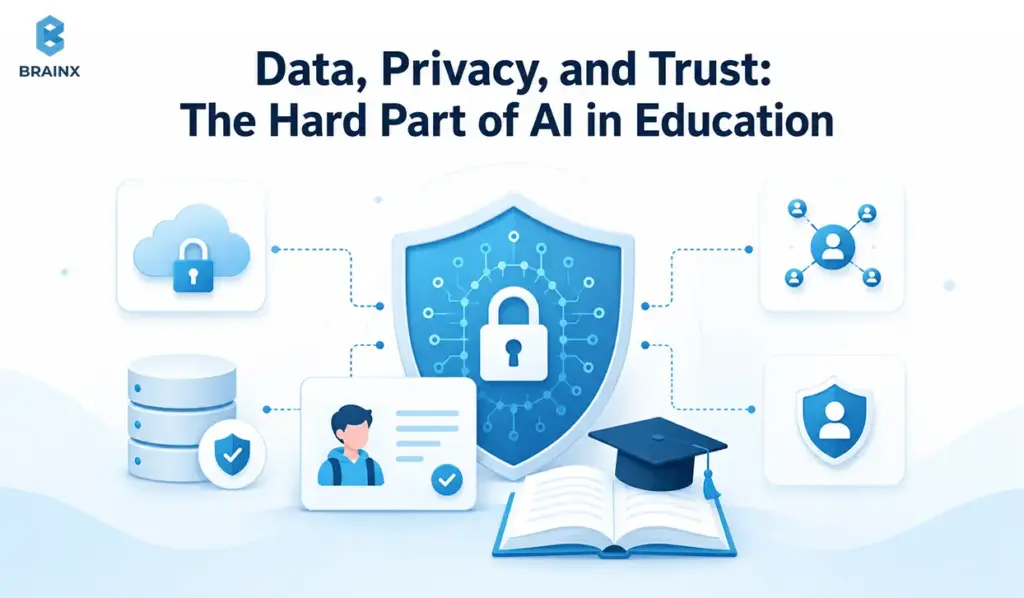
Data governance often determines whether an education AI product reaches production. Institutional buyers are not only assessing model quality. They are deciding whether the vendor can be trusted with learner records, minors, accessibility, and decisions that may affect academic progress.
Trust cannot be added through a privacy page after development. It must appear in identity design, data retention, vendor contracts, model evaluation, interfaces, and teacher controls.
A strong procurement response should explain what the system collects, why it collects it, where the data is stored, who can access it, how long it is retained, and whether a third-party model provider can reuse it.
Safety and Privacy in Student Data (FERPA, COPPA, GDPR Considerations)
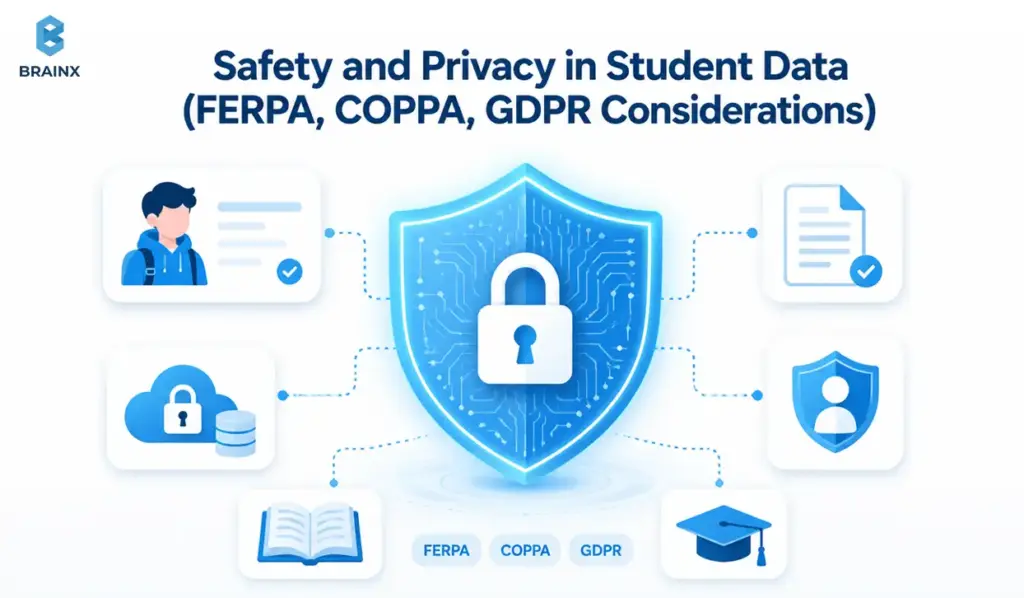
FERPA protects the privacy of student education records in the United States. It generally restricts disclosure of personally identifiable information without consent unless a permitted exception applies, and it places limits on redisclosure.
COPPA applies to online services directed to children under 13, and to services that knowingly collect personal information from children in that age group. Covered operators generally need verifiable parental consent before collecting, using, or disclosing that information.
GDPR applies to processing activities that fall within its territorial scope. It requires a lawful basis, transparency, data minimization, appropriate safeguards, and mechanisms for exercising data rights. Requirements for children’s consent to information society services vary by EU member state within the limits set by GDPR.
Product requirements should include:
- Data minimization by default
- Encryption in transit and at rest
- Tenant isolation
- Role-based access control
- Retention and deletion workflows
- Subprocessor documentation
- Consent and parental-control mechanisms
- Exportable audit records
- Institution-level AI controls
- Procedures for incident response
Accessibility belongs in the same product scope. WCAG 2.2 is the current W3C Recommendation for digital accessibility. AI-generated hints, navigation, teacher dashboards, captioning, and time-sensitive interactions should all be tested against accessibility requirements.
Bias, Fairness, and Explainability for Learner-Facing Recommendations
Bias can appear through lower-quality recommendations, inaccurate risk flags, inaccessible interfaces, or language that disadvantages certain learners.
Removing protected attributes does not automatically solve the problem. Attendance, location, device type, language, or course history may still act as proxies. The correct approach is to test outcomes, investigate disparities, and adjust the model or workflow.
Teams should ask:
- Are false-positive risk alerts concentrated in one learner group?
- Does recommendation quality differ by language or accessibility need?
- Are some learners consistently routed to easier material?
- Can teachers understand why an action was recommended?
- Can users challenge or override important decisions?
- Does performance change after a model or content update?
Explanations should be useful rather than technical. A teacher needs to know that a learner was flagged because of missed work and declining scores. They do not need a page of model coefficients.
For important decisions, the interface should present evidence, confidence, and an override path. NIST recommends evaluating fairness within the actual deployment context rather than treating bias as a one-time laboratory test.
Academic Integrity: Plagiarism, Hallucinations, and Assessment Validity
The academic-integrity problem is broader than plagiarism. The deeper risk is false mastery, where a learner appears successful because the system completes intellectual work on their behalf.
Product teams should design for productive struggle. In tutoring workflows, hints should usually come before final answers. In writing support, the system can identify weak reasoning or suggest a structure without producing the entire assignment.
Recommended controls include:
- Curriculum-grounded responses
- Source references
- Hint-first tutoring policies
- Rubric-constrained feedback
- Logging of high-risk interactions
- Confidence-based human review
- Separate policies for formative and summative work
- Assessment of independent transfer after assistance is removed
Hallucinations are particularly dangerous when the response sounds authoritative. Retrieval grounding reduces risk but does not eliminate it. The platform still needs evaluation sets, citation checks, refusal logic, and escalation.
Assessment validity also matters. A model may score consistently while measuring the wrong skill. Learning scientists and teachers should validate whether automated feedback aligns with the intended construct, not only whether it resembles historical grades.
Practical Implementation Roadmap (From MVP to Scaled Rollout)
A strong roadmap follows the way product teams actually learn: discovery, one-loop MVP, controlled pilot, then scaled rollout. Trying to launch tutoring, recommendations, risk prediction, and content generation together usually produces several weak features instead of one trusted feature.
The implementation sequence should reduce uncertainty in stages. First prove that the product captures meaningful signals. Then prove that the model makes useful decisions. Finally prove that the workflow improves outcomes in a real cohort.
BrainX’s AI development process covers data preparation, proof of concept, testing, integration, deployment, and monitoring.
Define Learning Goals and Success Metrics (Beyond “Engagement”)
Start by describing the learner problem in a sentence an educator would recognize.
Examples include:
- Reduce repeated misconceptions in algebra word problems.
- Improve speaking confidence for intermediate English learners.
- Identify disengaged learners two weeks earlier.
- Reduce teacher time spent reviewing first-draft essays.
- Improve transfer from guided practice to independent assessment.
Then define four types of measurement:
- Learning metrics: mastery gain, transfer score, completion, assessment improvement
- Behaviour metrics: hint dependency, repeat errors, pace stability, voluntary practice
- Operational metrics: teacher review time, support load, intervention response time
- Risk metrics: hallucination rate, override frequency, subgroup disparity, accessibility defects
Avoid making engagement the only north-star metric. Longer sessions may reflect interest, but they may also indicate confusion.
MVP Scoping: Pick One High-Impact Personalization Loop
The best MVP usually focuses on one of three loops:
- Recommendation loop: learner signal → next-best activity
- Tutor loop: learner attempt → hint or scaffold
- Intervention loop: risk signal → teacher or coach action
A focused MVP still needs a complete path. For an adaptive-practice feature, that might include event tracking, a small skills graph, a learner-state model, recommendation logic, an educator dashboard, and outcome measurement.
The scope should be narrow enough to evaluate within one subject, course, or cohort. A middle-school mathematics platform might begin with fractions rather than attempting to personalize the entire curriculum.
This is where edtech app development decisions have long-term consequences. Event schemas, logging, experimentation controls, and content metadata should be designed before the interface is presented as fully intelligent.
Evaluation Plan: Offline Tests + Pilot Cohorts + A/B Experiments
Evaluation should occur at three levels.
Offline evaluation tests model behaviour before learners see it. Teams can measure retrieval relevance, grading consistency, recommendation logic, safety-filter performance, and prompt adherence.
Pilot cohorts reveal issues that test datasets cannot. Teachers may reject a technically correct recommendation because it arrives at the wrong point in the lesson. Learners may misinterpret a hint or rely on it too quickly.
Controlled experiments determine whether the feature changes outcomes. Depending on the institution, this may involve A/B tests, stepped-wedge rollouts, matched cohorts, or pre-test and post-test comparisons.
The evaluation plan should include subgroup analysis, teacher feedback, and independent performance after assistance is removed. Strong published results in adaptive learning and AI tutoring come from structured evaluation, not feature adoption alone.
Scaling Plan: Latency, Cost Controls, and Multi-Tenant Deployment
The primary engineering considerations when you’re going to scale are latency, cost, tenant isolation, and operational visibility.
Use lower-cost models for classification, tagging, and simple routing when advanced reasoning is unnecessary. Cache stable explanations and frequently retrieved curriculum content. Separate synchronous learner-facing requests from asynchronous analytics and reporting jobs.
Multi-tenant systems need:
- Tenant-specific content and policy controls
- Separate permissions and data boundaries
- Configurable model features
- Institution-level reporting
- Region-aware storage where required
- Controlled rollout and rollback
- Per-tenant cost monitoring
Quality edtech app development services will account for these requirements in the MVP architecture. They should not appear for the first time when an enterprise buyer submits a security questionnaire.
Build vs. Buy (and When to Partner)
Most teams should not build every component themselves. The practical question is which layers create a durable advantage and which are better sourced from proven providers.
Infrastructure, base models, authentication, and standard LMS connectors can often be purchased. The learner model, pedagogy, recommendation logic, tutor experience, and institutional workflow may require custom development.
| Layer | Usually Buy | Usually Build | Common Hybrid Approach |
| LMS and SSO integration | Yes | Rarely | Buy connectors, build workflow logic |
| Event storage or LRS | Often | Sometimes | Buy infrastructure, define custom schemas |
| Tutor model access | Yes | Rarely | Buy model access, build tutor experience |
| Tutor pedagogy | Rarely | Often | Custom prompts, retrieval, and policy |
| Recommendation engine | Sometimes | Often | Start with rules, add custom ML |
| Content generation | Sometimes | Sometimes | Vendor model with custom review workflow |
| Monitoring tools | Often | Rarely | Buy tooling, define custom evaluation sets |
The hidden costs of buying include usage fees, vendor lock-in, limited observability, data restrictions, and integration work. The hidden costs of building include specialist hiring, model operations, security, and ongoing evaluation.
When EdTech App Development Should Be Custom (vs. Off-the-Shelf)
Custom edtech app development is appropriate when the product’s value depends on:
- A unique instructional method
- Proprietary content or skill mappings
- Complex learner, educator, and administrator workflows
- Institution-specific policy controls
- Deep integration with existing systems
- A differentiated adaptive or assessment experience
- Strict data residency or deployment requirements
Off-the-shelf tools are often enough for standard course delivery, basic reporting, simple branching, or early concept validation.
The strongest strategy is frequently hybrid. A team may use a commercial LMS, managed LRS, cloud model provider, and observability platform while owning the learner model, recommendation policy, and user experience.
Custom development is most justified when ownership of that layer affects retention, outcomes, institutional fit, or long-term product differentiation.
Where Vendors Fit: LMS, LRS, Proctoring, Content Tooling, and LLM Providers
Vendors can accelerate delivery across several layers:
- LMS platforms provide course delivery, enrolment, assignments, and reporting.
- LRS providers store xAPI learning records.
- Proctoring providers support exam identity and monitoring workflows.
- Content tools handle authoring, media, translation, or digital assets.
- Speech services provide transcription, text-to-speech, and pronunciation analysis.
- LLM providers supply foundation models through APIs or managed environments.
- Evaluation platforms support prompt testing, tracing, and monitoring.
Vendor selection should consider more than feature coverage. Analyze data retention, subprocessor application, deployment regions, service limits, ability for data export, and data re-use for model training.
Interoperability standards help minimize lock-in, but do not eliminate integration tasks. Teams still need custom schemas, permissions, content mappings, and product logic.
Team Roles You Actually Need: PM, Learning Science, Data, ML, QA, Security
A good delivery team typically contains:
- Product manager: Identifies the problem, stakeholders, priorities, and success metrics.
- Learning science or curriculum lead: Validates pedagogy, progression, and assessment.
- Full-stack engineer: Builds learner, educator, and administration workflows.
- Data engineer: Creates event pipelines, integrations, and analytical datasets.
- ML or AI engineer: Develops models, retrieval, recommendations, and evaluations.
- QA engineer: Tests software behaviour and model outputs.
- DevOps or MLOps engineer: Manages deployment, monitoring, and infrastructure.
- Security and privacy lead: Analyzes data flows, access, compliance, and data threats.
- Product designer: Designs experiences that are usable by learners and educators.
Some roles can be fractional during discovery, but learning science, security, and model evaluation should not be omitted.
A specialist partner is important when the capabilities needed to bring the product to market internally would take time and leave a gap in the long term.
Cost, Timeline, and Key Factors That Change the Budget
There is no honest flat price for AI in Edtech since it is influenced by data readiness, curriculum structure, integrations, evaluation, user roles, and compliance requirements.
The following ranges are representative planning bands and do not constitute a fixed quotation. They should be treated as early scoping estimates and confirmed against the final product scope.
| Delivery Stage | Typical Scope | Indicative Timeline | Illustrative Investment |
| Discovery and technical validation | Data audit, architecture, prototype, evaluation plan | 4–8 weeks | USD 20,000–50,000 |
| Focused personalization MVP | One loop, limited content domain, pilot dashboard, core integrations | 3–5 months | USD 60,000–180,000 |
| Integrated AI learning product | Multiple roles, tutor or recommendations, analytics, production controls | 5–9 months | USD 150,000–400,000 |
| Enterprise rollout | Multi-tenancy, broad integrations, governance, scale, formal procurement | 9–15+ months | USD 400,000+ |
Planning note: These figures are illustrative scoping ranges, not fixed market benchmarks or a BrainX quotation. Final cost and timeline depends on the scope of the product, data readiness, integrations and delivery model.
MVP Cost Drivers: Data Readiness, Content Structure, Integrations, and Evaluation
The largest MVP cost drivers are usually:
- Data readiness: Are learner events already accessible and reliable?
- Content structure: Is the curriculum tagged to skills, levels, and prerequisites?
- Integrations: Does the product require LMS, SIS, SSO, messaging, or reporting integration?
- Evaluation: Are rubrics, test sets, pilot cohorts, and baseline outcomes available?
- User experience: How many learner, teacher, parent and administrator workflows are needed?
- Compliance: Do consent, audit, residency, or age specific controls need to be implemented?
A product that has a structured curriculum and usable events already can get to a pilot quicker than one that needs a new content taxonomy and data pipeline first.
The cheapest prototype is not always the lowest-cost path. A demonstration without the consideration of logging, permissions, evaluation, and teacher workflows might need to be re-created for institutional use.
Ongoing Costs: Inference, Monitoring, Human Review, and Compliance Operations
Recurring costs usually include:
- Model inference
- Embedding generation
- Vector and event storage
- Monitoring and evaluation runs
- Human content review
- Teacher or assessor escalation
- Security and privacy operations
- Accessibility regression testing
- Model and prompt updates
- Support and incident response
Usage volume is only one driver. A low-volume assessment tool may require more human review and governance than a high-volume content recommender.
Teams should track cost per learner, cost per AI interaction, cost per completed course, and cost per measurable outcome. These metrics are more useful than a monthly API bill viewed in isolation.
Procurement Realities for Enterprises and Institutions (Security Reviews, Pilots)
Institutional procurement may add several months to delivery even when the software is technically ready.
Typical requirements include:
- Security questionnaires
- Data-processing agreements
- Subprocessor reviews
- Accessibility evidence
- Penetration testing
- Insurance documentation
- Architecture and data-flow diagrams
- Pilot approval
- Legal review
- Institution-specific retention terms
Product teams should not wait until launch to discover these constraints. Procurement requirements should shape architecture, hosting, audit logs, consent, and vendor selection during discovery.
A controlled pilot can help buyers evaluate learning value without committing to a full rollout. The pilot should still have defined success criteria, security boundaries, support responsibilities, and a decision point for expansion.
Choosing the Right Partner for Delivery
A delivery partner should understand that an education AI product is more than a model integration. It combines learning science, data engineering, product design, software development, evaluation, compliance, and ongoing operations.
The strongest partner will ask about learner outcomes and institutional workflows before proposing features. It should also challenge requests that cannot be measured or safely deployed.
Commercial due diligence should focus on evidence, process, and production readiness rather than polished AI demonstrations.
What to Expect from EdTech App Development Services
Strong edtech app development services should cover the full path from problem definition to scaled operations:
- Product and learning-goal discovery
- Data and content-readiness assessment
- Architecture and security planning
- UX design for learners, teachers, and administrators
- AI prototyping and model evaluation
- LMS, LRS, SIS, SSO, and reporting integrations
- Pilot design and controlled rollout
- MLOps, observability, and support
- Accessibility and compliance planning
- Documentation and internal-team handover
The partner should define what will be bought, what will be built, and why. It should also explain the operational cost of each major technology choice.
A credible team will not promise platform-wide personalization before reviewing learner events, curriculum structure, and evaluation options.
How to Evaluate an EdTech App Development Company (Checklist + Red Flags)
A capable edtech app development company should be able to answer these questions clearly:
- How will you connect AI outputs to defined learning outcomes?
- How will you evaluate hallucinations, bias, grading consistency, and rubric drift?
- How will teachers review or override important decisions?
- How will the platform isolate institution and learner data?
- How will model behaviour be monitored after launch?
- How will accessibility be tested?
- How will you measure the pilot against a baseline?
- What will our internal team receive at handover?
Common red flags include:
- “We can add AI everywhere.”
- “A pilot is unnecessary.”
- “The base model handles safety.”
- “Compliance can be completed after launch.”
- “Personalization is mainly a chatbot.”
- “Model accuracy is the only metric that matters.”
- “Your data does not need preparation.”
The right partner should be comfortable limiting scope when the evidence, data, or controls are not ready.
Proof to Ask For: Model Eval Approach, Security Posture, and Measurable Outcomes
Ask prospective partners for artifacts rather than broad claims.
Useful evidence includes:
- Sample evaluation scorecards
- Retrieval-quality benchmarks
- Model or prompt test plans
- Monitoring and audit-log designs
- Security and privacy documentation
- Accessibility test evidence
- Architecture diagrams
- Pilot reports
- Case studies with measurable outcomes
- Handover and operational-support plans
BrainX’s Work Ready Mobile project provides relevant education-platform experience. The solution supports adult basic education through web and mobile applications, multi-tenant delivery, multilingual workflows, reporting, and communication across in-app notifications, push, SMS, and email.
How BrainX Helps With AI in Edtech
BrainX approaches AI in Edtech as a product and engineering problem, not simply a model-selection exercise. The engagement begins by identifying the learning objective, auditing data and content, and defining one personalization loop that can be measured.
The delivery process typically follows five stages:
- Discovery and feasibility: Map learner workflows, data sources, curriculum structure, risks, and success metrics.
- Focused MVP: Build one recommendation, tutor, assessment, or intervention loop.
- Pilot and evaluation: Test with real users, compare outcomes, and collect educator feedback.
- Integration and governance: Add LMS connections, identity, tenant controls, auditability, and compliance requirements.
- Scaled rollout: Improve latency, cost controls, monitoring, content operations, and multi-tenant delivery.
BrainX supports custom AI development, machine learning, NLP, retrieval-augmented generation, product engineering, cloud integration, and model deployment. We have more than nine years of delivery experience, over 120 engineers, more than 250 projects, and over 130 clients..
Our team also brings adjacent education-platform experience through products such as Work Ready Mobile and MathaMentor. That matters because AI features must fit existing learner, educator, communication, and reporting workflows.
Conclusion
The most reliable way to build AI in Edtech is to start with one learning loop, prove it with a real cohort, and expand only after the data and evaluation support the decision.
Personalization at scale does not come from adding more model calls. It comes from structured curriculum, reliable learner signals, safe AI behaviour, teacher involvement, and disciplined product operations.
For teams planning a new platform or modernizing an existing product, the practical next step is to choose one measurable use case, assess data readiness, and design a pilot that can withstand pedagogy review, procurement, and production reality.
BrainX Technologies can support that journey from discovery and MVP development through integration, evaluation, and scaled delivery.
FAQs on the Role of Artificial Intelligence in Edtech
What Is AI in Edtech and How Is It Used for Personalized Learning?
AI in Edtech refers to using machine learning, NLP, predictive models, and generative AI within education products. These systems analyse learner performance, activity, revision history, and content interactions to decide what support should come next.
Personalized applications include recommending lessons, adjusting difficulty, generating hints, providing rubric-aligned feedback, and identifying learners who may need intervention.
The best implementations extend teacher capacity while keeping educators involved in important instructional and assessment decisions.
What Data Do You Need to Personalize Learning at Scale in an EdTech App?
A learning platform needs more than final grades. Useful data includes attempts, time-on-task, hint use, revision patterns, content progress, assessment results, teacher actions, and intervention outcomes.
The platform also needs structured content metadata. Lessons, exercises, and assessments should be connected to skills, prerequisites, learning levels, and curriculum objectives.
Standards such as xAPI and LTI can support event collection and interoperability across learning systems. The quality and consistency of these signals affect the reliability of every downstream recommendation.
How Do You Prevent Hallucinations and Unsafe Content in AI Tutoring Features?
Use retrieval-augmented generation over approved curriculum, constrained prompts, safety filters, confidence checks, and human escalation.
The tutor should prefer hints and guided reasoning before direct answers. It should cite or reference approved learning material and clearly refuse questions outside its scope.
Teams should maintain evaluation sets, log high-risk outputs, monitor unsupported claims, and let educators review important interactions. The available evidence supports structured tutor designs with grounding and safeguards rather than unrestricted chatbot access.
How Much Does It Cost to Build AI-Powered Personalization in an EdTech Platform?
Cost depends on data readiness, curriculum structure, integrations, model complexity, evaluation, user roles, and compliance requirements.
An early discovery or technical-validation phase may require approximately USD 20,000 to USD 50,000. A focused personalization MVP may fall between USD 60,000 and USD 180,000, while integrated or enterprise products can exceed USD 400,000.
These are planning bands rather than fixed quotations. A reliable estimate requires a review of the intended use case, content, learner data, deployment environment, and institutional requirements. Final pricing should be confirmed through project discovery.
What Privacy and Compliance Requirements Apply to AI in Education (FERPA/COPPA/GDPR)?
FERPA governs the privacy and disclosure of education records in the United States. COPPA applies to covered online services that collect personal information from children under 13. GDPR applies to personal-data processing within its territorial scope and requires a lawful basis, transparency, minimization, and appropriate safeguards.
Products may also need to meet WCAG 2.2 accessibility requirements and institution-specific security, retention, and procurement policies.
Compliance should shape data collection, identity, access control, retention, vendor selection, auditability, and human oversight from the beginning.
How Do You Measure Whether AI Personalization Actually Improves Learning Outcomes?
Measure learning directly rather than relying only on engagement. Useful metrics include mastery gains, transfer performance, completion, time to proficiency, intervention lift, teacher time saved, and subgroup outcomes.
Begin with offline tests, then run a pilot with real learners. Where appropriate, compare the AI-supported experience with a control group, matched cohort, or baseline period.
Also test performance after AI support is removed. A feature that improves task completion while increasing learner dependency may not improve durable understanding. Recent adaptive-learning and AI-tutoring research shows why controlled evaluation is essential.