 October 8, 2026 -
 16 minutes read


AI lead qualification automation integrates lead data, sales criteria, and AI analysis to determine which leads should be passed to sales, nurtured, or further investigated. It brings those decisions into your CRM and enables teams to react consistently while maintaining evidence of each handoff.
The question for the Revenue Operations (RevOps) leaders is what to automate and what sales should still own. If you’re looking for an AI lead scoring automation guide, start with the distinction between ranking a prospect and deciding what should happen next. This guide covers both, along with the workflow, data requirements, implementation steps, costs, and measures of success.
Quick Answers
What does AI lead qualification automate?
AI can research accounts, interpret inquiries, identify missing information, recommend qualification status, and prepare sales handoffs. Approved integrations then update CRM records, assign owners, or trigger follow-up according to your business rules.
How is qualification different from lead scoring?
Lead scoring ranks prospects by fit, engagement, or predicted conversion. Qualification determines whether the available evidence meets your sales criteria and which action should follow. A high score alone does not establish readiness for a sales conversation.
Which approach should a B2B team start with?
Start with explicit rules for eligibility and routing. Add AI where interpreting messages or recognizing patterns improves a decision. Use an interactive agent when collecting missing information requires a conversation.
What needs to be ready before implementation?
You need an agreed ideal customer profile, reliable decision-critical fields, CRM access, named owners, and a way to evaluate results. Predictive models also need representative historical outcomes; basic rules and text extraction do not require the same training history.
How should teams measure success?
Compare qualification errors, response time, human effort, and downstream opportunity quality against the existing process. Include missed qualified leads and operating costs. More meetings are useful only when those meetings justify sales attention.
Key Takeaways
- AI lead qualification automation needs clear ownership and a defined next action for every outcome.
- If the evidence is missing, ask a question or do a review. Don't automatically assume a negative answer.
- Leave original prospect statements aside from model interpretations to allow sellers to look at the evidence.
- Pilot one meaningful workflow before expanding channels, integrations, or automated actions.
- Assess full operating costs, such as enrichment, maintenance, and human review costs.
What Is AI Lead Qualification?
AI lead qualification is used to determine if a prospect is a good fit for your offering and what sales action you should take next. The system integrates company data, buyer's declared requirements, and your credentials. The output should contain a status, supporting evidence, and a proposed next step.
What is the Job of an AI Lead Qualification Agent?
An AI lead qualification agent performs qualification tasks with connected tools and predefined rules. It can understand a question, verify CRM data, follow-up questions, and create a sales handoff. The permissions decide what it's allowed to do on its own and what it will need approval for.
For example, an operations director at a 600-person company wants a software demo. The company is a good match for your target market, but you can't predict when to implement it. The agent might be able to label the lead as "potential fit; confirm timeline" and then ask when the lead is planning to launch before offering to hand it over to sales.
How Does AI Lead Qualification Work?
AI lead qualification is the process of gathering and enriching lead data, understanding buyer intent, verifying sales qualifications, and assigning each lead to the next step in the sales funnel. The workflow combines fixed rules, AI analysis, and human review where evidence is incomplete or conflicting.
Three mechanisms can contribute to this process, depending on the workflow. Rules are used to set specific requirements, predictive models to predict outcomes, and large language models (LLMs) to interpret unstructured messages. The definition of predictive scoring in HubSpot's documentation is to predict whether contacts will become customers in the next 90 days. While that forecast can lead to prioritization, it is up to your business to determine what action the score allows.
Capture And Normalize Incoming Leads
Gather leads from approved forms, email, chat, events or product signups. Standardize company names, domains, source fields, timestamps, and account identifiers. Make sure that there is no duplicate record or opportunity in place before adding a new record or assigning a new seller.
Preserve account ownership. If a current customer wants another product, then he/she may fit into an account manager's queue instead of the new-business queue.
Enrich The Profile And Interpret The Request
Only include information that can be used to answer a qualification question, such as company size, industry, supported geography, or relevant technology. Store the source and retrieval date so stale or conflicting information can be investigated.
An LLM can extract a use case, urgency, and stakeholder references from a message. If a prospect states that IT will participate in the security review, make a note of IT participation. Don't assume that the contact controls purchasing or that a budget has been approved.
Ask For Missing Evidence And Evaluate Fit
Ask the smallest number of questions needed to choose the next action. A complete company profile may leave only timing unresolved. If the inquiry is not clear, you will need to have a "use case" question before discussing the budget.
Apply the qualification rubric and document the result as: qualified, nurture, disqualified, or review. Ensure that reason codes are linked to observable evidence. Model-generated confidence values should never be reported as a closing probability, unless they have been validated for that purpose.
Route The Lead And Complete The CRM Handoff
Provide the next owner with a brief synopsis of the buyer's issues, needs, unanswered inquiries, and resources. Update the CRM with the status, reasons, timestamp, and workflow version.
If an update fails, send it to a monitored exception queue. Qualification is considered "operationally complete" when the result reaches the team who must take action on it.
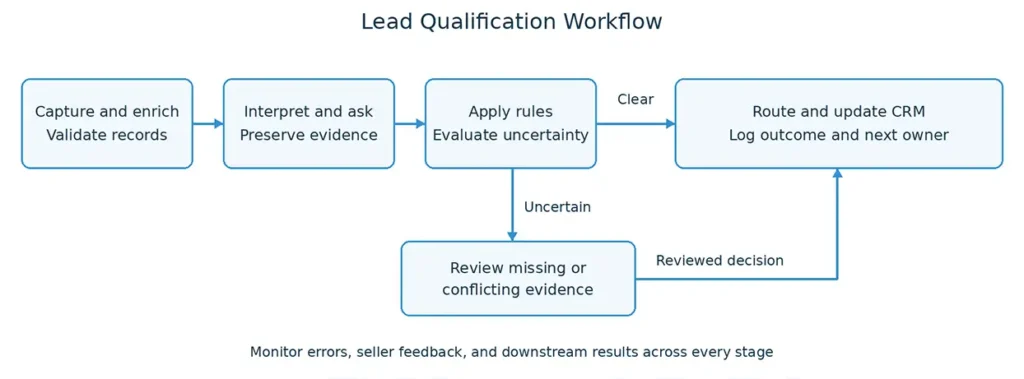
Figure 1. Illustrative workflow with a separate review path for uncertain evidence.
What A Useful Qualification Record Looks Like
For the illustrative operations director, the CRM handoff might contain the following:
- Status: review, with a request to confirm timing.
- Fit evidence: supported industry and company size, with the source recorded.
- Stated need: replace a manual approval process before a regional rollout.
- Unknowns: target launch date, procurement involvement, and approved budget.
- Next action: assigned seller confirms timing and purchasing process.
The important distinction is between what the buyer said and what the system inferred. A regional rollout suggests urgency, but it does not establish a deadline. A director-level title suggests possible influence, but it does not confirm purchasing authority.
This record also makes correction easier. The seller can update the missing fields without undoing a misleading “fully qualified” label or repeating discovery questions the buyer already answered.
What Data and Integrations Must Be Ready First
Gather the data required to make and implement the decision before choosing a model. A useful starting point is a written ideal customer profile (ICP), agreed qualification categories, and a field-by-field map linking each criterion to its evidence source.
Turn Sales Criteria Into Observable Evidence
“Good enterprise fit” is too vague to implement. Outline related company attributes, needs, and purchasing conditions. Determine mandatory and priority requirements.
Treat unknown values explicitly. If the budget field is blank, it does not mean that the buyer cannot afford your product, it simply means they don't know their budget. Similarly, a junior contact could be doing research for a buying committee.
Sales and RevOps should review sample leads together. Before asking AI to replicate the outcome, make sure they agree on the appropriate outcome in the first place.
An existing sales framework can organize those criteria. For example, BANT groups discovery around budget, authority, need, and timing. Don't expect all these categories to be mandatory gates on first contact; use them as prompts for evidence collection. An early-stage buyer may have a real business need before procurement defines a budget.
Connect Records And Actions Reliably
Map the CRM, capture channels, enrichment providers, notification tools, scheduling, and reporting systems. Define which application owns each field and which component can change it.
Authentication, rate limits, retries, and duplicate events are important points to consider with regard to integration planning. Retrying the same request must not create another lead, meeting, or email. Our guide to integrating AI into an existing technology stack explains the broader architecture and rollout considerations.
Keep a named owner for unresolved records. A review queue that doesn't have a response time limit can turn into another lead loss source.
Which Qualification Architecture Fits Your Sales Process
Choose the simplest architecture that can answer your qualification questions reliably. The volume of leads is important, but so are the maturity of the data, complexity of the conversations and the impact of a bad decision.
| Approach | Best fit | Main limitation |
| Rules | Clear eligibility, ownership, and routing criteria | Requires manual updates when policy changes |
| Predictive scoring | Prioritizing leads using representative historical outcomes | Past conversion patterns may not match the current market |
| Conversational agent | Interpreting inquiries and asking missing questions | Requires trusted product knowledge and strict action permissions |
| Hybrid workflow | Combining fixed rules, AI assistance, and human exceptions | Requires clear responsibility at each handoff |
A conversational agent earns its place when interaction changes the decision. If all the necessary fields are already on a form, then a background workflow might suffice.
Hybrid systems are useful when unusual accounts need judgment. Code can preserve account ownership, an LLM can summarize the request, and a seller can decide whether a strategic exception is justified. Keep those responsibilities visible so errors can be traced to the relevant step.
What Business Value Should Automation Create
The business case should define specific objectives to eliminate and specific outcomes to enhance. Common targets include less manual research, fewer routing errors, faster follow-up, and more complete sales handoffs.
Salesforce’s 2026 State of Sales findings report that sellers spend 40% of their time selling. The research surveyed 4,050 sales professionals in 22 countries during August and September 2025. It provides context for administrative workload, rather than a forecast of savings from your implementation.
Adam Alfano, identified in the report as Salesforce’s EVP of Sales, puts the objective plainly: “We want to kill the busywork so our teams can focus on what actually moves deals forward: building relationships and driving success.”
Our Radio Prospector case study offers a related implementation example. Its backend combined advertiser discovery, enrichment, deduplication, lead scoring, and campaign automation. These capabilities are relevant to sales workflows, although the case study does not establish a conversion benchmark for the qualification system described here.
How Do You Automate Lead Scoring and Qualification?
Implement one bounded workflow, compare its decisions with the existing process, and expand only after the evidence supports doing so. A pilot should test business usefulness and operational reliability together.
Step 1: Record The Current Process
Choose one lead source and document volume, qualification time, manual research effort, routing errors, and sales acceptance. Trace several real leads from arrival to follow-up to identify where delays actually occur.
If the main delay is an unstaffed sales queue, faster AI scoring will not resolve it. Use an AI automation readiness assessment to check whether the proposed workflow addresses the underlying bottleneck.
Step 2: Define Outcomes And Ownership
Write the evidence required for each qualification category, the permitted next action, and the person accountable for exceptions. Distinguish a buyer whose needs you cannot meet from a promising buyer who is not ready to purchase.
Create a small evaluation set containing straightforward leads, borderline cases, missing fields, duplicates, and conflicting information. Have knowledgeable reviewers agree on the expected decisions and record unresolved disagreements.
Step 3: Test Recommendations In Shadow Mode
In shadow mode, the system processes leads without controlling the official outcome. Compare recommendations with reviewed labels and later business results. Investigate disagreements rather than treating every human override as proof that AI was wrong.
Keep test examples separate from those used to tune prompts or rules. Otherwise, apparent improvement may reflect familiarity with the examples rather than reliable performance on new leads.
Include examples from different sources and periods. A test set dominated by recent demo requests will not reveal how the system handles older event contacts or vague email inquiries. Record whether each error came from missing data, incorrect interpretation, policy ambiguity, or an integration failure so the fix addresses the actual cause.
Step 4: Enable Limited Production Actions
Begin with reversible actions such as creating an internal task or drafting a handoff summary. Test timeouts, permission failures, duplicate requests, unavailable calendars, and failed CRM writes before enabling broader execution.
Give sellers a clear way to correct an outcome. Agree on pause conditions, such as repeated routing failures or an unacceptable rate of missed qualified leads, and confirm who can restore the manual process.
Step 5: Review Performance And Expand Deliberately
Review pilot results by lead source and customer segment. Expand when quality, workload, and reliability meet agreed requirements. Add channels or permissions separately so the cause of a performance change remains visible.
Version prompts, rules, and integrations. Retest relevant examples when products, qualification policies, data providers, or models change.
How Should Teams Manage Errors Privacy and Human Review?
Controls should match the decisions the workflow can make. A system that drafts an internal summary needs different safeguards from one that rejects prospects or sends external messages.
Preserve Uncertainty And Inspect Rejected Leads
Conflicting evidence should trigger review. If enrichment reports 40 employees while the prospect reports 400, retain both sources and confirm which is relevant. Do not quietly average them or select the convenient answer.
Sample rejected and nurtured leads as well as accepted ones. Reviewing only leads that reach sales hides false negatives. Check whether errors concentrate in particular regions, company types, or lead sources, then investigate the criteria and data behind them.
Limit Data Collection and Tool Access
Collect only the information needed to qualify a lead, such as company details, business needs, and relevant contact information. The Federal Trade Commission’s guidance for businesses recommends keeping sensitive personal information only when there is a legitimate business need and limiting how long it is retained. Set clear rules for storing, reviewing, and securely deleting lead data.
Restrict the AI system to the records, fields, and actions needed for its assigned task. For example, a system that evaluates fit may need to read company details and update a qualification status. Permission to read an account should not automatically allow it to export contacts or send messages.
Treat Outside Content As Untrusted Input
Prospect emails and retrieved websites can contain instructions that attempt to alter model behavior. OWASP identifies prompt injection as a risk involving both direct inputs and external content.
Validate model outputs before execution, restrict available tools, and enforce business rules outside the model. A message telling the system to ignore qualification criteria should never become authorization to change them.
Keep An Audit Trail And A Recovery Path
Record evidence, rule versions, model outputs, actions, approvals, and overrides. Assign responsibility for monitoring and incident response. NIST’s AI Risk Management Framework organizes risk work around Govern, Map, Measure, and Manage, providing a useful reference for ongoing oversight.
Maintain a tested way to pause automation, preserve incoming leads, and return work to a human queue.
How Do You Measure Qualification Quality and ROI
Measure decision quality, operational effort, and downstream results together. A faster system that sends unsuitable meetings to sellers may increase total workload.
| Metric | Calculation or definition | What it reveals |
| Qualification precision | Correctly qualified leads divided by all AI-qualified leads | How often leads labeled qualified actually meet your criteria. |
| Qualification recall | Correctly identified qualified leads divided by all truly qualified leads in the evaluated sample | How many worthwhile leads are captured |
| Rep override rate | Changed decisions divided by reviewed AI decisions | Disagreement requiring investigation |
| Time to qualification | Median time from arrival to a usable decision | Processing speed |
| Human effort | Research, review, and cleanup minutes per lead | Whether workload actually falls |
| Meeting-to-opportunity conversion | Opportunities created divided by meetings in the same cohort | Quality after handoff |
| Cost per accepted lead | Qualification operating cost divided by sales-accepted qualified leads | Ongoing unit economics |
Calculate precision and recall using reviewed labels, including sampled rejected leads. Override rate measures disagreement, which can result from model errors, unclear rules, or inconsistent seller judgment.
For outcome comparisons, keep lead sources, segments, sales capacity, and observation windows comparable. Where practical, use a randomized control group. Shadow mode can assess recommendations but cannot demonstrate the effect of automated follow-up that never occurred.
Separate labor capacity from cash savings. If automation saves ten hours but payroll stays unchanged, the immediate benefit is time available for other work. Track whether that time improves coverage or pipeline outcomes before assigning revenue value.
Review reliability alongside funnel metrics. Failed CRM writes, duplicate meetings, and growing exception queues can erase the value of accurate qualification.
For financial evaluation, use a consistent period: ROI equals attributable financial benefit minus total project cost, divided by total project cost. Include implementation and operating expenses. Avoid counting both saved labor and extra revenue from that same time unless the benefits are demonstrably separate. Finance should agree on the attribution method before the pilot starts.
How Much Does AI Lead Qualification Cost and How Long Does It Take
Estimate cost from the workflow scope, integrations, evaluation work, and ongoing operations. A form-based classifier and a conversational agent spanning several systems require different budgets. Obtain an estimate against defined deliverables rather than comparing headline AI prices.
Separate one-time work from recurring costs. Implementation includes discovery, data cleanup, field mapping, development, testing, security review, and deployment. Operations include subscriptions, model usage, enrichment, hosting, monitoring, maintenance, and human review.
An Illustrative Operating Budget
The following hypothetical inputs show how to calculate monthly operating cost. They are planning assumptions, not vendor prices or a BrainX quote.
| Monthly input | Assumption | Cost (USD) |
| Model and enrichment usage | 2,000 leads at $0.20 combined per lead | $400 |
| Platform and monitoring | Assumed fixed monthly expense | $300 |
| Human review | 200 leads at 5 minutes each and $30 per hour | $500 |
| Maintenance | 8 hours at an assumed $50 per hour | $400 |
| Total | Excludes implementation and existing CRM licenses | $1,600 |
If sales accepts 320 qualified leads, the illustrative operating cost is $5 per accepted lead. Include implementation separately when assessing total return. Replace every assumption with your volumes, contracts, and measured review requirements before making a purchasing decision.
Build The Timeline Around Dependencies
Schedule milestones for data readiness, integration access, evaluation, shadow testing, and production rollout. The observation period must also suit your sales cycle; early accuracy results cannot establish enterprise revenue impact.
Ask for milestone exit criteria as well as dates. Integration work is complete when failures are recoverable; evaluation is complete when agreed quality thresholds are met. This gives stakeholders a clearer basis for approving expansion than a calendar deadline alone.
BrainX experts can assess your lead sources, CRM, qualification rules, and operating requirements to develop a scoped estimate. A useful proposal should identify assumptions, exclusions, acceptance criteria, and the ongoing owner.
Should You Build, Buy or Customize?
Buy when a platform supports your qualification rules, systems, channels, and permissions with manageable configuration. Customize when the standard workflow is useful but a few data sources or approval steps require extensions. Build when essential requirements cannot be met reliably through supported features.
Evaluate access to decision evidence, data processing arrangements, integration limits, and the ability to override outcomes. Compare costs at expected volume, including enrichment and maintenance. A low subscription price can become expensive if sellers must repair every handoff.
Ask providers to demonstrate your difficult cases using representative data. Include an existing customer, a duplicate inquiry, contradictory company information, and an API failure. Their handling of exceptions will tell you more than a scripted demonstration using an ideal lead.
Plan Your Lead Qualification Workflow with BrainX
Start with one lead source, a clear qualification rubric, and a measurable handoff problem. That scope gives your team a practical way to test value before committing to a wider rollout.
BrainX Technologies provides custom AI development services covering model development, evaluation, integration, deployment, and monitoring. Bring your current lead journey and sample qualification rules to a scoping discussion. BrainX experts can help identify the appropriate architecture, integration work, and pilot requirements for your sales process.
Frequently Asked Questions
Can AI qualify leads without a chatbot?
Yes. A background workflow can analyze forms, emails, CRM records, and approved enrichment data, then recommend a status and create a sales task. Add a chatbot only when collecting missing information through conversation improves the buyer experience or decision.
Can a small team start without historical conversion data?
Yes. Start with explicit rules and AI-assisted extraction of stated needs. Save reviewed outcomes as the workflow operates. Predictive conversion scoring becomes an option when you have enough relevant, reliable examples to evaluate whether its predictions are useful.
Can this work with a custom CRM?
Yes, if the CRM provides reliable programmatic access and appropriate permissions. The integration must read the necessary fields, write outcomes safely, handle duplicate requests, and expose failures. A custom CRM may require additional engineering for those capabilities.
Should AI automatically disqualify prospects?
Automatic disqualification can suit clear, tested rules with recoverable consequences. Ambiguous evidence and strategic exceptions should receive review. Preserve the reason and allow correction so an incorrect field does not permanently remove a worthwhile prospect from consideration.
Who should own the workflow after launch?
RevOps should usually own qualification policy and performance reporting, with sales responsible for feedback and engineering responsible for integration reliability. Assign security and privacy responsibilities explicitly. One accountable business owner should coordinate changes across those teams.