 August 15, 2026 -
 51 minutes read


Key Takeaways
- Generative AI governance controls the complete AI system, including data, prompts, retrieval, models, outputs, tools, agents, people, approvals, and production changes.
- GenAI requires additional controls because probabilistic outputs, RAG, external tools, and autonomous actions create risks conventional model governance was not designed to manage alone.
- Strong ownership, permissions, lineage, quality, retention, and deletion make the relationship between data governance and generative AI foundational to trustworthy enterprise AI.
- Controls should scale with risk. An internal summarizer should not face the same oversight as a clinical assistant or autonomous financial agent.
- Governance policies become useful only when teams translate them into technical controls, measurable thresholds, evidence, monitoring, escalation, and accountable ownership.
Generative AI governance is the operating system an organization uses to decide which GenAI systems may be built, bought, deployed, changed, or retired. It defines policies, ownership, data rules, technical controls, evaluation standards, evidence, human oversight, and continuous monitoring across the AI lifecycle.
Trustworthy AI depends on more than the foundation model. It also depends on what enterprise information the system can retrieve, transform, retain, and expose. That makes data governance a core component of any responsible AI framework, particularly for RAG systems and AI agents connected to business data.
NIST's Generative AI Profile extends the AI Risk Management Framework to risks that are unique to, or intensified by, generative systems. It treats governance as a lifecycle discipline rather than a one-time approval exercise, spanning the design, development, use, and evaluation of AI systems.
From BrainX's delivery perspective, the most difficult pilot-stage problems are often operational rather than algorithmic: unclear ownership, undefined release thresholds, weak data boundaries, and no explicit production accountability. A good framework removes those ambiguities while preserving room for controlled experimentation.
What Is Generative AI Governance, and How Is It Different From Traditional AI Governance?
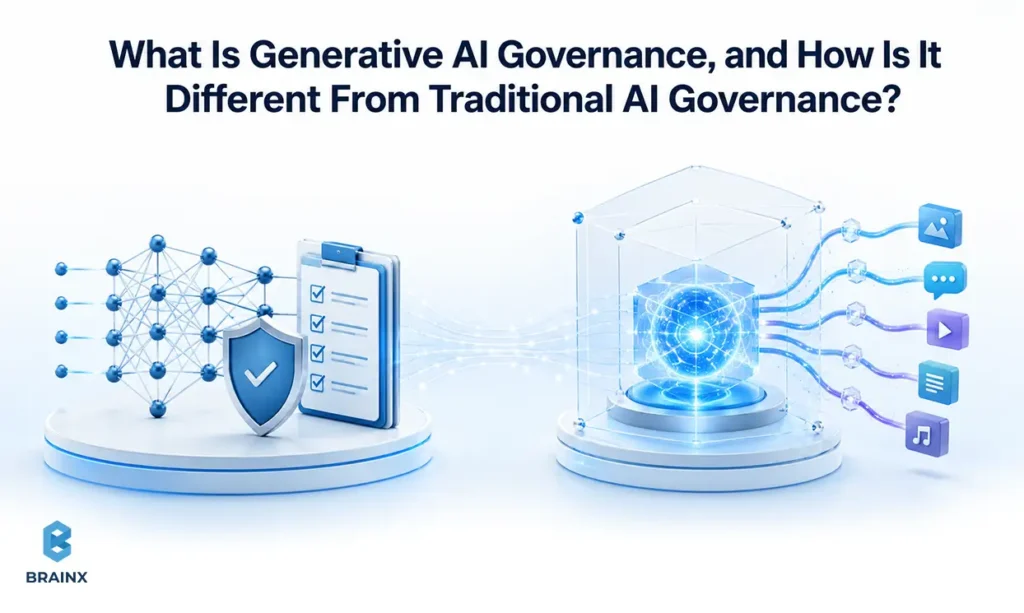
Generative AI governance expands conventional AI oversight beyond model training, validation, and deployment into prompts, generated content, retrieval systems, tools, agents, user behavior, and changing external dependencies.
What Is a Generative AI Governance Framework?
A generative AI governance framework is the structure an organization uses to turn AI governance principles into repeatable decisions, controls, and evidence. It defines what AI systems fall within scope, who can approve them, which data they may use, what tests they must pass, how risks are escalated, and what happens when the system changes after deployment.
The distinction is useful. Generative AI governance is the broader discipline of managing GenAI responsibly. The framework is the operating structure that makes that discipline executable across product, data, security, legal, engineering, and business teams.
A working framework therefore connects several elements that are often managed separately: risk classification, accountable ownership, data rules, technical safeguards, evaluation, approval, monitoring, incident response, and change management. The goal is not to create another compliance layer. It is to give teams a consistent way to answer practical questions such as: Can we use this model? Can this data source be retrieved? Does this change require reapproval? Who can accept the remaining risk?
That distinction becomes increasingly important as GenAI applications add RAG, external tools, multiple model providers, and autonomous actions. The more components that can alter system behavior, the more governance needs to operate across the whole application rather than around the model alone.
What Are the Core Components of an Effective GenAI Governance Framework?
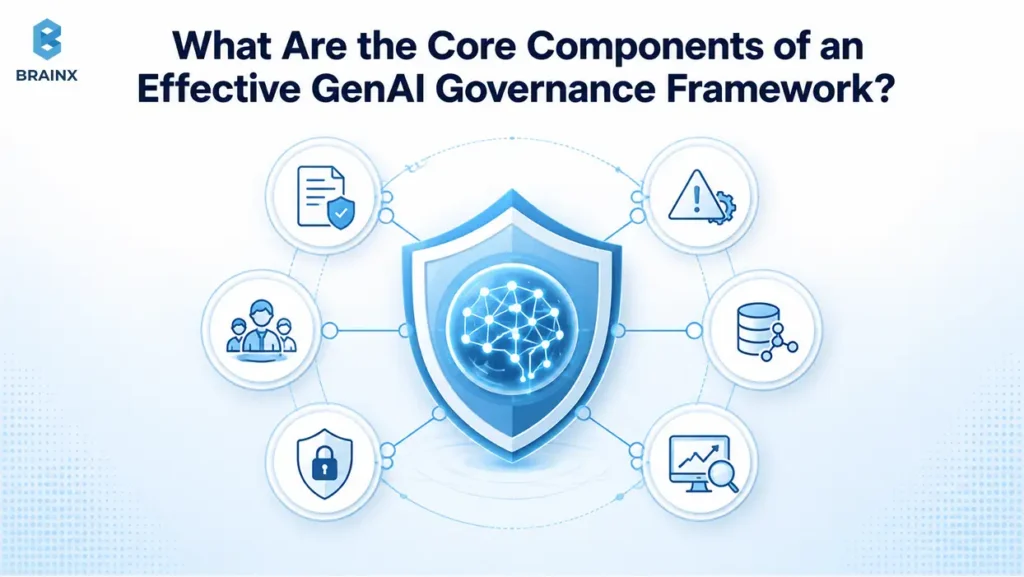
An operational AI governance framework needs decision rights, risk tiers, lifecycle controls, data rules, release evidence, monitoring, incident handling, and a mechanism for exceptions.
A Governance Charter Defines Scope, Authority, and Escalation
The charter establishes what falls under governance and who can make which decisions.
It should define:
- Systems in scope
- Governance authority
- Risk tiers
- Mandatory reviews
- Exception authority
- Escalation paths
- Reporting requirements
- Material-change rules
- Legacy-system treatment
- Decommissioning responsibilities
The charter prevents projects from negotiating governance rules only after a problem occurs.
A RACI Model Assigns Decisions Across Business, Data, Security, Legal, and Engineering
A practical RACI separates accountability from execution.
| Role | Primary Governance Responsibility |
| Executive Sponsor | Enterprise risk appetite and program sponsorship |
| Governance Committee | High-risk approval, standards, major exceptions |
| Product Owner | Intended use, users, business outcome |
| AI/Model Owner | Technical behavior, evaluation, configuration, versioning |
| Data Owner | Approved sources, purposes, quality, access |
| Security | Threat model, IAM, secrets, infrastructure, tool permissions |
| Legal/Compliance | Legal, regulatory, contractual, records obligations |
| Domain Expert | Task-specific quality and safety validation |
| Operations | Runtime monitoring, incidents, rollback |
A RACI should be built around decisions, not merely job titles.
For example: Who approves a new data source? Who can accept residual risk? Who declares an incident? Who can stop the system? Who signs off on a high-impact release?
Which Governance Controls Belong at Each AI Lifecycle Stage?
Controls should change as the system matures.
Discovery: intended purpose, prohibited uses, owner, preliminary risk, initial sources.
Design: architecture, model/provider decision, data policy, threat model, human role.
Build: IAM, prompt management, RAG controls, logging, evaluation automation.
Preproduction: release thresholds, red teaming, domain review, formal approval, rollback readiness.
Operations: quality, security, retrieval, cost, source health, user behavior, incidents.
Change: regression evaluation and reapproval for material changes.
Decommissioning: service shutdown, credential revocation, data deletion, evidence retention, dependency removal.
NIST's GenAI Profile includes lifecycle governance practices around inventories, monitoring, incident management, and decommissioning.
Risk Tiers Determine Review, Testing, and Human-Oversight Requirements
Risk classification should consider more than probability and financial impact.
Useful dimensions include:
severity + likelihood + detectability + data sensitivity + reversibility + autonomy + user vulnerability + downstream decision impact
A low-risk assistant may receive standard owner approval and a reusable test suite. A high-impact system may require independent validation, legal review, domain sign-off, and formal residual-risk acceptance.
Data Policies Must Connect to Technical Enforcement
A policy saying “confidential documents must not be disclosed” is incomplete.
A supporting standard may require document-level authorization. The technical control may be permission-aware retrieval. Evidence may include access-boundary tests and retrieval logs.
The full chain is:
Policy → Standard → Control → Evidence → Approval → Exception → Incident
Each link answers a different question:
- What must happen?
- How should it happen?
- What enforces it?
- How is it proven?
- Who approves it?
- How is an exception authorized?
- What happens when the control fails?
Monitoring and Incident Management Keep Governance Active After Launch
Production governance needs triggers and response actions, not dashboards alone.
Define what creates an alert, who receives it, containment authority, rollback conditions, legal notification requirements, required evidence, restoration criteria, and post-incident review.
A critical metric without an agreed response is only telemetry.
What a Generative AI Governance Framework Controls
A practical framework governs the complete deployed system, not only the model endpoint.
It should control:
| Governance Surface | Traditional Predictive AI | Generative AI |
| Inputs | Structured features | Prompts, files, images, conversation history, retrieved content |
| Outputs | Score, class, forecast | Open-ended text, code, media, recommendations, or actions |
| Data | Training and inference datasets | Training, fine-tuning, prompt, RAG, evaluation, conversation, and telemetry data |
| Behavior changes | Model or code update | Model, system prompt, retriever, source, tool, policy, or configuration change |
| Security | Pipeline, model, endpoint | Prompt injection, sensitive-data disclosure, tool misuse, embedding risks, excessive agency |
| Autonomy | Usually limited | May plan, invoke tools, write data, or execute actions |
| Evidence | Model validation | System evaluation, source traceability, runtime logs, approvals, human-review evidence |
OWASP's 2025 Top 10 for LLM and GenAI applications illustrates this broader boundary. It covers prompt injection, sensitive information disclosure, supply-chain risk, data and model poisoning, improper output handling, excessive agency, system-prompt leakage, vector and embedding weaknesses, misinformation, and unbounded consumption.
Why Prompts, Outputs, Retrieval Sources, and Agents Expand the Governance Surface
A GenAI system can change materially without retraining the underlying model.
A new system prompt can change refusal behavior. A re-indexed knowledge base can change factual answers. Connecting a new CRM API can give an agent authority it did not previously possess. A broader service credential can convert an assistant from a reader into an actor.
The governed configuration should therefore include the model, system instructions, embedding model, retrieval strategy, indexed sources, filters, tools, permission scopes, safety settings, fallback models, and material runtime parameters.
Prompt injection is particularly important because malicious instructions can arrive directly from a user or indirectly through content retrieved by the system. OWASP treats prompt injection and excessive agency as distinct GenAI application risks.
Where Responsible AI Governance Fits Within Data, Security, Legal, and Product Governance
Responsible AI governance should connect existing enterprise functions rather than create an isolated approval bureaucracy.
Product owns the intended use and user outcome. Data owners decide which sources and purposes are permitted. Security manages identity, credentials, threat models, and infrastructure. Legal and compliance map regulations, contracts, privacy, records, and intellectual-property obligations. AI engineering implements controls and produces evaluation evidence.
Governance coordinates those responsibilities into one lifecycle with clear decision rights.
ISO/IEC 42001 reinforces this organizational approach. The standard specifies requirements for establishing, implementing, maintaining, and continually improving an AI management system, rather than treating responsible AI as an isolated technical review.
Consider the difference in practice. A churn-prediction model may require feature governance, fairness evaluation, model validation, and drift monitoring. A customer-facing LLM assistant may additionally require permission-aware retrieval, prompt-injection testing, disclosure, hallucination evaluation, conversation controls, escalation, and continuous source monitoring.
How Do You Build a Responsible AI Governance Framework Step by Step?
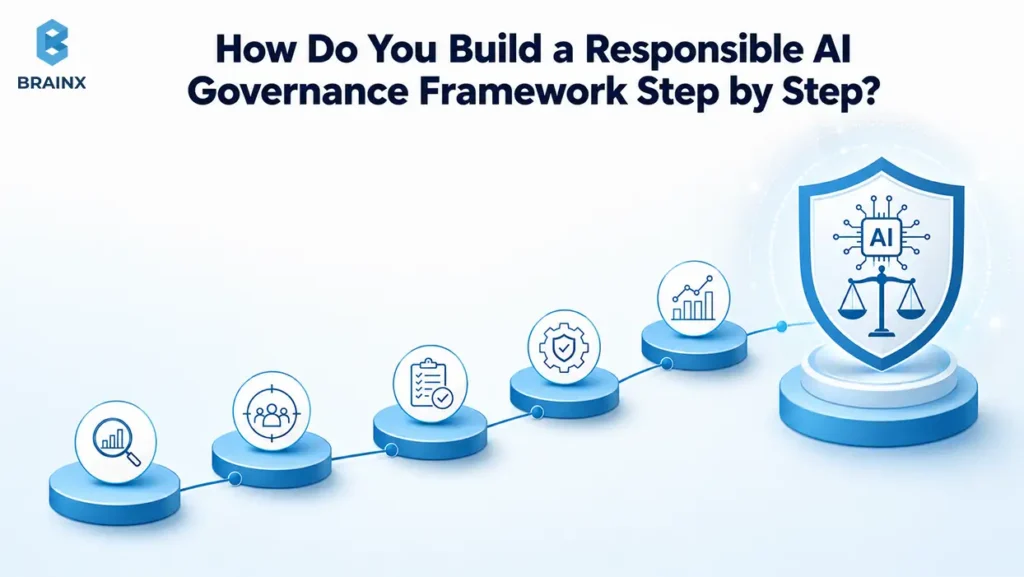
The most practical way to build a responsible AI framework is to start with the systems your organization is actually using, understand their risks, and introduce governance in stages. Trying to design every policy for every future AI use case before governing a single real system usually creates more documentation than control.
NIST's Govern, Map, Measure, and Manage functions provide a useful foundation for thinking about AI risk throughout the lifecycle. In practice, organizations can translate those principles into the following eight-step implementation sequence.
Step 1 — Inventory Approved, Experimental, and Shadow AI Use
Start by finding out where AI is already being used.
That sounds simple, but enterprise AI rarely exists only in projects formally labelled “AI.” Teams may be using public GenAI tools, AI features embedded in SaaS platforms, internally developed assistants, model APIs, automation workflows, or experimental agents that have never gone through a central review.
Your inventory should record enough information to understand what each system does and what it can affect. At minimum, capture its business purpose, owner, users, model or provider, data sources, integrations, level of autonomy, deployment status, and the countries or business units where it operates.
For example, a marketing team may be using an approved content assistant while a finance analyst independently connects a public LLM to internal spreadsheets. Both use GenAI, but their data exposure and oversight requirements are very different.
The purpose of this step is visibility, not punishment. If employees hide AI use because disclosure automatically leads to prohibition, shadow AI becomes harder to govern.
Deliverable: A centralized AI inventory covering approved, experimental, third-party, and shadow AI use.
Step 2 — Classify Each Use Case by Impact and Autonomy
Once the organization knows what AI systems exist, the next step is deciding which ones require the most oversight.
Not every application deserves the same review. An internal tool that summarizes public industry reports presents a very different level of risk from an AI assistant influencing financial, employment, healthcare, or customer-account decisions.
Evaluate each use case using factors such as:
- The consequence if the AI is wrong
- The sensitivity of the data involved
- Who will be affected by the output
- Whether the system is internal or customer-facing
- Whether a human reviews the result
- Whether the AI can take actions independently
- Whether an incorrect action can easily be reversed
- Whether legal or contractual obligations apply
The result should be a simple risk tier that determines what happens next. A low-risk assistant may need standard controls and product-owner approval. A high-impact system may require independent testing, legal review, domain-expert validation, and formal risk acceptance.
Deliverable: A documented risk score and provisional governance tier for every AI use case.
Step 3 — Map Data, Legal, Regulatory, Contractual, and Internal Requirements
Risk classification tells you how much governance is needed. Requirement mapping tells you which specific obligations the system must satisfy.
Start with the actual use case rather than attaching the same compliance checklist to every AI project. Identify the data it accesses, where that data comes from, which provider processes it, which users receive the output, and what business action may follow.
Then map the requirements that apply. These may include internal security policies, privacy requirements, data-retention rules, customer contracts, intellectual-property restrictions, records obligations, sector-specific regulation, the EU AI Act, or provider-specific terms.
For a RAG assistant, for example, the requirement map may show that confidential documents require role-based retrieval, customer records cannot be processed outside an approved geography, prompts must follow a specific retention policy, and certain generated responses require human review.
This step converts broad statements such as “the system must protect privacy” into requirements that engineering and product teams can actually implement.
Deliverable: A use-case-specific requirement map connecting business, data, legal, security, and regulatory obligations.
Step 4 — Define Decision Rights, Policies, and Exceptions
Governance becomes slow when teams do not know who has the authority to decide.
Define who can approve a new AI use case, a model provider, a sensitive data source, production release, a material system change, a policy exception, or the remaining risk after controls have been applied.
The same clarity is needed when something goes wrong. Who can pause the AI system? Who declares an incident? Who contacts affected customers? Who decides when the system is safe to restore?
These responsibilities should connect directly to the governance RACI established earlier in the article. Organizations do not necessarily need to create a new AI department. Product, architecture, data, security, legal, risk, and business leaders can operate through a federated governance group if the decision rights are explicit.
Exceptions also need a controlled path. A team may have a legitimate reason why one standard cannot be met, particularly with legacy applications or vendor limitations. The exception should identify the reason, compensating control, approver, expiration date, and conditions for review.
Deliverable: A governance RACI, approval workflow, and documented exception process.
Step 5 — Embed Data and Governance Controls Into Development Workflows
This is the point where governance moves from documentation into the system itself.
Instead of expecting teams to remember every policy manually, convert common requirements into reusable technical patterns. These may include approved model catalogs, architecture templates, identity rules, prompt repositories, permission-aware retrieval, automated evaluation tests, audit logging, security checks, deployment gates, and provider allowlists.
Consider a policy stating that employees should only retrieve documents they already have permission to access. The policy alone does not protect anything. The engineering control is an identity-aware retrieval layer that checks the user's current permissions before context reaches the model. The evidence is an access test and retrieval log showing that the rule works.
The same approach applies to release criteria. If a high-risk system cannot be deployed until required evaluations pass, that requirement should appear in the delivery workflow rather than in a policy document that developers must remember to consult.
Legacy systems may not support every preferred control. In those cases, document the gap and use compensating safeguards rather than silently bypassing the requirement.
If governance is being designed alongside the wider AI delivery roadmap, BrainX's guide on how to implement generative AI in your business connects these controls to use-case selection, development, integration, and deployment.
Deliverable: A control matrix showing each requirement, the control that enforces it, the evidence it produces, and where it operates in the development lifecycle.
Step 6 — Pilot the Framework on One Measurable Use Case
Do not roll a new governance framework across the entire enterprise before testing whether it works in practice.
Choose one bounded use case with a clear owner, measurable outcome, manageable risk, and enough complexity to expose weaknesses in the process. An employee knowledge assistant, for example, can test data ownership, RAG permissions, evaluation, monitoring, and release approval without carrying the same consequences as an autonomous financial agent.
Run that use case through the complete process: intake, inventory, risk classification, requirement mapping, architecture review, data approval, development, evaluation, production approval, monitoring, and incident readiness.
Pay attention to the governance process itself. Did teams know which evidence to provide? Did the approval take too long? Was a policy impossible to implement because of a vendor limitation? Did reviewers ask for evidence that the system could not produce?
Those lessons should improve the framework before it is applied more broadly.
Deliverable: A pilot evaluation plus a governance retrospective documenting gaps, delays, successful controls, and required framework changes.
Step 7 — Train Each Role on Its Actual Responsibilities
Responsible AI training should tell people what they need to do, not simply explain what responsible AI means.
Different roles require different knowledge.
Product owners need to understand context-of-use boundaries, risk tiers, approval requirements, and when a change needs re-review. Data owners need to know how to approve sources, classify sensitive information, maintain freshness, and trigger deletion. Engineers need secure RAG, tool-permission, evaluation, logging, and change-management procedures. Operations teams need monitoring thresholds, escalation paths, incident procedures, and rollback triggers.
Business users also need practical rules. They should know which tools are approved, what information cannot be entered into public models, how to verify important outputs, and how to report unexpected behavior.
Training should therefore be role-based and tied to real workflows. A generic annual presentation will not prepare an engineer to secure a tool-enabled agent or a data owner to approve a new retrieval source.
Deliverable: A role-based training plan, supporting guidance, and evidence that people with governance responsibilities understand how to execute them.
Step 8 — Monitor, Audit, Review, and Improve the Framework
Governance does not end when an AI system reaches production.
Production introduces new information that was unavailable during development: real user behavior, new attack patterns, changing data, vendor updates, higher traffic, unexpected costs, unusual tool calls, and failure cases that did not appear in testing.
Monitor both individual AI systems and the governance program itself.
For individual systems, track the quality, safety, data, security, operational, and cost metrics defined by their risk tier. For the governance program, track whether systems have owners, whether approvals are overdue, how frequently policy exceptions occur, whether incidents are resolved on time, and how long it takes a valid use case to move through approval.
Material changes should trigger re-evaluation. A new foundation model, significant prompt revision, added data source, broader user population, new tool, new geography, or shift toward autonomous action can change the risk profile even if the application still has the same name.
Governance should therefore operate as a maintained business capability with its own owners, metrics, review cadence, and improvement backlog.
Deliverable: A governance monitoring dashboard, scheduled review process, audit trail, and continuous-improvement backlog.
How Mature Is Your Generative AI Governance Framework?
AI governance maturity is less about how many policies an organization has and more about how consistently those policies influence real AI systems.
A practical maturity model can help teams identify where governance currently sits and what capability should be built next.
| Maturity Level | What Governance Looks Like | Priority for the Next Stage |
| 1. Ad Hoc | Individual teams choose tools, models, data, and controls independently. AI inventories are incomplete and approvals are informal. | Establish visibility, ownership, and minimum acceptable-use rules. |
| 2. Documented | Policies, committees, and roles exist, but enforcement still depends heavily on manual review and individual teams remembering the rules. | Translate written policies into repeatable controls, evidence, and approval workflows. |
| 3. Operationalized | Risk tiers, evaluation gates, data controls, approval records, and monitoring are embedded into AI delivery processes. | Standardize reusable controls across teams and systems. |
| 4. Integrated | Governance operates consistently across business units, providers, data environments, and AI architectures. Portfolio-level metrics influence investment and risk decisions. | Connect governance evidence to enterprise planning, procurement, security, and operational reporting. |
| 5. Adaptive | Monitoring, incidents, regulations, model changes, and user feedback continuously improve governance policies and technical controls. | Maintain continuous improvement without allowing governance complexity to slow delivery. |
The most important transition is usually from documented to operationalized governance. A company may already have responsible-AI principles, an AI committee, and acceptable-use policies but still depend on project teams to enforce those rules manually.
Operational maturity begins when a policy produces a predictable technical or procedural outcome. A sensitive-data rule becomes an access control. An evaluation standard becomes a release gate. A model change becomes a reapproval trigger. An incident threshold becomes an automatic escalation.
Organizations do not need to reach the highest maturity level before deploying AI. The objective is to match governance maturity to the scale and consequence of the AI portfolio. A company running two bounded internal assistants may need a simpler operating model than an enterprise managing hundreds of customer-facing models and autonomous agents.
A maturity assessment is therefore most useful when it answers one practical question: What governance capability is missing today that will become a bottleneck or risk as AI use expands?
Why Does Responsible AI Governance Matter to Businesses Now?
Responsible governance creates business value when it turns isolated AI experiments into a repeatable way to deploy systems with known boundaries and accountable owners.
The urgency is increasing as enterprise adoption moves faster than oversight. In IBM's 2026 study of 2,000 technology executives, 77% said AI adoption was already outpacing their organization's governance capabilities, while 70% reported that business teams were deploying technology faster than IT could track.
What Is Responsible AI?
Responsible AI is the practice of designing, developing, deploying, and operating AI so that its risks, impacts, and decisions are managed throughout the system lifecycle.
In this guide, ethical AI describes the values an AI system should respect, such as fairness, privacy, transparency, human agency, and avoidance of harm. Responsible AI is the practical work required to apply those values: assigning owners, defining policies, controlling data, testing behavior, documenting decisions, monitoring production systems, and responding when something goes wrong.
That distinction matters because a principle has little effect until it changes how the system operates. Saying that an AI application should be fair is an ethical commitment. Defining the affected groups, setting evaluation criteria, assigning an owner, testing outcomes, and blocking release when requirements are not met turns that commitment into responsible practice.
Responsible AI governance provides the operating structure for that work. It determines who makes decisions, which controls are mandatory, what evidence is required, and how the organization responds as the model, data, use case, or regulatory environment changes.
Governance Protects Innovation Speed, Trust, and Accountability
Governance can reduce friction when teams know the controls before development starts.
A reusable low-risk architecture, vendor-assessment template, data-access pattern, evaluation suite, and release checklist prevent every project from answering the same questions from scratch. Governance becomes an enablement layer rather than a queue of bespoke committee reviews.
IBM's 2026 analysis found that organizations embedding control directly into AI systems experienced 25% fewer incidents and deployed 16 times more AI agents than organizations relying on manual governance. These are reported associations rather than proof that governance alone caused the outcomes. This becomes increasingly important as how generative AI is reshaping industries shows AI moving from isolated experimentation into operational workflows.
“embedding control and visibility from the start” — Matt Lyteson, CIO, IBM
Ungoverned AI Creates Operational Risk Beyond Regulatory Exposure
The immediate risk is often not a fine, it is invisibility.
Shadow AI can create unknown data flows, inconsistent retention, undocumented vendors, duplicated pilots, uncontrolled costs, and business workflows that depend on tools IT does not know exist.
Deloitte's 2026 State of AI in the Enterprise found that agentic adoption is expected to grow quickly, yet only 21% of surveyed organizations reported a mature governance model for autonomous agents. The report also identifies risk, data, and infrastructure readiness as major concerns as organizations scale AI.
Good governance gives experimentation a visible status: experimental, approved, restricted, or production. That makes shadow systems easier to identify and legitimate projects easier to support.
Governance Becomes More Important When AI Outputs Trigger Business Actions
Risk increases when an AI response becomes an action.
A wrong internal summary can usually be corrected. A wrong tool call can modify an account, send a customer communication, expose a file, approve a transaction, or trigger downstream automation.
Agentic systems therefore need controls at the action layer: least-privilege identities, allowlisted tools, parameter validation, transaction ceilings, write restrictions, human confirmation for consequential actions, idempotency, rate limits, logging, rollback, and emergency disablement.
The key governance question changes from “Was the answer acceptable?” to “What was the system allowed to do because of that answer?”
Why Is Data Governance Critical to Responsible Generative AI?
Data governance for generative AI determines which information an AI application may use, who can retrieve it, how trustworthy it is, where it may be processed, and how long original and derived artifacts may remain.
Strong model performance cannot compensate for an unauthorized, obsolete, or incorrectly classified source.
Gartner reported in April 2026 that organizations with the highest maturity in AI-ready data and analytics capabilities were achieving up to 65% greater business outcomes, including revenue growth and cost optimization. Gartner also emphasized governed contextual access to trusted data as critical infrastructure for AI agents.
How Data Governance and Generative AI Work Together
Data governance and generative AI meet at runtime.
A policy may state that only members of the finance team can access forecast documents. The GenAI application must convert that policy into a technical decision before retrieval: should this specific user receive this specific chunk as context for this query?
The model should never become the access-control system.
Permission enforcement belongs in the surrounding architecture through identity, authorization, source metadata, retrieval filtering, and validated tool access.
This distinction is essential because a generated answer can be factually correct and still create a security incident if the user was not authorized to know the underlying information.
What Data Governance for Generative AI Must Control
A practical AI data-governance policy should define:
- Ownership: Who can approve a source or dataset for AI use?
- Classification: Is information public, internal, confidential, regulated, privileged, or restricted?
- Purpose: Can it be used for inference, RAG, evaluation, fine-tuning, analytics, or only one workflow?
- Access: Which users, groups, services, agents, or tools may retrieve it?
- Lineage and provenance: Where did the information originate, and how was it transformed?
- Quality and freshness: Which source is authoritative, current, and conflict-resolved?
- Residency: Where may data be processed and stored?
- Retention and deletion: What happens to prompts, outputs, logs, chunks, caches, vectors, and derived summaries?
- Vendor processing: Which providers receive data, retain it, or route it through subprocessors?
This layer determines whether enterprise information can become reusable AI context instead of an uncontrolled knowledge dump. For a broader data-readiness view, see how AI tools for enterprise data management support quality, access, governance, and operational use across enterprise systems.
How to Govern Training, Fine-Tuning, Prompt, and Evaluation Data
Different types of AI data create different obligations.
Training and fine-tuning data can affect model behavior persistently. Teams should record its origin, permitted purpose, rights, sensitive categories, preprocessing, quality checks, transformations, and version history.
Prompt and inference data may contain live customer or employee information that was never approved for training. It should therefore follow explicit rules for minimization, processing, logging, and retention.
Evaluation datasets also need governance. Teams frequently build them from support conversations, production failures, internal records, or subject-matter examples. Treating an evaluation set as “test data” does not remove its privacy or confidentiality requirements.
The real control question is not simply whether an organization uses personal data. It is which information enters which AI stage, under what authority, with what transformations, and how it can later be removed.
How RAG Governance Protects Source Access, Permissions, Lineage, and Freshness
RAG governance treats retrieval as both a data product and a security boundary.
Consider an employee knowledge assistant:
Ingestion → Classification → Permissions → Retrieval → Generation → Logging → Retention/Deletion
A document enters the pipeline with a source ID, owner, sensitivity level, version, effective date, and access metadata. Those attributes should survive chunking and indexing.
At query time, the retriever checks the user's current authorization before sending context to the model. The generated response records relevant source references and system versions. Retention policies then determine what happens to the query, output, retrieved context, and telemetry.
This design must address edge cases that generic “use clean data” advice misses:
| Edge Case | Failure | Governance Control |
| Source is deleted but embedding remains | Deleted information stays retrievable | Propagate deletion into chunks, vectors, indexes, and caches |
| User access is revoked after indexing | Stale permissions still expose content | Synchronize ACL changes and test revocation latency |
| Multiple policy versions conflict | AI grounds answers in obsolete rules | Effective dates, authority hierarchy, conflict-resolution rules |
| Sources become stale | Grounded answer is still wrong | Freshness SLAs, expiry metadata, re-index triggers |
| Retrieved text contains prompt injection | Hidden instructions manipulate the model | Treat retrieved content as untrusted and test indirect injection |
| Sensitive information enters logs | Monitoring becomes a new sensitive-data store | Redaction, restricted telemetry, retention controls |
| Source record is deleted | Derived AI artifacts survive | Maintain deletion lineage from source to vectors, summaries, and evaluation copies |
OWASP specifically identifies prompt injection and vector or embedding weaknesses as major risks in RAG-enabled applications.
“Context capabilities act as the brain for AI.” — Rita Sallam, Distinguished VP Analyst, Gartner Fellow and Chief of Research
What Retention and Deletion Rules Apply to Prompts, Outputs, and Embeddings
There is no universal retention rule for commercial AI services. Enterprises need a business requirement first, then must verify whether every model provider and feature can enforce it.
For example, OpenAI documents default abuse-monitoring retention of up to 30 days for API customer content, while some stateful features have separate application-state behavior. Eligible customers can request additional controls such as Zero Data Retention, but compatibility differs by endpoint and feature.
Anthropic documents automatic deletion of standard API inputs and outputs within 30 days, subject to customer-controlled features, negotiated terms, enforcement needs, and legal requirements.
Google Cloud likewise documents feature-specific storage. Some grounding functions retain prompts and outputs for 30 days, while achieving zero data retention requires specific configurations and may not be compatible with every feature.
Microsoft distinguishes stateless model inference from stateful service features and also distinguishes standard, Global, and DataZone processing models.
Governance should therefore maintain a feature-level provider-data map, not a single checkbox saying “vendor does not retain data.”
Deletion must also reach derived artifacts. Removing a source file while leaving vectors, caches, extracted text, generated summaries, or copied evaluation examples can defeat the purpose of deleting the original record.
Which GenAI Risks Must a Responsible Framework Manage?
An effective AI risk management model evaluates more than whether a risk exists. It considers severity, likelihood, detectability, reversibility, autonomy, affected-user vulnerability, and downstream impact.
NIST's GenAI Profile provides a cross-sector structure for managing GenAI risks, while OWASP addresses application-layer security failure modes.
Output Risks: Hallucinations, Bias, Toxicity, and Misleading Content
Generated content can be plausible but unsupported, incomplete, discriminatory, harmful, or inappropriate for the context.
Controls can include grounded generation, source attribution, abstention rules, domain-specific evaluations, harmful-content testing, fairness evaluation, human review, and restrictions on downstream use.
The consequence depends on context. A missed detail in internal meeting notes is inconvenient. An unsupported clinical recommendation can be dangerous.
Data Risks: Privacy Leakage, Unauthorized Retrieval, and Poor Provenance
A GenAI application can expose sensitive information through prompts, logs, retrieval, output, or tool calls.
Controls should test data boundaries, authorization, provenance, retention, minimization, deletion, and lineage alongside answer quality.
Poor provenance also makes incidents harder to investigate. If teams cannot identify which source or version grounded an important output, they cannot reliably reproduce or remediate the failure.
Security Risks: Prompt Injection, Data Exfiltration, and Tool Misuse
Prompt injection can manipulate system behavior through direct instructions or through content retrieved from untrusted sources.
Tool-enabled systems introduce further risks because outputs can become commands. A compromised instruction may trigger an API request, expose information, alter a record, or create cascading activity.
OWASP recommends treating prompt injection, improper output handling, sensitive information disclosure, excessive agency, and vector weaknesses as distinct application risks.
Legal Risks: Copyright, Consent, Records, and Regulatory Obligations
Legal obligations depend on the system, data, geography, affected users, and business context.
Organizations may need to map privacy, intellectual property, copyright, consent, employment law, consumer protection, records retention, accessibility, sector rules, contracts, and AI-specific legislation.
As of August 2026, the EU AI Act is broadly applicable, but important provisions follow different schedules. The Act's initial prohibitions began applying in February 2025, general-purpose AI governance rules followed in August 2025, and Article 50 transparency obligations apply from August 2, 2026. Following the AI Omnibus that entered into force in July 2026, rules for certain high-risk AI systems apply from December 2, 2027, while rules for AI embedded in regulated physical products apply from August 2, 2028.
Governance should map obligations to individual systems instead of making a blanket claim that an organization is “AI compliant.”
Operational Risks: Cost Spikes, Model Changes, Drift, and Vendor Dependency
A GenAI system can fail operationally without becoming less safe on a benchmark.
A provider may retire or update a model. A fallback model may produce a different schema. RAG quality may decline as documents age. A looping agent may consume excessive tokens or tools. Traffic may exceed planned cost.
Controls include cost limits, version management, regression suites, provider-change monitoring, fallback testing, capacity thresholds, source-health checks, and vendor exit plans.
Human Risks: Overreliance, Skill Erosion, and Unclear Accountability
Fluent AI output can encourage people to accept results without verification.
Governance must make the human role explicit. “Human in the loop” is too vague.
Define who reviews what, when review becomes mandatory, what evidence the reviewer receives, whether they can meaningfully override the system, and who remains accountable for the final action.
The required posture varies sharply by use case:
| Use Case | Example Consequence | Governance Posture |
| Internal summarizer | Inaccurate notes | Lightweight controls, correction path |
| Customer-support chatbot | Wrong customer policy | Grounding, disclosure, escalation, logging |
| Financial assistant | Incorrect material recommendation | Expert review, formal boundaries, audit evidence |
| Clinical drafting assistant | Potential effect on patient care | High-consequence testing, qualified human oversight |
| Autonomous operations agent | Unauthorized actions across systems | Least privilege, approval limits, action logging, kill switch |
Which Principles Should Guide Responsible Generative AI?
Ethical principles matter because they define the outcomes an organization is trying to protect, but principles alone cannot govern a production AI system. Each principle needs to translate into a policy, technical control, measurable evidence, and accountable owner.
The OECD AI Principles emphasize fairness and privacy, transparency, robustness, security, safety, human agency, traceability, and accountability. ISO/IEC 42001 provides a management-system structure for making those responsibilities repeatable.
Accountability Requires a Named Owner and Escalation Path
Every production system needs a business or product owner with decision authority, a technical owner responsible for system behavior, and owners for critical data.
“The AI team” is not an accountable individual.
Principle → Policy → Technical Control → Evidence → Owner
Accountability → Every system has a named accountable owner → ownership registry and escalation routing → system card and approval records → product or business owner.
Fairness and Safety Require Defined Tests, Not Values Statements
A fairness commitment should identify the populations, scenarios, measures, thresholds, and prohibited failure modes relevant to the system.
A safety commitment should become adversarial tests, domain-specific edge cases, restrictions, runtime safeguards, and escalation criteria.
Fairness and safety → measurable release requirements → evaluation suite → test report and remediation evidence → AI owner plus domain expert.
Transparency Requires Disclosures, Traceability, and Understandable Records
Transparency has two audiences.
Users may need to know they are interacting with AI and understand the system's limits. Operators need enough traceability to reconstruct the configuration behind an important response or action.
The OECD AI Principles recommend meaningful information about AI capabilities and limitations, awareness of AI interaction, and lifecycle traceability appropriate to context.
EU transparency obligations under Article 50 apply from August 2, 2026 for systems within scope.
Transparency → disclosure and traceability standard → disclosure UI, source references, version logs → interaction and system records → product owner with legal input.
Human Oversight Must Match the Consequence of Error
Human oversight should scale with the consequence and reversibility of failure.
Low-impact drafting may use sampling. A consequential recommendation may require expert approval. An autonomous action may require authorization before execution.
Oversight is meaningful only when the reviewer has enough information, time, authority, and expertise to intervene.
Human oversight → review-by-consequence policy → approval gates and override capability → review logs → domain or operations owner.
Privacy and Data Governance Must Be Designed Into the System
Privacy cannot be restored after deployment by adding a disclosure banner.
It requires data minimization, purpose limitations, secure retrieval, access control, residency decisions, logging controls, retention, vendor terms, and deletion mechanisms in the architecture.
Privacy and data governance → authorized and minimized data use → IAM, retrieval filters, redaction, retention configuration → inventory and access-test evidence → data/privacy owner.
Proportionality Means Applying Stronger Controls to Higher-Risk Uses
Proportionality prevents governance from becoming equally burdensome for every use case.
A low-risk internal assistant may require a documented owner, approved sources, basic evaluation, and traceable logs. A system affecting health, employment, finance, safety, legal rights, or material transactions should face much stronger evaluation and approval.
Proportionality → risk-tier policy → tier-specific deployment gates → risk score and approval evidence → governance committee.
“generative AI also brings risks that are significantly different from those we see with traditional software.” — Laurie E. Locascio, NIST Director
What Governance Deliverables Should Every GenAI Project Produce?
A governed GenAI system should leave behind evidence that another qualified reviewer can inspect and reconstruct.
The goal is not paperwork for its own sake. Evidence makes release decisions reproducible and incidents diagnosable.
AI System Card and Approved Context-of-Use Statement
Document the system's purpose, owner, users, architecture, models, capabilities, limitations, prohibited uses, risk tier, human role, and environments in which it is approved to operate.
The context-of-use statement defines the boundary.
Using the system outside that boundary should trigger reassessment.
Data Inventory, Source Register, and Lineage Record
Record relevant training, fine-tuning, RAG, prompt, evaluation, and telemetry sources.
For each source, capture ownership, classification, provenance, version, permitted use, transformations, access policy, and refresh expectations.
Data Access, Retention, and Usage Policy
Specify who can access data, for which purpose, from which geography, and for how long.
The policy should cover original sources and derived artifacts such as vectors, cached prompts, generated summaries, evaluations, and logs.
Risk Register and Regulation-to-Control Matrix
Document identified risks, ratings, mitigations, residual risk, owners, and status.
Then map each applicable internal or external requirement to a specific control and its evidence.
This turns compliance from a list of laws into an implementable engineering plan.
Evaluation Report With Defined Release Thresholds
Record evaluation datasets, methodology, metrics, thresholds, safety scenarios, failed cases, mitigations, and approval outcomes.
A release threshold should exist before the final evaluation is run.
Otherwise teams can unconsciously redefine success around whatever score the current system achieved.
Model, Prompt, Retrieval, and Tool Version Records
Maintain enough system state to reproduce important production behavior.
That may include:
- Foundation model and version
- System and developer prompts
- Embedding model
- Retrieval configuration
- Source snapshot
- Safety settings
- Enabled tools
- Tool schemas
- Permission scopes
- Fallback route
Human-Review and Escalation Procedure
Document when review is optional, mandatory, or independent.
Specify the evidence shown to reviewers, who can override the AI, response expectations, and where disputed or high-impact cases escalate.
Incident, Rollback, and Decommissioning Plan
Define incident triggers, containment, communication, rollback, restoration, and shutdown.
Decommissioning should revoke service credentials, remove scheduled jobs, disable integrations, address retained vectors and provider-side data, and preserve only records that must legally or operationally remain.
A useful lifecycle checklist is:
| Stage | Required Evidence |
| Discovery | Context of use, owner, initial risk score, source inventory |
| Pilot | Architecture, source approvals, threat model, evaluation plan |
| Production Approval | Final risk register, control matrix, evaluation report, release criteria, oversight plan |
| Operations | Version history, monitoring, access reviews, incidents, exceptions, change approvals |
| Decommissioning | Shutdown evidence, credential revocation, retention/deletion actions, final record |
NIST guidance explicitly includes deactivation and decommissioning as part of lifecycle risk management.
How Does GenAI Governance Change Across Real-World Use Cases and Risk Levels?
Not every AI system should follow the same approval process.
Risk-based enterprise AI governance applies proportionate controls based on consequence, data sensitivity, autonomy, affected users, and reversibility.
Low-Risk Internal Assistants Need Lightweight but Traceable Controls
An internal meeting summarizer may need approved data boundaries, a named owner, privacy checks, basic quality evaluation, and a correction mechanism.
Requiring independent committee review after every low-impact prompt adjustment would create a process without corresponding risk reduction.
Lightweight should still mean traceable.
For example, an internal assistant that summarizes approved marketing research may only need access restrictions, basic accuracy testing, a named owner, and a correction path.
The organization still needs traceability, but the governance process should not make a low-impact drafting tool wait for the same formal approval required for an AI system that can affect a person's finances or health.
Customer-Facing Systems Need Stronger Testing and Disclosure
A customer assistant can affect trust, service outcomes, contracts, and customer decisions.
It should receive stronger grounding evaluation, safety tests, identity-aware access, escalation mechanisms, and auditable interaction handling.
Disclosure requirements should be determined by jurisdiction and context, including applicable transparency obligations under the EU AI Act.
In ecommerce or customer service, this distinction becomes practical quickly. A chatbot may be allowed to explain published shipping or returns policies, but it should not automatically expose account information, approve exceptional refunds, or change an order unless identity, permissions, and action limits have been explicitly designed for those functions.
Regulated or High-Impact Systems Need Independent Review and Formal Approval
Systems affecting healthcare, employment, finance, safety, legal rights, or similarly consequential outcomes may require qualified domain review, stronger validation, legal assessment, formal risk acceptance, and independent challenge.
The EU AI Act illustrates why context matters: obligations vary according to the system's role and classification rather than applying one universal governance package.
In financial services, a generated explanation may influence a credit, investment, or compliance decision, which increases the need for traceability and qualified review.
In healthcare, even a drafting assistant can create greater risk if clinicians begin relying on unsupported recommendations.
The governance process therefore needs to reflect both the industry and the exact role the AI plays within the workflow.
Autonomous Agents Need Tool-Level Permissions, Limits, and Rollback
Agentic AI should be governed at the action layer.
Useful controls include:
Scoped service identities, allowlisted APIs, parameter validation, read/write separation, transaction ceilings, approval for consequential actions, action logs, rate limits, timeouts, rollback, and a kill switch.
The stronger the autonomy and the harder an action is to reverse, the stronger the pre-action controls should become.
A manufacturing operations agent illustrates the difference between content risk and action risk.
An assistant that recommends a maintenance step can be reviewed before anyone acts.
An agent that can update maintenance schedules, reorder parts, or change production settings needs stricter tool permissions, approval thresholds, action logging, and a reliable way to stop or reverse its actions.
Build, Buy, Fine-Tune, and RAG Architectures Create Different Data Obligations
Build: Greater responsibility for training pipeline, data provenance, model behavior, and evidence.
Buy/API: Vendor due diligence, contractual controls, data processing, and model-change management become central.
Fine-tune: Dataset provenance, rights, sensitive content, and persistent model effects deserve additional scrutiny.
RAG: Source authorization, freshness, lineage, retrieval quality, and embedding lifecycle dominate.
Multi-model: Governance policies must survive routing and fallback across providers.
A practical comparison:
| Use Case | Data Controls | Testing | Approval | Oversight | Rollback |
| Internal meeting summarizer | Approved internal data | Accuracy, privacy | Product owner | User verification | Disable feature/model |
| Employee knowledge assistant | Permissioned enterprise sources | RAG quality, ACL leakage, injection | Product + data owner | Sampling | Disable index/retrieval |
| Customer chatbot | Customer/context data | Grounding, safety, escalation | Product plus security/legal as needed | Human escalation | Handoff/fallback |
| Financial decision-support assistant | Sensitive domain data | Domain correctness, edge cases, fairness | Formal risk/domain approval | Qualified reviewer | Stop recommendations |
| Clinical drafting assistant | Sensitive health context | Clinical safety, omissions, unsupported claims | High-consequence domain approval | Qualified clinician | Immediate disable/handoff |
| Autonomous operations agent | Live state, credentials | Tool misuse, injection, cascading failures | Multi-function approval | Pre-action gates | Kill switch and compensating action |
How Should Organizations Govern Third-Party Models and AI Vendors?
Using an external foundation model transfers infrastructure work, not accountability for the enterprise use case.
The organization still chooses which data enters the system, what actions it can perform, what contractual terms are acceptable, and what evidence is required before production.
Vendor Due Diligence Must Cover Data Use, Retention, Security, and Subprocessors
Do not stop at asking whether a vendor trains on customer data.
Review the feature-level processing architecture:
| Assessment Area | Governance Question |
| Customer-data training | Are prompts or outputs used for model training by default, by opt-in, or never? |
| Retention | What is stored, where, for how long, and under which exceptions? |
| Subprocessors | Which entities can process customer data? |
| Residency | Where may inference and storage occur? |
| Security | Which controls, certifications, and assurance reports apply? |
| Model updates | Can the underlying model change automatically? |
| Auditability | Can the enterprise retrieve sufficient logs and version evidence? |
| Incidents | What notification commitment applies? |
| Portability | Can configuration and business assets be exported? |
| Deletion | How is deletion triggered and verified? |
| Exit | What data or resources remain after termination? |
Primary provider documentation demonstrates why this must be feature-specific. OpenAI, Anthropic, Google Cloud, and Microsoft each document different combinations of model training policies, monitoring, application state, zero-retention controls, data residency, and stateful storage.
Model Updates Require Regression Testing Before Production Promotion
A newer model is not automatically safer or better for a specific application.
It may change response structure, refusal behavior, citation patterns, tool-calling frequency, latency, cost, or performance on your domain.
Where version control is available, promote changes through the same evaluation pipeline as other material system changes.
Where vendors can change underlying behavior without a pinned version, monitor releases and maintain compensating regression tests.
Contracts Should Define Data Ownership, Audit Rights, Incidents, and Exit Terms
Contracts should address permitted use, confidentiality, data processing, security commitments, subprocessors, incident notification, audit evidence, provider changes, intellectual-property terms, deletion, portability, transition assistance, and termination.
No contract eliminates the need for technical validation.
Procurement evidence and runtime evidence answer different questions and should complement each other.
Victoria Medina, Chief Technology and Data Officer at Allianz Spain, warns that “many organizations are more exposed than they realize.” IBM executive perspectives
Multi-Model Architectures Need Consistent Policies Across Providers
A fallback path can quietly undermine governance.
The primary model may meet residency and retention requirements while the fallback does not. Another provider may lack equivalent safety configuration or structured-output behavior.
Govern the whole application route.
Record which provider handled a request, enforce provider eligibility according to data class and geography, and evaluate both primary and fallback behavior.
A Vendor Exit Plan Must Address Data Portability and Deletion
Exit planning should happen before procurement.
Keep prompts, evaluation sets, business rules, RAG configuration, policy logic, and monitoring definitions as portable as practical.
Document which provider-hosted assets must be exported, deleted, recreated, or replaced.
The goal is not avoiding all vendor dependency. It is preventing one model provider from becoming an uncontrolled operational dependency.
How Do You Evaluate and Monitor a Governed GenAI System?
Governed GenAI systems must be evaluated against their actual task, risk, users, and production conditions, then monitored for changes that invalidate the original evidence.
A one-time benchmark cannot prove that a changing RAG system or autonomous agent remains acceptable.
Quality Metrics Must Reflect the Actual Business Task
Generic model benchmarks are poor substitutes for task-level acceptance criteria.
A customer-support assistant may need measures for factual correctness, resolution quality, correct escalation, and policy adherence.
A data-extraction workflow may need field-level precision and recall.
An agent may need action success, invalid-action rate, and recovery performance.
Metrics should answer: Can this system do the job it is approved to do?
Safety Tests Must Cover Adversarial and High-Consequence Scenarios
Test realistic misuse and edge conditions.
Examples include direct and indirect prompt injection, attempts to obtain restricted data, social engineering, conflicting instructions, malformed tool output, permission bypass, unsafe content, and cases where refusal or escalation is the correct answer.
Higher-consequence applications need stronger scenario coverage and domain expertise.
RAG Evaluation Must Measure Retrieval and Generation Separately
A RAG answer can fail for at least two different reasons:
- The retriever found the wrong evidence.
- The generator mishandled the right evidence.
Those failures require different fixes.
AWS Bedrock's RAG evaluation guidance explicitly separates retrieval-only metrics such as context relevance and context coverage from generated-response metrics including correctness, completeness, faithfulness, citation precision and coverage, harmfulness, and refusal.
Data Quality and Retrieval Monitoring Must Continue After Deployment
The model can remain unchanged while system reliability declines.
Monitor:
- Ingestion failures
- Source freshness
- Deleted-document propagation
- ACL synchronization
- Conflicting versions
- Retrieval relevance
- Source coverage
- Index age
- Sudden changes in which sources dominate answers
For RAG, source health is production health.
Production Monitoring Must Track Quality, Safety, Cost, and User Behavior
Production observability should cover four dimensions:
Quality: task success, grounding, retrieval performance, escalation.
Safety and security: policy violations, injection attempts, leakage, suspicious tool behavior.
Operations: availability, latency, error rates, provider changes.
Economics: token use, tool charges, workflow cost, unexpected agent loops. For the engineering side of rollout, our guide to production-ready AI integration controls covers permissions, evaluation, observability, cost controls, and production hardening in existing technology stacks.
Human Feedback Must Feed a Controlled Improvement Process
User feedback is valuable evidence, but it should not flow directly into uncontrolled system changes.
Classify the feedback, reproduce the problem, identify root cause, update the relevant component, rerun regression evaluations, and approve the change according to its materiality.
Otherwise “continuous improvement” becomes uncontrolled behavioral drift.
Material Changes Must Trigger Re-Evaluation and Reapproval
Define material changes before production launch.
Common triggers include:
- Foundation-model change
- Model-provider change
- Significant system-prompt revision
- New retrieval source
- Embedding-model change
- New user population or geography
- Permission-model change
- New tool or broader scope
- Fine-tuning update
- Safety-configuration change
- Shift from recommendation to autonomous action
Sample Governance-Linked Metric Set
| Metric | Illustrative Acceptance Threshold* | Owner | Review | Failure Response |
| Grounded-answer rate | ≥95% on approved gold set | AI owner | Every release | Block promotion |
| Retrieval Recall@5 | ≥90% | RAG/data owner | Retriever/index change | Diagnose retrieval |
| Critical safety violations | 0 in mandatory high-risk suite | Security/AI owner | Every release | Block release |
| Domain task completion | ≥92% | Product/domain owner | Release + sampling | Investigate or rollback |
| High-risk escalation correctness | ≥98% | Domain owner | Release + monthly | Disable affected flow |
| Cost per completed workflow | Within approved budget | Product/operations | Weekly | Rate-limit or optimize |
Illustrative thresholds only. Each organization should set its own acceptance limits according to context and consequence.
An evaluation metric has governance value only if failing it causes a predetermined action.
What Business Value Can Responsible AI Governance Create?
The strongest business case for generative AI governance is not merely avoiding penalties. It is creating reusable data, control patterns, evidence, and decision processes that allow more AI systems to reach production responsibly.
Reusable Controls Can Reduce Repeated Review and Rework
Standard RAG patterns, vendor baselines, threat models, evaluation templates, and release gates prevent every team from rebuilding assurance from zero.
Over time, governance becomes an internal platform capability.
Governed Data Improves Reliability and Reuse Across AI Systems
A source with an accountable owner, clear classification, lineage, permission model, freshness requirement, and approved AI purpose can support multiple authorized applications.
Gartner found that organizations reporting successful AI initiatives invest up to four times more in foundations such as data quality, governance, AI-ready people, and change management than organizations reporting poor AI outcomes.
Clear Ownership Improves Decision Speed and Incident Response
Named ownership answers questions that otherwise bounce between teams.
Who can accept residual risk? Who decides that retrieval data is authoritative? Who can shut down an agent? Who communicates with customers after an incident?
Clear decision rights improve both release speed and response speed.
Trusted Systems Are More Likely to Gain Employee and Customer Adoption
Trust comes from predictable boundaries, useful disclosures, reliable outputs, accessible escalation, and evidence that somebody is accountable.
It is harder to build trust after deployment if users first encounter unexplained failures.
Governance therefore supports adoption by making trust an engineering and operating property rather than only a communications message.
Better Evidence Supports Enterprise Sales and Compliance Reviews
Enterprise customers increasingly ask vendors how AI systems process customer information, which model providers are involved, where processing occurs, how models are tested, and how incidents are handled.
Maintaining evidence during delivery is easier than reconstructing it during procurement or due diligence.
System cards, risk registers, provider assessments, test reports, and security documentation can reduce friction in those reviews.
Controlled Experimentation Helps Teams Scale Successful Use Cases
Governance should create safe places to experiment.
Sandboxes, approved datasets, restricted tool permissions, explicit pilot status, and defined exit criteria allow teams to test ideas without accidentally turning a proof of concept into production infrastructure.
Measure the governance program itself through KPIs such as:
- Time from use-case submission to approval
- Percentage of systems with named owners
- Evaluation pass rate
- Policy-exception rate
- Incident response time
- User escalation rate
- Percentage of governed data sources
- Cost per governed workflow
“leaders should enable enterprise value by consciously weaving AI into the fabric of their business workflows” — Nitin Mittal, Deloitte Global AI Leader
What Team, Timeline, and Budget Factors Shape Implementation?
Implementation effort depends on existing data maturity, AI portfolio size, use-case risk, regulatory exposure, architecture diversity, and evidence requirements.
There is no defensible universal budget or timeline.
Governance Ownership Requires Business, Technical, Data, Security, and Legal Roles
At minimum, governance needs product or business accountability, technical AI expertise, data ownership, and security participation.
Legal or compliance input becomes essential when contracts, regulation, personal data, employment, consumer rights, healthcare, financial services, or other regulated contexts are involved.
A dedicated Chief AI Officer is optional.
Clear responsibility is not.
Data Governance Maturity Determines the Starting Point
Organizations with mature identity, cataloging, classification, lineage, and retention systems can reuse them.
Organizations with unknown document ownership, inconsistent permissions, and no reliable source inventory have foundational work to complete before enterprise RAG can be trusted.
For many organizations, data governance for generative AI influences implementation effort more than connecting the foundation-model API itself.
Use-Case Volume and Risk Determine Review Workload
Ten internal drafting assistants and ten autonomous transaction agents do not create equivalent governance effort.
Estimate workload by risk-weighted portfolio size, vendor count, change frequency, sensitive-data exposure, geographies, and approval paths.
High-risk systems require deeper evidence and more independent review.
Challenges in Scaling AI Governance
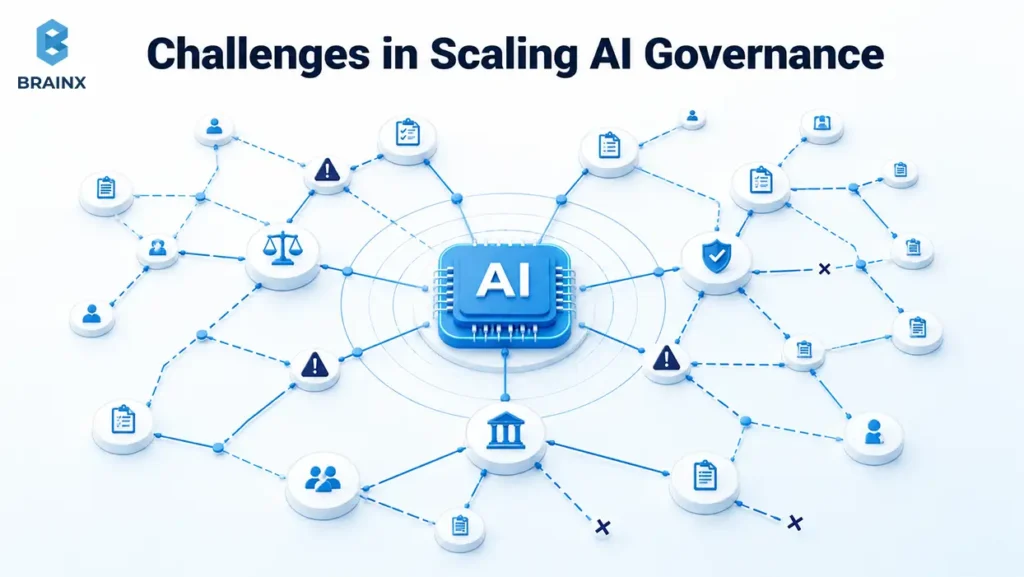
AI governance becomes harder to scale when the number of systems grows faster than the organization's ability to discover, review, monitor, and update them consistently.
A process that works for five AI applications may become a bottleneck when dozens of teams are using different models, providers, RAG pipelines, copilots, and agents. Spreadsheet inventories become stale. Review committees receive too many low-risk requests. Business units begin creating their own interpretations of policy. Monitoring data sits in different tools, making it difficult to see the enterprise risk picture.
The challenge is not simply “more AI.” It is governance fragmentation.
At scale, organizations need to standardize the parts of governance that should be reusable while preserving flexibility for use-case-specific risk. Useful capabilities include:
- A common inventory and ownership model across AI systems
- Consistent risk-tier definitions and approval requirements
- Reusable security, RAG, evaluation, and logging patterns
- Automated discovery or registration of new AI systems where practical
- Centralized evidence for audits and production reviews
- Continuous monitoring and material-change alerts
- A documented exception process
- Federated business ownership instead of sending every decision to one central committee
The objective is not to automate judgment out of governance. High-impact systems will still require qualified human review. Automation should remove repetitive administrative work so reviewers can spend more time on decisions that genuinely require legal, security, technical, or domain expertise.
This is also why scaling should happen in phases. The organization can first standardize governance for one category of use case, then reuse the same controls and evidence patterns as the AI portfolio expands.
Tooling Costs Depend on Monitoring, Evaluation, Lineage, and Audit Requirements
Potential tooling categories include:
Model gateways, prompt management, automated evaluations, red teaming, AI observability, data catalogs, lineage, vector databases, identity, secrets, policy enforcement, audit logging, and evidence management.
Do not buy an “AI governance platform” before defining the operating model.
Tools should implement controls, not decide what the organization's controls should be.
A Phased Rollout Is Safer Than an Enterprise-Wide Launch
Three practical implementation scopes are:
Governance Foundation: AI inventory, charter, RACI, risk tiers, vendor baseline, minimum policies, and control standards.
Governed AI Pilot: Apply the framework to one measurable system, implement controls, evaluate it, approve it, and monitor real production behavior.
Enterprise Governance Rollout: Automate evidence, standardize reusable architectures, integrate governance into engineering workflows, onboard legacy AI, and establish portfolio reporting.
BrainX's Ponder AI implementation provides a useful example of phased AI product development. BrainX first delivered Ponder as a proof of concept with voice-to-text and GPT-powered chat, then evolved it into a more scalable native wellness product with voice and text interaction, contextual recommendations, and structured wellness features.
Importantly, this case study supports phased AI implementation, not claims that Ponder used every governance control discussed in this article. Governance scope should be validated separately for each project.
Which Mistakes Cause Responsible AI Governance Programs to Fail?
Governance programs usually fail when sound principles remain disconnected from production systems.
A useful corrective pattern is:
Failure → Why It Happens → Consequence → Corrective Control
Treating Governance as a Policy Document Instead of an Operating System
Failure: Principles are published, but delivery workflows do not change.
Why: Writing policy is easier than engineering control.
Consequence: Compliance depends on memory and individual judgment.
Corrective control: Map every policy to standards, controls, evidence, and release gates.
Applying the Same Controls to Every Use Case
Failure: Every AI system enters the same review.
Why: A universal process appears administratively simple.
Consequence: Low-risk projects face unnecessary friction while reviewers have less capacity for consequential systems.
Corrective control: Use risk tiers based on impact, autonomy, reversibility, data, and affected users.
Leaving Data Ownership and Decision Rights Undefined
Failure: Nobody can definitively approve a source or accept residual risk.
Why: Responsibility is assigned broadly to IT or “the AI team.”
Consequence: Approvals stall and incidents become political.
Corrective control: Assign named product, AI, and data owners with explicit escalation authority.
Governing Models Without Governing Their Data
Failure: The LLM passes tests while its retrieval sources remain stale, incorrect, or unauthorized.
Why: Model evaluation is easier to see than data dependencies.
Consequence: A technically capable model can still generate unreliable or noncompliant answers.
Corrective control: Make source inventory, ownership, access, freshness, lineage, and deletion part of release approval.
Reviewing the Model but Ignoring Retrieval, Prompts, Tools, and Users
Failure: The model endpoint is approved while application configuration changes freely.
Why: Teams incorrectly define the model as the entire AI system.
Consequence: Behavior changes without governance review.
Corrective control: Version and test the deployed application configuration, including prompts, RAG, tools, permissions, safety settings, and fallback routes.
OWASP's GenAI risk taxonomy reinforces this wider system boundary.
Allowing Pilots to Reach Production Without Release Criteria
Failure: A successful demo gradually becomes a business-critical application.
Why: No formal transition exists between experimental and approved status.
Consequence: Production begins without accepted thresholds, risk approval, monitoring, or ownership.
Corrective control: Define production-release requirements before the pilot begins.
Ignoring Vendor Updates and Material System Changes
Failure: Models, retrieval sources, prompts, or tools change without regression evaluation.
Why: Teams assume provider updates or configuration changes are interchangeable.
Consequence: Quality, safety, cost, or behavior shifts silently.
Corrective control: Maintain change triggers and rerun required evaluations before promotion.
Monitoring Failures Without Defined Response Actions
Failure: Dashboards show problems, but nobody knows when to intervene.
Why: Metrics were designed for visibility rather than decisions.
Consequence: Known failures remain in production.
Corrective control: Connect critical thresholds to an owner and predefined response: investigate, restrict, rollback, escalate, or shut down.
Forgetting Decommissioning, Data Deletion, and Access Revocation
Failure: The interface is disabled while API keys, vectors, caches, provider resources, service accounts, or ingestion jobs remain active.
Why: Retirement is treated as a product decision rather than a technical lifecycle stage.
Consequence: Abandoned systems retain data and attack surface.
Corrective control: Maintain a decommissioning checklist covering services, credentials, jobs, storage, embeddings, derived artifacts, providers, and required evidence.
NIST lifecycle guidance specifically includes deactivation and decommissioning considerations.
Post-incident review closes the loop. Record root cause, affected systems and users, containment, remediation, validation, lessons learned, and whether similar AI systems need the same corrective control.
How BrainX Helps With Generative AI Governance
BrainX Technologies can approach generative AI governance as an implementation problem: define the operating model, then build the data, security, evaluation, deployment, and monitoring mechanisms that make governance enforceable.
BrainX's public AI delivery materials already span strategy, architecture, AI development, RAG, integration, evaluation, deployment, and ongoing improvement rather than positioning model integration as a standalone task.
AI Readiness, Use-Case Inventory, and Risk Assessment
An engagement can begin by mapping production, experimental, and shadow AI systems.
BrainX can document business context, model and data dependencies, users, autonomy, and potential impact before prioritizing what should be governed first.
Tangible deliverables: AI inventory, context-of-use statements, risk classification, risk-tier model.
Governance Operating Model and Responsible AI Policies
Governance must fit the organization's actual structure and risk tolerance.
BrainX can help define decision rights, approval flows, exception processes, lifecycle standards, and operating responsibilities across product, engineering, data, security, and compliance functions.
Tangible deliverables: governance charter, governance RACI, tier-specific requirements, exception procedure, release process.
Enterprise Data Governance and RAG Architecture
Enterprise assistants need secure, trustworthy context.
BrainX can design RAG architectures that preserve source classifications, provenance, permissions, and freshness throughout ingestion and retrieval.
Tangible deliverables: AI data-governance architecture, source register, lineage approach, RAG authorization model, freshness controls, deletion workflow.
Data, Security, and Access-Control Implementation
Policies need enforced technical boundaries.
Implementation can include identity-aware retrieval, least-privilege tool access, secrets management, input and output controls, telemetry, logging, and secure integration patterns.
Tangible deliverables: security architecture, IAM design, agent/tool permission model, audit logging, security test plan.
Evaluation Frameworks and Controlled Pilot Development
A production system needs measurable release criteria before launch.
BrainX can help build task-specific evaluation datasets and test suites covering quality, grounding, retrieval, security, domain safety, and known failure modes.
Tangible deliverables: evaluation dataset, metric framework, adversarial scenarios, release thresholds, regression suite, pilot evaluation.
Production Monitoring, Incident Readiness, and Handover
Production ownership must be explicit.
Teams need to understand which metrics matter, when an alert becomes an incident, who can stop the system, and how operation can be restored safely.
Tangible deliverables: monitoring plan, audit trail, incident runbook, escalation matrix, rollback procedure, decommissioning plan, team training, technical handover.
Governance Improvement as AI Systems and Regulations Evolve
AI systems are not static.
Providers change, new tools are connected, data changes, user behavior shifts, and regulation evolves. Governance should therefore include recurring reviews and defined material-change triggers rather than treating initial approval as permanent. For broader delivery support, explore BrainX's enterprise AI strategy and responsible AI services.
The most useful starting point is usually one real system rather than an organization-wide policy exercise. Teams ready to assess a live use case can schedule a generative AI governance assessment with BrainX.
Closing Summary: Start With One Governed Use Case
Responsible enterprise AI depends on aligning business objectives, risk classification, data governance, technical controls, human accountability, evaluation, and continuous monitoring. Generative AI governance makes those elements part of one operating model instead of separate compliance exercises.
Start with one bounded, measurable use case. Identify its owners and data, classify its risks, define release criteria, implement controls, prove they work, and monitor production behavior. Then reuse what the organization learns across the next system. Governance scales best when standards grow from real operational evidence rather than trying to predict every future AI scenario in advance.
Frequently Asked Questions
What Is Generative AI Governance?
Generative AI governance is the set of decision rights, policies, technical controls, evaluation processes, evidence, and oversight used to manage GenAI systems across their lifecycle.
It covers more than the foundation model. Governance also applies to prompts, enterprise data, RAG, outputs, tools, agents, vendors, human review, production monitoring, system changes, and decommissioning.
A strong framework defines who owns each decision, which risks are acceptable, what must be tested before release, and what evidence proves controls remain effective. NIST's Generative AI Profile provides a useful cross-sector foundation for structuring these responsibilities.
How Do Data Governance and Generative AI Work Together?
Data governance defines which information a GenAI application may access, why it may use that information, who owns it, how sensitive it is, how current it is, and when it must be deleted.
The AI application should inherit those controls instead of creating a separate, weaker information layer.
For RAG systems, this means maintaining classification and permission metadata through indexing, applying authorization before retrieval, recording source lineage, managing freshness, and propagating deleted or revoked data into downstream indexes and derived artifacts.
Why Is Data Governance for Generative AI Important?
Data governance for generative AI matters because model quality cannot compensate for unauthorized, obsolete, conflicting, or poorly governed information.
A capable LLM can still return the wrong business answer if it retrieves an old policy. It can still create a privacy incident if the retriever supplies information the user is not permitted to access.
Governance therefore needs ownership, classification, permissions, provenance, lineage, freshness, residency, retention, and deletion alongside model evaluation. Gartner's 2026 research similarly emphasizes governed, context-rich data as critical infrastructure for enterprise AI and agents.
Who Should Own AI Governance and Enterprise Data Governance?
AI governance should have business accountability with cross-functional execution.
The product or business owner should remain accountable for intended use and outcomes. AI engineering owns technical behavior and evaluation. Data owners approve information sources and permitted purposes. Security owns technical risk controls. Legal and compliance map external obligations. Operations owns production response and rollback.
Enterprise data governance often has separate data-accountability structures because the same source can support many applications. AI teams should connect to those owners rather than independently authorizing enterprise data for new purposes.
ISO/IEC 42001 similarly treats responsible AI as an organization-wide management discipline rather than the responsibility of one engineering group.
Which Standards and Regulations Should a Responsible AI Framework Follow?
A useful cross-sector foundation includes the NIST AI Risk Management Framework and Generative AI Profile, ISO/IEC 42001, and the OECD AI Principles. Together, they cover practical risk management, management-system governance, transparency, accountability, safety, human oversight, and traceability.
Regulatory requirements should then be mapped according to jurisdiction and use case.
As of August 2026, the EU AI Act is broadly applicable, while high-risk rules follow the updated AI Omnibus timeline: December 2, 2027 for certain high-risk systems and August 2, 2028 for AI embedded in regulated physical products. Privacy, healthcare, employment, financial-services, consumer-protection, intellectual-property, records, and other sector rules may also apply.
The right approach is:
Requirement → Internal Policy → Technical Control → Evidence
rather than claiming universal compliance with a list of frameworks.
How Long Does It Take to Implement an Enterprise AI Governance Framework?
There is no responsible universal timeline because organizational scope varies widely.
A business governing one bounded internal assistant may establish ownership, risk classification, controls, evaluation, and release evidence within the project's delivery cycle. A global enterprise with legacy AI, multiple providers, regulated workflows, and immature data ownership needs a phased program.
A practical sequence is:
Governance Foundation → Governed AI Pilot → Enterprise Rollout
The pilot should test both the AI system and the governance process itself: who approves each decision, which evidence is difficult to generate, which controls can be automated, and where the operating model creates unnecessary friction.
That phased approach becomes increasingly important as AI portfolios grow. IBM's 2026 study found that 77% of surveyed organizations said AI adoption was already moving faster than their governance capabilities.