
 April 15, 2026 -
  13 minutes read

Key Takeaways
- Businesses should not hire offshore development team members when the direction of the product is uncertain, but when they already have a roadmap and require additional capacity to deliver.
- A dedicated offshore team is ideal in long term product development where continuity, ownership, and predictable output during sprints is important.
- Direction of the product can be kept in house while execution can be outsourced with a clear definition of architecture, QA and reporting ownership.
- The most common offshore failures are due to the ineffective governance, inadequate vetting, and lack of clarity in the design of communication rather than due to the geography.
- The safest way of testing the fit of the team, model, and operating rhythm to your business is through a 90-day pilot.

Businesses are under great pressure in today’s time to release quicker, scale smarter, and manage development costs without compromising on quality. One powerful growth strategy is to hire offshore development team support. Through access to talented engineers in all parts of the world, firms are able to decrease delivery schedules and develop scalable engineering capacity that can meet the demand.
Indeed, according to industry analysts, it is estimated that offshore software development market will grow from about $122 billion in 2024 to roughly $283 billion by 2032. The booming market indicates the fact that organizations make use of offshore teams not only to reduce costs, but to gain other advantages as well. Businesses can access difficult to find skills, reduce time to market, and free their in-house team to work on strategy and innovation.
Instead of relying solely on local hiring, savvy companies now expand their talent pool worldwide. are able to work across time zones, niche technologies (AI, cloud, security, and more), and scale up or down as required.
The strongest offshore relationships are not built around cheap delivery. They are built around speed, capacity, and better use of internal leadership. When the model is right, offshore teams help companies move faster without forcing every roadmap decision through slow local hiring cycles. When the model is wrong, they create confusion, weak accountability, and expensive rework.
Today’s blog is designed as a decision framework, not another generic offshore guide. It will help you in deciding when you can hire offshore, when it makes sense to have a dedicated team, what to keep in-house, what red flags you would want to identify early, how to run a 90-day pilot and how to compare regions in terms of cost and development time.
When to Hire an Offshore Dedicated Software Development Team
The offshore model does not fit all projects. To determine whether a dedicated offshore team (long-term, exclusive) would be suitable to you, use the following criteria:
- Long-term Project Roadmap: If your product development is ongoing (new features, maintenance, iterative upgrades) rather than a one-off project, a dedicated team excels. These teams become extensions of your company, preserving knowledge between sprints and releases. Conversely, very short-term, narrowly scoped tasks may be cheaper on a fixed-price basis.
- Rapid Skill Needs: Are there technical areas you can’t staff locally fast (e.g. AI, cybersecurity, cloud architects)? Offshore teams often have these skills readily. If you need to scale a multidisciplinary team quickly, a dedicated model is ideal. It lets you “instantaneously add talent to accelerate your roadmap”.
- Budget Constraints with Growth Goals: When you must grow but have tight budgets, offshoring stretches funds. Verified analysts note that offshore projects still cut costs by ~40–70% even after considering all overhead. If freeing the budget to reinvest in your product is a priority, offshore is attractive. However, if budget is ample and speed less critical, onshore might suffice.
- Need for Control and Security: Dedicated offshore teams provide more client control than generic outsourcing. You hire the team and manage it, maintaining IP ownership and process standards. It is essential when your product processes sensitive information or has proprietary technology. In contrast, when outsourcing entire projects to agencies (without dedicated personnel) there is a risk of losing some control and knowledge.
- Company Size and Execution Focus: Larger companies and scale-ups often have the processes to integrate offshore teams, whereas small startups might find it challenging. That said, even startups use offshore squads for MVPs. The key is whether you have internal dev leads who can coordinate a remote team.
If these conditions align, hiring an offshore dedicated software development team is likely a smart move. But just to make sure you’re on the right track, you have to consider the following next.
Also Read: IT Staff Augmentation in Software Development – Smart Way to Upscale!
Should You Hire Offshore Development Team Right Now?
Before you compare regions or vendors, you need to answer one question clearly: are you ready to hire offshore development team capacity now, or are you just reacting to delivery pressure?
The choice is best when your business has a stable direction and just requires assistance with implementation. If your roadmap is clear, your product owner is active, and your internal team is stretched, offshore can increase throughput quickly. If your company is still changing direction every week, offshore will amplify the disorder.
You Are Likely Ready If:
- You have a documented roadmap for at least the next two quarters
- Your core product requirements are reasonably stable
- You need skills that are slow or expensive to hire locally
- Your internal team is spending too much time on maintenance and not enough on roadmap delivery
- You have a product owner, CTO, or engineering lead who can guide priorities and review outcomes
You May Not Be Ready If:
- Your product vision changes constantly
- No one internally owns the backlog
- You need constant same-room collaboration to make progress
- You want the offshore team to figure out product strategy for you
- You do not yet know which roles you actually need
A useful test is this: if you answered “no” to roadmap clarity, internal ownership, and process readiness, pause before you hire offshore development team support. In that case, a smaller advisory engagement or a short-term specialist may be a better first move.
When a Dedicated Offshore Team Is the Right Model
Not every offshore model serves the same purpose. Some are designed for fixed-scope delivery. Others are designed for long-term product execution. If your goal is scalable growth, the most effective structure is usually the dedicated model.
When you hire offshore dedicated software development team support, you are not buying a one-off project. You are building a remote extension of your engineering function. That team works on your backlog, follows your priorities, and stays aligned with your product over time.
A Dedicated Team Makes Sense When:
- Your roadmap extends beyond a single release cycle
- Knowledge retention matters to long-term product quality
- You need consistent sprint velocity instead of ad hoc task delivery
- Architecture continuity is important
- You want engineers to become familiar with your users, workflows, and internal standards
Dedicated Team vs. Project Outsourcing
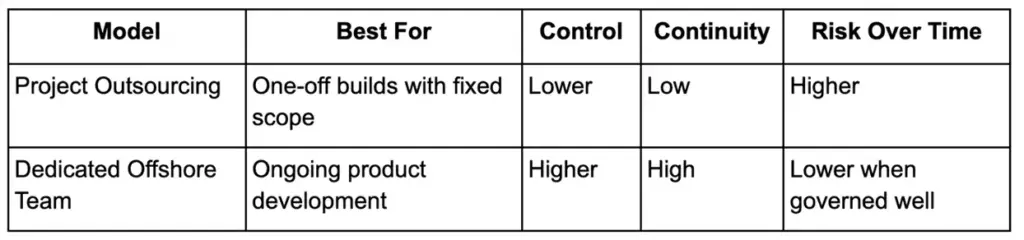
A project outsourcing model can work for a standalone microsite, migration task, or internal utility. It becomes far less effective when your product needs monthly releases, evolving priorities, and long-term maintenance. In those cases, a dedicated structure creates better accountability and far less context loss.
Who Owns What? Product, Architecture, QA, and Delivery
One of the most common reasons offshore initiatives fail is simple: nobody defines ownership properly.
Before you hire offshore development team members, decide which responsibilities stay close to the business and which can be distributed.
Product Ownership
This should remain in-house. Your internal leadership should own:
- Vision
- Roadmap prioritization
- Customer context
- Feature definition
- Acceptance criteria
Offshore teams can execute product decisions. They should not be expected to invent your product direction.
Architecture
Architecture should be shared, but not delegated blindly. A strong setup usually looks like this:
- Internal CTO or lead engineer sets architectural direction
- Offshore technical lead handles implementation discipline
- Major system decisions are reviewed together
This prevents a situation where speed wins in the short term but technical debt grows quietly underneath.
QA and Testing
QA can be led offshore if standards are defined clearly. That includes:
- Test coverage expectations
- Regression cycles
- CI/CD checks
- Bug severity definitions
- Release readiness criteria
This is where a strong written process matters. Offshore QA works well when quality is treated as a system, not a person.
Delivery and Sprint Execution
Day-to-day delivery can be managed offshore, but visibility must remain shared. It means, you should have:
- Daily standups with clear overlap time
- Transparent sprint planning
- Delivery dashboards
- Weekly reviews
- Written handoffs and documented decisions
IP, Code, and Access Control
This part should never be vague.
Before any delivery begins, your contracts and operating setup should make these points clear:
- All work product belongs to your company
- Your company controls the repository
- The team works inside your GitHub or GitLab organization
- Access is role-based and revocable
- Exit procedures are documented before the engagement starts
If a vendor resists this level of control, treat it as a serious warning sign.
Risks and Red Flags to Watch For
The decision to hire offshore development team support carries real risks, but most of them are predictable. The goal is not to avoid all risks. The goal is to catch the wrong fit early.
Strategic Risks
These come from your side of the engagement:
- No internal product owner
- Undefined KPIs
- No clear sprint rhythm
- Constant priority changes
- A vague “let’s just see what happens” mindset
Vendor Red Flags
These are often visible during the first few calls:
- No transparent pricing structure
- No direct access to the actual engineers you may hire
- No documented security or IP process
- No clear replacement policy if a team member leaves
- No examples from companies similar to your size or stage
Common Operational Failure Patterns
These usually appear after the contract starts:
- The senior people from the pitch disappear after signing
- Overlap hours slowly shrink and feedback cycles become too slow
- Developers say yes to unclear requirements instead of asking questions
- Documentation is weak, so every issue becomes a meeting
- Code quality varies because standards were never defined early
Offshore teams do not fail because they are offshore. They fail because governance is weak.
How to Hire Offshore Development Team or Partner
Follow these action steps to go from “maybe offshore?” to having a productive team working for you:
Step 1 – Define Project Scope and Team Needs

Defining project scope and outlining your needs for an offshore development team should take first priority.
Clarify Goals
Start by explicitly defining why you want an offshore team. Is it to speed up an upcoming release, add specialized skills, or extend coverage to 24/7? Write down the project’s vision, key features, timeline, and expected outcomes.
Identify Roles and Skills
List the exact tech skills required (e.g. “5 front-end developers with React,” “2 cloud engineers with AWS expertise”). Outline deliverables for at least the first 3–6 months. This clarity will help vendors propose the right team size and mix.
Set Success Metrics
Define what success looks like (e.g. “Launch X by date”, “Improve release cadence by 50%”). Tying the offshore team’s work to business KPIs keeps everyone focused.
Step 2 – Set Budget and Engagement Model
Once goals, roles and targets are determined, it’s time to move towards finalizing your budget and the engagement model.
Calculate Total Cost
Besides developer salaries, include project management, communication tools, possible travel for visits, and any third-party services. Also allow a buffer (typically 10–20%) for overhead or scope changes.
Choose Engagement Type
Based on scope and flexibility needs:
- Dedicated Team: Pay a predictable monthly rate per role. Best for long-term, evolving projects. Offers maximum flexibility (you can shift priorities mid-project).
- Staff Augmentation: Similar to dedicated, but often managed partly by your in-house lead.
- Fixed-Price Contract: If scope is very clear-cut and unlikely to change, you can negotiate a fixed bid. This shifts scope-change risk to the vendor but reduces your control.
- Time & Material (T&M): Pay for actual hours used. Useful if requirements are fuzzy, but requires diligent time tracking.
Also Read: Detailed IT Staff Augmentation Handbook: On Benefits, Process, And More
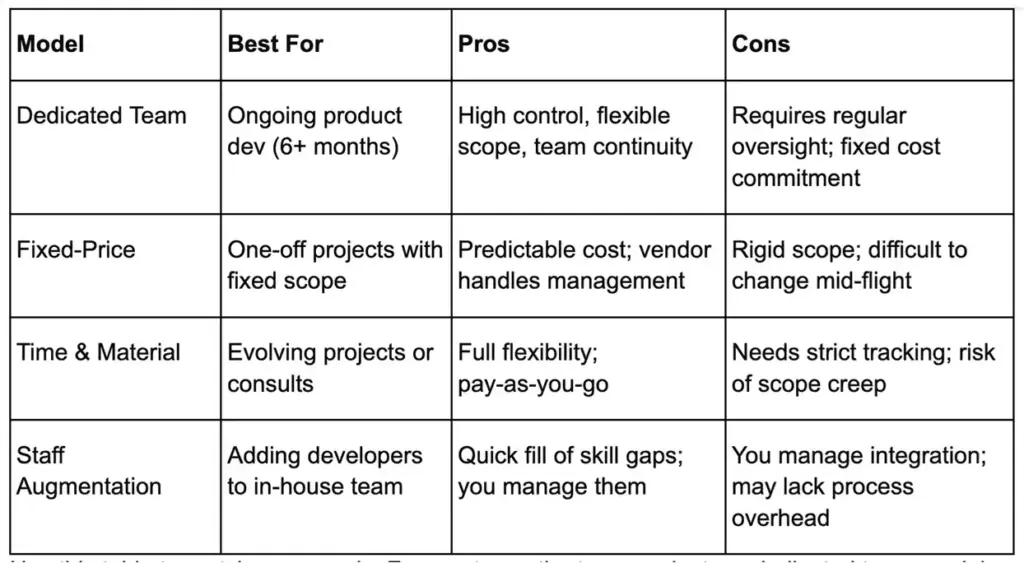
Use this table to match your needs. For most growth-stage products, a dedicated team model (or staff augmentation) is recommended, as it balances control with scalability.
Step 3 – Select Location and Partner

At this point, you should evaluate all the different regions. Consider cost vs. time overlap vs. language. Verified data shows:
- Eastern Europe: Strong English skills, EU-friendly laws, 3–6 hours ahead of US, rates ~$25/hr. Great for EU and US companies alike.
- Latin America: Small time difference with US, moderately high English, growing tech hubs. Rates ~$30–$35/hr (higher than Asia, but still 30–50% less than US).
- Asia (India, Vietnam, Philippines, Pakistan): Very low costs (starting around ~$15/hr) and a huge talent pool. The time zone difference is large (US companies manage via overlapping mornings/evenings). Philippines offers good English, India has vast skills and Pakistan can be cost effective while offering all the things mentioned before for its competitors.
- Others: The Philippines and Eastern Europe are top choices now, per Deloitte and IDC. Africa (Kenya, Egypt) is emerging for Europe, Canada remains top-tier (onshore), etc.
Check Legal/IP Framework
Favor countries with clear IP laws and stable business environments. For example, EU countries (Poland, Romania) follow EU IP directives. India’s legal system enforces contracts well. Vendor Screening: Choose providers (agencies or consultancy firms) that specialize in your tech stack. Look for:
- Established track record (case studies, client reviews)
- Strong internal processes (e.g. Agile, quality assurance)
- Good communication (responsiveness in initial discussions)
On shortlist, conduct technical tests or trial projects. Ensure the vendor can assemble the roles you need (frontend, backend, QA, etc.) within your timeline.
Step 4 – Vet and Onboard the Team
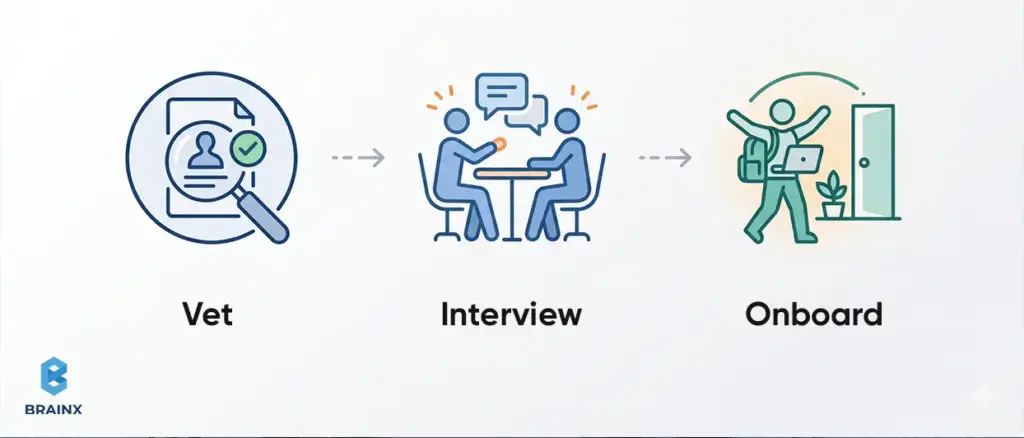
A very important step is to thoroughly vet, interview and on board your new tech partner or team members.
Technical Vetting
Conduct interviews or coding assessments for candidates. Test real-world problems to gauge skill level. Also assess communication: can they explain solutions clearly? Ideally, include both technical leads and product owners in interviews.
Background Checks
Verify work history and references, especially for key roles (team lead, architect). Ensure their English proficiency meets requirements.
Contracts & Legal
Sign detailed contracts/Master Service Agreements. Include:
- IP Assignment clauses (all code and work-products belong to you)
- Non-Disclosure Agreements (NDA)
- Data Protection clauses (GDPR/CCPA compliance if relevant)
- Termination terms and exit transition (knowledge transfer responsibilities)
These safeguards are crucial. As one whitepaper notes, explicitly addressing IP and security in contracts is a must.
Knowledge Transfer & Tools
Plan a thorough handoff. Provide documentation of existing systems, design specs, and coding standards. Give the team access to code repositories, dev environments, and project trackers. Arrange onboarding sessions where senior local developers explain architecture to the offshore team.
First Project
If possible, start with a small pilot feature or a short proof-of-concept. This lets both sides adjust processes before committing to major deliverables. More details on that. Let’s discuss the final step of hiring offshore developers.
Step 5 – Manage and Scale Ongoing

Here are the factors that you need to keep constant watch on to manage your projects flawlessly and keep on scaling without any hiccups.
Agile Processes
Run your offshore team in your chosen Agile framework. Hold regular sprint planning, demos, and retrospectives. Use shared project management tools (Jira, Asana). Track burndown charts and velocity to spot issues early.
Communication
Maintain daily or bi-weekly standups (overlap hours) to synchronize. As one analysis emphasizes, “everything important needs written documentation” to bridge distance. After meetings, circulate summaries and updates in chat or email. Encourage questions in writing to avoid misunderstandings.
Integration with Onshore Team
Treat offshore developers as teammates. Include them in all relevant meetings (demo days, design reviews). Organize occasional virtual team-building (online games, coffee chats). If budget allows, occasional in-person offsites or visits can cement relationships.
Quality and Security
Enforce coding standards and mandatory code reviews for all commits. Build CI/CD pipelines and automated tests that the whole team adheres to. For security and IP: use version control with access control, require secure VPNs, and rotate credentials. Regularly remind the team of NDAs and compliance policies.
Scalability
Monitor workload and cycle times. As needs grow, promptly onboard additional developers via the same partner. Conversely, if a project winds down, gracefully sunset extra roles.
[Read more about these steps in: Why Offshore Software Product Development Is Growing in 2026]
The 90-Day Pilot: Test Before You Commit
Long contracts should not be part of your first move.
If you are still deciding how to hire offshore development team support the right way, a 90-day pilot is the smartest path. It gives both sides enough time to test real work, while still protecting you from a bad long-term fit.
Days 1–30: Setup and Integration
Use the first month to test fundamentals, not volume. Focus on:
- Contract finalization and IP safeguards
- Tool access and environment setup
- Architecture walkthroughs
- Backlog alignment
- A small, low-risk sprint scope
The goal here is not speed. It is communication quality, responsiveness, and working rhythm.
Days 31–60: Execution Validation
Now move into real delivery. Use this period to assess:
- Sprint predictability
- Code quality
- QA reliability
- Documentation habits
- Ability to handle feedback without drift
Assign work that matters, but not the most fragile part of your roadmap.
Days 61–90: Scale Decision
By the final month, you should have enough data to make a real decision. Evaluate:
- Cost efficiency
- Feature throughput
- Defect rates
- Team fit
- Management overhead
- Confidence in scaling the model
At the end of the pilot, you usually have three outcomes:
- Scale up if delivery is strong and coordination is healthy
- Adjust the team shape if the model works but the role mix is wrong
- Offboard cleanly if the fit is weak
The pilot phase should leave you with no hesitations as it is a practice for disciplined buying.
Cost vs. Development Time by Region
Companies often compare offshore regions by rate alone. That is the wrong lens.
A lower hourly rate can still cost more if handoffs are weak, overlap is limited, or rework slows delivery. A better question is to ask, “Which region gives us the best output for our product type?
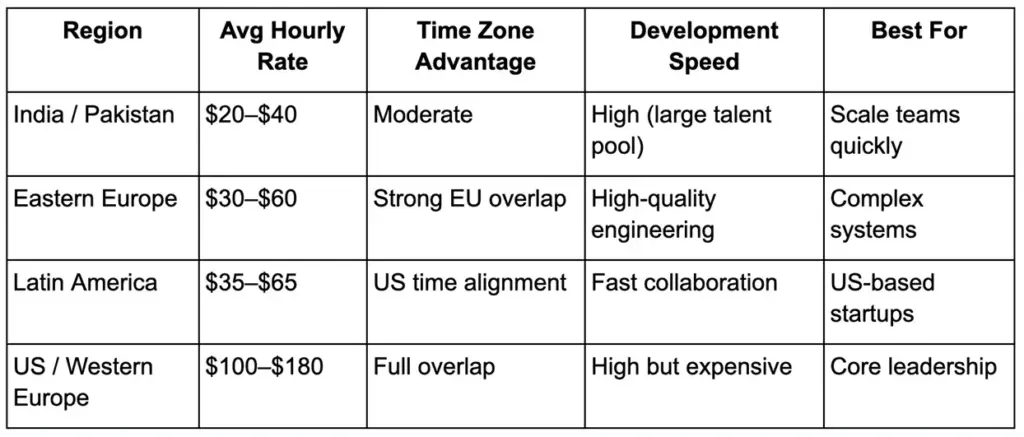
How to Read This Table
Choose based on delivery pattern, not just price.
- If your product needs real-time collaboration and fast decision loops, Latin America can justify a higher monthly cost.
- If you need strong engineering quality with reasonable overlap, Eastern Europe is often a strong fit.
- If you are scaling support functions, maintenance, or large execution capacity with disciplined async processes, South and Southeast Asia can be highly efficient.
The real metric is not hourly rate, it is cost per feature shipped well and on time.
Final Decision Checklist Before You Hire Offshore
Use this before you sign anything.
- Do we have a clear roadmap?
- Do we know which roles we need?
- Do we have internal product ownership?
- Are we ready to manage sprint cadence and reviews?
- Have we defined who owns product, architecture, QA, and delivery?
- Are our IP, code access, and exit terms documented?
- Are we willing to validate the relationship through a 90-day pilot?
- Have we chosen a region based on delivery fit, not just lower rates?
If most of these answers are yes, the decision to hire offshore development team support is likely grounded in execution logic rather than urgency.
Conclusion
Companies do not scale well just by hiring more engineers. They scale by building better delivery systems.
That is why the best offshore setups in 2026 are not built as cost experiments. They are built as structured operating models with clear ownership, strong communication design, measurable pilot periods, and disciplined partner selection.
If you choose to hire offshore development team support, do it with the same seriousness you would bring to building any other core business capability. Get the model right, and offshore becomes more than a staffing move. It becomes a practical engine for growth.
FAQs
How Much Does It Cost To Hire An Offshore Development Team?
The cost depends on region, seniority, team size, and engagement model. A small dedicated team will usually be more expensive than a few freelancers on paper, but often more efficient over time because it reduces re-onboarding, quality drift, and delivery inconsistency. Contact our team and find out what it can cost you to hire offshore developers for your project?
What Is An Offshore Dedicated Software Development Team?
It is a team of developers, testers, and related specialists based in another country who work exclusively on your product over an ongoing period. Unlike project outsourcing, the team is aligned to your backlog, your roadmap, and your operating process.
What Industries Benefit Most From Offshore Development?
SaaS, fintech, healthtech, ecommerce, logistics, and enterprise software teams often benefit the most because they need steady product iteration, engineering specialization, and scalable delivery support.
What Are Common Challenges When Working With An Offshore Team?
The most common challenges are weak communication design, unclear ownership, poor documentation, low overlap hours, and inconsistent quality controls. These issues are manageable when governance is strong.
Is A Dedicated Offshore Team Right For Startups?
Yes, but only when the startup already has product clarity and someone internally who can guide execution. For very early-stage startups with shifting priorities, a smaller advisory or specialist model may be the better first step.