
 April 1, 2026 -
  15 minutes read

Key Takeaways
- Offshore software product development is on the rise in 2026 as companies require superior product delivery times, improved AI governance and budget control.
- Global IT spending growth is putting more pressure on teams to deliver digital products faster and more reliably.
- New AI regulations are positioning compliance readiness as a major consideration in the way that modern product teams plan and scale.
- Access to specialized talent and round the clock execution is helping businesses accelerate releases without overstretching internal teams.
- Clear processes, strong QA and measurable performance in delivering the product is now more important than just cost when choosing a development partner.

In 2026, product leaders face a sharper mandate: ship faster, de-risk AI features, and still control budget and delivery quality. That's why offshore software product development is increasingly being treated as a strategic operating model, not just a labor-arbitrage decision.
Global demand signals support the shift: Gartner forecasts worldwide IT spending will reach $6.15 trillion in 2026, up 10.8% from 2025, raising expectations for digital delivery throughput and resilience. At the same time, governance is getting real deadlines: the EU AI Act entered into force on August 1, 2024 and is scheduled to be fully applicable on August 2, 2026. This means product teams must integrate compliance into their AI roadmap.
This guide explains the drivers of offshore development, the delivery models that work, and how to select an offshore partner with measurable proof.
Offshore Software Product Development: Everything You Need to Know in 2026
Offshore software product development has matured into a comprehensive delivery option for 2026 and beyond. It’s not just about cost. These days other drivers include talent shortages, rising hiring costs and the complexity of new technologies. Analysts estimated the global offshore dev market to be $178.6 billion in 2025, rising to $198.3 billion in 2026. For context, the overall software outsourcing market is much larger ($564B in 2025, $897B by 2030). With these market dynamics, companies increasingly use offshore teams to scale capacity, tap specialized skills, and accelerate time-to-market.
[Also Read: Outsourcing Software Development – 10 Critical Mistakes Businesses Should Avoid]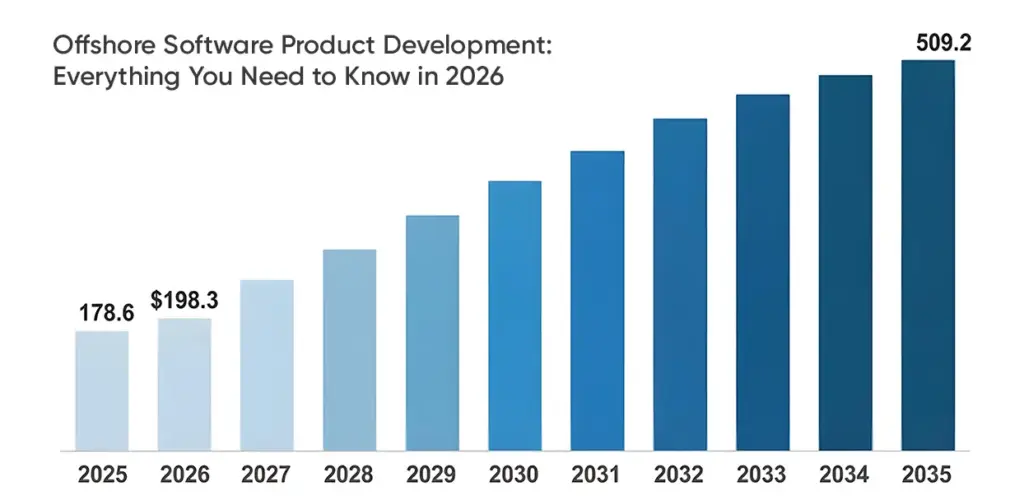
A Comprehensive Look at the Offshore Software Product Development Industry
Several trends underlie this offshore boom. Most enterprises face local labor crunches: for example, U.S. BLS projects 129,000 new developer jobs by 2032 with few applicants. Many EU and UK companies see similar shortages. In contrast, countries in Eastern Europe, Latin America and Asia are churning out millions of software engineers every year. At the same time, product roadmaps are more ambitious. Gartner reports an increasing demand for cloud and AI/ML talent. In short, companies need more throughput and resilience, while offshore teams can help to provide exactly that.
Market data underscore the trend. Offshore product development is said to reach $178.6B in 2025 and $198.3B in 2026. (For perspective, outsourcing overall was supposed to be around $564B by 2025.) Growth is driven by strategic need, not just cut-rate labor: organizations now view offshore delivery as an operating model. In the sections below we’ll unpack what “offshore product development” means, why companies choose it, the benefits & challenges, and how to make it work in practice.
What Is Offshore Software Product Development?
Offshore software product development refers to the process of building or extending your product team in another country, often with a large disparity in time zones and price. In reality, a company recruits a remote team (or an extended team) in a foreign location to design, construct and maintain digital products. This is in contrast to in-house (on-site) development where all of the engineers work co-located with the company.
Offshore vs. In-house
In in-house development, local employees or teams are used. This provides the best possible control and collaboration in real time, but is often much more expensive and hiring takes longer. Offshore development means that the development work is carried out by a remote team located abroad, which generally implies lower salaries and larger labor pools. However, it requires explicit processes for the collaboration.
For example, onshore/in-house teams have high cost and overhead, whereas offshore teams in distant time zones trade off extra coordination for scale and cost-control.
Offshore vs. Nearshore vs. Onshore
All three models differ by location. Onshore means that teams are in the same country (or very close), low time zone difference and high cost. Nearshore refers to adjacent or regional countries (e.g. Eastern Europe for Western Europe, Mexico for the U.S.), with some cost savings and improved time overlap. Offshore means far away countries (often with a sizable time difference) - this offers the greatest cost saving and labor provision but requires robust written processes and asynchronous collaboration.
The trade-offs: onshore teams give fastest feedback and control but cost the most, nearshore balances overlap and savings, and offshore yields the greatest scale per cost benefits (if processes are strict).
When Offshore Makes Sense
Offshore development is most appealing when local constraints bite. For example, if you have a stable backlog or repeatable delivery process but need to ship faster, an offshore team can extend your capacity. Or if you lack senior skills in-house (e.g. niche AI or cloud expertise), an offshore partner can fill that gap. Offshore can ship faster if requirements are clear, fill skill gaps if seniority is verified, and scale capacity if your process is well-defined.
In short, offshore tends to make sense when accelerating development or accessing specialized talent is the priority.
Hybrid Software Development
Hybrid software development blends local ownership with distributed execution. In practice, this usually means keeping product strategy, architecture, or stakeholder management close to the business, while assigning development, QA, or support functions to nearshore or offshore teams. It gives companies more flexibility than a fully in house model without shifting every responsibility to a remote team.
It is a model that works well for businesses requiring tighter control over product direction while still benefiting from broader talent access and better delivery capacity. For example, a company may keep product leadership and solution design internally, while using external teams to accelerate sprint delivery, testing, or maintenance.
The trade-off is that hybrid setups require stronger coordination, clearer ownership, and consistent delivery standards across all teams. If governance is weak, a hybrid setup can quickly turn into a split system where knowledge, priorities, and accountability drift apart.
Why Companies Choose Offshore Software Product Development
Companies opt for offshore delivery for strategic rather than financial reasons. The strongest offshore relationships help teams increase output while keeping internal leaders focused on product, customers and growth.
Access To Specialized Talent
One of the biggest drivers is access to skills that are expensive or difficult to hire locally. Many offshore markets have deep capability in cloud engineering, full stack SaaS delivery, mobile development, AI integration, cybersecurity, and DevOps.
For product companies, this is relevant because speed is often not limited by the lack of ideas, but by the lack of the right roles. A roadmap may be clear, but execution stalls if the business is not able to hire the right people fast enough.
Cost Efficiency And Better Budget Control
Offshore delivery can improve budget efficiency in two ways. First, direct labor costs are often lower. Second, companies avoid a large share of recruitment, office, benefits, and bench overhead that comes with expanding full time local teams.
That said, strong buyers do not evaluate cost through hourly rates alone. They look at total cost of ownership. A cheaper vendor that creates rework, communication delays, or weak documentation can become more expensive than a stronger partner with a higher rate.
Faster Delivery Under Tight Deadlines
When a product team needs to ship quickly, offshore delivery can extend working capacity without waiting through long hiring cycles. Teams can add developers, QA support, or engineering pods faster than most local recruitment pipelines allow.
In many cases, time zone separation can also support faster progress. With the right process, work can continue across a longer daily window, which helps move tickets, testing, and bug resolution forward more quickly.
Extended Time Zone Coverage
Time zone distribution can be a genuine delivery advantage when handled properly. Teams can create a productive mix of async progress and live collaboration. Support requests, QA cycles, and engineering updates can continue beyond local office hours.
This does not mean round the clock output happens automatically. It depends on handoff quality, documentation, and clarity around ownership. When those are present, broader coverage can become a meaningful strength.
Business Continuity And Risk Diversification
Concentrating all engineering activity in one geography creates operational risk. Outages, hiring disruptions, or regional instability can affect delivery more severely when teams are not diversified.
A multi geography operating model improves resilience. Even if one location faces disruption, work can continue through other teams or backup coverage. For growth stage and enterprise teams, this diversification supports continuity planning.
Support For Niche Product Requirements
Different offshore markets develop different strengths. Some are known for enterprise architecture, some for fintech and SaaS, some for scale, mobile, or AI support. This allows buyers to choose regions and partners that align more closely with the technical and domain needs of the product.
That is especially helpful when products involve regulated workflows, complex integrations, or performance heavy systems that require more than generic developer capacity.
Freeing Up Internal Teams For Core Priorities
Strong offshore teams allow internal leaders to spend less time on execution pressure and more time on product strategy, customer insight, roadmap decisions, and business growth.
This is one of the most underestimated benefits. Offshore delivery should not just save cost. It should create space for better leadership focus.
The Benefits of Offshore Software Product Development
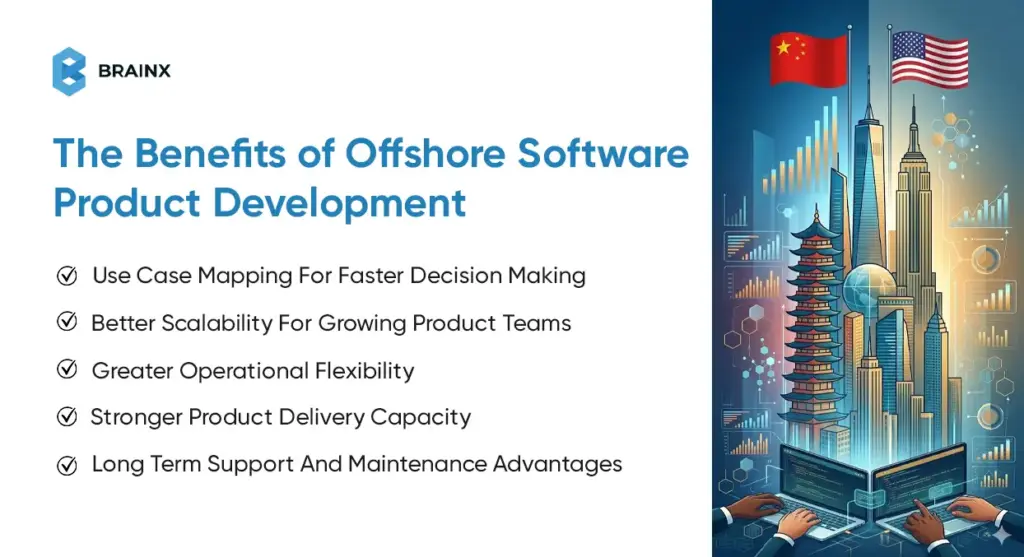
When the model is structured well, offshore delivery creates both operational and strategic advantages.
1. Use Case Mapping For Faster Decision Making
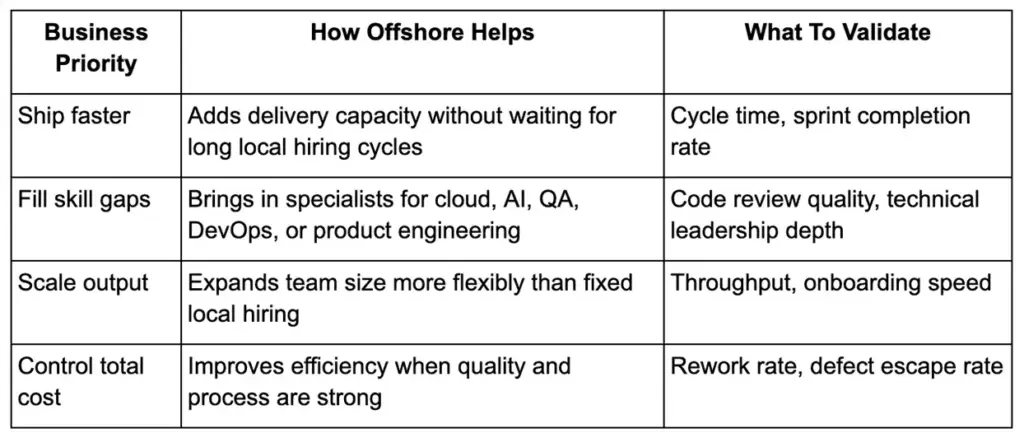
This kind of mapping helps companies choose offshore for the right reason. It also creates a better evaluation lens during partner selection.
[ Also Read: A GDPR Perspective: Cross-Border Outsourcing for Businesses]
2. Better Scalability For Growing Product Teams
Offshore delivery makes it easier to grow in stages. A business may begin with a small squad, expand into a dedicated pod, and later build a broader product team with QA, DevOps, and support functions.
That scalability matters for companies moving from MVP to growth stage, or from one product line to multiple streams of execution.
3. Greater Operational Flexibility
Companies rarely need the same team shape forever. Priorities change. Product requirements evolve. Launches, migrations, redesigns, and integrations all require different delivery patterns.
Offshore partnerships are useful because they allow more flexibility in how capacity is deployed. A company can start lean, scale up around specific delivery needs, and adjust the model over time.
4. Stronger Product Delivery Capacity
The strongest benefit is simple: more products can get built. Not because offshore teams work magic, but because they expand execution capacity in a structured way.
This makes a real difference when internal teams are stuck between product maintenance, roadmap pressure, compliance work, and customer support demands. Offshore teams create room to move.
5. Long Term Support And Maintenance Advantages
Product work does not end at launch. Modern software requires maintenance, monitoring, version updates, bug resolution, performance tuning, and ongoing improvement. Offshore teams can support this phase very effectively, especially when they already understand the codebase.
This reduces the burden on internal teams and supports smoother long term ownership.
The Real Challenges of Offshore Product Development
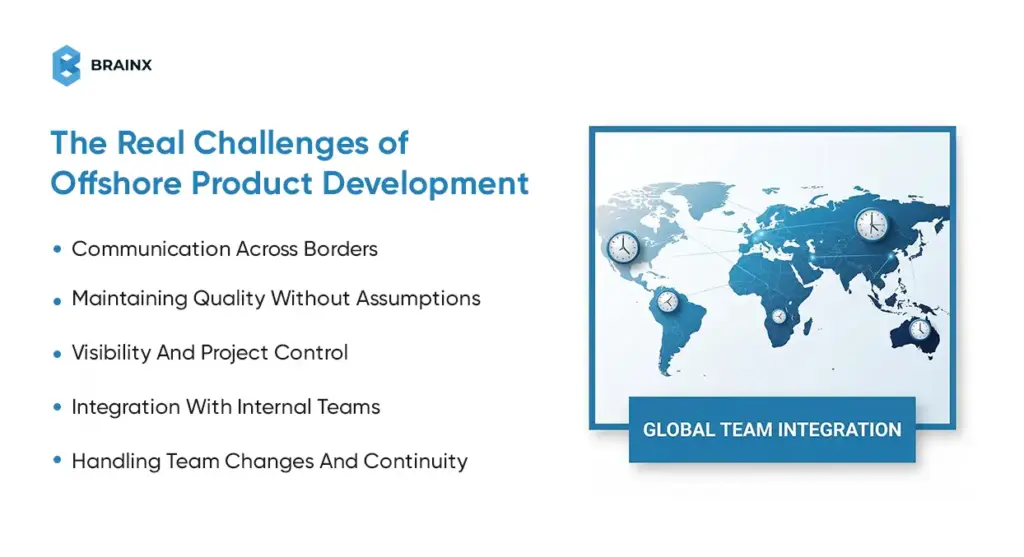
Offshore delivery can create value, but only if its challenges are managed deliberately. The main challenges teams face are often people and process related:
Communication Across Borders
Distance creates friction when communication is weak. Questions take longer to resolve, assumptions grow, and requirements can drift. This is often where offshore projects fail.
The answer is not more meetings. It is a better communication design. Teams need clear written requirements, defined channels, documented decisions, and structured overlap time for the conversations that actually matter.
Maintaining Quality Without Assumptions
Remote teams cannot rely on tribal knowledge. They need explicit standards. If acceptance criteria are vague, code quality expectations are unclear, or testing ownership is loose, rework rises quickly.
Quality in offshore delivery must be engineered into the process, not inspected at the end.
Visibility And Project Control
Leaders often worry about losing control when work moves offshore. That concern is valid if reporting is weak or delivery metrics are missing.
Visibility comes from good systems: sprint rituals, dashboards, demos, quality metrics, documentation, and clear ownership. Without those, project control becomes reactive instead of proactive.
Integration With Internal Teams
An offshore team should not operate like a disconnected vendor. It needs to function like an extension of the product organization. That means participation in planning, shared context on business goals, and alignment on standards and priorities.
Weak integration usually produces weak outcomes, even if the individual engineers are strong.
Handling Team Changes And Continuity
Turnover can happen anywhere, but offshore teams need especially strong continuity planning. Knowledge transfer, technical documentation, ownership logs, and backup staffing matter. If one person leaves and delivery stalls, the operating model is too fragile.
How to Manage Offshore Product Development Challenges Successfully?
To overcome these challenges, the right processes and tools are essential. Here are key practices:
Setting Clear Communication Systems
Create clear rules for where work is tracked, where decisions are recorded, and when meetings happen. Use async updates for status. Use live overlap for planning, demos, and blockers that require real discussion.
A strong communication system reduces confusion, speeds up decision making, and lowers dependency on ad hoc calls.
Building Strong QA And Review Processes
Quality cannot depend on developer intent alone. It needs checkpoints. That includes clear definition of done, peer review rules, test coverage expectations, release criteria, and issue prioritization.
The most reliable offshore teams treat QA as part of delivery, not a final step.
Creating Visibility Through Reporting And Delivery Rituals
Visibility comes from rhythm. Weekly reporting, sprint reviews, backlog refinement, demo sessions, and quality metrics all create alignment. Leaders should be able to answer basic questions quickly: What is blocked? What shipped? What is at risk? What quality signals are improving or slipping?
If those answers are hard to get, the management system needs work.
Reducing Risk With Documentation And Ownership Clarity
One of the highest leverage tools in offshore delivery is documentation. Requirements, architecture decisions, release notes, ownership maps, and runbooks all reduce ambiguity and make delivery more resilient.
Ownership clarity matters just as much. Every area of work should have a clearly responsible lead.
Offshore Software Product Development Services You Can Outsource
What exactly can you hand off to an offshore team? Virtually the entire software lifecycle can be handled offshore when the scope and handoffs are well structured.
Core Offshore Software Product Development Services For Growing Product Teams
Modern offshore software product development services usually include a mix of engineering, design, QA, DevOps, and support capabilities. The best partners can support a single function or deliver across the product lifecycle depending on need.
Software Design And Architecture
Offshore teams can support solution design, technical planning, architecture decisions, and system documentation. This is especially useful when products need scalable cloud foundations or modernization work.
End-to-End Product Development
Many teams outsource the full development stream, from interface work and backend systems to integrations, testing, and release support. This is common for MVP builds, product extensions, and new platform initiatives.
Also Read: Follow These 14 Simple Rules To Outsource A Development Team
Product Management Support
Some offshore teams also support backlog management, requirement refinement, sprint planning, and cross functional coordination. This can improve alignment when internal product bandwidth is limited.
Refactoring And Modernization
Legacy systems often require restructuring so that they can handle future growth. Offshore teams are often employed for refactoring, platform upgrade and architecture modernization.
Quality Assurance And Testing
Manual QA, automation testing, regression cycles, performance testing, and release validation are all common offshore delivery functions. It is often one of the quickest ways to improve product reliability.
Post Launch Support And Maintenance
After release, offshore software product development services can continue on in the form of support, patching, upgrades, monitoring, and incremental improvements.
Factors to Consider Before Hiring an Offshore Agile Development Partner
Before you commit, evaluate the project and partner thoroughly:
- Define Your Project Scope Clearly: Have your product vision, target users, and key requirements documented in advance. BrainX’s Step 1 is to “outline your product vision, target market, scope, and technical requirements” before engaging a vendor. Think through what problems you’re solving and what success looks like. If you can’t articulate acceptance criteria up front, offshore delivery will falter.
- Proven Agile Delivery Experience: Look for vendors who live by agile methods. Ask how they run sprints, adapt to change, and deliver incrementally. Ideally, they should have case studies demonstrating successful Scrum or Kanban projects. For example, we have noted most clients use offshore agile – planning sprints, holding daily standups, and doing QA each iteration. Verify that the partner has credible project managers and scrum masters who are capable of integration with your agile rituals.
- Communication and Language Fit: Check the vendor's English proficiency (e.g. through EF EPI index or by interviewing their staff). Evaluate their overlap hours if you are relying on real-time collaboration. Normally, a company that is in a nearshore time zone may be better. You may try out some tools such as WorldTimeBuddy to compare your working hours with the offshore location. Also consider cultural fit. Figure out whether they have experience working with clients in your region, and whether they understand your market context or not.
- Time Zone Overlap: Determine how much overlap is needed for your process. If you need daily pairing or support, choose a region with some common hours. As a rule of thumb, Latin America (GMT -5 to -8) is often the partner of North American teams as the overlap is easy, and Eastern Europe (GMT 1 to 3) is the choice of European teams. Pakistan (GMT+5) is very compatible with Europe/Middle East, while India/GST time is closer to Asia-Australia. Balance your need for real-time calls versus willingness to use async modes.
- Collaborative Mindset: The best offshore partners see themselves as your co-development team, not just hired hands. During evaluation, look for signs of openness and partnership. Ask about their communication process: Are they transparent and responsive? Do they invite frequent client feedback? We suggest asking vendors if their processes are easy to work with and transparent. Check if they use collaborative tools (Shared boards, chat, documentation) and if they’re willing to adjust to your way of working.
- Technical Depth and Innovation Capability: Ensure that the vendor has demonstrated experience in the technologies and domain that you are looking for. Review their portfolio and case studies: have they delivered products similar in complexity or industry? Some questions: Do they have R&D or innovation teams? Have they worked with the particular programming languages, cloud platforms, or compliance standards your project requires? For example, if you are looking for expertise in AI/ML, you need to see whether they have data scientists on staff. Further verify that their developers can solve problems (and not just code to spec).
By carefully vetting these factors, you’ll increase the odds of a successful offshore partnership.
How to Choose an Offshore Software Product Development Company
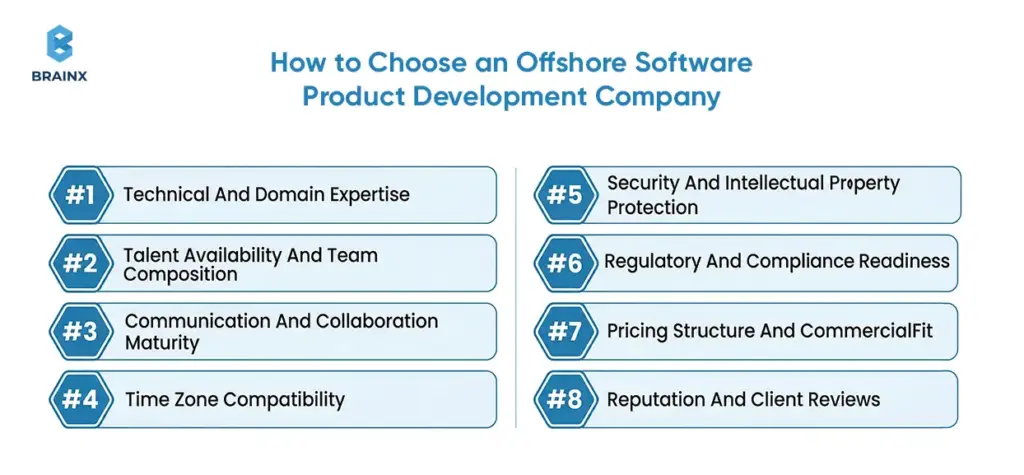
Choosing the right partner requires more than a capability list. A strong offshore software product development company should show delivery maturity, not just technical claims.
How to Choose a Software Development Company: Fundamental Do’s and Don’ts
What To Look For In An Offshore Software Product Development Company
Check if the company has a structured delivery process, solid documentation practices, transparent progress reports, a strong focus on quality, stable teams, and experience in your domain. Strong references and case studies matter, but operating maturity matters just as much.
Technical And Domain Expertise
The partner should understand your product stack, architecture patterns, and business context. Technical skill without domain awareness often creates avoidable misalignment.
Talent Availability And Team Composition
Review the team shape, not just the company profile. Who will actually work on the product? What is the balance between senior and mid level roles? How stable is the bench?
Communication And Collaboration Maturity
Ask how the team manages updates, deals with blockers, handles documentation, plans sprints, and keeps track of decisions. Teams that communicate well are usually the most reliable when it comes to delivery.
Time Zone Compatibility
The time zone does not need to be perfect, but it needs to support your collaboration model. Teams should agree early on overlap expectations.
Security And Intellectual Property Protection
Security, access control, code ownership, and IP protection should be explicit in both process and contract. This becomes even more important for regulated products and AI related systems.
Regulatory And Compliance Readiness
As buyers face growing demands to comply with rules and regulations, they need partners who can meet strict standards for protecting sensitive information, keeping data safe, and following proper governance procedures. This is particularly crucial when it comes to products that handle personal data or use artificial intelligence to automate workflows.
Pricing Structure And Commercial Fit
Choose a commercial model that suits the product stage. Fixed price fits stable scope. Dedicated teams fit longer term execution. Time and materials fit evolving priorities with strong oversight.
Reputation And Client Reviews
Client feedback helps validate how the partner performs under real delivery conditions. Don’t just look for individual good reviews—watch for consistent patterns across feedback.
9 Steps to Take When Outsourcing Product Development
After you decide to outsource, stick to a clear plan:
1. Defining Requirements and Business Objectives: Document your goals first. Write out your product vision, target users, main features, and how you’ll measure success. List user stories and priorities clearly. This brief will help vendors understand and share your goals.
2. Choosing the Right Engagement Model: Decide how you want to set up the contract. Your options are:
- Dedicated Team: A stable offshore group becomes part of your company (best for long-term work).
- Fixed-Price Project: The vendor delivers agreed features on a set timeline (good for shorter, well-defined projects).
- Managed Services: The partner takes over the whole SDLC, from planning through delivery (great for turnkey work).
- Offshore Development Center (ODC): A longer-term arrangement where the vendor basically creates a team that feels like part of your business—including HR and infrastructure.
For your ease, our experts provide guidance on choosing: e.g., dedicated teams for sustained velocity, fixed-price when scope is clear.
3. Shortlisting and Evaluating Vendors: Once you have your needs and model clear, start evaluating vendors. Look at their previous work and case studies while focusing on projects like yours. Check for certifications like ISO or GDPR to confirm they’re compliant. Interview their key people and test their communication style. A pilot project can also be very insightful: it “turns ‘claims’ into measurable delivery – velocity, defect escape, and decision speed under your constraints”.
4. Setting Timelines, Milestones, and Delivery Expectations: Once you pick a vendor, work out a detailed Service Level Agreement (SLA). The SLA should lay out deliverables, milestones, and deadlines. Agree on what success means for each release. Decide how you’ll measure progress (sprint goals, acceptance testing, etc). Also, set the payment method (fixed price, time & materials, etc.) during this phase.
5. Negotiating Contracts and Governance Terms: Lock down the details in formal contracts. The SLA or Statement of Work (SOW) must cover:
- Scope of Work: Exactly what services or features will be delivered.
- Payment Terms: How you’ll pay (fixed, T&M, dedicated, etc.).
- IP Rights & Confidentiality: Make sure you own your product and data.
- Termination & Exit Plan: Spell out how the contract ends and how IP/data is handed back or deleted.
We suggest including clear IP assignment and confidentiality language in legal terms. Include audit rights and data protection clauses, especially if GDPR or the EU AI Act applies.
6. Planning Post-Launch Support and Ownership: Make sure you define support after launch. Clarify what’s covered (bug fixes, updates, response times under SLA). Also, discuss what happens next: will the same team handle future phases, or is their work done? Ensure both sides understand who “owns” the product code and any future enhancements. You should note that after launch, “the offshore team will provide ongoing support, including bug fixes, updates, and security patches”. Build this into the contract or a separate maintenance agreement.
7. Team Onboarding and Kickoff: With paperwork done, bring the teams together. BrainX’s process involves an onboarding step: setting up IT infrastructure, communication tools, and workflows. Get the offshore team on board with your product vision and sprint plans. Define roles and responsibilities up front. A kickoff meeting, virtual or in person, helps get everyone moving in the same direction.
8. Development and Execution: Once you’re underway, work iteratively. Most teams use agile, like planning a sprint (2–4 weeks), hold daily standups (even with time zone differences), and demo regularly for feedback. Keep reviewing your backlog and calendar for sprint reviews. Test every sprint for quality. Track issues with your chosen tools and make sure the team logs their time and progress.
9. Post-Launch Transition: After your MVP or first version goes live, set up a handover. The offshore team should provide all documentation (including code docs, user guides, etc.), and hand off any third-party licenses. Agree on a support plan: who watches uptime, fields user feedback, and continues enhancements? Often, the offshore team will keep supporting you. That way, you can keep improving features, UX, and stay on top of upgrades as your product grows. Planning for this early keeps things smooth.
By using these steps, you can outsource product development in an organized way and avoid unexpected issues.
Also Read: CTO Outsourcing Strategies For Overcoming C-level Challenges
How to Manage an Offshore Team Effectively
Getting the team set up is just the beginning; managing them day to day is something else entirely. Here are best practices:
Aligning Product Goals and Sprint Priorities
Start each phase by ensuring shared understanding. Share the why behind features with the offshore team, not just tasks. Clearly communicate user personas, product roadmap, and “what good looks like.”
We suggest setting up clear roles and letting the offshore team handle specific parts, so everyone knows what they're responsible for. Make sure the product vision gets shared with every team member. Run joint planning sessions during overlapping hours to get everyone on board with sprint goals and acceptance criteria.
Running Async and Live Collaboration Effectively
Adopt an “async-first” mindset with scheduled overlap. Design for async by default, and reserve live time for decisions and demos. Practically, this means daily updates (via chat or ticket comments) instead of synchronous status calls. Then use the overlapping window each day for live backlog grooming or reviews.
For example, the daily routine could be asynchronous standup updates (yesterday/today/blockers), while key meetings (planning, demos) happen when both teams are available. This rhythm scales well across time zones.
Maintaining Accountability Without Micromanagement
Set clear ownership instead of looking over your shoulders. Spell out who owns each module or sprint result, and trust them to deliver. Skip micromanaging hours; instead, hold people accountable for whatever deliverables and quality metrics you’ve agreed on. Keep an eye on progress with tools like burndown charts and issue trackers, and step in only if things slip.
One tip is to have someone, usually a senior offshore engineer, record decisions and status updates. That person acts as the information hub, ensuring nothing is forgotten when working asynchronously.
Keeping Offshore Teams Engaged and Stable Over Time
Build a sense of shared mission. Include offshore members in all-team ceremonies, social interactions, and recognition. Invest in their growth with training or challenging assignments. Keep an eye on morale—talk about career paths and show you value good work. Look for ways to cut turnover, like offering skill development or letting them work on interesting projects. A steady team gets more done and keeps product knowledge sharp. If churn happens, your earlier documentation and knowledge transfer plans will make the switch smoother.
With this approach—sharing vision, mixing async and live teamwork, focusing on outcomes, and keeping people engaged—you can turn a remote group into a solid unit that gets results.
Overview of Key Offshore Development Destinations
If you're thinking about where to offshore, compare regions by what they offer and their risks:
Eastern Europe
Places like Poland, Ukraine, Romania, and Bulgaria have a strong engineering tradition. Quality for the price is excellent. Developers come with solid math and engineering backgrounds; many have university degrees. English levels are generally high, and EU data rules make compliance easier for European clients.
The average rate in Eastern Europe runs $30–60/hr. These teams shine in AI/ML, blockchain, and big enterprise software, and you’ll see plenty of innovation. Costs are a little higher than Asia or LATAM, but you’re paying for top talent and closer culture ties to the EU. Time zones in Eastern Europe give you a few hours of overlap with North America, so same-day collaboration is feasible.
Latin America
Mexico, Brazil, Argentina, and Colombia make up the LATAM tech hub. They’re now popular with U.S. firms, mainly because time zones line up (mostly GMT-5 to -3). Rates are about $30–50/hr, which is cheaper than North America but pricier than Asia, so LATAM stays competitive.
LATAM teams stand out in fintech, SaaS, and nearshore support. Cultural fit with the West is strong, and lots of developers speak English. The talent pool is still getting bigger; right now, it’s smaller than Asia or Eastern Europe, but it’s growing fast. Risks? Local economies can swing, and sometimes infrastructure isn’t perfect.
Asia
China, India, Vietnam, and the Philippines lead the offshore scene in Asia, with some rising players like Pakistan and Bangladesh. Hourly costs are low ($15–45/hr) compared to Western regions. Asia offers a massive talent pool, especially in large countries like India. For example, India alone has hundreds of thousands of software graduates each year.
The region excels in sheer scale: Asia can provide large dedicated teams for long-term projects. However, the trade-offs include less time-overlap with Western markets and widely varying quality. You need strong vetting. If working with Asia, ensure your partner enforces coding standards and senior reviews.
Comparing Regions
To choose a region, consider your priorities:
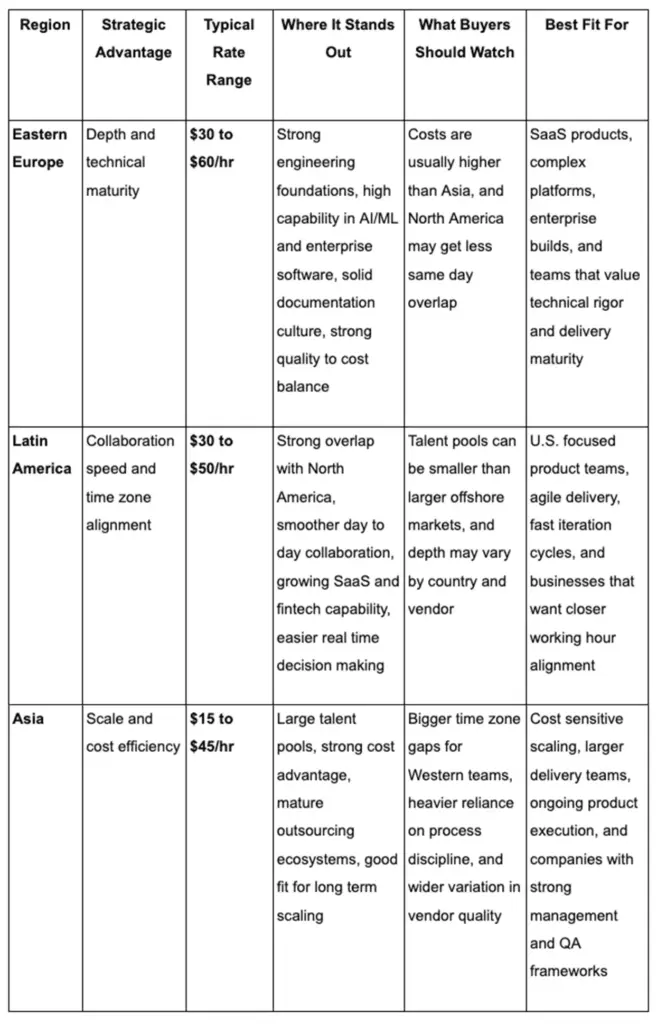
How to compare regions: Eastern Europe gives you technical depth, Latin America makes collaboration fast, and Asia delivers scale and cost savings.
Ultimately, No single solution works for all. A mature buyer will evaluate potential countries based on their product needs. For example, a European company might pick Eastern Europe for cultural and hourly overlap. U.S. startups could start with Latin America to keep time lag minimal, or Asia for budget. Compliance (GDPR, data residency) matters too. Use resources like Coursera’s skill reports or global English indices to see where talent and language match your needs.
Cost, Pricing, and Total Cost of Ownership in Offshore Product Development
Pricing models: Offshore engagements typically use one of several models:
- Time & Materials (T&M): You pay for the actual work delivered. It’s flexible if your scope changes, but needs tight management.
- Fixed Price: A set amount for a defined project scope, with extra controls for anything beyond that. Works if requirements are stable.
- Dedicated/Capacity-Based: You “rent” a team by the month. Great for long-term work and evolving scope. The vendor provides X developers full-time under your direction. Each model has trade-offs. Fixed-price gives cost certainty but needs strict scope control, whereas T&M provides flexibility but can drift without governance.
Total Cost of Ownership (TCO): Don’t get caught up in hourly rates alone. Real TCO covers everything such as recruiting, onboarding, travel, management time, plus any rework or defects. Even if the rates look low, costs get out of hand fast if the quality drops or communication breaks down. They advise tracking big drivers: delivery speed, quality assurance, security, and long-term maintenance. Similarly, We recommend considering recruiting costs, employee turnover, and technical debt as part of TCO. When you’re comparing vendors, figure out how many developer-months you’ll actually need—including rework and churn—then ask yourself what the overall ROI looks like, not just what the hourly price says.
Comparing Proposals Fairly: To really compare quotes, make sure you’re accounting for the same assumptions. Compare similar staffing plans and define deliverables the same way. Bring all hidden costs into the picture, like management effort, certification fees, subcontracting, and whatever applies. Get vendors to spell out roles and responsibilities clearly in their proposal. If one company is at $30/hr and another at $50/hr, check if the $30/hr group isn’t leaving out key stuff like design or testing while ensuring their staff has the same experience level. Clarify any extra charges for things like project management or QA.
What to Watch Beyond Rates: Beyond cost, watch for red flags: proposals that promise suspiciously fast deliverables or double-digit savings without explaining how. Look at sample deliverables – a weak proposal might omit key artefacts like architecture docs or test plans. Look for quality guarantees from the vendor (such as bug-fix timelines and performance SLAs). Make sure the contract includes intellectual property rights and warranties. Sometimes, the cheaper option turns out pricey if you end up sacrificing your product’s security or maintainability.
[Also Read: How Much Does AI App Development Cost?]

Offshore Software Product Development Trends in 2026
Looking ahead, a few key trends are changing offshore product development:
AI-Enabled Delivery Workflows
Offshore teams are increasingly using AI tools to streamline dev. Teams are adding AI code assistants, testing bots, and analytics right into their pipelines. According to a 2026 survey, outsourcing partners are making AI-driven tools part of their offering, sometimes even rolling out their own AI platforms. But this opens up fresh governance concerns. Contracts are getting AI-specific clauses dealing with data quality, human oversight, and who owns the models because of new regulations. In short, your offshore vendor might double as your AI partner soon, so expect them to manage and explain their use of AI more closely.
Growing Demand for Product-Led Offshore Teams
Clients are asking for outcome-oriented squads, not just code-jockeys. This means vendors are expected to think as “product teams” – bringing suggestions for features, owning metrics (like user engagement or MRR), and collaborating on roadmaps. In practice, this trend shows up as more offshore teams including product managers and UX designers on staff. While we haven’t seen a specific citation, industry buzz suggests buyers want partners who act like internal teams with business sensibility (often called a “product-led” approach).
Higher Expectations for Compliance and Security
Security and regulatory compliance are top of mind. Companies now insist offshore providers have rigorous security practices by default. Managed security services are usually bundled with outsourcing deals. Providers are responsible for monitoring threats, sticking to data laws, and giving rapid notice about breaches. With regulations tightening (like the EU AI Act), obligations now reach further along the supply chain. So by 2026, your offshore contracts will likely mandate compliance with privacy and AI regulations, and you’ll audit vendors for it.
Shift from Staff Augmentation to Outcome-Based Delivery
There is a clear move away from simply billing by the hour (staff augmentation) and toward outcome-linked models. Many clients now tie offshore vendor compensation to business outcomes – such as feature adoption rates, uptime, or project ROI – rather than lines of code. This is reflected in some contracts adopting value-based pricing or bonus-penalty clauses. As Morgan Lewis notes, “Companies are increasingly tying compensation to business outcomes ... rather than transaction-based metrics”. Service-Level Agreements are getting sharper and success is being measured by real value, not just hours worked.
Offshore Product Development in Pakistan: The Practical Realities
Pakistan continues to grow as a practical offshore destination, especially for cost conscious product teams.
Talent Availability And Technical Strengths
Pakistan offers a large and growing technical workforce, with strong capability in web, mobile, backend, and increasingly AI related work. Senior depth varies by partner, so vendor selection matters.
Cost Competitiveness And Value
Pakistan remains highly competitive on cost. For companies looking to stretch budget without stopping product development altogether, it can offer strong value.
Communication And Collaboration Realities
English proficiency is generally workable for business delivery, though it varies by team. Pakistan also offers useful overlap for Europe, the Middle East, and some structured collaboration with North America.
When Pakistan Is A Strong Offshore Option
Pakistan is a strong option when companies need cost-efficient product execution, especially for SaaS, mobile, web platforms, and growth-stage product work. It is particularly attractive when the partner brings strong process maturity and QA discipline.
From MVP to Market: Offshore Product Delivery in Practice
To illustrate the end-to-end flow, here’s how an offshore-led product build typically proceeds:
- Discovery and Alignment: Start with a discovery phase. Work side-by-side with your offshore partner to set clear objectives. Nail down the Minimum Viable Product (MVP) scope, its core user flows, and any compliance needs. Map out key features so the vendor’s got a clear picture. Usually, it means joint workshops to gather business and technical requirements.
- Design and Prototyping: Next, jump into UX/UI and prototyping. The offshore team builds out wireframes, interface mockups, and click-through demos. Regular online reviews help keep things on track with your vision. Offshore designers can handle user research and usability tests, which brings those insights back to your product team.
- Architecture and Planning: Before anyone starts coding, finalize your technical architecture and project plan. Offshore architects (usually senior developers) will create system diagrams, tech stacks, and integration points. They’ll put together an architecture doc or diagram for you to approve. Then, set up your release schedule: break the MVP into pieces you can deliver, each with a milestone.
- Development in Sprints: Once the plan is ready, the team works in agile sprints. Typical sprints run 1–4 weeks with planning upfront, daily stand-ups (sometimes asynchronous), and demos at the end. Code gets written, tested, and merged without pause. The offshore team should commit code daily to a shared repository (like GitHub) and pull in the latest updates so everyone stays up-to-date.
- Quality in Every Release: Quality assurance happens in every iteration. After each sprint, offshore QA engineers handle regression tests, performance checks, and security scans. If they find any defects, they log and prioritize them. Keep an eye on KPIs like test coverage and bug counts. If you run into serious issues, deal with them right away. The acceptance criteria and definition-of-done you agreed on during planning need to shape what “done” really means for each feature.
- User Acceptance and Launch: Quality assurance happens in every iteration. After each sprint, offshore QA engineers handle regression tests, performance checks, and security scans. If they find any defects, they log and prioritize them. Keep an eye on KPIs like test coverage and bug counts. If you run into serious issues, deal with them right away. The acceptance criteria and definition-of-done you agreed on during planning need to shape what “done” really means for each feature.
- Support Beyond Launch: After going live, product support kicks in. The offshore team typically provides ongoing maintenance. They will set up monitoring and alerts, plus handle bug fix releases. Down the road, the team can build new features based on user feedback. Basically, the partnership shifts into a maintenance and growth phase to ensure your product keeps performing well in the market.
Each stage above is collaborative. Your internal product owners and engineers should remain deeply involved, steering priorities and integration. And honestly, when you use your offshore team the right way, you’ll move from idea to market faster and more affordably than sticking with just your in-house employees.
Conclusion
Offshore software product development is taking off because it solves real-world problems for today’s product teams. It lets businesses scale up, tap into hard-to-find expertise, release faster, and build delivery models that can handle change. When chosen carefully and managed well, it becomes more than a sourcing model. It becomes a strategic advantage.
How BrainX Can Help as Your Offshore Software Product Development Partner
As an experienced offshore development provider, BrainX brings global talent and tested methods to bring your product to life. We help product teams scale with a delivery model built on speed, transparency, quality, and long-term partnership. If you need more execution power but can’t lose accountability, we’ve got you.
BrainX is ISO 9001:2015 certified, which shows our focus on strong processes and quality management. We also follow strict security standards (like ISO/IEC 27001), so your data stays protected. Our teams handle everything from design and engineering to QA, support, and software architecture. We focus on structured communication, clear ownership, measurable delivery results, and collaboration that works across time zones.
Need a full offshore team or just targeted skills like cloud architecture, UI/UX, or AI?
Either way, BrainX can scale up for your needs. We’ll work with you on the best engagement model (dedicated team, fixed-scope, whatever fits) and help you sort through vendor choices if you’re still deciding.
In short, BrainX brings the talent, experience, and partnership you want to make offshore work for you.
Frequently Asked Questions About Offshore Software Product Development
What Is Offshore Software Product Development?
Offshore software product development means using a team in another country to design, build, test, and maintain software products. It helps businesses grow their delivery power, get specialized skills, and control costs but only if they have the right processes and communication in place.
How Is Offshore Different From Nearshore And Onshore Development?
Onshore teams are in your own country. Nearshore teams are in nearby regions with overlapping time zones. Offshore teams are farther away so the cost and scale benefits are bigger, but you depend highly on documentation and structured teamwork.
What Are The Benefits Of Offshore Software Product Development?
You get access to new talent, better scalability, more budget flexibility, faster delivery, broader time coverage, and strong support for the long haul.
What Challenges Should Businesses Expect?
You might run into communication gaps, less visibility, unclear ownership, uneven quality standards, and continuity issues if your documentation isn’t solid.
Which Product Development Services Can Be Outsourced?
Design, architecture, front end, back end, QA, DevOps, support, modernization, and product management support, basically all of these can be outsourced as long as your partner’s setup can handle it.
How Do You Choose The Right Offshore Product Development Partner?
Look for a partner with a strong delivery track record, technical depth, great communication, team stability, solid security, and proof that they can align with your product goals.