
 April 8, 2026 -
  9 minutes read

Key Takeaways
- The advantages of custom software development in 2026 include stronger scalability, deeper integrations, better security, and greater long term control for growing businesses.
- Custom software helps businesses align technology with unique workflows, reduce manual work, and improve productivity across teams.
- Compared to off the shelf tools, custom software provides companies with more ownership, roadmap control and protection from vendor lock in.
- For regulated and data heavy businesses, custom software supports stronger compliance readiness, auditability, and secure by design architecture.
- The long term value of custom software comes from better business fit, lower operational friction, and a platform that can evolve as the company grows.
In 2026, “just implement a tool” is rarely enough. Most organizations now operate across sprawling application ecosystems, while integration remains a persistent constraint: enterprise IT leaders report widespread difficulty integrating data across systems, with only a minority of applications typically connected. Gen AI is mainstream too—McKinsey & Company reports that 71% of companies use gen AI in at least one business function—so your stack must be ready for automation, governed data access, and traceability.
That’s why the advantages of custom software development have become more practical (and less theoretical) than they were even a few years ago. Custom systems allow growing businesses to have better control over integrations, security, artificial intelligence readiness and adaptability over the long term - as compliance timelines tighten and breach costs are still material. For example, IBM and Ponemon Institute report a global average data-breach cost of USD 4.4M in their research for the year 2025 in addition to findings regarding governance gaps related to AI adoption.
What Is Custom Software Development?
Custom software development is the design, build, and ongoing improvement of software tailored to one organization’s workflows, data, and users—rather than adopting a prebuilt product intended for broad use.
In 2026, “custom” may be an internal operations tool, a customer portal, an API layer, or workflow orchestration that connects existing systems. The defining trait is fit: the software is shaped around how your business runs.
For many teams, the advantages of custom software development start with eliminating manual workarounds and building one dependable “source of truth” for decision-making.
What Custom Software Development Means in 2026
In 2026, custom matters less because it’s “bespoke” and more because it creates operational control in a world of complex stacks, AI-enabled workflows, and higher governance expectations.
For leaders evaluating the advantages of custom software development, the key question is: where do we need deeper control than a configurable tool can reliably provide?
What Custom Software Development Actually Includes
Most custom builds include a combination of:
- Discovery and requirements mapping (often called software product discovery)
- UX/UI design (internal users and/or customers)
- API development, integrations, and data work
- Security controls (identity, access, logging, encryption)
- Testing, deployment, and monitoring
- Ongoing support and iterative releases
Also Read: How to Choose a Software Development Company: Fundamental Do’s and Don’ts
This is also where a good partner’s custom software development services should feel most valuable: helping you narrow scope to the outcomes that matter.
How Custom Software Differs From Configurable Software
Configurable software gives you settings and extensions within a vendor’s constraints.
Custom software gives you control over:
- Workflow logic (including edge cases)
- Data models and “source of truth” rules
- Security posture and audit trails
- Integration patterns and automation
If your process is standardized, configuration is usually enough. If your process is how you win, custom becomes a strategic option.
Why the 2026 Business Environment Makes Custom More Valuable
Three realities stand out in 2026:
- Integration complexity: enterprises report that they use 897 applications on average, and integration is still difficult at scale.
- AI adoption: the use of gen AI is already common across industries and functions.
- Governance deadlines: the EU AI Act is fully applicable on 2 August 2026 (with phased obligations), and the Cyber Resilience Act introduces reporting requirements from 11 September 2026.
Custom Software Development vs Off-the-Shelf Software
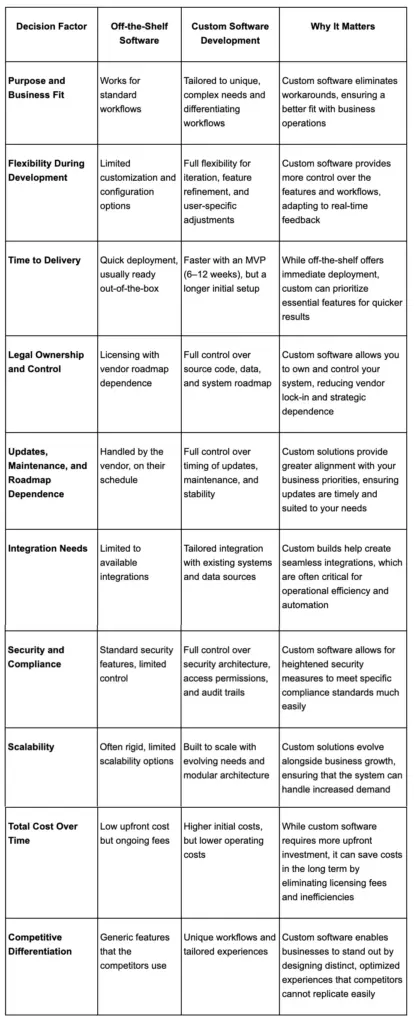
Most mature organizations end up with a portfolio: buy what’s standard, build what’s differentiating, and integrate it all. If you’re weighing the advantages of custom software development against off-the-shelf tools, focus on business fit, governance needs, and the true cost of integration and change over time.
Off-the-shelf software is often the fastest path to baseline capability. Custom development becomes compelling when business fit, integrations, or control requirements outgrow what configuration can handle.
Purpose and Business Fit
Buy when the workflow is common and “good enough” is truly good enough.
Build when the workflow is a differentiator, involves many exceptions, or must span multiple teams and systems without manual handoffs.
Flexibility During Development
Off-the-shelf flexibility is limited to what the vendor exposes.
Custom development lets you iterate around real users, refine workflows in weeks (not quarters), and design AI guardrails and controls alongside the features.
Time to Delivery
Buying usually wins on day-one speed.
Custom can still move quickly when you ship in 6–12 week increments: MVP first, then expand by priority instead of waiting for a single “big launch.”
Legal Ownership and Control
With off-the-shelf tools, you license the product and inherit roadmap dependency.
With custom software, you can contract for source-code ownership, data control, and portability—reducing vendor lock-in when the system becomes business-critical.
Updates, Maintenance, and Roadmap Dependence
Off-the-shelf updates are handled for you, but on the vendor’s schedule.
Custom requires planned software maintenance services, yet gives you control over release timing, stability windows, and backward compatibility for critical workflows.
Build vs Buy Scorecard for Decision Makers
A simple way to decide is to look at the underlying business conditions.
Buy when:
- The workflow is standard
- Speed matters more than differentiation
- Integration needs are light
- Lock in is acceptable
- The software solves a temporary or non strategic problem
Build when:
- The workflow is unique or business critical
- Multiple systems need to work together seamlessly
- Security, compliance, or governance needs are high
- Roadmap control matters
- The software will support long term growth or differentiation
If you want a structured starting point before making that decision, begin with software product discovery.
Top Advantages Of Custom Software Development that Create Real Business Value
The advantages of custom software development become most valuable when they translate into measurable business outcomes. For growing businesses, it is not just about having software that works. The point is to have software that fits your operations, that can support the growth, better control and remain adaptable as the business changes.
This is where custom software creates real value in terms of operations, efficiency, security, reporting and long term performance.
1. Tailored Functionality That Matches Unique Business Processes
One of the greatest advantages of custom software development is that it is built around the way your business actually operates. Instead of forcing teams to adjust to generic tools, the software is shaped around your workflows, roles, approvals, and operational rules.
That is important because most growing businesses outgrow standard processes eventually. As the complexity grows, off the shelf tools tend to add unnecessary steps and unused features and workarounds to the process. Custom software removes that friction and gives teams a system that fits the business from the start.
[Also Read: IT Staff Augmentation in Software Development – Smart Way to Upscale!]
2. Increased Efficiency And Productivity Through Workflow Automation

Custom software helps improve efficiency by automating repetitive work and reducing the manual work that slows teams down. This can include approvals, notification, data entry, scheduling, handoffs, and task routing activities that can otherwise take up time across departments.
The value is greater than just time savings. It also helps the teams to use their skills in a better way. When people spend less time patching up broken workflows, or moving data from system to system, they are able to work on higher value work that supports customers, revenue and growth.
3. Scalability For Future Growth Without Tool Limitations
As businesses grow, the demands of software increase. More users, more transactions, more data and more complexity can quickly expose the shortcomings of generic systems. One of the practical advantages of custom software development is that it can be designed with future growth in mind.
That means that your platform can accommodate new markets and bigger teams, new features and higher use without having to completely rebuild the platform. Instead of outgrowing the software, you improve it as the business grows.
4. Seamless Integration With Existing Systems And Workflows

Modern organizations rarely operate from one system alone. Most depend on a combination of in-house platforms, cloud applications, customer applications, finance applications, operational databases and legacy technology. Custom software helps connect those systems into one coordinated workflow.
This helps in improving the flow of data across the business, reduces the need for manual reconciliation, and makes automation much easier. It even allows teams to have better visibility and help establish a more reliable source of truth for daily operations and decision making.
5. Better Security, Compliance, And Data Control

Security and compliance are now central to software decisions, especially for businesses handling customer data, financial information, healthcare records, or regulated workflows. Custom software allows companies to have greater control over how data is stored, accessed, monitored, and protected.
Instead of depending on the default controls developed for a large market, businesses can more precisely define permissions, create auditability into critical workflows, and tailor the system to their real risk profile. In practice, this creates stronger operational confidence and a more resilient compliance posture.
6. Long Term ROI And Cost Efficiency Over Time
Off the shelf software may appear to be more cost-effective initially, but the economics may be more complex in the long run. Subscription fees, per user pricing, add on modules, integration costs, and inefficiencies can increase total cost over time.
Custom software typically has a higher upfront cost, but can reduce ongoing costs and produce greater long term returns. When the system is more efficient, errors can be reduced and various overlapping tools can be replaced. It leads to easier justification of the business value year after year.
7. Full Ownership, Roadmap Control, And Reduced Vendor Lock In
Another key advantage of custom software development is that of ownership. When your business owns the system, it has greater control over what gets built, when updates happen, and how the platform evolves over time.
This reduces dependence on outside vendors whose pricing, roadmap, support model, or packaging decisions may no longer align with your priorities. It also gives your business more flexibility to adapt without waiting for a third party to move first.
8. Competitive Differentiation Through Unique Workflows And User Experiences
With many markets, though, software is more than an internal tool. It becomes part of the customer experience, part of the operating model or part of what makes the business difficult to copy. Custom software supports this by enabling workflows, features, and experiences that are unique to your business.
That differentiation may manifest itself through quicker service, easier customer journeys, greater internal coordination, or improved utilization of proprietary data. Over time, those advantages can improve retention, strengthen brand value, and create a meaningful edge in crowded markets.
9. Data Accuracy, Precise Reporting, And Better Decision Making

Strong decisions depend on reliable data. Custom software improves data accuracy by reducing manual entry, standardizing process logic, and connecting systems in ways that keep operational information more consistent.
It also makes reporting more useful. Instead of relying on generic dashboards, businesses can create reporting tools based on their own KPIs, workflows, and operational priorities. This gives leaders clearer visibility into performance and supports faster, more confident decision making.
10. Flexibility, Reliability, And Operational Continuity As Your Business Evolves
Business needs do not stay fixed. Markets change, user expectations shift, internal processes mature, and growth introduces new complexity. Custom software gives organizations the flexibility to respond without waiting for a vendor roadmap to catch up.
It also improves operational continuity. Because the system is built around your processes and managed on your terms, you are less exposed to sudden platform changes, discontinued features, or third party limitations. That mix of adaptability and reliability makes custom software especially valuable for businesses planning for long term growth.
Advantages Of Custom Software for Growth-Focused Teams
For growth focused teams, the value of custom software is not just better fit. It is the ability to grow without adding unnecessary operational drag. The advantages of custom software become clearer when companies need to move faster, coordinate across teams, and increase output without multiplying complexity.
Advantages Of Custom Software For Tailored Functionality And Leaner Workflows
As companies grow, even small inefficiencies start to compound. Custom software helps reduce that drag by standardizing approvals, removing duplicate work, and streamlining workflows that would otherwise become harder to manage at scale.
This creates operating leverage. Instead of adding more people just to manage broken processes, businesses can use tailored systems to support cleaner execution and more sustainable growth.
Advantages Of Custom Software For Product Differentiation And Faster Innovation
Growth depends on more than efficiency. It also depends on speed of learning and speed of iteration. Custom software gives teams more freedom to experiment with onboarding, pricing logic, internal tools, AI enabled features, and customer experiences without being limited by an external vendor roadmap.
That agility helps businesses respond faster to market feedback, improve product experiences more quickly, and test new ideas without waiting for third party priorities to align with their own.
Advantages Of Custom Made Software For Ownership And ROI
The advantages of custom made software are especially relevant when software is tied closely to revenue, customer experience, compliance, or operational control. In those cases, ownership is not just a technical preference. It becomes a financial and strategic advantage.
Advantages Of Custom Made Software For Ownership And Cost Control
One of the most important advantages of custom made software is that it turns software into a controlled business asset rather than an ongoing dependency. Ownership gives companies more freedom over infrastructure choices, release timing, performance optimization, and long term vendor strategy.
That control matters financially. As usage grows, businesses can manage costs more intentionally instead of being pushed into higher subscription tiers, packaging changes, or add-on fees that do not reflect real business value.
Advantages Of Custom Made Software For Long Term Return On Investment
The long term return from custom software comes from compounded gains, not just one time savings. Better workflows, fewer errors, cleaner reporting, stronger automation, and less software sprawl all contribute to stronger performance over time.
The critical thing is to assess the ROI over the life of the system. For many businesses, the return becomes clearer after launch, when the software starts reducing recurring spend and improving execution across multiple teams.
Advantages Of Custom Written Software For Security And Compliance
The advantages of custom written software are especially important in 2026, when businesses face greater expectations around traceability, governance, resilience, and secure by design development. This section should not just say custom is safer. It should show why custom can create a stronger foundation for real security and compliance readiness.
Advantages Of Custom Written Software For Secure Architecture
The advantages of custom written software are clear when security needs to match actual business risk. Instead of relying on default protections made for broad use cases, businesses can design access controls, logging, monitoring, encryption, and incident response around their real environment.
That matters more in 2026 because secure architecture is no longer just a technical best practice. It is part of operational readiness. Businesses using AI, integrating more systems, or handling sensitive data need software that supports controlled access, strong visibility, and better accountability from the start.
Advantages Of Custom Written Software For Compliance Ready Systems
Compliance ready systems do more than protect data. They generate evidence, support governance, and make regulatory response faster and more reliable. That is where the advantages of custom written software become especially valuable.
For regulated or high trust businesses, custom systems can support audit logs, documentation, role based permissions, and software supply chain visibility in ways that are much harder to achieve with generic tools. In a 2026 environment shaped by the EU AI Act, Cyber Resilience Act reporting obligations, NIST SSDF, SBOM expectations, and OWASP Top Ten 2025, custom development gives businesses a stronger foundation for proving compliance, not just claiming it.
When Custom Software Is the Right Choice
Custom is most successful when it solves a durable business problem—something that won’t disappear with better training or a different configuration.
Businesses With Unique Workflows and Operational Complexity
If workflows have many exceptions, approvals, or handoffs, off-the-shelf tools can add complexity instead of removing it.
Custom software lets you encode your process, standardize execution, and still support edge cases—one of the advantages of custom software development when operational consistency matters.
Teams Blocked by Disconnected Tools and Manual Workarounds
When systems aren’t integrated, humans become the integration layer—hurting speed and data quality.
Given how common integration pain is at scale, this is often where the advantages of custom software development show up first (in hours saved and fewer errors).
Companies Handling Sensitive or Regulated Data
If you handle sensitive data, you typically need tighter control over permissions, auditing, retention, and incident response.
High breach costs reinforce the case for preventive controls and clear governance.
Organizations Competing in Crowded Markets Where Experience Matters
If experience is strategy, custom workflows and UX can become a moat—especially when they reduce customer effort and increase switching costs.
When Custom Is a Long-Term Investment and Not a Temporary Fix
Custom is rarely worth it for a short-term patch.
It’s most valuable when you’re building a platform for automation, AI, and multi-year growth—often aligned through digital transformation consulting.
Custom Software Use Cases by Business Type
SMEs That Need Efficiency Without Enterprise Tool Bloat
SMEs often benefit from custom internal tools that replace spreadsheets, enforce data quality, and automate core workflows—without complex licensing tiers.
Mid Market Companies That Need System Integration and Process Automation
Mid-market teams often hit the integration wall first.
The advantages of custom software development in the mid-market can often be reduced to integration and automation: lessening handoffs, removing re-entry, and enabling data to be used inter-team.
The workflow customization will be able to tie sales, operations, financial, and support together within one process–lessening the amount of manual reconciliation and speeding-up cycle time.
Enterprises That Need Governance, Scale, and Control
Enterprises often use custom platforms to unify fragmented systems while enforcing access controls, logging, and operating procedures that scale across teams.
SaaS Businesses That Need Product Differentiation and Proprietary Workflows
In SaaS business, the product is custom software and differentiation is often proprietary workflow, data flow and scalability.
Things to Consider Before Choosing Custom Software Development
Higher Upfront Investment
Custom software usually costs more initially because you’re funding design, engineering, and quality work that vendors amortize across customers.
Longer Delivery Timelines Than Plug and Play Tools
Buying is faster for initial rollout.
Custom delivery can still be fast when you define an MVP and ship iteratively.
Need for Technical Planning and Stakeholder Alignment
Custom work requires decisions about data ownership, approvals, and failure modes (for example, what happens when an integration is down).
Alignment reduces rework later.
Importance of Choosing the Right Development Partner
A good partner should bring clear discovery, transparent delivery, and modern secure engineering practices—plus a plan for long-term maintenance.
Keep evaluation focused on evidence, not promises.
Why These Tradeoffs Are Often Worth It for the Right Business Case
If integration needs, compliance requirements, or workflow complexity are durable, custom becomes an investment in operating leverage.
That’s where the advantages of custom software development can outweigh the downsides.
Best Practices for Maximizing the Value of Custom Software
To capture the advantages of custom software development without increasing risk, treat delivery as a product discipline: define outcomes, ship iteratively, and fund the system’s lifecycle (not just the launch).
Align Development With Business Goals and Measurable KPIs
Start with measurable outcomes (time saved, error reduction, conversion lift), then design software that moves those metrics.
Prioritize Security and Compliance From the Start
Use frameworks like the SSDF to structure secure development, and plan for software transparency and provenance (including SBOM-ready practices).
Use Agile and Iterative Delivery to Reduce Waste
Agile software development reduces risk by learning early: small releases, real user feedback, and automated testing.
Plan Ongoing Support, Maintenance, and Improvements
Plan for monitoring, dependency updates, performance tuning, and a backlog of improvements.
This is where software support and maintenance protects your investment.
Document Ownership, Integrations, and Future Scalability Early
Document what you own, how integrations work, and how scaling will be handled. This documentation also strengthens governance and audit readiness.
How to Decide Between Custom Software and Off-the-Shelf Tools
To move from “learning” to “decision,” connect build vs buy to concrete operational outcomes, risk tolerance, and time horizon—not just feature checklists. Used properly, the advantages of custom software development become a measurable business case.
Questions to Ask Before You Invest
- Is this workflow standard—or is it a differentiator?
- How many systems must share data for this to work?
- What risks exist if a vendor changes pricing or deprecates features?
- Do we need audit trails, data residency, or incident reporting readiness?
- Will AI features require governed access to internal data?
[ Also Read: Outsourcing Software Development – 10 Critical Mistakes Businesses Should Avoid ]
A Simple Build vs Buy Framework
- Buy when needs are standardized and speed matters most.
- Build when workflows are unique, integration is complex, or ownership/governance is strategic.
- Hybrid when you buy a core tool but build custom layers for orchestration, integrations, or user experience.
When a Hybrid Approach Makes More Sense
Hybrid often works when you keep standard tools for “table stakes” functions, but build custom workflow and data layers to create differentiation and governance.
Final Takeaway
In 2026, custom software is a control strategy: control over integrations, governance, and adaptability as AI adoption and compliance requirements accelerate. With the EU AI Act fully applicable from 2 August 2026 and Cyber Resilience Act reporting obligations starting 11 September 2026, businesses that treat software as a governed asset—not just a tool—are better positioned to scale.
For the right use cases, custom software can deliver higher business fit, stronger security posture, clearer ownership, and long-term ROI.
FAQs About the Advantages of Custom Software Development
What Are the Main Advantages of Custom Software Development
These benefits typically include better fit to your workflows, stronger integration across your systems, more control over data and security, and ownership of your roadmap—especially important in 2026 as AI and compliance expectations rise.
How Is Custom Software Better Than Off the Shelf Software
Custom can be better when the workflow is unique or strategic, or when governance needs demand deeper control. Off-the-shelf is often better for standardized needs and immediate deployment.
Is Custom Software Worth the Cost
It’s worth it when the advantages of custom software development outweigh the upfront investment—often true in integration-heavy or regulated workflows where inefficiency is costly.
Is Custom Software More Secure Than Off the Shelf Software
Not automatically. It can be more secure when built with secure-by-design practices and ongoing maintenance; frameworks like NIST SSDF help define those practices.
Can Custom Software Scale as My Business Grows
Yes—when scalability is designed in through modular architecture, performance targets, observability, and a plan for continuous optimization.
Can Custom Software Integrate With My Existing Systems
Yes—and integration is often the primary reason organizations pursue custom, especially when data silos block automation.
Why Is Custom Software Development Important for SMEs
SMEs can use custom tools to replace spreadsheets, automate workflows, and connect essentials systems without paying for enterprise bloat.
When Is a Custom Implementation Worth It
When the workflow is strategically important, long-lived, and hard to support with configuration alone.
Why Build Custom Software When Open Source Options Already Exist
Open source can accelerate development, but you still need product design, integration, security hardening, and long-term ownership to deliver unique value.
How Do I Choose the Right Custom Software Development Partner
Choose a partner with a strong discovery process, secure engineering practices, evidence of long-term support, and an implementation approach you can measure.