 August 9, 2026 -
 22 minutes read


Key Takeaways
- Validate the problem and willingness to pay before committing a full development budget.
- Define the MVP around one core user outcome and a measurable activation event.
- Design tenant management, security, billing, observability, and scalability early because they shape the platform foundation.
- Treat go-to-market, onboarding, customer success, and retention as product responsibilities, not work that begins after release.
- Choose an internal, external, or hybrid team based on capability gaps and long-term ownership, not cost alone.
SaaS product development is a continuous business and engineering lifecycle that moves from problem validation to MVP delivery, launch, operation, and improvement. The team is not finished when the product goes live. It becomes responsible for keeping the service useful, secure, available, and commercially sustainable for every customer who continues to subscribe.
That responsibility changes how the product should be planned. Pricing affects entitlements and billing logic. Customer type affects tenancy and access control. Retention depends on onboarding, support, reliability, and how quickly users reach value. A successful launch is therefore a major checkpoint, not the endpoint. The lifecycle continues through measured releases, customer feedback, cost control, and roadmap decisions based on real behavior.
What Is SaaS Product Development, and Why Is It a Continuous Lifecycle?
SaaS product development is the end-to-end work of turning a validated problem into subscription software that is delivered, operated, and improved through the cloud. As reflected in the AWS SaaS Lens and Microsoft Azure multitenant guidance, it combines product discovery, commercial planning, application engineering, platform operations, and customer-success systems in one ongoing model.
What Does SaaS Product Development Include Beyond Coding?
It includes every system needed to acquire, activate, serve, bill, support, and retain customers. Engineering may build the visible workflows, but the platform must also support tenant onboarding, identity and access management, permissions, plan entitlements, usage metering and billing, analytics, support access, backups, deployment automation, and incident ownership.
How Is a SaaS Product Different From a Traditional Web Application?
A web application describes a delivery interface. A SaaS product combines software, recurring access, centralized operation, and an ongoing value exchange. Customers usually access one continually updated service, while the vendor remains responsible for availability, security, upgrades, billing, and data stewardship.
Why Do Discovery, Delivery, and Improvement Overlap After Launch?
They overlap because real usage exposes needs that interviews and prototypes cannot fully predict. New customers reveal edge cases, integration expectations, onboarding friction, and differences between what users requested and what they actually adopt. Atlassian’s Jira Product Discovery guidance similarly treats interview quotes, support tickets, sales messages, analytics, and external research as evidence that should remain connected to product decisions.
This overlap is why the lifecycle works as a recurring sequence of discovery, delivery, validation, and improvement rather than a one-way handoff between disconnected teams.
How Does the SaaS Product Development Lifecycle Move From Idea to Launch?
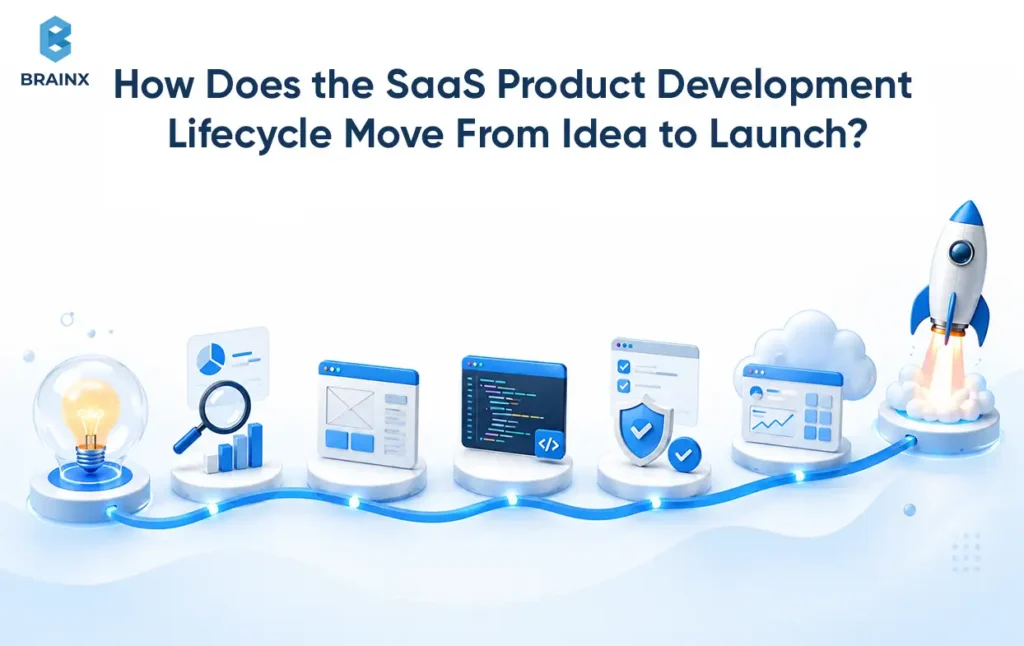
The lifecycle moves through eight overlapping stages. Each stage should create a tangible output, name an owner, and end with a decision gate. The purpose is not to force waterfall delivery. It is to prevent assumptions, risks, and launch dependencies from disappearing between teams.
Stage 1 — Discovery and Market Validation
This stage confirms the target customer, painful problem, current workaround, urgency, and willingness to pay. Research should include both users and economic buyers when they are different people.
Expected output: interview synthesis, ICP definition, problem statement, commercial evidence, and validation scorecard. Exit gate: evidence supports a clear go, revise, pause, or stop decision.
Stage 2 — Product Strategy, Roadmap, and Monetization
This stage converts evidence into a focused offer. The team defines positioning, activation, MVP boundaries, pricing logic, and the release sequence. It also identifies which assumptions must still be tested during delivery.
Expected output: product brief, measurable objectives, MVP scope, monetization model, and release roadmap. Exit gate: product, technical, and commercial owners approve the scope and assumptions.
Stage 3 — UX Research, User Flows, and Prototyping
This stage tests whether target users can complete the core workflow and understand the product’s value. Prototype testing should include empty states, permissions, admin tasks, and common failure scenarios, not only the ideal path.
Expected output: user flows, clickable prototype, usability findings, and resolved design decisions. Exit gate: representative users can complete the activation workflow with acceptable support.
Stage 4 — Architecture, Data, and Technology Planning
This stage defines tenancy, identity, authorization, data boundaries, integration patterns, cloud environments, observability, recovery, and the initial scaling strategy. Decisions should be recorded with context and trade-offs so future teams understand why they were made.
Expected output: architecture diagrams, architecture decision records, data model, integration map, risk register, and nonfunctional requirements. Exit gate: architecture and security reviewers accept the design and its known risks.
Stage 5 — MVP Engineering and Iterative Delivery
Engineering delivers the activation journey in small, testable increments. Acceptance criteria should cover behavior, authorization, analytics events, error handling, and operational needs. Stakeholders review working software rather than waiting for a complete release.
Expected output: deployable MVP increments, automated tests for critical paths, CI/CD pipeline, feature controls, and product instrumentation. Exit gate: the MVP satisfies agreed acceptance criteria for the target workflow.
Stage 6 — Quality Assurance, Security, and Compliance Validation
Testing covers functional behavior, integrations, regression, access control, tenant isolation, resilience, performance, and recovery. Security review should verify how the system behaves under misuse and failure, not only whether the happy path works.
Expected output: QA evidence, vulnerability findings, compliance gap list, recovery results, and release-risk assessment. Exit gate: critical issues are resolved and remaining risks are explicitly accepted by the right owner. NIST’s Secure Software Development Framework supports integrating security throughout delivery, while the 2026 Verizon DBIR reports that 31% of breaches now start with software vulnerabilities.
Stage 7 — Beta Release, Launch Preparation, and Go-to-Market
A beta validates the complete service with a controlled customer group. The team tests onboarding, billing, support, documentation, incident routing, commercial messaging, and the operational workload created by real accounts.
Expected output: beta findings, onboarding assets, support runbook, GTM plan, launch checklist, and closed critical issues. Exit gate: product, engineering, security, support, and commercial owners approve the launch.
Stage 8 — Monitoring, Feedback, Optimization, and Scale
After launch, the team measures customer value, revenue health, system reliability, and unit cost. Support tickets, lost deals, renewal objections, usage patterns, incidents, and cloud spend all become roadmap evidence.
Expected output: operating dashboard, prioritized improvement backlog, cost visibility, experiment plan, and updated roadmap. Exit gate: there is no final endpoint. This stage feeds the next discovery and delivery loop.
For a broader application-delivery framework, see BrainX’s web application development process guide.
Why Does a Structured SaaS Lifecycle Matter to the Business?
A structured lifecycle matters because it turns product spending into a sequence of testable business decisions. Disciplined SaaS product development reduces the amount invested before evidence exists, connects delivery to recurring revenue, and gives leaders measurable gates for security, reliability, and launch readiness. Gartner’s April 2026 forecast projects worldwide software spending of $1.44 trillion in 2026, up 15.1% from 2025.
It Reduces the Cost of Testing the Wrong Assumptions
The earlier an assumption is tested, the cheaper it is to change. An interview can invalidate a buyer hypothesis in days. A prototype can expose an unusable workflow before development. A paid pilot discussion can show that interest does not translate into budget.
It Connects Product Decisions to Recurring Revenue and Retention
Subscription growth depends on keeping existing revenue and creating expansion, not only acquiring new accounts. ChartMogul’s SaaS benchmarks show that companies with stronger retention grow materially faster. ChartMogul reports that companies with customer-retention rates above 85% grow 1.5 to 3 times faster, while net revenue retention above 100% signals that revenue from existing customers is expanding.
It Creates a Repeatable Model for Launching and Improving Features
A documented lifecycle gives teams a reusable path from evidence to release. The same artifacts can support each initiative: a problem statement, success metric, prototype, architecture decision, acceptance criteria, test plan, rollout strategy, and post-release review.
It Makes Security, Reliability, and Customer Trust Measurable
Security and reliability become manageable when the team defines practices and targets. NIST’s Secure Software Development Framework recommends integrating secure development into the software lifecycle. Google’s SRE guidance uses service-level indicators and objectives to translate reliability into measurable user-facing targets.
“Start by thinking about what your users care about, not what you can measure.” — Google Site Reliability Engineering
How Should You Validate a SaaS Idea Before Development Starts?
Validate a SaaS idea by collecting evidence that a defined customer experiences an important problem, is motivated to change the current workflow, and will pay enough for a viable solution. SaaS product development should begin with buying evidence, not compliments.
Define the Painful, Frequent, and Valuable Problem
A strong problem is costly enough to create urgency and frequent enough to support recurring use. Describe who experiences it, what triggers it, how they solve it today, and what the current process costs in time, money, risk, or missed revenue.
Identify the Ideal Customer Profile and Jobs to Be Done
Define the ideal customer profile by industry, company size, operating maturity, current systems, regulatory pressure, budget authority, and buying trigger. In B2B products, separate the daily user, account administrator, economic buyer, and security approver because each has different requirements.
Test Demand With Interviews, Prototypes, Landing Pages, and Pre-Sales
Use several tests because each answers a different question. Interviews reveal pain and language. Prototypes reveal usability and workflow fit. Landing pages test positioning. Pre-sales, paid pilots, letters of intent, or procurement discussions test urgency and budget. Atlassian’s product-discovery guidance provides a useful framework for keeping these different forms of evidence connected to product decisions.
Validate Willingness to Pay, Not Just User Interest
A prospect saying “I would use this” does not prove demand. Ask what budget already exists, who approves it, what alternative would be displaced, and what commercial commitment the buyer can make before the product is complete. For usage-based products, the commercial test should also identify the measurable activity that reflects customer value, because that choice later becomes the billing meter in a usage-based subscription model.
Set Evidence-Based Go, Revise, Pause, or Stop Criteria
Define decision thresholds before research begins. Otherwise, teams keep interviewing until they find enough positive comments to support the original idea. Criteria should cover problem consistency, buyer urgency, commercial commitment, delivery feasibility, and strategic fit.
| Decision | Evidence Pattern | Recommended Action |
| Go | The same costly problem appears across the target segment, qualified buyers advance commercially, and a feasible delivery path exists. | Approve the next investment stage and retain the tested scope. |
| Revise | The pain is real, but the segment, workflow, positioning, or pricing assumption is wrong. | Change one major assumption and run a focused validation loop. |
| Pause | Evidence is mixed, timing is weak, or a dependency makes delivery premature. | Record findings and define the condition that justifies restarting. |
| Stop | The problem is not urgent, switching costs are too high, or buyers will not fund the outcome. | End the initiative before sunk cost drives further investment. |
For a narrower technical-feasibility test, see BrainX’s proof of concept in software development guide.
What Must Be Decided Before the First Development Sprint?
Before sprint one, decide who the product serves, what promise it makes, how it earns revenue, what event proves first value, which constraints shape delivery, and who has final decision rights. These choices give SaaS product development a clear commercial and technical boundary before the backlog is written.
Define the Product Vision, Positioning, and Target Segment
Write a one-page product brief that defines the target customer, painful workflow, product promise, primary alternative, and reason to switch. The vision should guide trade-offs, while positioning should explain the commercial difference in language the buyer already uses.
Select the Pricing and Monetization Model
Choose the charging model before architecture is finalized. Flat-rate, per-seat, tiered, usage-based billing, hybrid, and enterprise-contract pricing all create different requirements for plans, entitlements, metering, invoices, taxes, upgrades, downgrades, and usage visibility.
Choose the Activation Event and Initial Success Metrics
The activation event is the first measurable moment when a user receives the promised value. Amplitude’s activation guidance treats activation as a meaningful value milestone, while Paddle’s time-to-value guidance emphasizes how quickly the user reaches it. The event should therefore represent a completed outcome, not a vanity action such as creating an account or opening a dashboard.
Map Core Workflows, Integrations, Data, and Compliance Requirements
Document the main workflow from signup through the core outcome, including imports, approvals, notifications, integrations, errors, and offboarding. Classify the data being collected and identify where it is stored, processed, exported, and deleted. Apply the relevant requirements from the European Commission’s GDPR guidance, the HHS HIPAA Security Rule, and PCI DSS when the product handles the corresponding data.
Assign Product Ownership and Decision Rights
Name the person accountable for product scope, the person accountable for architecture, and the person who owns commercial assumptions. Define who can approve a release, accept a risk, change pricing, or add scope. A lightweight decision-rights matrix prevents every trade-off from becoming a committee debate.
| Product Brief Field | Example |
| Ideal Customer Profile | Operations teams in 50 to 500 employee B2B service companies using disconnected scheduling and reporting tools. |
| Core Promise | Complete one auditable scheduling and reporting workflow without spreadsheet reconciliation. |
| Activation Event | The first team workflow is completed, approved, and exported. |
| Launch Metric | Percentage of qualified accounts reaching activation within 14 days. |
| Constraints | SSO roadmap, two required integrations, regional data handling, and defined recovery targets. |
| Decision Owners | Product: scope; architect: platform; GM: commercial. |
Which SaaS Architecture Decisions Must Be Made Before the Product Scales?
In SaaS product development, the most expensive architecture mistakes are often delayed business decisions. Tenancy, identity, pricing, recovery, and cost controls become difficult to change once many customers, contracts, and data sets depend on the original model.
Should You Use Shared, Isolated, or Hybrid Multi-Tenancy?
Choose the tenancy model according to customer risk, scale, compliance, and unit economics. Microsoft Azure’s multitenant guidance describes isolation as a spectrum rather than a binary choice. The AWS SaaS Lens similarly defines pool, silo, and bridge patterns that can be combined across application layers.
| Model | Cost Efficiency | Isolation | Operational Complexity | Typical Fi |
| Shared | High | Logical separation within shared resources | Lower at small and medium scale, but isolation testing is critical | Self-serve and cost-sensitive products with consistent requirements |
| Isolated | Lower | Dedicated resources for each tenant | High because deployment and maintenance multiply by tenant | Regulated or enterprise customers with strict isolation needs |
| Hybrid | Balanced | Shared default with selected dedicated components or tiers | Moderate to high, requiring unified onboarding and operations | Products serving both volume customers and higher-control enterprise accounts |
How Will You Protect Tenant Data and Enforce Role-Based Access?
Tenant context should be a first-class part of identity and authorization. AWS SaaS identity guidance emphasizes carrying tenant context through identity and access decisions. Every request must be associated with the correct tenant, and every data operation must enforce that boundary. Roles should reflect actual responsibilities rather than broad labels such as “admin” and “user.”
Should the MVP Start With a Modular Monolith or Microservices?
Most early products should start with the simplest architecture that preserves clean domain boundaries. A modular monolith can support fast iteration, shared transactions, straightforward testing, and lower operational overhead while the team is still learning where stable service boundaries belong.
How Will Billing, Metering, Entitlements, Taxes, and Failed Payments Work?
Billing architecture should implement the commercial model exactly. It must know which plan a tenant owns, which features are enabled, how usage is counted, when charges are calculated, how upgrades are prorated, and what happens when payment fails. Paddle estimates that failed payments and billing issues drive 20% to 40% of subscription churn, making recovery workflows a product concern rather than an accounting afterthought.
What Observability, Backup, Recovery, and Availability Targets Are Required?
Define reliability in user terms. Set service-level indicators for availability, latency, errors, and critical workflow completion, then assign realistic objectives using Google’s SRE approach to service-level objectives. A 99.9% target is not automatically appropriate for every feature, and no target is useful without a measurement window and response policy.
How Will You Control Cloud Costs as Usage Grows?
Track cost in units the business can act on, such as cost per active tenant, workflow, API request, report, or AI task. Aggregate cloud spend can rise while unit economics improve, or remain flat while one customer becomes unprofitable. Unit visibility reveals the difference. The State of FinOps 2026 reports that 90% of respondents manage SaaS spend or plan to, while 98% now manage AI spend.
How Do You Define an MVP That Is Lean but Production-Ready?
A production-ready MVP is narrow in customer value but complete enough for real use. SaaS product development goes wrong when teams cut the platform foundations that customers need while preserving optional visible features that make the demo look larger.
PoC vs. Prototype vs. MVP vs. Version One
A proof of concept tests technical feasibility. A prototype tests the workflow and interaction model. An MVP is the smallest live product that delivers the core outcome to real customers. Version one adds breadth, operational maturity, and secondary use cases after early evidence exists.
Which Core Platform Capabilities Belong in a SaaS MVP?
A real MVP usually needs authentication, password recovery, tenant creation, user invitations, role-based permissions, the activation workflow, analytics instrumentation, internal admin tools, support access, and a basic backup and monitoring posture.
How Should Features Be Prioritized Around One Activation Event?
Prioritize features by whether they help the target customer reach the first meaningful outcome faster and more reliably. Remove work that serves a future segment, an untested expansion idea, or a workflow that does not affect activation.
Which Edge Cases Must Be Addressed Before Real Customers Join?
Address edge cases that can lock a customer out, corrupt data, expose another tenant, create an incorrect bill, or prevent support from resolving an issue. These failures carry more risk than cosmetic imperfections.
- Password reset, expired sessions, and repeated authentication failure
- Incorrect invitations, role changes, and user removal
- Failed payments, retries, grace periods, and subscription cancellation
- Import validation, partial failures, duplicate data, and export requests
- Account deletion, data retention, and offboarding
- Internal support access, audit trails, and escalation
- Release rollback and recovery from a failed migration
How Do Feature Flags, Staged Rollouts, and Rollbacks Reduce Launch Risk?
Feature flags separate deployment from customer exposure. A team can place code in production, enable it for a small cohort, monitor behavior, and stop the rollout if errors or support issues increase. Google Cloud’s gradual-rollout guidance shows how staged exposure limits the blast radius without requiring a new deployment for every decision.
How Does the Lifecycle Change for Different Types of SaaS Products?
The same SaaS product development stages remain useful across product types, but the definition of readiness changes. Customer profile, buying motion, regulation, and variable operating cost determine where the team needs deeper evidence and stronger controls.
B2B and Enterprise SaaS Requires Procurement and Administration Readiness
Enterprise products need account administration, SSO options, auditability, data export, security documentation, implementation planning, and clear service commitments earlier. The buyer may require architecture, privacy, and vendor-risk reviews before a broad rollout begins.
Self-Serve SaaS Prioritizes Activation, Onboarding, and Product-Led Growth
Self-serve products must explain, configure, and prove value without a sales or implementation team guiding every account. Signup friction, activation, time to value, trial design, in-product education, and upgrade prompts become central development concerns.
Regulated Vertical SaaS Requires Earlier Compliance Decisions
Regulated products must identify applicable obligations before architecture and vendor selection. Data location, access logging, retention, encryption, incident handling, contractual requirements, and evidence collection can shape the platform from the first release. The EU AI Act is being phased in, and the AI Omnibus entered into force on July 27, 2026, extending selected implementation timelines while preserving the broader risk-based framework.
AI-Enabled SaaS Requires Evaluation, Guardrails, and Usage-Cost Controls
AI-enabled SaaS adds uncertainty in output quality, security, data use, and marginal cost. Use the NIST AI Risk Management Framework to structure evaluation and governance, the OWASP Top 10 for LLM Applications 2025 to address application-level security risks, and the State of FinOps 2026 to plan usage-cost controls. The lifecycle should include representative evaluation sets, acceptance thresholds, fallback behavior, human review where risk requires it, prompt-injection defenses, output validation, and monitoring for drift.
Which SaaS Product Development Trends Will Matter in 2026 and Beyond?
The fundamentals of building a reliable SaaS product remain consistent, but the tools, operating models, and commercial expectations around them are changing. AI-assisted delivery, consumption-based pricing, broader cost governance, and continuous security evidence are becoming part of mainstream SaaS product development.
These trends do not replace product discovery, sound architecture, or disciplined delivery. They increase the value of those capabilities because faster execution can also amplify unclear requirements, weak controls, and unsustainable unit economics.
AI-Assisted Engineering Is Becoming a System-Level Capability
AI-assisted development is moving beyond individual code completion. Product teams are using AI to summarize research, refine backlogs, generate test cases, review code, document APIs, investigate incidents, and accelerate routine engineering work.
However, faster output does not automatically produce a better product. DORA’s 2025 research describes AI as an amplifier of the organization around it:
“AI’s primary role is as an amplifier, magnifying an organization’s existing strengths and weaknesses.”
A team with clear product goals, reliable testing, modular architecture, and fast feedback can use AI to shorten delivery cycles. A team with vague ownership, fragile code, and inconsistent quality controls may simply create defects and rework faster.
The practical response is to treat AI enablement as an operating-model change. Teams need approved tools, data-handling rules, review expectations, quality gates, and measurements that distinguish faster activity from improved customer outcomes.
AI-Native SaaS Is Reshaping Pricing, Metering, and Entitlements
AI-enabled products often incur variable costs each time a user generates content, runs an agent, processes a document, or calls a model. Traditional per-seat pricing may not accurately reflect either the value delivered or the cost incurred.
This is encouraging the use of usage-based, credit-based, hybrid, and outcome-linked pricing models. Stripe’s 2026 usage-based pricing guidance reports that 74% of surveyed suppliers had adopted usage-based models. It also emphasizes that the selected value metric must be measurable, understandable, and connected to customer value.
That change affects more than the pricing page. Product teams must decide:
- Which customer action counts as billable usage
- How usage is metered and rated
- Which limits and entitlements apply to each plan
- How customers monitor consumption
- When alerts, caps, or approval thresholds appear
- How unusual usage or model failures affect billing
For AI-native SaaS, unexpected charges can become a product-experience problem. Usage visibility, spending controls, and understandable invoices should therefore be designed alongside the feature itself.
FinOps Is Expanding From Cloud Spend to SaaS and AI Unit Economics
FinOps is evolving from a cloud-cost discipline into a broader way of connecting technology consumption with business value. The State of FinOps 2026 reports that 90% of respondents manage SaaS spending or plan to, while 98% manage some form of AI spending.
For SaaS product teams, this means aggregate infrastructure cost is no longer enough. Leaders need unit-level measures that explain what the business receives for its technology spending.
Relevant units may include:
- Cost per active tenant
- Cost per completed workflow
- Cost per generated report
- Cost per API transaction
- Cost per resolved customer case
- Cost per AI agent action
- Cost per retained or expanded account
These measures help teams distinguish healthy growth from inefficient consumption. Total cloud spending may increase while the cost per customer improves. Conversely, overall spending may appear stable while one feature, tenant tier, or AI workflow becomes commercially unsustainable.
Cost visibility should therefore influence pricing, architecture, feature design, and roadmap decisions before scale makes inefficient patterns difficult to reverse.
Secure Development and Compliance Evidence Are Becoming Continuous
Security and compliance are moving away from periodic pre-launch reviews toward evidence collected throughout development and operation. Enterprise customers increasingly expect teams to show how software is designed, tested, released, monitored, and improved, not merely present a policy document at procurement time.
NIST’s updated Secure Software Development Framework draft reinforces this direction by describing secure and reliable development, delivery, and improvement as an integrated lifecycle responsibility.
For SaaS teams, continuous evidence may include:
- Reviewed architecture decisions
- Threat models and access-control tests
- Dependency and vulnerability scanning
- Secure code-review records
- Deployment approvals and rollback evidence
- Backup and recovery test results
- Incident-response exercises
- AI evaluation and governance records
- Documentation of accepted risks and responsible owners
This approach reduces the disruption of assembling evidence immediately before an audit or enterprise deal. It also gives product and engineering leaders a clearer view of whether controls operate consistently as the platform changes.
What Determines SaaS Product Development Cost and Timeline?
Cost and timeline depend on the workflows, platform responsibilities, integrations, risk controls, and team model behind the product. Screen count and technology labels alone cannot produce a responsible estimate. A useful estimate states its assumptions and becomes more precise as evidence improves.
Product Scope and Workflow Complexity
Each user role, approval path, exception, notification, and report adds design, engineering, test, analytics, and support work. Real-time collaboration, configurable workflows, complex permissions, and offline behavior increase effort more than a simple sequence of forms.
Architecture, Integrations, and Data Migration
Tenancy design, event processing, search, reporting, and reliability targets influence platform effort. Integrations add authentication, mapping, retries, rate limits, version changes, monitoring, and support ownership. Legacy migration adds profiling, cleanup, reconciliation, and rollback.
Security, Compliance, and Enterprise Requirements
SSO, fine-grained roles, audit logs, data residency, vulnerability management, recovery testing, security questionnaires, and formal evidence increase delivery effort. They also reduce sales friction and rework when the target market expects them. IBM’s 2026 Cost of a Data Breach Report places the global average breach cost at $4.99 million, a 12% increase from the previous year.
Team Structure, Location, and Delivery Model
A small experienced team can outperform a larger fragmented one because it resolves decisions faster and reduces handoff loss. Cost depends on role mix, seniority, location, employment model, project duration, and whether specialists are needed for security, cloud, data, compliance, or AI. Deloitte’s 2024 Global Outsourcing Survey found that 80% of executives planned to maintain or increase third-party outsourcing investment, with skilled talent and agility joining cost reduction as major drivers.
Hidden Costs Beyond the Initial Build
Budget for cloud services, observability, support tools, third-party APIs, payment processing, tax handling, security testing, compliance work, backups, data migration, customer implementation, and ongoing maintenance. AI products may also carry variable inference and evaluation costs.
How Can Teams Control Scope Without Creating Technical Debt?
Control scope with a stable activation outcome, explicit acceptance criteria, written architecture decisions, and a change process that shows the effect on time, cost, and risk. Deferring a feature is healthy. Deferring authorization, data integrity, tests for critical paths, or operational visibility creates debt that threatens the launch.
| Product Shape | Typical Characteristics | Planning Focus |
| Prototype | One or two key flows, limited data, no full operating model | Optimize for learning and usability evidence |
| Focused MVP | Real users, one activation journey, basic commercial path, admin and analytics support | Optimize for a safe, measurable production launch |
| Growth-Stage Product | Multiple roles, integrations, reliability targets, customer-success workflows | Optimize for retention, unit economics, and delivery repeatability |
| Enterprise SaaS | Procurement, SSO, auditability, stricter isolation, implementation and service commitments | Optimize for trust, control, evidence, and scale readiness |
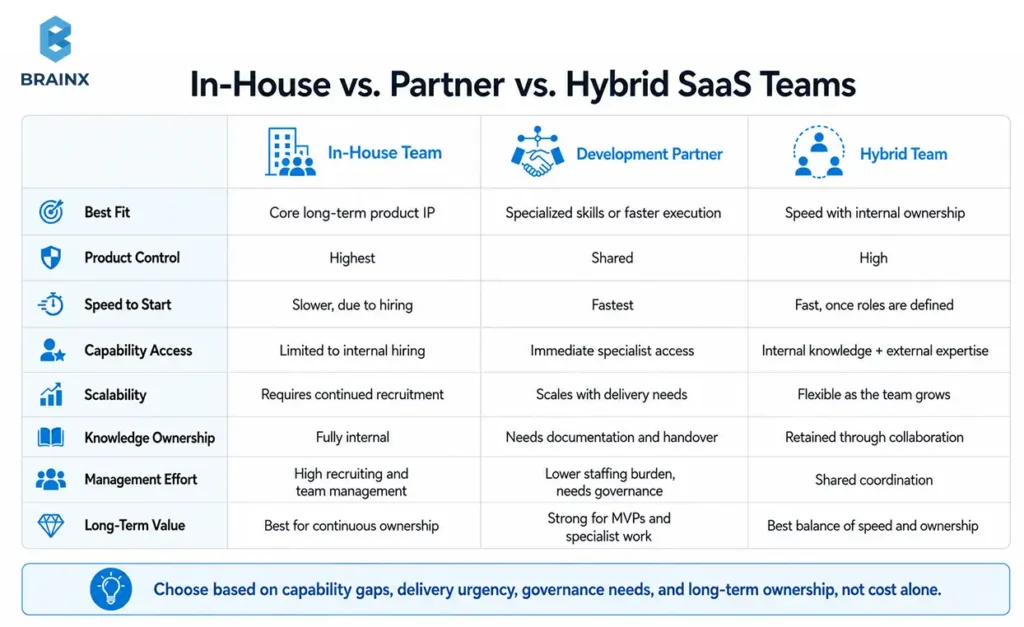
When Should You Build In-House, Use a Development Partner, or Choose a Hybrid Team?
Choose the execution model according to capability, speed, governance, and ownership. SaaS product development services are most useful when they close a specific gap and leave the company with better product knowledge, documentation, and operational control.
When Is an Internal Product Team the Better Long-Term Choice?
An internal team is usually the best long-term owner when the product is the company’s core intellectual property, the roadmap requires constant domain decisions, and leadership can recruit and retain the full set of product, design, engineering, QA, cloud, and security capabilities.
When Do SaaS Product Development Services Add the Most Value?
SaaS product development services add the most value when the opportunity is clear but the organization lacks experienced discovery leadership, SaaS architecture, product design, DevOps, QA automation, security, AI, or enough capacity to reach the next milestone. Deloitte’s 2026 analysis reports that 67% of surveyed organizations had adopted outcome-based outsourcing models focused on measurable results and innovation.
What Should Professional SaaS Product Development Services Deliver at Each Stage?
Professional SaaS product development services should deliver evidence and reusable artifacts, not only engineering hours. The buyer should know what will exist at the end of discovery, design, architecture, delivery, testing, launch, and handover.
- Discovery findings, ICP evidence, assumptions, and validation decision
- Product brief, roadmap, MVP boundary, and measurable success criteria
- User flows, prototype, and usability findings
- Architecture diagrams, decision records, data model, and risk register
- Prioritized backlog with testable acceptance criteria
- QA strategy, security controls, release plan, and rollback path
- Operating documentation, knowledge transfer, and ownership handover
When Does a Hybrid Team Provide the Best Balance of Speed and Ownership?
A hybrid team works well when the company retains product leadership and key domain decisions while a partner supplies delivery capacity or specialist capability. The internal owner protects strategic context, while the external team accelerates execution and transfers knowledge.
Which Evidence Should You Request Before Selecting a Partner?
When comparing professional SaaS product development services, ask for relevant case studies, sample architecture reasoning, delivery artifacts, security and QA practices, incident ownership, handover approach, and references that can discuss behavior when priorities changed or production issues appeared.
For a deeper comparison of sourcing models, see why offshore software product development is growing in 2026.
What Must Be Ready Before Launch, and What Should Be Measured Afterward?
Before launch, SaaS product development must prove that the product is usable, secure, billable, supportable, observable, and reversible. After launch, measure customer value, recurring revenue health, system behavior, and support demand in one operating view.
Product and User-Experience Readiness
Confirm that new users can sign up or be provisioned, understand the product, complete the activation workflow, recover from common mistakes, and find help. Remove placeholder content and test the experience with users who were not involved in building it.
Security, Privacy, and Compliance Readiness
Close critical findings, verify tenant isolation and authorization, protect secrets, confirm encryption, review logs, publish required policies, and test data-access, export, and deletion workflows. Compliance evidence should match the claims being made to customers.
Billing, Customer Support, and Operational Readiness
Test real plan activation, upgrades, downgrades, renewals, refunds, tax behavior, failed payments, grace periods, and cancellation. Give support staff controlled tools, clear escalation paths, and enough account context to resolve issues without unsafe database access.
Performance Testing, Incident Response, and Rollback Readiness
Test critical workflows under expected and stressed conditions. Define incident severity, on-call ownership, communication channels, decision authority, and customer-notification criteria. Rehearse rollback and data restoration before launch rather than trusting that the procedures will work.
Activation, Time to Value, Retention, Churn, and Expansion Metrics
Track the percentage of qualified users reaching activation, the median time to value, cohort retention, logo churn, gross revenue retention, net revenue retention, upgrades, and contraction. These metrics show whether the product is creating durable recurring value.
Availability, Latency, Error Rate, and Support-Volume Metrics
Measure user-facing availability, p95 or p99 latency for critical actions, error rates, failed background jobs, queue delays, and support tickets by type and severity. Technical dashboards should connect incidents to affected tenants and customer outcomes.
How Should Customer Feedback Return to the Product Roadmap?
Create one evidence pipeline for support issues, sales objections, lost deals, renewal risk, product analytics, research, and incidents. Atlassian’s product discovery framework and its guidance on connecting insights provide a useful model. Each item should retain its source, affected segment, frequency, business impact, and relationship to activation or retention.
- MVP acceptance criteria signed off
- Critical defects and vulnerabilities closed
- Product analytics and alerting validated
- Billing success and failure paths tested
- Support and admin workflows ready
- Rollback and recovery procedures rehearsed
- Launch owners and escalation paths confirmed
- First 30-day optimization backlog prepared
What Are the Most Common SaaS Product Development Challenges, and How Can Teams Solve Them?
The most damaging SaaS product development challenges rarely appear as one dramatic failure. They accumulate when market evidence, scope, architecture, security, operations, and customer feedback gradually separate from delivery.
Teams can reduce these risks by identifying each challenge early, assigning an owner, and defining the evidence required before investment or exposure increases.
How Can Teams Validate Demand Before Overinvesting?
The challenge begins when stakeholder confidence is treated as market evidence. Teams start with a feature list, build a polished product, and only then test whether buyers experience the problem frequently enough to change their behavior or allocate budget.
The solution is to reverse that sequence. Define the target segment, document the current workflow, and test whether the problem creates meaningful cost, risk, delay, or lost revenue. Use interviews to understand the pain, prototypes to test the proposed workflow, and commercial conversations to validate urgency and willingness to pay.
Development should expand only when the evidence becomes stronger. When the market signal is weak, revising or stopping the idea is a disciplined business decision, not a failed development effort.
How Can Teams Prevent MVP Scope Creep?
MVP scope expands when every stakeholder adds one “small” requirement. Each addition may appear manageable in isolation, but it also creates design, permission, analytics, testing, documentation, support, and maintenance work.
The solution is to organize the MVP around one measurable activation event. A feature belongs in the first release only when the target user cannot reach the core outcome safely or reliably without it.
Secondary workflows, future-segment requirements, advanced configuration, and speculative integrations should remain in a ranked post-launch backlog. Every proposed addition should show:
- Which user outcome it supports
- Which metric it is expected to influence
- Why it must exist before launch
- What delivery or operational work it adds
- Which currently approved item will be delayed
This makes scope changes visible rather than allowing them to enter the backlog without a trade-off.
How Can Teams Right-Size Architecture Without Blocking Scale?
Overengineering and underengineering create different versions of the same problem. Premature microservices, excessive abstraction, and infrastructure designed for hypothetical scale delay learning. Ignoring tenant isolation, identity, billing integrity, backups, or observability produces a fragile service that becomes expensive to repair.
The solution is to match architecture to current evidence while protecting foundational boundaries. Many early SaaS products can begin with a modular monolith, provided that business domains, data access, permissions, and integrations remain clearly separated.
Architecture decision records should document:
- The decision being made
- The customer and business requirements behind it
- The alternatives considered
- The accepted trade-offs
- The conditions that would require the decision to be revisited
This allows the platform to begin simply without making future teams guess why important choices were made.
How Can Teams Build Security and Compliance Into Delivery?
Security becomes expensive and disruptive when it is postponed until the product is nearly ready to launch. Retrofitting controls can affect the data model, APIs, roles, cloud environments, logs, integrations, and operating procedures.
The solution is to integrate security activities into planning, engineering, testing, and release management. NIST’s Secure Software Development Framework provides a useful foundation for embedding secure practices into the development lifecycle.
The team should identify applicable obligations early and translate them into specific backlog items and acceptance criteria. Common activities include threat modeling, access-control review, secret management, dependency scanning, tenant-isolation testing, secure code review, vulnerability remediation, and recovery testing.
Compliance evidence should be created as work is completed. It should not depend on reconstructing months of decisions immediately before an audit or customer review.
How Can Teams Prepare Onboarding, Support, Analytics, and Rollbacks?
A product can function technically and still fail as a commercial service. Users may not understand how to reach value, support may lack the context needed to resolve issues, analytics may not show where adoption breaks, and a failed release may be difficult to reverse.
The solution is to treat operational readiness as part of the product scope. Before launch, teams should confirm that:
- New accounts can be provisioned correctly
- Users can complete the activation workflow
- Common errors have clear recovery paths
- Support has controlled administrative tools
- Product events and alerts are working
- Billing success and failure paths have been tested
- Incident and escalation owners are named
- Feature flags or rollback procedures are available
- Backup restoration has been rehearsed
These capabilities should be validated during beta rather than discovered after a broader customer launch.
How Can Teams Balance Acquisition With Activation and Retention?
Acquisition becomes a costly distraction when users sign up but fail to reach the product’s core value. Increasing traffic in that situation increases the rate at which the business pays to create inactive or short-lived accounts.
The solution is to connect growth decisions with product outcomes. Teams should measure whether qualified users activate, how long value takes to appear, whether cohorts remain engaged, and whether recurring revenue is retained or expanded.
When activation or retention is weak, the priority should be diagnosing onboarding friction, workflow fit, product reliability, implementation barriers, or unmet customer expectations. Spending more on acquisition should follow evidence that the product can create and sustain value for the customers already entering the funnel.
How Can Teams Keep Customer Feedback Connected to Delivery?
Customer feedback loses value when it remains scattered across sales notes, support systems, analytics dashboards, research documents, and internal chat channels. Without shared context, teams may prioritize the loudest request rather than the most important pattern.
The solution is to create one evidence pipeline that retains:
- The original source
- The affected customer segment
- The frequency of the issue
- The workflow or outcome involved
- The commercial or operational impact
- The relationship to activation, retention, or expansion
- The decision made and its rationale
Product, support, sales, customer success, and engineering should review this evidence together. Every significant request should be accepted, deferred, or rejected with a recorded reason so that future teams do not repeatedly reopen the same discussion without context.
How BrainX Can Help You With SaaS Product Development
BrainX Technologies supports SaaS product development from early discovery through design, engineering, testing, cloud delivery, and post-launch improvement. Its software development services and custom web application development capabilities position the company as an end-to-end partner with web, mobile, AI, DevOps, UI/UX, and ecommerce expertise.
According to the BrainX company profile, the company has 9+ years of experience, 120+ engineers, 250+ delivered projects, and 130+ satisfied clients. It also identifies ISO 9001:2015 and ISO 27001 certification, which provides relevant quality and information-security context for buyers evaluating a long-term product partner.
From Product Discovery to a Validated SaaS Roadmap
BrainX begins by clarifying business requirements, user workflows, technical constraints, and delivery priorities. For SaaS engagements, that work should produce a focused roadmap, MVP boundary, acceptance criteria, and decisions that connect the customer problem to architecture and release planning.
Cross-Functional Design, Engineering, QA, Cloud, and DevOps Delivery
A cross-functional model reduces gaps between interface design, application behavior, infrastructure, quality, and release operations. BrainX’s software development services describe an end-to-end approach that covers design, development, testing, and deployment, supported by multiple technical specializations.
“Along with engineering, they have their own testing, design, and QA which makes BrainX a product manager’s dream.” — Peter Johnson, Product Manager at Kustomer
Security, Scalability, Integrations, and Post-Launch Improvement
BrainX can support multi-tenant web platforms, integrations, cloud deployment, CI/CD, testing, and maintenance as parts of one delivery lifecycle through its custom web application development services. For AI-enabled products, its AI development services also cover proof of concept, testing, integration, deployment, and monitoring.
Relevant BrainX Product-Development Proof
The CORE workforce management platform is the most relevant published example. A Toronto construction company was using manual, disconnected systems for hours, jobs, financial records, payroll, and certifications. BrainX conducted collaborative discovery sessions, refined prototypes with the client, and used Agile feedback during delivery.
BrainX then built a responsive MERN-stack platform with dedicated worker, team-leader, and administrator dashboards. The solution included time tracking, job management, payroll workflows, records, certificates, version control, continuous integration, and automated testing. In the CORE case study, BrainX reports that the deployed platform increased automation, reduced manual effort and errors, improved transparency, and created a scalable path for future commercialization.
Professional SaaS product development services are most useful when they reduce uncertainty at every gate and leave the client with clear ownership.
Discuss your SaaS product with BrainX to define the customer problem, activation event, operating constraints, and evidence required for a responsible first release.
Frequently Asked Questions
What Is SaaS Product Development, and How Does Its Lifecycle Work?
SaaS product development is the process of validating, designing, building, launching, operating, and improving subscription software delivered through the cloud. The lifecycle usually moves through discovery, product strategy, UX, architecture, MVP engineering, quality and security validation, launch, and post-launch optimization. The stages overlap because real customer behavior continues to change requirements after release.
How Long Does It Take to Develop and Launch a SaaS Product?
The timeline depends on workflow complexity, user roles, integrations, data migration, security requirements, and the team’s maturity. A prototype can be completed much faster than a production MVP, while an enterprise or regulated product may require longer discovery, procurement, testing, and evidence collection. Estimate in stages and state the assumptions behind each milestone rather than relying on one generic market range.
How Much Does SaaS Product Development Typically Cost?
There is no responsible fixed price without a defined scope. Cost is driven by product workflows, tenancy, integrations, migration, billing, security, compliance, quality expectations, and the delivery model. Budget should also include cloud services, observability, support tools, third-party APIs, payment processing, maintenance, and customer implementation after the initial build.
What Features Should Be Included in a SaaS MVP?
A SaaS MVP should include one complete activation journey plus the platform capabilities required for real customers. These commonly include authentication, tenant setup, permissions, password recovery, analytics, internal admin tools, support access, basic monitoring, and a clear commercial path. It should also handle critical failures such as incorrect invitations, payment problems, data import errors, cancellation, and rollback.
When Should a Company Use Professional SaaS Product Development Services?
A company should consider professional SaaS product development services when it needs capabilities that are missing internally, must reach a learning or launch milestone faster, or wants to validate the product before building a permanent team. A strong partner should provide discovery evidence, architecture decisions, acceptance criteria, quality and security practices, release planning, documentation, and a clear ownership handover.
What Are the Biggest Risks When Developing a SaaS Product?
The largest risks are building without willingness-to-pay evidence, allowing the MVP to expand, selecting architecture without considering tenancy and billing, delaying security, and launching without onboarding, support, analytics, recovery, or rollback. Another major risk is optimizing acquisition while activation and retention remain weak. A staged lifecycle reduces these risks by requiring evidence and approval gates before investment increases.