 August 30, 2026 -
 29 minutes read


Key Takeaways
- Voice recognition in healthcare turns clinical speech into valuable documentation, instructions, or data for structured workflows instead of just audio.
- Modern healthcare voice systems combine automatic speech recognition, speaker processing, medical language processing, contextual AI, and healthcare-system integrations.
- Clinical documentation is the most mature use case, while voice can also support EHR navigation, radiology, telehealth, patient services, and hands-free workflows.
- Testing should be conducted not just on overall transcription accuracy, but on accuracy in the following areas: medications, dosages, negation, numbers, speaker attribution, accents, noise, omission, and overlapping speech.
- Before rolling out to production, HIPAA safeguards, patient communication, audio-retention policies, EHR interoperability, human review and monitoring should be designed.
- When implementing voice AI, it's essential for healthcare organizations to focus on measurement metrics beyond transcription speed, such as documentation time, correction burden, adoption rates, workflow throughput, and cost.
Modern voice recognition in healthcare records speech, automatically transcribes it into text using automatic speech recognition (ASR), understands the clinical context with natural language processing (NLP), organizes relevant details, and directs the approved output into healthcare workflows, like electronic health record (EHR) documentation.
The important word is approved. Producing fluent text is not the same as creating a reliable medical record.
Evidence around ambient documentation is becoming more substantial. A 2025 multicenter quality-improvement study across six healthcare systems reported improvements in documentation burden, after-hours documentation, and focused attention after 30 days. Because the study was not randomized, those findings should not be treated as guaranteed outcomes for every implementation.
Our medical voice recognition guide covers what the term means, how it works, where it adds value, where it doesn't, how much it costs, and how healthcare teams can responsibly validate it.
What Does Medical Voice Recognition Mean?
Medical voice recognition is an umbrella term for technologies that use spoken language inside healthcare workflows. Depending on the system, that may include transcribing speech, distinguishing speakers, interpreting clinical meaning, executing commands, or creating draft documentation.
The above mentioned capabilities are related but they are not technically identical. Each requires different models, evaluation methods, safeguards, and integrations.
How Voice Recognition in Healthcare Differs From Speech Recognition and Speaker Recognition
Speech recognition is used to identify what was said. Speaker recognition determines who is speaking. In everyday healthcare terminology, “voice recognition” is often used broadly for both, but the distinction matters when specifying a system.
Automatic speech recognition (ASR) converts spoken language into text, while NIST treats speaker recognition as a distinct speaker-detection and voice-biometrics problem.
A third capability, speaker diarization, answers a related question: who spoke when? It breaks down a multi-speaker audio file into segments and labels them with speaker identities, but it doesn't always confirm them.
For example:
- Speech recognition: “The patient stopped metformin last month.”
- Speaker recognition: Dr. Smith is the person speaking.
- Speaker diarization: Speaker A asked the question; Speaker B gave the answer.
That difference matters in ambient clinical conversations. A perfect transcript can still create an incorrect record if a patient's statement is attributed to the clinician.
Terminology in real projects: Requirements should separately specify transcription, clinician-patient separation, verified speaker identity, voice commands, medical concept extraction, and AI-generated notes. Strong performance on one capability does not guarantee strong performance on another.
Where Voice Recognition Technology in Healthcare Fits Across Clinical Workflows
Voice recognition technology in healthcare sits at the input layer of a larger workflow. Speech becomes operationally useful when downstream software can safely convert it into documentation, structured information, or an approved system action.
A practical architecture looks like this:
spoken interaction → speech processing → contextual interpretation → workflow logic → healthcare-system integration → human verification where required
That workflow can produce a progress note, radiology report, appointment request, structured clinical field, or EHR navigation action.
This is why voice AI should rarely be evaluated as an isolated microphone or transcription feature. It is usually one component of a broader healthcare automation workflow.
BrainX's automation in healthcare guide explains the wider principle: automation creates value when it connects a defined trigger to a measurable outcome with clear exception handling and human responsibility.
What Types of Medical Voice Recognition Systems Are Used?
How Dictation, Ambient Scribing, and Voice Assistants Differ
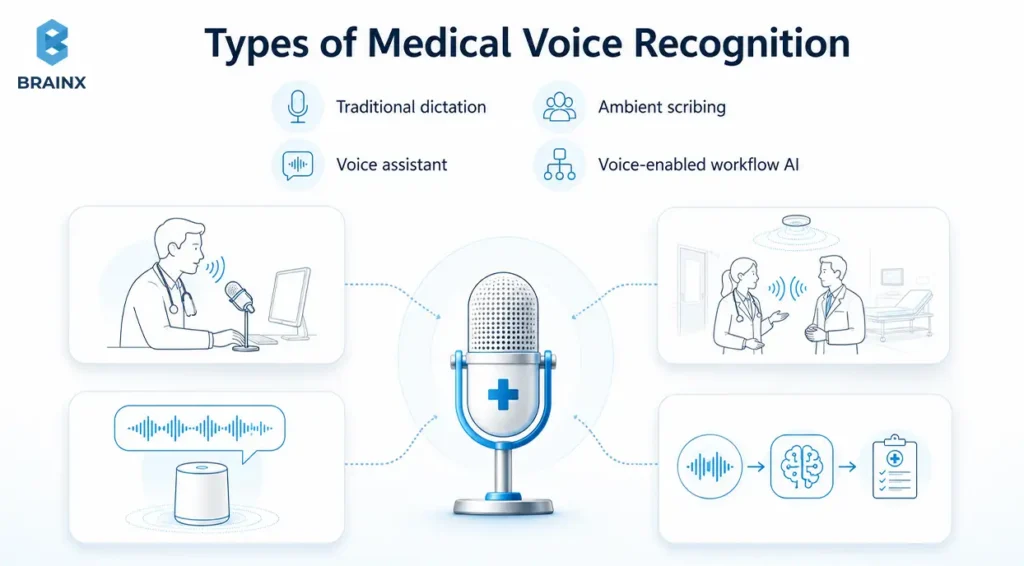
Dictation, ambient scribing, and voice assistants use speech for different purposes.
| Approach | Typical Input | Primary Output | Typical Human Role |
| Traditional dictation | Clinician deliberately dictates | Transcript or report | Clinician edits and signs |
| Ambient scribing | Natural clinician-patient conversation | Draft clinical note | Clinician reviews, corrects, and approves |
| Voice assistant | Spoken request or command | Action, answer, or navigation | User confirms higher-risk actions |
| Voice-enabled workflow AI | Conversation plus application context | Structured data or workflow event | Depends on clinical risk |
Traditional dictation mainly solves speech-to-text. Ambient scribing introduces another problem after transcription: clinical summarization and generation.
That distinction matters because a transcript can accurately capture a conversation while the generated note still omits or misrepresents an important fact.
A 2026 prospective JAMA Network Open study of AI-generated hospital-course summaries illustrates this broader generative risk. Among 100 summaries with physician feedback, omissions were reported in 25%, inaccuracies in 20%, and hallucinations in 2%. The study evaluated one particular workflow rather than ambient voice technology generally, but it shows why transcription quality and generated-document quality require separate evaluation.
Front-End and Back-End Recognition Support Different Workflows
Front-end recognition returns the transcript or draft directly to the clinician so it can be corrected before signing, submission, or EHR write-back. This model fits interactive dictation and many ambient workflows where the user reviews the output soon after the encounter.
Back-end recognition processes recorded speech after capture and returns the result later for review. It can fit batch reporting and transcription workflows, but it introduces different expectations around latency, queues, exception handling, and who owns final verification.
The practical distinction is not which approach sounds more advanced. It is when recognition occurs, when the user sees the output, and where human verification sits before the information becomes operational.
Why Are Healthcare Organizations Moving Toward Voice-Enabled Workflows?
Healthcare organizations are adopting voice-enabled workflows primarily because documentation consumes clinician attention and time. Ambient AI and improved system integration now address more of that workflow than traditional dictation could.
Documentation Burden Makes Clinical Workflow Efficiency a Priority
The strongest current driver for clinical voice AI is documentation friction. The problem is larger than typing: clinicians must capture facts, organize notes, review prior information, enter structured data, complete required documentation, and stay engaged during the encounter.
That makes voice technology most relevant where speech is already part of the workflow and the documentation steps around it are repetitive, time-sensitive, or difficult to complete without interrupting the interaction.
The adoption decision should begin with workflow mapping rather than a general desire to use AI. Teams need to identify which steps consume attention without requiring independent clinical judgment and which steps must remain under explicit professional control.
A better implementation question is:
Which part of the documentation workflow consumes attention without requiring independent clinical judgment, and can voice AI remove that work without moving it somewhere else?
Ambient AI Is Moving Voice Systems Beyond Traditional Dictation
Ambient AI turns speech recognition from a transcription tool into a documentation workflow. It can listen during an encounter, distinguish speakers, identify clinically relevant information, organize that information, and generate a draft note for review.
The technology has already reached substantial operational scale in some healthcare systems. The American Medical Association reported that The Permanente Medical Group exceeded 2.5 million ambient AI scribe uses during its first year after rollout.
Scale does not remove the need for specialty-specific validation. A 2026 JAMA Network Open study evaluating ambient scribes across neurology, cardiology, gastroenterology, and hematology-oncology found differences in documentation quality, perceived usefulness, technical reliability, and specialty needs.
A voice workflow that performs well in primary care therefore should not automatically be assumed to work equally well in cardiology, oncology, emergency care, or psychiatry.
Better EHR Integration Is Expanding Where Voice Can Be Used
Voice AI becomes much more useful when approved information can move into and out of the EHR through governed interfaces.
Fast Healthcare Interoperability Resources (FHIR) is an HL7 standard for exchanging healthcare information electronically. The standard supports structured healthcare data exchange between applications.
FHIR does not make an integration correct or safe by itself.
Healthcare voice applications still need:
- authentication and authorization
- patient and encounter matching
- field mapping
- input validation
- permission controls
- failed-write handling
- duplicate protection
- auditability
- human approval where required
The engineering objective is not merely to make the EHR API respond successfully. It is to ensure the right information reaches the right patient, encounter, field, and reviewer.
The implementation point is echoed by a cardiology participant in a 2026 VHA cross-specialty simulation study: “So that integration piece, I think, is going to be key to seeing if this can be successful in specialty care.”
How Does Voice Recognition in Healthcare Work?
Voice recognition in healthcare works through a chain of processing stages rather than a single speech-to-text call. Audio is captured, cleaned, transcribed, attributed to speakers, interpreted clinically, structured, connected to healthcare systems, and reviewed according to workflow risk.
Step 1: Audio Capture and Noise Preprocessing
The first stage captures usable speech and reduces acoustic problems that could damage downstream recognition.
Microphone quality, room acoustics, speaker distance, interruptions, network compression, simultaneous conversation, and medical equipment can all affect the audio reaching the model.
Preprocessing may include:
- voice-activity detection
- noise reduction
- echo cancellation
- audio normalization
- segmentation
- microphone or channel selection
The right benchmark is the intended clinical environment, not a quiet demonstration room. A telehealth visit, emergency department, examination room, nursing station, and radiology workstation create different audio conditions.
Step 2: Automatic Speech Recognition Converts Audio Into Text
Automatic speech recognition converts the acoustic signal into text and timestamps.
Modern ASR models learn relationships between audio and language, while healthcare-oriented systems may use medical vocabulary, contextual prompts, or domain adaptation to improve recognition.
Clinical language creates unusually difficult recognition problems:
- medication and drug names
- anatomical terminology
- abbreviations
- similar-sounding conditions
- dosages and units
- proper nouns
- new therapies
- specialty-specific language
For this reason, overall word error rate (WER) should not be the only acceptance metric. Ten harmless punctuation or filler-word errors can matter less than one incorrect medication dose.
Step 3: Speaker Diarization Separates Clinician and Patient Speech
Speaker diarization identifies which speech segments belong to different speakers.
Consider this exchange:
Clinician: “Are you still taking metformin?”
Patient: “No, I stopped it last month.”
The transcript could contain every word correctly and still create the wrong clinical meaning if those speakers are reversed.
Diarization becomes even harder when conversations include nurses, interpreters, family members, trainees, or multiple clinicians.
That means healthcare teams should evaluate speaker-attribution error separately from transcription error.
Step 4: Medical NLP Interprets Terminology, Context, and Intent
Medical natural language processing turns transcript text into clinically meaningful concepts and relationships.
Depending on the workflow, the NLP layer may identify:
- symptoms
- medications
- dosages
- anatomical terms
- temporal references
- clinical negation
- commands
- procedures
- sections of a clinical note
Context is critical.
“Patient denies chest pain” cannot become “patient reports chest pain.”
“Stopped warfarin two weeks ago” cannot become “currently taking warfarin.”
Advanced ambient systems may also use large language models to summarize conversations or generate notes. That adds flexibility, but it also introduces generative errors that do not originate in the ASR transcript.
Step 5: Clinical Information Is Structured and Confidence-Scored
The system converts relevant concepts into a structure the downstream workflow can validate and use.
That structure might contain note sections, medication references, problems, procedures, follow-up instructions, or application-specific fields.
A robust application can preserve more than polished final prose. It may retain:
- speaker labels
- timestamps
- source transcript spans
- ASR confidence
- extraction confidence
- relationships between generated statements and supporting speech
Consider:
“Patient denies chest pain but reports shortness of breath.”
A strong processing chain would look like:
transcript → patient speaker label → negated chest-pain concept + positive shortness-of-breath concept → draft note → clinician review → approved record
Keeping intermediate information traceable helps teams understand where an error entered the workflow, instead of evaluating only the final note.
Step 6: How Voice Recognition Software in Healthcare Connects With EHRs
Voice recognition software in healthcare usually connects to an EHR through supported APIs, vendor interfaces, or application integration layers.
FHIR can standardize appropriate healthcare data exchange, while EHR-specific interfaces may still be necessary for actions that are not exposed through standard resources.
A voice integration should clearly define:
what the application reads → what AI can process → what it generates → where output is staged → who approves it → what can be written back
Teams also need to test:
- patient identity
- encounter context
- permissions
- field mapping
- duplicates
- retries
- failed transactions
- audit trails
- version conflicts
- unsupported data
A successful API response does not necessarily mean the clinical integration worked correctly.
BrainX's EHR vs. EMR guide explains why applications surrounding an EHR should extend the system of record without bypassing provenance, review, access controls, or auditability.
Step 7: Clinician Review Creates the Final Safety Gate
Voice-generated clinical documentation should remain a draft until the responsible clinician has reviewed what the workflow requires.
Clinician review is not a disclaimer added after development. It is part of the product design.
A usable review interface should make uncertainty easy to inspect. For example, an uncertain medication could be highlighted beside the source transcript rather than buried inside an otherwise polished note.
The 2026 JAMA Network Open hospital-summary study reinforces this principle. Physician reviewers found clinically relevant omissions and inaccuracies even though hallucinations were relatively uncommon.
The lesson is broader than that individual system: good-looking generated text still requires task-specific validation and appropriate human accountability.
Where Is Medical Voice Recognition Used in Healthcare?
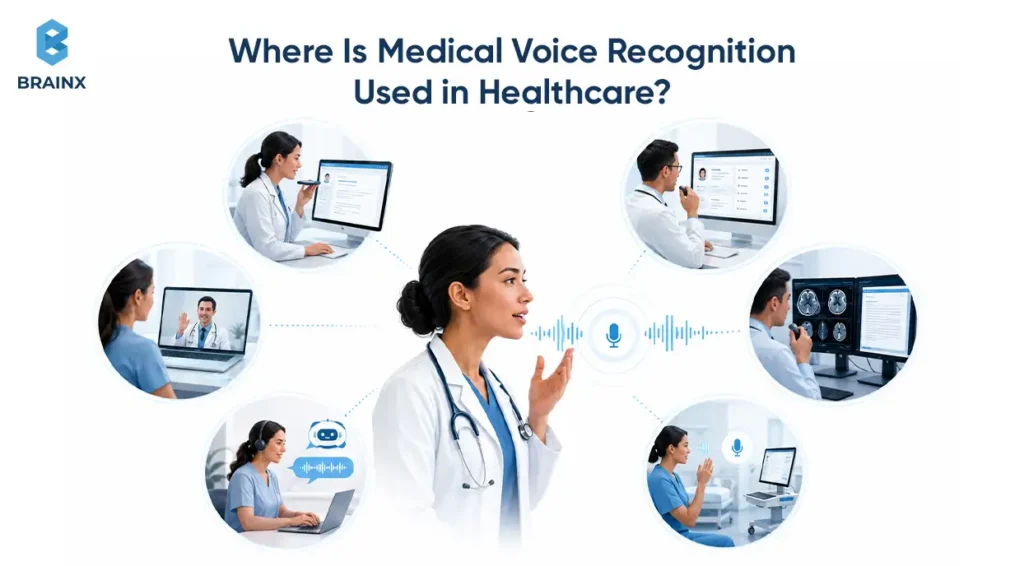
Healthcare voice applications create the most value when speech is already central to the workflow and the resulting output or action can be reviewed and measured clearly.
Clinical Documentation and Ambient AI Scribing
Ambient documentation currently has one of the strongest evidence bases because it targets a measurable source of administrative work.
User: clinician and patient
Spoken input: natural encounter conversation
System action: generates a draft clinical note
Human checkpoint: clinician edits and signs
KPIs: documentation time, after-hours EHR time, correction rate, same-day closure, adoption
The 2025 multicenter study associated ambient scribe use with lower burnout and documentation burden and better focused attention on patients. These are study-specific associations rather than guaranteed outcomes.
Hands-Free EHR Navigation and Voice Commands
Voice commands can reduce navigation friction when clinicians need to interact with software while their hands or attention are occupied.
User: clinician or nurse
Spoken input: explicit command
System action: retrieves information or navigates the application
Human checkpoint: confirmation for sensitive actions
KPIs: task completion time, command accuracy, fallback rate, clicks reduced
The risk should determine the confirmation model.
“Open the medication list” is not equivalent to “place a medication order.” High-consequence actions require stronger verification and authorization.
Radiology and Diagnostic Reporting
Radiology is a natural voice workflow because speech recognition has long been used to produce reports while radiologists review images.
User: radiologist
Spoken input: dictated findings
System action: transcription and structured report preparation
Human checkpoint: radiologist verifies and signs
KPIs: report turnaround, correction rate, addenda, completion time
Modern systems can add structured templates and contextual checks, but the final report still needs professional verification.
Telehealth Consultation Transcription
Telehealth offers a native digital audio source for transcription or ambient documentation, but it introduces its own recognition conditions.
User: clinician and remote patient
Spoken input: consultation audio
System action: transcript or draft note
Human checkpoint: clinician review
KPIs: documentation time, correction burden, note completion, user acceptance
Validation should include poor microphones, packet loss, background household noise, speakers sharing devices, multilingual conversations, and intermittent connectivity.
A voice system validated only in examination rooms may perform differently in virtual care.
Patient Scheduling, Support, and Virtual Assistants
Patient-facing voice agents are best suited to bounded service workflows rather than unsupervised clinical decision-making.
Possible workflows include:
- appointment requests
- status checks
- routine FAQs
- reminders
- routing
- structured intake
- staff escalation
User: patient
Spoken input: service request
System action: identifies intent and performs or routes an approved task
Human checkpoint: staff handles exceptions
KPIs: containment rate, transfer rate, task completion, abandonment, satisfaction
A scheduling agent should not drift into diagnosis or medication advice simply because a language model can continue the conversation.
Organizations building these products can use custom AI development services to combine voice processing with application logic, integrations, evaluation, and deployment.
Accessibility and Hands-Free Clinical Workflows
Voice interfaces can make clinical software easier to use when typing, touching a device, or continually looking at a screen is impractical.
User: clinician, authorized staff member, or accessibility-focused user
Spoken input: bounded instruction or dictation
System action: executes the supported task
Human checkpoint: confirmation where necessary
KPIs: successful task completion, interaction time, error rate, fallback use
Accessibility should be validated with intended users rather than assumed from the existence of a voice interface. Recognition performance, hearing and speech differences, interface design, and environmental noise can all affect usability.
What Are the Key Benefits of Medical Voice Recognition?
The main benefits of medical voice recognition come from improving the full documentation and workflow process, not from producing a transcript faster in isolation. The most useful outcomes are less documentation work, faster completion, better use of clinician attention, and measurable workflow improvement without shifting effort elsewhere.
Saves Documentation Time
Voice AI can reduce the time clinicians spend creating and completing notes, but the right measure is total documentation time, including review and correction.
A 2025 JAMA Network Open study reported improved self-reported after-hours documentation after ambient scribe adoption. A 2026 multisite JAMA study across five academic medical centers found 13.4 fewer total EHR minutes and 16.0 fewer documentation minutes per eight scheduled patient hours among adopters, although EHR time outside scheduled hours did not significantly change.
A separate 2026 analysis of 1,547 clinicians found no immediate reduction in after-hours documentation but a modest sustained decline over time, alongside a small immediate reduction in note time. The variation across studies is why healthcare organizations should establish their own baseline before rollout.
Reduces Documentation Burden
Time saved and documentation burden are related but not identical. Voice AI can reduce the mental effort of reconstructing an encounter into a complete note by capturing the conversation and preparing a draft for review.
In the 2025 multicenter quality-improvement study, clinicians reported improvements in cognitive load associated with note writing and documentation after hours after 30 days of ambient scribe use. The benefit is not removing clinical judgment; it is reducing repetitive capture, formatting, and reconstruction work around that judgment.
Teams should still measure correction burden, abandoned drafts, perceived cognitive load, and how much documentation remains outside the normal workflow. A system that creates a polished draft but requires heavy rework may reduce typing without reducing documentation burden.
Improves Workflow Efficiency
The relevant measure is time to a usable, signed output, not time to the first AI draft. A draft generated in two minutes may provide little benefit if the clinician then spends ten minutes correcting it.
Useful workflow measures include time from encounter to signed note, same-day note closure, edits per note, abandoned AI drafts, and critical versus cosmetic corrections. These measures expose downstream effort that raw transcription speed hides.
At the organizational level, efficiency can also show up as throughput when added volume does not create more correction, billing, or clinician workload elsewhere. A 2026 UCSF study covering more than 1.2 million qualifying ambulatory encounters found ambient AI scribe adoption was associated with higher physician financial productivity and visit volume, with no observed increase in claim denials. The associated increases were 1.81 RVUs and 0.80 encounters per physician per week relative to nonadopters.
An accompanying JAMA Network Open commentary summarized the relative changes as approximately 5.8% more weekly RVUs and 2.8% more encounters per week. The study came from one academic health system and should not be treated as a universal ROI forecast.
Efficiency and workforce sustainability should be measured separately. Turning every saved minute into additional appointments could erase part of the well-being benefit.
Supports Patient Engagement
Reducing screen and keyboard attention may create more room for direct clinician-patient interaction, but that benefit should be measured rather than assumed.
In the 2025 multicenter study, clinicians reported a significant improvement in their ability to give patients undivided attention after ambient scribe use.
Vincent Liu, MD, MSc, a Kaiser Permanente researcher and TPMG chief data officer, summarized the practical value in an AMA report: “Both doctors and patients highly value face-to-face contact during a visit, and the AI scribe supports that.”
Organizations can combine clinician surveys with patient-experience data to determine whether that perceived improvement is reflected in actual encounters.
Supports Clinician Well-Being
The strongest well-being case is not that voice AI prevents burnout. It is that reducing documentation friction may improve some contributors to burnout when the workflow is well designed and the correction burden remains manageable.
In the 2025 multicenter quality-improvement study, the proportion of participants reporting burnout decreased from 51.9% at baseline to 38.8% after 30 days of ambient scribe use. Because the study was not randomized, this should be treated as an encouraging implementation finding rather than a guaranteed effect.
Healthcare organizations should track clinician satisfaction, perceived workload, after-hours documentation, correction effort, and adoption over time. A system that saves minutes but creates constant editing, exception handling, or monitoring work may not improve well-being.
What Can Go Wrong in Real Clinical Environments?
Clinical environments expose failure modes that polished demos often hide. Voice systems need explicit safeguards for noise, speaker confusion, linguistic variation, medical terminology, generative errors, privacy decisions, and integration failures.
Background Noise and Overlapping Speakers Reduce Recognition Quality
Noise can damage both transcription and speaker attribution.
Real environments may include monitors, keyboards, carts, television audio, telephones, masks, doors, family members, interpreters, and multiple clinicians speaking at once.
Testing should intentionally reproduce these conditions.
A system that performs well on clean single-speaker audio should not receive production approval for a noisy, multi-speaker workflow without additional evaluation.
Accents, Dialects, and Code-Switching Can Produce Uneven Performance
Aggregate ASR accuracy can hide substantial differences between speaker populations.
A 2024 JAMIA Open study evaluated 860 patient utterances from home-health encounters across AWS General Transcribe, AWS Medical Transcribe, Whisper, and Wav2Vec. All evaluated systems showed lower transcription accuracy for Black patients than White patients, with statistically significant differences for the AWS systems.
Earlier peer-reviewed PNAS research across five commercial speech-recognition systems also documented substantial racial disparities in word error rate.
The right response is not to claim a model is “accent independent.” Healthcare teams should test intended users, relevant dialects, multilingual or code-switching scenarios, and subgroup error rates.
Medical Homophones, Abbreviations, Negation, and Dosages Raise the Stakes
A small transcription error can have disproportionate clinical importance.
Examples include:
- “no nodule” becoming “nodule”
- 5 mm becoming 5 cm
- 10 mg becoming 100 mg
- “denies chest pain” becoming “reports chest pain”
- one medication name becoming a similar-sounding drug
These examples show why clinically consequential words and numbers should receive more attention than punctuation or harmless filler-word differences.
ASR Errors and AI-Generated Note Errors Are Different Failure Modes
An ASR error changes what the transcript says. A generative error changes what the AI writes or concludes from that transcript.
A system can therefore produce:
- an incorrect transcript but a plausible note
- a correct transcript but an incomplete note
- a correct transcript but wrong speaker attribution
- a correct transcript and wrong EHR field mapping
| Failure Mode | Example | Required Safeguard |
| Incorrect speaker attribution | Patient statement assigned to clinician | Diarization testing + visible speaker context |
| Missed negation | “No fever” becomes “fever” | Critical-term tests + clinician review |
| Wrong drug or dosage | Drug or strength mistranscribed | Medication-specific evaluation + source verification |
| Wrong numerical measurement | 5 mm becomes 5 cm | Number and unit validation |
| Inaudible audio | Clinically relevant segment missing | Low-confidence flag + replay/manual entry |
| Overlapping conversation | Two statements merged | Overlap detection + fallback |
| Unsupported generated detail | Note adds information never stated | Grounding + source traceability |
| EHR write-back failure | Correct information reaches wrong field or fails | Mapping tests + transaction monitoring |
The 2026 hospital-summary study is a useful reminder that omission and inaccuracy can remain important even when outright hallucination is uncommon.
Patient Consent, Audio Retention, and PHI Require Explicit Policies
Voice AI creates privacy and security decisions before the first model call occurs.
The HIPAA Privacy Rule applies to individually identifiable health information in electronic, written, and oral forms. HHS states that covered entities must reasonably safeguard PHI, including oral information.
For electronic protected health information (ePHI), the HIPAA Security Rule requires regulated entities to implement reasonable and appropriate administrative, physical, and technical safeguards. Current HHS guidance includes access control, audit controls, authentication, integrity, transmission security, and risk management.
Healthcare teams should explicitly determine:
- whether raw audio is stored
- how long audio and transcripts are retained
- where processing occurs
- which vendors receive PHI
- which users can access recordings or transcripts
- what is logged
- how deletion works
- how patients are informed
- whether additional consent requirements apply under state or local law
- which business associate arrangements are required
For ambient scribing specifically, AMA ethics guidance published in 2026 emphasizes clear disclosure and consent communication, together with manual verification of AI-generated clinical documentation.
A useful nuance is that HHS states HIPAA itself does not require covered entities to make digital recordings of oral communications or retain recordings after transcription. Other legal, contractual, clinical, or organizational requirements may still affect retention.
Clinical Workflows Need a Safe Fallback When Voice AI Fails
Every production voice workflow needs a known non-AI path.
Fallbacks may include:
- conventional dictation
- manual note entry
- keyboard navigation
- staff escalation
- replay or re-entry
- saving a draft without EHR write-back
The engineering principle is simple:
Fail visibly, not silently.
If the system cannot hear a segment, loses connectivity, encounters unsupported speech, or fails to write to the EHR, the user should know what happened and what action is required.
What Does Medical Voice Recognition Cost to Implement?
Medical voice recognition costs vary because buying an ambient scribe, integrating a speech API, and building a custom healthcare voice product are fundamentally different projects.
The budget should separate software or model cost from integration, validation, security, workflow design, and ongoing operations.
Buying, Integrating, and Building Custom Software Have Different Cost Models
Buying usually emphasizes licensing, integration emphasizes engineering, and custom development spreads cost across the full product lifecycle.
For one current reference point, a 2026 JAMA Network Open commentary reported that many health systems pay approximately $200 to $600 per clinician per month for ambient AI scribe subscriptions. That is an ambient-scribe subscription benchmark, not an estimate for custom software development.
| Delivery Model | Main Cost Drivers | Typical Fit |
| Packaged voice product | Licenses, deployment, configuration, support | Standardized workflow |
| Speech/AI API integration | Usage, application engineering, integrations | Existing product adding a bounded voice feature |
| Workflow-specific custom app | AI services, UX, backend, EHR integration, validation | Differentiated healthcare workflow |
| Enterprise voice platform | Multiple workflows, specialties, interfaces, governance, operations | Organization-wide capability |
Model Complexity and EHR Integration Drive Development Cost
The AI model is only one part of a custom voice project's cost.
A single-speaker dictation feature is materially simpler than an ambient multi-speaker application that performs:
- diarization
- medical concept extraction
- note generation
- confidence scoring
- EHR write-back
- audit logging
- monitoring
Integration can be equally expensive.
FHIR helps standardize healthcare information exchange, but actual effort still depends on the EHR, permitted resources, authentication, field mapping, write-back rules, workflow actions, and deployment environment.
Estimate the entire data and workflow path, not “speech recognition” in isolation.
Clinical Validation and Security Add Work Beyond Core Development
A healthcare voice application needs evidence and safeguards in addition to working software.
Important delivery work may include:
- representative evaluation data
- clinical error analysis
- clinician testing
- subgroup evaluation
- security architecture
- access control
- audit logging
- vendor assessment
- penetration and integration testing
- incident response planning
HHS risk-analysis guidance requires regulated entities to conduct an accurate and thorough assessment of potential risks and vulnerabilities to ePHI and manage those risks with reasonable and appropriate safeguards.
A prototype that transcribes speech successfully has therefore not reached the same readiness level as a clinically evaluated, integrated production workflow.
A Pilot and an Enterprise Rollout Should Have Different Timelines
A focused pilot should move faster because it intentionally limits users, systems, workflows, and risk.
An enterprise deployment may need to support multiple:
- specialties
- sites
- EHR configurations
- roles
- security reviews
- templates
- languages
- training programs
- support processes
Instead of promising an arbitrary number of weeks, plan around validation gates:
working prototype → representative validation → EHR sandbox → supervised pilot → production readiness → staged expansion
A project should advance when the evidence supports the next stage, not simply because a planned calendar date has arrived.
Hidden Costs Include Training, Monitoring, Support, and Workflow Change
The recurring cost of medical voice AI extends beyond model inference or subscription fees.
Organizations should budget for:
- user onboarding
- clinical support
- correction review
- monitoring
- model or vendor changes
- API usage
- observability
- security operations
- integration maintenance
- workflow redesign
- incident response
The correction burden deserves particular attention. A cheaper product that produces significantly more editing or abandoned notes may cost more per successfully completed workflow.
Procurement should therefore compare total cost per completed, accepted workflow, not simply price per audio minute or clinician license.
How to Measure ROI Against the Existing Documentation Baseline
Voice AI ROI starts with the cost and performance of the current workflow.
| KPI | Before Deployment | After Deployment | What to Watch |
| Documentation minutes per encounter | Establish baseline | Measure actual change | Include editing time |
| After-hours EHR time | Establish by role | Compare consistently | Work shifting elsewhere |
| Note turnaround | Time to signed note | Re-measure | Draft speed alone |
| Correction rate | Existing edits | AI-related edits | Critical vs minor errors |
| Adoption rate | Not applicable | Eligible active use | Silent abandonment |
| Clinician satisfaction | Baseline survey | Repeat survey | Specialty differences |
| Patient-experience signal | Existing measure | Compare consistently | Do not infer from clinician sentiment |
| Cost per encounter | Current full cost | AI + review + support | Hidden operating costs |
The key measure is net workflow value.
If voice AI saves time during transcription but increases editing, help-desk tickets, integration failures, or exception handling, the organization needs to count those costs too.
How Do You Build and Implement Medical Voice Recognition Software?
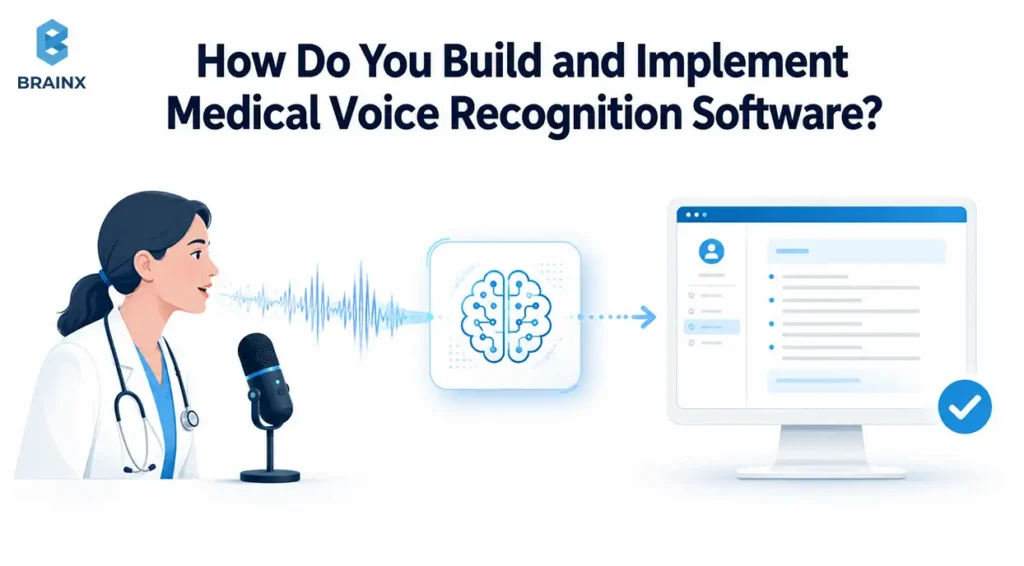
Healthcare teams should treat voice AI as a controlled workflow change, not as a one-time model integration. Safe implementation requires representative testing, explicit human responsibility, clinical error metrics, EHR validation, supervised rollout, and continuous monitoring.
Step 1: Choose One High-Value, Low-Ambiguity Workflow
Start with one bounded workflow where both success and failure are easy to define.
Good first candidates may include a structured documentation template, reporting workflow, or low-risk navigation command.
Avoid starting with a general-purpose clinical voice assistant that is expected to understand every specialty and perform broad autonomous actions.
Document the existing workflow first:
- users
- task steps
- volume
- time required
- exception paths
- approval points
- systems touched
- measurable outcome
The first implementation should prove workflow value, not showcase the maximum number of AI features.
Step 2: Define Architecture, Data Flow, and Human Responsibility
Map where audio and PHI travel before selecting the final architecture.
The design should answer:
- Where is audio captured?
- Is raw audio retained?
- Where does ASR run?
- Which services receive PHI?
- What information reaches an LLM?
- What is returned to the application?
- What enters the EHR?
- Who reviews it?
- What is logged?
- What happens when processing fails?
Human responsibility also needs to be specific.
“The clinician reviews the note” is insufficient unless the workflow defines what must be reviewed, at which point, and what happens when an error is found.
Step 3: Choose the Speech AI Stack and Deployment Model
Choose the technology stack around the workflow requirements rather than treating medical voice recognition as a single-model decision. A production system may combine automatic speech recognition, speaker diarization, medical NLP, an LLM or summarization layer, validation rules, application logic, and EHR interfaces.
Evaluate candidate components against the conditions that matter in production: medical vocabulary accuracy, speaker separation, streaming or batch support, latency, language and accent coverage, PHI handling, data residency, model-version control, observability, integration options, and cost at the expected usage volume.
Deployment may be managed cloud, private or on-premises infrastructure, or a hybrid design. The right choice depends on security requirements, latency, operational capability, integration constraints, and where PHI is allowed to flow. A more private deployment is not automatically safer if patching, access control, monitoring, and incident response are weak.
Step 4: Build a Representative Clinical Evaluation Dataset
The evaluation dataset should resemble production conditions rather than ideal laboratory audio.
Include relevant:
- specialties
- encounter types
- medical vocabulary
- medications
- local abbreviations
- accents and dialects
- speaking rates
- multilingual speech
- code-switching
- background noise
- interruptions
- microphone conditions
- overlapping speakers
Healthcare-specific evidence showing recognition disparities between Black and White patient speech demonstrates why a single aggregate benchmark is insufficient.
Synthetic clean audio can supplement testing, but it should not replace real-world stress conditions.
Step 5: Test Critical Clinical Errors, Not Just Word Error Rate
A high transcription-accuracy percentage does not prove that a voice system is clinically reliable.
WER measures substitutions, insertions, and deletions at the word level. Clinical risk depends heavily on which words, concepts, speakers, or fields are wrong.
A practical evaluation scorecard should include:
| Metric | What It Detects |
| Overall WER | General transcription performance |
| Medical-term error rate | Errors in diagnoses, anatomy, procedures, and terminology |
| Medication/dosage error rate | Drug, strength, frequency, or dose errors |
| Negation error rate | Meaning reversals involving “no,” “denies,” or “without” |
| Speaker-attribution error | Clinician and patient statements assigned incorrectly |
| Omitted clinical fact | Relevant spoken information missing from output |
| Unsupported/generated fact | Information appearing without source support |
| EHR field-mapping error | Correct information written into the wrong context |
The information-gain principle here is important:
One clinically consequential error may matter more than dozens of harmless transcription mistakes.
Step 6: Integrate the Workflow With EHR and Human Review
Test EHR integration in a controlled sandbox before allowing production write-back.
Validate:
- patient matching
- encounter context
- resource and field mapping
- permissions
- duplicate handling
- retries
- failed writes
- timestamps
- audit trails
- review states
FHIR provides an important standards-based foundation, but application-level testing remains necessary around the specific EHR and workflow.
Human review should occur where the reviewer has enough context to detect errors efficiently. An uncertain medication, for example, can be displayed beside the supporting transcript span.
Step 7: Pilot With Real Users Before Scaling
A real-user pilot evaluates the whole socio-technical workflow, not just the AI model.
Clinicians may expose problems that offline testing misses:
- notes are too long
- editing takes too many clicks
- specialty templates are wrong
- microphone behavior disrupts conversation
- processing latency is distracting
- one role saves time while another gains work
- users stop using the system despite good accuracy
The 2026 cross-specialty ambient-scribe evaluation found important differences in perceived usefulness and specialty requirements.
Pilot measures should include quality, safety, adoption, workflow time, fallback use, user satisfaction, and correction burden.
Step 8: Monitor Accuracy, Adoption, Drift, and Workflow Exceptions
Validation continues after deployment because the environment and the technology keep changing.
Monitor:
- failure rates
- low-confidence segments
- correction patterns
- critical clinical errors
- subgroup performance
- latency
- EHR transaction failures
- adoption
- fallback frequency
- security incidents
- changing workflow outcomes
Model providers may update systems. EHR interfaces may change. New medications and terminology appear. Users may also begin using the application in scenarios that the original pilot never covered.
A practical BrainX-style delivery blueprint is:
Workflow discovery → Architecture and stack → Prototype → Representative validation → EHR sandbox → Supervised pilot → Staged deployment → Production monitoring
Every stage should include exit criteria and a fallback or rollback path.
That is the same operational principle discussed in our predictive analytics in healthcare guide, where it says healthcare AI should be treated as an operating capability that is evaluated and monitored, not as a feature that becomes permanently “finished” when a model ships.
How BrainX Helps Build AI Voice Agents
BrainX Technologies helps organizations turn voice-AI concepts into integrated software products by combining AI engineering with application development and system integration.
Depending on the workflow, an engagement can include:
- workflow and feasibility assessment
- speech and AI architecture
- custom application development
- secure APIs and system integrations
- EHR/API integration
- evaluation and testing
- deployment
- production monitoring and iteration
The architecture should match the actual problem rather than forcing every project into a generic voice assistant.
For healthcare use cases, that means defining PHI data flows, EHR boundaries, human checkpoints, failure states, validation requirements, and measurable outcomes before increasing automation.
BrainX also has verified voice and conversational-AI experience outside medical transcription. The Ponder App case study documents an initial voice-to-text and GPT-powered experience that later expanded into real-time voice and text interaction within an AI-powered wellness product. This demonstrates relevant product and voice-AI implementation experience, but it should not be interpreted as an ambient clinical-scribe or EHR-transcription case study.
For teams evaluating voice recognition in healthcare, the most useful starting point is usually a specific workflow, measurable baseline, defined integration boundary, and validation plan. BrainX can then help determine whether the requirement is better served by an existing speech service, an integrated AI layer, or a purpose-built application.
Frequently Asked Questions
What Is Voice Recognition in Healthcare, and How Does It Work?
Voice recognition in healthcare converts spoken clinical interactions into digital information or software actions. A typical system captures audio, uses automatic speech recognition to create text, separates speakers when necessary, applies medical NLP or AI to interpret context, and routes the result into documentation or another healthcare workflow. Ambient systems can go further by creating structured draft notes. Human review remains important when generated information becomes part of clinical documentation.
How Accurate Is Medical Voice Recognition in Noisy Clinical Environments?
There is no single accuracy percentage that applies across clinical environments. Performance depends on the ASR model, specialty vocabulary, microphone setup, background noise, speaker overlap, accents, dialects, languages, and type of conversation. Healthcare teams should test representative clinical recordings and measure medical-term, medication, dosage, negation, and speaker-attribution errors in addition to overall WER.
What Is the Difference Between Speech Recognition, Voice Recognition, and Ambient AI Scribing?
Speech recognition determines what was said, while speaker or voice recognition can determine who is speaking. Speaker diarization identifies who spoke when within a recording. Ambient AI scribing goes further by capturing a clinician-patient conversation and using speech and language models to organize relevant information into draft clinical documentation for review.
Is Medical Voice Recognition Software HIPAA Compliant?
A software product cannot make an entire healthcare workflow HIPAA compliant by itself. HIPAA compliance depends on how regulated organizations and their business associates collect, transmit, store, access, protect, and disclose PHI, together with appropriate safeguards, policies, contracts, and risk management.
HHS requires reasonable and appropriate administrative, physical, and technical safeguards for ePHI. Healthcare organizations should evaluate the complete architecture, data flow, retention model, access controls, auditability, and applicable business associate arrangements rather than relying solely on a vendor's “HIPAA compliant” label.
How Much Does Medical Voice Recognition Software Cost to Implement?
Cost depends on whether an organization buys an existing product, integrates speech APIs, or builds custom software. As one limited benchmark, a 2026 JAMA Network Open commentary reported ambient-scribe subscription fees of roughly $200 to $600 per clinician per month for many health systems.
Custom implementations also need to budget for application engineering, EHR integration, clinical validation, security, training, monitoring, and ongoing support.
How Do You Integrate Medical Voice Recognition With an EHR?
Medical voice applications usually connect to an EHR through supported APIs or vendor-specific interfaces, with HL7 FHIR providing an important standards-based approach to healthcare information exchange.
The implementation must define patient and encounter context, what data the application can read, where generated output is staged, who approves it, and what can be written back. Teams should validate permissions, field mapping, duplicates, failed transactions, audit logs, and human-review steps before production rollout.