 September 16, 2026 -
 16 minutes read


Key Takeaways
- The most important artificial intelligence trends in 2026 don't involve new models, they involve transitioning from AI experimentation to integrated, governed, and measurable enterprise operations.
- Widespread adoption of AI does not necessarily mean AI maturity. The true competition is now between companies that are providing AI tools for employees and those that are reimagining entire workflows around AI.
- Agentic AI represents the largest new automation opportunity, but autonomy should be extended alongside the development of the permissions, evaluation, observability, human approval and rollback controls that go with it.
- Enterprises don't have to have one model for every task. Smaller models, specialized models, RAG, model routing, private deployment, and edge inference can often provide a better balance of quality, cost, latency, and control.
- AI governance is an integral component of system design. The risk classification, access controls, audit trails, monitoring and action boundaries are increasingly being required to operate in production and not just in policy.
- The strongest AI investments will be judged by workflow and business outcomes, such as cycle time, throughput, quality, customer impact, revenue influence, and risk reduction, rather than licenses, prompts, or employee adoption alone.
Enterprise AI in 2026 is being shaped by agentic systems, multimodal and specialized models, deeper data integration, stronger governance, and pressure to prove value. The primary barrier to using AI is no longer access but the ability to obtain the desired results.
According to Stanford HAI's 2026 AI Index, 88% of organizations have adopted AI in 2025. The broad rate of adoption was the same in McKinsey's December 2025 study, with 7% noting the use of AI was fully scaled throughout their organizations. The approaches vary, but the one thing that's agreed is that experimentation is popular, enterprise-wide transformation is not.
Why Is 2026 a Turning Point for Enterprise AI Adoption?
Enterprise AI adoption is moving from experimentation into execution. The harder questions now involve workflow redesign, integration, governance, accountability, and measurable outcomes.
Enterprise Adoption Is Broad, But Scaled Transformation Remains Limited
Using AI, scaling AI, and transforming a business with AI are different maturity stages. Stanford HAI reports 88% organizational AI use in 2025 and notes that agent deployment remained in the single digits across nearly every business function.
AI Access -> Adoption -> Integration -> Transformation
Access means people can use AI. Adoption means they do. Integration connects AI to business systems. Transformation changes the workflow or operating model.
Enterprises Are Moving From Ai Tools To Ai-Enabled Operating Models
The next stage is redesigning work around AI, not adding it to unchanged processes. Deloitte's 2026 enterprise AI research found that 48% of respondents had introduced AI without redesigning surrounding workflows or roles, while only 12% reported redesign at scale with a new operating model.
The executive question becomes: which workflow improves when AI is connected to the right data, systems, controls, and people? BrainX's enterprise AI solutions page provides guidance on readiness evaluation, value-oriented use-case prioritization, operating-model design and enterprise AI implementation capabilities for organizations making these decisions.
Ai Capability Is Advancing Faster Than Organizational Readiness
Stronger models do not automatically create production-ready systems. To be reliable, the deployment also needs authentication, permissions, integrations, evaluation, monitoring, cost controls and ownership. Enterprise readiness must be built across processes, data, architecture, governance, and teams.
Which Artificial Intelligence Trends Are Shaping Enterprise Adoption in 2026?
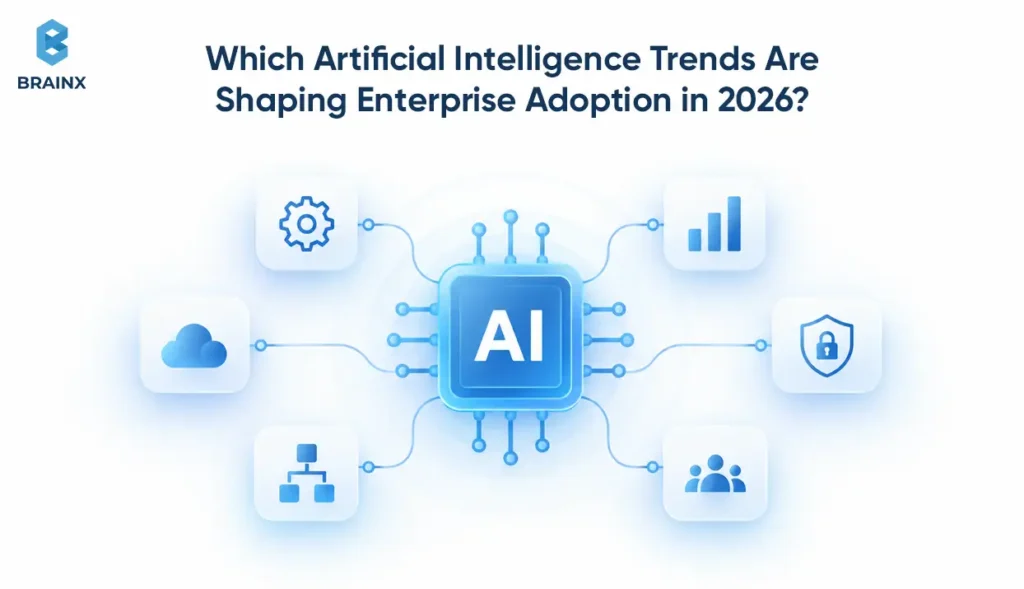
The most impactful enterprise AI trends span across models, applications, infrastructure, trust, security, and operations. Together, they move AI into governed workflows.
1. Agentic AI Moves From Copilots to Governed Autonomous Workflows
Agentic AI moves automation from recommendations toward multi-step execution. An agent can retrieve information, choose tools, call APIs, and update systems. The Model Context Protocol (MCP) provides a standardized way for AI applications to connect with external data sources and tools.
The key issue is consequence. Drafting a response is reversible; approving a payment is not. A sensible progression is: recommend -> draft -> act with approval -> reversible actions -> bounded autonomy.
Stanford HAI's 2026 AI Index shows why controlled rollout still matters as agent deployment remained in the single digits across nearly all business functions in 2025.
2. Multimodal AI Becomes Standard Across Enterprise Inputs and Interfaces
Multimodal AI enables the same workflow to work across text, images, speech, documents, screenshots, video and structured data. It matters because enterprise processes rarely arrive as clean text prompts.
A claims workflow may combine a form, scan, photograph, transcript, policy file, and customer record. Multimodal AI makes those fragmented inputs usable inside one governed workflow.
3. Domain-Specific and Smaller Models Challenge the One-Model-for-Everything Strategy
Enterprises increasingly have a model portfolio problem, not a "best model" problem. Frontier models may suit difficult reasoning, while smaller models can fit narrow, high-volume tasks better. Evaluate quality, latency, privacy, throughput, deployment constraints, and cost. RAG grounds a model in approved knowledge; fine-tuning changes model behavior.
4. Context Engineering and Enterprise Knowledge Layers Matter More Than Prompt Tricks
Dependable enterprise AI increasingly depends on supplying the right context, not finding one clever prompt. Context engineering covers instructions, retrieved knowledge, permissions, tool definitions, operational data, and session state. RAG still needs ownership, freshness rules, metadata, and access controls. The advantage shifts toward permission-aware knowledge and integration layers. For practical architecture patterns, see BrainX's AI integration services guide.
5. Enterprise AI Platforms and AI Factories Industrialize Deployment
Large organizations are standardizing AI through shared platforms for model access, routing, evaluation, observability, security, deployment, and cost tracking. At a very large scale, some use "AI factories" for development and high-volume inference. Spectro Cloud's 2026 analysis notes that AI factory hardware is specialized, complex, and expensive, with additional demands around integration, security, observability, and multitenancy. Architecture should therefore follow workload scale.
6. Sovereign, Private, and Edge AI Expand Enterprise Deployment Choices
Enterprise AI architecture is becoming more distributed as organizations balance capability, residency, privacy, latency, connectivity, and regulation.
Private AI keeps processing in controlled environments. Sovereign AI adds jurisdictional requirements around data, compute, models, or control. Edge AI moves inference closer to devices. These options come into consideration when latency, connectivity, or compliance make public-cloud-only deployment unsuitable.
7. AI Governance Shifts From Policy Documents to Runtime Controls
AI governance is moving into production architecture. Runtime controls can include AI inventories, risk tiers, evaluation gates, identity controls, approvals, monitoring, incident processes, and audit evidence.
European Commission guidance confirms that Article 50 transparency obligations under the EU AI Act apply from August 2, 2026. Certain AI systems placed on the market before that date have a transition until December 2, 2026 for Article 50(2), so compliance timing should still be assessed by system and use case. Our AI TRiSM enterprise guide explains how governance, risk, security, privacy, evaluation, and monitoring can be operationalized across the AI lifecycle.
8. Agent Identity, Permissions, and Observability Reshape AI Security
When AI can select tools and act independently, security must cover the agent's identity, permissions, memory, instructions, connections, and transaction authority. OWASP's Top 10 for Agentic Applications 2026 identifies critical risks facing autonomous and agentic systems and provides an operational framework for reducing those risks. In practice, enterprises should apply least privilege, action logging, transaction boundaries, approval for consequential actions, and rapid shutdown controls.
9. AI-Assisted Software Engineering Accelerates Enterprise Modernization
AI-assisted engineering now extends into testing, documentation, migration, refactoring, and repository analysis. It can accelerate modernization, but faster code generation does not guarantee better architecture, security, testing, maintainability, or production ownership. BrainX's AI-assisted enterprise app development guide explores how teams can use AI across the development lifecycle while keeping experienced engineers responsible for architecture, security, integration, and release decisions.
10. Artificial Intelligence Market Trends: Investment, Compute Costs, and Efficiency Pressure
The defining artificial intelligence market trends combine accelerating investment with pressure to control infrastructure economics. Stanford HAI reports that global corporate AI investment reached $581.69 billion in 2025, up 129.9% year over year, while compute costs and infrastructure spending also reached record levels.
Attention is shifting from cost per token toward cost per successful task. Routing, caching, batching, smaller models, and fewer unnecessary agent steps can improve unit economics.
The maturity labels below are a BrainX decision-support heuristic, not externally validated research.
| Trend | Enterprise Impact | Adoption Maturity | Main Dependency |
| Agentic AI | Multi-step automation | Pilot selectively | Permissions and evaluation |
| Multimodal AI | Richer input handling | Focused deployment | Data and evaluation |
| Smaller/domain models | Better fit and economics | Deploy where suitable | Model evaluation |
| Context engineering | Better grounding | Adopt now | Governed data |
| AI platforms/factories | Standardized operations | Platform now; factory at scale | Platform engineering |
| Sovereign/private/edge AI | More deployment options | Requirement-led | Deployment topology |
| Runtime governance | Enforceable controls | Adopt now | Risk ownership |
| Agent security | Safer autonomous access | Required with agents | Identity and observability |
| AI-assisted engineering | Faster modernization | Adopt with controls | Testing and architecture |
| AI economics | Sustainable scaling | Adopt now | FinOps and telemetry |
What Do AI Trends Mean for Enterprise Business Value?
The most important metric is not AI usage. It is what the deployment changes. Leaders need to move from activity metrics toward workflow, customer, financial, quality, and strategic outcomes.
How Artificial Intelligence Trends Are Changing Enterprise Buying Priorities
Enterprise AI buying decisions increasingly evaluate production fit, not benchmark performance alone. Buyers ask whether a system connects to enterprise data, enforces permissions, supports model choice, measures outputs and actions, and meets privacy, cost, sector, and geographic requirements.
Workflow Redesign Creates More Value Than AI Tool Access Alone
Individual productivity matters, but end-to-end workflow redesign can change business economics. A support workflow can classify requests, retrieve context, prepare approved resolutions, update the CRM, and route exceptions to humans. Deloitte's 2026 enterprise AI research argues that access and usage are poor proxies for transformation; a stronger test is whether AI changes decisions, handoffs, cycle time, and quality.
AI ROI Is Expanding Beyond Time and Cost Savings
Credible AI ROI should connect deployment to business outcomes rather than stop at hours saved.
| Measurement Level | Example |
| Activity | Users, tasks, queries |
| Productivity | Handling time, output |
| Workflow | Cycle time, throughput |
| Business outcome | Revenue, retention, quality, risk |
| Strategic capability | Faster products, new services, better decisions |
This creates an AI value ladder: activity -> productivity -> workflow -> business outcome -> strategic capability. Define the baseline before implementation, then measure the result after deployment.
Workforce Roles Shift Toward AI Supervision, Exception Handling, and Operations
As routine generation becomes automated, people spend more time defining objectives, reviewing exceptions, validating outcomes, and deciding when AI should not act. AgentOps and AI operations add responsibility for evaluations, incidents, costs, permissions, and continuous improvement.
Which AI Trends Should Your Enterprise Prioritize First?
No enterprise should pursue all ten trends equally. Prioritize by business impact, readiness, risk, maturity, implementation difficulty, and operating cost.
BrainX Enterprise AI Adoption Priority Matrix
The BrainX Enterprise AI Adoption Priority Matrix is a decision-support framework, not market research.
| Dimension | Decision Question |
| Business impact | Does this improve an important outcome? |
| Data readiness | Is required data accurate, current, accessible, and permissioned? |
| Integration complexity | How many systems and handoffs must change? |
| Security/compliance exposure | What is the consequence of failure or misuse? |
| Human oversight requirement | Which decisions require review or approval? |
| Technical maturity | Can this be evaluated reliably today? |
| Time to measurable value | How quickly can an outcome be observed? |
| Ongoing operating cost | What will production use cost at scale? |
Sheikh Hunain, Chief Innovation Officer at BrainX Technologies, writes: "The next wave of companies won't add AI on top of old systems. They'll build around it..."
Adopt Now, Pilot Selectively, or Monitor
Adopt-now foundations include permission-aware retrieval, enterprise integration, evaluation, runtime governance, cost telemetry, and controlled AI-assisted development. Pilot higher-autonomy workflows with bounded, reversible actions. Consider specialized infrastructure only when scale justifies it.
The Right Trend Depends on the Workflow, Not the Hype Cycle
A support team may prioritize RAG and CRM integration. A manufacturing plant may justify edge inference for low-latency sensor decisions. A regulated financial workflow may keep consequential actions behind human approval.
The technology shortlist should emerge from workflow requirements.
What Must Be Ready Before Enterprises Scale AI?
Model access is rarely the hardest production dependency. Enterprise AI needs five readiness layers: data, integration, evaluation and observability, security and governance, and organizational ownership.
Data Quality, Ownership, and Permission-Aware Access
AI cannot reliably ground decisions unless the organization knows which data is authoritative and who may access it. Readiness includes ownership, lineage, freshness, retention, classification, and permissions. A RAG system should never bypass existing authorization rules.
Integration Architecture Across APIs, CRMs, ERPs, Data Platforms, and Legacy Systems
Enterprise transformation usually requires operational connectivity across CRMs, ERPs, data platforms, and legacy systems. That requires authentication, reliable connectors, failure handling, and reconciliation when a multi-system workflow fails partway through.
Evaluation and Observability Before Production Scale
Enterprise AI should have success and failure criteria before autonomy or user volume expands. Evaluate correctness, retrieval quality, tool selection, task completion, latency, policy compliance, and cost. Production observability should also track errors, model changes, agent traces, escalations, and the business KPI.
The NIST AI Risk Management Framework continues to be a voluntary cross-sector reference for AI risk management, and NIST says AI RMF 1.0 is under revision in 2026 as part of the U.S. AI Action Plan.
Security, Governance, and Compliance by Risk Level
Controls should become stricter as the consequence of failure increases. Classify use cases by data sensitivity, decision impact, autonomy, legal obligations, and reversibility. Next, add NIST, OWASP, rules from your sector and any jurisdiction-specific regulation where applicable.
Ownership, Workforce Readiness, and Change Management
Every production AI workflow needs named owners for behavior and outcomes. Teams should be aware of who has the authority to approve changes, owns the KPI, reviews exceptions, investigates incidents, expands autonomy, and can suspend the system.
What Causes Enterprise AI Programs to Stall in 2026?
Rather than weak models, enterprise AI programs typically fail due to operating-model, integration, measurement, governance, or cost issues.
Pilot Sprawl Creates Activity Without Enterprise Capability
Disconnected proofs of concept create activity without reusable capability. Standardize successful integrations, evaluation suites, identity controls, and observability. Retire weak pilots.
Legacy Workflows Remain Unchanged After AI Is Added
The addition of AI to a poor workflow can help one step to become faster but not eliminate the bottleneck. Map the process end to end and identify where decisions, handoffs, approvals, and system boundaries should actually change.
Teams Deploy Without Baselines or Success Metrics
An AI initiative cannot prove improvement when the original workflow was never measured. Establish cycle time, cost, quality, error rate, conversion, or another meaningful baseline before implementation.
Agent Permissions Expand Faster Than Accountability
Agentic AI becomes risky when tool access grows faster than approval rules and ownership. Keep privileges task-specific, separate read from write access, log actions, and require approval when consequences exceed a defined threshold.
Model and Compute Costs Grow Without Fit-for-Purpose Routing
Costs can grow faster than value when every request uses the most expensive architecture. Monitor cost per successful workflow outcome and route requests according to difficulty, risk, latency, and required quality.
Shadow AI and Fragmented Tooling Undermine Governance
Uncoordinated AI adoption obscures which models receive company data and which workflows depend on unmanaged tools. Use approved tools, identity controls, data-handling rules, vendor review, and monitoring.
| Failure Mode | Early Warning Signal | Corrective Action |
| Pilot sprawl | Many demos, few reusable components | Standardize strong patterns |
| Unchanged workflows | Usage rises, KPI does not | Redesign one workflow |
| No baseline | Pre-AI performance is unknown | Establish workflow KPIs |
| Excessive agent access | Broad write permissions | Apply least privilege |
| Cost growth | Spend rises faster than task volume | Route models and measure unit economics |
| Shadow AI | Unknown tools handle sensitive data | Create approved tooling and visibility |
How Should Leaders Build a 2026–2027 Enterprise AI Roadmap?
Do not build an enterprise AI roadmap around ten technologies. Build it around valuable workflows and reusable capabilities.
Step 1: Baseline the Existing AI Portfolio and Business KPIs
Do an inventory of AI tools, models, vendors, pilots, data sources, integrations, owners, costs, risks, and controls. Document the workflow baselines that each initiative hopes to improve. This exposes overlap, missing owners, shadow AI, and projects without measurable objectives.
Step 2: Select One High-Value Workflow for End-to-End Redesign
Choose one workflow where better speed, quality, revenue, customer experience, or risk management is important. Start with a process such as support resolution, document review, knowledge retrieval, or software modernization, not an abstract goal such as "deploy agents." Deloitte's 2026 guidance similarly focuses on redesigning end-to-end workflows instead of just adding AI to existing process maps.
Step 3: Match Model, Architecture, and Deployment to the Use Case
Choose architecture after understanding the workflow. The final answer can be anything like managed API, small language model, RAG, fine-tuning, deterministic automation, an agent, private inference, or edge processing.
Utilize the most simple architecture that satisfies all quality, latency, privacy, security and scale requirements.
Step 4: Build Evaluation, Security, and Governance Before Expanding Autonomy
Define test cases, quality parameters, access rights, tools to be used, escalation rules, logging and procedures to be followed before granting authorities.
Start with recommendations, then allow approved or reversible actions, and widen autonomy only when measured performance supports the change.
Junaid Ahmed Qureshi, CEO of BrainX Technologies, advises: "Start with 'recommend and draft,' then graduate to 'act' only when confidence and auditability are proven."
Step 5: Instrument Business and Operational Value
Measure both technical performance and commercial workflow results. Track task success, retrieval quality, latency, errors, escalations, cost per successful task, cycle time, conversion, customer satisfaction, throughput, defects, or risk exposure as relevant.
Step 6: Standardize Reusable Patterns and Scale Selectively
Scale the capabilities that made the workflow reliable, including authentication, model gateways, permission-aware retrieval, integrations, evaluations, approvals, observability, and governance. BrainX's Ponder case study illustrates phased AI product development: the first version began as a proof of concept with voice-to-text and GPT-powered chat, then evolved into a more scalable native wellness product with structured and personalized features.
Transform AI Trends Into Enterprise Value with BrainX
The top artificial intelligence trends for an enterprise are the ones that can be transformed into a better workflow, capability, or measurable business outcome.
BrainX Technologies helps organizations in assessing AI readiness, prioritizing use cases, aligning AI systems with current applications and governed data, developing production AI systems, and creating scalable deployment patterns. To learn more, check our AI development services that cover AI strategy, generative AI, agentic AI, RAG, AI integration, LLM development, and AI DevOps/MLOps.
For 2026–2027 planning, start with one valuable workflow, measure its baseline, assess risk, then build the smallest architecture that improves it.
Frequently Asked Questions
What artificial intelligence trends will have the biggest impact on enterprises in 2026?
The biggest trends include agentic AI, multimodal and specialized models, context engineering, new deployment options, runtime governance, agent security, AI-assisted engineering, and cost discipline. Together, they move AI into operations.
Is agentic AI mature enough for enterprise production use in 2026?
Yes, for bounded workflows with appropriate controls. High-consequence actions need stricter permissions, evaluation, logging, approvals, and escalation. Expand autonomy only when measured reliability supports it.
Should enterprises invest in larger AI models or smaller domain-specific models?
Most enterprises should evaluate a model portfolio. Larger models can suit difficult reasoning, while smaller models may offer better latency, privacy, cost, or deployment fit. Measure against the real task and route workloads accordingly.
How can CIOs decide which AI initiatives are worth funding now?
Prioritize initiatives that combine material business impact with sufficient data, integration, security, and organizational readiness. Start with a workflow baseline and measurable outcome, then assess complexity, oversight, operating cost, and time to value.
What infrastructure and data capabilities are required to scale enterprise AI?
Scaling enterprise AI requires governed data, reliable integrations, model access or routing, evaluation, observability, identity and permissions, security controls, and operational ownership. Add specialized infrastructure only when requirements justify it.
How should businesses measure whether AI adoption is creating real ROI?
Compare business and workflow outcomes before and after implementation, not just licenses or prompts. Useful measures include cost per successful task, cycle time, throughput, quality, customer outcomes, revenue influence, and risk reduction.