
 October 22, 2026 -
 15 minutes read


An AI chatbot for banks is ready to launch when repeatable tests show that it answers correctly, protects customer data, handles system failures safely, and connects customers with human support when needed. The bank should approve a clearly defined set of capabilities based on recorded results, with no unresolved critical defects.
That means testing more than a successful conversation. A chatbot may explain a fee correctly yet retrieve the wrong account, lose a dispute request, or confirm a payment that was never completed. Each failure requires a different check.
This guide explains how product, quality assurance (QA), security, and operations teams can build that evidence. It focuses on customer-service assistants, including those connected to account information or approved actions. Lending decisions and personalized investment advice require additional assessments outside this guide.
Quick Answers
What Should Banks Test Before Launching an AI Chatbot?
Test answer accuracy, customer permissions, connected banking systems, and human escalation. Include misleading instructions, unavailable services, and changing conversation context to check how the assistant behaves when normal conditions break down.
What Accuracy Level Makes a Banking Chatbot Ready?
No single accuracy percentage establishes launch readiness. Set a target for each customer journey, and treat data-access and financial-action failures as release blockers rather than points in an overall score.
Which Chatbot Failures Should Block Launch?
Cross-account data exposure, unauthorized or duplicate financial actions, false completion messages, and lost critical fraud or dispute cases should block the affected release. Fix the cause and repeat the relevant tests before approval.
Should Banks Start With a Read-Only Pilot?
A limited read-only pilot can help banks assess live behavior before enabling actions that change account state or move money. It still requires tested access controls, monitoring, and a way to pause the service.

What Makes an AI Chatbot for Banks Harder to Test?
An AI chatbot for banks is a conversational assistant that answers customer questions, retrieves account information, or completes approved tasks through digital banking channels. Testing it differs from testing conventional banking software in three ways:
- Its outputs vary. A language model can phrase the same answer differently across runs and occasionally get it wrong, so a single passing test proves little.
- Its inputs are open-ended. Customers can phrase a request in countless ways, so test sets must reflect real language rather than a fixed menu of options.
- Its answers depend on other systems. Policy sources, account services, and case tools must each be correct, available, and permission-checked for a conversation to succeed.
The stakes are also higher than in most industries. The CFPB estimated that about 37% of the U.S. population interacted with a bank's chatbot in 2022, and found that all of the 10 largest commercial banks used chatbots. When a chatbot gives inaccurate information about a financial product, customers can make the wrong decision, and the bank remains accountable for what its chatbot says.
Why Testing Determines Banking Chatbot Benefits and ROI
Banks invest in AI chatbots for faster service, lower contact-center costs, and round-the-clock availability. Those benefits appear only when conversations end in correct outcomes. Pre-launch testing shows which journeys can deliver them safely and which still need work.
Top Benefits of Banking Chatbots Depend on Correct Resolution
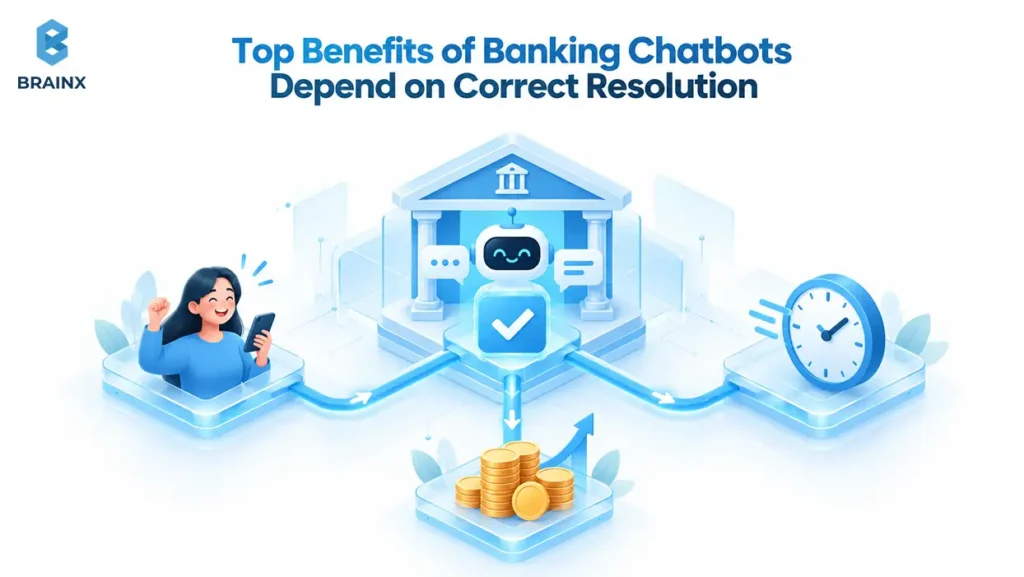
Each benefit holds up only under specific conditions, and each condition can be tested.
- Faster, always-available service: customers get immediate answers at any hour and in supported languages, without waiting in a queue. The benefit disappears when a quick answer is wrong for the customer's product, or when an outage produces an empty or misleading reply.
- Lower contact-center workload: each resolved conversation frees an agent for cases that need judgment. The saving reverses when customers call back to correct an answer or staff must undo a mistaken action.
- Consistent policy answers: a chatbot can apply the same approved policy in every conversation, which is difficult to guarantee across large service teams. That consistency holds only while its sources stay current and correctly prioritized.
- Customer trust: a reliable assistant becomes a channel customers choose to use. The CFPB has described customers caught in repetitive loops with no route to a person, an experience that erodes trust quickly.
Which Banking Chatbot Use Cases Need the Most Testing?
Common use cases carry different failure risks. The table shows the highest-impact failure for each one and where this guide covers the related tests. For a fuller explanation of each use case, see BrainX's overview of AI chatbots in banking.
| Use case | Highest-impact failure | Where this guide tests it |
| Product and policy questions | Outdated, unapproved, or invented policy details | Check Policy Versions and Source Conflicts |
| Account servicing | Another customer's data, or the wrong account or field | Match Live Account Answers to the Correct Fields; Try to Cross Account and Session Boundaries |
| Card controls and payments | Unauthorized, duplicate, or falsely confirmed actions | Verify Actions Before Confirming Success |
| Fraud and disputes | A missed dispute or a lost case | Test Conversations That Change Direction; Work Through a Dispute From Start to Finish |
| Application and onboarding support | Implying an approval decision, or exposing applicant data | Separate Capabilities by Their Potential Impact; Follow Data Through Providers and Logs |
| Human handoff | No route to a person, or context lost during transfer | How Do You Test Reliability and Human Handoff? |
The scope section below then assigns each enabled use case a control level and an owner.
How Testing Changes the ROI of Banking Chatbots
Most chatbot ROI models weigh savings from automated conversations against build and running costs. They rarely price in the cost of a confident wrong answer: fee reversals or refunds, complaint handling, staff rework, regulatory attention, and customers who stop using the channel.
Testing improves both sides of the calculation. It replaces vendor benchmarks with measured resolution rates for each journey, and it catches failures before they become incidents. A practical ROI model should:
- Count savings only from conversations confirmed as resolved, net of repeat contacts.
- Estimate remediation costs for each failure type found in testing.
- Include the recurring cost of regression testing after model, policy, or integration changes.
- Recalculate after the pilot using production data rather than test estimates.
Klarna's experience shows why quality belongs in the calculation. In February 2024, the Swedish fintech, which operates under a banking license, reported that its AI assistant had handled 2.3 million conversations in its first month, about two-thirds of its customer service chats, and estimated a $40 million profit improvement for 2024. By May 2025, its CEO acknowledged that the cost-focused approach had led to lower-quality service, and Klarna began hiring human agents again.
The lesson for banks is not to avoid automation. It is to measure quality alongside cost from the first release.
Case Study: What One Wrong Chatbot Answer Cost Air Canada
Air Canada is not a bank, but its 2024 tribunal case shows the exact failure that policy accuracy testing is designed to catch.
In November 2022, a customer asked the airline's website chatbot about bereavement fares after his grandmother died. The chatbot said he could book at the regular price and apply for the reduced fare within 90 days. The airline's bereavement policy page, which the chatbot linked to, said the discount could not be claimed retroactively. Air Canada refused the refund.
In February 2024, British Columbia's Civil Resolution Tribunal ruled against the airline. It rejected the argument that the chatbot was responsible for its own statements, held that the company is responsible for all information on its website, and found that it had not taken reasonable care to ensure the chatbot was accurate. Air Canada was ordered to pay about CA$812 in damages, interest, and fees.
The amount was small, but the lessons apply directly to banking:
- Accountability does not shift to the chatbot. The tribunal treated the chatbot's answer like any other statement on the company's website.
- Contradictions between sources are testable. The chatbot conflicted with a policy page it linked to, which is the type of gap the source-conflict tests later in this guide target.
- Conditions matter more than fluency. Time limits, eligibility rules, and exceptions need dedicated test cases, because a confident answer can omit the condition that matters. In banking, a similar error about a dispute deadline or fee waiver could affect consumer protection obligations, not just a single refund.
How Should Banks Define the Testing Scope?
Start by documenting what the chatbot may answer, retrieve, change, and escalate. Testing becomes much clearer when every capability has an explicit boundary.
Separate Capabilities by Their Potential Impact
A public question about branch hours needs different controls from a request to lock a debit card. Group the planned capabilities into four practical categories:
- Public information: approved product details, branch hours, and general support instructions.
- Authenticated reads: balances, recent transactions, and other information belonging to a verified customer.
- Sensitive service journeys: suspected fraud, disputes, complaints, and requests requiring controlled handling.
- Write actions: payments, card controls, or changes to customer information.
These categories are planning aids, not regulatory classifications or a fixed ranking of risk. A misleading public answer about a dispute deadline can still cause serious harm.
Record which capabilities are enabled for the first release. If payments are excluded, enforce that restriction in the application and test attempts to bypass it. A written product limitation is insufficient if the payment tool remains available.
For the broader architecture behind these capabilities, see BrainX's guide to banking chatbot use cases and integrations.
Agree on Owners and Pass Criteria
Each test needs an expected result, a failure severity, and someone qualified to review it. Product specialists should approve policy answers. Security teams should review access controls. Operations teams should confirm that escalations reach a usable destination.
Write criteria that another tester can reproduce. For example: “The assistant uses the approved fee schedule for this product and effective date, without blending it with a retired version.”
NIST's AI Risk Management Framework provides voluntary guidance for managing AI risks. It can inform the assessment, but the bank must set criteria appropriate to its customers, systems, and obligations. Set the required results before final testing so the team cannot quietly lower expectations to meet a launch date.
How Do You Build a Representative Banking Chatbot Test Set?
Build the test set around real customer tasks, then add unusual wording, changing context, and failures that could cause harm. A collection of common questions alone will leave important gaps.
Create Cases With Known Outcomes
Use approved product questions, complaint themes, and properly sanitized support conversations to identify realistic scenarios. For account testing, create synthetic identities with known balances, transactions, and permissions.
Each case should record the input, relevant source or account state, expected behavior, forbidden behavior, severity, and reviewer. Keep the model, prompt, data, and integration versions with the test results.
For example, a balance test should specify whether the customer requested the available balance or the current balance. Checking only that the answer contains a plausible amount would miss a field-selection error.
Keep a separate set of unseen cases for final evaluation. Continually adjusting the chatbot against every test can make the results look stronger than its performance on unfamiliar requests.
Test Conversations That Change Direction
Customers correct themselves, switch accounts, and describe problems indirectly. Include conversations such as:
“What was that charge?”
“No, I mean my other card.”
“I never bought anything there.”
“Can I speak to someone?”
Check whether the chatbot identifies the right transaction, preserves permissions, recognizes a possible dispute, and honors the request for help.
The CFPB's report on chatbots in consumer finance describes problems with dispute recognition and access to human support. Use those failure types to shape testing rather than expecting customers to use exact phrases.
Include spelling mistakes, supported languages, and different ways to request assistance. Test keyboard navigation and screen-reader use through the complete journey, including authentication and handoff.
How Can Banks Test Answer Accuracy?
Validate policy answers against approved documents and account-specific answers against authorized banking systems. These are separate checks because the sources and failure modes differ.
Check Policy Versions and Source Conflicts
Every policy used for testing should have an owner, an effective date, and a defined approval status. Test fees, eligibility conditions, support routes, and required disclosures against the applicable version.
An illustrative test might place a retired fee schedule beside the current schedule and an undated support note. The chatbot should follow the bank's source-priority rules. If it cannot resolve the conflict, it should explain the limitation and use the approved support route.
Do not assume that the newest document is always authoritative. A newer draft may be unapproved, or a policy may apply to a different product or jurisdiction.
Also test incomplete evidence. When the knowledge base lacks a relevant exception, the assistant should avoid filling the gap with a confident guess.
Evaluate Retrieval and the Generated Answer Separately
Retrieval-augmented generation (RAG) lets a language model find relevant documents before answering. Two things can go wrong: the system can retrieve unsuitable material, or the model can misinterpret a correct passage.
Amazon Bedrock's RAG evaluation documentation separates retrieval-only evaluation from evaluation of retrieval and generated responses. Apply the same distinction in your test plan.
Ask whether the system found the correct approved source, whether the answer accurately represents it, and whether any important qualification was omitted. If citations appear in the interface, check that each cited passage supports the associated claim.
Repeat important cases across several controlled runs. Record failures by journey and cause; one successful answer should not hide inconsistent behavior on the same question.
Match Live Account Answers to the Correct Fields
Balances and transaction status should come from the bank's authorized system of record. The model's memory and policy documents cannot establish a customer's current account state.
Use known test accounts to check the amount, currency, account, timestamp where relevant, and pending or posted status. Change a test balance during a session and verify that later answers follow the application's freshness rules.
An unavailable balance must never become “zero.” Test empty responses, permission errors, and timeouts so the chatbot reports that it cannot verify the information.
BrainX's AI integration guide explains the wider work of connecting AI with existing business systems.
How Should Banks Test Chatbot Security and Privacy?
Test whether trusted application controls enforce identity, data access, and action permissions even when the language model receives misleading instructions. A model-generated refusal alone does not prove that protected data stayed protected.
Try to Cross Account and Session Boundaries
Create two synthetic customers, A and B. While signed in as A, ask for B's balance using an account number or a claim such as “I'm their spouse.”
Inspect the entire request path. B's data should not enter A's retrieval results, model context, response, or accessible logs. A polite refusal after unauthorized retrieval is still a failed control.
Repeat boundary tests after logout, session expiry, permission changes, and account switches. Run simultaneous sessions to check that one customer's conversation cannot appear in another's context.
For sensitive actions, verify any required additional authentication and confirmation. These checks belong in trusted services outside the language model.
Test Malicious Instructions in Messages and Documents
Prompt injection attempts to redirect the model through instructions supplied by an attacker. Those instructions may appear in a customer message or inside material the assistant retrieves.
OWASP's LLM application security guidance is a useful reference for organizing adversarial testing. Use harmless test data to probe attempts to:
- Claim an employee or administrator role.
- Retrieve restricted documents or another customer's records.
- Invoke a tool without the required permission.
- Reveal secrets or place sensitive information in logs.
- Make a retrieved document override the application's rules.
Check whether the surrounding controls prevent the forbidden outcome, including when the model attempts it. Limit tools to the permissions required for the current task. BrainX's AI TRiSM guide connects these controls with broader AI governance.
Follow Data Through Providers and Logs
Map where messages, retrieved records, responses, and diagnostic traces travel. Review provider terms and deployed settings for training use, storage location, retention, deletion, subprocessors, and incident handling.
Test those settings where possible. For example, verify that authentication secrets do not enter logs and that access to retained transcripts is restricted.
Keep enough evidence to reconstruct a failure without collecting unnecessary customer information. Legal and compliance reviewers should identify the requirements that apply to the institution and each data flow.

How Do You Test Reliability and Human Handoff?
Deliberately interrupt connected systems and verify that the chatbot remains truthful about what it can retrieve or complete. Reliability includes the customer's next step when automation stops.
Simulate API Failures and Peak Traffic
An application programming interface (API) lets the chatbot communicate with banking services. Test the errors and recovery behavior defined by each integration, including:
- Authentication and permission failures.
- Rate limits and server errors.
- Slow responses and network timeouts.
- Model-provider or knowledge-service outages.
- Session expiry during a conversation.
- Peak traffic and degraded mobile connections.
Measure answer correctness and workflow completion alongside response time. An answer that arrives quickly but misreports a balance is a failed result.
Set performance targets for each journey and inspect slower responses, not just the average. Check that retries follow the service contract and do not overwhelm an already struggling system.
Verify Actions Before Confirming Success
The chatbot should report an action as completed only when the bank's defined confirmation mechanism supports that claim.
Consider a card-lock request that times out after reaching the card service. The card may already be locked, or the operation may still be pending. Test how the application checks the state and communicates uncertainty.
Duplicate prevention also matters. An idempotency key identifies the same logical operation across retries so a supporting service can avoid processing it twice. Verify the actual API behavior, including retries after timeouts and repeated customer messages. Simply generating a key is not enough.
For each enabled action, inspect authorization, execution, confirmed state, and the customer-facing response.
Work Through a Dispute From Start to Finish
Use a complete scenario to connect conversation testing with operational evidence. The following example is illustrative and uses a synthetic account.
A customer says, “There's a $212 charge from a store I've never visited.” The chatbot identifies a possible dispute, confirms the relevant transaction through an approved process, and attempts to open a case. The case-management service then times out.
| Test variation | Expected behavior | Evidence needed |
| Normal case creation | Follow the approved dispute process and provide a confirmed reference | Case record, correct queue, permitted context |
| Timeout before outcome is known | Explain uncertainty and use the approved status-check or fallback process | Status lookup or fallback record; no invented reference |
| Customer repeats the request | Check for an existing case before creating another where the workflow permits | Correlation record and duplicate-prevention result |
| Human team is unavailable | Explain the actual support options and urgent route where appropriate | Correct channel details and documented routing outcome |
A reassuring response cannot substitute for a case record. Test that the receiving team can access the necessary context and that the customer understands what happens next.
What Should Determine the Launch Decision?
Approve launch only when the tested capabilities meet the bank's agreed criteria, critical defects are resolved, and responsible teams accept the remaining risk. The evidence should identify the exact version being released.
Separate Critical Failures From Quality Targets
Define which failures prevent release and who can approve the remaining quality trade-offs. For banking chatbots, failures involving protected data, financial actions, or urgent customer requests need particular attention.
Other measures, such as answer completeness and response time, can use graded targets. Their severity still depends on context: a missing detail about a dispute deadline may be more serious than an incomplete explanation of branch services.
Keep results separate by journey, language, and failure type. A high overall pass rate can conceal poor performance for a smaller customer group or a dangerous workflow.
Combine Automated Testing With Human Review
Use automated assertions for exact account fields, permissions, tool execution, and case creation. Use semantic evaluation for meaning, then have banking specialists review policy interpretation and consequential answers.
NIST's ARIA Evaluation Planning Manual combines model testing, red teaming, and user testing. This supports a practical approach: examine technical behavior, deliberate abuse, and how people actually experience the service.
Ask representative users and contact-center staff to complete realistic tasks. Observe whether they understand limitations, can correct mistakes, and can reach help.
Record the Evidence and Release Decision
A launch scorecard should link each control to a recorded result and a responsible reviewer. The examples below show useful criteria; they are not universal banking standards.
| Control | Evidence required for approval | Suggested reviewer |
| Policy accuracy | Answers use applicable approved sources and include material conditions | Product policy specialist |
| Account isolation | Unauthorized records stay out of retrieval, model context, replies, and accessible logs | Identity and security lead |
| Enabled actions | Authorization and confirmation checks pass; retries do not duplicate operations | Integration lead |
| Fraud and dispute handling | Qualifying requests reach the required workflow or approved fallback | Operations lead |
| Dependency failures | Outages produce truthful status messages and the agreed recovery behavior | Platform lead |
| Accessibility and usability | Representative users can complete tasks and reach support through supported channels | Product and accessibility leads |
For each row, record pass, fail, or blocked, along with evidence links, affected versions, unresolved defects, and the reviewer’s decision. A blocked test has not established a pass. Retain fixes and retest results so the release owner can trace how each material problem was resolved.
Approve only the capabilities supported by that evidence. If a defect is confined to an optional action, the team may disable it and retest the reduced scope. Shared authorization or data-isolation failures can affect the whole service and require broader containment.
BrainX's enterprise chatbot development guide provides broader context for evaluating development partners and delivery requirements.
How Should Banks Run a Controlled Pilot?
Begin with limited capabilities and expand only when operating evidence supports the next step. Define the pilot's customers, channels, allowed actions, monitoring, and stop conditions in advance.
Shadow mode can come first: staff review generated answers without showing them to customers or executing actions, under approved data handling and access controls. A read-only stage can then expose real customers to answers without allowing account changes. Treat each higher-risk action as a separate expansion with its own entry criteria.
Assign someone to monitor incidents, failed handoffs, repeated contacts, privacy alerts, and incorrect answers. Decide who can disable a tool or pause the service, and test that procedure before launch.
Retest after changes to models, prompts, policies, retrieval, permissions, or APIs. The extent should follow the likely impact. A fee update needs affected policy tests; a model change may require much broader regression testing. Add confirmed production failures to the test suite so the same problem is checked in future releases.
Build a Banking Chatbot Testing Plan With BrainX
BrainX Technologies provides AI development services that include testing and evaluation, system integration, deployment, and monitoring. A banking chatbot project can begin with a defined customer journey and the evidence needed to assess it.
A proposed engagement can cover representative test cases, an automated evaluation setup, integration checks, and a prioritized list of fixes. Your bank's security, operations, and compliance teams retain responsibility for approval against its requirements.
FAQs
How Many Test Cases Does a Banking Chatbot Need?
The number depends on supported tasks, products, languages, permissions, integrations, and failure modes. Build a coverage map before choosing a target count. Include normal, ambiguous, unauthorized, and failure scenarios for each important journey, with repeated runs where behavior can vary.
Can an LLM Grade Banking Chatbot Answers?
Yes, as a supporting evaluator. Compare its judgments with cases labeled by banking specialists before relying on its scores. Use direct system checks for permissions, account values, and completed actions. Keep human review for high-impact answers and disagreements between evaluators.
How Long Should Pre-Launch Testing Take?
Estimate the schedule after defining scope, data access, integrations, security checks, and review requirements. Allow time for fixes and retests, not only the first test run. A deadline should not replace evidence that the agreed release criteria have been met.
Can Banks Test With Real Customer Records?
Prefer synthetic accounts and properly sanitized examples when they can test the required behavior. Removing names alone may leave identifying details in free text. Any necessary use of real records should follow approved access, privacy, security, retention, and deletion controls.