 September 23, 2026 -
 18 minutes read


Key Takeaways
- Chatbots in banking industry environments are not just limited to answering FAQs, but are becoming verified assistants to access account-related data and execute controlled actions.
- Their biggest value comes from integrating conversational AI into the core banking, CRM, payments, identity, fraud, and knowledge systems.
- High-value use cases include account servicing, payments, fraud support, onboarding, personalized insights, and employee assistance.
- Banks should measure chatbot ROI across customer experience, efficiency, AI quality, revenue impact, and risk rather than containment alone.
- Effective authentication, least-privilege access, sound responses, monitoring, auditability and human escalation are all important for securing deployments.
- Banks should gradually increase the scope of a chatbot, pushing its capabilities beyond information retrieval to transactions and only when controls justify it.
Conversational AI is reshaping the service channels and elevating them to intelligent resources for information, personalized support, workflow automation, and regulated banking actions. Chatbots in banking industry deployments can now engage customers in natural conversation to connect them with account data, payments, fraud systems and support teams.
Banking is different from a low-risk customer-service chatbot. An inaccurate answer can lead a customer to a wrong conclusion about an account. Weak authorization can expose sensitive financial data. Poor escalation can prevent someone from resolving a fraud report or disputed transaction.
Banks must recognize conversational AI as a component of their financial technology infrastructure, rather than just another chat interface.
What Are AI Banking Chatbots?
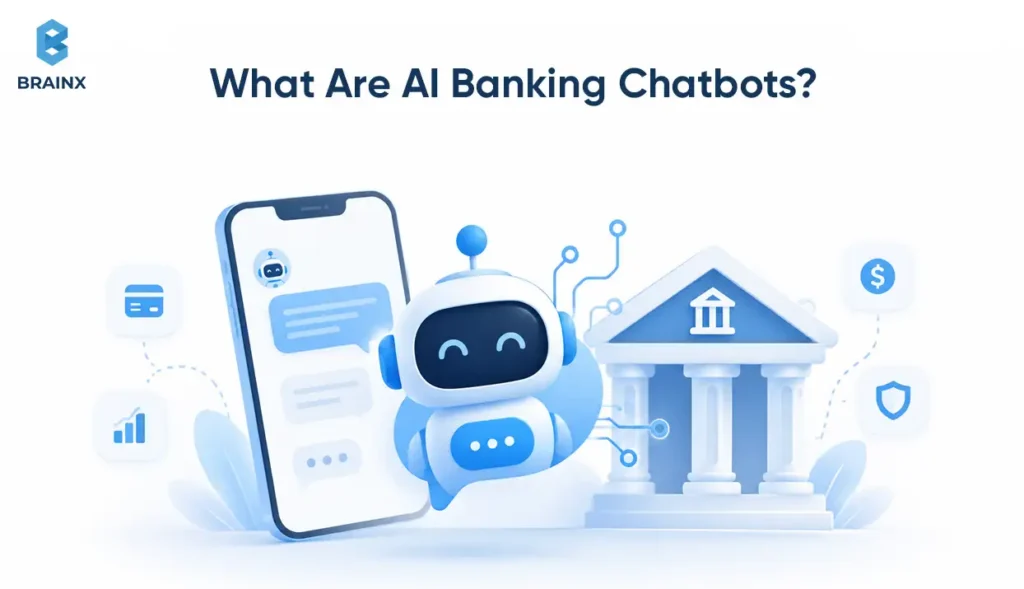
An AI banking chatbot is a conversational interface that helps customers or employees interact with banking information, services, and workflows using natural language. The modern systems can include deterministic business rules, customer context, APIs, Retrieval-Augmented Generation (RAG), and large language models (LLMs) combined with natural language processing (NLP).
The chatbot is the interface. Conversational AI is the broader technology that helps it understand and respond to language.
How Are AI Chatbots Different From Traditional Bots?
Traditional bots are mostly menu-driven, relying on intents or keywords, and scripted with responses. AI chatbots, however, can understand varied language, remember context, find information, and provide more natural responses.
This is by no means saying that all banking functions require an LLM. Deterministic flows remain appropriate for predictable steps such as validating an amount, selecting an account, or displaying a required disclosure.
Generative AI is most useful when customers use varying language or when information comes from multiple sources.
How AI Chatbots in Banking Industry Differ From Rule-Based Bots
AI chatbots in banking industry deployments become more capable when they combine natural-language understanding with authenticated customer context and banking systems.
A traditional bot may explain how to replace a debit card. An advanced assistant could identify the relevant card, guide verification, and invoke an approved card-management workflow.
Greater capability also increases risk. More data creates more privacy exposure, while additional tool access increases the consequences of errors or attacks. The CFPB's research on chatbots in consumer finance similarly distinguishes traditional rule-based systems from more advanced technologies using NLP, machine learning, and generative AI.
Banking Chatbots vs Conversational AI vs Virtual Assistants vs AI Agents
These terms sound similar, but their capacities aren't exactly the same.
| Aspect | Rule-Based Bot | Conversational AI | GenAI Assistant | AI Agent |
| Understanding | Fixed intents and menus | Natural-language context | Flexible generative interaction | Goal-oriented, multi-step reasoning |
| Data access | Limited or scripted | Enterprise/customer context | APIs plus RAG | Multiple approved tools and systems |
| Ability to act | Limited commands | Controlled workflows | May call approved tools | Sequences tools toward a goal |
| Risk | Lower | Depends on integrations | Higher output risk | Highest with real-system actions |
An AI agent differs because it can use tools across multiple steps to pursue a defined goal. For more context, see BrainX's guide to why AI agents are the next step after chatbots.
How Do AI Banking Chatbots Work Inside a Bank’s Technology Stack?
A production banking chatbot acts as an orchestration layer between the customer and the bank's systems. It understands requests, checks identity (if necessary), fetches allowed data, applies controls, calls upon approved services, logs activity and escalates if automation should not be continued.
Intent Detection, LLMs, and Conversation Context
Intent detection identifies what the customer wants to accomplish. An LLM can then interpret natural phrasing and relevant context.
For example, “Why did my balance fall after yesterday's transfer?” requires the assistant to understand the transaction, account, time reference, and customer intent rather than simply detecting the word balance.
Conversation memory should still be constrained. Previous messages should not automatically become trusted instructions for sensitive actions.
RAG Grounds Responses in Approved Banking Knowledge
Retrieval-Augmented Generation connects an LLM with external information before it generates an answer. In banking, RAG can retrieve current policies, product documentation, servicing procedures, or employee guidance.
AWS's RAG guidance explains how external enterprise data can provide more relevant context to a generative model.
RAG reduces reliance on model memory, but it does not guarantee accuracy. Retrieval can return the wrong material, and an LLM can misinterpret valid content.
RAG should also be separated from live transactional access. Policies may come from a knowledge repository. A customer's current balance should come from an authorized banking API or system of record.
Identity, Core Banking, CRM, Payment, and Fraud Integrations
Useful assistants commonly connect with:
- Identity and access management (IAM)
- Core banking systems
- Customer relationship management (CRM)
- Card and payment services
- Fraud systems
- Knowledge bases
- Contact-center platforms
The LLM should not become the authorization layer. Identity, access rights, transaction rules, and permissions should remain enforced outside the model.
BrainX's AI integration services guide covers similar data, permission, and workflow considerations for integrating AI with existing enterprise systems.
Tool Calling, Guardrails, Audit Logs, and Human Handoff
Tool calling lets an AI assistant request approved functions such as checking a transaction or locking a card.
Before a banking system changes anything, a separate control layer should verify identity, permissions, parameters, limits, and required confirmation.
Interactions and actions should also be logged. If the assistant comes across a conflict, a confusing transaction, a security concern or an unsupported request, it should pass sufficient context to a human representative to ensure the conversation proceeds smoothly.
How Chatbots in Banking Industry Are Transforming Financial Services
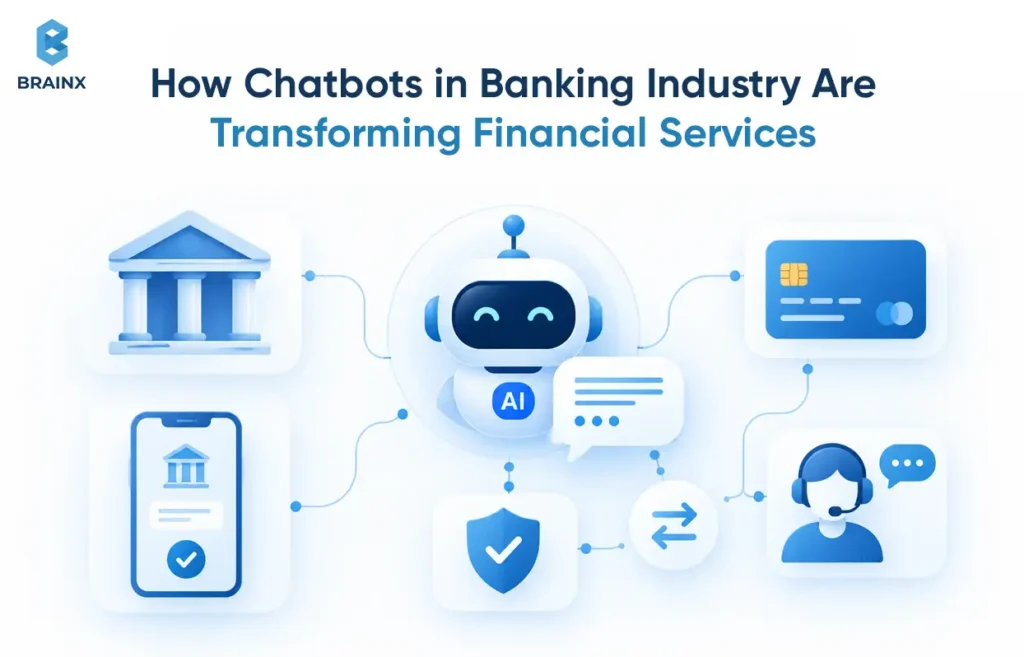
The strongest banking chatbot use cases combine frequent customer demand, clear process boundaries, accessible data, and measurable outcomes.
Customer Service and Account Servicing
Banking assistants can retrieve authenticated balances and transactions, explain account activity, answer service questions, and guide routine servicing.
Public questions and account-specific questions should follow different data paths. “What is an overdraft fee?” may use approved knowledge. “Why was I charged this fee?” requires authenticated account context.
Cards, Payments, and Transaction Support
Conversational AI can explain transactions, check payment status, lock cards, and initiate constrained workflows.
The assistant may interpret the customer's request, but card and payment systems should validate the actual action. Sensitive transactions may also require step-up authentication or explicit confirmation.
Fraud Alerts and Secure Verification Workflows
Chatbots can explain alerts, display transaction details, collect structured responses, and route customers into fraud workflows.
Capital One's Eno, for example, monitors account activity and can alert customers to potentially unexpected card transactions.
The conversational assistant supports the fraud process. It does not replace the bank's fraud engine.
Customer Onboarding, KYC, and Loan Application Support
Conversational AI can explain documentation requirements, guide Know Your Customer (KYC) steps, collect preliminary information, and provide application-status updates.
However, supporting a lending journey is different from making a lending decision. Underwriting, adverse actions, and other regulated outcomes require appropriate decision systems and governance.
Personalized Financial Insights and Proactive Notifications
Banking assistants can surface spending patterns, recurring charges, upcoming payments, and unusual activity.
Wells Fargo's Fargo virtual assistant helps authenticated mobile customers with everyday banking questions and spending insights.
Employee Agent Assist and Internal Banking Knowledge
Employee-facing copilots can retrieve approved policies, summarize customer context, and suggest next steps while a representative remains responsible for the interaction.
In July 2026, Bank of America reported that more than 18,000 customer-service representatives use EricaAssist.
| Journey | Main Systems | AI Role | Action Level | Human Review |
| Account servicing | IAM, core banking | Answer/retrieve | Read-only | Exceptions |
| Cards/payments | IAM, cards, payments | Answer/act | Constrained | Higher-risk actions |
| Fraud | Fraud engine, CRM | Verify/route | Limited | Often |
| Onboarding/KYC | CRM, KYC, documents | Guide/collect | Workflow steps | Exceptions |
| Lending | CRM, lending | Guide/status | Limited | Material decisions |
| Agent assist | CRM, knowledge | Retrieve/suggest | Staff-controlled | Human remains responsible |
For broader financial-services applications, see BrainX's guide to generative AI in finance.
What Business Value Can Banks Expect From AI Chatbots?
AI chatbots create value when they improve customer and operational outcomes, not simply when they automate more conversations.
Faster Service and Higher Digital Self-Service
A well-designed assistant can answer routine questions immediately without requiring a call-center queue.
But availability does not equal customer preference. Deloitte's 2025 banking chatbot research, based on 2,027 U.S. banking customers, found that 74% preferred a human agent even for routine interactions.
Banks therefore need effective self-service and accessible human support.
Lower Contact-Center Workload and Cost Per Resolution
Automation saves effort only when the chatbot resolves the issue.
Containment can be misleading if customers later call again, abandon the interaction, or file a complaint. Cost per resolved conversation is therefore more useful than cost per chatbot interaction alone.
Better Personalization, Engagement, and Product Discovery
Authenticated assistants can explain relevant products, surface useful account insights, and guide customers toward appropriate services.
Banks should still distinguish useful personalization from financial advice that requires stronger suitability or compliance controls.
Higher Agent Productivity Through AI Assistance
Employee copilots can reduce time spent searching policies and systems.
Bank of America reports that EricaAssist has reduced average call time by nearly one minute. That result belongs to one implementation, but it shows why employee assistance can deliver measurable operational value.
Risk Reduction Depends on Better Controls, Not Automation Alone
AI can amplify errors as quickly as successful processes.
| Outcome | Business Metric | Guardrail Metric |
| Efficiency | Cost per resolution, AHT | Repeat contacts |
| Customer experience | CSAT, FCR | Complaints, abandonment |
| Engagement | Journey completion | Inappropriate recommendations |
| Employee productivity | Assisted resolution time | Override/error rate |
| Risk | Safe completed workflows | Unauthorized actions, AI incidents |
The business case becomes stronger when efficiency improves without reducing accuracy, trust, or control quality.
What Can Banks Learn From Real-World AI Chatbot Deployments?
Leading banking assistants share four patterns: strong integration, gradual expansion, proactive assistance, and continued access to people.
Bank of America Erica: Scaling Customer-Facing AI Assistance
Erica shows the value of embedding conversational AI inside an authenticated banking experience.
Bank of America's July 2026 Fast Facts report 3.6 billion Erica interactions since its 2018 launch, including 1.9 billion proactive personalized insights.
The lesson is not simply scale. Repeat usage depends on the assistant helping customers with meaningful financial tasks rather than functioning as a searchable FAQ.
Bank of America EricaAssist: AI Supporting Human Service Representatives
EricaAssist applies AI to employee workflows while keeping representatives in control.
More than 18,000 service representatives use the system for contextual guidance. This demonstrates why human-agent copilots may create value before highly autonomous customer-facing agents.
Capital One Eno: Proactive Account and Fraud Assistance
Capital One's Eno combines customer questions with proactive monitoring and alerts around account activity and potentially unexpected card transactions.
Its main lesson is that conversational banking does not need to wait for the customer to initiate every interaction. Timely alerts can be valuable when they connect clearly to a safe next step.
Wells Fargo: Mobile Banking Assistance and Financial Insights
Fargo is integrated into Wells Fargo's mobile experience and supports everyday banking questions and financial insights.
The lesson is contextual integration: a virtual assistant becomes more useful when natural language connects securely with the customer's existing banking environment.
What Security, Privacy, and Compliance Controls Do Banking Chatbots Need?
A banking chatbot should never receive broader data access or action authority than its customer journey requires.
In February 2026, the U.S. Treasury released its Financial Services AI Risk Management Framework, describing it as a “tailored framework for managing AI risks in financial services.” OWASP's LLM Top 10 2026 addresses major security risks facing LLM-powered applications and agentic systems.
The BrainX Banking Chatbot Action-Risk Matrix below is an editorial decision framework, not a compliance standard.
| Tier | Interaction | Example | Recommended Boundary |
| 1: Inform | Public information | Account-opening requirements | Approved public knowledge |
| 2: Retrieve | Authenticated read-only data | Recent card payment | Authentication and authorization |
| 3: Act | Constrained action | Lock a card | Confirmation, validation, limits, logging |
| 4: Escalate/Approve | High-impact or ambiguous | Complex dispute | Human or enhanced approval |
Authenticate Customers Before Exposing Account-Specific Information
Private banking information should only be retrieved after the required identity assurance is established through trusted authentication systems.
Higher-risk tasks may require step-up authentication. An LLM should never determine identity based on conversation alone.
Apply Least-Privilege Access to Banking Data and Tools
Least privilege gives the assistant only the permissions needed for the current task.
An assistant retrieving a credit-card due date does not need permission to edit customer information. The same principle applies to RAG: retrieval must respect customer and employee access rights.
Protect PII, Financial Data, Prompts, Logs, and Retrieved Content
Personally identifiable information (PII) can appear in prompts, API responses, retrieved documents, histories, and logs.
Banks should map these flows and apply appropriate encryption, minimization, masking, retention, and permission controls. The critical question is which information reaches which component, why, and for how long.
Defend Against Prompt Injection, Misinformation, and Excessive Agency
Prompt injection attempts to manipulate an LLM through malicious or untrusted instructions. The risk increases when the model can access data or tools.
Practical controls include narrow tool scopes, authorization outside the model, parameter validation, separation of trusted and untrusted instructions, output checks, and adversarial testing.
Route Disputes, Financial Advice, and High-Risk Requests to Humans
Disputes, unclear fraud reports, ambiguous money movement, vulnerable customers, and material financial-advice requests may require human judgment or regulated handling.
The chatbot should escalate these cases instead of optimizing for maximum containment. The CFPB warns that deficient chatbots that block access to human support can create consumer harm and compliance problems.
Preserve Auditability, Retention Controls, and Governance Evidence
Banks need records showing what an AI system did.
Relevant evidence may include retrieved sources, tool calls, customer confirmations, API results, escalation decisions, model configurations, and final outcomes. Retention requirements should be aligned with the applicable jurisdiction and financial process.
How Should Banks Implement and Measure an AI Chatbot Program?
Banks should start with one bounded, measurable journey and expand only after proving data readiness, integration reliability, quality, safety, and customer acceptance.
Score Banking Use Cases Before Choosing the Technology
Start with a prioritized use-case shortlist, not a model.
Rate candidate journeys across business impact, conversation volume, data readiness, integration readiness, consumer risk, action complexity, human-handoff clarity, and measurability.
A high-volume read-only workflow with reliable data is often a safer first project than a valuable but high-risk transaction journey.
Define Customer Journeys, Risk Tiers, and Human Escalation
Map what the assistant may answer, retrieve, act on, refuse, or escalate.
The journey should also define where escalated customers go and what context is transferred to the human representative.
Prepare Approved Knowledge, Data Access, and Permissions
RAG content should have clear owners, versions, effective dates, and permission rules.
Live account and transaction data should continue to come from authoritative systems of record rather than semantic retrieval.
Choose Rules, RAG, LLMs, or Agentic Workflows by Use Case
Use the simplest architecture that solves the task reliably.
Rules suit predictable flows. RAG supports changing knowledge. LLMs improve natural-language understanding and generation. Agentic workflows are appropriate when controlled multi-step tool execution creates enough value to justify the added complexity and risk.
Integrate Identity, Core Banking, CRM, and Operational Systems
Expose narrow, permissioned services rather than giving an LLM broad access to databases or core systems.
Each integration should define authentication, authorization, parameters, limits, errors, timeouts, and logging.
Test Accuracy, Safety, Latency, Edge Cases, and Adversarial Inputs
Testing should cover normal requests and failure conditions such as ambiguous instructions, stale knowledge, permission violations, unavailable services, prompt injection, malicious retrieved content, unsupported advice, and attempted tool misuse.
NIST's AI RMF Generative AI Profile, published in 2024 and updated in April 2026, and OWASP's 2026 guidance provide useful foundations for risk and security testing.
Launch a Controlled Pilot Before Expanding Autonomy
Limit the first production release by customers, products, channels, or permitted actions.
Follow progressive autonomy: prove information retrieval first, then constrained actions, and only then consider broader multi-step workflows.
BrainX's enterprise AI chatbot development guide covers broader architecture, governance, and rollout considerations.
Measure Customer, Operational, AI-Quality, and Risk KPIs
Track four dimensions:
| Category | Metrics |
| Customer | CSAT, abandonment, escalation success, repeat contacts |
| Operations | Containment, FCR, AHT, cost per resolution |
| AI quality | Grounded-answer accuracy, intent accuracy, fallback rate, latency |
| Risk | Unauthorized actions, policy violations, complaints, AI incidents |
No single metric proves success. High containment with poor first-contact resolution may simply mean customers are trapped in automation.
What Determines Banking Chatbot Cost and Implementation Timeline?
There is no reliable universal cost or timeline.
The main variables are authentication, channels, legacy integrations, data readiness, permitted actions, model infrastructure, security, testing, and compliance review.
A read-only assistant for one journey can move much faster than an agentic system spanning payments, fraud, and several legacy platforms. Banks should estimate delivery after completing use-case, integration, data, and risk discovery.
How Are Banking Chatbots Evolving Into AI Agents?
The next stage of conversational banking is less about human-like wording and more about controlled tool use, workflow execution, proactive assistance, and human-AI collaboration.
From Answering Questions to Executing Multi-Step Banking Workflows
A chatbot may explain when a payment is due. A grounded assistant can retrieve the exact date.
A tool-using agent could retrieve the amount, present eligible accounts, request confirmation, invoke the payment service, verify the result, and report completion.
The bank's deterministic controls should still govern each action.
Human-Agent Copilots May Scale Before Fully Autonomous Customer Agents
Employee copilots provide a practical path toward more capable AI while keeping human judgment in the loop.
EricaAssist illustrates this approach at scale. For higher-risk workflows, helping employees make faster, better-informed decisions may deliver more near-term value than removing them.
Voice, Multimodal Interfaces, and Cross-Channel Continuity
Conversational banking is also expanding into voice and multimodal experiences involving speech, documents, and images.
Cross-channel continuity can let a customer move from chat to human support without repeating the issue. Any transferred context should remain permission-aware and limited to what the next channel needs.
More Autonomy Requires Stronger Identity, Permissions, and Monitoring
An agent that can change financial systems creates greater potential impact than an informational chatbot.
Banks therefore need stronger identity controls, permissions, confirmation requirements, action limits, monitoring, audit trails, and adversarial testing as autonomy increases.
A useful maturity path is:
Scripted Bot → Conversational Assistant → Grounded Banking Copilot → Tool-Using Agent → Bounded Autonomous Workflow
Authority should expand only when the previous level demonstrates sufficient reliability and control.
Build Secure AI Chatbots for Banking with BrainX
Building a banking assistant is an integration, security, and governance challenge as much as an AI challenge.
BrainX Technologies provides enterprise AI development capabilities across conversational AI, LLM development, RAG systems, AI integration, and agentic workflows. We help organizations design AI systems around their existing data boundaries, APIs, workflows, and measurable goals.
For a financial institution, the most useful starting point is one clearly defined journey. Establish its business value, required data, risk level, integrations, escalation path, and success metrics before deciding how much AI autonomy it actually needs.
FAQs About AI Chatbots in Banking
How secure are chatbots in banking industry deployments for account-specific tasks?
Banking chatbots can support secure account-specific workflows when strong authentication, authorization, data protection, monitoring, and escalation controls surround the AI. The LLM should never decide access rights itself. Banks should combine trusted IAM, least privilege, narrow tool permissions, audit logs, and AI-specific security testing.
Can a banking chatbot transfer money or change an account without a human agent?
Yes, but only for actions the bank has explicitly authorized and constrained. Deterministic banking services should verify identity, accounts, amounts, limits, rules, and customer confirmation. Ambiguous, high-value, disputed, advisory, or irreversible actions should receive stronger controls or human review.
What data and integrations does an AI banking chatbot need?
A banking chatbot should access only the systems needed for its approved journeys. These may include IAM, core banking APIs, CRM, payment services, fraud systems, knowledge repositories, and contact-center platforms. RAG can support knowledge questions, while live account facts should come from authorized systems of record.
Should banks use RAG, fine-tuning, or AI agents for conversational banking?
The choice depends on the task. Use RAG for changing approved knowledge, fine-tuning for specialized model behavior where justified, and AI agents for controlled multi-step workflows. Many production systems will combine deterministic rules, RAG, LLMs, and narrowly scoped tools.
How long does it take to implement an enterprise banking chatbot?
There is no universal timeline. A bounded pilot may take weeks to a few months, while transactional or agentic systems typically require more time. Authentication, legacy integrations, data readiness, security testing, compliance review, channels, and permitted actions are the main schedule drivers.
Should a bank build a chatbot in-house, buy a platform, or work with an AI development partner?
The best model depends on internal expertise and integration complexity. Platforms can accelerate common features, while in-house teams provide greater control. A development partner can help with custom RAG, system integration, security engineering, evaluation, and agentic workflows. Compare data ownership, flexibility, governance, lifecycle cost, and vendor lock-in before deciding.