

 June 8, 2026 -
  45 minutes read

Key Takeaways
- Generative AI in finance is best implemented when it supports governed workflows and not just standalone chat experiments.
- The safest early wins come from internal copilots, case summaries, compliance drafting, and policy-grounded support.
- Human review, citations, access controls, and audit trails should be built in from day one.
- RAG helps finance teams ground AI outputs in approved documents, policies, and system data.
- Start with one measurable workflow, prove accuracy and value, then scale with stronger governance.

Banks, fintechs, and finance teams are done “trying GenAI” as a side experiment. The conversation has shifted to production workflows, such as shortening investigation time in risk teams, writing and validating compliance documentation, speeding up customer support, and normalizing finance operations in close, reporting and reconciliations. Generative AI in finance is now most effective when it assists in reading, reasoning, and generating a proven and traceable work output, and not just conversing.
That shift is also showing up in the market. McKinsey estimates that generative AI could unlock $200 billion to $340 billion in annual value for banking if the highest-value use cases are fully implemented. KPMG-cited research also shows the tension finance leaders face: 51% of the financial sector says AI is already reshaping the business, while 72% remain concerned about data quality even though they use it regularly. That is why the opportunity is not just automation. It is automation with better data foundations, access control, and review.
If you are evaluating what to automate first, what architecture is “safe enough,” and how to avoid governance pitfalls, this guide breaks down the practical path from pilot to scaled rollout.
Although generative AI is reshaping many industries, its finance impact is different because every useful workflow must balance speed, accuracy, governance, and accountability.
What Is Generative AI In Finance?
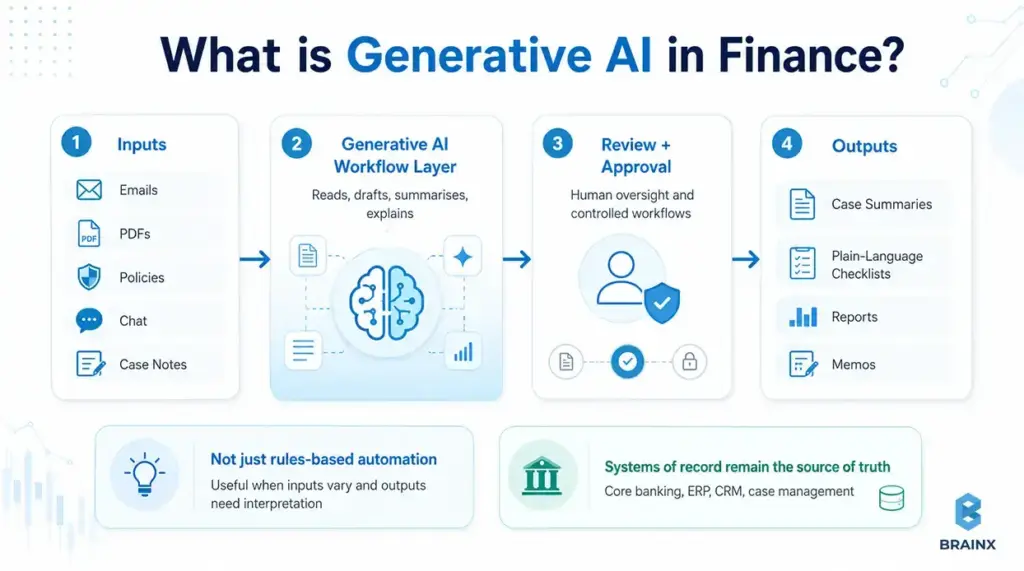
Generative AI, at its simplest, is a category of models that can create new content, such as text, summaries, classifications, explanations, and structured output, based on the patterns they've learned from data. In finance, that capability can come in handy when your model can turn jumbled inputs (emails, PDFs, policies, chat, case notes, contracts, etc.) into consistent outputs that teams can review, approve, and incorporate into regulated processes.
It is important to separate “GenAI” from general analytics or rules-based automation. Traditional automation is great at repeating steps that it’s already familiar with. When the input is variable and the output involves interpretation, drafting or synthesis of information from multiple sources, GenAI can be of value.
A practical definition for leaders: GenAI in finance is a workflow layer that reads and/or writes in the language of your business, which can include policies, controls, tickets, memos, reports, while your systems of record (e.g., core banking, ERP, CRM, case management) remain the source of truth.
For instance, a model can analyze a transaction history and create a fraud case summary. It can also turn a dense compliance update into a plain-language checklist for the team that needs to act on it.
The important point is not that the model “knows finance.” The value comes when it is connected to approved financial data, controlled documents, and human review workflows.
How Generative AI Differs From Traditional Finance Automation
The typical ways to automate traditional finance are:
- Rules engines (if X then Y)
- RPA that clicks through UIs
- ETL pipelines that move and transform data
- BI dashboards that visualize metrics
Where processes are stable, inputs are well structured and exceptions are few, those tools provide the best results. The hard parts of finance operations are often the opposite: exceptions are common, documentation quality varies, and decisions must align with policy.
Generative models help by:
- Summarizing long case histories or customer interactions into audit-friendly narratives
- Drafting first-pass responses, reports, and control descriptions
- Extracting entities and key fields from unstructured documents
- Answering questions grounded in internal policies and knowledge bases (when implemented with retrieval)
The key is not “replace processes,” it is to reduce manual reading and writing while keeping review and accountability intact.
Where Generative AI In Finance And Accounting Fits
The most reliable fit is in workflows where outputs are:
- Text-heavy (memos, narratives, ticket updates, regulatory drafts)
- Policy-constrained (must follow internal rules and templates)
- Reviewable (a human can approve, edit, or reject)
- Traceable (citations back to source data are possible)
That is why many teams start with assistive use cases: close support, variance explanations, reconciliation narratives, exception handling notes, and internal policy Q&A.
This is also where the use of generative AI in finance and accounting becomes real. It saves time on repetitive documentation and interpretation tasks, and puts finance leaders in control of the end result.
Why Finance Teams Need Human Review And Governance
Finance is not a “move fast and hope it works” environment. Errors can lead to regulatory investigations, loss of money, damage to customers, or a damaged reputation. The tail risk matters even if a model is accurate most of the time.
Human review isn't a fail-safe, it's a way you put accountability into practice:
- Approvals are mapped to roles (analyst, manager, compliance officer)
- Evidence is collected (sources used, prompts, model version, timestamps)
- Exceptions are escalated (low confidence, policy conflict, missing data)
Practically, the safest designs treat GenAI outputs as drafts with citations, not as autonomous decisions.
Role Of Generative AI In Finance
The role of generative AI in finance is not to replace core systems, finance teams, or final decision-makers. Its real role is to reduce the heavy reading, writing, summarising, and documentation work that slows regulated workflows down.
That is why the strongest applications usually sit between data and decision. The AI prepares the draft, extracts the context, compares the information, or explains the scenario. Then the right person reviews, approves, or escalates the output.
In practice, this makes GenAI more useful as a controlled workflow assistant than a standalone automation layer.
First-Draft Generation
Many finance workflows begin with a blank page: a risk note, compliance response, case summary, customer reply, audit comment, or management reporting narrative.
GenAI can create the first draft by pulling from approved templates, internal policies, customer context, and source documents. This does not mean the draft is ready to publish or submit. It means the analyst, support agent, or finance manager starts from a structured version instead of building everything manually.
This is useful when teams need speed, but still need control. The reviewer can check the sources, adjust the wording, correct missing context, and approve the final version.
Document Summarisation And Extraction
Finance teams work with a constant flow of documents: KYC files, regulatory updates, contracts, statements, audit evidence, case notes, support transcripts, and internal policies.
GenAI can summarise long documents, extract key fields, identify missing information, and convert unstructured content into a cleaner format for review. For example, it can turn a long case file into a short evidence summary, or pull important details from a compliance document into a checklist.
The value is not just speed. Better summarisation also helps teams reduce inconsistent interpretation across analysts, departments, and regions.
Scenario Analysis And Decision Support
Finance decisions often depend on context. Teams need to understand what happened, what changed, what risk exists, and what action may be reasonable.
GenAI can support that work by comparing scenarios, explaining trade-offs, summarising possible outcomes, and helping leaders review the available evidence more clearly. For example, it can help a risk team compare related fraud patterns, or help finance leaders understand the drivers behind a variance.
The final decision should still remain with the responsible person or team. GenAI supports judgment by making the context easier to understand, not by replacing accountability.
Why Generative AI In Finance Matters Now
The urgency is spurred by three factors: the increasing workload of compliance, the need for quick response from customers, and the need to scale up manual processes. It's also been discovered by finance organizations that previous pilots have not been unsuccessful due to the absence of technology, but due to the absence of the right architecture for retrieval, integrations and governance.
The business case is becoming easier to justify because the pressure is rising from multiple sides. Banks and financial services teams are handling more regulatory documentation, more fraud signals, more digital support volume, and more internal reporting expectations. GenAI helps when it reduces the manual reading and drafting burden without removing governance.
Morgan Stanley’s 2026 AI rate-of-change study shows that the market is moving from AI exposure to measurable ROI. Its analysts found that AI adopters’ EBIT margins expanded by 310 basis points from 2024 to 2025, more than double the 150 basis-point increase for the MSCI World.
The study also found that AI benefits are expected to skew mainly toward cost efficiency, with 89% of AI adopters expected to gain more from efficiency improvements than revenue growth. For finance teams, that supports a practical message: AI adoption is becoming less about experimentation and more about workflow efficiency, margin impact, and measurable business value
Meanwhile, regulators and internal model risk teams are establishing more clearly-defined expectations for validation and monitoring. The result is a practical window: teams can ship value now, as long as they build within a controlled framework.
What Is Causing The Rapid Adoption Of AI In Finance?
The rapid adoption of AI in finance is being driven by practical pressure, not just technology hype. Finance teams are handling more documents, more fraud signals, more customer requests, and more reporting expectations than manual workflows can comfortably support.
Three forces are pushing adoption forward:
- Operational pressure: Teams need faster ways to summarise cases, draft reports, review alerts, and respond to support queries.
- Better AI architecture: RAG, secure integrations, role-based access, and human review workflows make AI easier to use in regulated environments.
- Measurable business value: Finance leaders are now looking at AI through productivity, cost efficiency, margin impact, and risk reduction instead of experimentation alone.
That is why adoption is moving fastest in workflows where the task is repetitive, document-heavy, and reviewable. The goal is not to automate every decision. It is to reduce the manual load around decisions while keeping control, evidence, and accountability in place.
Growing Risk And Compliance Workloads
Risk and compliance teams are dealing with:
- More transactions across more channels
- Faster product iteration in fintech partnerships
- Increased reporting requirements and documentation needs
- Rising fraud sophistication and social engineering
KYC and AML are good examples as the work is document driven and requires evidence. Before a decision can be made, analysts have to review customer records, adverse media, policy rules and escalation notes, amongst others. GenAI can greatly streamline that context building phase by generating a structured summary that includes source references.
The attacker side is also moving faster. According to a survey by 2025 Deep Instinct, reported by Axios, 45% of financial services firms experienced an attack using AI in the last year, and 55% said deepfakes attacks had increased. All this makes fraud triage, identity verification and evidence review more challenging when done manually.
A lot of the workload is reading: alerts, case notes, KYC documents, policy changes, and regulatory updates. GenAI helps most when it compresses that reading into structured summaries, suggested next steps, and evidence-backed narratives that investigators can validate.
The impact is not just time savings. Better synthesis can reduce inconsistency across analysts, which matters for audit defensibility.
Rising Customer Expectations In Digital Finance
Customers expect:
- Always-on support
- Fast dispute handling
- Clear explanations of fees, holds, and verification steps
- Consistent answers across channels
The information is spread across support and operations teams in a variety of places, such as policy PDFs, in-house wikis, ticket notes, product releases, and CRM history. With the right retrieval and access controls, GenAI can generate responses based on approved knowledge and still safeguard sensitive information.
That's why agent-assist is a more secure approach than a fully automated customer chatbot. The AI drafts the answer, pulls the relevant policy or account context, and the support agent approves it before anything goes to the customer.
This is where customer experience and compliance intersect: speed without policy alignment creates risk.
Manual Finance Processes Are Becoming Harder To Scale
Many finance organizations still run critical workflows on spreadsheets, email threads, and PDF attachments. That is manageable at low volume, then breaks as volume rises.
Common breaking points include:
- Month-end close checklists scattered across tools
- Inconsistent reconciliation narratives
- Repetitive vendor and invoice exception handling
- Manual compilation of audit support packs
The “scale problem” is often not computation, it is documentation and coordination. GenAI can standardize how work is written up, categorized, and handed off.
The Use Of Generative AI In Finance Is Moving From Pilots To Practical Workflows
Early pilots were often “chatbots on top of nothing,” disconnected from systems of record and not designed for review. Now the practical pattern is clearer:
- Connect models to approved knowledge via retrieval
- Integrate into existing workflows (case management, ticketing, ERP)
- Add confidence signals and validation rules
- Require human approval when outputs affect customers or reporting
This shift is why the use of generative AI in finance is increasingly framed as workflow automation with controls, not just a new interface.
How Generative AI Is Transforming The Finance Industry
Generative AI is transforming the finance industry by changing how teams read information, prepare work outputs, serve customers, and review risk. The biggest shift is not that AI is taking over financial decisions. The shift is that finance teams can now process more context, draft faster, and respond with more consistency.
The most useful applications are still the ones with clear boundaries. The AI helps prepare the work, but humans stay responsible for judgement, approval, and escalation.
Automated Financial Reporting
Financial reporting often depends on structured numbers and unstructured explanation. Teams do not just need dashboards. They also need commentary, variance explanations, management notes, audit support, and board-ready narratives.
GenAI can help by creating first drafts from approved templates, ledger data, reporting packs, and prior-period commentary. It can explain what changed, highlight missing context, and prepare a cleaner version for finance teams to review.
This reduces the time spent writing and formatting reports, but it should not replace finance review. The final numbers, assumptions, and narrative still need human sign-off.
Fraud Detection And Risk Analysis
Fraud and risk teams are dealing with faster attacks, more signals, and more complex case histories. GenAI can help by turning scattered data into a clear investigation summary.
For example, it can summarise why a transaction was flagged, extract related account details, compare similar patterns, and draft investigation notes. It can also help analysts understand whether a case needs escalation or further evidence.
The safest role for AI in this area is support, not autonomous action. Fraud blocking, account restrictions, and high-impact risk decisions still need clear thresholds, audit trails, and human review.
Personalised Financial Advice
Personalisation is becoming more important as customers expect financial services to feel more relevant and easier to understand. GenAI can help by explaining options, summarising account context, and preparing personalised education or guidance.
For example, it can help a customer understand spending patterns, savings behaviour, product differences, or portfolio updates in plain language. It can also support advisors by preparing client summaries before meetings.
This area needs extra caution. Personalised advice can quickly become regulated advice, so AI outputs should be limited, explainable, and reviewed where required.
AI-Powered Customer Support
Customer support is one of the clearest transformation areas because financial customers expect fast answers, but support teams must still follow policy.
GenAI can help agents draft responses, summarise conversations, pull approved policy details, and suggest next steps. It can also create clean handoff notes when a case moves from one team to another.
The best starting point is usually agent-assist, not full automation. The AI drafts the response, and the agent approves it before it reaches the customer.
Predictive Market Analysis
Finance teams and advisors often need to understand market movement, risk signals, customer behaviour, and portfolio exposure. GenAI can support this by summarising large volumes of market commentary, research notes, earnings updates, and internal analysis.
It can also help teams compare scenarios and explain what might be driving a change. For example, it can summarise how interest rate shifts, sector changes, or macroeconomic signals may affect a portfolio or business plan.
The important boundary is that GenAI should support analysis, not present predictions as certainty. Market analysis still needs clear assumptions, data sources, and expert interpretation.
Algorithmic Trading
Algorithmic trading has used automation for years, but GenAI adds a new layer around research, strategy explanation, monitoring, and operational support.
It can help teams summarise trading signals, review market news, document strategy logic, generate test cases, and explain why a model behaved in a certain way. In more advanced environments, AI agents may support multi-step workflows around monitoring and execution.
This is also one of the highest-risk areas. Trading systems need strict controls, model validation, latency awareness, explainability, and human oversight because small errors can scale quickly.
Regulatory Change Management
Regulatory updates are difficult to manage because they are often long, technical, and time-sensitive. GenAI can help compliance teams summarise new guidance, compare it with existing policies, and draft control updates.
For example, a compliance copilot can turn a regulatory update into a checklist of affected processes, required documents, and internal owners. This makes it easier for teams to act quickly without missing important details.
The output should still be reviewed by compliance and legal teams before any policy or process changes are approved.
Credit And Lending Decision Support
Credit and lending workflows depend on documents, financial history, repayment behaviour, risk rules, and policy constraints. GenAI can help analysts prepare credit memos, summarise borrower information, highlight missing documents, and explain risk factors.
This can reduce manual preparation time and improve consistency across loan reviews. It can also make internal review easier because the system can show sources behind each summary.
The final lending decision should remain with the authorised team. AI can support the analysis, but it should not independently approve, reject, or explain high-impact credit decisions without controls.
Treasury And Liquidity Planning
Treasury teams need to understand cash positions, liquidity needs, funding risks, and scenario changes. GenAI can support this by summarising cash-flow drivers, preparing scenario notes, and explaining changes across business units or time periods.
It can also help teams convert complex treasury data into clearer narratives for leadership. Instead of spending hours preparing commentary, teams can review an AI-generated first draft and focus on judgement.
This works best when the AI is connected to approved data sources and reporting templates, so the output is grounded in current financial information.
How Generative AI Works In Financial Workflows
A production-grade system is not only a model call. It is an architecture that controls what the model can see, how it uses information, and how outputs are validated, reviewed, and logged. Most finance implementations also include a governance layer that maps to risk controls and audit requirements.
A common pattern is:
Data sources → ingestion and indexing → retrieval → model generation → validation and policy checks → human review → system updates and audit logs
Access control, documentation, and ongoing monitoring are being increasingly emphasized as key components of security and governance guidance for AI-enabled systems.
Financial Data, Documents, And Knowledge Sources
Finance workflows touch diverse inputs:
- Structured data: transactions, ledgers, CRM fields, ticket metadata
- Semi-structured: CSVs, exports, forms, statements
- Unstructured: PDFs, email threads, policy docs, call transcripts, chat logs
A key design decision is what becomes “model-accessible,” and under what permissions. Most teams start with internal knowledge that is stable and non-sensitive, then expand to customer-specific data with strict access controls and masking.
The highest leverage sources are often:
- Policies and procedures
- Product documentation and fee schedules
- Case playbooks and investigation templates
- Prior resolved tickets (with redaction)
You can also include market data, SEC filings, analyst reports, customer emails, call transcripts, regulatory updates, loan files, investment notes, and previous case decisions.
The goal is not to expose everything to the model. The goal is to decide which sources are approved, current, permissioned, and useful for the workflow.
Retrieval-Augmented Generation For Finance Knowledge
RAG reduces the risk of plausible-sounding but incorrect answers by grounding responses in retrieved internal sources. Instead of relying on the model’s general training, the system:
- Converts documents into searchable chunks
- Retrieves relevant chunks per question or task
- Instructs the model to answer using only those sources
- Returns citations and links back to the originals
For example, a compliance copilot can retrieve the latest policy update, a prior audit note, and the approved reporting template before it drafts an answer. That makes the response easier to verify because the reviewer can see what the AI used.
In finance, RAG is valuable because it supports:
- Policy-aligned support responses
- Consistent regulatory drafting templates
- Explainable outputs with source references
The retrieval layer also provides the option to have a governance handle, you can control which documents are in scope, version them and monitor their usage.
Human-In-The-Loop Review And Approval Flows
Human in the loop (HITL) is not a single generic step. You should design review gates based on impact:
- Low-impact (internal summaries): optional review, sampling-based QA
- Medium-impact (customer support drafts): agent approves before sending
- High-impact (compliance filings, adverse action): mandatory approval with evidence capture
Good HITL design includes:
- A “diff” view showing what the AI changed
- Required reason codes when overriding suggestions
- Escalation triggers when confidence is low or policy conflicts appear
This turns AI into a controlled assistant, and creates training feedback for continuous improvement.
Integrations With CRMs, ERPs, Core Banking, And Support Tools
Value increases when outputs flow into the systems people already use:
- CRM and ticketing (Salesforce, Zendesk, Intercom)
- ERP and finance suites (NetSuite, SAP, Dynamics)
- Case management and GRC tools
- Core banking systems and data warehouses
Integrations enable:
- Auto-populating case notes, summaries, and disposition codes
- Pulling relevant customer context under RBAC
- Writing back approved outputs, with audit logging
The safest pattern is “read most, write selectively,” where AI can read context but only writes to specific fields after approval.
Applications Of Generative AI In Banking And Finance
The strongest applications of generative AI in banking and finance usually sit where teams handle high volumes of documents, customer questions, risk signals, and internal approvals. These workflows are valuable because they involve language, judgement support, and repeatable documentation.
A useful way to think about the applications is by business function:
- Risk and fraud teams use GenAI to summarise alerts, draft investigation notes, compare patterns, and prepare escalation summaries.
- Compliance teams use it to review documents, support KYC and AML workflows, draft regulatory narratives, and map policy changes to internal controls.
- Customer support teams use it to create agent-assist replies, summarise conversations, and answer policy-grounded questions with human approval.
- Finance and accounting teams use it to draft variance explanations, reconciliation notes, management commentary, and audit documentation.
- Advisory and wealth teams use it to prepare client summaries, explain portfolio updates, and turn complex financial information into clearer language.
- Leadership teams use it to summarise reports, compare scenarios, and understand business drivers across functions.
The common pattern across these applications is the same: GenAI prepares, explains, or summarises the work. Humans still review, approve, and make the final decision.
This is what keeps the technology useful without turning it into an uncontrolled decision engine.
High-Impact Use Cases Of Generative AI In Finance
The strongest use cases combine three traits: high volume, high cognitive load (reading/writing), and clear reviewability. Finance leaders should look for workflows where the AI’s job is to draft, summarize, classify, and recommend, while humans decide and approve.
Below are practical, high-impact categories with implementation notes and control considerations.
Automating Risk Analysis And Fraud Investigation
Fraud and risk teams spend time gathering context before they can act. GenAI can accelerate that front end by:
- Summarizing alerts into a consistent case narrative
- Extracting entities (merchant, device, account, IP, address)
- Drafting investigation notes and recommended next steps
- Clustering related cases by pattern similarities (with embeddings)
A practical design is a “case copilot” that sits inside the investigation workflow. It pulls only permitted data, generates a summary with citations, then asks the investigator to confirm key facts before it drafts final notes.
A stronger fraud workflow might help investigators answer questions like: “Why was this payment flagged?” or “Which related accounts show a similar pattern?” The system can summarize the alert, list supporting signals, and draft investigation notes, while the investigator confirms the final finding.
For early projects, keep the AI focused on triage and documentation. Let humans own the decision.
For fraud specifically, avoid fully autonomous actions early. Instead, start with triage and investigation acceleration, then move toward semi-automated workflows with thresholds and approvals.
The fraud risk is moving in the same direction. Deloitte has projected that U.S. fraud losses could reach $40 billion by 2027 as generative AI makes impersonation, synthetic identity, and deepfake-enabled scams easier to scale. That makes controlled AI support useful for detection, but risky if the system acts without review.
Automating Compliance Monitoring, KYC, AML, And Regulatory Reporting
Compliance work is documentation-heavy and template-driven, which makes it a strong fit. Examples include:
- KYC document checklist assistance and exception summaries
- Drafting SAR narratives (with strict review and evidentiary support)
- Summarizing policy changes and mapping them to controls
- Monitoring communications for policy violations (with careful tuning to reduce false positives)
This can also support KYC refreshes and regulatory reporting. The AI can extract relevant fields from documents, compare them against a checklist, draft exception notes, and prepare the first version of a compliance narrative.
The final report should still go through compliance review. The value is speed and consistency, not unchecked automation.
You can also use GenAI to draft first-pass regulatory reports by pulling structured metrics and generating the narrative sections, then routing to compliance for edits and sign-off.
Because these workflows are sensitive, implement:
- Strong access controls and least-privilege retrieval
- Mandatory citations to internal evidence
- Audit logging of prompts, sources, and approvals
Automating Customer Service And Financial Support
Customer support is often the first visible win, but it is also where mistakes are costly. Safer starting patterns include:
- Agent-assist drafting (not fully automated sending)
- Policy-grounded answers with citations
- Auto-summarization of conversations into ticket notes
- Suggested next actions based on playbooks
For support teams, the practical win is not just faster replies but better consistency across agents. When the AI drafts from approved policies and customer context, teams can reduce policy drift and make handoffs cleaner.
A real finance-sector example shows both the potential and the need for guardrails. Klarna reported that its AI assistant handled two-thirds of customer service chats in its first month, completed 2.3 million conversations, did the equivalent work of 700 full-time agents, and reduced repeat inquiries by 25%. The lesson is not to remove human support. It is to narrow the scope, measure quality, and keep fallback routes available.
When you do deploy self-service, constrain it:
- Limit to FAQs, onboarding, and status checks
- Require authentication for account-specific actions
- Add fallback routes to human agents
This reduces handle time while keeping customer-facing risk under control.
Generative AI In Finance And Accounting Workflows
Finance operations and accounting teams can use GenAI to standardize how work is documented and explained, especially during close and audits. Common examples include:
- Drafting variance explanations based on ledger movements and drivers
- Summarizing reconciliation exceptions and proposed resolutions
- Creating first drafts of management reporting narratives
- Generating documentation for controls and process updates
For example, the system can create a first draft of a variance explanation by comparing current-period movements with prior-period notes and approved reporting templates. Treasury teams can also use it to summarize cash-flow drivers or prepare scenario notes for review. It keeps finance managers in control while reducing repetitive drafting work.
The best results come when the model can reference a controlled data set (close checklist status, GL extracts, prior period narratives) and when outputs are reviewed by finance managers before distribution.
This is a central area where generative AI in finance and accounting becomes a day-to-day productivity layer, not a one-off experiment.
Internal Knowledge Assistants For Analysts, Advisors, And Support Teams
Internal assistants are often the safest and highest ROI starting point because the “customer impact” is indirect and review is natural.
Use cases include:
- Policy Q&A with source citations
- Product and pricing guidance for support and sales teams
- Analyst research assistance, such as summarizing filings and internal memos
- Onboarding assistants for new hires in finance ops and compliance
A well-designed assistant is not a general chatbot. It is a governed tool with:
- Document scope control (what it can reference)
- Versioning (policy updates roll forward cleanly)
- Role-based answers (different depth for different roles)
A practical internal assistant can answer policy, product, risk, and process questions from approved documents. New analysts can use it to understand procedures faster, while experienced teams can use it to reduce time spent searching through scattered files.
The assistant should still show sources, document versions, and confidence signals so employees know what they can trust.
Benefits Of Generative AI In Finance
The benefits of generative AI in finance are strongest when the technology is tied to specific workflows, not used as a general productivity tool. Finance teams gain value when AI reduces repetitive preparation work, improves documentation quality, and helps people make faster, better-supported decisions.
The goal is not to make every process fully autonomous. The goal is to help teams handle more work with better structure, stronger evidence, and fewer manual handoffs.
Speed On Routine Deliverables
Many finance deliverables take time because teams must collect information, read documents, prepare summaries, and format outputs before review. GenAI can shorten that preparation stage.
It is useful for risk notes, support responses, compliance drafts, variance explanations, audit comments, and internal reporting narratives. Instead of starting from scratch, teams can review a structured first draft and spend more time checking accuracy and judgement.
The benefit is not only faster output. It also reduces the friction that slows teams down when the same type of document needs to be prepared repeatedly.
Consistent, Audit-Ready Documentation
Finance work depends on consistency. If two analysts describe the same type of case differently, it can create confusion during review, audit, or escalation.
GenAI can help standardise how summaries, reports, case notes, and compliance narratives are written. It can follow approved templates, include required evidence, and structure information in a way that is easier to review.
All of this makes documentation more audit-ready because teams can show what was used, what was generated, who reviewed it, and what changed before approval.
Scalability Without Proportional Headcount Growth
As transaction volume, support requests, reporting needs, and compliance checks increase, teams often feel pressure to add more people. GenAI can help absorb part of that workload by reducing manual reading, drafting, and summarising.
It does not mean replacing finance teams, but helping the same team manage higher volume with better workflow support.
For example, a compliance team can review more cases if the AI prepares evidence summaries first. A support team can manage more tickets if the AI drafts policy-grounded responses for agent approval.
Better Client Communication At Scale
Finance customers often need clear explanations, not just fast replies. They want to understand account actions, fees, disputes, product details, verification steps, or investment updates without reading complex policy language.
GenAI can help teams explain financial information in simpler, more consistent language. It can prepare personalized drafts based on approved knowledge and customer context, while agents or advisors approve the final message.
This improves communication at scale without sacrificing control. The customer gets a clearer answer, and the business keeps review, policy alignment, and escalation paths in place.
Faster Access To Internal Knowledge
Finance teams often lose time searching through policies, product documents, reporting templates, case histories, and internal notes. GenAI can reduce that search burden when it is connected to approved knowledge sources through retrieval.
An internal assistant can help analysts, advisors, support agents, and compliance teams find the right information faster. It can answer process questions, point to source documents, and summarise relevant guidance.
It is especially useful for onboarding, cross-team support, and fast-changing policy environments.
Improved Risk Visibility
GenAI can help teams see patterns that are harder to spot when information is scattered across systems and documents. It can summarise related cases, compare signals, and highlight missing evidence before a reviewer makes a decision.
It improves visibility into fraud, compliance, credit, and operational risk workflows. Teams can understand the context faster and decide whether a case needs escalation.
The value comes from better preparation, not automated judgement. Human reviewers still need to confirm the finding and approve the next step.
Stronger Knowledge Transfer Across Teams
Finance operations often depend on experienced employees who know where information lives, how cases are handled, and what exceptions matter. When that knowledge stays informal, teams become harder to scale.
GenAI can help capture and reuse that knowledge through approved templates, internal assistants, workflow summaries, and documented review paths.
This makes work easier to hand over between teams, regions, or new employees. It also reduces dependency on scattered files, individual memory, or repeated explanations.
Business Value Of Generative AI In Finance
To justify investment, tie each workflow to measurable KPIs. Finance leaders typically care about cycle time, accuracy, cost-to-serve, risk exposure, and audit readiness. GenAI investments are easiest to defend when they reduce high-cost manual labor and improve consistency.
The strongest ROI usually comes from workflows that repeat often and require a lot of reading or writing. Examples include alert summaries, support replies, compliance narratives, close commentary, and audit documentation. These are not glamorous use cases, but they are measurable and easier to govern.
Productivity studies and benchmarks often cite meaningful time savings for knowledge-heavy tasks, but results vary widely by workflow design and governance maturity.
Recent customer-service AI research shows why finance teams should measure both speed and control. A 2026 field experiment with Alibaba’s customer service operations found that a GenAI assistant improved service speed by helping agents identify issues faster and reduce chat duration. It also improved subjective service quality through better customer ratings and lower dissatisfaction, although it did not significantly improve objective quality measured by customer retrial rates.
Cisco’s 2026 AI support transformation shows a similar lesson at enterprise scale: after redesigning workflows around intelligent routing, nearly 88% of its 1.5 million annual support cases were routed to the right engineer the first time. The takeaway for finance teams is clear: GenAI can improve support productivity, but only when it is tied to workflow design, accuracy thresholds, and human fallback paths.
Faster Risk Reviews And Fraud Investigations
Relevant KPIs:
- Time to triage an alert
- Time to resolution
- Investigator throughput per day/week
- False positive handling time
GenAI value often comes from compressing context-building. If investigators spend less time reading across systems and more time making decisions, throughput increases without cutting corners.
Also consider quality metrics: more consistent narratives and better evidence capture can reduce rework during audits or escalations.
Lower Support Load And Faster Response Times
Support KPIs typically include:
- Average handle time (AHT)
- First contact resolution (FCR)
- Backlog size and time-to-first-response
- Escalation rate to Tier 2
Agent-assist can reduce AHT by drafting replies and summarizing context, while knowledge-grounded answers reduce policy drift. The biggest mistake is measuring only speed. Track accuracy and customer satisfaction in parallel.
Stronger Audit Readiness And Reporting Consistency
Audit readiness is often a hidden cost center. GenAI improves it when it:
- Enforces consistent templates and language
- Ensures narratives include required evidence
- Creates standardized documentation for control changes
- Makes it easier to assemble audit support packs
The value shows up as fewer audit findings, less scramble, and reduced dependence on a few “tribal knowledge” employees.
Better Productivity Across Generative AI In Finance And Accounting Teams
Productivity improvements become material when you apply AI to repeated, high-volume writing and summarization tasks. That includes close commentary, reconciliation narratives, exception write-ups, and internal reporting.
Done well, the system becomes a “documentation co-pilot” that:
- Reduces time spent drafting and formatting
- Improves consistency across regions and business units
- Makes outputs easier to review and approve
This is also where the distinction matters: you are not automating judgment, you are automating the first draft.
Improved Decision Support For Leaders And Advisors
Executives do not need more dashboards, they need clearer stories and drivers. GenAI can:
- Summarize business performance drivers with citations to metrics
- Generate board-ready narrative drafts from approved templates
- Provide Q&A over internal reports (with retrieval and permissioning)
The impact is faster decision cycles and fewer “analysis thrash” loops across teams.
Challenges Of Using Generative AI In Finance
Generative AI can create strong value in finance, but implementation is rarely simple. The challenge is not only choosing a model. It is making sure the AI can work with sensitive data, regulated workflows, legacy systems, and real review processes.
Most finance teams run into problems when the AI looks useful in a demo but becomes harder to trust, integrate, or govern in production.
Poor Data Quality And Fragmented Knowledge
GenAI is only as useful as the information it can access. Many finance teams have policies, reports, case notes, customer records, and process documents spread across different systems.
If the source data is outdated, duplicated, poorly labelled, or inconsistent, the AI may produce weak summaries or miss important context. This creates extra review work instead of reducing it.
Before building, teams need to clean, organise, and approve the knowledge sources that the AI can use.
Legacy System Integration
Finance workflows often depend on older systems, custom databases, ERPs, CRMs, case management tools, and core banking platforms. Connecting AI to these systems can take more effort than the model setup itself.
The challenge is not just access. Teams need secure APIs, identity controls, permission checks, logging, and clear rules for what the AI can read or write back.
This is why many finance AI projects start with a sidecar copilot before moving into deeper system automation.
Model Reliability In High-Stakes Workflows
Finance teams cannot rely on outputs that sound confident but are incomplete, outdated, or unsupported by evidence. A small error in a compliance summary, support response, or risk note can create larger business consequences.
Reliability becomes harder when workflows involve exceptions, changing policies, complex product rules, or customer-specific context.
The solution is not to expect perfect AI. The better approach is to design workflows where outputs include sources, confidence signals, validation checks, and review gates.
Data Privacy And Security Concerns
Finance teams handle sensitive customer, transaction, and business data. If that data is exposed to the wrong model, prompt log, user, or third-party system, the risk can become serious.
Teams need to decide where data is processed, what is logged, who can access it, and whether any information is used for model training.
This makes privacy and security a core implementation challenge, not a final checklist item.
Change Management And User Trust
Even a well-built AI system can fail if teams do not trust it or understand how to use it. Analysts, support agents, compliance officers, and finance managers need to know what the tool can do, where it may be wrong, and when they must override it.
If users see AI as a black box, they may avoid it. If they trust it too much, they may approve weak outputs too quickly.
Training, clear workflows, and transparent source references help teams build the right level of trust.
Measuring ROI Beyond The Pilot
Many finance AI pilots show promise, but scaling them is harder. A pilot may work for one team, one document set, or one narrow workflow. The real test is whether it improves cycle time, accuracy, consistency, and cost-to-serve across a larger operation.
Finance leaders should define success metrics before the build starts. Otherwise, the project may feel innovative without proving business value.
The most useful metrics include review time, error rate, escalation rate, support backlog, audit findings, and user adoption.
Tools And Technologies Used In AI Finance
AI finance systems are usually built from several connected technologies, not one standalone model. The right stack depends on the workflow, data sensitivity, integration needs, and level of automation required.
For finance teams, the technology choice should always come back to one question: can the system produce useful output while staying secure, traceable, and reviewable?
Large Language Models And Foundation Models
Large language models are the core engine behind many GenAI workflows. They help generate summaries, draft reports, classify documents, explain policies, and respond to user questions.
In finance, these models should not work alone. They need approved context, clear prompts, output rules, and review paths. A general-purpose model may be useful for drafting, but regulated workflows usually need stronger grounding and validation.
The model is only one part of the system. The surrounding architecture decides whether the output can be trusted.
Retrieval-Augmented Generation Systems
RAG helps connect the model to approved internal knowledge. Instead of relying only on what the model learned during training, the system retrieves relevant documents, policies, templates, or case notes before generating an answer.
This is especially useful in finance because rules, products, fees, policies, and regulations change over time. RAG helps keep answers grounded in the latest approved sources.
A strong RAG setup should include source citations, document version control, access permissions, and rules that stop the model from answering when evidence is missing.
Vector Databases And Search Layers
Vector databases and search layers help AI systems find relevant information across large document sets. They convert documents into searchable representations so the system can retrieve similar or related content quickly.
For example, a compliance assistant may use a search layer to find the right policy section, prior audit note, or reporting template before drafting an answer.
In finance, the search layer must respect permissions. A user should only retrieve information they are allowed to see in the original system.
Data Pipelines And Document Processing Tools
Many finance documents are messy. They may come from PDFs, scanned forms, spreadsheets, emails, contracts, customer records, or ticket histories.
Document processing tools help extract text, structure fields, identify entities, remove duplicates, and prepare data for retrieval or analysis. This step matters because weak input quality creates weak AI output.
Before deploying GenAI, teams often need to clean their documents, define source ownership, and decide which data is current enough to use.
Integration APIs And Workflow Automation
AI becomes more valuable when it fits into existing finance workflows. That usually means connecting it with CRMs, ERPs, case management systems, core banking tools, ticketing platforms, document repositories, and reporting systems.
APIs and workflow automation tools allow the AI to read approved context, create drafts, update specific fields, or route outputs for approval.
The safest pattern is still controlled access. AI may read broad context under permissions, but write-back actions should be narrow, logged, and approved where needed.
AI Agents And Copilot Interfaces
Copilots and AI agents are becoming common in finance workflows, but they should be designed carefully.
A copilot supports a human user inside an existing workflow. It may draft a response, summarise a case, or suggest the next step. An AI agent can go further by carrying out multi-step actions across systems.
For regulated finance, copilots are usually safer starting points. Agents can be useful later, but only when actions are tightly scoped, monitored, and controlled.
Model Evaluation And Monitoring Tools
Finance AI systems need ongoing evaluation. A model that works well during a pilot may perform differently when policies change, data shifts, or users ask unexpected questions.
Evaluation tools help teams test answer accuracy, source grounding, hallucination risk, refusal behaviour, response quality, and consistency across repeated tasks.
Monitoring is also important after launch. Teams should track usage, errors, escalations, review time, user feedback, and unusual behaviour.
Security, Access Control, And Governance Tools
Security tools control who can access which data, what the model can retrieve, where outputs are stored, and how logs are protected.
Finance AI systems usually need role-based access control, encryption, data masking, audit logs, retention rules, and clear policies around model training and prompt storage.
Governance tools help teams document intended use, risk level, approvals, model versions, and monitoring results. Without this layer, even a useful AI tool can become difficult to approve or scale.
Cloud, Private Cloud, And On-Premise Infrastructure
Finance teams can deploy AI through public cloud, private cloud, hybrid, or on-premise infrastructure. The right choice depends on data sensitivity, compliance requirements, latency, cost, and internal IT maturity.
Public cloud platforms can speed up experimentation and provide managed AI services. Private or hybrid setups may be better when data control, residency, or internal security rules are stricter.
The best infrastructure decision is the one that supports both delivery speed and long-term governance.
Risk, Compliance, And Governance Requirements Before You Build
Finance implementations succeed or fail on controls. A model that produces impressive demos but cannot be governed will not survive security review, model risk management, or audit.
Use established frameworks as guardrails, then map them to your internal control environment.
Data Privacy And Secure Access Controls
Non-negotiables include:
- Role-based access control (RBAC) for both data retrieval and actions
- Data minimization, only retrieve what the task requires
- PII masking/redaction where feasible
- Clear policies on whether data is used for model training, and where it is stored
Also define where prompts and outputs are logged. Logs are essential for auditability, but they can also become a sensitive data store.
Hallucination Controls And Response Validation
You cannot “prompt” your way out of hallucinations for high-stakes workflows. Practical controls include:
- Retrieval with source citations
- “Answer only from sources” constraints
- Structured output schemas (JSON, templates) with validation
- Confidence scoring and refusal behavior when evidence is missing
- Automated checks against known rules (for example, fee policy constraints)
For regulated responses, route low-confidence outputs to mandatory review, or block them entirely.
Bias, Explainability, And Model Risk
Finance organizations should treat GenAI as part of their model risk universe:
- Document intended use, limitations, and failure modes
- Test for bias in classification, summarization, and recommendation patterns
- Monitor drift when policies, products, or fraud patterns change
- Provide explanations that are meaningful to humans (often via citations and rationale, not just model “confidence”)
Explainability does not mean the model reveals its internal weights. It means the system can show what evidence it used and how it applied policy.
Audit Trails For The Use Of Generative AI In Finance
Auditors and regulators will ask: who did what, when, based on what data, and with what approvals?
Design for:
- Immutable logs for prompts, retrieved sources, outputs, and approvals
- Model versioning and configuration tracking
- Workflow-level traceability, linking outputs to cases/tickets/reports
- Retention policies aligned with compliance requirements
A strong audit trail also helps internal investigations and reduces operational ambiguity.
Human Review For High-Impact Finance Decisions
Some workflows should never be fully automated, especially early:
- Adverse action and account restriction explanations
- Regulatory filings that carry legal accountability
- High-value payment approvals
- Credit or risk decisions without clear policy constraints
You can still use AI to draft and summarize, but keep humans as accountable decision-makers, with explicit sign-offs.
How To Choose The Right Use Of Generative AI In Finance
Choosing the right starting point matters more than choosing the “best model.” The best first project is the one that delivers measurable value, stays inside your risk appetite, and can be governed without heroics.
This section focuses on selecting the use of generative AI in finance that fits your operating reality, not just what looks good in a demo.
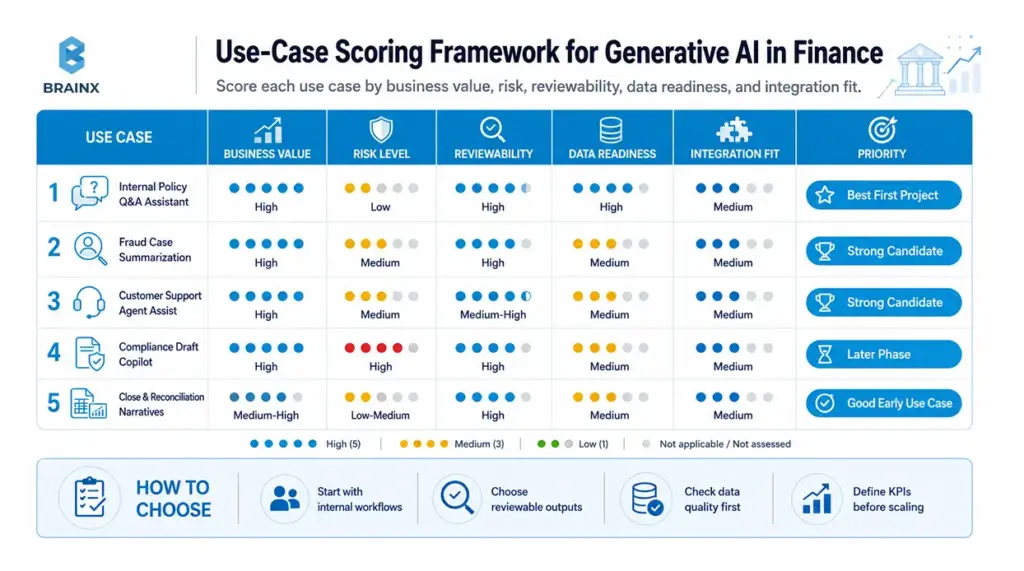
Score Each Use Case By Business Value And Risk
Use a simple scoring model to prioritize. Example criteria:
- Business value: time saved, cost-to-serve reduction, revenue support
- Risk: customer impact, regulatory exposure, financial loss potential
- Reviewability: can a human reliably validate the output?
- Standardization: are there clear templates and policies?
A strong first candidate often has high value, low external impact, and clear templates, such as internal case summaries or policy Q&A with citations.
Check Data Readiness Before Selecting A Workflow
If your knowledge is outdated, inconsistent, or scattered, the model will reflect that.
Assess:
- Where the “source of truth” lives (and whether it is current)
- Whether documents are accessible via APIs or require manual exports
- How often policies change, and how updates are governed
- Data sensitivity and what must be masked
A common pattern is to start with a curated, approved document set, then expand gradually as governance matures.
Evaluate Integration Complexity Across Finance Systems
Integration work often dominates timelines. Before committing, confirm:
- APIs exist for your case system, CRM, ERP, or ticketing platform
- You can implement RBAC end-to-end (identity, retrieval, actions)
- Event hooks exist to trigger workflows (new case, new ticket, close task)
If integrations are heavy, start with a “sidecar” copilot that reads context and drafts outputs without writing back automatically.
Start With Internal Copilots Before Customer-Facing Automation
Internal copilots are a safer proving ground. They let you:
- Validate retrieval quality and citations
- Test review workflows with real users
- Measure productivity gains without customer risk
- Build governance muscle (logging, access, monitoring)
Once internal reliability is proven, you can expand to customer-facing automation with stronger constraints and fallbacks.
Define Success Metrics For The Use Of Generative AI In Finance
Define KPIs before you build, and tie them to real operational outcomes:
- Cycle time reduction (triage, close tasks, reporting turnaround)
- Quality metrics (error rates, rework, audit exceptions)
- Adoption and user satisfaction (internal)
- Customer metrics where applicable (CSAT, containment rate, escalation rate)
For the use of generative AI in finance, “it feels faster” is not a metric. You need baseline measurements, pilot targets, and acceptance thresholds.

Generative AI Implementation Roadmap For Finance Teams
A roadmap prevents two common failures: shipping a demo that cannot pass governance, or building controls so heavy that adoption dies. The goal is staged delivery, where each stage adds value and reduces risk.
Enterprise AI best practices typically emphasize phased rollouts, governance, and continuous monitoring rather than one-time releases.
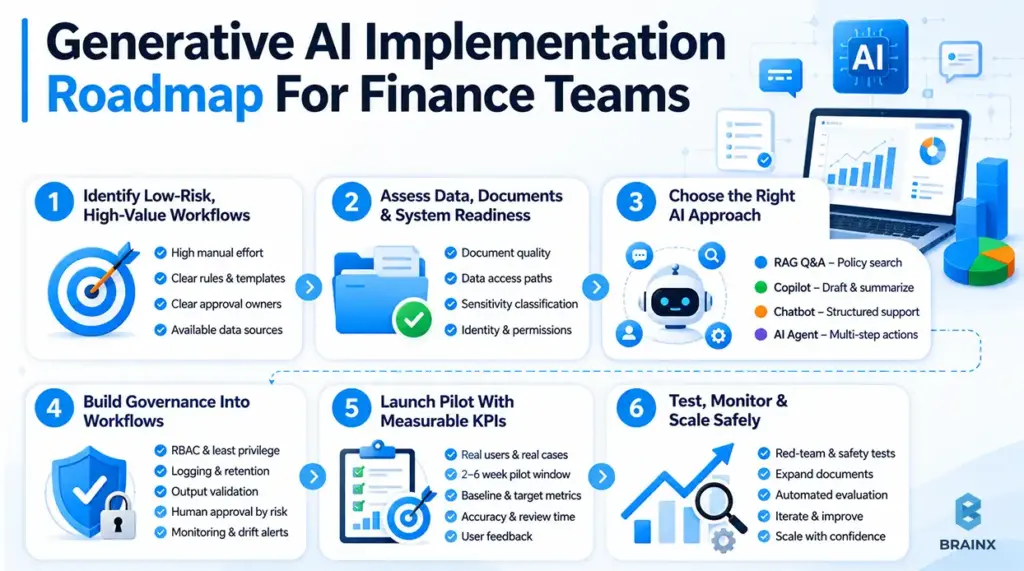
Step 1: Identify Low-Risk, High-Value Finance Workflows
Start by inventorying workflows across:
- Risk and fraud investigations
- Compliance drafting and reporting
- Customer support and operations
- Accounting close and reconciliations
Then pick 1–2 workflows with:
- High manual effort
- Clear templates and rules
- Clear approval owners
- Available data sources
Avoid “replace the entire support org” as a first scope. Focus on one measurable workflow.
Step 2: Assess Data, Documents, And System Readiness
Do a readiness pass that includes:
- Document quality and currency (policies, playbooks, templates)
- Data access paths (APIs, warehouses, document stores)
- Sensitivity classification (PII, PCI, confidential)
- Identity and permission model alignment
A short readiness sprint saves months later, especially when compliance teams need to approve data access.
Step 3: Choose Between Chatbot, Copilot, AI Agent, Or RAG System
Pick the interface and autonomy level that matches risk:
- RAG Q&A: best for policy search and grounded answers
- Copilot: best for drafting and summarization in existing tools
- Chatbot: best for structured self-service with strict scope
- AI agent: best when multiple steps must be executed, but requires strong guardrails
In regulated finance contexts, many teams start with RAG + copilot patterns, then introduce agents for limited internal actions.
Step 4: Build Governance Into Generative AI In Finance And Accounting Workflows
Do not bolt on governance later. Bake it in:
- RBAC and least-privilege retrieval
- Prompt and output logging with retention policies
- Output schemas and validation checks
- Human approval routing by risk tier
- Monitoring dashboards for quality and drift
For generative AI in finance and accounting workflows, governance is what makes the system auditable and scalable across business units.
Step 5: Launch A Pilot With Measurable KPIs
Pilot scope should be small but real:
- Real users, real cases, real tickets
- A defined time window (2–6 weeks)
- Baseline and target metrics
- A clear acceptance threshold for accuracy and review time
Also capture qualitative feedback: what users trust, where they hesitate, and what evidence they need to approve outputs faster.
Step 6: Test, Monitor, And Scale Safely
After the pilot:
- Run red-team tests (prompt injection, data leakage attempts)
- Expand document coverage with versioning controls
- Add automated evaluation, sampling, and escalation paths
- Iterate on prompts, retrieval chunking, and templates
Scaling should follow governance maturity. Add customer-facing automation only when internal reliability and controls are proven.
Cost, Timeline, And Team Requirements For Finance AI Projects
Budgeting is easier when you break costs into: data work, integration work, governance, and user experience. The model itself is rarely the biggest line item, especially when you need secure deployment, monitoring, and enterprise integrations.
Cost ranges vary by scope, region, and security requirements. If you present numbers, cite them and explain assumptions.
What Affects The Cost Of Generative AI In Finance
Key cost drivers include:
- Data preparation: cleaning, redaction, indexing, document lifecycle
- Security: RBAC, key management, network controls, compliance reviews
- Integrations: ERP/CRM/case system connectors, event triggers, write-backs
- Governance: logging, audit trails, evaluation harnesses, monitoring
- UX and change management: embedding in workflows and training users
If you need on-prem or private cloud deployment, costs often rise due to infrastructure and security requirements.
MVP Vs Enterprise-Grade Finance AI Rollout
A small MVP can focus on one workflow, one document set, and one team. That keeps cost and review cycles manageable.
An enterprise rollout is different. It usually needs deeper integrations, stronger security reviews, audit logging, monitoring dashboards, role-based access, and ongoing model evaluation. That is why the budget depends less on the model itself and more on data readiness, governance, and system integration.
Here’s a helpful way to frame scope:
MVP (4–8 weeks)
- One workflow, limited document set
- RAG + copilot experience
- Manual approvals, basic logging
Workflow Automation System (8–16 weeks)
- Multiple workflows or one end-to-end process
- Stronger integrations and write-backs
- Evaluation and monitoring dashboards
Enterprise Rollout (4–9 months)
- Multiple departments, standardized governance
- Formal model risk management documentation
- High availability, DR, ongoing tuning and support
Most finance teams should plan for a staged rollout rather than “enterprise from day one.”
In-House Team Vs AI Development Partner
In-house teams work well when you already have:
- Strong platform engineering
- Mature security and compliance engineering
- Internal ML and evaluation expertise
- Time to build and iterate
A partner is often a better fit when you need to move quickly, integrate across systems, and establish governance patterns without reinventing them.
The best model is frequently hybrid: your team owns domain knowledge and approvals, the partner accelerates architecture, delivery, and quality systems.
Skills Needed For Generative AI In Finance And Accounting Projects
A realistic team mix includes:
- Product owner with finance domain context
- Solution architect (security, integrations, data)
- Backend engineers (APIs, connectors, workflow services)
- Frontend engineer (embedded copilot UI)
- ML/LLM engineer (retrieval, prompting, evaluation)
- Security/compliance lead (RBAC, logging, reviews)
- QA and test automation (including red-team testing)
Even if you use managed LLM services, you still need engineering depth to build a governable system.
Common Mistakes To Avoid When Using GenAI In Finance
Most failures are not about model choice. They are about shipping an ungoverned assistant into regulated workflows, then discovering you cannot validate outputs or explain what happened.
The following mistakes show up repeatedly in finance AI programs, and each has a practical fix.
This matters because failed scale-ups are becoming expensive. Gartner expects more than 40% of agentic AI projects to be canceled by the end of 2027 because of escalating costs, unclear business value, or weak controls. Finance teams should treat that as a warning to start with governed workflows, not broad AI rollouts.
Starting With A Generic Chatbot Instead Of A Governed Workflow
A generic chatbot is hard to control:
- It lacks clear document scope
- It produces answers without citations
- It is difficult to audit and validate
Start with a workflow: case summarization, policy Q&A with citations, or ticket drafting with templates. Tie it to approvals and metrics so it can pass governance review.
Using Sensitive Financial Data Without Access Controls
If your system can retrieve any customer record for any user, it will fail security review.
Implement:
- Identity-based authorization
- Least-privilege retrieval
- Masking and redaction where possible
- Clear retention policies for logs and outputs
Also decide early whether prompts and outputs can contain sensitive data, and how those logs are protected.
Ignoring Hallucination And Audit Risks
Hallucination is not only wrong answers. It is also missing citations, fabricated references, and overconfident tone.
Controls that help:
- RAG with citations
- Refusal behavior when evidence is missing
- Structured outputs with validation
- Sampling-based QA and automated evaluation tests
Audit risk is reduced when you log sources, approvals, and model versions.
Treating Compliance As A Post-Launch Task
Compliance teams should be involved in:
- Use case selection and risk tiering
- Data access approvals and scoping
- Logging and retention decisions
- Review and sign-off workflows
When compliance is consulted late, projects stall at the finish line. Build shared ownership from the start.
Scaling The Use Of Generative AI In Finance Without Clear KPIs
If you cannot show measurable impact, adoption fades and budgets get cut.
Define KPIs per workflow and track them continuously. For the use of generative AI in finance, scaling decisions should be based on data: accuracy, review time, exception rates, and operational outcomes.
Removing Human Review Too Early
Teams often remove reviews to capture “full automation,” then see quality issues and trust collapse. A better approach:
- Keep review mandatory for high-impact outputs
- Reduce review time through better citations and templates
- Move from full review to sampling only when accuracy is consistently proven
Trust is earned through consistent performance, not by declaring autonomy.
Real-World Proof: What Finance AI Projects Can Learn From BrainX Work
Teams evaluating AI vendors often want proof of engineering maturity in regulated, security-sensitive environments. While each finance organization has unique controls, the underlying capabilities are transferable: secure architecture, integration depth, and experience building complex fintech products.
Below are examples of what BrainX has delivered that maps well to finance AI needs.
Secure Finance Product Architecture
Finance AI systems need more than a model, they need a platform approach:
- Secure APIs and service boundaries
- Identity and access integration
- Audit-friendly logging and observability
- Controlled data flows across environments
BrainX teams routinely build SaaS architectures with strong security posture, which is foundational when you add AI components that touch sensitive documents and workflows.
Blockchain, Smart Contracts, And Investment App Experience
BrainX has delivered fintech product work that involves transaction logic, investment user experiences, and trust-oriented product design. That experience matters because finance AI projects frequently require:
- Clear user flows for approvals and exceptions
- Immutable or traceable records for key actions
- Tight integration with financial data models and reporting needs
For fintech work like KELP, the transferable value is not only blockchain development. It is the discipline of building finance products where transaction logic, user trust, security, and traceability matter from the start.
That same discipline applies to finance AI projects. If an AI system drafts a compliance note, summarizes a risk case, or supports an investment workflow, the product must show what happened, who approved it, and which data supported the output.
AI And Machine Learning Integration For Finance Products
A successful GenAI rollout often combines classic ML and GenAI:
- ML models for fraud scoring or anomaly detection
- GenAI for case narratives and decision support
- Retrieval for policy grounding and explainability
Finance AI rarely works as one standalone model. A strong system often combines classic ML for scoring or anomaly detection, retrieval for policy grounding, and GenAI for narratives, summaries, and decision support.
That combination is where BrainX can position its value clearly: not as a chatbot vendor, but as an engineering partner that builds secure, integrated workflows.
How BrainX Helps With Generative AI In Finance
Finance teams usually need a partner who can bridge product thinking, security, data architecture, and AI delivery. BrainX Technologies helps organizations move from a prioritized use case to a deployable system with governance, integrations, and measurable KPIs.
If you are exploring generative AI in finance for risk, compliance, customer support, or finance operations, BrainX can support strategy through implementation and ongoing optimization.
We can help you with:
- AI Strategy And Use-Case Discovery
- Data Readiness And Solution Architecture
- RAG, Chatbot, Copilot, And AI Agent Development
- Secure Integrations With Existing Finance Systems
- Testing, Monitoring, Handover, And Continuous Improvement
Final Takeaway: Build Finance AI Around Trust, Not Just Automation
The organizations getting real value are not chasing maximum autonomy. They are building governed systems that reduce reading and writing workloads, keep humans accountable for decisions, and make outputs auditable. Generative AI in finance works best when it is grounded in approved knowledge, integrated into real workflows, and designed for review from day one.
If you want to move from pilot ideas to reliable workflow automation, partner with a team that treats security, compliance, and measurable outcomes as first-class requirements.
The goal is not to replace finance judgment. The goal is to give teams a trusted copilot that helps them catch risks earlier, respond faster, and spend more time on work that actually needs human expertise.
FAQs on Gen AI in Finance Industry
What is generative AI in finance?
Generative AI in finance refers to using generative models to draft, summarize, classify, and synthesize finance-related content like case notes, policies, reports, and support responses. The most effective deployments ground the model in approved internal knowledge and data, then require review for high-impact outputs. In practice, teams use it to reduce manual documentation work while improving consistency and audit readiness. It is less about replacing finance systems and more about adding an intelligence layer to workflows.
What are the main use cases of generative AI in finance?
The highest-impact use cases include risk and fraud case summarization, compliance drafting and monitoring support, agent-assist for customer service, and documentation automation in finance operations. Internal knowledge assistants are also common because they are easier to govern and validate. Many teams start with RAG-based policy Q&A and case copilots, then expand to broader workflow automation once controls are proven.
How is generative AI in finance and accounting used by modern teams?
Modern teams use it to draft close narratives, generate variance explanations, summarize reconciliation exceptions, and standardize internal reporting language. It is also used to speed up audit preparation by organizing evidence and producing consistent documentation drafts. The best results come when outputs are generated from approved templates and backed by citations to underlying data and documents. Review workflows remain essential, especially for external reporting.
What is the safest use of generative AI in finance for a first project?
The safest first project is usually an internal copilot that summarizes cases or answers policy questions using retrieval and citations. It keeps impact internal, makes validation straightforward, and builds governance habits like access control, logging, and approval flows. Agent-assist in customer support can also be safe if responses are drafted for humans to approve rather than sent automatically. Start with one workflow, measure accuracy and time savings, then expand.
How can generative AI improve risk management and compliance?
It can reduce time spent reading alerts, policies, and documents by producing structured summaries and first-pass narratives with evidence links. Compliance teams can use it to draft templates for reports, map regulatory changes to internal controls, and standardize documentation quality across analysts. When grounded with retrieval and backed by audit trails, it also improves defensibility during reviews. The gains come from consistency and speed, not from letting the model make unreviewed decisions.
What are the risks of using generative AI in finance?
Key risks include hallucinations, data leakage, insufficient access controls, and weak auditability. There are also model risk concerns like bias, drift as policies change, and over-reliance by users when outputs sound confident. These risks are manageable with retrieval, validation rules, role-based access, human review for high-impact steps, and robust logging. Governance is not optional, it is the enabling layer that makes AI usable in regulated workflows.