
 July 25, 2026 -
  36 minutes read

Generative AI in pharma is supporting scientists and clinical trial teams to develop scientific hypotheses, suggest molecular and protein designs, search for evidence, review protocols, and even draft controlled documents. It can also support site feasibility, regulatory intelligence, medical information, manufacturing knowledge, and pharmacovigilance workflows. ts value is that it saves time in the searching, comparing, structuring and drafting of information through complex pharmaceutical processes.
The boundary is equally important. Generative AI does not replace laboratory validation, clinical evidence, qualified scientific judgment, sponsor accountability, quality oversight, or regulatory review. A generated molecule is not automatically a viable drug candidate. A drafted clinical document is not ready for submission until qualified reviewers verify its claims, sources, calculations, and context.
In 2026, the challenge for pharmaceutical leaders is to find ways to reap measurable benefits from GenAI without compromising data integrity, privacy, traceability, or inspection preparedness. Strong implementations start with a bounded use case, approved data, realistic tests, accountable review, and lifecycle controls. This risk-based approach is reflected in the FDA’s 2025 draft guidance, EMA’s 2024 reflection paper, and the 2026 EMA-FDA principles.
Key Takeaways
- The fastest near-term value usually comes from document-heavy internal workflows such as scientific retrieval, controlled summarization, regulatory intelligence, and drafting support.
- Discovery applications can expand the design space, but generated structures still require computational filtering, synthesis, wet-lab testing, preclinical evaluation, and clinical evidence.
- Clinical outputs carry greater risk because errors may affect participant safety, trial integrity, manufacturing quality, or regulated evidence.
- Validation requirements depend on the system’s context of use, degree of influence, and consequences of error, not on the model name or vendor alone.
- RAG improves grounding, but it does not guarantee factual accuracy, complete context, current sources, or faithful citations.
- Strong first pilots are narrow, measurable, use approved data, and have a named reviewer with authority to reject the output.
- Production systems require data provenance, role based access, audit logs, timely and modeled versioning, evaluation datasets, monitoring and incident response.
- Choose a controlled internal workflow, a bounded R&D assistant, or a higher-scrutiny operational pilot only after mapping its validation burden.
What Is Generative AI in Pharma, and How Is It Different From Traditional AI?
Generative AI produces new outputs like text, summaries, chemical structures, protein sequences, translations, designs, and proposed workflow steps. In traditional pharmaceutical AI, the prediction is typically a single or binary result, such as whether the compound is likely to be toxic, have high binding affinity, be eligible for clinical trials, or have a high probability of manufacturing deviations.
Rules-based automation is based on a set of rules and is useful for repetitive and predictable tasks. Predictive machine learning algorithms are used to discover patterns in past data and then provide a score, class or prediction. Generative models work better for open-ended knowledge work, inverse design, drafting and workflows where the system needs to generate information as well as classify information.
Modern solutions may combine foundation models, LLMs, multimodal models, chemistry or biology models, RAG, and workflow agents. Regulated deployments are controlled systems, not stand-alone chatbots.
A validated predictive model or rules engine may be simpler and safer for a narrow task. NIST’s Generative AI Profile and the current FDA and EMA frameworks reinforce this context-specific approach.
Predictive AI vs. Generative AI: Inputs, Outputs, and Decision Boundaries
| Capability | Predictive AI | Generative AI |
|---|---|---|
| Primary output | Scores, classes, rankings, forecasts | Text, structures, sequences, designs, summaries |
| Typical question | How likely is this outcome? | What could be generated or proposed? |
| Example | Predicting toxicity risk | Proposing candidate structures |
| Main risk | Incorrect prediction or poor calibration | Plausible but invalid, incomplete, or unsupported output |
| Human role | Review the prediction and its confidence | Review, verify, revise, and approve the generated output |
| Validation need | Tied to intended use and impact | Tied to intended use, with added generation and source-faithfulness risks |
A toxicity classifier can be assessed by sensitivity, specificity, calibration and external validation. A generative system may also need factuality tests, citation checks, novelty analysis, constrained outputs, abstention behavior, serious-error thresholds, and qualified human review.
Where Generative AI in Pharma Creates Value Across the Medicines Lifecycle
Generative AI can support the medicines lifecycle, but acceptable autonomy should decrease as outputs become more influential.
- Discovery: Literature synthesis, target hypotheses, knowledge-graph exploration, and molecular or protein design.
- Nonclinical research: Study-report comparison, evidence organization, controlled summaries, and experiment planning.
- Clinical development: Protocol support, site-feasibility analysis, clinical document comparison and controlled drafting.
- Regulatory operations: Guidance search, precedent retrieval, commitment tracking, and submission-support drafting.
- Manufacturing and quality: Procedure retrieval, deviation summarization, investigation support, and change-impact analysis.
- Medical affairs: Evidence-grounded response drafts and scientific-exchange preparation from approved sources.
- Pharmacovigilance: Summarizing cases, narrating them, and organizing information while leaving the causality and escalation of decisions in the hands of qualified professionals.
- Post-market monitoring: Literature monitoring, signal-context assembly, and documentation support.
A controlled workflow is: research question -> approved sources -> generated hypotheses -> scientific filters -> expert review -> laboratory testing -> documented decision. Retain sources, versions, reviewer comments, and rationale.
Why Is Pharmaceutical GenAI Becoming More Practical in 2025-2026?
Because of the evolution of scientific models, enterprise infrastructure, evaluation, and regulatory thinking, Pharmaceutical GenAI has become more practical.
AI is being employed by regulators internally as well. The FDA initiated Elsa in June 2025 to aid in activities like protocol review, scientific evaluation, adverse-event summarization, and document comparison. EMA has expanded knowledge-mining capabilities through tools such as Scientific Explorer. These examples show operational adoption inside regulated institutions, although they do not establish universal ROI for pharmaceutical companies.
What Has Changed in Models, Data Infrastructure, and Enterprise Deployment?
Scientific models can work across chemical structures, proteins, text, images, omics, and structured data. Better representations and multimodal architectures make research outputs more useful.
Enterprise deployment now supports private gateways, restricted retention, role-based access, audit records, approved retrieval, regression tests, and observability.
Integration remains the practical differentiator. Useful systems must connect safely with document, trial, safety, laboratory, quality, and regulatory platforms. AlphaFold 3 illustrates progress in multimodal biomolecular modeling, while NIST’s GenAI Profile provides a practical governance layer for enterprise deployment.
How Regulatory Thinking Is Evolving Around AI in Drug Development
The regulators are considering the context in which AI is used more than ever, what it is doing, who it is being used by, what decision is it impacting, and what are the consequences if it is incorrect?
The FDA’s January 2025 draft guidance proposes a credibility framework tied to the question of interest and context of use. The January 2026 EMA-FDA principles add human-centered design, multidisciplinary oversight, traceable data governance, complete-system evaluation, and lifecycle monitoring.
What Challenges Do Biopharma Teams Face When Scaling Generative AI?
Scaling generative AI across biopharma operations is more difficult than demonstrating a successful prototype. A pilot may perform well with a limited dataset, a small user group, and tightly controlled prompts. Production deployment introduces broader data access, more complex integrations, changing source material, higher review volumes, and greater regulatory and operational risk.
The main challenge is not model capability alone. Biopharma teams must also establish reliable data foundations, clear ownership, fit-for-use validation, measurable business value, and an operating model that supports continuous monitoring and change control.
Fragmented Data and Difficult Enterprise Integration
Biopharma data is often distributed across scientific literature platforms, laboratory systems, clinical databases, safety tools, manufacturing records, document repositories, and regulatory systems. These sources may use different formats, metadata standards, access rules, and ownership models.
A GenAI system cannot produce reliable results when it retrieves incomplete, outdated, duplicated, or poorly governed information. Scaling therefore requires more than connecting additional data sources. Teams must define which sources are approved, who owns them, how permissions are enforced, and how updates or conflicting records are handled.
Integration also becomes more demanding as the system moves beyond a stand-alone assistant and becomes part of existing research, clinical, quality, or regulatory workflows.
Pilot Performance Does Not Guarantee Production Reliability
A controlled pilot usually involves known users, selected documents, and predictable questions. Production systems face a wider range of inputs, edge cases, user behaviors, languages, and operational conditions.
Performance may change when the knowledge base grows, the model is updated, new user groups gain access, or the system is connected to additional workflows. Latency, availability, retrieval failures, source conflicts, and vendor changes can also affect results.
Biopharma teams should therefore evaluate whether the system remains reliable outside the original pilot conditions. A successful demonstration is evidence of technical feasibility, not proof of production readiness.
Validation Burden Increases With System Influence
Validation requirements grow as GenAI outputs become more influential. An internal scientific-search assistant creates a different level of risk than a system supporting clinical documents, pharmacovigilance workflows, manufacturing investigations, or regulatory evidence.
Higher-impact use cases require more representative evaluation data, stronger traceability, qualified reviewers, documented release criteria, and stricter change control. Teams must also evaluate the complete human-AI workflow, including whether reviewers can identify serious errors and whether the system is used only within its approved context.
Scaling should therefore happen by validated use case rather than by giving one approved system unrestricted access to additional decisions or departments.
Ownership and Operating Models Are Often Unclear
Many GenAI pilots begin without clearly assigned responsibility for the data, model, evaluation process, quality review, security controls, incident response, or final release decision.
Scaling also requires cross-functional expertise across pharmaceutical science, AI engineering, data, quality, security, privacy, and regulatory operations, which may not be available within one team.
This lack of ownership becomes more serious as the user base and system influence grow. Biopharma organizations need named business, scientific, data, quality, security, and technical owners, with clear authority over approvals, exceptions, monitoring, and retirement.
Without an operating model, the system may continue evolving without consistent evaluation, documentation, or accountability.
ROI Is Difficult to Measure Accurately
Time saved during search or drafting is only one part of the business case. Teams must also measure verification time, correction effort, integration work, validation costs, user adoption, monitoring, incidents, and ongoing support.
A GenAI system may create drafts faster while increasing review effort or producing outputs that users do not trust. It may also shift work from one team to another rather than reducing the total workload.
A credible ROI assessment should compare the complete workflow before and after implementation. Useful measures include total cycle time, reviewer effort, rework, unsupported-claim rate, adoption, escalation frequency, and the cost of operating and maintaining the system.
Biopharma teams can scale GenAI more confidently when data readiness, validation, ownership, integration, and measurable workflow improvement are built into the product from the beginning rather than added after a pilot succeeds.
How Does Generative AI Accelerate Drug Discovery End to End?
Generative AI can expand and prioritize the discovery search space. It does not remove scientific plausibility checks, computational validation, wet-lab testing, preclinical development, clinical trials, or regulatory review.
Its practical value is prioritization: searching broadly, eliminating weak options earlier, and focusing laboratory capacity on candidates that meet defined criteria.
Target Identification and Scientific Hypothesis Generation
Target discovery connects literature, patents, omics, pathways, disease phenotypes, and experimental findings. A controlled system can structure this evidence and propose testable relationships.
- Input datasets: Curated literature, licensed patent data, disease ontologies, internal assay findings, multi-omics datasets, and approved knowledge graphs.
- Generated output: Ranked hypotheses with linked evidence, proposed mechanisms, contradictions, uncertainty indicators, and experiments to run.
- Scientific reviewer: A disease-area biologist, translational scientist, pharmacology lead, or computational biologist.
- Acceptance criteria: Approved sources, visible contradictions, no unsupported mechanism presented as fact, and an experimentally testable hypothesis.
- Evidence artifact: A versioned hypothesis report with sources, prompt and model version, reviewer comments, and decision rationale.
- Next experimental step: Assay design, target-expression validation, pathway perturbation, biomarker analysis, or another defined laboratory action.
Molecular, Protein, and Sequence Generation
VAEs sample learned latent spaces, GANs use generator-discriminator training, diffusion models support geometry-aware design, and transformers generate structured molecular or biological sequences.
Structure-conditioned systems add target, pocket, scaffold, or property constraints. Their outputs still need checks for validity, synthesizability, novelty, biological relevance, and experimental tractability. AlphaFold 3 is a current example of diffusion-based modeling across proteins, nucleic acids, ligands, ions, and modified residues.
How Candidate Designs Should Be Evaluated
Candidate evaluation should combine computational filters, expert judgment, IP review, and experimental evidence. Thresholds must be program-specific.
| Evaluation Dimension | Example Metric | Reviewer | Go/No-Go Threshold | Evidence Retained |
|---|---|---|---|---|
| Chemical validity | Valence and structural checks | Computational chemist | No critical structural errors | Validation report |
| Novelty | Similarity and prior-art review | Medicinal chemist and IP counsel | No blocking conflict identified | Similarity and patent review |
| Potency | Predicted activity with uncertainty | Modeling scientist and medicinal chemist | Program-specific target range | Model output and benchmark |
| Selectivity | Predicted off-target profile | Pharmacology lead | No critical liability signal | Screening summary |
| ADMET | Absorption, distribution, metabolism, excretion, and toxicity estimates | DMPK and toxicology teams | Program-specific limits | Prediction and assay plan |
| Synthesizability | Route feasibility and complexity | Synthetic or process chemist | Feasible route | Route assessment |
| Uncertainty | Confidence interval or ensemble disagreement | ML lead | Separate review for high uncertainty | Calibration and uncertainty log |
What the Evidence Proves, and What Still Requires Wet-Lab Validation
Evidence maturity must be described accurately. Generation, property prediction, computational filtering, synthesis, assay activity, preclinical safety, clinical evidence, and regulatory acceptance are separate gates.
Synthesis establishes physical feasibility, while assay activity proves only a result under defined conditions. Human safety and effectiveness still require clinical evidence and regulatory review.
AIM-NASH illustrates narrow, context-specific regulatory qualification for AI-assisted liver-biopsy assessment in MASH trials. It is not a general approval of generative AI for drug discovery.
Where Generative Models Fail in Discovery
- Chemically invalid structures or impossible stereochemistry.
- Synthetic routes that are theoretically possible but impractical, unsafe, or too expensive.
- Training-set memorization presented as novelty.
- Data leakage between training and evaluation sets that inflates performance.
- Poor out-of-domain performance on rare scaffolds, modalities, or disease areas.
- Biased biological datasets that underrepresent important genotypes, phenotypes, or experimental conditions.
- Weak uncertainty calibration that makes unreliable outputs appear confident.
- Candidate volume exceeding available synthesis, assay, and laboratory capacity.
Faster generation can shift the bottleneck to synthesis, assays, or translational biology. Value appears only when the broader pipeline can separate useful signal from plausible noise.
How Can GenAI Improve Clinical Trial Efficiency Without Compromising Quality?
GenAI can reduce clinical search, comparison, drafting, and review work, but it must operate within GCP controls that protect participants and preserve reliable results. That requirement is grounded in the final ICH E6(R3) Good Clinical Practice guideline and EMA’s lifecycle reflection paper.
Protocol Design, Complexity Review, and Amendment Prevention
GenAI can draft protocol synopses, compare eligibility criteria, review schedules of activities, identify inconsistencies, and flag operational burdens.
The controlled workflow is: draft -> source verification -> medical review -> biostatistics review -> operational review -> quality review -> approval. The model should not approve the protocol or change critical design decisions.
Site Selection and Patient Recruitment Using Privacy-Safe Insights
Site-selection tools can summarize feasibility data, analyze approved performance information, support geographic planning, and localize recruitment materials. Advanced matching or recommendation systems need stronger bias controls.
- Representation across relevant demographic and clinical groups.
- Historical enrollment and site-selection bias.
- Potential exclusion of underserved populations.
- Consent and lawful use of personal information.
- PHI and personal-data minimization.
- Human approval of eligibility and outreach criteria.
Historical performance may reflect unequal access and investment. A ranking model can reinforce inequity if it rewards enrollment speed while ignoring who was excluded. FDA’s Diversity Action Plan guidance reinforces the need to plan for representative enrollment, while emerging trial-matching research still reports heterogeneous evaluation and ongoing concerns about bias, leakage, and unsupported output.
Clinical and Regulatory Document Automation
Document automation is a strong controlled use case because inputs, reviewers, and formats can be defined for each artifact.
| Artifact | Approved Sources | Generated Output | Required Reviewer | Verification and Final Authority |
|---|---|---|---|---|
| Clinical study report sections | Protocol, analysis plan, tables, listings, figures, and approved templates | Draft narrative with linked evidence | Medical writer and statistician | Claim-level source check; clinical lead or sponsor designee approves |
| Patient narratives | EDC extracts, safety fields, coding outputs, and approved case data | Structured narrative draft | Safety physician or PV lead | Reconcile dates, events, and source fields; PV quality owner approves |
| Safety letters and monitoring summaries | Documented findings, monitoring outputs, and approved evidence | Draft letter or summary | Clinical operations and quality | Verify every claim and required action before release |
| Submission-support content | Approved regulatory sources, prior decisions, and controlled templates | Comparison, summary, or proposed wording | Regulatory professional and quality reviewer | Trace claims to sources; named authority approves final use |
EMA’s reflection paper states that generative systems used to draft, edit, translate, tailor, or review medicinal-product information should remain under close human supervision because outputs may be plausible but wrong or incomplete.
Where GenAI Should Assist Rather Than Make Autonomous Clinical Decisions
GenAI should not independently determine:
- Participant eligibility
- Diagnosis
- Treatment selection
- Dosing
- Adverse-event causality
- Safety escalation
- Protocol approval
- Regulatory conclusions
- Final clinical-document approval
A model may organize evidence or draft an assessment, but qualified professionals must make the decision and have authority to reject the output.
What Clinical Trial Teams Should Measure
Trial teams should measure efficiency and quality together, including total verification effort and serious-error risk.
- Protocol-development cycle time
- Number and type of amendments
- Time to site activation
- Enrollment velocity
- Screen-failure rate
- Query volume
- Deviation rate
- Document-review time
- Rework rate
- Reviewer acceptance rate
- Unsupported-claim rate
- Safety-related escalation rate
A faster draft is not valuable if it increases correction time or serious-error risk. The pilot baseline should include total review effort, error categories, escalation frequency, and user adoption, not only drafting time.
Which Pharmaceutical GenAI Use Cases Offer the Best Balance of Value and Risk?
The best early use cases combine frequent knowledge work, approved data, measurable baselines, qualified reviewers, and containable failure consequences.
Generative AI Use Cases in Pharma: ROI, Evidence, and Risk Matrix
| Use Case | Value | Evidence and Risk Profile | Reviewer | Priority |
|---|---|---|---|---|
| Scientific literature assistant | High | Operational use; low-medium risk | Scientific SME | Start now |
| Internal knowledge assistant | High | Operational use; low-medium risk | Content owner | Start now |
| Quality-document retrieval | High | Operational use; medium risk | Quality reviewer | Start now |
| Regulatory intelligence | High | Pilot to production; medium risk | Regulatory lead | Start now |
| Research hypothesis generation | High | Experimental; medium risk | Research scientist | Pilot carefully |
| Molecule generation | Potentially high | Early experimental; medium-high risk | Chemistry and biology SMEs | Pilot carefully |
| Protocol drafting support | High | Operational assistance; high if unchecked | Cross-functional clinical reviewers | High scrutiny |
| Clinical document support | High | Operational assistance; high if unchecked | Medical or clinical reviewer | High scrutiny |
| Pharmacovigilance case support | High | Operational assistance; very high risk | Safety professional | High scrutiny |
Start now: scientific retrieval, internal knowledge search, regulatory intelligence, and controlled document retrieval. Pilot carefully: research hypotheses, molecule generation, manufacturing summaries, and other workflows requiring substantial expert evaluation. High scrutiny: protocols, clinical documents, medical information, safety workflows, and patient-facing outputs. Do not automate autonomously: eligibility, diagnosis, treatment, dosing, causality, safety escalation, and final regulatory decisions.
Illustrative example: a mid-sized biotech could begin with an internal literature and protocol assistant for one therapeutic program. The system would use only approved internal trial documents, curated literature, and controlled templates. Review would remain mandatory. Success measures could include search time, drafting time, citation accuracy, unsupported-claim rate, reviewer acceptance, and total verification effort. This is an illustrative scenario, not a reported BrainX client result.
What Regulatory and Human-Accountability Boundaries Apply?
Define the system’s intended use before selecting the model, vendor, or validation approach. The same model can require very different controls across brainstorming, scientific prioritization, and regulated evidence support.
Define the Context of Use Before Selecting the Model
Teams should document:
- Exact system purpose
- Intended users
- Approved input data
- Expected output
- Decision influenced by the output
- Potential impact of an error
- Required human reviewer and approval authority
- Deployment environment
- Performance thresholds
- Conditions where the system must not be used
The FDA’s 2025 draft guidance recommends a risk-based credibility assessment linked to the model’s specific context of use. Because the guidance is draft and non-binding, it should be treated as current regulatory direction rather than a finalized legal mandate.
How Risk Changes Across Research, Operations, and Regulatory Evidence
Risk rises from internal brainstorming to scientific prioritization, nonclinical evidence, clinical operations, manufacturing, pivotal analyses, pharmacovigilance, and patient-facing use. Impact and influence, not model identity, determine the control burden.
Patient-facing and pharmacovigilance uses create additional safety and communication risks. Risk therefore depends on both impact and influence. A system can be technically identical while its validation burden changes completely between use cases.
GxP, ICH E6(R3), Electronic Records, and Auditability
GCP, GLP, GMP, and GVP apply to different regulated workflows. Encryption or audit logging alone does not make a system compliant.
Controls may include computerized-system validation, approved requirements, trustworthy electronic records, audit trails, traceability, access control, retention, change control, quality oversight, and training.
In the United States, 21 CFR Part 11 may apply to regulated electronic records and signatures, depending on the actual workflow and records. Clinical-trial systems should also be assessed against ICH E6(R3) where applicable.
When Early Regulatory Engagement May Be Necessary
Early regulatory interaction may be appropriate when patient risk is high, the method is novel, AI influences pivotal evidence or endpoints, the model changes after release, or outputs may affect benefit-risk assessment.
- The system creates high patient risk
- Its output materially affects regulatory evidence
- The methodology is novel
- AI is used in pivotal trials or supports an endpoint
- The model adapts or changes after deployment
- Existing guidance does not clearly address the use
- Output may influence benefit-risk assessment
Teams should enter early regulatory discussions with a defined context of use, risk analysis, data description, evaluation plan, proposed controls, and unresolved questions. Both EMA’s reflection paper and FDA’s draft guidance encourage early interaction for higher-risk or novel contexts of use.
Jurisdiction Matters
| Area | United States | European Union | Organization’s Responsibility |
|---|---|---|---|
| AI-supported regulatory decisions | FDA draft guidance proposes context-based credibility assessment | EMA lifecycle guidance and EMA-FDA principles support risk-based use | Confirm current status and applicable product requirements |
| Clinical trials | FDA requirements and ICH E6(R3) apply as relevant | EU Clinical Trials Regulation, member-state requirements, and ICH E6(R3) apply | Map the system to trial roles, records, participant risk, and quality controls |
| Electronic records | 21 CFR Part 11 may apply | Applicable EU GxP and e-record expectations | Validate systems and preserve reliable records |
| Personal data | HIPAA may apply to covered entities and business associates; other laws may also apply | GDPR and related health-data requirements may apply | Confirm lawful basis, security, transfers, and retention |
Disclaimer: Regulatory requirements vary by jurisdiction, context of use, product, organization, and deployment model. Organizations should obtain qualified legal, quality, privacy, and regulatory advice for their specific implementation.
What Data, Architecture, and Governance Are Required for Regulated GenAI?
Regulated GenAI needs controlled data, identity management, traceability, evaluation, change control, and accountable review. Architecture should make approved use easy and unsafe use difficult.
What a Controlled Pharmaceutical GenAI Architecture Looks Like
- Approved enterprise data sources: validated repositories, controlled documents, licensed literature, approved datasets, and governed operational systems.
- Data-ingestion layer: parsing, classification, metadata extraction, validation, redaction, and versioning.
- Retrieval and indexing: search across approved content with source and permission filters.
- Model gateway: approved model routing, data-use policies, rate limits, and vendor controls.
- Prompt and policy controls: approved templates, prohibited actions, required citations, and structured output formats.
- Identity and role-based access: authentication, least privilege, and separation of duties.
- Sensitive-data detection: PHI, personal data, confidential research, and intellectual-property controls.
- Output guardrails: refusal behavior, constrained fields, source requirements, and risk flags.
- Human-review interface: side-by-side evidence, comments, corrections, approvals, and escalation.
- Logging and audit records: inputs, sources, model version, prompt version, output, reviewer actions, and final decision.
- Evaluation and monitoring: regression tests, safety checks, drift monitoring, incident management, and performance reporting.
- Version and change control: approved releases, impact assessment, rollback procedures, and revalidation triggers.
RAG can improve grounding by retrieving relevant sources. It does not prevent hallucinations. Teams must still evaluate retrieval accuracy, source quality, context completeness, citation correctness, unsupported additions, conflicting documents, and outdated content.
For implementation detail, BrainX’s LLM development services cover custom LLM applications, RAG-based knowledge systems, integrations, and deployment planning.
Generative AI in Pharma Industry Compliance: GxP, Validation, and Model Risk
Governance should document intended use, risk, requirements, tests, traceability, SOPs, training, release approval, periodic review, change control, and decommissioning.
Data Provenance, Quality, and Representativeness
Document data origin, ownership, permitted use, version, inclusion rules, transformations, representativeness, and retention. Separate training, validation, and test data to reduce leakage.
Assess performance across relevant therapeutic areas, modalities, populations, languages, sites, genotypes, and phenotypes. Use external or prospective evaluation when poor generalization could create material harm. The 2026 EMA-FDA principles specifically call for traceable data provenance, processing steps, and analytical decisions.
How to Protect PHI, Personal Data, and Intellectual Property
- Data minimization
- Tokenization or pseudonymization where appropriate
- Redaction
- Encryption at rest and in transit
- Tenant isolation
- Role-based access and least privilege
- Vendor data-use restrictions and model-training opt-outs
- Retention limits
- Controlled prompt and output logging
Vendor contracts should address storage, training use, subcontractors, deletion, incidents, and data location. The HHS HIPAA Privacy Rule applies only in defined covered relationships. For EU personal data, organizations should also assess the European Commission’s international-transfer rules.
BrainX Technologies can also help organize the governed data and integration layer required before a model is connected to regulated workflows.
Prompt, Model, and Knowledge-Base Version Control
Maintain a prompt registry, model-version records, retrieval-corpus versions, linked evaluation results, approvals, rollback procedures, and revalidation triggers.
Monitoring After Release
- Output accuracy
- Unsupported claims
- Retrieval and citation failures
- Bias indicators
- Security events
- User overrides and reviewer rejection rate
- Data drift and model drift
NIST’s AI Risk Management Framework and Generative AI Profile complement, but do not replace, pharmaceutical quality and regulatory requirements.
Teams assessing a controlled GenAI pilot can discuss architecture, evaluation, and governance requirements with BrainX.
How Do You Validate Generative AI Outputs?
Validation should show that the complete system performs acceptably for defined users, data, workflow, and consequences. Generic benchmarks do not establish fitness for a pharmaceutical use case.
Build Evaluation Sets Around the Intended Context of Use
- Representative use cases
- High-risk failure cases
- Out-of-distribution inputs
- Adversarial and red-team prompts
Tests should reflect realistic failures, such as conflicting protocol sources, outdated templates, retracted papers, contradictory evidence, and questions with insufficient support.
Use Gold Standards and Qualified Reviewers
Qualified experts should create and approve gold standards, with rules for disagreement and updates when guidance or scientific evidence changes.
Measure More Than Fluency
- Factual accuracy
- Completeness
- Citation accuracy
- Source faithfulness
- Unsupported-statement rate
- Retrieval precision and recall
- Sensitivity and specificity where applicable
- Reviewer acceptance rate
- Serious-error rate
Metrics should reflect consequences: a missing citation in internal search differs from an unsupported safety or regulatory conclusion.
Validate the Complete Human-AI System
- Whether users understand the limitations
- Whether reviewers detect serious errors
- Whether automation bias changes decisions
- Whether escalation is used correctly
- Whether the system fits the actual workflow
- Whether claims remain traceable to sources
- Whether the interface encourages unsafe acceptance
- Whether workload allows meaningful review
Blinded review can compare AI-assisted and non-AI drafts to measure total review effort, error detection, and quality. This complete-system approach is consistent with the 2026 EMA-FDA principles and NIST’s GenAI Profile.
Define Release and Stop Criteria
| Requirement | Metric | Illustrative Threshold | Test Method | Owner | Evidence Artifact |
|---|---|---|---|---|---|
| Groundedness | Unsupported-statement rate | Within approved use-case limit | Claim-level audit | Product owner and SME | Evaluation report |
| Critical safety | Critical-error count | Zero for prohibited failure categories | Red-team and expert testing | Quality and safety owner | Critical-failure log |
| Source support | Citation coverage and correctness | Approved citation threshold | Evidence trace check | Knowledge or regulatory owner | Citation audit |
| Human oversight | Required review completion | 100% for controlled high-risk outputs | Workflow log review | Process owner | Approval records |
| Reviewer performance | Serious-error catch rate | Approved minimum | Human-factors study | Validation lead | Reviewer study |
Stop criteria may include unsupported clinical claims, data leakage, reviewer failure, material drift, security incidents, or use outside the approved context.
What Are the Biggest Risks and Failure Modes?
Failures occur when plausible output enters a workflow without adequate evidence, ownership, or review. Risk includes the data, interface, user, vendor, and operating process.
Hallucinated or Unsupported Scientific Claims
Models may invent mechanisms, combine incompatible evidence, or cite sources that do not support the claim. Use controlled retrieval, constrained formats, claim-level verification, abstention, and qualified review.
Bias and Poor Population Representation
Bias can enter through genetic, phenotypic, geographic, linguistic, clinical, and operational data. Evaluate relevant groups and investigate concentrated errors or exclusions.
Data Leakage and Intellectual-Property Exposure
Prompts may contain unpublished compounds, clinical data, manufacturing information, PHI, or proprietary research. Approve models, contracts, retention, access, and logging before sensitive use.
Automation Bias and Overreliance
Human review fails when reviewers assume the model is correct, sources are hidden, workload prevents verification, or accountability is unclear. Reviewers need time, expertise, and authority to reject output.
Model Drift, Vendor Changes, and Reproducibility
Vendors and knowledge bases change. Material updates should trigger regression testing, impact assessment, possible revalidation, and rollback readiness.
Weak Governance and Unclear Ownership
Weak governance appears as missing owners, approvers, incident processes, monitoring, or retirement plans. These gaps allow other risks to remain unresolved.
| Risk | Potential Impact | Preventive Control | Detective Control | Owner | Required Evidence |
|---|---|---|---|---|---|
| Unsupported output | Wrong scientific, clinical, or regulatory action | Approved sources, constrained generation, reviewer SOP | Claim-level audit | Domain lead | Evaluation logs |
| Population bias | Unequal or unreliable performance | Representative data and subgroup testing | Bias monitoring | Data and clinical owner | Subgroup report |
| Data leakage | Loss of PHI or IP | Private gateway, encryption, vendor restrictions | Security monitoring | Security owner | Logs and incident records |
| Automation bias | Unsafe acceptance of output | Human-factors design and training | Reviewer catch-rate testing | Process owner | Human-factors report |
| Model drift | Changed or declining performance | Version control and pinned releases | Regression tests | Model owner | Versioned evaluation |

How Much Does a Pharmaceutical GenAI Initiative Cost, and What Team Is Required?
There is no universal price or timeline. Cost depends on context of use, risk, data readiness, integrations, validation, infrastructure, security, user volume, monitoring, and licensing.
Main Cost Drivers
- Discovery and requirements definition
- Context-of-use and risk analysis
- Data preparation and governance
- Model or platform fees
- Retrieval infrastructure
- Application and interface development
- Enterprise-system integration
- Evaluation-set creation
- Validation documentation
- Security and privacy controls
- Quality and regulatory review
- User training and change management
- Ongoing monitoring and support
Data, evaluation, and validation often require more effort than the initial model connection.
Illustrative Timeline From Discovery to Controlled Pilot
- Use-case and risk definition
- Data and system assessment
- Prototype
- Evaluation-set development
- Controlled implementation
- User testing
- Validation and approval
- Limited rollout
- Monitoring and scale decision
Estimates should state included data, integrations, users, evaluation scope, controls, validation responsibilities, and exclusions.
The Multidisciplinary Team
- Executive sponsor
- Product owner
- Pharmaceutical or clinical SME
- AI/ML engineer
- Data engineer
- Software engineer
- UX designer
- QA engineer
- Validation or quality specialist
- Security and privacy specialist
- Regulatory representative
- Change-management lead
A smaller pilot may combine roles, but it should retain scientific, quality, security, and release accountability.
Who Owns What?
| Activity | Accountable | Responsible | Consulted | Informed |
|---|---|---|---|---|
| Use-case approval | Executive sponsor | Product owner | Domain, quality, regulatory | Delivery team |
| Data approval | Data or business owner | Data steward or engineer | Privacy, security, domain SME | Engineering |
| Model selection | Product owner | AI lead | Security, domain, procurement | Quality |
| Risk assessment | Quality owner | Product and quality teams | Regulatory, security, domain | Users |
| Evaluation | Validation lead | AI, QA, and SMEs | Quality and product owner | Executive sponsor |
| Clinical or scientific review | Functional head | Qualified reviewers | Quality and regulatory | Product team |
| Release | Product and quality owners | Delivery team | Security and domain leads | Users |
| Incident response | Named incident owner | Security or quality responders | Domain, legal, vendor | Leadership |
BrainX’s custom LLM development approach can support model integration, workflow orchestration, reviewer interfaces, and production controls.
How Do You Choose a Strong First GenAI Pilot?
A strong first pilot solves one bounded problem, uses approved data, has a measurable baseline, and keeps a qualified human responsible for the final output.
Select a Narrow Problem With a Measurable Baseline
- One clearly defined user group
- Approved and accessible data
- Repetitive but meaningful work
- A measurable current baseline
- Limited direct patient or regulatory risk
- A qualified reviewer
- A controlled release environment
- A realistic path to operational use
Good starting points include scientific retrieval, regulatory intelligence, quality-document search, and controlled drafting from approved sources.
A Practical Pilot Selection Scorecard
| Criterion | Low Score | High Score |
|---|---|---|
| Business value | Minor convenience | Frequent, costly workflow |
| Data readiness | Fragmented or unclear | Approved and accessible |
| Risk | Direct safety or regulatory impact | Limited direct impact |
| Integration complexity | Many uncontrolled systems | Few stable systems |
| Evaluation feasibility | No clear ground truth | Reliable gold standard |
| User readiness | Unclear owner or low adoption | Named, engaged users |
| Regulatory impact | Material decision influence | Internal assistance only |
Six-Stage GenAI Pilot Plan for Biopharma Teams
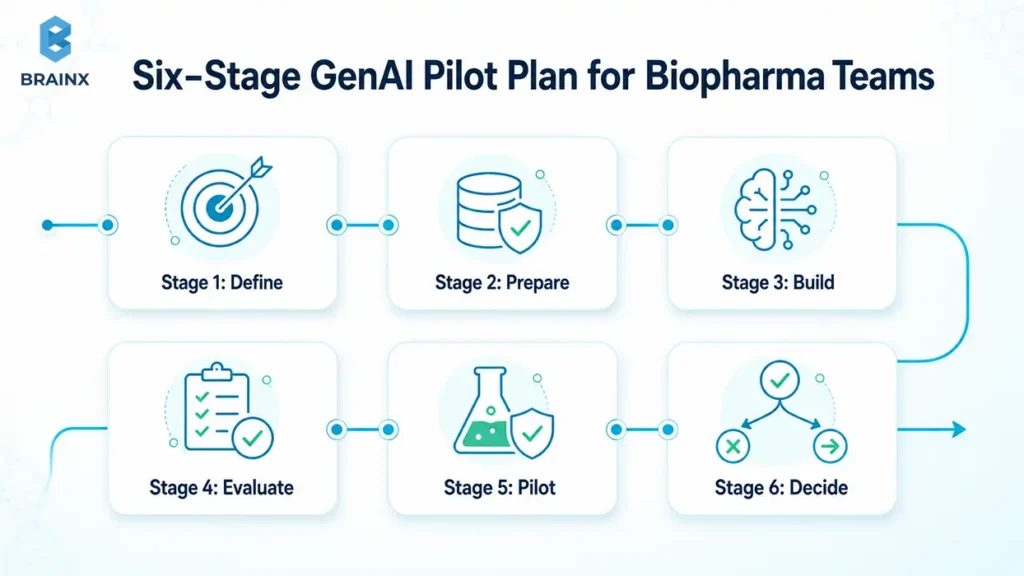
At a high level, teams create value by selecting the right workflow, validating it through a controlled pilot, and scaling only when the evidence supports expansion.
Stage 1: Define
Identify the users, problem, baseline, context of use, prohibited uses, and success criteria.
Stage 2: Prepare
Approve data access, reviewers, evaluation sets, security controls, and source-quality requirements.
Stage 3: Build
Implement retrieval, model integration, the user interface, logging, access controls, source citations, and guardrails.
Stage 4: Evaluate
Run gold-standard tests, edge-case evaluations, red-team prompts, human-factors testing, and a security review.
Stage 5: Pilot
Release the system to a limited group of users with mandatory review, incident tracking, monitoring, and structured feedback.
Stage 6: Decide
Scale, revise, pause, replace, or retire the system based on the evidence.
What to Prepare Before Day One
- Named business owner
- Named quality and domain reviewers
- Data inventory
- Approved data access
- Baseline metrics
- Evaluation criteria and release thresholds
- Risk register
- Vendor review
- Incident process
- Security requirements
- Version-control plan
- User-training plan
Missing ownership or evaluation criteria should delay development.
Build vs. Buy for Regulated Pharmaceutical Workloads
| Factor | Build | Buy |
|---|---|---|
| Speed | Slower initial delivery | Faster initial access |
| Control | High | Depends on vendor |
| Customization | High | Limited by platform |
| Data residency | Configurable | Vendor-dependent |
| Validation support | Built for the client’s process | Varies widely |
| Integration | Custom and deep | Prebuilt where supported |
| Model-update control | Greater control and version pinning | Vendor may change models |
Ask vendors about retention, training use, version pinning, change notices, audit-log export, deletion, subcontractors, service discontinuation, evidence export, and quality-process support.
Go/No-Go Criteria Before Production
- Performance thresholds are met
- Critical failure modes are controlled
- Human review works in practice
- Security and privacy reviews are complete
- Ownership is assigned
- Monitoring is active
- Rollback is possible
- Users are trained
- Intended-use boundaries are documented
- Change and incident procedures are approved
A pilot should advance because evidence supports controlled operational use, not because the demonstration is impressive.
What Is the Future of Generative AI in Pharma?
The future of generative AI in pharma is likely to involve more connected scientific models, bounded AI agents, shared enterprise platforms, and lifecycle-based governance. Pharmaceutical companies will move beyond isolated experiments toward controlled capabilities that support multiple approved workflows.
This shift will not remove the need for laboratory testing, clinical evidence, quality oversight, or qualified decision-makers. The strongest systems will combine improved AI capabilities with governed data, defined human authority, and evidence that the complete workflow performs reliably.
Multimodal Models Will Connect More Scientific Data
Future pharmaceutical models will increasingly work across scientific literature, molecular structures, medical images, genomics, transcriptomics, proteomics, laboratory results, and structured clinical data.
A 2025 Nature perspective on multimodal foundation models describes how models trained across different omics and biological data types could support biomarker discovery, cell-state characterization, gene-regulation analysis, and experimental design. These systems may help researchers identify relationships that are difficult to find when each data type is analyzed separately.
Their value will still depend on data quality, biological relevance, representativeness, and experimental confirmation. Combining more data modalities can improve context, but it can also introduce additional uncertainty, licensing constraints, integration challenges, and validation requirements.
AI Agents Will Support Bounded Pharmaceutical Workflows
Generative AI is also moving from stand-alone assistants toward agents that can retrieve evidence, use authorized tools, complete defined steps, check outputs, and route work to qualified reviewers.
A 2026 review of generative AI in pharmaceutical R&D identifies the transition from large language models to AI agents as an important emerging direction. Separate industry research has also examined how agentic systems may help researchers navigate real-world drug-discovery tools and workflows.
In practice, an agent might search approved sources, prepare a structured evidence summary, identify missing information, and send the result for scientific review. It should not independently approve a target, determine trial eligibility, interpret safety causality, or make final regulatory decisions.
Agent permissions, tools, data access, actions, and escalation rules will need to be tightly controlled and auditable.
GenAI Will Become a Shared Enterprise Capability
Pharmaceutical companies are likely to move away from separate departmental pilots toward reusable enterprise foundations.
These foundations may include:
- Governed scientific and operational data layers
- Permission-aware retrieval systems
- Approved model gateways
- Shared evaluation and monitoring services
- Reusable human-review workflows
- Audit logging and version control
- Standard integrations with research, clinical, safety, quality, and regulatory systems
This model allows teams to reuse approved components without assuming that one validation decision applies to every use case. A literature assistant, protocol-support system, and pharmacovigilance workflow may share infrastructure while retaining separate risk assessments, evaluation criteria, and reviewer responsibilities.
The EMA AI Observatory is also tracking AI applications, policy developments, regulatory-science research, and operational adoption across the medicines lifecycle. Its work supports the European medicines regulatory network’s data and AI plans through 2028, indicating that AI is becoming a sustained organizational capability rather than a temporary experiment.
Evidence and Governance Will Cover the Full AI Lifecycle
Future adoption will depend less on impressive demonstrations and more on documented performance throughout development, deployment, monitoring, change, and retirement.
The joint FDA and EMA principles for good AI practice emphasize clear context of use, risk-based assessment, multidisciplinary expertise, data governance, complete-system evaluation, lifecycle management, and transparent communication of limitations.
As models, prompts, retrieval sources, integrations, and user groups change, pharmaceutical companies will need defined re-evaluation triggers. Monitoring will increasingly cover unsupported claims, source failures, subgroup performance, reviewer behavior, security events, drift, and use outside the approved scope.
Human Expertise Will Remain Central
Generative AI will change how pharmaceutical professionals search, analyze, draft, review, and document information. It is less likely to remove the need for scientific, clinical, quality, safety, and regulatory expertise.
Future teams will need people who can work across:
- Pharmaceutical and biological science
- Clinical and regulatory operations
- AI and data engineering
- Quality and validation
- Security and privacy
- Human-factors evaluation
The most valuable systems will not simply generate more output. They will help qualified teams reach better-supported decisions while preserving clear responsibility for evidence, safety, quality, and regulatory conclusions.
How BrainX Supports Pharmaceutical GenAI Initiatives
BrainX Technologies can help organizations move from an AI concept to a controlled product with defined users, approved data, measurable evaluation, and operational safeguards.
Use-Case and Risk Discovery
BrainX can define the objective, context of use, workflow, risk, data, review boundaries, validation needs, and success metrics before development.
Data and Architecture Assessment
The assessment covers data sources, access, quality, retention, integrations, security, retrieval design, reviewer interfaces, audit logging, evaluation, monitoring, and model selection.
BrainX Technologies applies the same software engineering discipline to healthcare and life-sciences workflows, where privacy, interoperability, and operational reliability shape the architecture.
Controlled Pilot Development
A controlled pilot may include RAG or model integration, reviewer workflows, evaluation datasets, traceability, audit logging, guardrails, controlled testing, and monitoring.
Integration, Monitoring, and Scale
Once evaluated, BrainX can help in supporting enterprise integration, access control, versioning, regression testing, monitoring, incident workflows, roll back and performance optimization.
Proof and Delivery Experience
BrainX brings experience across custom AI software, data platforms, cloud applications, automation, and healthcare-related products. While this experience supports the technical foundation for pharmaceutical GenAI initiatives, outcomes depend on the specific use case, data, workflow, and regulatory context.
Where relevant, BrainX case studies clearly outline the use case, our role, implementation scope, measurement approach, results, timeframe, and material limitations, subject to client approval.
BrainX does not promise guaranteed compliance, zero hallucinations, regulatory approval, or universal timeline reductions. Validation and compliance remain shared, use-case-specific responsibilities involving the client’s scientific, quality, legal, privacy, security, and regulatory teams.
Conclusion
Generative AI in pharma can support discovery, clinical operations, and regulated knowledge workflows. Its worth is based on approved data, fit-for-use evaluation, integration into workflow, qualified review, and monitoring.
The strongest starting point is often a lower-risk internal workflow with clear sources and measurable review quality. Scale only after the complete human-AI workflow produces reliable evidence.
Frequently Asked Questions About the Use of GenAI in Pharma
What Is Generative AI in Pharma, and How Is It Being Used Today?
Generative AI creates text, structures, sequences, summaries, translations, and draft workflow outputs. Pharma teams use it for scientific retrieval, hypothesis support, molecular design, protocol and document assistance, regulatory intelligence, and safety operations. Mature deployments are usually internal, grounded in approved data, and reviewer-mediated.
Can Generative AI Reduce Drug-Discovery Timelines?
It can reduce time in literature review, hypothesis generation, virtual screening, prioritization, and documentation. It cannot guarantee end-to-end acceleration because results depend on the target, data, modality, laboratory capacity, and later-stage success. Synthesis, testing, preclinical work, trials, and regulatory review remain necessary.
Can an AI-Generated Molecule Be Considered a Drug Candidate?
Not immediately. A generated structure is a computational proposal. It becomes more credible only after chemical, biological, ADMET, synthesizability, IP, synthesis, assay, and preclinical gates. Clinical evidence and regulatory review come later.
How Are GenAI Outputs Validated in a GxP-Regulated Workflow?
Validation starts with intended use, risk, requirements, evaluation sets, gold standards, and release thresholds. Teams test the complete workflow, preserve traceability, require qualified review for high-impact outputs, and continue monitoring and change control after release.
Can Generative AI Make Clinical-Trial Eligibility or Safety Decisions?
No. GenAI may organize evidence, compare criteria, or draft an assessment, but qualified investigators, clinicians, safety professionals, and regulatory teams must retain decision authority and documented accountability.
What Are the Greatest Risks of Using GenAI in Clinical Trials?
Major risks include unsupported claims, privacy failures, population bias, automation bias, weak traceability, and uncontrolled model changes. Approved data, qualified review, audit logs, evaluation sets, version control, monitoring, and incident procedures reduce these risks.
Is RAG Enough to Prevent Hallucinations?
No. RAG improves grounding but cannot guarantee relevant, complete, current, or correctly interpreted evidence. Retrieval testing, citation checks, source governance, constrained outputs, and human review remain necessary.
Should a Pharmaceutical Company Build or Buy a GenAI System?
It depends on risk, data sensitivity, integration depth, validation needs, update control, internal capability, and total cost. Buying can be faster; building offers more control. Many organizations combine external models with a custom gateway, retrieval, review, and monitoring layer.
What Is the Best First GenAI Pilot for a Biotechnology Company?
Start with a narrow internal workflow using approved data and qualified reviewers, such as literature retrieval, regulatory intelligence, or quality-document assistance. Measure baseline time, source support, reviewer acceptance, serious errors, and total verification effort.
How Often Should a Pharmaceutical GenAI System Be Re-Evaluated?
Re-evaluate on a scheduled basis and after material changes to the model, prompt, data, retrieval corpus, integration, users, workflow, regulations, or intended use. Incidents, drift, security events, and reviewer failures should also trigger review.