 September 29, 2026 -
 19 minutes read


An AI automation readiness assessment checks whether a specific workflow has the business value, data, integrations, controls, ownership, and measurement needed for a controlled pilot. It should produce a clear decision: pilot now, fix defined gaps first, or defer the use case because its value or feasibility remains unproven.
Choosing a model, agent framework, or automation platform before assessing the workflow can commit budget to the wrong solution. Unavailable data, unsupported integrations, unclear permissions, and an unstable process can change the investment case. A readiness review exposes those dependencies while the scope and spending can still be adjusted.
Assess the workflow with its actual users, systems, exceptions, and intended AI actions. An internal drafting assistant and an agent that changes customer records need different evidence and controls. This guide explains how to score seven readiness dimensions, identify blockers, and turn the findings into a pilot that tests the business case.
Key Takeaways
- An AI automation readiness assessment should determine whether a specific workflow can deliver measurable value safely, not assign a vague company-wide AI score.
- Strong automation candidates combine worthwhile business outcomes, stable processes, usable data, feasible integrations, accountable owners, and measurable success criteria.
- A high readiness score should never cancel a critical blocker involving data rights, security, compliance, system permissions, human oversight, or ownership.
- A useful assessment ends with a decision: pilot, remediate then pilot, or defer, with named actions and owners.
- Baseline cost, cycle time, error, quality, throughput, or revenue measures belong in readiness because teams need a pre-automation benchmark.
- The most useful path from assessment to implementation combines evidence-backed scoring, mandatory gates, and a tightly bounded proof of concept (PoC).
Quick Answers
What does “ready” mean for one AI automation use case?
Enough evidence supports a bounded pilot with measurable value and appropriate controls. Readiness applies to that scope, not every AI opportunity in the business.
Should readiness be assessed company-wide or workflow by workflow?
Make the pilot decision workflow by workflow. Use company-wide capabilities as context, as explained under organization versus workflow readiness.
Can a high total score still mean “do not pilot yet”?
Yes. A critical failure in authorization, approved data use, ownership, or oversight blocks the proposed pilot regardless of its total score.
What evidence should teams collect before assigning scores?
Start with process maps, performance baselines, representative data, integration documentation, and operating responsibilities. The evidence matrix below identifies what to inspect.
What Is a Secure AI Automation Readiness Assessment?
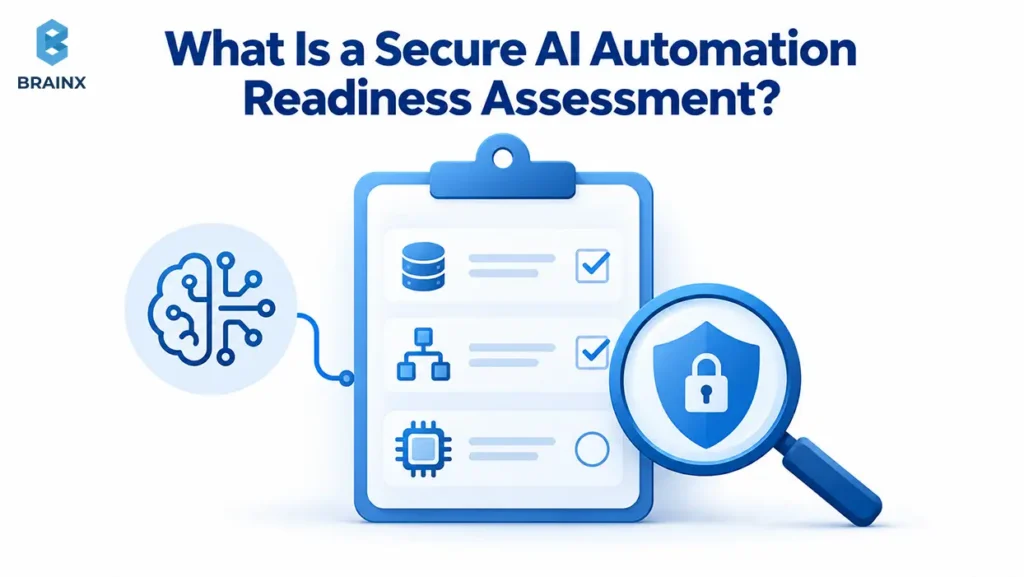
A secure AI automation readiness assessment should answer a practical decision: Can this defined workflow move into a controlled pilot now, what must change first, or should the use case be deferred?
The assessment connects business feasibility with the controls needed for the proposed AI role. It distinguishes permission to experiment in a restricted environment from permission to automate live work.
“Secure” is important because an automation can be technically feasible while still being unsafe to deploy. A system that can summarize a document is different from an AI agent that can access customer records, update a CRM, send external communications, or trigger a financial action.
NIST’s AI Risk Management Framework provides voluntary guidance for managing trustworthiness across AI design, development, use, and evaluation. NIST currently states that AI RMF 1.0 is being revised.
ISO/IEC 42001:2023 addresses AI management systems across an organization. Neither reference replaces the workflow evidence needed for a pilot decision.
What Should the Assessment Produce?
The assessment should produce a decision package that explains whether the workflow can proceed, the evidence behind that verdict, and what must happen next. It should distinguish verified capabilities from assumptions that still need testing, so the budget owner can judge the remaining uncertainty.
Organization Readiness Vs. Workflow Readiness: Which Should You Assess?
Assess both, but use them differently.
Organization readiness describes the operating environment: governance, security practices, architecture standards, AI skills, procurement, vendor controls, and leadership support.
Workflow readiness determines whether a particular automation opportunity can actually proceed. It asks whether the required data exists, the process is understandable, integrations work, actions can be authorized, exceptions can be handled, and value can be measured.
A capable organization can still have an unsuitable workflow. A less mature organization may also have a narrow, low-risk workflow that is ready for a carefully controlled pilot.
The whole organization does not need to reach a uniform maturity level before any AI work begins. A narrow use case can move forward when its own requirements are met; unresolved controls cannot be bypassed by calling the work an experiment.
AI Readiness vs. Data Readiness: What Is the Difference?
Data readiness asks whether the information needed for a task is available, usable, current, and permitted for the intended use. AI readiness includes those checks and also examines business value, workflow design, integration feasibility, people, controls, and measurement.
For example, a complete and accurate order database may be suitable for answering order-status questions. That does not establish whether an assistant can access it securely, handle exceptions, or deliver enough value to justify implementation. Data readiness is one part of the broader decision.
When Should You Run an AI Automation Readiness Assessment?
Run an assessment when a defined AI opportunity is approaching an investment or delivery decision: before committing to a platform, funding a substantial pilot, or changing systems to support automation. Early screening can be lightweight. Deeper technical checks should follow when uncertainty could change the scope, cost, or permission to proceed.
Reassess before expanding a pilot into a new workflow, adding sensitive data, giving AI more action authority, or introducing materially different integrations. A previous verdict covers the scope reviewed at that time. Changes in regulation, ownership, vendor behavior, or observed failures may also require renewed assessment.
Do not wait for every enterprise capability to be complete before investigating a use case. Use interviews, sample-data reviews, and small technical experiments to resolve uncertainties, with controls appropriate to the information and systems involved.
How to Conduct an AI Automation Readiness Assessment Step by Step
Begin with one workflow and follow the sequence below. Each step should resolve a decision or produce evidence for the next; uncertain assumptions can be tested through a restricted technical experiment.
Step 1: Define the Workflow and Business Outcome
Identify the trigger, users, inputs, outputs, and boundary of the work. Agree on the problem worth solving and record the current performance baseline. The candidate-selection section below explains how to judge whether the opportunity merits investment.
Step 2: Map the Current Process and Intended AI Role
Document the normal path, important exceptions, systems, and handoffs. Specify which actions AI may suggest and which it may execute. Include informal workarounds that employees rely on, because these often reveal missing rules or escalation paths.
Step 3: Gather Evidence and Test Uncertain Dependencies
Collect the artifacts listed in the evidence matrix. Verify consequential assumptions with representative data, permission checks, or integration tests. Record what remains unknown and assign responsibility for resolving it.
Step 4: Score the Dimensions and Check Mandatory Gates
Apply the same evidence-based scale across all seven dimensions. Review blocking conditions separately from the total so strengths in one area cannot hide a failure in another.
Step 5: Record the Decision and Next Actions
Use the template fields to record whether to pilot, remediate and reassess, or defer. Translate remaining gaps into the roadmap, with owners, completion criteria, and the evidence required for the next approval.
Who Needs To Participate In The Assessment?
Include the process owner and technical owner, then bring in the people who control the workflow’s data, risks, and daily operation.
Operational users can expose exceptions that a process diagram misses. Data owners validate access and quality. Security, privacy, legal, or compliance specialists assess the obligations relevant to the use case. The budget owner decides whether the proposed value warrants the investment.
Not every stakeholder needs to attend every session. The important requirement is that business value, implementation feasibility, data rights, operating ownership, and material risk are not decided by people who lack authority over them.
What Makes a Workflow a Strong Candidate for AI Automation?
A high-value workflow is not automatically automation-ready. The strongest early candidates combine worthwhile economics with understandable operating boundaries.
A process that is expensive but chaotic may need redesign before automation. A technically easy task may not deserve investment if its business impact is negligible.
Is There A Measurable Business Outcome Worth Automating?
Choose a business outcome that can be measured before and after the pilot.
Ask what should improve if the automation works. Depending on the workflow, useful baselines may include:
- cycle time or waiting time;
- manual effort and cost per transaction;
- error, rework, or quality rates;
- throughput or capacity;
- service-response measures;
- conversion, retention, or revenue where they are directly attributable.
The current baseline belongs in readiness because the pilot needs something meaningful to beat. Without it, a team can demonstrate that AI produced outputs without demonstrating that the workflow improved.
Volume and frequency also matter. A repetitive task performed thousands of times may justify automation differently from an equally complex task performed several times a quarter.
For help identifying opportunities, explore BrainX’s generative AI use cases and business outcomes.
Is The Workflow Stable Enough To Automate?
A workflow is stable enough when the team can describe its normal path, recognize significant exceptions, and route uncertain cases to an accountable person.
That does not require every step to be deterministic. It does require the team to know the normal path, inputs and outputs, major decision points, common exceptions, escalation route, and definition of successful completion.
A useful “do not automate yet” test is simple: Can the team explain how the process should work when things go wrong?
If different employees perform the same task in materially different ways, ownership is unclear, or exceptions dominate normal processing, process redesign may create more value than adding AI immediately.
How Much Decision Authority Should The AI Receive?
Specify whether the AI can only suggest an action or also execute it.
An AI system that drafts a response for human approval has a different risk profile from an agent that sends the response automatically. The same distinction applies to systems that recommend versus approve, read versus write, or prepare a transaction versus execute it.
List permitted actions separately, including reading records, classifying requests, drafting responses, sending messages, updating systems, and triggering transactions.
Controls should reflect the consequence and reversibility of each action. Sending a sensitive email can carry more risk than updating a reversible internal label, so these capabilities are not a universal ladder of risk.
What Does an AI Automation Readiness Assessment Include?
Score the dimensions that determine whether the selected automation workflow can create value and operate reliably. Data readiness alone is not enough.
The seven-dimension matrix below is a practical assessment worksheet developed for this guide. Its scoring is illustrative, not a validated industry benchmark or certification.
AI Readiness Assessment Framework and Evidence Matrix
Use the matrix to examine seven distinct conditions for delivery. Record a score, evidence reference, evidence date, and named owner for every dimension.
Use one 0–3 scale throughout: 0 = no supporting evidence; 1 = major gaps; 2 = partial evidence with specific remediation needed; 3 = evidence supports the defined pilot scope. Missing evidence means readiness is unknown, not that the capability necessarily does not exist.
Seven Dimension Readiness Matrix
| Dimension | Evidence to inspect | Warning sign | Accountable role |
| Business value | Baseline KPI, task volume, cost, intended outcome | The objective is only to use AI | Business owner |
| Process | Normal path, exception samples, escalation rules | Important steps rely on undocumented judgment | Process owner |
| Data | Representative samples, quality checks, ownership, approved uses | Required data is unusable or its use is unapproved | Data owner |
| Systems and integrations | API tests, identity model, permissions, test environment | Required operation is unsupported | Technical owner |
| Security and governance | Risk review, policies, threat tests, approval and recovery paths | Consequential actions lack controls | Security or governance owner |
| People and ownership | Support responsibilities, training, user feedback, escalation plan | Nobody owns output quality or exceptions | Operations owner |
| Measurement and scale | Evaluation set, cost assumptions, monitoring, acceptance criteria | Success cannot be measured or monitored | Business and technical owners |
How Do You Check Whether Data Is Fit for the Workflow?
Inspect representative inputs from the actual process, including common cases and meaningful exceptions. Check whether required fields are present, records agree across systems, timestamps are current enough, and documents reflect the rules employees must follow. A large dataset can still be unsuitable if it excludes the cases the automation will encounter.
Define quality requirements around the action being assessed. A missing optional description may be tolerable for routing a request; a missing customer identifier may prevent a reliable record lookup. Record each issue, the affected part of the workflow, and how the team will verify the correction. Avoid assigning a universal data-quality percentage without considering the consequence of errors.
Identify the data owner and who approves the proposed use. Keep permission failures separate from quality defects: cleaning a dataset does not establish a right to use it. For a document assistant, include access boundaries and outdated or contradictory source material in the review.
How Should Evidence Support Each Readiness Score?
Assign each score from evidence that another reviewer can inspect.
Keep interviews as discovery inputs, then substantiate important claims using the artifacts listed in the matrix. Record disputed assumptions and the test needed to resolve them.
For example, “our CRM has an API” is weaker evidence than documentation showing the required endpoint, authentication method, rate constraints, permitted write operation, test environment, and owner.
The evidence standard should rise with consequence. A low-risk internal drafting assistant may need less validation than an automation that can modify customer records or initiate transactions.
Are Your Architecture and Integrations Ready for the Workflow?
Delivery readiness depends on the entire path between the workflow trigger and the final business action.
Map source systems, APIs, identity, model access, destination systems, logging, monitoring, recovery, and human escalation. For retrieval-augmented generation (RAG), also check document permissions, indexing, retrieval quality, and source freshness. RAG retrieves external information to support model responses.
BrainX’s guide to integrating AI into existing technology stacks explains how workflow needs affect architecture and rollout.
How Should You Score Readiness Without Hiding Critical Blockers?
A readiness score helps teams compare gaps, but it should never average away a critical blocker.
A workflow can score well on six dimensions and still be unfit for a pilot because the seventh contains a material authorization, privacy, ownership, or safety problem.
Why Should Mandatory Readiness Gates Override The Total Score?
Mandatory gates are conditions that must be satisfied before the proposed pilot can proceed.
Proposed gate categories include:
- no accountable business or operating owner;
- no approved or otherwise valid path for required data;
- unresolved handling of sensitive or regulated information;
- no authorization for the system actions AI would perform;
- no escalation or containment mechanism for consequential failures;
- no credible way to determine whether the pilot succeeded.
These are assessment gates, not automatic legal conclusions. The exact privacy, compliance, and security requirements depend on jurisdiction, industry, system role, and the data or decisions involved.
A failed gate means “resolve this before proceeding,” even if the aggregate readiness score looks attractive.
What Should “Pilot,” “Remediate,” And “Defer” Mean?
Use the score to understand relative preparedness and the gates to determine whether the workflow may proceed.
Use-Case Decision Matrix
| Business value | Delivery readiness | Gate status | Decision |
| Worthwhile | Evidence supports bounded pilot | All applicable gates pass | Pilot |
| Worthwhile | Specific gaps can be fixed | Gates pass after remediation | Remediate, then reassess |
| Worthwhile | Otherwise strong | Any critical gate fails | Resolve gate before pilot |
| Low or unclear | Any | Any | Defer or reframe |
| Potentially worthwhile | Major unresolved dependencies | No feasible resolution yet | Defer until prerequisites change |
There is intentionally no universal “80% means ready” rule here. Different workflows have different consequences, dependencies, and operating environments. A qualitative verdict supported by evidence is often more defensible than false numerical precision.
AI Automation Readiness Assessment Template Fields
A reusable AI automation readiness assessment template should preserve the evidence, decision, and actions needed to repeat the review.
Record the workflow and baseline; intended AI actions; data and systems; seven dimension scores with evidence links; gate status and reasons; remediation owners and deadlines; pilot scope and success criteria; stop conditions; final verdict; and next review trigger.
For example, “Data = 2 because 12 of 100 sampled records lack required fields” identifies a testable gap. Record the missing-field remediation separately from the mandatory gate for approved data use. The sample numbers here are illustrative.
Worked Example of a Readiness Decision
Consider an illustrative support assistant that drafts order-status replies. The team proposes allowing it to issue refunds as well. Business value, process, data, ownership, and measurement score 3 each; integrations score 2; security and governance score 1. The total is 18 out of 21, yet refund authorization and approval controls remain unresolved.
The verdict is to remediate before piloting the refund workflow. The team could separately assess a narrower drafting-only pilot with read-only access and employee approval before sending. That revised scope needs its own gate review; reducing scope does not automatically establish readiness.
AI Automation Readiness Assessment Checklist: Questions to Ask Before a Pilot
Use these questions to gather evidence for the matrix, not to calculate a second score. Record the answer, supporting artifact, owner, and any unresolved action in the same assessment worksheet.
Business Value and Process Questions
What outcome should change, and what is today's baseline? How often does the work occur? Which exceptions consume the most effort? Who owns the process? Would simpler rules, process redesign, or conventional automation meet the same need?
Data Readiness Questions
Which inputs are essential? Do samples include realistic exceptions? What quality or freshness issues could change the result? Who can approve the proposed use, and how will changes to the source data be detected?
Systems and Integration Questions
Which applications must the automation read from or write to? Have the required operations been tested with the intended permissions? What happens when a model, API, or destination system is unavailable?
Risk and Human-Oversight Questions
Who could be affected by an incorrect output or action? Which actions require approval? How will errors be detected, contained, and escalated? Which policies, contracts, or legal requirements govern the workflow?
People, Skills, and Operating Questions
Does the team have the capacity and skills to build, evaluate, and support the automation? Who will review outputs and handle exceptions? What training or changes in responsibilities do users need? Have operational users tested whether the proposed process is workable?
Measurement and Scale Questions
Which result would justify continuing, redesigning, or stopping? Does the cost estimate include review, rework, support, and usage growth? Can performance be monitored after launch, and who will decide whether wider rollout is justified?
What Security, Compliance, and Human-Oversight Checks Are Required?
A commercially attractive workflow is not ready for AI automation if the organization cannot define what the AI may access, what it may do, who remains accountable, and how failures will be detected and contained.
What Data And System Permissions Will The Automation Need?
Grant only the data access and system actions required for the defined workflow.
Classify the required data. Identify credentials and external providers. Separate read permissions from write permissions. Determine whether production and test environments are isolated appropriately. Define how access will be logged, how secrets are managed, and how an unwanted system action can be recovered or reversed where possible.
Use least-necessary authority as a design principle. A workflow that needs to read order status should not receive permission to modify orders simply because the integration account makes that convenient.
The OWASP Top 10 for LLM Applications 2025 identifies prompt injection, sensitive information disclosure, improper output handling, and excessive agency among its risks. Include tests for these failures when an LLM reads external content or calls tools.
Where Must Humans Review, Approve, Or Escalate AI Actions?
Human oversight should be proportional to the consequence, reversibility, uncertainty, and applicable obligations of the action.
An internal suggestion that an employee reviews before use may justify light controls. An action that changes an entitlement, communicates externally, modifies an authoritative record, or triggers a consequential transaction requires a different analysis.
Name the reviewer, show them the relevant source evidence, define response deadlines, and specify what happens if they reject an action or are unavailable. Enforce authorization in the application or underlying service; a model-generated instruction must not grant new permissions.
Consider people affected by the output as well as the employee operating the system. Where recommendations influence access, eligibility, or other consequential decisions, test for relevant differences in error rates and outcomes across affected groups. Define how a person can seek review or correction. The tests should reflect the workflow and its consequences.
NIST’s AI RMF Playbook recommends documenting intended uses, affected stakeholders, potential impacts, and human responsibilities. Use that context to determine which evaluations are necessary for the proposed pilot.
Which Governance And Regulatory Requirements Apply To The Use Case?
Separate voluntary frameworks, management standards, internal policies, and legally binding obligations. They serve different purposes.
Use the NIST AI RMF for voluntary risk-management guidance and ISO/IEC 42001:2023 for organizational management-system requirements. Applicable laws and contracts require separate evaluation.
As of September 28, 2026, the European Commission’s AI Act timeline shows staged application. Transparency obligations apply from August 2, 2026, while specified high-risk rules have later dates, including December 2, 2027, and August 2, 2028. Identify the system’s role, classification, and applicable provisions before assigning a compliance gate.
Healthcare, financial services, employment, education, and other regulated applications may also trigger sector-specific requirements. Those checks should use the competent regulator and legal requirements for the jurisdiction rather than a generic AI checklist.
BrainX’s guide to AI trust, risk, and security controls covers the broader governance and monitoring work around enterprise AI.
How Do You Turn Readiness Findings Into a Pilot Roadmap?
A readiness roadmap translates the verdict into a delivery sequence. For each action, record its owner, dependencies, completion evidence, and the decision it enables. Include effort or budget assumptions, the people needed to complete the work, and approval checkpoints before pilot launch and wider rollout.
Which Blockers Should You Fix First?
Prioritize gaps by whether they block permission to proceed, prevent technical delivery, or undermine the business case. Put prerequisite work ahead of dependent tasks: for example, approve the data-use scope before configuring access, then test the permitted integration before evaluating the end-to-end workflow.
Prefer fixes that can support additional workflows, such as a reusable permission model or a supported API integration, when their wider value justifies the effort.
Set a completion condition for each item. “Improve integration” is difficult to verify; “demonstrate the required read operation with scoped credentials and a tested failure path” gives the reviewer something concrete to approve. Reassess when the evidence is available, rather than treating a planned fix as a passed gate.
How Should You Scope A Bounded AI Automation Pilot?
A bounded pilot should test the smallest realistic version of the workflow that can validate both business value and important production dependencies.
Define the target workflow and users, permitted data, source and destination systems, AI action authority, exception path, monitoring, baseline, success measures, and stop or escalation conditions before rollout.
Do not remove every difficult dependency merely to make a demo succeed. If production requires CRM write access, permission controls, human escalation, and live data quality, a useful PoC should validate enough of those dependencies to inform the real investment decision.
In the Radio Prospector case study, BrainX describes a backend-first proof of concept that validated data workflows, scoring logic, and integration feasibility before UI/UX work. It illustrates testing core delivery assumptions early; it does not establish that the client used this article’s readiness worksheet.
How Do You Measure Whether the Automation Created Business Value?
Compare total workflow effort, quality, and cost with the pre-pilot baseline.
Count human review, exceptions, rework, model usage, infrastructure, and ongoing support. Measure cost per successfully completed task, not only cost per model call.
Also measure failure behavior. A system that processes normal cases quickly but creates excessive exceptions or manual correction may shift work rather than remove it.
Avoid using generic adoption measures as a substitute for outcomes. “Employees used the AI system 3,000 times” says little about whether the workflow became faster, cheaper, safer, or better.
Illustrative Pilot Economics
Suppose 2,000 monthly cases require eight minutes of manual work each. If a pilot reduces total human handling to three minutes per case, including review and average rework, it releases about 166.7 hours per month. At an assumed loaded labor cost of $30 per hour, that represents $5,000 of capacity value.
If model, infrastructure, and support costs total $1,500 monthly, the estimated net monthly value is $3,500 before implementation costs. A hypothetical $21,000 implementation would have a six-month simple payback if that value is fully realized. These are calculation assumptions, not BrainX results or market benchmarks.
Released capacity is not automatically cash savings. Confirm whether the team can redeploy the time, avoid additional hiring, or reduce actual expenditure. Recalculate the case if quality declines, demand changes, or exception handling grows.
What Happens After The Pilot?
Use the pilot evidence to make one of three decisions:
- Scale when evidence supports the target value and the control model is adequate.
- Iterate or remediate when the opportunity remains attractive but specific technical, operating, quality, cost, or risk gaps need work.
- Stop or defer when the workflow does not create sufficient value, the dependency burden changes the economics, or unresolved risks make the proposed automation inappropriate.
Validated integrations, evaluation methods, and support practices can reduce repeated discovery work for later use cases. Reuse them only after checking that the new workflow has compatible requirements. A successful pilot does not automatically approve broader data access or greater action authority.
When Should You Use a Self-Assessment vs. an Expert Review?
A self-assessment is appropriate for screening and alignment. Expert review becomes more useful when technical dependencies, risk, organizational complexity, or investment consequences increase.
AI Readiness Assessment Tool: When Is Self-Assessment Enough?
An AI readiness assessment tool is useful for initial screening when the team can verify its answers. A questionnaire alone cannot test API behavior, inspect data quality, or prove that authorization works.
Self-assessment works particularly well when the workflow is narrow, the data and systems are understood, the process owner is available, the action is low consequence, and the internal team can verify technical and governance assumptions.
A questionnaire becomes less reliable when respondents must guess about API behavior, data rights, architecture, permissions, security controls, regulatory classification, or production economics. At that point, the unknowns themselves are part of the readiness problem.
What Should A Credible External Assessment Partner Deliver?
A credible assessment partner should leave you with enough implementation evidence to make the next investment decision.
Ask the partner to show how recommendations follow from inspectable evidence, identify untested assumptions, and explain what would change the verdict. Check whether the proposed architecture and pilot plan address the difficult dependencies of your actual workflow, and whether your team can use the findings after the engagement ends.
Be cautious when an assessment produces only a polished enterprise maturity presentation. A buyer ultimately needs to understand what can be built, what has to change, how value will be tested, and what risks remain.
Which Signals Mean You Need Technical Validation Before Committing To Automation?
Deeper technical validation becomes more valuable when the proposed workflow involves uncertain API access, fragmented or sensitive data, legacy applications, cross-system write actions, complicated exceptions, consequential decisions, unclear AI architecture, or disagreement over the baseline and success criteria.
A small architecture experiment, sample-data review, integration test, or security review can resolve these uncertainties before a larger commitment.
Validate Your AI Automation Readiness with BrainX
Choose one workflow and bring its current process, performance baseline, and known constraints to a discovery conversation.
BrainX’s AI development and strategy services cover problem identification, data preparation, proof of concept, testing, integration, deployment, and monitoring.
Contact BrainX experts to discuss the evidence your use case needs before a pilot and the dependencies that could affect delivery.
FAQs
How long does an AI automation readiness assessment take?
The duration depends on access to evidence and the tests needed to resolve uncertainty. A narrow workflow with documented APIs and available data can be reviewed more quickly than a process spanning legacy systems and sensitive records. Ask for milestones and dependencies rather than accepting a universal timeline.
Does a small business need a formal assessment?
A small business can use a lightweight worksheet for one workflow. It should still identify an owner, verify data use and system permissions, establish a baseline, and define how failures will be handled. Assessment effort should reflect the consequences of the automation.
Can you assess readiness before choosing an AI vendor?
Yes. Define the outcome, data restrictions, integration requirements, evaluation criteria, and operating limits first. Use those findings to compare vendors, then validate vendor-specific assumptions such as retention settings, access controls, supported integrations, and usage costs.
Does every automation opportunity need generative AI?
No. Predictable rules and structured inputs may be handled by conventional software, workflow tools, or robotic process automation. Generative AI is more relevant when the task involves variable language or unstructured content. Compare the simplest feasible approach against the same outcome and quality criteria.
Does passing the assessment mean the system is production-ready?
No. Passing supports the defined pilot scope. Production approval requires evidence from testing and operation, including security, reliability, monitoring, support, and recovery. Wider access, new users, or greater action authority changes the scope and requires renewed review.