 August 29, 2026 -
 22 minutes read


Key Takeaways
- AI TRiSM is an operating model designed to manage governance, trust, risk, security, privacy, evaluation, and monitoring throughout the AI lifecycle.
- The framework encompasses all aspects of the AI system, spanning data, models, GenAI applications, RAG pipelines, external tools, APIs, copilots, and AI agents.
- Controls should be proportional to risk. An internal summarizer should not face the same approval process as AI influencing healthcare, hiring, financial, or other consequential decisions.
- RAG and agentic AI create additional risks around data authorization, tool permissions, external actions, identity, and auditability that prompt-level guardrails cannot solve alone.
- Governance can be a speedy process rather than a release bottleneck, using re-usable risk tiers, evaluation criteria, approved architectures and evidence requirements.
- Enterprise adoption is growing faster than governance maturity. McKinsey reported 88% regular organizational AI use in at least one function, while Deloitte found only 21% of surveyed companies had mature governance for autonomous agents.
AI TRiSM gives enterprises a practical way to govern, test, secure, and continuously monitor AI throughout its lifecycle. Instead of treating AI governance, cybersecurity, privacy, model evaluation, and operational monitoring as separate projects, it connects them through one operating model.
This matters because enterprise AI is no longer limited to predictive models. Organizations now use generative AI applications, retrieval-augmented generation (RAG), embedded copilots, third-party foundation models, and agents capable of invoking tools or changing business systems.
Gartner defines AI TRiSM as ensuring “AI model governance, trustworthiness, fairness, reliability, robustness, efficacy and data protection.” Its 2026 AI-readiness guidance expands the operating layer to include visibility and traceability, approval workflows, continuous assurance, runtime inspection and enforcement, and information governance.
The goal is not to eliminate every AI risk. It is to identify material risks early, assign ownership, apply appropriate safeguards, and verify that those safeguards remain effective as the system changes.
What Is AI TRiSM and What Does It Govern?
When leaders ask what is AI TRiSM, the simplest answer is that it is a coordinated management approach for trustworthy, secure, and accountable AI.
It governs the complete AI system rather than the model alone. That includes:
- Data used for training, fine-tuning, or retrieval
- Internally developed and third-party models
- Prompts, embeddings, and vector stores
- Applications and APIs
- User identities and permissions
- RAG pipelines
- Agent tools and external actions
- Generated outputs
- Monitoring and audit logs
- People responsible for approving and operating the system
This broader scope reflects a core principle of modern AI risk management: risk depends on how a system is designed, deployed, used, and connected to other systems. The NIST AI Risk Management Framework similarly applies risk management across the design, development, deployment, use, and evaluation of AI systems.
Such lifecycle perspective also matters when scoping AI development services, because controls need to be designed alongside data preparation, testing, integration, deployment, and monitoring.
What Is the Difference Between AI TRiSM and AI Governance?
AI governance defines the rules and accountability for enterprise AI; AI TRiSM provides the technical and operational controls that help keep those rules enforceable in practice. Governance covers policies, ownership, risk appetite, approvals, documentation, and acceptable use.
Gartner’s 2026 guidance explains that policy-based governance alone is not enough as AI becomes more embedded and autonomous. AI TRiSM adds capabilities such as system inventory, continuous assurance, information governance, runtime inspection, and policy enforcement.
In simple terms, governance establishes what should happen. AI TRiSM helps verify and enforce that expectation while models, applications, and agents are operating.
How Are Trust, Risk, and Security Different, but Connected, in Enterprise AI?
Trust determines whether an AI system can be relied on, risk determines what can go wrong, and security protects the system against misuse or attack. An enterprise needs all three.
Trust may involve accuracy, fairness, transparency, reliability, explainability, and appropriate human oversight.
Risk management assesses the likelihood and impact of failures, including financial loss, harmful decisions, regulatory exposure, privacy breaches, and operational disruption.
Security addresses threats such as prompt injection, unauthorized access, sensitive-data disclosure, insecure tool use, and compromised integrations.
Consider a customer-support copilot. The system can still be untrustworthy, even if it blocks unauthorized access, because it may confidently provide consumers with inaccurate information.
Conversely, a highly accurate assistant may still be unsafe if employees can manipulate it into retrieving confidential records.
AI TRiSM connects these disciplines so that model evaluation does not ignore security and security testing does not ignore business impact.
Which AI TRiSM Controls Belong at Each Stage of the AI Lifecycle?
Controls should start when a use case is proposed and continue through retirement. Applying safeguards only before launch can leave architectural risks unresolved.
| AI Lifecycle Stage | Practical Controls |
| Data sourcing | Provenance, permitted use, classification, quality, retention, access rights |
| Model selection or training | Vendor due diligence, model suitability, bias and quality evaluation, version records |
| Application development | Threat modeling, access control, secure retrieval, output validation, tool restrictions |
| Pre-release validation | Quality tests, security testing, red teaming, approval evidence |
| Deployment | Secrets, environment controls, logs, rollback plans |
| Runtime operation | Quality monitoring, drift detection, security alerts, cost monitoring, human escalation |
| Change management | Version tracking, regression tests, renewed risk assessment |
| Incident response | Detection, containment, investigation, escalation, remediation |
| Retirement | Access revocation, data disposition, dependency cleanup, evidence retention |
The NIST AI RMF takes the same lifecycle-oriented view of managing AI risk, while its Generative AI Profile adds considerations specific to generative systems.
For example, an enterprise RAG assistant should not reach production simply because its answers look accurate. Teams must also verify document permissions, retrieval boundaries, user access, output handling, logging, and monitoring.
Why Do Enterprise AI Programs Need a Unified Trust, Risk, and Security Model Now?
When AI shifts from being a standalone experiment to an integrated system that impacts real users, personal data, and business processes, a unified model becomes critical.
McKinsey’s 2025 global AI survey found that 88% of respondents reported regular AI use in at least one business function. However, just one-third reported that their organizations have started scaling AI programs enterprise-wide.
Why this matters now:
- AI estates are expanding: third-party models, RAG applications, copilots, and agents are harder to govern through one-time reviews.
- AI can act, not just answer: agents can invoke tools, change records, and trigger workflows, so permissions and runtime controls matter more.
- Evidence must keep pace: security, privacy, and compliance teams need traceable approvals, testing, monitoring, and enforcement as systems change.
This creates a difficult transition point. AI use is broad enough to create meaningful exposure, but operating controls may still be designed for experimentation.
What Changes When a Company Moves From AI Pilots to Production Systems?
Production turns an AI capability into an accountable business service. Real users, live data, integrations, availability requirements, and downstream actions significantly increase the consequences of failure.
Compare two systems.
An internal policy assistant may use approved documents, remain read-only, and provide non-binding answers. Its primary risks might be inaccurate information and inappropriate employee use.
A claims assistant may access customer records, interpret policy information, recommend outcomes, and update case-management software.
The second system requires more:
- Strong identity and authorization
- Sensitive-data controls
- Tested evaluation datasets
- Human escalation rules
- Detailed action logs
- Rollback procedures
- Incident response
- Formal approval evidence
Agents raise the stakes further because AI can move from generating an answer to taking an action.
Deloitte’s 2026 State of AI in the Enterprise research shows the gap clearly. Only 21% of the surveyed companies reported having a mature governance model for autonomous agents, with expectations that this figure will increase significantly.
The IBM Cost of a Data Breach Report 2025 revealed that 97% of companies that experienced an AI security incident had no proper AI access controls.
This is particularly crucial while incorporating AI models into CRMs, ERPs, knowledge bases, permissions, and live business workflows while leveraging AI integration services.
Which AI Risks Should Leaders Assess Before Deploying Models, GenAI Apps, and Agents?
Leaders should assess risk across data, models, applications, operations, users, and business outcomes. Model accuracy alone cannot reveal insecure retrieval, excessive agent permissions, or unsafe downstream actions.
NIST suggests evaluating AI risks by context and potential impact, and the OWASP GenAI LLM Top 10 2026 offers up-to-date application-security guidance for LLM-based systems.
How Can Teams Identify Data, Model, Application, and Human-Use Risks?
Start by tracing how information and decisions move through the entire AI system. Then assess failure modes at each layer.
Data risks include unclear provenance, exposure of confidential data, data quality issues, poor retention policies, lack of consent and unauthorized retrieval.
Model risks include inaccurate outputs, bias, drift, weak explainability, model extraction, and unexpected behavior after provider updates.
Application risks include prompt injection, insecure output processing, broken authorization, exposed secrets, unsafe integrations, and excessive tool permissions.
Operational risks include shadow AI, missing ownership, inadequate logging, provider changes, unmanaged exceptions, and weak incident procedures.
Human and business risks include automation bias, employees over-trusting outputs, harmful decisions, customer impact, compliance problems, and financial loss.
Teams should assess both likelihood and consequence. A hallucination in an internal brainstorming tool has a different impact from an incorrect recommendation affecting a customer transaction.
Which Risks Are Unique to Retrieval-Augmented Generation and AI Agents?
RAG adds retrieval and authorization risks. Agents add delegated authority and action risks.
A RAG application may authenticate the user correctly but still retrieve documents that user cannot access in the original system. Securing the vector database itself does not solve this problem.
Authorization should therefore follow the requesting user into the retrieval layer. Document or record permissions should be enforced before sensitive context reaches the model.
Agents require additional controls because they can act.
An agent connected to CRM, email, payments, support systems, or infrastructure may be able to:
- Modify customer records
- Issue refunds
- Send external communications
- Create or delete resources
- Trigger workflows
- Access sensitive information
The OWASP Top 10 for Agentic Applications 2026 codifies risks such as agent goal hijacking, misuse of tools, abuse of identity and privilege, agentic supply-chain vulnerabilities and unexpected code execution.
Use least-privilege permissions, tool allowlists, transaction limits, action logging, approval checkpoints, and deterministic authorization outside the model.
A stronger system prompt cannot compensate for an agent holding administrator credentials it never needed.
How Does AI TRiSM Work? The Four Layers of the Framework
AI TRiSM works by translating governance policies into technical controls that can observe, evaluate, and constrain AI behavior. Gartner’s 2025 Market Guide for AI Trust, Risk and Security Management describes the market as four layers of technical capabilities that enforce AI governance policies.
Each layer answers a different question: What AI exists and who owns it? What data may it use? What should be inspected or blocked at runtime? And what infrastructure makes those controls observable and auditable?
| Layer | Primary role | Typical controls |
| AI governance | Establish visibility, ownership, risk context, and approval evidence. | AI inventory, risk scoring, model documentation, approval workflows, continuous assurance |
| AI runtime inspection and enforcement | Evaluate live AI interactions and enforce policy during use. | Prompt and output inspection, anomaly detection, policy checks, blocking, sanitization, escalation |
| Information governance | Define what data AI systems may access and under which conditions. | Classification, access rules, retention, data mapping, oversharing controls |
| Infrastructure and stack | Provide a secure, observable environment for AI workloads and controls. | Hosting isolation, API gateways, network paths, logs, telemetry, CI/CD controls |
Palo Alto Networks’ AI TRiSM architecture presents traditional protections such as network security, identity, data protection, and monitoring as the foundation beneath these AI-specific layers. AI TRiSM connects to those existing controls rather than replacing them.
How Does AI TRiSM Apply to Models, Applications, and Agents?
The control point changes with the AI entity. Palo Alto Networks’ TRiSM guidance distinguishes models, applications, and agents because each exposes different enforcement points.
| AI entity | What TRiSM checks | Typical failure pattern |
| Models | Inputs and outputs, prompt injection, extraction attempts, unsafe or unwanted responses | A prompt produces unsafe, inaccurate, or disallowed output |
| Applications | Retrieval scope, user permissions, context handling, output validation | Overshared or mis-permissioned data reaches the wrong user |
| Agents | Tool calls, action sequence, identity and privileges, approved operating scope | The agent performs an unintended or unauthorized action |
Agents therefore need stronger least-privilege access, action-level monitoring, transaction limits, and human approval for high-impact operations. The same policy cannot be enforced at the same point for every type of AI system.
What Does an AI TRiSM Control Flow Look Like in Practice?
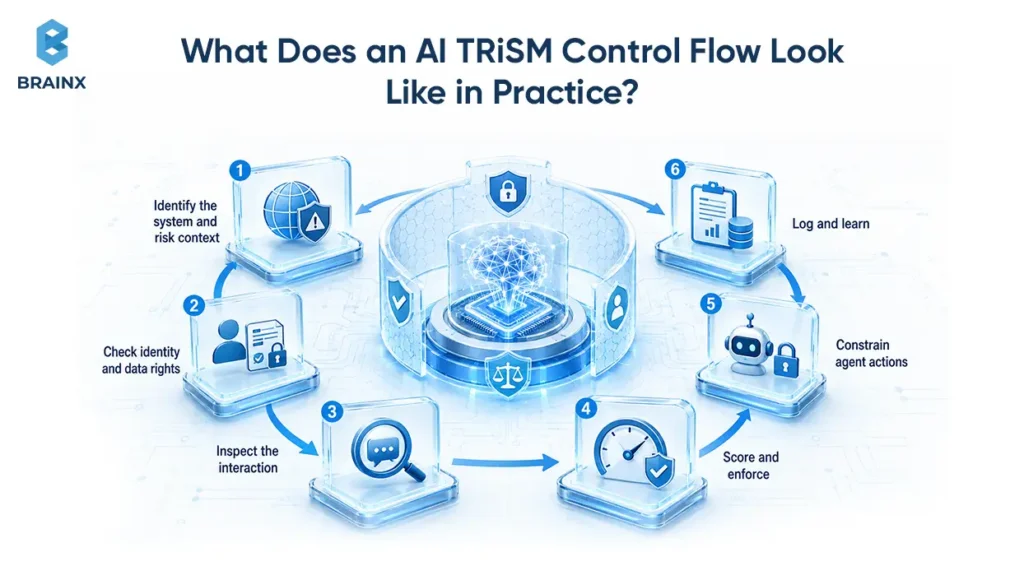
At runtime, a layered TRiSM architecture should connect catalog context, data permissions, inspection, enforcement, and evidence in one flow:
- Identify the system and risk context. The request is associated with a cataloged model, application, or agent, along with its owner, risk tier, and approved use.
- Check identity and data rights. The system verifies who is making the request and which data or retrieval sources that user is allowed to access.
- Inspect the interaction. Prompts, retrieved context, model outputs, or proposed tool calls are checked for policy, privacy, and security issues.
- Score and enforce. Low-risk activity proceeds; suspicious content can be blocked, sanitized, or routed for review.
- Constrain agent actions. High-impact tool calls require the right permission and, where appropriate, explicit human approval.
- Log and learn. Decisions, overrides, incidents, and evaluation results feed monitoring and continuous assurance.
For example, an IT service-desk agent may authenticate an employee successfully but still block or escalate a privileged-account reset because the proposed action exceeds the agent’s approved scope.
How Does a Practical AI TRiSM Operating Model Work Across the Enterprise?
At the organizational level, a practical operating model converts governance principles into repeatable decisions, clear ownership, and evidence teams can produce during normal delivery.
A workable program-level process is straightforward:
- Maintain an inventory of AI systems.
- Assign an accountable owner.
- Classify each use case by risk.
- Apply a predefined control baseline.
- Add deeper controls where impact increases.
- Collect approval evidence.
- Monitor after release.
- Reassess when material changes occur.
The goal is not a larger policy library; it is a predictable path from use-case intake to production.
Who Owns Decisions Across Product, Engineering, Security, Data, Legal, and Compliance?
The rules of the enterprise should be set by central governance while delivery teams remain responsible for implementing them.
A lightweight ownership model can look like this:
| Role | Primary Accountability |
| Product owner | Purpose, users, business impact, success criteria |
| Data owner | Provenance, sensitivity, access, retention, permitted use |
| AI/model owner | Model selection, evaluation, versions, limitations |
| Engineering | Application architecture, integrations, controls, testing |
| Security | Threat model, IAM, secrets, testing, incident readiness |
| Legal/privacy/compliance | Regulatory requirements, privacy, approval conditions |
| Operations | Runtime monitoring, escalation, rollback, incident coordination |
The central governance function can maintain risk definitions, approval requirements, exception processes, and evidence templates. Engineering teams then implement those requirements within the application.
This avoids the common failure mode where “AI governance” belongs to a committee that cannot see what the production system actually does.
How Should Teams Use Risk Tiers to Avoid Slowing Down Low-Risk AI Work?
Risk tiers let enterprises standardize easy decisions and concentrate review on systems where failure has greater consequences.
| Tier | Example | Typical Controls |
| Low | Internal read-only assistant using non-sensitive content | Inventory, approved provider, data boundaries, basic evaluation, logging |
| Moderate | Customer-support copilot accessing account data with human escalation | IAM, permission-aware retrieval, privacy checks, stronger evaluation, security testing |
| High | AI influencing consequential decisions or executing sensitive transactions | Formal risk assessment, red teaming, human oversight, approval gates, least privilege, continuous monitoring |
A low-risk assistant using an approved model and architecture should be able to inherit an existing control baseline.
A high-risk system should trigger deeper review before architecture decisions become expensive to reverse.
This is how governance can increase delivery predictability instead of making every AI project wait for the same committee.
What Controls Make AI Systems More Trustworthy, Secure, and Auditable?
The four-layer framework only becomes useful when each layer is backed by concrete safeguards. At the implementation level, teams need controls across identity, data access, model behavior, application security, infrastructure, monitoring, and human oversight.
No single safeguard is sufficient.
IAM controls who can access the system. Data controls limit what information can be used. Evaluations test output behavior. Security testing probes attack paths. Monitoring detects changes after deployment. Audit logs preserve evidence when something goes wrong.
MITRE ATLAS has a living knowledge base of adversarial tactics and techniques for AI-enabled systems, covering predictive, generative, agentic and enterprise AI.
How Do Evaluation, Monitoring, and Incident Response Create Continuous Assurance?
Continuous assurance verifies that an AI system remains within approved boundaries after deployment.
Pre-release evaluations establish baselines for areas such as:
- Accuracy
- Groundedness
- Hallucination rates
- Refusal behavior
- Fairness
- Data leakage
- Security
- Policy compliance
- Latency and reliability
But production conditions change. Models are updated. Retrieval data evolves. Users find unexpected workflows. Attack techniques change.
Monitoring should therefore compare real-world behavior against defined thresholds.
Alerts also need actions attached to them. A severe data disclosure might automatically suspend the affected workflow. Quality degradation may trigger rollback to a previous model or prompt version.
Incident procedures should identify who can disable the system, preserve evidence, investigate root cause, notify stakeholders, and approve restoration.
That closes the loop between governance and actual production behavior.
What Should an AI TRiSM Solution Include for Enterprise-Scale Oversight?
An AI TRiSM solution should centralize visibility, risk workflows, evaluation evidence, monitoring, and audit information without replacing established enterprise controls.
Useful capabilities include:
- AI system, model, and agent inventory
- Data and dependency mapping
- Risk questionnaires and tiering
- Approval and exception workflows
- Evaluation and regression testing
- Model, prompt, dataset, and provider versioning
- Runtime monitoring
- Incident management
- Audit evidence
- Integrations with IAM, SIEM, DLP, CI/CD, ticketing, and data governance tools
Gartner’s 2026 AI-readiness guidance highlights visibility and traceability, approval workflows, continuous assurance, runtime inspection and enforcement, information governance, and guardian agents as important TRiSM capabilities.
Buying an AI TRiSM solution does not automatically make an organization compliant or trustworthy. Technology supports the operating model. It does not replace accountability, architecture, testing, or human decision-making.
For teams deciding what to build, configure, or source externally, our custom AI development guide explains how architecture, evaluation, deployment, and operational ownership fit together.
Where Does AI TRiSM Create Measurable Business Value?
Its business value comes from reducing uncertainty, rework, approval friction, avoidable incidents, and inconsistent AI delivery.
Enterprises can measure that value through operational metrics rather than vague statements about “responsible AI.”
Relevant indicators include:
- Time from AI use-case intake to approval
- Percentage of projects using approved architectures
- Evaluation pass rates
- Number and age of unresolved high-risk findings
- Policy-exception volume
- Mean time to detect and contain AI incidents
- Production rollback frequency
- Unauthorized access or retrieval events
- User adoption and escalation rates
The best metrics connect control performance to business outcomes.
How Can Stronger Controls Improve Adoption, Delivery Speed, and Customer Confidence?
Good controls can make AI easier to adopt because teams know what is allowed, what evidence is required, and how a system reaches production.
Without reusable standards, every project starts the same debate: Which data is allowed? Which model can we use? Does security need to review this? What testing is sufficient? Who approves the release?
A mature operating model pre-answers many of those questions.
Low-risk projects can inherit approved providers, reference architectures, evaluation templates, logging standards, and security controls.
Higher-risk projects receive deeper review earlier, when architecture can still be changed without major rework.
Trust also affects adoption. Employees are more likely to use an AI tool when they understand its limits and escalation paths. Customers benefit when organizations can explain how sensitive information and high-impact decisions are controlled.
The result is not “fewer controls.” It is less uncertainty around the right controls.
How Can an Enterprise Implement AI TRiSM Without Delaying Innovation?
Start with one real production use case and build reusable controls around it. Avoid spending months designing an abstract governance framework before testing whether it works with actual engineering teams.
The first implementation should reveal where policies, architecture, security, data access, evaluation, and ownership need to connect.
What Should the First 90 Days of an AI TRiSM Program Look Like?
The first 90 days should establish visibility, risk tiers, baseline controls, and one working implementation.
Days 1–30: Inventory and ownership
- Inventory active AI applications, models, agents, providers, and key data flows.
- Identify customer-facing, regulated, sensitive-data, and autonomous systems.
- Assign an executive sponsor.
- Choose one production use case for the initial implementation.
- Document current owners and control gaps.
Days 31–60: Risk model and baseline controls
- Define simple low, moderate, and high-risk criteria.
- Set minimum controls for each tier.
- Assign product, data, AI, security, privacy, and operational owners.
- Define required evaluations.
- Create approval and exception workflows.
- Establish evidence requirements.
Days 61–90: Pilot the operating model
- Apply the framework to the selected production use case.
- Run quality, safety, privacy, and security evaluations.
- Review identity and data boundaries.
- Add runtime logging and monitoring.
- Conduct relevant adversarial testing.
- Test the incident-response process.
- Record approval evidence.
After 90 days, teams can expand proven patterns to additional systems and automate evidence collection where useful.
A concise intake form should capture purpose, affected users, data types, provider, autonomy, external tools, decision impact, integrations, human oversight, and applicable regulatory exposure.
For a related delivery view, see BrainX’s 30–90 day AI implementation planning guide for partner-led, in-house, or hybrid execution.
What Common AI TRiSM Implementation Pitfalls Should Enterprises Avoid?
The biggest implementation failures are usually operational rather than conceptual. CrowdStrike’s AI TRiSM guidance highlights fragmented ownership, limited visibility, weak monitoring and data controls, tool sprawl, and scaling before safeguards mature as common pitfalls.
- Treating policy as the control. Written rules do not substitute for runtime enforcement and evidence.
- Skipping inventory and ownership. Uncataloged models, applications, or agents cannot be risk-tiered or monitored consistently.
- Using one review path for every use case. Over-governing low-risk AI creates bottlenecks, while under-governing high-risk AI creates exposure.
- Adding security after architecture is fixed. Data boundaries, permissions, logging, and agent tool access are easier to design early.
- Monitoring without response actions. A dashboard is not assurance unless thresholds trigger an owner, escalation, rollback, or containment step.
- Buying overlapping tools without a control model. Tool sprawl fragments evidence and makes accountability less clear.
A phased rollout avoids most of these problems: start with one production use case, prove the control baseline, then standardize and automate what works.
When Should Teams Build Controls Internally, Configure Existing Tools, or Seek Specialist Support?
Build controls that differentiate your AI product, reuse mature enterprise tools where possible, and bring in specialists where capability gaps create material risk.
Internal development makes sense for proprietary evaluation criteria, domain-specific rules, product workflows, or business-specific approval logic.
Existing platforms are usually better suited to mature functions such as identity, secrets management, security monitoring, DLP, ticketing, and CI/CD.
Specialist support becomes useful when teams need:
- AI or agentic threat modeling
- Independent architecture review
- Authorization-aware RAG design
- Agent permission architecture
- Red teaming
- Evaluation frameworks
- Production monitoring design
- Governance workflow implementation
- Fast establishment of a repeatable enterprise control model
Third-party models also require due diligence around retention, model-training use, regional processing, subprocessors, provider changes, security commitments, and exit options.
The EU AI Act adds another reason to evaluate controls according to use case and jurisdiction. The Act was generally applied from August 2, 2026, with exceptions. Following the updated enforcement timeline, rules for high-risk systems listed in Annex III apply from December 2, 2027, while rules for high-risk AI embedded in regulated products apply from August 2, 2028.
How BrainX Helps Enterprises Operationalize Trusted AI
BrainX Technologies helps enterprises translate AI governance requirements into secure architecture, practical controls, testing, and production-ready systems.
Support can include:
- Enterprise AI risk and architecture assessments
- Secure GenAI application development
- Authorization-aware RAG architecture
- AI agent permission and approval design
- Quality, safety, and security evaluation
- Governance intake and evidence workflows
- Production monitoring and incident readiness
- Integration with existing enterprise security and data systems
The engagement can begin with one priority use case rather than a company-wide transformation.
BrainX can map the system’s data, users, models, integrations, permissions, and business impact. From there, teams can identify control gaps, assign a risk tier, define evaluation requirements, and design a production architecture that supports the required evidence.
The approach remains vendor-neutral. An enterprise can have more than one model provider, cloud platform, database, IAM system, security products, and governance technology. The objective is to have those capabilities work as a single, unified control space, not to replace everything with a single AI TRiSM solution.
AI TRiSM works best when governance becomes part of delivery, not an approval exercise added at the end. Clear ownership, proportional controls and ongoing assurance ensure that enterprises can expand AI sensitivity without obscuring risks and managing them effectively.
If you want to assess a live use case, schedule a free consultation with our experts to review architecture, risk, data access, and production controls.
Frequently Asked Questions
What Is AI TRiSM?
AI TRiSM stands for AI Trust, Risk and Security Management. It connects governance, trustworthiness, risk management, privacy, security, evaluation, monitoring, and assurance so enterprises can manage AI systems throughout their lifecycle.
Is AI TRiSM the Same as Responsible AI?
No. Responsible AI is the broader set of principles around fairness, transparency, accountability, safety, and human impact. AI TRiSM focuses more directly on operationalizing those expectations through controls, testing, ownership, monitoring, and evidence.
Can AI TRiSM Work With NIST AI RMF or ISO/IEC 42001?
Yes. AI TRiSM can complement both. The NIST AI RMF is a voluntary, use-case-agnostic framework for managing AI risk across the lifecycle, while ISO/IEC 42001 specifies requirements for an organizational AI management system. AI TRiSM can provide technical controls, monitoring, and evidence that help operationalize governance requirements. The mapping is context-specific, so adopting TRiSM does not by itself demonstrate compliance with either framework or standard.
Which AI Systems Need AI TRiSM Controls?
Any enterprise AI system should receive controls proportional to its risk. Low-risk internal tools may need lightweight safeguards, while customer-facing, sensitive-data, regulated, or autonomous systems require stronger evaluation, approval, monitoring, documentation, and human oversight.
What Are the Biggest AI TRiSM Risks for GenAI Applications and Agents?
Key risks include prompt injection, sensitive-data leakage, hallucinations, insecure output handling, unauthorized RAG retrieval, excessive agent permissions, unsafe tool use, provider changes, and missing audit trails. Agentic systems require particular attention because they can take external actions.
Does an Enterprise Need a Dedicated AI TRiSM Platform or Can It Use Existing Tools?
Not necessarily. Enterprises can reuse IAM, SIEM, DLP, CI/CD, observability, ticketing, and governance systems. A dedicated AI TRiSM solution becomes useful when centralized inventory, automated evaluation, risk workflows, runtime inspection, and consolidated evidence are needed at scale.