 November 6, 2026 -
 23 minutes read


An AI proof of concept (AI PoC) is a small, time-limited test that shows whether an AI idea can solve a real business problem with your own data. It compares the AI with how you work today and ends in one of four decisions: stop, pivot, pilot or build.
A slick demo is easy to build. Proving that it works on your messy data, at a cost you can live with, is the hard part. That gap is why so many AI projects stall:
- Gartner predicted that at least 30% of generative AI projects would be abandoned after proof of concept by the end of 2025, because of poor data quality, weak risk controls, rising costs or unclear business value (July 2024).
- IDC research with Lenovo found that only 4 of every 33 AI PoCs reached wide-scale production, so 88% did not (reported by CIO.com, March 2025).
- RAND found that more than 80% of AI projects fail, about twice the rate of IT projects without AI (August 2024).
This guide shows you how to run an AI PoC that gives you a clear answer, not just a nice demo.
Key Takeaways
- An AI PoC answers one question: can this AI approach work well enough, on our data, to be worth more investment?
- Set success criteria before you build. Otherwise the goalposts move to fit the results.
- Always compare the AI with today’s method, and count the time people spend checking its work.
- Every AI PoC should end in one of four decisions: stop, pivot, pilot or build.
- Published AI PoC budgets mostly fall between $10,000 and $80,000. Most PoCs take 4 to 8 weeks (3 to 16 depending on the type of AI).
- Start with the simplest AI approach (prompting, then RAG, then fine-tuning or agents).
- Plan the path to production during the PoC, not after it. That’s where most AI projects stall.
What Is an AI Proof of Concept (AI PoC)?
An AI proof of concept is a short experiment that tests one AI idea against one real problem. It uses a small set of your real data, a clear way to score the results, and a fixed budget and deadline.
In AI, “PoC” simply means proof of concept. The goal is not to build a product. The goal is to learn, quickly and cheaply, whether the idea deserves a bigger investment. For general software projects, see our guide to proof of concept in software development.
What an AI PoC Must Prove
A useful AI PoC tests six things. If any one fails, the project is at risk:
- Value: Does it save enough time, cost or effort to matter?
- Data: Is the data available, accurate and allowed to be used?
- Quality: Is it right often enough on the cases that matter?
- Cost: Can you afford it at the volume you expect?
- Risk: What happens when it’s wrong, and can people catch it?
- Fit: Does it work in the real workflow, with real permissions?
NIST’s AI Risk Management Framework places AI evaluation within the context of intended use and risk.
How an AI PoC Differs From a Traditional Software PoC
A normal software PoC asks, “Can we build this?” An AI PoC also asks, “Will it behave well enough, often enough?” The main differences:
- Results vary: The same input can give different outputs, so you test many cases.
- Data decides success: Poor data can sink a good model.
- “Mostly right” is normal: You need an agreed error limit, not pass or fail.
- Costs grow with use: Every request costs money, so cost per task matters.
- Models change: Hosted models get updated, so re-check results over time.
What’s Different About a Generative AI PoC
Generative AI PoCs (chatbots, assistants, content tools) test language models instead of trained prediction models. They add five checks:
- Hallucinations: does it make up facts? Measure how often answers aren’t backed by your sources.
- Grounding: does it use your documents (RAG) instead of guessing?
- Prompt injection: can hidden instructions in documents or user input redirect it?
- Cost per request: token use can grow fast with long documents and retries.
- Model changes: hosted models get updated, so re-test after updates.
What’s Different About an AI Agent PoC
An AI agent doesn’t just answer; it takes actions with tools, such as updating a ticket or sending an email. An agentic AI PoC must also test:
- Autonomy limits: Which actions can it take alone, and which need human approval?
- Tool permissions: Give it only the tools and access the task needs.
- Agent type: Match it to the workflow: a single assistant, a multi-step workflow or several cooperating agents.
- Failure handling: What happens when a tool call fails or times out? Cap retries.
- Action checks: Verify the result of each action, not just that the command ran.
- Audit trail: Log every request, approval and action.
- A stop switch and an owner: Someone must be able to switch automation off and be accountable for it.
New to agents? Our guide to why AI agents are the next step after chatbots explains how they plan steps and use business tools.
Why Run an AI PoC? 8 Benefits
An AI PoC costs a fraction of a full build and answers the questions that decide whether the full build is worth it. Here’s what it gives you:
- Lower risk: You find problems before you spend most of the budget.
- Real evidence for leaders: Decisions rest on test results, not on a demo or a vendor pitch.
- Early data checks: Missing, messy or restricted data shows up in weeks, not months.
- A true cost estimate: You measure today’s process and learn the real cost per task, including human review.
- Faster decisions: A fixed deadline forces a clear stop, pivot, pilot or build call.
- Safer rollout: Security, privacy and permission issues surface before real users are involved.
- Better vendor choice: You can compare models or vendors on the same test set.
- Stakeholder buy-in: Users who help test it are more likely to adopt it, and the test set carries into the pilot.
AI PoC vs PoV vs Prototype vs Pilot vs MVP
These stages answer different questions. They’re often mixed up, which leads to the wrong test at the wrong time.
| Stage | Main Question | Typical Evidence | Typical Length |
| PoC | Can this approach work on our task? | Quality, failure cases, data fit, estimated costs | 4–8 weeks (3–16 by type) |
| Proof of value (PoV) | Will it deliver measurable business value? | ROI on a real workflow, user adoption | Varies with scope; often a few weeks |
| Prototype | What will it look and feel like? | User reactions to screens and flows | 2–4 weeks |
| Pilot | Does it work in a real workflow? | User feedback, reliability, integration performance | 3–6 months |
| MVP | Does this usable product deliver value? | Adoption, feedback, customer outcomes | 3–6 months |
| Production | Can we run it reliably at scale? | Uptime, cost, monitoring, support | Ongoing |
Typical lengths come from published 2026 industry guides. These are not a fixed sequence: a pilot can test an MVP, and a prototype can run alongside a PoC.
When to Run an AI PoC (and When Not To)
7 Signs You Should Run an AI PoC
- The idea is promising, but nobody knows if AI can do it well enough.
- The investment is big enough that a wrong bet would hurt.
- Your data is messy, scattered or untested for this use.
- Leaders or customers need proof before they commit.
- You’re comparing vendors, models or approaches.
- Mistakes could be costly, so you need to know the error rate.
- The AI must fit into existing systems, permissions or workflows.
6 Times an AI PoC Is a Waste of Time
- A simple rule or existing software already solves the problem.
- A proven off-the-shelf AI feature does the same job the same way.
- There’s no clear business problem or owner yet.
- The real question is whether people want it; test that with interviews or a clickable prototype.
- There’s no budget or plan to act on a “yes.”
- The data you’d need doesn’t exist and can’t be collected.
How to Choose the Right Use Case for an AI PoC
The best first AI PoC is valuable, measurable and low-risk. Score each idea with these eight questions. Pick the one with the most “yes” answers:
- Is there a clear business owner who wants this solved?
- Can you measure the result in time, money or quality?
- Does the task happen often enough to matter?
- Do you already have the data, and are you allowed to use it?
- Can you measure how the task is done today?
- Is a wrong answer low-risk, or easy for a person to catch?
- Can a small version be tested in a few weeks?
- Would a “yes” lead to a real next step, such as a pilot with a budget?
Good first candidates include answering questions from internal documents, pulling fields from invoices, sorting support tickets and forecasting demand. See the AI PoC examples below for how each one is tested.
If the AI must work inside your current CRM, ERP or data systems, check that early. Our guide to adding AI to your existing tech stack covers data readiness and phased integration.
How to Build an AI Proof of Concept in 12 Steps
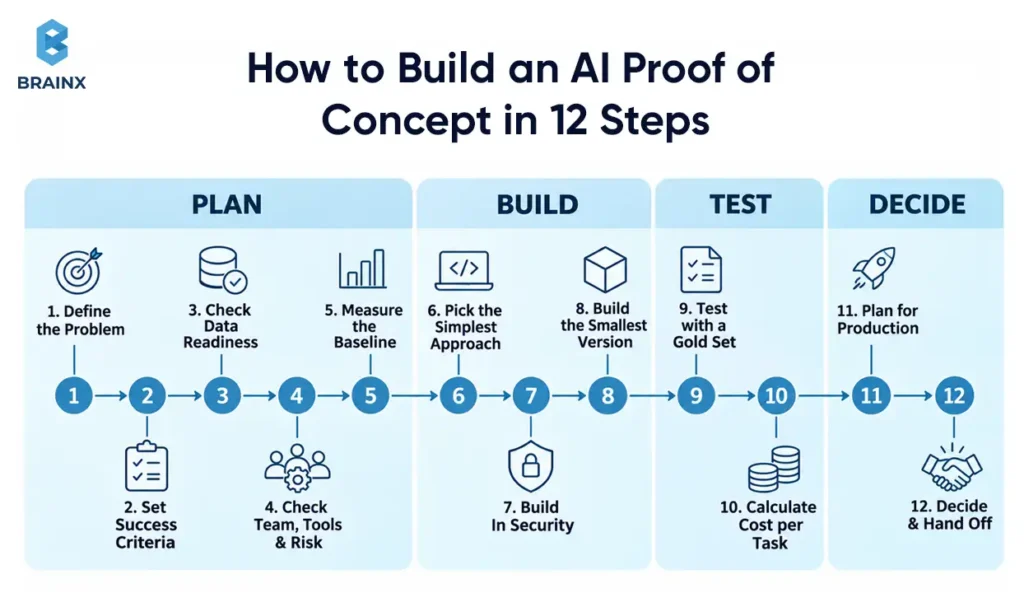
Each step should leave something another person can review. Keep the scope small and the deadline fixed, but don’t ignore delays caused by missing data or approvals.
1. Define the Problem and the Decision
Write down who needs help, with which task, and what decision the PoC will support. Turn it into a claim that testing could prove wrong.
“Use AI to improve customer support” is too broad. A better version: “Draft answers from approved policy documents with less reviewer effort than manual drafting, while keeping serious factual errors within an agreed limit.”
2. Set Success Criteria Before You Start
Agree on the numbers that mean “go” before anyone builds anything: required quality, speed, cost per task and review effort. Avoid an unexplained “95% accuracy” target. Say what is counted, which errors matter most, and who accepts the remaining risk.
3. Check That Your Data Is Ready
Collect a representative sample: everyday cases, hard cases and the mistakes that would be costly. Confirm you’re allowed to use it. Testing only clean English documents, for example, tells you nothing about multilingual scans.
4. Check Your Team, Tools and Risk
Data is only one part of readiness. Before you build, confirm four things: a business owner and a technical lead with time to spare, a domain expert who can review results (at least a few hours a week), the tools and system access you’ll need, and a clear view of legal, privacy and security limits.
5. Measure Today’s Baseline
Record how the task is done now: quality, time, review effort and cost. The baseline might be manual work, ordinary search or a simple rules-based tool. Use the same scoring rules for the AI later, and include human correction time in both.
6. Pick the Simplest Approach That Could Work
AWS guidance on generative AI PoCs recommends starting with the simplest method that can prove the business value. A good order to try:
| Approach | When to use it | Main trade-off |
| Prompting a hosted model | The task needs general knowledge or writing | Fastest to test; least control |
| Retrieval (RAG) | Answers must come from your own documents | Needs clean, permission-aware documents |
| Fine-tuning | Prompting and RAG can’t reach the quality bar | Needs labeled data; more cost and time |
| AI agents with tools | The task needs actions, not just answers | Harder to test; needs strict limits |
| Classic machine learning | Forecasting or scoring from historical data | Needs reliable history and targets |
Add tools and actions only when the task really needs them. Each extra part adds cost, testing work and risk.
Common tools teams use in AI PoCs (examples, not recommendations):
| Category | Examples |
| Foundation models | GPT, Claude, Gemini, Llama, Mistral |
| Orchestration frameworks | LangChain, LlamaIndex |
| Vector search for RAG | pgvector, Pinecone, OpenSearch |
| Classic machine learning | scikit-learn, XGBoost, PyTorch, TensorFlow |
| Experiment tracking | MLflow |
| Data preparation | pandas, SQL, document parsers and OCR |
7. Build Security and Access In From Day One
If access rules are part of the real workflow, test them in the PoC. Enforce permissions in the application and tools; a prompt telling the model to protect data is not a security control. Also test prompt injection, where hidden instructions in user input or documents try to redirect the model. OWASP’s prompt injection guidance explains why retrieval and fine-tuning don’t remove this risk.
8. Build the Smallest Useful Version
Connect only what you need to test the idea. For a document assistant: load approved documents, find relevant passages, generate an answer with source references, and log each output for review. A simple test screen is enough. Billing, fancy dashboards and unrelated integrations can wait.
9. Test It Against a Gold Test Set
Keep a reserved set of test cases with expert-approved answers, and don’t look at it while building. Run it at the end and compare with the baseline. Review serious errors one by one, not just the average score.
10. Work Out the Cost per Accepted Task
Cost per accepted task = total operating cost ÷ tasks that met your criteria. Include model usage, retrieval, infrastructure, human review and rework. For example, if a test run costs $100 and produces 80 acceptable outputs, the cost is $1.25 per accepted output. This is an illustration, not a benchmark.
11. Plan the Path to Production
Don’t wait until the PoC is done. Note what production would need: integrations, expected volume, monitoring, support, and running cost at scale. A PoC that only works with manual exports or admin access is not ready for a pilot.
12. Decide, Document and Hand Off
Recommend stop, pivot, pilot or build (see the decision guide below). Explain what the evidence supports, what is still unknown, and what the next stage needs. Record dataset versions, model settings and prompts so another team can repeat the work.
One-Page Charter Template: Scope, Risks, and Exit Criteria
A charter records what the experiment will test and when it should stop. Complete it before development and record any later changes.
| Field | What to Record |
| Problem | Who needs help, with which task, and why |
| Hypothesis | The improvement AI should deliver |
| Baseline | The alternative measured on equivalent cases |
| Data boundary | Included sources, permissions, and exclusions |
| Owners | Business decision-maker, technical lead, data owner |
| Success criteria | Required quality, speed, cost, and review effort |
| Risk limits | Failures that would block further use |
| Budget and deadline | Maximum spending, effort, and elapsed time |
| Exit decision | Evidence needed to stop, revise, or proceed |
How to Decide: Stop, Pivot, Pilot or Build
This is the point of the whole PoC. Use the decision tree at the top of this guide, then match your results to one of four outcomes.
Decide using all the evidence, including weak results and open risks. A great demo should never outweigh losing to the baseline or a serious security failure.
| Decision | When It Fits |
| Stop | The baseline is sufficient, value is too low, or a blocking issue remains |
| Pivot | A specific change could resolve the problem within an approved budget |
| Pilot | Feasibility is established, but operational value needs limited real-world testing |
| Build | Further development is justified and remaining validation is explicitly planned |
Stop before a pilot when serious failures exceed the limits you agreed: users seeing data they shouldn’t, unsafe actions, or errors reviewers can’t reliably catch. The business owner approves the spend, and tech, data and security leads each check their part. Write down any conditions, owners and review dates, not just “go.”
How to Tell if Your AI PoC Is Good Enough
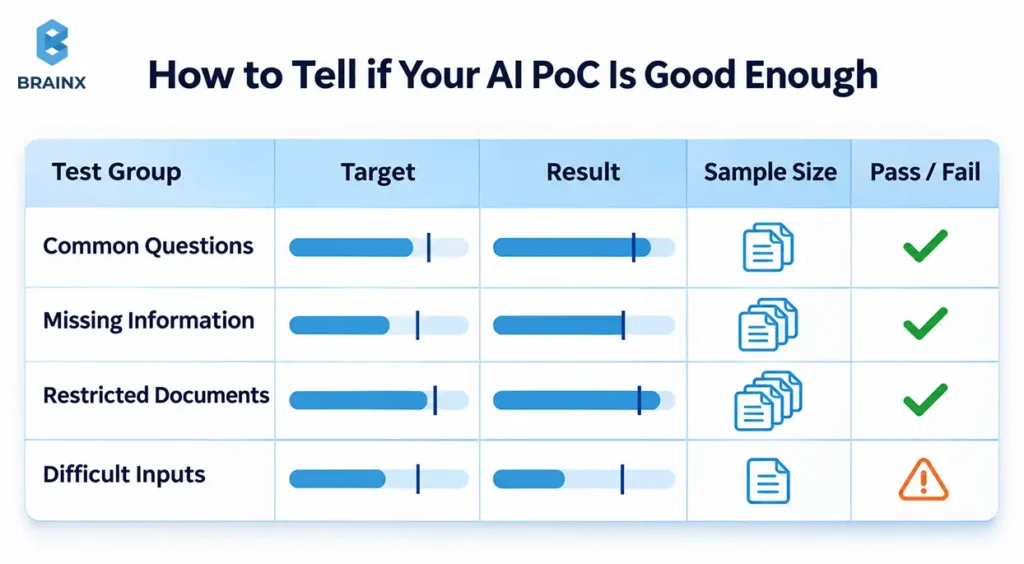
“Good enough” means acceptable results at an acceptable cost, including the time people spend checking the AI’s work. Split results by meaningful groups, such as document type, language or question type. A strong average can hide poor results on the cases that matter most.
Key terms in plain English: Precision: when the AI says yes, how often is it right? Recall: of all the real cases, how many did it find? Groundedness: is every claim backed by your documents? Latency: how long the whole task takes, including retries.
Track these 18 measures in three groups. Pick the ones that fit your use case and set targets before testing:
| Business value | Answer quality | Running the system |
| Time saved per task | Accuracy / precision | Response time (p95 latency) |
| Cost per accepted task | Recall (cases found) | Error and timeout rate |
| Cost of errors avoided | Groundedness | Cost per 1,000 requests |
| Tasks handled per hour | Hallucination rate | Human review time per output |
| User adoption | Correct refusals and escalations | Blocked unsafe requests |
| Return on investment (ROI) | Consistency across repeated runs | Retries per task |
Precision and recall catch different kinds of mistakes (see Stanford’s information retrieval reference). Neither replaces looking at the serious errors one by one.
Set targets before the final test, then show results next to them in a simple scorecard, split by test group (common questions, missing information, restricted documents, difficult inputs).
Keep real error examples next to the numbers. Seeing no failures in a small test does not prove there is zero risk.
How Much Does an AI PoC Cost?
Published 2026 industry guides put most AI PoC budgets between $10,000 and $80,000. The range is wide because cost depends on data work, expert review, integrations and the type of AI. Based on our review of five published guides, typical ranges look like this:
| Type of AI PoC | Typical published range |
| Simple, well-scoped PoC (one task, prompting or RAG) | 10K–20K |
| AI agent PoC | 15K–40K |
| Complex PoC (custom models, vision, several systems) | 25K–80K |
These are market ranges from other companies, not a BrainX quote. Your number depends on your scope, data and team.
To judge whether it pays off, use a simple ROI formula: ROI = (expected yearly benefit − total cost) ÷ total cost. Use the cost per accepted task from your PoC, not a vendor’s estimate.
A simple way to estimate your own budget: PoC budget = people’s time + data preparation + model and infrastructure usage + testing + a contingency. For illustration, 120 hours at an assumed $100 hourly rate is $12,000 in labor, before the other costs.
7 Costs Vendors Often Leave Out
- Expert time to label data and review answers
- Data cleanup and access approvals
- Failed experiments and re-runs
- Integration setup, even for a test
- Security and privacy review
- Agent call and retry costs (agree on limits up front)
- Handover work so the next team can continue
Ask whether a quote covers fixing what the tests find, or only a demo. Keep PoC spending separate from future running costs. Our AI app development cost guide covers the bigger build, integrations and ongoing support.
Build In-House or With a Partner?
Build in-house if you already have AI engineers, data access and time. Use a partner if you need speed, skills you don’t have, or an outside view.
We compare both in AI development partner vs in-house team. Before you hire a partner, ask these seven questions:
- Have you built a PoC for a similar use case, and can we talk to that client?
- What exactly is included, and what would count as “done”?
- How will you measure success, and against what baseline?
- Who owns the code, data, prompts and results at the end?
- How do you handle security, privacy and our data?
- What does the price include: fixes found in testing, or just a demo?
- What happens after the PoC: do you help with the pilot and production?
Can You Get Funding for an AI PoC? (AWS and Microsoft ECIF)
Sometimes. Both major cloud providers fund some customer AI work through their partners:
- AWS: its partner funding programs include funds to explore proofs of concept on partner-led opportunities.
- Microsoft ECIF: End Customer Investment Funds pay partners fixed sums for customer service engagements, and Microsoft lists demonstrating proofs of concept as one use.
Amounts, eligibility and timing change, and you usually apply through a certified partner. Ask your cloud provider or development partner before you start.
How Long Does an AI PoC Take?
Most AI PoCs take 4 to 8 weeks. Depending on the type of AI, the full range is 3 to 16 weeks, according to published 2026 industry guides. The real schedule depends on what is ready on day one.
Typical published estimates by type of AI (2026):
| Type of AI PoC | Typical length |
| Generative AI (chatbot, assistant, RAG) | 3–5 weeks |
| Traditional machine learning | 6–10 weeks |
| Computer vision | 8–12 weeks |
| Agentic AI | 8–14 weeks |
| Enterprise-wide, many systems | 10–16 weeks |
Most delays come from waiting for data access or legal approval, cleaning or labeling data, busy experts, security reviews, integrations with older systems and investigating failed tests. Book reviewer time before the build starts, and give each dependency an owner and a date.
AI PoC Examples: What Success and Failure Look Like
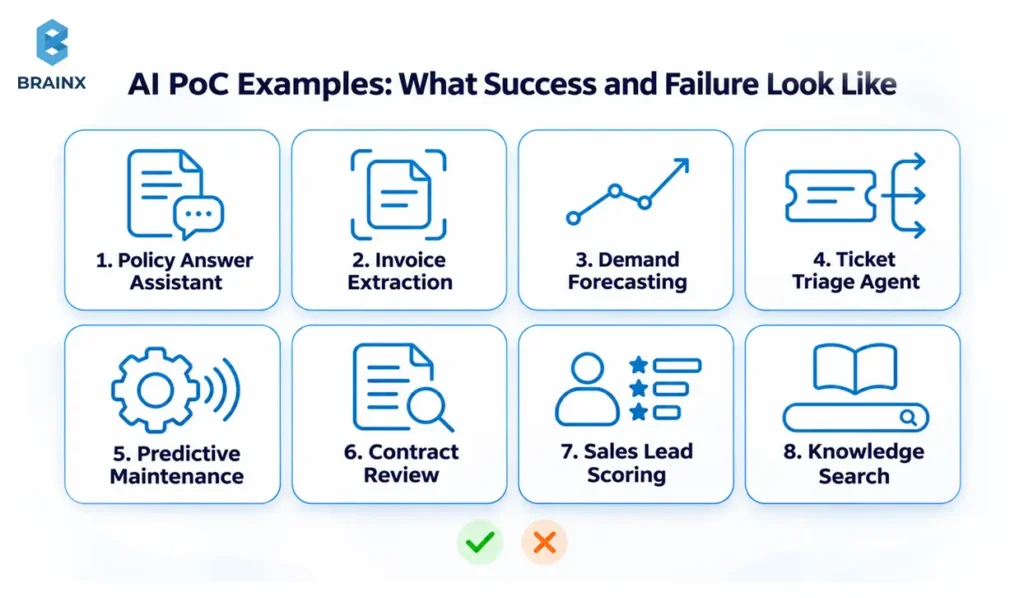
Good AI PoC examples connect a business question with data, a comparison and a decision rule. The first eight are typical scenarios (illustrations, not client results). The last three are real.
8 Common AI PoC Use Cases
- Policy answer assistant (RAG): Test against manual search on answerable, unclear, outdated and restricted questions. Measure answer support, corrections and drafting time.
- Invoice extraction: Compare with OCR plus manual entry on unfamiliar layouts, poor scans and multiple currencies. Score each field separately, since a wrong amount matters more than a missing description.
- Demand forecasting: Compare with a seasonal baseline using only data known at each forecast date. Check promotions, stockouts and low-volume products separately.
- Support ticket triage agent: Measure how many tickets it routes correctly and how often it escalates the right ones to people.
- Predictive maintenance: Test whether sensor data flags failures early enough to act, and count false alarms.
- Contract review: Check whether it finds key clauses and risks that lawyers agree with, and how much review time it saves.
- Sales lead scoring: Compare its ranking with past deals that actually closed.
- Internal knowledge search: Measure whether staff find the right answer faster than with today’s search.
Real Example: A PoC That Did Not Scale
McDonald’s tested AI voice ordering with IBM at about 100 US drive-thrus, then ended the test in 2024. Industry reports put order accuracy in the low 80% range, against a target above 95%. The lesson: set the quality bar up front, and measure it on real, noisy conditions.
Real Example: An AI Rollout That Scaled, Then Rebalanced
Klarna reported that its AI assistant handled 2.3 million conversations, two-thirds of its customer service chats, in its first month, with average resolution time falling from 11 minutes to under 2 (company press release, February 2024).
In May 2025, Klarna’s CEO said the company was hiring human agents again because AI-only support had lowered quality, and customers should always be able to reach a person. The lesson: measure quality and review time, not just speed and cost.
Real Example From BrainX: MathaMentor
Our MathaMentor project started with a focused PoC: a single 20–25-minute conversational GCSE Maths lesson. The team tested response latency, conversational pacing and synchronized lesson content before expanding into a school-ready MVP with educator oversight and administration. Testing one focused experience first made the bigger build safer.
Why AI PoCs Fail (and How to Avoid It)
Gartner points to poor data quality, weak risk controls, rising costs and unclear business value. IDC adds unclear ROI, too little AI-ready data, too little in-house AI expertise and underfunded PoCs. RAND adds misunderstood problems, too little data, chasing new technology, weak infrastructure and problems too hard for today’s AI. Here are the eight most common reasons, each with its fix:
- No clear business problem: Fix: start from one decision and one task, not a model.
- Success criteria set after the results: Fix: write success criteria and risk limits before building.
- Unrepresentative data: Fix: test on real data with permission, including hard cases.
- No baseline, or review time ignored: Fix: measure today’s process and count checking time on both sides.
- Hidden running costs: Fix: track cost per accepted task at the volume you expect.
- Security left for later: Fix: enforce permissions in the system, not the prompt, and test prompt injection early.
- Test leakage: Fix: lock a gold test set you never build against, and re-test after model updates.
- Demo-only shortcuts and no next owner: Fix: list shortcuts like manual exports or admin access, prove the real workflow works without them, and name a funded owner for the pilot.
From AI PoC to Production: What It Actually Takes
Building a demo is the easy part. Most AI projects stall when they meet real users, real data volumes, security reviews and running costs. That’s why IDC found only 4 of every 33 PoCs reached production.
Why Successful PoCs Stall Before Production
- No budget or owner was planned for the next stage.
- The PoC relied on shortcuts the real workflow can’t use.
- Costs that looked small in testing grow too big at full volume.
- Security, privacy or compliance reviews start too late.
- Integrations with existing systems were never tested.
- Users weren’t involved, so adoption is low.
Run a Pilot First
A pilot puts the AI into one real team’s workflow for a limited time, with monitoring and an easy way back to the old process. It answers the question a PoC can’t: will people use it, and does it hold up day to day?
What Production Needs: 10 Essentials
A PoC is not production-ready. Moving from AI PoC to production, including AI agents, needs these things in place:
- Runnable code, setup instructions, model settings, prompts and dependencies.
- Dataset references, permitted uses, evaluation results and known limits.
- Monitoring, human review, and escalation responsibilities.
- A fallback process when the system fails.
- For agents: strict tool permissions, action limits and a way to switch automation off.
- A named owner for incidents, model updates and change approval.
- Monitoring for quality drift, cost and response time in production.
- A repeatable deployment pipeline (MLOps/LLMOps) with testing before each release.
- Training and support for the people who will use it.
- Governance rules: who can change prompts, models and data, and how changes are approved.
AI PoC Checklist
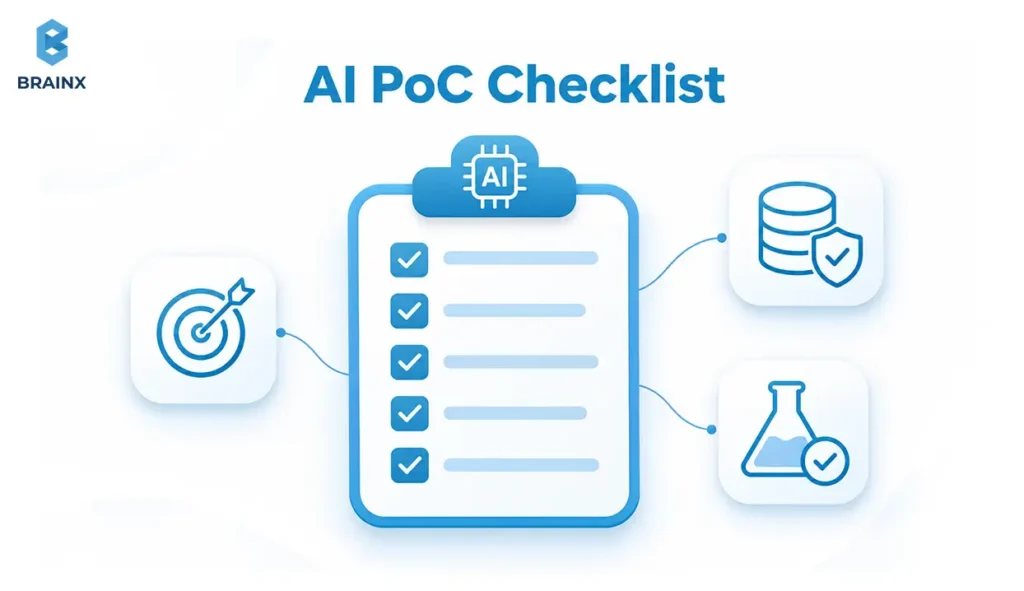
Use this before, during and after your AI PoC. Every “no” is a risk to fix or accept on purpose.
Before you start
- A business owner is named and committed
- The problem and decision are written down
- Success criteria and risk limits are agreed
- Budget and deadline are fixed
- There is a plan and budget to act on a “yes”
Data and access
- Representative data is collected, including hard cases
- Permission to use the data is confirmed
- Sensitive data is minimized or anonymized
- A gold test set is set aside and locked
- System access and tools are approved
Build and test
- Today’s baseline is measured
- The simplest approach was tried first
- Permissions are enforced in the system, not the prompt
- Prompt injection and data leaks were tested
- Cost per accepted task is calculated
Decision and handoff
- Serious errors were reviewed one by one
- A clear decision is recorded: stop, pivot, pilot or build
- Dataset versions, prompts and settings are saved
- The production needs and running costs are estimated
- An owner for the next stage is named
Validate Your AI Idea With BrainX
BrainX Technologies can help you assess an AI idea through its AI development services, including AI PoC development, model refinement and testing.
Bring one use case, a description of the current process, and the data or integration constraints you already know. We’ll use the charter in this guide to agree on the question, deliverables, success criteria and stopping point before you commit to a bigger build.
FAQ Section
What Does PoC Mean in AI?
In AI, PoC stands for proof of concept. It means a short experiment that proves, or disproves, that an AI approach works well enough on a specific task to justify more investment. It is not a finished product or a pilot with real users.
How Much Does an AI PoC Cost?
Published AI PoC budgets mostly range from about $10,000 to $80,000, depending on data preparation, expert review, integrations and the type of AI. Simple prompting tests cost less; agents and computer vision usually cost more. Always include human review time in the estimate.
How Long Does an AI PoC Take?
Most AI PoCs take 4 to 8 weeks (3 to 16 depending on the type of AI). The biggest delays usually come from data access, approvals and expert availability, not from building the model. Set a fixed deadline and a review point.
What Is an Example of an AI PoC?
A common example is a policy answer assistant: the AI drafts answers from approved company documents, and the team compares accuracy and drafting time against manual search. Other examples include invoice extraction, ticket triage and demand forecasting.
What Data Do You Need for an AI PoC?
You need a small but representative sample of real data: everyday cases, hard cases and costly mistakes, plus expert-approved answers for testing. You must be allowed to use it. Clean, perfect data isn’t required, but it must reflect real conditions.
How Do You Take AI Agents From PoC to Production?
Limit what the agent can do, enforce permissions in your systems, and require human approval for high-impact actions. Add monitoring, logging and a way to switch automation off. Then run a controlled pilot before a wider rollout.
BrainX’s AI development services cover agent PoCs through to production.
Can an AI PoC Use Real Customer Data Safely?
Yes, with approval and safeguards. Use as few records as possible, restrict access, and check the AI provider’s data retention and training terms. Synthetic or anonymized data may be enough, if it still reflects the real conditions you need to test.
What Should Happen When the Baseline Outperforms the Model?
Keep the baseline, unless the AI brings another measurable benefit that outweighs its weaknesses. Check both were tested on the same inputs. Fund another round only if you have a specific fix to test, not just a hope that a newer model will do better.
How Many Test Cases Are Enough to Make a Decision?
There’s no fixed number. Cover every important task type, the hard cases and the costly failures. Many easy, repeated examples give false confidence. If rare errors could be serious, ask a statistics or domain expert.
Who Should Approve the Move From Feasibility Testing to a Pilot?
The business owner approves the value and takes responsibility for the pilot. Tech, data and security leads confirm their parts are ready. Add legal or compliance review if needed, and name who can pause the pilot.
Sources
- Gartner (July 2024): 30% of GenAI projects will be abandoned after proof of concept by end of 2025
- CIO.com (March 2025): IDC/Lenovo research, 88% of AI PoCs don’t reach production
- AWS Prescriptive Guidance: Architecting a successful generative AI proof of concept
- NIST AI Risk Management Framework
- OWASP GenAI Security Project: LLM01 Prompt Injection
- Stanford NLP: Evaluation of unranked retrieval sets
- Nation’s Restaurant News (June 2024): McDonald’s ends AI drive-thru test with IBM
- Klarna press release (Feb 2024): AI assistant handles two-thirds of chats
- Entrepreneur (May 2025): Klarna CEO says it is hiring human agents again
- BrainX: MathaMentor case study
- RAND (Aug 2024): The Root Causes of Failure for AI Projects