 August 21, 2026 -
 23 minutes read


Key Takeaways
- Business process transformation services redesign end-to-end operations across people, process, data, technology, decisions, and governance instead of optimizing isolated tasks.
- Transformation is justified when recurring friction is structural, such as fragmented ownership, rising exceptions, legacy constraints, or scaling problems that local fixes cannot resolve.
- A strong program establishes the current-state baseline before designing the future state or selecting technology.
- Successful implementation accounts for exceptions, coexistence, business continuity, adoption, and rollback, not only the ideal workflow.
- Benefits should be measured through cycle time, cost-to-serve, error rates, customer outcomes, adoption, control performance, and realized financial value.
- AI, automation, process mining, packaged platforms, and custom software are enablers. The business outcome should determine which technologies are used.
Business process transformation services fundamentally redesign how an important business outcome is delivered. They go beyond digitizing paperwork or automating an existing workflow. Transformation rethinks the roles, decisions, handoffs, data, systems, controls, exceptions, and performance measures behind the outcome.
That distinction matters as organizations increase investments in AI and automation. McKinsey's 2025 State of AI research found that 88% of respondents reported regular AI use in at least one business function, yet only 39% reported enterprise-level EBIT impact. AI high performers were also nearly three times as likely as others to report fundamentally redesigning individual workflows. The implication is practical: technology creates more value when the surrounding work is redesigned with it.
This guide explains what business process transformation is, when it is justified, which frameworks can help, what transformation services include, how to implement and roll out change, how to measure benefits, what drives cost, which risks derail programs, and how to evaluate a transformation partner.
What Is Business Process Transformation?
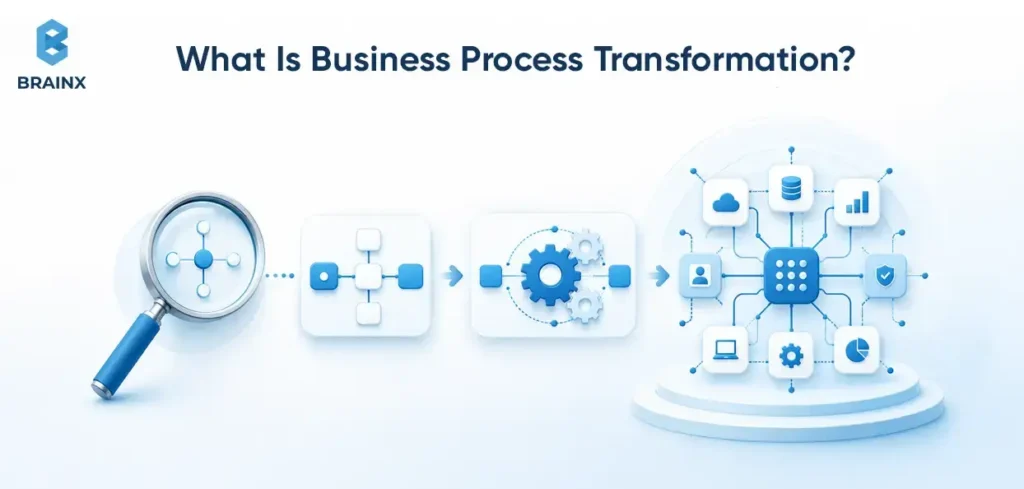
Business process transformation is the deliberate redesign of an end-to-end business process and the operating model that supports it. The objective is not simply to make the current workflow faster. It is to determine how the business outcome should be delivered if unnecessary historical constraints, duplicated work, fragmented ownership, and system limitations were removed.
That redesign can change process steps, roles, decision rights, customer interactions, data ownership, controls, automation boundaries, applications, service levels, and measurement. In other words, transformation changes how work is organized and governed, not only which tool executes a task.
A useful test is scope. If a change affects one task, it may be optimization or automation. If it changes the complete path from trigger to outcome across people, systems, data, decisions, and controls, it is closer to business process transformation.
How Is Business Process Transformation Different From Process Improvement?
Process improvement refines the current way of working. Business process transformation asks whether the current way of working should remain at all. This distinction matters because applying automation to a structurally weak process can make the same problems occur faster.
Business Process Transformation vs BPM, BPR, Automation, and Digital Transformation
| Approach | Main Question | Typical Scope | Example |
| Process improvement | How can the current process work better? | Specific delays, waste, or defects | Remove an unnecessary approval |
| BPM | How do we manage and improve processes systematically? | Ongoing process management | Establish process ownership, monitoring, and optimization |
| Automation | Which repeatable work should software execute? | Tasks or defined workflows | Automatically validate and route an invoice |
| BPR | Should the process be fundamentally rethought? | Radical process redesign | Replace departmental processing with one cross-functional flow |
| Process transformation | How should the complete outcome be delivered? | Process, people, systems, data, decisions, controls | Redesign order-to-cash end to end |
| Digital transformation | How should digital capability change the wider business? | Potentially enterprise-wide | New operating models, platforms, products, or channels |
ABPMP International describes BPM as both a management discipline and a set of technologies for managing by process. Gartner defines business processes as coordinated behavior across people, systems, and things that produces specific business outcomes.
Automation is narrower. IBM's task automation guidance describes task automation as applying technology to complete a task or augment a workflow while reducing or eliminating human intervention. A workflow can therefore be automated without questioning whether its steps, ownership, or decision model should change.
Business process reengineering provides the more radical foundation. In his 1990 Harvard Business Review article “Reengineering Work: Don't Automate, Obliterate”, Michael Hammer argued that organizations should use technology to rethink work instead of simply accelerating obsolete processes.
Consider order-to-cash. Improvement might remove a duplicate approval. Automation could perform a credit check or move data between systems. Transformation could redesign order capture, credit decisions, fulfillment signals, invoicing, collections, exception management, ownership, and customer notifications as one connected operating system. This distinction is easier to see in practical business process automation examples, where technology executes defined steps without necessarily redesigning the full operating model.
Why Is Business Process Transformation Important?
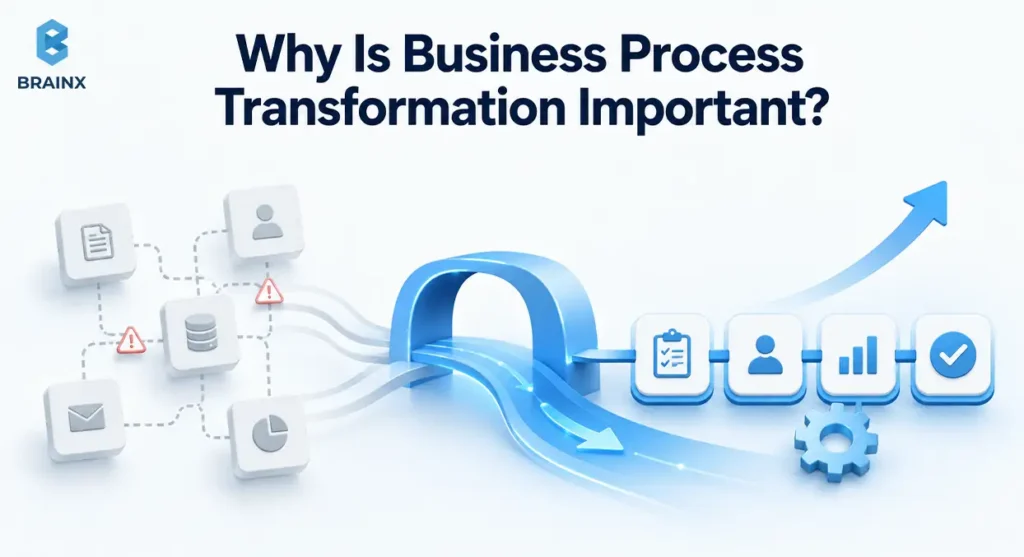
Business process transformation is important when operational complexity has outgrown the workflow that originally supported the business. New systems, channels, regulations, acquisitions, products, and automation can each add local capability while leaving the end-to-end process more fragmented.
Workflow Redesign Is Becoming the Value Layer Behind Digital Investment
Cloud platforms, AI assistants, automation, and analytics can improve individual activities. Larger gains often require organizations to rethink who performs the work, where decisions are made, how information moves, which exceptions need people, and how performance is governed. McKinsey's 2025 findings reinforce this point: organizations seeing the greatest AI impact are more likely to redesign workflows rather than add AI to isolated steps.
Deloitte's operating-model guidance similarly frames an operating model as the integrated system that translates strategic intent into how work gets done across capabilities, processes, technology, data, AI, service delivery, organization, talent, governance, and measurement. Process transformation is therefore a bridge between strategy and execution.
Process Debt Grows as Systems, Teams, and Exceptions Multiply
Process debt accumulates when operational complexity grows faster than workflow design. A company adds a CRM, an ERP module, a regional approval, an acquired business, a regulatory control, a reporting tool, and an AI application. Each addition may make sense independently. Together, they can leave employees reconciling spreadsheets, duplicating information, managing undocumented exceptions, and debating which system contains the authoritative record.
The result is operating friction, not just technical debt. Transformation becomes valuable when another isolated integration would merely preserve that complexity. The goal is to remove unnecessary work and clarify ownership before deciding how technology should support what remains.
When Is the Right Time to Transform Business Processes?
The right time is when repeated local fixes no longer resolve the underlying operating problem. The strongest signal is structural friction that spans teams, systems, data, decisions, or controls.
Signs Your Current Processes Are Holding Growth Back
- Exception volume keeps rising: More transactions require manual intervention as volume grows.
- Cycle time deteriorates: Growth creates additional coordination instead of operating leverage.
- Handoffs multiply: Work repeatedly moves between functions without clear end-to-end ownership.
- Duplicate entry persists: Employees enter the same operational or customer data in multiple systems.
- Shadow spreadsheets become essential: Unofficial trackers compensate for missing workflow visibility.
- Ownership remains unclear: Every team owns a step, but nobody owns the complete result.
- The same escalations recur: Teams resolve individual cases without removing the shared root cause.
APQC's Process Classification Framework (PCF) v8.0 provides a common process taxonomy that can help teams organize, compare, and benchmark processes using shared terminology instead of relying only on anecdotal pain points.
Transformation Triggers: Scale, M&A, Legacy Systems, Compliance, and AI
Several events expose process designs that no longer fit the business. Rapid scale reveals workflows that depended on experienced employees knowing undocumented workarounds. M&A introduces duplicate systems, policies, and process variants. Legacy modernization forces decisions about which historical rules should survive. Compliance changes may require stronger evidence, approvals, segregation of duties, or auditability. AI can also trigger redesign when new automation changes data access, human review, escalation, governance, or accountability.
These triggers do not automatically justify full transformation. A stable workflow with one redundant approval may only need optimization. Inconsistent execution may need standard procedures. An unclear rule may require a policy decision. Diagnosis should determine the intervention.
What Business Process Transformation Frameworks and Strategies Can You Use?
No single framework covers every part of business process transformation. The most useful approach combines process management, redesign, evidence, change management, and measurement according to the problem being solved.
BPM and APQC for Process Structure and Ongoing Management
Business process management provides the discipline for identifying, designing, executing, measuring, monitoring, and controlling processes over time. APQC's PCF adds a standardized taxonomy that helps teams name processes consistently and connect them with relevant measures. These tools are useful when the organization needs a repeatable process-management system rather than a one-time redesign exercise.
BPR and Lean Six Sigma for Fundamental Redesign and Waste Reduction
Business process reengineering is useful when the current workflow is structurally wrong and incremental change cannot produce the required outcome. Lean and Six Sigma techniques are more useful when the process is directionally correct but contains waste, variation, defects, or unnecessary handoffs. Transformation programs can use both: radical redesign for the operating model, then continuous improvement to stabilize and refine it.
Process Mining for Evidence-Based Discovery
Process mining strengthens discovery by reconstructing how work actually flows through system event data. It is particularly useful when documented procedures differ from real behavior or when a process has many variants. Process mining should inform redesign, not dictate the future-state process by itself.
ADKAR and Structured Change Management for Adoption
A redesigned process only creates value when people use it. Prosci's change-management guidance combines organizational change processes with the ADKAR model for individual adoption. This is useful for role changes, training, readiness, reinforcement, and resistance management during transformation.
Use a Hybrid Strategy Instead of Forcing One Method
A practical program may use APQC to define process scope and metrics, process mining to validate the current state, BPR to challenge structural assumptions, Lean methods to remove waste, agile delivery to build and test the future state, and change-management frameworks to support adoption. The framework should support the business outcome, not become the outcome.
What Do Business Process Transformation Services Actually Include?
Business process transformation services turn an operating problem into a designed, implemented, adopted, and measurable future-state process. A credible engagement should therefore deliver more than a strategy deck. It should establish the current baseline, redesign the future state, translate that design into technology and operating requirements, support rollout, and create post-launch governance.
Process Discovery, Mapping, and Baseline Measurement
Discovery determines how the process actually works, including paths that standard operating procedures may not show. Teams can combine stakeholder workshops, process maps, system analysis, event logs, operational metrics, data profiling, policies, customer feedback, and direct observation.
Typical deliverables: current-state process map, process inventory, system map, data flows, ownership map, exception taxonomy, control points, pain-point evidence, KPI baseline, data-quality assessment, and prioritized constraints.
Future-State Process and Operating Model Design
Future-state design defines how the desired result should be delivered after structural friction is removed. It covers workflow sequence, roles, decision rights, customer interactions, human review, automation boundaries, data responsibilities, controls, service levels, and governance.
Typical deliverables: future-state blueprint, ownership model, decision matrix, target KPIs, exception design, controls, capability gaps, acceptance criteria, and implementation backlog.
How Digital Business Process Transformation Services Connect Data, Systems, and Automation
Digital business process transformation services translate the future-state operating model into a connected digital environment. That can involve APIs, workflow engines, ERP and CRM integration, data pipelines, custom applications, intelligent document processing, process mining, RPA, analytics, and AI.
The sequencing principle is simple: design the process first, then choose the enabling technology. Packaged platforms can handle standard capabilities, while custom components can address proprietary rules, unusual user journeys, or legacy constraints.
BrainX's AI development services cover capabilities relevant to transformation architecture, including AI implementation, integration, testing, deployment, and production monitoring. Where the future-state workflow needs custom applications, APIs, or data pipelines, those components should be designed around the process rather than added as disconnected tools.
Change Management, Training, and Governance
A redesigned process produces value only when employees consistently use it. Prosci research reports that projects with effective change management met or exceeded objectives 88% of the time compared with 13% for projects with poor change management. Change work should therefore begin during design, not shortly before go-live.
Teams need role-impact analysis, communications, sponsor engagement, training, readiness assessment, user support, adoption measurement, feedback loops, and reinforcement. Governance should also define who owns the process, which KPIs are reviewed, how exceptions are escalated, and how future changes are approved.
Typical deliverables: change-impact assessment, stakeholder plan, communication plan, training assets, readiness criteria, adoption dashboard, governance forums, escalation model, and post-launch ownership.
Steps to Implement Business Process Transformation
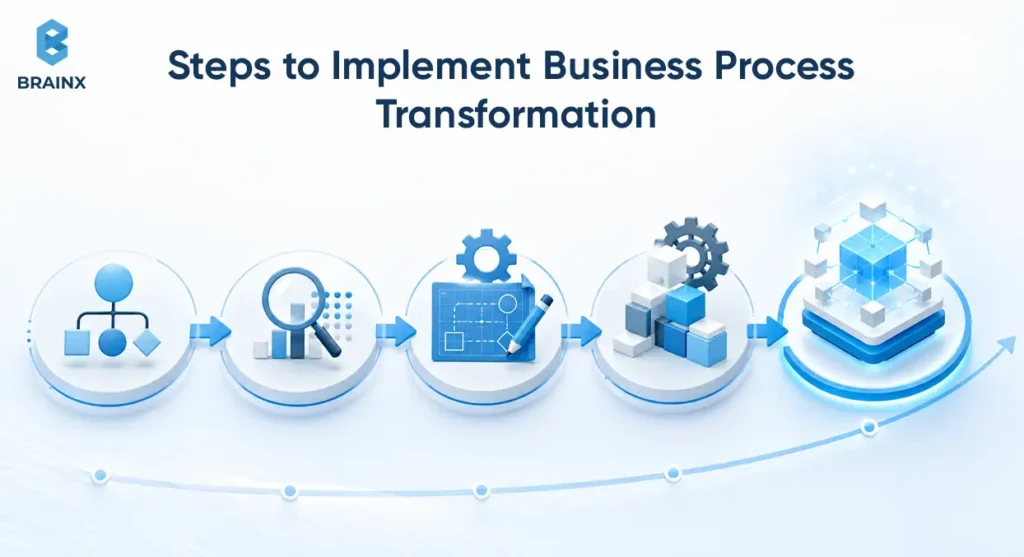
A reliable transformation follows connected stages that establish evidence, ownership, and measurable outcomes before technology choices become difficult to reverse. Each step should produce a concrete artifact that supports the next decision.
Step 1: Define Outcomes, Scope, and Executive Ownership
Start with the business outcome, not the solution. Define what must materially improve, such as onboarding completion, order cycle time, cost-to-serve, claims turnaround, first-time-right rate, working capital, or control performance. Assign an executive sponsor and an end-to-end process owner who can resolve cross-functional decisions.
Prosci's sponsorship research reports that 72% of respondents with extremely effective sponsors met or exceeded objectives, compared with 29% of those with extremely ineffective sponsors.
Deliverable: transformation charter with outcomes, scope, ownership, success measures, boundaries, and decision rights.
Step 2: Map the Current State and Baseline KPIs
Document what happens today, who performs the work, which systems participate, where queues form, which data moves between systems, and which exceptions occur. Avoid relying only on averages. A four-day average may hide simple cases completed in hours and an exception population taking two weeks.
Deliverable: current-state process map, KPI baseline, exception inventory, control map, system/data map, and data-quality assessment.
Step 3: Prioritize Friction, Risk, and Business Value
Not every inefficient step deserves the same investment. Rank issues using transaction volume, delay, customer impact, labor demand, failure cost, compliance exposure, data readiness, dependency complexity, and automation feasibility. This prevents visible symptoms from displacing higher-value root causes.
Deliverable: prioritized opportunity backlog with value mechanism, risks, dependencies, sequencing, and proposed intervention type.
Step 4: Design the Future-State Process
Design the target workflow around the required outcome and explicitly include exception paths. For important decisions, define the actor, inputs, decision rule or judgment standard, output, escalation route, retained evidence, and performance requirement. Remove unnecessary work before automating anything.
Deliverable: future-state process blueprint, ownership model, decision logic, exception paths, control points, target KPIs, and acceptance criteria.
Step 5: Select the Technology and Integration Architecture
Choose technology only after the future process, data, constraints, controls, and user needs are understood. The architecture may use packaged workflow software, custom applications, APIs, integration platforms, AI, RPA, process mining, or a combination. Build-versus-buy decisions should reflect differentiation, implementation effort, integration complexity, security, maintainability, and total cost of ownership.
Deliverable: solution architecture, build-versus-buy decisions, data model, integration contracts, security design, observability plan, and nonfunctional requirements.
Step 6: Pilot the Process With Exceptions and Controls
A pilot should test the operating model, not only confirm that software functions. Include incomplete records, duplicate transactions, failed integrations, unusual approvals, permission differences, manual overrides, rejected AI outputs, unavailable downstream systems, and recovery scenarios. Define the go/no-go criteria before the pilot begins.
Deliverable: production-like pilot, acceptance results, exception coverage, reconciliation evidence, support procedure, and go/no-go recommendation.
Step 7: Roll Out, Train, and Manage Adoption
Production rollout changes responsibilities as well as interfaces. Define migration waves, role-based training, communication, support channels, adoption targets, legacy-process restrictions, cutover responsibilities, and escalation routes. Measure actual usage and process compliance instead of assuming training attendance equals adoption.
Deliverable: rollout plan, readiness checklist, training plan, change-impact assessment, support model, and adoption dashboard.
Step 8: Measure, Govern, and Continuously Improve
Go-live starts benefit realization; it does not end transformation. Track the future process against baseline and target performance. Review process variants, exceptions, control failures, customer outcomes, adoption, system health, and financial benefits. Maintain a governed backlog so improvement continues without recreating the fragmentation the program was designed to remove.
Deliverable: governance dashboard, benefit register, review cadence, improvement backlog, metric owners, and operational handover.
Which Rollout Approach Should You Choose: Pilot, Phased, or Enterprise-Wide?
Choose the rollout model according to uncertainty, interdependency, reversibility, and business-continuity risk. For complex business process transformation services engagements, rollout strategy is part of process design rather than a deployment detail.
| Approach | Best Fit | Main Advantage | Primary Risk |
| Pilot-led | High uncertainty or new technology | Tests assumptions before scaling | Pilot may underrepresent enterprise complexity |
| Phased | Multiple teams, regions, products, or systems | Limits disruption and supports learning | Temporary coexistence adds complexity |
| Enterprise-wide | Highly interdependent workflows with limited coexistence options | Avoids prolonged dual operations | Larger cutover and rollback risk |
PMI's discussion of phased versus big-bang deployment illustrates the trade-off between learning through staged implementation and the coordination demands of synchronized cutover.
Pilot-Led Transformation for High-Uncertainty Processes
Use a pilot when important assumptions are still unproven. A meaningful pilot covers an end-to-end process lane, customer type, product, transaction category, or region while exposing real operating conditions. Do not select only the easiest transactions; a pilot without realistic exceptions creates false confidence.
Phased Rollout Across Teams, Regions, or Processes
A phased rollout works when transformation can be divided without breaking the complete service. One region or business unit can adopt the new process first, generate feedback, and inform later waves. During coexistence, teams need explicit reconciliation rules so transactions do not disappear between old and new environments.
When Enterprise-Wide Redesign Is Actually Justified
Enterprise-wide cutover is appropriate when coexistence would introduce greater risk than synchronized migration. A tightly coupled ERP replacement or mandatory control change may make two parallel sources of truth unacceptable. The readiness threshold should be high: rehearsed migration, capacity testing, reconciliation, incident management, executive decision rights, and explicit rollback criteria.
Plan Coexistence, Rollback, and Business Continuity Before Launch
Every rollout should define what happens when the plan fails. Clarify stop conditions, reconciliation checkpoints, rollback triggers, treatment of in-flight transactions, manual-continuity limits, system-of-record rules, incident authority, and criteria for retiring the legacy workflow. These details separate a convincing transformation presentation from a dependable operating system.
What Business Benefits Should Process Transformation Deliver?
Transformation should change measurable business performance, not merely increase digital activity. A credible case for business process transformation services connects each expected benefit to an operational mechanism and then to a KPI.
Lower Cost and Faster Cycle Times
Cost and speed improve when redesign removes unnecessary work, queues, duplicate entry, rework, and avoidable manual coordination.
| Benefit | Operational Mechanism | Example KPI |
| Lower cost | Fewer manual touches and less rework | Cost per transaction |
| Faster completion | Fewer queues and handoffs | End-to-end cycle time |
| Higher productivity | More completed outcomes with existing capacity | Transactions per FTE |
| Less waste | Reduced duplicate work | Rework rate |
APQC's benchmarking approach supports process-specific comparison rather than relying on one universal transformation percentage. The appropriate target depends on the process, industry, baseline, and quality of available benchmark data.
Better Customer and Employee Experiences
Customers benefit when a redesigned workflow removes uncertainty and repeated effort. Better integration can prevent resubmission of the same information, clear ownership can reduce escalations, and better exception routing can stop unusual requests from disappearing into general queues. Employees benefit from fewer manual reconciliations, clearer priorities, better context, and less time spent discovering who owns the next step.
Relevant KPIs include customer effort, repeat-contact rate, first-contact resolution, abandonment, administrative time, employee adoption, and exception-handling time.
Stronger Compliance, Resilience, and Process Visibility
Process redesign can embed controls directly into execution. Approval rules can run consistently, evidence can be captured automatically, permissions can follow defined roles, overrides can require reason codes, and exceptions can generate traceable escalation records. Managers also gain visibility into work in progress instead of depending on periodic spreadsheet reports.
More Scalable Operations and Faster Organizational Change
A process scales when growth does not create proportional coordination overhead. That requires standardized data, reusable workflows, clear ownership, stable integrations, defined exceptions, and measurable controls. Transformation should leave the organization with an operational capability that can support new regions, products, channels, or teams without recreating the process from scratch.
How Do You Measure the Success of a Business Process Transformation?
Measure success against a baseline, target, authoritative data source, named owner, review cadence, and expected business benefit. Effective business process transformation services establish this measurement model during discovery instead of trying to calculate ROI after deployment.
Operational KPIs: Cycle Time, Error Rate, Throughput, and Exceptions
- Median and 90th-percentile cycle time
- First-time-right rate
- Error and rework rate
- Manual touches
- Exception volume and age
- Throughput
- SLA attainment
- Percentage of cases following the intended process
Process mining can strengthen this analysis. Celonis explains that event logs contain, at minimum, a Case ID, Activity, and Timestamp, allowing teams to reconstruct process sequences, variants, and deviations from system data.
Financial and Customer KPIs
Financial measures translate operational change into economic value. Examples include cost per transaction, revenue leakage, working capital, avoided penalties, support cost, and cost-to-serve. Customer measures can include resolution time, abandonment, repeat contacts, complaints, customer effort, retention, or process-specific conversion.
Avoid treating every saved employee hour as cash savings. The organization should explain whether released capacity will be redeployed, avoided, or monetized.
Adoption and Change KPIs
A technically functional process can fail if users bypass it. Track training completion, active usage, process compliance, manual workarounds, overrides, support tickets, user proficiency, and adoption by role, location, or business unit. These metrics show whether the future-state process has actually replaced the old way of working.
Track Leading Indicators Before Waiting for ROI
ROI is a lagging indicator. Transformation teams need earlier evidence that the operating model is moving in the intended direction. The following scorecard is illustrative, not a BrainX client result.
| KPI | Baseline | Target | Data Source | Owner | Review |
| Median onboarding cycle | 3.8 days | 2.0 days | Workflow log | Operations | Weekly |
| First-time-right rate | 72% | 90% | QA records | Process owner | Weekly |
| Manual exception rate | 31% | 15% | Workflow platform | Operations | Weekly |
| Repeat-contact rate | 18% | 10% | CRM | CX lead | Monthly |
| Active adoption | 68% | 90% | Application telemetry | Change lead | Weekly |
| Cost per completed case | $42 | $31 | Finance + workflow | Finance | Monthly |
The exact numbers will differ. What matters is the structure: baseline, target, source, owner, review cadence, and realized benefit.
What Determines the Cost and Timeline of Process Transformation?
Cost and timeline depend on process breadth, system dependencies, data condition, control requirements, rollout risk, and organizational change. There is no credible universal estimate because two similar-looking workflows can differ significantly in integration complexity, exception volume, and adoption effort.
Scope, Process Complexity, and Cross-Functional Dependencies
Scope grows with the number of process variants, functions, regions, products, customer groups, decision points, and owners. A departmental approval workflow might touch two applications, while order-to-cash may involve sales, credit, fulfillment, finance, billing, collections, customer service, and several systems. Each dependency adds discovery, design, coordination, testing, and governance.
Legacy Systems, Integrations, and Data Readiness
Integration complexity is often underestimated. Teams need to determine whether APIs exist, which system owns each data element, how identities map, whether historical records can be trusted, what latency is acceptable, and how failed transactions recover. Poor data quality can expand scope through cleansing, deduplication, migration, or master-data redesign.
Compliance, Testing, Training, and Change-Management Effort
Regulated and mission-critical workflows require more validation. Testing may include security, access control, calculations, auditability, migration, performance, data reconciliation, failover, accessibility, AI evaluation, and exception handling. Training effort increases with the number of roles, shifts, locations, languages, and process changes.
Why Universal Cost and Timeline Estimates Are Misleading
A useful commercial estimate should state its assumptions before presenting a fixed budget or schedule.
| Cost Driver | Questions That Change the Estimate |
| Discovery | How many roles, processes, variants, and regions require analysis? |
| Redesign | Which policies, decisions, controls, and ownership structures change? |
| Software | Packaged configuration, custom development, or both? |
| Integration | How many systems are involved, and how reliable are their APIs? |
| Data | Is migration, cleansing, deduplication, or master-data redesign required? |
| AI | Are model evaluation, human validation, or AI governance required? |
| Testing | What security, performance, regulatory, and reconciliation tests apply? |
| Rollout | Pilot, phased deployment, or synchronized cutover? |
| Change | How many users, roles, locations, and training paths are affected? |
| Support | What monitoring and post-launch optimization are required? |
Challenges in Business Process Transformation and How to Overcome Them
Transformation programs usually fail because only part of the operating system changes. Technology may be replaced while process logic, ownership, data, exceptions, adoption, or governance remain unresolved. The best response is to pair each challenge with a design control before implementation begins.
Challenge 1: Automating or Digitizing a Broken Process
Automation can make a poor workflow execute faster without fixing the logic that makes it poor. A common warning sign is technology selection beginning before root causes and the future-state process are understood.
How to overcome it: baseline performance, identify root causes, remove unnecessary steps, redesign the process, and only then select technology.
Challenge 2: Weak Ownership and Unclear Decision Rights
Cross-functional processes struggle when every team owns a step but nobody owns the complete outcome. Decisions stall, incidents move between teams, and local priorities override end-to-end performance.
How to overcome it: appoint an end-to-end process owner, define executive sponsorship, document decision rights, and assign operational ownership before design disputes begin.
Challenge 3: Underestimating Exceptions, Data Quality, and Integrations
The normal path is usually the easiest part to digitize. Production complexity appears when data is missing, integrations fail, identities conflict, duplicate requests arrive, permissions differ, or policy exceptions apply.
| Failure Mode | Warning Sign | Mitigation |
| Hidden exceptions | Pilot uses only clean cases | Build an exception taxonomy from real transactions |
| Poor data quality | Users constantly correct records | Profile critical data before build |
| Fragile integrations | Manual reconciliation remains common | Design retry, error handling, monitoring, and ownership |
| Unclear ownership | Incidents move between teams | Assign process and system owners |
| Weak controls | Overrides lack reasons or audit history | Design control evidence into the workflow |
| Low adoption | Shadow spreadsheets survive launch | Measure usage and deliberately retire workarounds |
Challenge 4: Treating Go-Live as the Finish Line
Go-live demonstrates that the new process can operate. It does not prove sustained value. Production requires monitoring, KPI reviews, control testing, exception analysis, incident ownership, feedback, policy updates, and continuous improvement.
How to overcome it: define who owns the process 30, 90, and 180 days after deployment, establish review forums, and maintain a measured improvement backlog.
Tips for Implementing and Sustaining Transformation
The implementation details differ by organization, but several principles consistently reduce transformation risk and keep the future-state process from drifting back toward the old model.
- Baseline before redesign: Without a reliable starting point, teams cannot prove whether the transformation improved anything.
- Design exceptions with the happy path: If exception handling is added late, manual workarounds will reappear after launch.
- Make one person accountable for the end-to-end outcome: Functional ownership is necessary, but it does not replace process ownership.
- Treat adoption as a measurable workstream: Track usage, compliance, proficiency, and workarounds rather than assuming training creates behavior change.
- Plan coexistence and rollback before cutover: Business continuity and reconciliation should be designed while implementation choices are still reversible.
- Keep a governance and improvement cadence after launch: Review KPIs, exceptions, incidents, control failures, and user feedback so the process keeps improving instead of accumulating new process debt.
Where Do AI, Process Mining, and Automation Fit Into Transformation?
Technology should support the future-state process rather than define it. The practical sequence is: understand the outcome, observe the current process, document constraints, redesign the workflow, and then choose the technology that best enables the new operating model.
Process Mining Reveals What the Workflow Actually Does
Process mining reconstructs execution from event data and can reveal variants, bottlenecks, rework loops, waiting time, and deviations that interviews alone may miss. It improves the evidence available for redesign but does not determine what the future process should be.
Automation Handles Stable Rules and Repetitive Execution
Automation is effective when the process is understood and the action is deterministic. Examples include validating required fields, routing cases, checking thresholds, creating records, transferring data through APIs, sending notifications, and scheduling follow-ups. Human review remains appropriate where judgment or accountability is required.
AI Supports Unstructured Inputs and Complex Decisions
AI is useful where deterministic rules cannot efficiently handle the information. It can support document extraction, request classification, case summarization, anomaly detection, natural-language queries, knowledge retrieval, recommendation generation, and intelligent routing. The control model should reflect the consequence of error, with stronger validation and human approval for high-impact decisions.
For broader context, see how generative AI is reshaping industries. In regulated, exception-heavy operations, BrainX's guide to intelligent automation in insurance shows how workflow, AI, controls, and human review can be combined.
Custom Software and Integrations Connect the Operating Model
Packaged platforms are valuable when the redesigned process fits their capabilities. Custom software becomes relevant when proprietary logic, complex integrations, specialized user experiences, legacy coexistence, or differentiated workflows require purpose-built behavior. The objective is not maximum customization. It is the right combination of standard and custom capabilities around the future-state process.
How Should You Evaluate a Process Transformation Partner?
Evaluate a transformation partner on its ability to connect business diagnosis, process design, engineering, adoption, and measurement. A framework or polished presentation is not enough. The future process eventually has to work with real data, legacy systems, security constraints, edge cases, employees, and customers.
Look for Business-First Discovery and Process Expertise
- Who owns the current-state baseline?
- How are exceptions discovered?
- How are frontline employees represented during discovery?
- How are symptoms separated from root causes?
- Who owns the end-to-end outcome?
- How are future-state decisions documented?
A technology-neutral partner should be comfortable recommending standardization, process redesign, packaged software, custom development, automation, or no major technology change when the evidence supports that choice.
Assess Integration, Security, and Technical Delivery Capability
Transformation often fails at system boundaries. Ask how the partner handles APIs, legacy interfaces, identity, access control, reconciliation, system failures, monitoring, deployment, performance testing, recovery, and ownership of production incidents.
Verify Change-Management and Adoption Support
Ask who is responsible for changing the way employees work. The proposal should explain role-impact analysis, training, readiness, adoption measurement, feedback, support, and reinforcement. If adoption work appears only as a final training task, the operating-model change is probably under-scoped.
Require Measurement, Governance, and Post-Launch Ownership
Ask how rollback is handled, what happens to in-flight transactions, how integrations are monitored, who investigates rising exception rates, who owns the baseline, who decides when the legacy process is retired, and who owns continuous improvement after go-live. These questions reveal whether the provider treats transformation as a project or an operating commitment.
How BrainX Helps With Process Transformation
BrainX Technologies can support organizations when process redesign needs to be translated into custom software, integrations, AI, automation, testing, deployment, and production monitoring. The strongest fit is where the problem extends beyond purchasing another disconnected tool.
Discovery and Future-State Process Design
The first task is to understand the operational problem before choosing an architecture. That means mapping workflows, roles, data dependencies, systems, exceptions, controls, and measurable pain points. The future-state design can then identify where standardization, policy change, integration, custom development, automation, or AI can remove structural friction.
Custom Software, Integration, AI, and Automation
Once the future state is defined, BrainX can help translate it into the required technology architecture. Depending on the requirements, implementation may combine custom web or mobile applications, APIs, middleware, workflow tools, AI services, data pipelines, cloud infrastructure, or packaged enterprise platforms. Each component should support a defined process outcome, integration requirement, control, or user need.
Deployment, Adoption, Monitoring, and Continuous Improvement
A relevant public example is BrainX's CORE workforce-management case study. BrainX describes using discovery sessions to understand existing business processes before building a unified system for time logging, job management, financial details, certifications, and payroll workflows. The published case supports qualitative outcomes such as reduced manual effort, fewer errors, improved transparency, and stronger operational control.
Transformation should leave the organization with an operating capability that can be measured and improved. Production testing, rollout planning, monitoring, incident ownership, adoption measurement, KPI reviews, exception analysis, and a continuous-improvement backlog are therefore part of the delivery model, not optional post-project work.
If your operational challenge has moved beyond incremental fixes, you can schedule a transformation consultation with BrainX to assess the process, constraints, and most appropriate next step.
Frequently Asked Questions
What Do Business Process Transformation Services Include?
Business process transformation services typically include current-state discovery, process mapping, KPI baselining, root-cause analysis, future-state process and operating-model design, technology architecture, integrations, implementation, testing, change management, rollout, measurement, and continuous improvement. The scope should cover people, process, data, applications, controls, exceptions, and governance.
What Is the Difference Between Business Process Transformation and Business Process Automation?
Business process automation uses technology to execute repeatable work or coordinate defined workflow steps. Business process transformation asks whether the workflow, ownership, data model, decisions, controls, and supporting systems should be redesigned first. Automation can be part of transformation, but the two are not interchangeable.
How Long Does Business Process Transformation Typically Take?
There is no responsible universal timeline. Duration depends on scope, process variants, participating functions, integrations, legacy constraints, data quality, regulatory requirements, software development, testing, training, and rollout strategy. Providers should estimate timing only after documenting those dependencies.
What Are the Main Benefits of Transforming Business Processes?
Typical benefits include shorter cycle times, lower cost-to-serve, fewer errors and exceptions, improved customer and employee experiences, stronger compliance, better visibility, and more scalable operations. Each benefit should map to a baseline and KPI so the organization can verify realized value.
How Do You Know Which Business Processes Need Transformation?
Look for processes where operational problems persist despite repeated local fixes. Warning signs include rising exceptions, longer cycle times as volume grows, excessive handoffs, duplicate entry, shadow spreadsheets, fragmented applications, unclear ownership, recurring escalations, and dependence on undocumented workarounds.
What Technologies Are Used in Business Process Transformation?
Common technologies include BPM and workflow platforms, ERP and CRM systems, APIs, integration platforms, custom software, process mining, RPA, intelligent document processing, analytics, machine learning, generative AI, AI agents, and monitoring tools. The technology mix should follow the future-state process rather than lead it.