
 July 15, 2026 -
  50 minutes read

The right way to hire machine learning developers is to define the ML problem, production ownership, product environment, and engagement model before reviewing candidates. A forecasting platform, a mobile vision feature, and an LLM-powered support tool need different people, even when every job description says “machine learning engineer.”
AI and big data are among the top skills that are projected to grow quickly over the next four years (through 2030), as cited in the World Economic Forum's Future of Jobs Report 2025, and the AI Index 2026 underscores the rise in the disparity between AI capabilities and the systems that can measure, monitor, control, and apply AI responsibly.
A recurring scoping issue BrainX sees during discovery is companies hiring a model-focused profile for what is actually an application engineering problem. The model may work in a notebook, but the product still lacks APIs, latency controls, monitoring, fallbacks, and clear ownership after launch. This guide shows how to avoid that mismatch.
Key Takeaways
- Define the ML use case before selecting a job title.
- Match the developer profile to the product and deployment environment.
- Prioritize production evidence over certificates and framework lists.
- Use a paid, role-relevant work sample and a structured scorecard.
- Depending on scope and capacity of internal management, select a person or a team of dedicated individuals.
- Take into account total hiring costs, rather than salary or hourly rate.
- Establish data, infrastructure, access and success metrics prior to hiring.
Why Companies Need Production-Ready ML Talent in 2026
AI adoption is moving beyond isolated demonstrations. Companies are placing recommendations, forecasting, document intelligence, copilots, fraud controls, and automated decisions inside products and operational workflows.
Stanford’s 2025 AI Index reported that 78% of surveyed organizations used AI in 2024, compared with 55% the previous year. As adoption grows, the central challenge is no longer gaining access to a model. It is turning that capability into a system that performs reliably, integrates with existing technology, and creates measurable value.
AI Features Are Becoming Part of Core Products and Workflows
An experimental model can be evaluated with a static dataset and a limited group of users. A production feature must work with live data, application releases, permissions, traffic, operational processes, and changing customer behavior.
This shift creates demand for developers who can connect model behavior with software architecture and business requirements. The role may involve building an inference service, integrating a third-party model, creating an evaluation pipeline, or supporting a decision workflow used every day.
Integration Matters as Much as Model Quality
A technically capable model can still fail as a product. It may respond too slowly, cost too much to operate, expose sensitive information, provide no usable fallback, or depend on data that is unavailable during live inference.
Production-ready ML developers account for these constraints during design rather than after launch. They consider APIs, user experience, observability, security, cost, release strategy, and ownership alongside model performance.
This is why hiring solely for algorithm knowledge or framework familiarity is increasingly risky. The business needs someone who can make the capability work within the wider system.
Stable ML Capability Reduces Long-Term Dependency
A successful ML initiative creates more than a model. It also produces data definitions, evaluation methods, integration patterns, monitoring rules, operating knowledge, and a record of important technical decisions.
Companies need a clear way to retain that knowledge, whether through an internal engineer, a dedicated team, or a long-term development partner. Without continuity, future teams may struggle to explain why the system behaves as it does or how it should be changed safely.
Weak Implementation Introduces New Business Risks
Growing adoption does not guarantee responsible or effective deployment. The Stanford AI Index notes that AI-related incidents are increasing while standardized responsible-AI evaluation remains inconsistent.
An unprepared team may release a system without reliable evaluation, cost limits, data controls, monitoring, or human escalation. These gaps can lead to incorrect outputs, degraded performance, unexpected expenses, security incidents, and unclear accountability.
The objective in 2026 is therefore not simply to hire someone who can build an ML model. It is to secure the engineering and operational capability needed to turn AI into a reliable part of the business.
Types of AI/ML Roles: What Does Your Project Need?
“AI developer” is often used as a broad label for professionals who build AI-powered applications, integrate existing models, or develop and deploy custom machine learning systems. Because the title is not standardized, companies should define the expected responsibilities instead of relying on the label alone.
You need to choose the role according to what the person must own in production. Before you hire machine learning developers, determine if the uncertainty is with the data and model, the application integration, or reliability of system operations post release.
Machine Learning Engineer
A machine learning engineer builds, deploys, and improves ML systems that must work reliably outside a notebook. This role combines model knowledge with software engineering, data pipelines, APIs, performance optimization, and production monitoring.
Hire this profile when you already understand the business problem and need someone to turn data and models into a scalable service. Typical projects include recommendation systems, fraud detection, demand forecasting, ranking, personalization, and automated decision support.
The role should usually be about more than model training. Google Cloud describes ML engineers as professionals who build, evaluate, productionize, optimize, monitor, and improve both traditional and generative AI solutions.
Best fit: A production ML feature that requires custom modeling, reliable inference, and ongoing improvement.
Data Scientist
A data scientist investigates data, tests hypotheses, develops predictive models, and translates findings into business recommendations. The work usually emphasizes experimentation, statistical reasoning, model evaluation, and communication rather than application infrastructure.
Hire a data scientist when the main question is still analytical. You may need to understand customer behavior, identify risk factors, forecast an outcome, test a business assumption, or determine whether the available data can support an ML solution.
O*NET defines the role around transforming raw data into meaningful information, comparing models, identifying business problems, and recommending data-driven solutions to stakeholders.
Best fit: Exploratory analysis, experimentation, forecasting research, segmentation, and decision support where the production path is not yet the main challenge.
AI Engineer
An AI engineer builds complete applications using AI models and services. In 2026, this title commonly covers generative AI systems, RAG applications, AI agents, copilots, document intelligence, natural language interfaces, and multimodal features.
Unlike a research-oriented role, an AI engineer often works with existing foundation models rather than training a model from scratch. The focus is on orchestration, retrieval, tool use, evaluation, guardrails, APIs, and integration with the wider product.
Microsoft describes AI engineering as an end-to-end role that includes requirements, design, development, deployment, integration, maintenance, performance tuning, and monitoring.
Best fit: LLM-powered products, enterprise knowledge assistants, AI agents, document workflows, and applications built on commercial or open-source foundation models.
MLOps Engineer
An MLOps engineer builds the systems and processes that make machine learning repeatable, observable, and safe to operate. The role focuses on deployment automation, model registries, pipeline orchestration, infrastructure, versioning, monitoring, retraining, and rollback.
Hire an MLOps engineer when models already exist but releases are manual, environments are inconsistent, monitoring is weak, or several teams need a shared ML platform. This role becomes especially important when the organization operates multiple models or works under strict reliability and governance requirements.
Google defines MLOps as the practice of unifying ML development and operations through automation and monitoring across integration, testing, release, deployment, and infrastructure management.
Best fit: Scaling an existing ML program, automating the model lifecycle, improving reliability, or standardizing deployment across teams.
Machine Learning Research Engineer or Applied Scientist
A research engineer or applied scientist investigates approaches that are not yet well established. The role may involve designing new model architectures, adapting recent research, running extensive experiments, or improving the state of the art for a narrow problem.
Most product teams do not need this profile for standard prediction, recommendation, computer vision, or generative AI integration. Hire one when model novelty creates a genuine competitive advantage and existing models or services cannot meet the requirement.
The distinction is important because a strong researcher may produce an advanced prototype without owning the application, infrastructure, or operational work required to release it.
Best fit: Novel algorithms, proprietary model research, highly specialized scientific problems, or products whose value depends on original ML intellectual property.
Data Engineer for Machine Learning Systems
A data engineer creates the reliable data foundation that model development depends on. The role typically owns ingestion, transformation, orchestration, storage, schemas, data quality checks, lineage, and access patterns.
Hire this profile when the main blocker is not the model but fragmented, delayed, poorly documented, or unreliable data. Without this foundation, data scientists spend too much time repairing datasets, while ML engineers inherit pipelines that are difficult to reproduce or monitor.
A data engineer supports ML delivery but should not automatically be treated as the model owner. The role is most valuable when operational data must move consistently from source systems into training and inference pipelines.
Best fit: Projects involving multiple data sources, streaming events, large-scale transformations, unreliable schemas, or recurring training datasets.
Machine Learning Developer vs. Data Scientist vs. Data Engineer
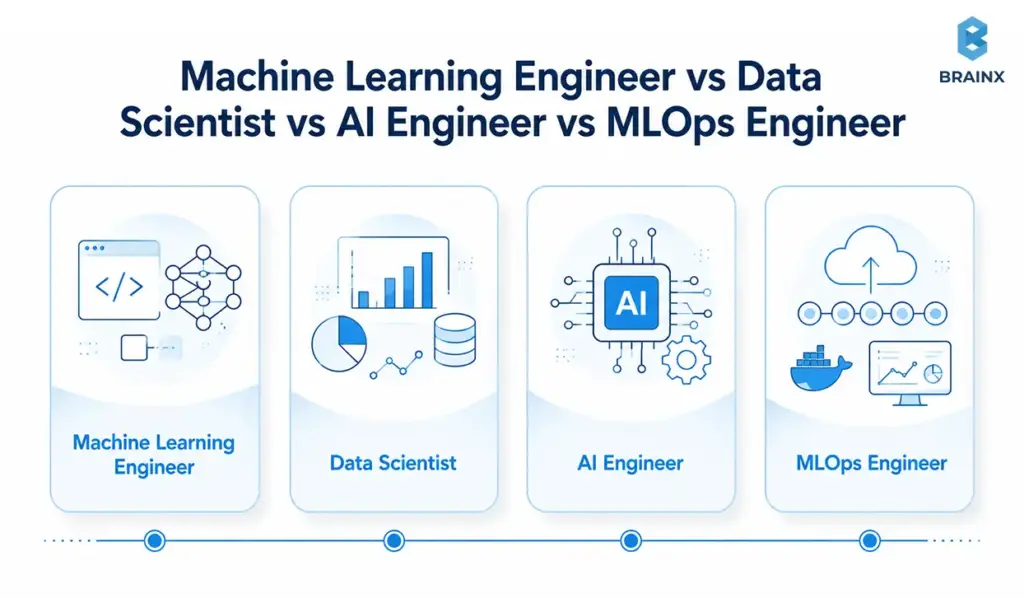
These three roles may work on the same ML initiative, but they own different stages of delivery. A data engineer creates the data foundation, a data scientist explores the data and validates the model, and a machine learning developer turns that model into a reliable product feature or service.
| Area | Machine Learning Developer | Data Scientist | Data Engineer |
| Primary focus | Building and operating production ML systems | Analyzing data and validating predictive approaches | Creating reliable data pipelines and infrastructure |
| Typical output | A deployed ML feature, API, or service | An analysis, experiment, or validated model | Trusted datasets and reusable data pipelines |
| Core strengths | ML, software engineering, APIs, deployment, and monitoring | Statistics, experimentation, modeling, and business interpretation | Data ingestion, transformation, storage, orchestration, and quality |
| Best time to hire | When an ML capability must be integrated into a live product | When the business problem or model feasibility is still uncertain | When fragmented or unreliable data is blocking ML development |
Many production projects need all three roles, although not always at the same time. The hiring decision should therefore reflect the project’s current bottleneck: data readiness, model discovery, or production delivery.
When Should You Hire Machine Learning App Developers for a Product-Focused Project?
Hire this profile when AI or ML is one part of a customer-facing web or mobile product. The challenge is not only generating a prediction. It is making that prediction work inside a reliable user journey.
A machine learning app developer connects models with backend services, APIs, mobile or web clients, authentication, analytics, feature flags, and fallback behavior. The role should understand how latency, device limits, traffic, release cycles, and user-facing errors affect the feature.
For example, a computer vision model may perform well during testing, but a mobile product still needs camera handling, device compatibility, offline behavior, model updates, and clear responses when confidence is low. A recommendation model also needs event tracking, caching, API integration, experimentation, and graceful handling of new users.
Software development responsibilities such as understanding user needs, defining interfaces, testing systems, improving performance, and monitoring operation are central to this profile.
Best fit: Recommendations, visual search, intelligent forms, mobile vision, embedded forecasting, fraud alerts, and AI copilots delivered through a web or mobile interface.
The titles may overlap, especially in smaller companies. A senior ML engineer may handle deployment, and an AI engineer may also build application APIs. The hiring brief should therefore describe the expected outputs and ownership boundaries instead of relying on the title alone.
Which Responsibilities Belong to the Developer and Which Belong to the Wider Product Team?
The developer can own model implementation, inference code, evaluation, deployment support, and monitoring setup. The wider team must still own the user problem, commercial KPI, data approvals, UX, rollout decisions, and legal or compliance review.
For example, an eCommerce recommendation engineer can build the ranking service, but product and analytics must define events and experiments. A mobile vision developer can optimize inference, but QA must test device, lighting, and camera edge cases.
Explore BrainX AI development services for the wider engineering capabilities that often surround an ML specialist.
What Does a Machine Learning Developer Do?
A machine learning developer turns business requirements and data into a working ML capability that can be tested, integrated, deployed, and improved over time. The exact responsibilities vary by project, but the role usually extends beyond training a model.
In a product environment, the developer may work with data scientists, backend engineers, product managers, QA teams, and cloud specialists. Their responsibility is to make sure the model does not remain an isolated experiment but becomes part of a reliable application or workflow.
Core Responsibilities of a Machine Learning Developer
A machine learning developer may be responsible for:
- Defining the ML problem: Translating a business objective into a prediction, ranking, classification, recommendation, or automation task with measurable success criteria.
- Preparing and validating data: Cleaning datasets, creating features, checking labels, identifying leakage, and making the data pipeline reproducible.
- Building and evaluating models: Establishing a baseline, selecting suitable approaches, training models, comparing metrics, and analyzing where the system fails.
- Integrating models into applications: Creating inference APIs, connecting models with backend services, and supporting web, mobile, or internal product workflows.
- Optimizing production performance: Managing latency, throughput, compute cost, model size, caching, batching, and fallback behavior.
- Deploying and monitoring ML systems: Supporting release pipelines, tracking model quality and system health, identifying drift, and defining retraining or rollback triggers.
- Documenting decisions and limitations: Recording assumptions, data constraints, evaluation results, architecture choices, and operational requirements for the wider team.
- Collaborating with product and engineering teams: Explaining trade-offs, aligning model behavior with user needs, and helping stakeholders decide whether the system is ready to launch.
Not every machine learning developer will own all of these responsibilities. In larger teams, data engineers may manage pipelines, data scientists may lead experimentation, and MLOps engineers may handle deployment infrastructure. The hiring brief should identify which responsibilities belong to the role and which will be supported by the wider team.
Industries That Hire Machine Learning Developers Most Actively
Machine learning developers are most valuable in industries that generate large volumes of data and make frequent decisions that can be improved through prediction, ranking, detection, or automation.
The required profile still varies by sector. A retail company may prioritize experimentation and low-latency recommendations, while a healthcare organization may give more weight to validation, privacy, explainability, and human oversight.
Financial Services and Insurance
Banks, insurers, fintech platforms, and payment companies hire machine learning developers for fraud detection, credit and risk analysis, claims automation, customer segmentation, document processing, and personalized financial services.
These environments usually require strong data governance, security, explainability, and monitoring. Candidates should understand that an accurate model is not enough when its decisions affect customers, financial exposure, or regulated processes.
Healthcare and Life Sciences
Healthcare and life sciences organizations use ML in medical imaging, clinical workflow support, patient-risk prediction, trial matching, operational forecasting, and drug or scientific research.
Projects in this sector often require carefully validated datasets, privacy controls, auditability, and appropriate human review. Domain expertise may be especially important because technical metrics must be interpreted alongside clinical or scientific consequences.
Retail and eCommerce
Retailers and eCommerce businesses hire ML developers to build recommendation engines, search and ranking systems, demand forecasts, inventory models, pricing tools, churn prediction, fraud controls, and personalized customer experiences.
Product-facing experience is important in this sector. The developer may need to work with event data, experimentation platforms, customer profiles, low-latency APIs, fallback rules, and web or mobile applications.
Manufacturing and Supply Chain
Manufacturers, logistics companies, and supply-chain operators use machine learning for predictive maintenance, visual quality inspection, demand planning, route optimization, process control, and anomaly detection.
These projects may combine time-series data, sensors, computer vision, edge devices, and operational systems. Reliability matters because an incorrect or unavailable prediction can interrupt a physical process rather than only affect a digital interface.
SaaS and Technology Companies
SaaS providers and technology companies hire ML developers to add copilots, intelligent search, document processing, recommendations, anomaly detection, forecasting, and workflow automation to their products.
These roles commonly require strong software engineering and application-integration skills. Candidates may need to work with multi-tenant systems, APIs, permissions, evaluation pipelines, usage analytics, model costs, and frequent product releases.
Media, Advertising, and Telecommunications
Media, advertising, and telecommunications companies use ML for content recommendations, ad ranking, audience segmentation, churn prediction, moderation, network optimization, and customer-support automation.
Developers in these environments may work with high-volume event streams, real-time inference, changing user behavior, and feedback loops. Privacy, bias, latency, and the unintended effects of automated ranking should be considered from the beginning.
Industry experience can shorten the learning curve, but it should not replace production evidence. A candidate from another sector may still be a strong fit when the data type, delivery environment, risk level, and system requirements are similar.
Why Hiring Top Machine Learning Engineers Is a Whole Different Challenge
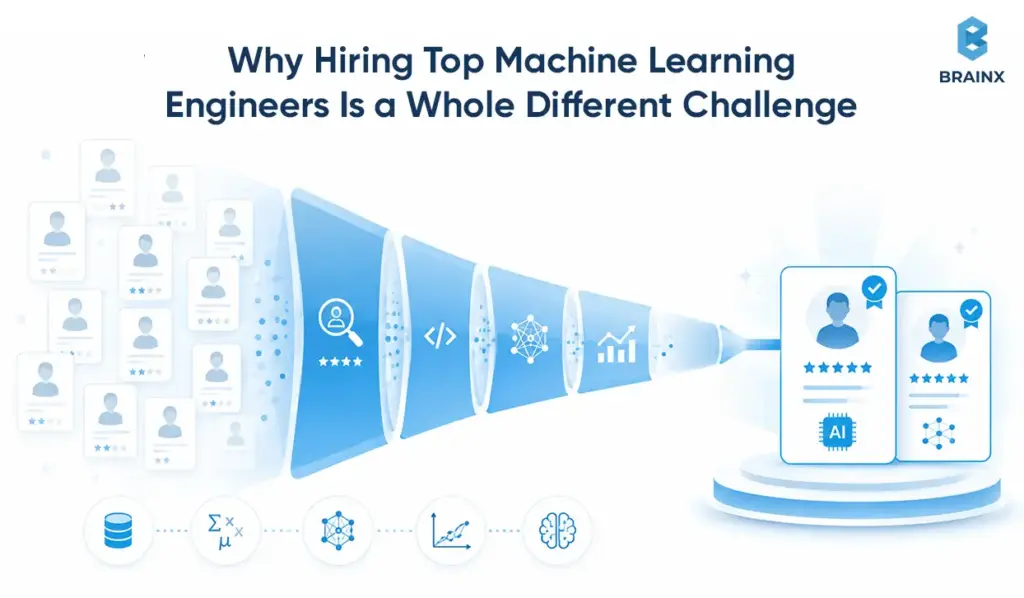
Hiring a strong machine learning engineer is not simply a harder version of hiring a software developer. The role sits across data, modeling, software architecture, product delivery, and operations. A candidate may be excellent in one area and still struggle with the part your project depends on most.
The difficulty is not limited to talent scarcity. Companies must also define an inconsistent role, assess experience that is often hidden behind proprietary systems, and judge whether their own data and infrastructure are ready for the person they want to hire.
The Role Combines Several Technical Disciplines
Machine learning engineering draws from software engineering, data science, statistics, cloud infrastructure, and product development. Few candidates are equally strong across every area.
Someone with deep modeling knowledge may have limited experience building reliable APIs. A capable backend engineer may understand deployment but lack the statistical judgment needed to detect leakage or select the right evaluation metric. An experienced data scientist may create a valuable prototype but depend on another engineer to make it production-ready.
This makes broad job descriptions risky. A long list of tools can attract candidates with very different strengths while giving the hiring team little indication of who can own the actual outcome.
Job Titles Do Not Reveal the Candidate’s Real Scope
The title “machine learning engineer” can describe very different jobs. At one company, the role may focus on experimentation and model training. At another, it may involve backend services, deployment pipelines, monitoring, and incident response.
Seniority labels can be equally misleading. A senior engineer from a research environment may not have owned a customer-facing service. Meanwhile, a mid-level engineer from a smaller product company may have handled the entire lifecycle from data preparation to production monitoring.
This is why role selection must be based on responsibilities and expected outputs, not the title printed on a resume.
Production Experience Is Hard to Verify From a Portfolio
A traditional software engineer can often share applications, libraries, interfaces, or open-source contributions. Machine learning work is harder to inspect because the most meaningful evidence may involve proprietary data, internal pipelines, confidential models, or regulated systems.
Public portfolios tend to show clean datasets and controlled experiments. They rarely reveal how the candidate handled missing data, model drift, traffic spikes, security reviews, changing requirements, or a failed deployment.
Even measurable claims need context. “Improved accuracy by 20%” means little without the original baseline, evaluation method, affected users, production constraints, and business outcome. The hiring team must work harder to distinguish genuine ownership from participation in a larger project.
The Technology Changes Faster Than Most Hiring Cycles
ML tools and delivery patterns continue to change quickly. The rise of foundation models, retrieval systems, AI agents, multimodal applications, and new evaluation methods has altered what many applied AI roles require.
The 2026 AI Index notes that AI capabilities are advancing faster than many evaluation, governance, and supporting systems can keep pace with. That gap affects hiring because a checklist built around last year’s tools may already be too narrow.
Hiring only for familiarity with a specific framework can therefore create a short-lived match. Strong candidates need stable fundamentals, sound engineering judgment, and evidence that they can learn when the stack changes.
Experienced Candidates Have More Leverage
Production-ready ML engineers remain difficult to find because companies are competing for the same combination of specialized skills. Robert Half’s 2026 technology research says professionals with the AI expertise companies need remain hard to find. It also reports that 87% of technology leaders typically offer higher salaries to candidates with specialized skills than to candidates without them in the same role.
Strong candidates may already be employed and evaluating several opportunities. They are likely to compare more than compensation. The quality of the problem, access to data, engineering standards, decision-making authority, technical leadership, and realistic expectations all affect whether they accept an offer.
A vague job post or a slow interview process does more than delay hiring. It can remove the strongest candidates from the pipeline first.
The Hiring Team May Lack the Expertise to Assess the Role
A company making its first ML hire may not have an internal specialist who can distinguish polished explanations from sound technical judgment. Conventional coding interviews do not fully test data quality, model evaluation, monitoring, or production trade-offs.
This creates an uncomfortable dependency: the company needs ML expertise to evaluate the person it hopes will provide that expertise.
In such cases, a senior software architect can assess code and systems, while a data or ML adviser reviews modeling and evaluation decisions. Without credible evaluators, teams may overvalue academic language, recognizable employers, or framework knowledge because those signals are easier to judge.
Company Readiness Can Make a Good Hire Look Like a Bad One
An experienced engineer cannot compensate indefinitely for inaccessible data, unclear ownership, missing environments, or stakeholders who have not agreed on success.
When these foundations are weak, the new hire spends the first months resolving organizational issues rather than building the ML system. Progress appears slow even though the real blockers are outside the role.
This is one reason ML hiring must include an internal readiness check. The company should know who owns the data, who approves infrastructure, how the feature will reach users, and which metric will determine whether the investment is working.
The Cost of a Hiring Mismatch Often Appears Late
A weak software hire may produce visible problems quickly through broken builds or poor code. An ML mismatch can remain hidden behind a convincing prototype.
The model may perform well offline while relying on unavailable data, leaking future information, exceeding the latency budget, or lacking a realistic integration path. These problems may not become obvious until the business has spent months on development.
That delayed feedback makes the wrong hire particularly expensive. The company may need to redesign the architecture, rebuild pipelines, change the role, or add several specialists to finish work that was initially assigned to one person.
The answer is not a longer interview process. It is a more precise one. Define the ownership boundary, use evidence that reflects the production environment, and make sure the organization is ready to support the person it hires.
How Do You Hire Machine Learning Developers Without Hiring the Wrong Role?
You prevent the wrong hire by translating the business need into a one-page engineering brief before sourcing begins. When teams hire machine learning developers from a vague request such as “add AI,” candidates cannot judge the data, integration effort, delivery boundary, or production risk.
Understanding the Role of a Machine Learning Engineer
A machine learning engineer is responsible for turning data and models into a system that can operate reliably in a real product environment. When hiring for this role, the important question is not whether the candidate knows a particular framework. It is which parts of the ML lifecycle they will be expected to own.
In one company, the engineer may receive a validated model from a data scientist and focus on deployment, APIs, and monitoring. In another, the same title may include data preparation, feature engineering, model training, integration, release, and ongoing maintenance. These are materially different jobs and should not use the same hiring brief.
Define the role across four ownership areas:
- Data ownership: Will the engineer clean data, build pipelines, create features, and manage training datasets, or will a data engineering team handle that work?
- Model ownership: Will they select, train, evaluate, and tune models, or mainly productionize models created by others?
- Product ownership: Will they build inference APIs, connect the model to web or mobile applications, manage latency, and support user-facing fallbacks?
- Operational ownership: Will they monitor drift, investigate incidents, trigger retraining, manage releases, and maintain rollback procedures?
The balance between these responsibilities determines the profile you need. A model-heavy role calls for deeper statistics and experimentation experience. A product-facing role requires stronger backend, API, and application-integration skills. A full-lifecycle role needs both, along with cloud deployment and MLOps experience.
Before sourcing candidates, document what the engineer will receive, what they must deliver, which systems they will access, and who will maintain the work after launch. That definition will shape the job description, interview questions, practical assessment, seniority level, and hiring model.
What Should Your Brief Include Before You Hire Machine Learning Developers?
- Use case and users: Who uses the system and which decision or workflow changes?
- Data reality: What sources, volumes, labels, ownership rules, and known gaps exist?
- Deployment target: Will the system run in the cloud, at the edge, on mobile devices, on-premises, or in a hybrid environment?
- Integration surface: Which APIs, applications, data platforms, queues, and third-party systems are involved?
- Service expectations: What are the requirements for latency, availability, traffic, security, and support?
- Success and ownership: Which business KPI and technical acceptance criteria define success, and who owns the system after launch?
Translate the Business Goal Into Data, Model, Product, and Integration Requirements
Replace “build a recommendation engine” with a deliverable such as: recommend related products on web and iOS using clickstream and order history; respond within 150 ms at p95; support new users through fallback rules; integrate with the Node.js backend; and run behind an A/B testing flag.
That description attracts candidates who can discuss data freshness, cold start, service design, experimentation, and monitoring, not only algorithms.
Define Whether the Role Owns Experimentation, Deployment, or the Full ML Lifecycle
State where responsibility begins and ends. An experimentation role validates feasibility and hands off. A deployment role packages and integrates the model. A full-lifecycle owner manages data, training, release, monitoring, retraining, and rollback.
Google Cloud’s MLOps guidance treats CI, continuous delivery, continuous training, and production monitoring as distinct parts of operating ML systems at scale.
Identify Data, Infrastructure, Security, and Compliance Constraints
Share constraints before interviews. Candidates should be familiar with the labeling of data, its location, how access is permitted, which cloud is allowed, and whether or not the system comes in contact with personal, health, financial or regulated data.
The NIST AI Risk Management Framework suggests making trustworthiness an integral part of design, development, use and evaluation of AI systems. For regulated projects, legal and security teams should confirm the applicable obligations.
Establish First 30, 60 and 90-Day Deliverables
- Days 1-30: data audit, reproducible baseline, architecture review, and risk register.
- Days 31-60: evaluated prototype or integrated service in staging, plus monitoring design.
- Days 61-90: pilot release, validated rollback path, operating runbook, and next-phase recommendation.
Where Can You Find Machine Learning Developers?
The best sourcing channel depends on the type of work, required seniority, hiring timeline, and level of technical oversight available internally. A public job post may generate a large applicant pool, but specialist communities, referrals, and development partners can produce candidates with more relevant experience.
Use more than one channel when the role is difficult to fill. Sourcing broadly improves reach, while a consistent vetting process ensures that candidates are assessed against the same production requirements.
Professional Networks and Employee Referrals
LinkedIn, former colleagues, technical leaders, investors, founders, and employee networks are practical starting points for experienced ML talent. Referrals can provide useful context about a candidate’s reliability, communication, and past ownership.
However, a recommendation should not replace structured evaluation. Referred candidates should complete the same portfolio review, technical interviews, practical assessment, and reference checks as everyone else.
When publishing the role, describe the use case, available data, deployment environment, ownership boundaries, and expected first milestone. A specific job post is more likely to attract relevant candidates than a broad request for someone who “knows AI.”
GitHub and Open-Source Communities
GitHub can help identify developers who contribute to ML libraries, deployment tools, evaluation frameworks, data infrastructure, or domain-specific projects. The platform describes itself as a developer environment for building, scaling, and delivering software, with public repositories and community activity that can provide evidence beyond a conventional resume.
Look beyond contribution counts. Review whether the candidate writes maintainable code, responds to issues, documents decisions, tests changes, and collaborates with other contributors. A large number of small commits is less meaningful than sustained ownership of a relevant project.
Public code is still incomplete evidence. Open-source work may demonstrate engineering ability, but it does not automatically prove experience with proprietary data, production traffic, security controls, or business stakeholders.
Hugging Face and Applied AI Communities
Hugging Face is particularly useful for sourcing candidates with experience in natural language processing, computer vision, generative AI, datasets, model evaluation, and open-source AI applications. The platform allows practitioners to publish and collaborate on models, datasets, and interactive applications, which can make their technical interests and practical work easier to inspect.
Review model cards, datasets, Spaces, technical discussions, and contribution history. Look for clear evaluation methods, stated limitations, reproducible code, and responsible handling of data rather than focusing only on downloads or popularity.
Technical forums, specialist Slack or Discord groups, research communities, and local ML meetups can also surface experienced candidates who are not actively applying through conventional job boards.
Freelance and Specialist Talent Platforms
Freelance platforms can work well for bounded tasks such as a data audit, model evaluation, prototype, performance review, API integration, or short-term specialist gap. Major platforms maintain dedicated categories for machine learning engineers, AI developers, data scientists, and data engineers.
This route is less suitable when one individual would become responsible for an unclear, multi-quarter product roadmap without internal technical leadership. Before engaging a freelancer, define:
- the exact deliverable and acceptance criteria
- the permitted data and system access
- documentation and handover requirements
- ownership of code, models, and related artifacts
- the support period after delivery
Use a paid discovery phase when the scope cannot yet be defined clearly enough for a fixed assignment.
Universities, Research Labs, and Industry Events
Universities and research communities can be useful for graduate roles, internships, applied-science positions, and projects requiring specialized knowledge. Relevant candidates may be found through faculty referrals, research labs, technical conferences, poster sessions, hackathons, and university career programs.
Academic work can demonstrate mathematical depth, experimentation, and familiarity with recent methods. It does not automatically show that the candidate can build APIs, operate cloud infrastructure, manage latency, or maintain a customer-facing system.
Match the sourcing channel to the role. A research partnership may be appropriate when the company needs a novel model, while a production ML feature usually requires stronger evidence of software engineering and deployment ownership.
Dedicated Teams and AI Development Partners
A dedicated team or development partner is useful when the project requires several capabilities rather than one isolated specialist. The engagement may include machine learning, data engineering, backend development, application integration, QA, cloud infrastructure, security, and MLOps.
This option is especially relevant when:
- delivery must begin before a full internal team can be recruited
- the company lacks senior ML leadership
- the scope includes discovery as well as implementation
- several technical workstreams must progress in parallel
- the system will require continued support after launch
Evaluate a partner using the same discipline applied to individual candidates. Review relevant project evidence, technical leadership, delivery processes, security practices, documentation standards, team composition, and the proposed ownership model.
How Should You Compare Different Talent Sources?
Compare sourcing channels against the project rather than selecting one by habit.
Choose based on:
- Urgency: How quickly must qualified talent begin?
- Scope: Is the work narrow and defined or still uncertain?
- Duration: Is this a short assignment or a continuing product capability?
- Seniority: Does the project need execution support or technical leadership?
- Internal capacity: Who will review architecture, quality, and priorities?
- Confidentiality: What data, code, and business information will be shared?
- Continuity: Who will maintain the system and retain knowledge after delivery?
- Replacement risk: What happens if the individual becomes unavailable?
The sourcing channel affects reach, speed, and engagement structure. It does not remove the need for a clear role definition, production evidence, and a consistent assessment process.
Key Skills to Look for When You Hire a Machine Learning Developer
A strong machine learning developer needs more than experience with Python and a familiar list of frameworks. The role often sits between data, modeling, software engineering, product delivery, and operations. The skills you prioritize should therefore reflect what the developer must deliver after joining.
When you hire a machine learning developer, look for evidence that the candidate has applied these skills under real constraints. A polished demonstration does not show how they handled unreliable data, performance limits, changing requirements, or a model that began to degrade after release.
Must-Have Skills for a Machine Learning Developer in 2026
The exact technical stack will vary, but most production-facing roles require competence across the following areas:
- Python, SQL, and software engineering: Candidates should write maintainable Python, work confidently with SQL, use version control, create tests, and structure code that other engineers can review and extend.
- Statistics and machine learning fundamentals: They should understand validation design, data leakage, class imbalance, calibration, feature selection, uncertainty, and why a particular metric reflects the business problem.
- Data preparation and pipeline development: Strong developers can clean and validate data, create reproducible features, handle schema changes, and identify missing, delayed, or unreliable inputs before they affect the model.
- Model development and evaluation: Candidates should be able to establish a baseline, compare appropriate approaches, analyze errors across user or data segments, and explain when a simpler model is the better choice.
- Backend and API integration: Product-facing developers need experience exposing predictions through reliable services, validating requests, managing versions, handling timeouts, and connecting models with existing applications.
- Performance and cost optimization: They should understand latency, throughput, batching, caching, model size, compute requirements, and the trade-offs between model quality and operating cost.
- Security and responsible AI awareness: Depending on the use case, this may include access controls, privacy-aware logging, sensitive-data handling, explainability, fairness testing, output validation, and human review.
- Product judgment and communication: A capable developer should connect model behavior with user needs and business outcomes. They must also explain limitations, risks, and trade-offs without relying on unnecessary technical language.
Framework familiarity is useful, but it should not become the main hiring criterion. Libraries and platforms change. Sound engineering judgment, statistical reasoning, and the ability to learn a new stack are more durable indicators of performance.
Skill Priority by Use Case
Not every project needs the same depth in every area. Use the product environment and main source of risk to decide which skills should carry the most weight.
| Use case | Skills to prioritize | Evidence to request |
| Forecasting | Time-aware validation, seasonality, leakage prevention, uncertainty, and operational interpretation | Backtesting approach, baseline comparison, forecast-error analysis, and examples of changing data patterns |
| Recommendations and ranking | Event data, cold-start handling, ranking metrics, online experiments, feedback loops, and low-latency serving | A/B test results, ranking-service architecture, fallback strategy, and evidence of business impact |
| Computer vision | Label quality, augmentation, device variation, throughput, model compression, and edge deployment | Error analysis by image condition, device tests, inference benchmarks, and labeling documentation |
| NLP and document intelligence | Annotation quality, extraction, search relevance, evaluation datasets, domain shift, and privacy | Domain-specific evaluation results, failure examples, retrieval metrics, and sensitive-data controls |
| Generative AI, RAG, and agents | Retrieval design, grounding, evaluation, prompt-injection controls, tool permissions, output validation, and token-cost management | Evaluation datasets, source-attribution tests, red-team findings, cost analysis, and fallback behavior |
| Web and mobile ML features | APIs, authentication, caching, telemetry, client integration, latency, offline behavior, and graceful degradation | API documentation, load tests, device coverage, feature-flag strategy, and user-facing error handling |
| ML platforms and shared infrastructure | Pipeline orchestration, registries, CI/CD, observability, infrastructure as code, governance, and access controls | Deployment workflows, monitoring dashboards, rollback procedures, and platform architecture |
The table should guide interview weighting rather than become another general checklist. A computer vision developer working on mobile inference may need stronger device optimization than cloud pipeline experience. A forecasting engineer may need deeper statistical judgment than frontend integration skills.
For hybrid projects, identify which requirement creates the greatest delivery risk. That area should receive the most attention in portfolio reviews, interviews, and the paid practical assessment.
Deployment and MLOps Skills
Deployment skills determine whether a promising model can become a reliable system. A developer does not need to be a dedicated MLOps engineer in every project, but a production-facing candidate should understand how models are released, observed, updated, and recovered.
Look for experience in the following areas:
- Reproducible development: Versioned code, data references, configurations, dependencies, experiments, and model artifacts.
- Deployment pipelines: Automated testing, containerization, CI/CD, environment management, and controlled promotion from development to production.
- Model and feature versioning: Registries, metadata, lineage, compatibility checks, and clear links between models, data, and application releases.
- Production monitoring: Model quality, drift, training-serving skew, latency, errors, resource use, cost, and feature adoption.
- Retraining and release decisions: Defined triggers, approval steps, validation gates, shadow testing, canary releases, and scheduled or event-driven retraining.
- Rollback and failure handling: Previous model versions, fallback rules, incident ownership, alert thresholds, and tested recovery procedures.
- Infrastructure and security: Cloud services, managed secrets, role-based access, audit logs, environment separation, and infrastructure-as-code practices.
- Operational documentation: Runbooks, architecture diagrams, alert explanations, deployment instructions, and ownership after handover.
Ask candidates to describe a model that failed, became stale, exceeded its latency target, or produced unexpected results after deployment. The strongest answers explain how the issue was detected, how users or business operations were protected, and what changed afterward.
For roles with limited operational ownership, the developer should still understand how their work will be handed to the platform or MLOps team. For full-lifecycle roles, deployment, monitoring, retraining, and rollback should be assessed as core requirements rather than optional experience.
Freelance, In-House, or Development Partner: Which ML Hiring Model Is Right?
The right hiring model depends on more than budget. Consider how clearly the project is defined, how quickly delivery must begin, which skills already exist internally, and who will own the system after launch.
An in-house hire may be the right choice for long-term platform ownership, while a freelancer can handle a focused and well-defined task. A dedicated team or development partner is often more practical when the project involves several disciplines, such as data engineering, model development, backend integration, QA, cloud deployment, and MLOps.
The lowest hourly rate is not always the lowest-cost option. A less expensive engagement can become costly when internal teams must provide extensive management, repair integration gaps, or rebuild knowledge after the work ends.
How to Choose the Right ML Developer Hiring Model
Use the following questions to narrow the choice before comparing individual candidates or vendors:
- How defined is the scope? A freelancer can work well when the task, inputs, outputs, and acceptance criteria are already clear. Uncertain data or feasibility may require a discovery-led partner.
- How long will the work continue? A permanent employee is better suited to an ongoing internal capability, while contract or partner models can support a defined phase or changing roadmap.
- How many disciplines are involved? One specialist may be enough for a narrow modeling task. A customer-facing ML product may also need data, backend, application, QA, cloud, and MLOps expertise.
- Who will provide technical direction? Freelancers and staff-augmentation hires are easier to manage when an internal leader can review architecture, priorities, and quality. A development partner is safer when that leadership must be included.
- What happens after deployment? Clarify who will monitor the model, investigate incidents, manage retraining, update integrations, and maintain documentation after release.
- How sensitive is the data or system? Confidential data, regulated workflows, or high-impact decisions may require stronger security processes, governance, and contractual controls.
- How quickly must delivery begin? Freelancers and established teams may start sooner than a full-time employee, but speed should not come at the expense of role fit or production ownership.
Choose an in-house employee when the company needs long-term ownership and can support the role internally. Use a freelancer for a bounded task with clear oversight. Select a dedicated team when the roadmap requires several specialists over multiple phases. Choose a development partner when the project also needs discovery, architecture, technical leadership, integration, and delivery governance.
Full-Time Employee vs Freelancer vs Dedicated Team vs Development Partner
| Model | Best Fit | Main Limitation |
|---|---|---|
| Full-time employee | Long-term platform ownership and internal capability | Longer recruitment cycle and ongoing employment cost |
| Freelancer | Narrow, well-defined specialist task | Single-person dependency and limited continuity |
| Dedicated team | Multi-quarter roadmap with several workstreams | Needs clear governance and product ownership |
| Development partner | Discovery plus cross-functional delivery | Higher all-in rate than basic staff augmentation |
When Should You Hire Dedicated Machine Learning Developers Instead of a Freelancer?
Use a dedicated setup in cases where there are parallel data, model, application, QA, and MLOps workstreams within the project, or there is a need to continue providing support after the system’s release. One freelancer can work well on a bounded task, but becomes a critical dependency when architecture and operations expand.
What Roles Should a Dedicated ML Team Include?
A lean product team typically consists of an applied ML engineer, backend engineer, data engineer, and shared MLOps or platform support. Depending on the user journey and risk level, you can add QA, product management, UX, security, or compliance. All roles don't necessarily have to be full-time during the entire engagement.
Which Model Works Best for a Proof of Concept, MVP, or Long-Term Platform?
- Proof of concept: one senior specialist or a short discovery team focused on feasibility and data risk.
- MVP: a small cross-functional team that can integrate, test, release, and measure the feature.
- Long-term platform: an internal core team, often supported by specialist or partner capacity during growth phases.
When Does an ML Application Require a Cross-Functional Product Team?
Bring in a cross-functional team when the feature affects a live workflow, multiple systems, sensitive data, or user trust. Beyond model development, there are product, design, analytics, QA and governance decisions that need to be made in a variety of products, systems, and tools, such as recommendation engines, fraud systems, support copilots, and clinical workflow tools.
How Do Control, Time Zones, Management Capacity, and Knowledge Retention Affect the Decision?
Full-time hires offer control and continuity. Freelancers offer speed but concentrate knowledge. Nearshore teams can improve working-hour overlap, while offshore teams require stronger asynchronous processes. If there is no internal leader to review architecture and priorities, select an engagement that includes technical leadership.
When Is a Fractional AI Lead or CTO the Right Choice?
A fractional AI lead or CTO can help when the company needs senior technical direction but is not ready to hire a full-time executive or build a complete internal ML leadership function.
This model is most useful during early discovery, architecture planning, vendor selection, team formation, or a transition between technical leaders. The fractional leader may help define the AI roadmap, assess feasibility, establish engineering standards, review architecture, and guide internal developers or external partners.
It is not a replacement for sustained delivery capacity. Fractional leaders typically work limited hours and may not be available for daily implementation, production incidents, or continuous team management. Define the expected availability, decision authority, deliverables, and handover plan before the engagement begins.
Choose this model when the main gap is technical leadership. If the company also needs data pipelines, model development, application integration, testing, and deployment, pair the fractional lead with an internal team, dedicated engineers, or a development partner.
When Is a Paid Discovery Sprint or Contract-to-Hire Arrangement Safer?
If data quality is not known, or the feasibility or amount of effort for integration cannot be determined, use a paid discovery sprint. Its outputs should include a data audit, baseline, architecture, risks, delivery plan, and staffing recommendation. Contract-to-hire is useful when you have strong internal leadership and want evidence of delivery before making a permanent commitment.
Compare an AI development partner with an in-house team and review BrainX’s IT staff augmentation guide for deeper engagement-model considerations.
What Is the Best Step-by-Step Vetting Process for ML Talent?
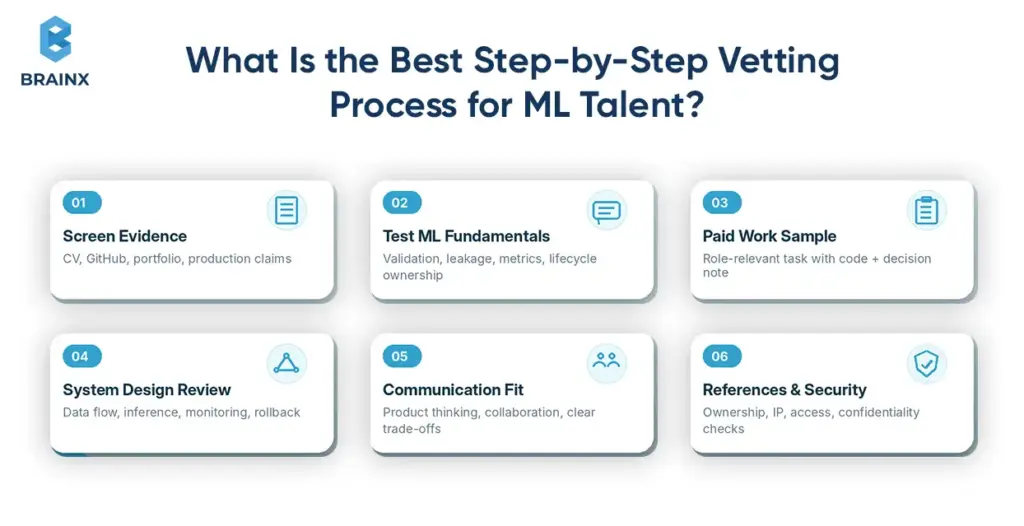
Employ a brief, focused, evidence-based process. The intent is not to introduce additional rounds of interviews but to assess skills that will be applied in the role upon hire. According to the US Office of Personnel Management, work samples are highly valid when they closely simulate the tasks performed on the actual job.
Stage 1 — Screen the CV, GitHub Profile, Portfolio, and Production Claims
Check whether examples match your data type, product environment, and ownership level. Look for scale, deployment context, monitoring, failure handling, and measurable outcomes. Reject vague claims such as “improved accuracy” without a baseline, dataset, metric, or production result.
Stage 2 — Confirm Role Fit and Machine Learning Fundamentals
Run a structured 45-minute interview covering validation, leakage, metrics, data limitations, and lifecycle ownership. Use the same core questions and scoring anchors for every candidate. Add role-specific probes only after the shared foundation.
Stage 3 — Assign a Paid, Role-Relevant Practical Assessment
Give a two-to-four-hour paid task using anonymized or synthetic data. Ask for code, a short decision note, limitations, and a production next step. The OPM work-sample guidance recommends tasks that are identical or highly similar to the work performed on the job.
Stage 4 — Conduct an ML System Design and Application Integration Review
Ask the candidate to design the data flow, training process, inference service, monitoring, and rollback approach. Introduce realistic constraints such as a latency target, traffic spike, sensitive dataset, or changing schema. Strong candidates make trade-offs visible.
Stage 5 — Evaluate Communication, Product Thinking, and Collaboration
Use behavioral questions about difficult stakeholders, uncertain results, failed releases, and changing requirements. The candidate should explain how they converted technical evidence into a product decision and how they documented the outcome for others.
Stage 6 — Complete References, Security Checks, and Contract Review
References should confirm ownership, reliability, communication, and handover behavior. Contracts should define confidentiality, IP ownership, permitted data use, subcontractors, security requirements, documentation, access revocation, and exit support. Use legal counsel for jurisdiction-specific terms.
Use a Weighted Scorecard to Compare Candidates Consistently
| Criterion | Recommended Weight |
|---|---|
| Role fit and production evidence | 25% |
| Problem framing and data judgment | 20% |
| Practical assessment quality | 20% |
| System design and integration | 15% |
| MLOps and operational thinking | 10% |
| Communication and collaboration | 10% |
Adjust the weighting to the role. A research position can give more weight to modeling depth; a product role should not allow a brilliant model answer to outweigh weak deployment or communication skills.
What Information Should You Collect During Candidate Evaluation?
Keep a consistent evidence record for every candidate rather than relying on general interview impressions. The evaluation should document:
- role fit and the parts of the ML lifecycle previously owned
- relevant data types, products, scale, and deployment environments
- verified contribution to each portfolio example
- practical-assessment scores, assumptions, and limitations
- system-design decisions and production trade-offs
- communication, collaboration, and product judgment
- reference feedback and any security or eligibility checks
- final weighted score and the reason for the hiring decision
Separate observed evidence from interviewer opinion. For example, record that the candidate designed a rollback strategy and identified a leakage risk rather than writing that they “seemed senior.”
Use the same core criteria for every candidate, while allowing role-specific evidence to affect the weighting. The final record should make it clear why one candidate is better suited to the defined role, not simply who performed most confidently during the interview.
What Should Practical Tests and Technical Interviews Measure?
Assessments should measure judgment under your real constraints. When you hire machine learning developers, avoid algorithm trivia that has little relationship to data quality, integration, or operating the system after launch.
Choose a Task That Reflects the Actual Product and Data Environment
Match the modality, delivery mode, and constraints. A fraud role should see imbalanced transaction data. A vision role should address device or throughput issues. An app role should expose predictions through an endpoint. A platform role should design deployment and monitoring.
Test Problem Framing Before Model Complexity
The candidate should define the target, baseline, metric, validation design, and business cost of errors before choosing an algorithm. Google’s Rules of Machine Learning recommends robust infrastructure, simple models, and measurable product goals before unnecessary complexity.
Score Data Handling, Model Evaluation, Code Quality, and Deployment Thinking
Reward reproducible data processing, leakage checks, sensible baselines, segmented evaluation, readable code, tests, and an honest deployment plan. A strong submission states assumptions and limitations instead of hiding uncertainty behind an impressive metric.
Include Leakage, Imbalance, Drift, Latency, Cost, and Failure Modes
Ask candidates to identify future-data leakage, choose metrics for imbalance, define drift signals, estimate inference cost, and describe fallback behavior. These questions expose production judgment quickly because each choice depends on business impact, not a memorized formula.
Adapt the Test for ML Application Development and API Integration
Provide a model or stub and require an inference endpoint with validation, error handling, logging, and a latency target. Ask how the client should version requests, handle timeouts, and fall back when the service is unavailable.
Adapt the Test for NLP, Computer Vision, Tabular ML, MLOps, or LLM Work
- NLP: label quality, privacy, domain shift, and evaluation sets.
- Vision: augmentation, device variance, throughput, and edge deployment.
- Tabular ML: leakage, explainability, calibration, and feature pipelines.
- MLOps: CI/CD, registry, monitoring, retraining, and infrastructure as code.
- LLM: retrieval quality, groundedness, prompt injection, safety, and token cost.
Ask About a Model That Failed After Deployment
This question reveals operational maturity. A credible answer names the failure signal, detection method, customer or business effect, immediate mitigation, root cause, and process change. Candidates with no failure story may not have owned a live system.
Ask How the Candidate Balances Accuracy, Latency, Cost, and Explainability
Strong candidates treat this as a business trade-off. They may propose a simpler model, different service tiers, human review for high-risk cases, or a fast default with a slower fallback. The answer should include measurable thresholds rather than personal preference.
Keep the Assignment Paid, Time-Bounded, and Separate From Client Work
Pay for the assessment, limit it to a few hours, use synthetic or anonymized data, and state whether AI coding tools are allowed. Do not disguise billable work as a test. Clarify that evaluation artifacts are for hiring and that candidate-owned generic code remains theirs.
Machine Learning Developer Cost and Salary Benchmarks for 2026
Compare like with like. Salary, total compensation, freelance rates, dedicated-team pricing, and project budgets represent different commitments. If you hire machine learning developers on price alone, you may exclude management, benefits, cloud costs, QA, security, or post-launch support.
Machine Learning Developer Salary Ranges in the US
Robert Half’s 2026 Technology Salary Guide lists national starting compensation for AI/ML engineers at $134,000 on the low end, $170,750 at the midpoint, and $193,250 at the high end. The guide defines these bands by experience and advanced skills, not strictly by years in the profession.
| Planning Level | 2026 US Base-Salary Reference |
|---|---|
| Early-career or limited role experience | $134,000 |
| Moderate experience and most role requirements | $170,750 |
| Advanced skills and extensive role experience | $193,250 |
Freelance Hourly Rates by Seniority and Specialization
Upwork’s current machine learning engineer rate guide places typical marketplace rates at $50-$80 per hour for beginners, $80-$120 for intermediate talent, and $120-$200+ for advanced specialists. Treat marketplace data as a sourcing reference, not a guarantee of quality or availability.
Dedicated ML Team Rates by Region and Team Composition
Dedicated-team pricing is less standardized because quotes may include recruiting, employment, project management, QA, and bench risk. Revelo’s June 2026 LATAM benchmark estimates mid-level nearshore ML engineers at about $46,000-$96,000 annually and senior talent at roughly $56,000-$130,000, depending on country and specialization.
Use those figures only as directional vendor data. Request role-level rates and confirm whether technical leadership, data engineering, MLOps, QA, security, paid leave, equipment, and replacement support are included.
ML Application Development Rates by Product Complexity
Project pricing depends more on data and integration complexity than the job title. BrainX’s AI app development cost guide estimates the pricing of simple AI applications to cost around $30,000, and advanced enterprise solutions costing $500,000 or more, depending on scope, data readiness, model complexity, integration, and compliance.
Why MLOps, Computer Vision, and Generative AI Specialists Cost More
These specialists carry additional delivery risk. MLOps engineers own reliability and lifecycle automation. Vision engineers may manage labeling, GPUs, edge constraints, and device testing. Generative AI engineers must handle retrieval, evaluation, safety, model changes, and unpredictable usage cost. Production evidence commands the premium.
Base Salary vs Total Compensation vs Vendor Billing Rate
Base salary excludes bonuses, equity, benefits, payroll costs, equipment, recruitment, and management. A freelance rate usually covers the individual’s time. A vendor rate may include employment administration, delivery management, replacements, and overhead. Compare annualized total cost and responsibilities addressed or included.
What Hidden Costs Should Be Included in the Hiring Budget?
- Recruiting, interviews, notice periods, and onboarding time.
- Data cleaning, labeling, licenses, and evaluation datasets.
- Cloud compute, GPUs, APIs, logging, and monitoring.
- Security, privacy, compliance, and legal review.
- Maintenance, retraining, incident response, and documentation.
How to Onboard Machine Learning Developers for Success
A signed offer or contract does not make a machine learning developer immediately productive. The company still needs to provide technical context, secure access, clear ownership boundaries, and a realistic path into the system.
ML onboarding can be more involved than conventional software onboarding because the developer must understand the data, model assumptions, application architecture, deployment process, business objective, and production risks. Preparing these elements before the start date reduces avoidable delays and helps the new hire contribute safely.
Expected Hiring Timelines for Full-Time, Freelance, and Dedicated Models
As a planning range, allow roughly four to eight or more weeks to hire a full-time specialist, several days to two weeks to engage a vetted freelancer, and two to six weeks to form a dedicated team.
These are editorial planning ranges rather than guaranteed market averages. Seniority, notice periods, interview speed, security checks, specialist availability, and contract reviews can shorten or extend the process.
A faster start does not always mean faster delivery. A freelancer or external team may become available quickly, but progress will still stall if repositories, data, environments, or decision-makers are unavailable.
Prepare Data, Systems, and Secure Access Before the Start Date
Prepare the resources the developer or team will need before onboarding begins:
- Code repositories and branch conventions
- Approved datasets and a data dictionary
- Architecture and data-flow diagrams
- API specifications and integration documentation
- Development and staging environments
- Baseline metrics and previous evaluation results
- Deployment instructions and monitoring dashboards
- Security policies and access-request procedures
- Known technical debt, current risks, and open decisions
Use role-based access, least privilege, managed secrets, audit logs, and separate development and production environments. Provide sanitized or anonymized datasets for local development where possible.
Access should be sufficient for the developer to begin useful work without exposing production systems or sensitive information unnecessarily. Expand permissions as responsibilities become clearer, and remove access promptly during role changes or offboarding.
Assign an Onboarding Owner and Explain the Business Context
One person should be accountable for the onboarding plan, even when several teams are involved. This may be an engineering manager, technical lead, product owner, or senior developer.
The onboarding owner should help the new hire understand:
- Who uses the ML capability
- Which decision or workflow it affects
- What the current process or baseline looks like
- How success will be measured
- Which errors create the greatest business risk
- Who owns the data, application, infrastructure, and final product decisions
Assign a technical contact who can explain the codebase, data sources, deployment process, and important decisions that may not be fully documented.
Business context should come before detailed model work. Without it, the developer may optimize an offline metric that does not improve the real product or operational outcome.
Start With a Small, Production-Relevant Task
The first assignment should help the developer learn the actual system without introducing unnecessary risk.
Suitable starting tasks may include:
- Reproducing the current model baseline
- Tracing one prediction from source data to the application
- Documenting an existing pipeline or service
- Adding a data-validation check
- Investigating a known latency or quality issue
- Improving a monitoring signal
- Updating a test, API response, or fallback rule
Avoid making the first task a complete model redesign. A smaller, production-relevant contribution helps the developer understand how the system works while confirming that access, environments, reviews, and collaboration processes are functioning correctly.
It also gives the wider team an early view of the developer’s technical judgment, communication, and documentation habits.
Define the First 30-, 60-, and 90-Day Outcomes
Use milestone ranges to provide direction rather than treating them as fixed promises. The exact pace will depend on data readiness, integration complexity, and regulatory risk.
Days 1–30: The developer should understand the business problem, users, data sources, architecture, baseline, and main risks. Expected outputs may include a data audit, reproduced baseline, architecture review, or prioritized technical findings.
Days 31–60: The developer should contribute an evaluated improvement, integrated service, or production-relevant feature in staging. The team should also have a clearer view of testing, monitoring, rollout, and infrastructure requirements.
Days 61–90: Expect a validated pilot, production path, or measurable system improvement, supported by documentation, monitoring, rollback planning, and agreed ownership for the next phase.
The first 90 days should demonstrate more than technical activity. They should show that the developer can access, evaluate, change, and explain the system safely.
Establish Communication, Knowledge Transfer, and Operational Handover
Define how the developer will communicate progress, risks, and technical decisions. The process may include short technical check-ins, weekly stakeholder reviews, code reviews, architecture discussions, written experiment summaries, and documented decision records.
The goal is not to add unnecessary meetings. It is to prevent changing requirements, unresolved dependencies, and technical assumptions from remaining hidden.
For remote or distributed teams, record important decisions asynchronously so knowledge does not depend on attendance in one call or time zone.
Build knowledge transfer into daily delivery rather than leaving it until the final week. Require useful artifacts as the work progresses, including:
- Architecture diagrams
- Data and API contracts
- Evaluation summaries
- Deployment instructions
- Experiment and decision records
- Dashboard and alert explanations
- Model limitations
- Operating runbooks
Use shared code reviews, technical walkthroughs, and pairing sessions so knowledge moves between the new hire and the existing team.
Before onboarding is considered complete, the developer should be able to explain the system, identify the correct technical owners, reproduce the baseline, follow the release process, and connect their work with the intended business outcome.
A slow start does not always indicate a poor hire. It may expose missing documentation, inaccessible data, unclear ownership, or weak internal processes. Treat onboarding as a test of company readiness as well as individual performance.
How Should You Measure the Business Value of the Hire?
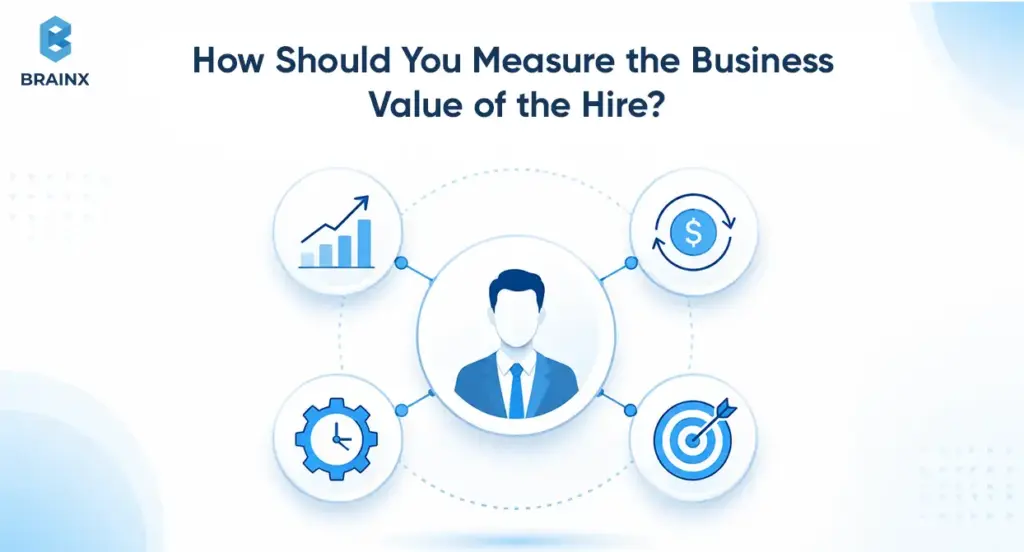
Define value before development begins. The best candidates help connect model performance to revenue, cost, risk, user experience, and operating quality, instead of optimizing an isolated technical metric.
Connect Model Metrics to Revenue, Cost, Risk, or Customer Experience
Map recommendation quality to conversion or revenue per session, forecasting to stockouts or planning accuracy, fraud detection to losses and review burden, and support automation to resolution time and customer satisfaction.
Set Product and Model Baselines Before Development Begins
Record the current process, heuristic, cost, latency, error rate, and user behavior. Without a starting point, neither the team nor the business can demonstrate improvement or decide whether further investment is justified.
Track Accuracy Alongside Latency, Reliability, Cost, and Adoption
A production scorecard should cover model quality, p95 latency, service errors, cost per inference, monthly budget, feature adoption, drift, and alert frequency. Azure recommends monitoring multiple production signals and setting thresholds that trigger investigation or retraining.
Define the First Production Milestone and Acceptance Criteria
Define “done” as an integrated, monitored, reversible release that meets agreed performance and risk thresholds. Include a measurable business result or validated learning, not only deployment.
Measure Team Productivity Without Rewarding Model Complexity
Reward safe cycle time, valid experiments, documentation, stability, and reduced incidents. Do not reward larger models or more architecture unless they create measurable value. A simpler system that users trust and the team can operate is often the better outcome.
Distinguish a Successful Experiment From a Successful Product
An experiment proves feasibility or exposes a limitation. A product performs repeatedly for real users, has an owner, stays within cost and risk limits, and improves a business outcome. Your hiring criteria should reflect the bar the role must reach.
Red Flags When Hiring a Machine Learning Developer
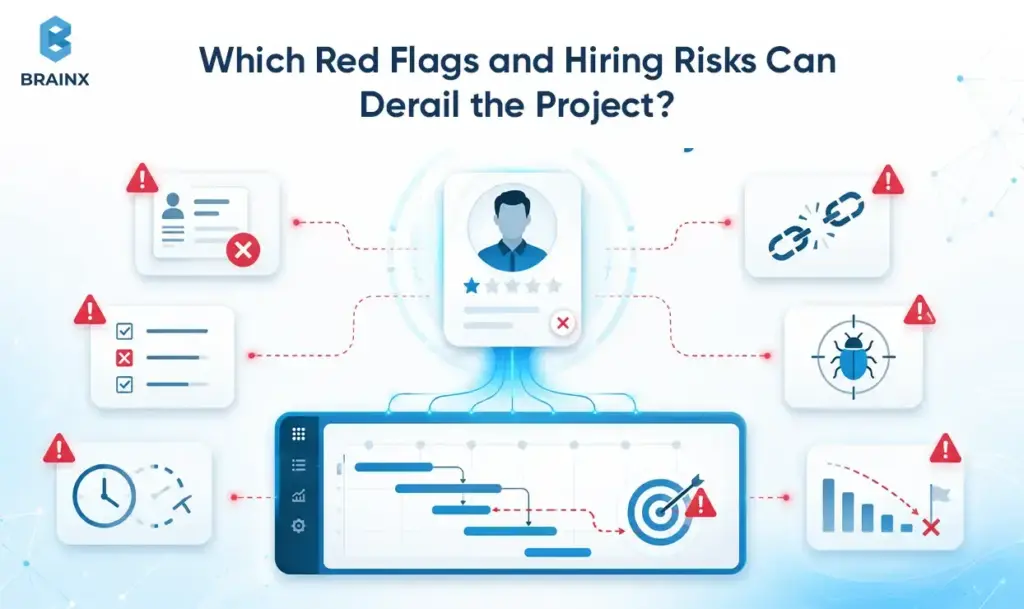
The warning signs in ML hiring are not limited to the candidate. A capable developer can still struggle when the project has poor data, unclear success criteria, weak technical leadership, or no plan for operating the model after release.
Review candidate evidence, application requirements, organizational readiness, and contractual protections together. Claims about model accuracy or framework expertise should be supported by context: the baseline, dataset, production environment, business outcome, and the candidate’s actual level of ownership.
Some risks appear quickly during interviews. Others remain hidden until the model must integrate with a live product, handle changing data, or recover from a production failure. Identifying these issues before hiring is less expensive than correcting the role, architecture, and operating model halfway through delivery.
Candidate Red Flags: Notebook-Only Work, Vague Claims, and Metric Fixation
Be cautious when candidates cannot describe deployment, monitoring, failure cases, or stakeholder decisions. Claims such as “30% better accuracy” are weak without the baseline, metric, dataset, cohort analysis, and business result.
Application Red Flags: Weak Integration Skills and No Performance Testing
A customer-facing feature needs latency testing, load behavior, fallbacks, versioning, and observable errors. If no one owns these concerns, the model may become a product reliability problem.
Project Red Flags: Poor Data, No Baseline, and Undefined Success
Pause hiring when there is no data owner, labels are unreliable, definitions change across teams, or success is simply “the model works.” A short discovery phase may be more valuable than immediately adding headcount.
Operational Red Flags: No Monitoring, Retraining, Rollback, or Incident Ownership
Every live model needs defined signals, thresholds, investigation steps, and an owner. Google Cloud notes that models can degrade as data profiles evolve, so teams must monitor online performance and be able to notify, retrain, or roll back.
Team Red Flags: Missing Leadership and Single-Person Dependency
One expert cannot replace product ownership, data access, security review, platform support, and QA. Require shared documentation, code review, and backup ownership so the initiative does not stop when one person leaves or takes time off.
Contract Red Flags: Unclear IP, Data Rights, Confidentiality, and Exit Terms
Clarify ownership of code, models, prompts, fine-tuned weights, datasets, and derived artifacts. Define permitted data use, retention, subcontractors, confidentiality, handover, and access revocation. Review these terms before any proprietary data is shared.
Responsible AI Red Flags: Bias, Privacy, Security, and Human Oversight
Higher-impact systems need fairness testing, privacy controls, auditability, appropriate explanations, security testing, and a clear human review path. Apply the relevant governance framework and seek qualified legal advice for sector or regional requirements.
A Final Checklist for Hiring Machine Learning Developers
Before making an offer or signing an engagement, confirm that you have:
- Defined one business use case and measurable outcome.
- Matched the role to the main data, modeling, integration, or operational gap.
- Documented the available data, systems, constraints, and ownership boundaries.
- Selected a hiring model that fits the timeline and internal management capacity.
- Reviewed evidence of production work rather than relying on framework lists.
- Used a paid, role-relevant assessment and a consistent scorecard.
- Compared total cost, including management, infrastructure, and ongoing support.
- Agreed on the first 30-, 60-, and 90-day deliverables.
- Confirmed security, IP ownership, documentation, and access requirements.
- Assigned responsibility for monitoring, retraining, incidents, and post-launch improvement.
A strong hiring decision should connect the candidate or team to a defined production outcome. If those conditions are still unclear, resolve them through discovery before committing to a long-term hire.
Conclusion: Hire for Production Ownership, Not Framework Familiarity
The strongest hiring decisions start with role clarity and end with evidence of safe, measurable delivery. Match the profile to the product environment, test the work the person will actually perform, and compare engagement models using total cost and operational responsibility.
In 2026, the best way to hire machine learning developers is to prioritize people who can explain what happens before training, during integration, and after deployment. Framework familiarity matters, but production ownership is what protects the business value.
How BrainX Helps You Hire and Scale Machine Learning Development
BrainX Technologies helps companies define the right machine learning role, close technical capability gaps, and build AI systems that are ready for production. Support can range from adding a focused specialist to an existing team to providing cross-functional delivery across data, models, applications, cloud infrastructure, and ongoing operations.
Why companies work with BrainX for machine learning development:
- Cross-functional AI and engineering expertise: BrainX brings together AI engineers, data scientists, web and mobile developers, cloud specialists, QA engineers, and DevOps support. Its AI capabilities include machine learning, computer vision, natural language processing, predictive analytics, RAG chatbots, and AI/ML strategy consulting.
- Experience delivering complete digital products: BrainX reports more than nine years of delivery experience, a team of over 120 engineers, more than 250 completed projects, and over 130 satisfied clients. This wider product-engineering background matters when an ML feature must connect with existing applications, APIs, data platforms, and user workflows.
- A production-focused AI development process: BrainX’s delivery process covers problem definition, data preparation, proof of concept development, model refinement, testing, integration, deployment, and monitoring. This helps companies move beyond an isolated prototype toward a system that can be maintained and improved after launch.
- Proven AI integration experience: For T-ShirtDeal, BrainX developed a multilingual AI chatbot that connected with the company’s website and customer communication channels. The solution included order and product assistance, human escalation, internal agent support, and a centralized administration dashboard. The case study reports 24/7 multilingual service, shorter response times, and more streamlined support workflows.
- Established quality and security practices: BrainX is ISO 9001:2015 and ISO 27001 certified, providing a more structured foundation for quality management, information security, and delivery governance. The company works with startups, growing businesses, and enterprises across multiple industries.
The engagement should match the problem. BrainX can help clarify whether the project needs one application-focused ML engineer, several dedicated specialists, or a wider AI product team covering data engineering, model development, backend integration, testing, deployment, and monitoring.
BrainX’s T-ShirtDeal GPT case study shows this broader delivery model in practice. The project combined multilingual AI support, website and messaging-channel integration, order and product assistance, human escalation, internal agent support, and a central administration layer.
A short discovery phase can define the ownership boundaries, technical risks, required roles, and first production milestone before the company commits to a longer hiring or development cycle.
FAQs About Hiring Machine Learning Developers
How do I hire machine learning developers for a startup?
Start with one use case, one product surface, and one measurable outcome. Then hire machine learning developers who can cover the riskiest gap, usually data readiness, integration, or production ownership. If the scope is uncertain or the startup lacks an ML lead, begin with a paid discovery sprint or a small senior-led team rather than a permanent junior hire.
How do I hire a machine learning developer if I’m not technical?
Start with a clear business problem, the data you already have, and one measurable outcome. Ask a trusted technical adviser or development partner to help define the role, review production experience, and assess a paid practical task. If you lack internal ML leadership, choose a senior-led team or partner rather than relying on one unsupported developer.
When should I hire dedicated machine learning developers instead of a freelancer?
Choose a dedicated team when delivery spans several months, multiple systems, or more than one discipline. It is usually safer for customer-facing products, regulated data, ongoing model operations, or roadmaps that need data engineering, backend integration, MLOps, QA, and documentation. A freelancer remains suitable for narrow, well-bounded work.
What should I evaluate before I hire machine learning app developers?
Evaluate the target platform, data flow, API boundaries, latency, expected traffic, fallback behavior, security, analytics, and post-launch owner. Test the candidate with a realistic integration task rather than a model-only exercise. For mobile products, also assess on-device constraints, offline behavior, release cycles, and model updates.
How much does a machine learning developer cost in 2026?
Robert Half lists US AI/ML engineer starting compensation at $134,000 to $193,250, depending on experience and advanced skills. Upwork lists marketplace rates of about $50 to $200+ per hour. Dedicated-team and project costs vary further because they may include management, QA, data engineering, infrastructure, and continuing support.
How can I test whether an ML developer has production experience?
Ask for deployed examples, architecture diagrams, monitoring dashboards, incident stories, and rollback decisions. Then use a paid work sample that includes data checks, evaluation, clean code, and a production next step. Candidates with real ownership can explain drift, latency, fallbacks, operational cost, and what happened when a live model failed.
Should I choose a full-time employee, freelancer, dedicated team, or AI development partner?
Choose a full-time employee for long-term internal ownership, a freelancer for a narrow task, a dedicated team for multi-quarter delivery with several workstreams, and a development partner when you also need discovery, technical leadership, product engineering, and operating processes. The best choice depends on roadmap duration and internal management capacity