
 July 4, 2026 -
  24 minutes read

Shoppers do not think in channels. They are looking for consistent pricing, availability, personalized recommendations and seamless service whether they browse online, visit a store, or contact support. This is where custom retail software development can help retailers connect customer data, inventory, commerce platforms, and AI-powered experiences across every touchpoint.
The goal is not simply to “add AI.” It's about making the shopping experience measurably easier with faster product discovery, less out-of-stocks, more confident purchase decisions and better post-purchase support.
Adobe Analytics data from May 2026 found that shoppers referred to US retail websites by large language models generated 53% more revenue per visit than visitors from other sources. However, a 2026 consumer survey found that while 69% of respondents used AI chatbots at least occasionally, only 24% trusted their fashion and beauty recommendations, while 55% actively distrusted them.
The bottom line is that AI can create more valuable shopping journeys, but personalization must remain transparent, grounded in reliable data, and supported by meaningful customer control and human oversight.
Key Takeaways
- Custom retail software development delivers better results when focused on a single measurable customer journey or one goal at a time.
- High-impact AI use cases that impact the bottom line are personalized recommendations, shopping assistants, targeted promotions, demand forecasting, and inventory optimization.
- Clean product data, accurate inventory, consented customer profiles, and consistent event tracking matter more than model selection.
- RAG-based shopping assistants enhance the reliability of the product, policy, inventory, and service responses by referencing trusted business data.
- AI-driven pricing and promotions require clear margin rules, fairness checks, approval workflows, and measurable guardrails.
- Secure retail AI relies on privacy by design, transparency about the use of data, ongoing monitoring, human oversight, and limited access to the system.
- Begin with one channel, set KPI baselines, prove measurable lift, strengthen integrations, and then scale across additional journeys.
What Is Custom Retail Software Development and Why AI Changes the Equation
Custom retail software development simply refers to designing and developing retail systems that align with your business model rather than trying to forcefully fit your storefront, operations and service teams into a generic workflow. In practice, that can include ecommerce, POS extensions, OMS orchestration, WMS workflows, CRM or CDP connections, loyalty logic, clienteling tools, and internal dashboards that share one view of product, customer, and order data. When AI is layered into that stack, software stops being just a transaction engine and becomes a decision engine.
Definition and Scope
A modern retail tech stack usually spans storefronts, payments, product information, order routing, fulfillment, returns, customer data, and service tooling. The reason custom work matters is that shoppers experience all of those systems as one brand promise, even when the backend is fragmented.
The core systems involved include:
- POS for store sales, returns, promotions, and associate workflows
- Ecommerce platforms for catalogs, search, product pages, checkout, and accounts
- OMS for routing, fulfillment, cancellations, pickup, and returns
- WMS for inventory movement, picking, packing, and replenishment
- CRM or CDP for identity, consent, segmentation, and preferences
- Loyalty and clienteling tools to reward, recommend, set appointments, and personalize outreach
AI only becomes useful when these systems stop operating as silos. Recommendations depend on accurate pricing and inventory, while service automation depends on live order, shipping, and returns data.
Custom Retail Software Development vs Off-the-Shelf Platforms: When Building Wins
When the objective is speed, a standard checkout flow and a traditional approach to merchandising, off-the-shelf platforms are the most ideal option. Building starts to win when your edge depends on unique bundles, complex fulfillment rules, store-associate workflows, proprietary loyalty mechanics, or AI models that need access to first-party data and business rules across channels.
Deloitte found that 44% of retail executives say legacy systems are slowing innovation, and 67% expect AI-driven personalization capabilities within the next year. These are the two signals that indicate composability and extensibility now matter more than feature checklists alone.
How AI Is Reshaping the Shopping Experience Across the Customer Journey
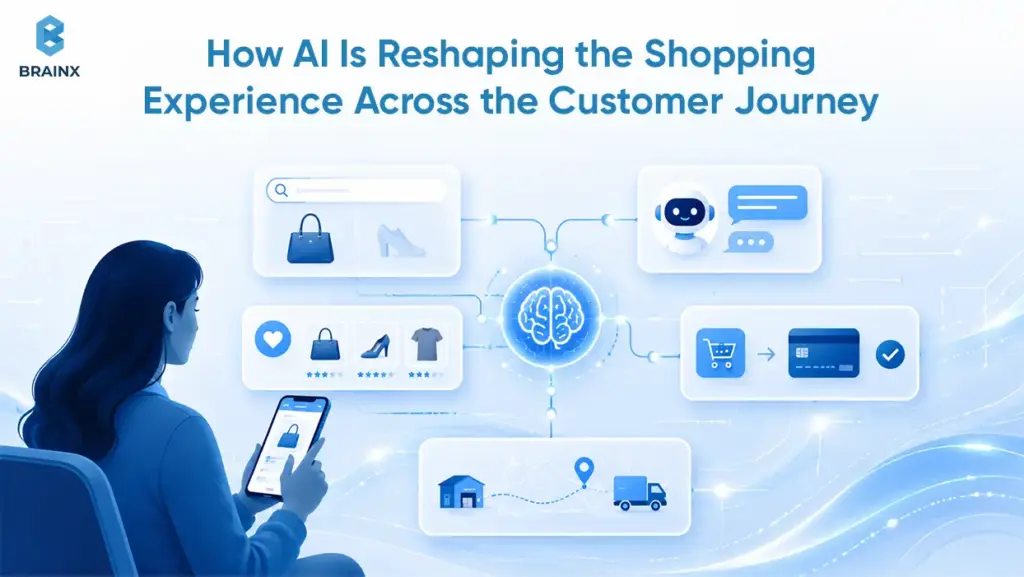
The most significant difference is that AI is not just used for marketing purposes anymore. It's transforming the way customers find products, what merchants display, the way fraud is evaluated, and how relevant teams provide after-sales service. IBM found that 59% of consumers would like to use AI applications as they shop.
AI-Powered Product Discovery
The focus of search is moving from keywords to intent. That is, rather than having to choose from a limited range of pre-defined categories, customers can now specify outcomes, constraints, or use cases, like “a couch for a small apartment for less than 900 dollars” and “gift bundle for toddler birthday party”, instead of navigating static categories. Adobe’s traffic data point to a world where AI-driven discovery becomes a more important entry point to retail sites and product consideration.
Here are some short examples:
- Semantic search that understands attributes, synonyms, and shopping intent
- Personalized ranking based on availability, brand preferences, size, price sensitivity, and delivery requirements
- Natural-language discovery that helps shoppers refine broad requirements into suitable products
Discovery models should also consider real-time inventory and fulfillment promises. A useful suggestion is of little value if the right product can't be shipped or delivered to the customer at the right time.
Personalization, Recommendations, Bundles, and Next-Best Actions
Today, good personalisation is no longer “Customers who bought this also bought that.” It increasingly includes ranking, dynamic bundles, timing, channel selection, and next-best actions based on context. McKinsey reports that personalization can cut acquisition costs by up to 50%, boost revenues by 5-15% and increase the return on investment by 10-30%
Checkout Optimization, Dynamic Offers, and Fraud Signals
When it comes time to check out, AI can determine which payment options are emphasized, if the shopper deserves a “save-the-cart” offer, and if the transaction should be double-checked. Stripe and Visa both outline real-time machine learning models that rely on behavioral, transactional, and device signals to achieve better fraud detection than traditional rules, enhancing both customers' trust and approval rates.
Post-Purchase Automation for Returns, Retention, Loyalty, and Support
After purchase, AI is most valuable when it lowers operational drag without making support feel robotic. That includes automated return triage, loyalty nudges, replenishment reminders, proactive delay notices, and assistants that can answer policy questions with a live-agent fallback. According to Salesforce, customers are looking for clarity around guardrails and the need for human involvement, with 72% stating that transparency around communicating with an AI agent is important.
Highest-Impact AI Use Cases to Build With Custom Retail Software Development Solutions
The best custom retail software development solutions usually combine one revenue use case, one operations use case, and one measurement layer. That avoids the common failure mode of shipping a shiny AI surface with no reliable data, no integration depth, and no proof of business lift.
| Use Case | Minimum Data Needed | Systems Touched |
| Personalization engine | Product attributes, browsing history, cart events, purchase history | Ecommerce, CRM/CDP, loyalty, analytics |
| Shopping assistant | Product catalog, FAQs, policy content, inventory availability | Search, CMS, PIM, support, order systems |
| Visual AI | Product images or video, planograms, shelf or camera feeds | PIM, store ops, loss prevention, analytics |
| Forecasting | Sales history, seasonality, promotions, stock and lead times | ERP, OMS, WMS, replenishment |
| Pricing optimization | Margin rules, elasticity signals, promo history, inventory state | Pricing engine, ecommerce, POS, promo tools |
Personalization Engines in Custom Retail Software Development Solutions
A strong personalization engine should rank products, tailor bundles, suppress irrelevant offers, and trigger actions based on known intent—not simply recommend what is popular. McKinsey and BCG both point to meaningful upside here: retailer personalization leaders improve conversion and growth by making customer interactions faster, easier, and more relevant, while personalized offers can outperform mass promotions materially.
A production-ready personalization engine requires:
- Identity resolution: Connect guest, logged-in, loyalty, and device-level activity within consent boundaries.
- Reusable behavioral features: Capture affinity, recency, frequency, price sensitivity, and category interest.
- Decision policies: Prevent irrelevant, unavailable, low-margin, or out-of-season recommendations.
- Experimentation hooks: Support A/B tests and holdouts to prove incremental lift.
Start with one surface, such as product-page recommendations, and instrument it properly before expanding personalization across every channel.
Conversational Commerce: AI Shopping Assistants + Human Handoff
A retail assistant should not try to replace every human interaction. It should qualify intent, surface curated options, answer policy and product questions, and route complex or high-value moments to a person with context intact. RAG is useful here because it grounds model output in proprietary content, and Salesforce’s customer research reinforces the need for clear disclosure and human-in-the-loop design.
Here are the four production requirements:
- RAG connected to product information, policies, sizing details, delivery information, and store availability
- Tool calling for inventory checks, order tracking, returns, and appointment booking
- Human escalation with the conversation and customer context preserved
- Safety controls for policy hallucinations, inaccurate pricing, unsupported recommendations, and unsafe outputs
A useful assistant should be able to handle requests such as “Find a gift under $80 that is available for pickup today,” rather than simply producing generic product descriptions.
Visual AI: Product Tagging, Shelf Analytics, Loss Prevention
Visual AI is most valuable where manual review is slow or inconsistent. Retail teams use it for image tagging, visual search, shelf audits, exception detection, and, in the right context, shrink or loss-prevention workflows. At BrainX, we apply computer vision, object detection, visual search, forecasting, and analytics to help retailers automate image-based and store-level workflows.
Demand Forecasting and Inventory Optimization
Forecasting models become meaningful only when they are tied to store-level and DC-level decision points such as reorder thresholds, substitutions, transfers, allocation, and promotion planning. Deloitte reported that six in 10 retail buyers said AI-enabled tools improved demand forecasting and inventory management in 2024, and its 2026 outlook says 59% of executives expect positive ROI from AI-driven supply chain initiatives within the next year.
Pricing and Promotion Optimization
Pricing AI should operate inside policy boundaries, margin rules, and brand safeguards. The goal is not to let an opaque model chase short-term response rates at the expense of trust. BCG finds that personalized offers can outperform mass promotions, but the FTC’s recent work on surveillance pricing shows why retailers need governance, explainability, and legal review when individualized prices or offers depend on personal and behavioral data.
Practical guardrails include:
- Minimum and maximum price thresholds
- Margin and markdown rules
- Promotion eligibility criteria
- Brand and merchandising restrictions
- Fairness checks
- Approval requirements for high-impact changes
- Holdout groups for measuring incremental lift
If merchandising teams cannot understand why the system recommended a price or offer, adoption and governance will remain difficult.
Reference Architecture: What a Modern AI Retail Stack Looks Like
If you are building for scale, custom retail software development needs a layered architecture that separates systems of record from decisioning, retrieval, experimentation, and experience delivery. That is how you keep models swappable, data reusable, and customer experiences consistent across web, mobile, stores, and service channels.
| Layer | What Lives Here | Why It Matters |
| Core Systems | POS, ecommerce, OMS, WMS, ERP, CRM/CDP, loyalty, payments | Source of truth for transactions, inventory, customers, and fulfillment |
| Data Layer | ETL/ELT, streaming events, catalog pipelines, feature stores, identity resolution | Makes AI usable across channels and teams |
| AI Layer | Recommenders, forecasting, fraud models, LLMs, RAG, experimentation | Powers personalization, prediction, and assisted workflows |
| Experience Layer | Web, mobile, kiosks, in-store tools, service consoles | Delivers AI outputs where staff and shoppers actually act |
| Governance Layer | Monitoring, evaluation, security, approvals, audit logs | Reduces operational, legal, and trust risk |
Core Systems
Core retail systems should stay authoritative for orders, inventory, product records, customer profiles, and payment state. AI should consume from them and write back decisions where appropriate, but not become the system of record itself. This architectural separation, rather than model choice alone, determines whether an AI pilot can scale safely into production.
Data Layer
The data layer should unify batch and real-time signals: catalog updates, browsing events, cart state, store interactions, support tickets, inventory snapshots, and returns history. Without that, your recommender ranks on stale attributes, your assistant answers from outdated content, and your forecast ignores current demand shifts.
Deloitte’s 2026 outlook explicitly points to accurate, accessible product and pricing data as AI hygiene factors.
The data layer should support both real-time pipelines for time-sensitive signals, such as inventory and customer activity, and batch pipelines for historical analysis and model training. Consistent SKU, store, customer, and order identifiers help connect information across systems, while stable behavioral event definitions ensure actions such as searches, product views, cart additions, and purchases are measured consistently.
When data remains fragmented, build a minimum viable data layer around the first selected use case rather than attempting an enterprise-wide data transformation before proving value.
AI Layer for Model Hosting, Experimentation, and RAG-Based Product Knowledge
This layer includes model serving, feature access, evaluation pipelines, prompt orchestration, and retrieval. Microsoft’s guidance describes RAG as a pattern that grounds responses in proprietary content, while NIST’s generative AI profile recommends benchmarking model performance, documenting adaptations, and reviewing sources and citations during risk measurement and ongoing monitoring.
Treat prompts, retrieval configurations, evaluation datasets, and model versions as production code. Version them, test them, monitor failures, and maintain rollback options.
Experience Layer Across Web, Mobile, In-Store Tools, Kiosks, and Customer Service
Retail AI should be channel-aware but decision-consistent. A customer who asks for help in chat, checks stock on mobile, and then visits a store should not start over every time. BCG’s 2026 retail analysis says digital will increasingly shape the shortlist before store visits, while stores themselves move toward confidence, consultative support, and fulfillment.
Set latency budgets so recommendations and AI calls do not slow product and category pages. In-store associate and kiosk applications may also require offline-tolerant behavior where connectivity is unreliable.
Observability and Governance for Secure Custom Retail Software Development
Secure AI in retail requires more than uptime monitoring. NIST says trustworthy AI should be valid and reliable, safe, secure and resilient, accountable and transparent, explainable and interpretable, privacy-enhanced, and fair with harmful bias managed. OWASP’s LLM guidance highlights prompt injection and insecure output handling as core risks, while PCI and ISO guidance reinforce the need to isolate payment environments and operate inside a formal security management system.
Data Readiness Checklist
Most retail AI initiatives do not fail because the model is weak. They fail because the underlying data is inconsistent, the event stream is incomplete, or the organization cannot safely operationalize the output.
Deloitte’s research shows many retailers are prioritizing AI recommendations while still lacking confidence in enterprise-wide AI execution.
Score individual product categories for AI readiness and prioritize data cleanup where it can influence revenue fastest.
Data Quality: Product Catalog Hygiene, Inventory Accuracy, Pricing Integrity
If attributes are incomplete, images are mislabeled, or stock is wrong, every downstream AI feature gets worse. Search quality drops, recommendations get noisy, and store-associate tools lose credibility fast. Make catalog completeness, inventory latency, and pricing reconciliation visible before you scale any customer-facing model.
You need to add checks for:
- Required product attributes
- Consistent categories and filters
- Reliable product imagery
- Inventory update latency
- Pricing and promotion reconciliation
Customer Data: Consent, Identity Matching, Loyalty, Preference Capture
Retailers need a lawful basis for processing, clear privacy notices, preference capture, and a reliable identity graph across channels. GDPR stresses lawfulness, fairness, transparency, and privacy by design, while CCPA gives consumers rights to know, delete, correct, limit, and opt out of sales or sharing of personal information.
Customer data readiness starts with a clear view of each customer’s current consent state and how their information may be used. Deterministic identifiers, such as account logins or loyalty IDs, can connect activity across channels, while explicitly captured preferences provide more reliable personalization signals than inferred behavior alone.
Retailers should also maintain clear workflows for data access, correction, and deletion requests. Where identity matching is limited, session-based personalization can still tailor the experience using current browsing intent without relying on a persistent customer profile.
Instrumentation: Event Taxonomy for Browsing, Cart, Checkout, and Store Interactions
Teams should define one event taxonomy for product views, add-to-cart, save-for-later, checkout steps, support contacts, returns, and store-side actions. That gives analysts and models the same behavioral language, which is essential for ranking, experimentation, and attribution. Without it, AI becomes impossible to evaluate cleanly across channels.
Instrumentation should capture meaningful events across the full shopping journey. These may include:
- Search queries, applied filters, result clicks, and zero-result searches
- Product views, image interactions, wish-list additions, and size selections
- Cart updates, coupon attempts, payment errors, and checkout completion
- Return reasons and relevant store-associate actions
Using consistent event names and properties helps teams analyze customer behavior, identify friction, and train AI systems on reliable signals.
Governance: Policies for Model Use, Bias, Approvals, and Vendor Access
Create approval paths for high-risk use cases, document model purpose and limits, define escalation rules, and restrict third-party access to only what is needed. NIST’s AI RMF and generative AI profile both emphasize lifecycle governance, evaluation, documentation, and the role of human decision-makers in deployment approval and monitoring.
Build vs Buy: Choosing the Right Approach for AI-Powered Retail
The strategic question is not “Should we build everything?” It is “Which parts of the stack are actually differentiating?” For many retailers, custom retail software development belongs in orchestration, decisioning, customer experience, and integration—not necessarily in commodity commerce plumbing.
| Approach | Best Fit | Main Risk |
| SaaS-first | Standard workflows, urgent launch timelines, limited engineering capacity | Limited differentiation, roadmap dependency |
| Custom-first | Unique CX, complex operations, proprietary data or logic | Higher upfront cost and delivery complexity |
| Hybrid | Composable commerce, AI overlays, legacy coexistence | Integration debt if ownership is unclear |
When SaaS Is Enough
Use SaaS when speed matters more than uniqueness: basic checkout, standard merchandising, common promo mechanics, and predictable workflows. If the business is still validating category-market fit, buying proven building blocks is often the right move.
When Custom Wins
Build when your differentiation lives in how products are discovered, how orders are routed, how store teams sell, or how loyalty and service work together. This is especially true when your data has strategic value and generic vendor logic would flatten your edge.
Hybrid Approach
Hybrid is the common sweet spot: SaaS for core commerce primitives, custom services for orchestration and AI, and internal platforms for shared data and experimentation. At BrainX, we use APIs, middleware, event streams, secure data pipelines, and clear data contracts to connect AI capabilities with both modern and legacy retail systems.
Vendor Evaluation Scorecard
Evaluate vendors on data access, API quality, extensibility, TCO, lock-in risk, evaluation support, and operational transparency. If a vendor cannot expose the data or controls needed to measure and improve AI behavior, it is not really AI-ready for production retail.
Implementation Roadmap: Zero to Ninety Days to Production, Then Scale
The safest path is staged delivery: discovery, one measurable MVP, integration hardening, then rollout. Our AI delivery emphasizes discovery, readiness, architecture, build, deployment, and ongoing support rather than isolated model experimentation, which is the right shape for retail execution.
Phase One: Discovery + KPI Baseline + Data Audit
Pick one journey, define the KPI baseline, audit data quality, and identify integration constraints. You should leave this phase with a business case, a solution scope, and a no-go criterion if data quality is not yet good enough.
Expected outputs include:
- Selected journey and use case
- KPI baseline
- Data-readiness findings
- Integration map
- MVP scope
- A clear no-go condition if the required data is not reliable enough
Phase Two: MVP With One Journey, One Channel, Measurable Lift
Build one end-to-end, production-adjacent journey, such as ecommerce product recommendations or a service assistant for returns and policy questions. Include analytics, experiment assignment, fallback behavior, and clear operational ownership so the team can measure business lift rather than engagement alone.
Phase Three: Integration Hardening + MLOps
Once lift is proven, harden the data contracts and operational controls around OMS, POS, ERP, inventory, and customer systems. Before expanding the rollout, establish:
- Monitoring
- Rollback logic
- Retraining or re-evaluation triggers
- Approval workflows
- Integration error handling
These controls help teams detect failures early, recover safely, and maintain clear ownership when models, data, or connected systems change.
Phase Four: Rollout + Experimentation + Continuous Optimization
Scale by customer segment, store group, geography, or channel rather than releasing the capability everywhere simultaneously. Expand only what is measurable, and keep a backlog of new experiments rather than a vague “AI transformation” roadmap.
Cost, Timeline, and Team: What Drives AI Retail Software Budgets
Retail AI budgets are usually driven less by model-fee line items than by data cleanup, integration depth, compliance requirements, workflow design, and post-launch monitoring. BrainX’s 2026 cost content also points to scope, data readiness, model complexity, security, and ongoing maintenance as the largest drivers of total spend.
| Scope | Typical Timeline | Directional Budget |
| Narrow PoC | 4–6 weeks | $25k–$75k |
| MVP with real users | 8–14 weeks | $75k–$200k |
| Production rollout with integrations and governance | 4–9 months | $200k+ |
Cost Drivers
The biggest cost drivers are data engineering, system integration, workflow complexity, model evaluation, security boundaries, and change management. If the product touches payment environments, regulated data, or store operations, cost rises quickly because testing, governance, and deployment controls expand with it.
Typical Timelines by Scope
A narrow PoC can move in weeks if it avoids brittle integrations. An MVP that affects live users takes longer because content quality, analytics, experimentation, and fallback behavior must all be production-ready. Multi-store or multi-channel deployments take quarters, not sprints, because operational hardening matters as much as feature completeness.
Team Composition
A practical team usually includes a product owner or PM, UX designer, backend engineer, frontend engineer, data engineer, ML or applied AI engineer, QA, and DevOps or platform support. Add domain experts from merchandising, store ops, and customer service early; retail AI fails when technical teams build without business rule owners in the room.
Risks, Compliance, and Trust: Retail AI That Customers Accept
Customers are more open to personalization than they were a few years ago, but they are also more protective of their data and more skeptical about how AI is used. Salesforce’s research captures that tension clearly: customers want relevant experiences, but they also want transparency, control, and fair value in return for their information.
Privacy and Consent Management
GDPR requires lawfulness, fairness, transparency, and data minimization, and it reinforces privacy by design and documented consent where consent is the basis for processing. CCPA gives Californians rights around disclosure, deletion, correction, opt-out, and non-discrimination, while California also treats Global Privacy Control as a valid opt-out signal that covered businesses must honor.
Hallucinations and Unsafe Outputs in GenAI
Retail assistants should never improvise on returns rules, pricing terms, or product claims. Use RAG to ground outputs, add evaluation metrics such as groundedness and relevancy, review citations, and test for prompt injection and insecure output handling before deployment. NIST also recommends real-world evaluation, adversarial testing, and documented overrides after launch.
Bias and Fairness in Offers and Pricing
Promotions and price decisions can unintentionally favor or exclude groups if the data is skewed, the optimization target is too narrow, or proxies leak into the model. NIST explicitly treats fairness with harmful bias managed as a trustworthiness characteristic, and the FTC’s surveillance pricing work shows why retailers should treat differentiated pricing and targeting as a board-level policy issue, not just a growth lever.
Security
Keep payment boundaries separate, minimize PII exposure, and align controls with recognized frameworks. PCI DSS exists to protect payment account data environments, segmentation can reduce scope and risk, ISO/IEC 27001 defines requirements for an information security management system, and the AICPA Trust Services Criteria cover security, availability, processing integrity, confidentiality, and privacy.
KPIs to Prove ROI: Shopping Experience + Operations
AI should earn the right to expand. That means every launch needs a baseline, a target metric, and a measurement design credible enough to survive executive scrutiny. NIST’s generative AI profile repeatedly stresses documented performance measures and validated claims.
CX KPIs
Track conversion rate, average order value, assisted conversion, repeat purchase rate, loyalty participation, customer satisfaction, and time to resolution. For assistants, add containment rate, escalation rate, grounded answer rate, and shopper satisfaction after human handoff.
Ops KPIs
Operational KPIs should show whether AI improves inventory, fulfillment, service, and workforce efficiency.
Track stockout rate, on-shelf availability, forecast accuracy at SKU-store and category levels, fulfillment SLA adherence, order cancellation rate, markdown rate, picks per hour, time per return, support handling time, and cost to serve.
Connect these measures to margin, shipping costs, labor efficiency, and customer service costs to determine whether operational improvements are producing financial value.
Experimentation Design
Use A/B tests when traffic volume supports it, holdouts when workflows cut across channels, and incrementality logic when media, promotion, and loyalty effects overlap. Most important, document the test design before launch so teams do not retroactively claim success from directional movement alone.
The measurement plan should include:
- A/B tests for digital recommendations, search, and offers
- Holdouts for long-term personalization incrementality
- Store-level or geographical tests for operational AI
- Guardrail metrics covering margin, returns, latency, complaints, and error rates
Every experiment should document its hypothesis, primary metric, guardrails, target duration, and decision rule before launch.
How BrainX Helps With Its Custom Retail Software Development Services
Retail AI initiatives succeed when product strategy, data engineering, software development, and operations move together. At BrainX Technologies, we help retailers modernize their technology stacks, integrate AI responsibly, and deliver measurable improvements across customer and operational journeys.
Our focus is on practical delivery through defining secure architecture, reliable integrations, production-ready AI capabilities, and clear KPIs from the beginning.
Custom Retail Software Development Services for Discovery, MVP Build, and Team Augmentation
We support retailers through three common engagement models:
- Discovery and architecture: Use-case prioritisation, KPI baselines, data audits, integration planning, and solution architecture.
- MVP development and productionization: Building one measurable retail journey with experimentation, monitoring, and operational controls.
- Team augmentation: Adding backend, data engineering, AI/ML, QA, cloud, or DevOps expertise to existing product teams.
We also help align merchandising, operations, customer service, and IT stakeholders so the selected solution is both commercially valuable and technically achievable.
What We Build
Our retail software capabilities include:
- personalization and recommendation systems with inventory awareness, business guardrails, and experimentation support
- AI shopping assistants with RAG-based knowledge, tool calling, and human handoff
- POS, OMS, ERP, PIM, CRM, and inventory integrations
- Demand forecasting and operational analytics
- Customer, merchandising, and experimentation dashboards
- Event tracking, model monitoring, and AI governance workflows
Delivery Principles
We design retail AI systems for production rather than isolated demonstrations.
- Security by design: Clear PII boundaries, least-privilege access, audit logs, encryption, and controlled vendor access
- MLOps from the beginning: Versioning, monitoring, evaluations, deployment controls, and rollback planning
- Measurable ROI: KPI baselines, experiments, holdouts, and reporting connected to business outcomes
- Composable architecture: Modular services and integrations that reduce vendor lock-in and support future expansion
Using this approach, BrainX helps retailers move from one successful use case to a scalable portfolio of AI-enabled customer and operational capabilities.
Conclusion: What to Build First If You Want Results This Quarter
Custom retail software delivers the greatest value when retailers begin with one clearly defined problem rather than attempting to transform every customer and operational journey at once. The best starting point is a use case with reliable data, measurable business impact, and a realistic path to production.
Depending on the retailer’s priorities, that first use case could be inventory-aware recommendations, personalized search ranking, or post-purchase automation connected to live order management data. Each can improve the shopping experience while creating reusable data, integration, and governance foundations for future AI initiatives.
A practical implementation sequence is:
- Establish instrumentation and baseline the customer, operational, and financial KPIs the solution should improve.
- Launch one production-ready MVP with experimentation, monitoring, fallback behavior, and clear ownership.
- Strengthen the required POS, OMS, ERP, inventory, ecommerce, or customer-data integrations.
- Reuse the same architecture, data standards, and governance controls to expand into additional journeys.
The objective is not to add AI for its own sake. It is to build connected retail experiences that help customers find the right products, reduce operational friction, and support better commercial decisions.
FAQs About Customized Retail Software Development
What Is Custom Retail Software Development, and How Is It Different From Ecommerce Development?
Custom retail software development is broader than ecommerce development. Ecommerce work usually focuses on the storefront and checkout experience, while retail software spans order orchestration, inventory, store tools, loyalty, customer data, returns, and service workflows across channels. In other words, ecommerce is one surface; retail software is the full operating layer behind the customer experience.
Which AI Features Deliver the Fastest ROI in Custom Retail Software Development Solutions?
The fastest ROI usually comes from recommendations, personalized offers, AI shopping assistants grounded in product and policy content, and demand forecasting linked to replenishment decisions. Those use cases improve either conversion or operating efficiency quickly and are easier to test in controlled rollouts than more ambitious, enterprise-wide AI programs.
How Do You Integrate AI With POS, ERP, OMS, and Inventory Systems?
Treat core systems as systems of record and place AI in a separate decisioning layer that consumes trusted data and writes back approved actions or recommendations. Use APIs, middleware, event streams, and clear data contracts; then add monitoring, evaluation, and rollback logic before expanding. BrainX’s public AI integration pages emphasize legacy connectivity, secure pipelines, and end-to-end workflow unification, which is the right pattern here.
How Much Does Custom Retail Software Development Cost When AI Is Included?
Costs vary widely, but a practical planning range is roughly $25k–$75k for a narrow PoC, $75k–$200k for an MVP used by real customers or teams, and $200k+ for production systems with integrations, governance, and monitoring. The biggest drivers are data readiness, integration complexity, security and compliance scope, model evaluation, and post-launch operations.
What Data Do Retailers Need for AI Personalization and Recommendations?
At minimum, retailers need clean product attributes, pricing, availability, browsing events, cart and checkout events, purchase history, and consented customer profile data. If identity resolution is weak or catalog quality is poor, recommendation quality drops quickly because the model cannot reliably match shopper intent to valid products.
What Are the Biggest Risks When Using AI in Retail Apps?
The most important risks are privacy violations, biased offers or pricing, hallucinated answers, insecure model behavior, and weak payment-data boundaries. GDPR and CCPA require lawful and transparent data practices, NIST and OWASP emphasize evaluation and security guardrails for AI systems, and PCI guidance reinforces tight scope control around payment environments.