 August 13, 2026 -
 36 minutes read


Key Takeaways
- IT infrastructure management helps ensure reliable, secure, and business-prioritized interconnected systems, networks, cloud resources, storage and dependencies.
- The ability to have complete visibility and clear ownership is more important than adding another monitoring or automation platform.
- There should be operating practices that are distinct but coordinated for systems, networks, storage, cloud resources, and endpoints.
- Modern infrastructure also depends on SaaS platforms, APIs, identity providers, DNS, certificates, and third-party services.
- When introducing widespread automation or AI-driven remediation, make sure the configurations are standardized and monitoring can be done reliably.
- Outsourcing can provide greater cover and knowledge, but the ownership of risk, priorities for architecture and governance should remain with the business.
IT infrastructure management is the coordinated practice of operating, securing, monitoring, maintaining, and improving the technology resources that support business services. It reaches far beyond keeping servers online. Modern teams must manage cloud platforms, networks, storage, endpoints, identity, SaaS dependencies, observability, recovery, and automation as one connected environment.
The discipline has a direct impact on uptime, security, performance, scalability, expenditure and business continuity. According to Uptime Institute's Annual Outage Analysis 2026, 57% of respondents reported that their last major outage cost more than $100,000, and one-in-five reported the cost of their last major outage was more than $1 million. According to IBM's research, Cost of a Data Breach 2026, the average cost of a data breach in the world is $4.99 million.
This guide describes what modern infrastructure entails, how teams operate it, what concerns matter, how it relates to resilience and AI, how it's measured, and when it's helpful to seek external support.
What Is IT Infrastructure?
IT infrastructure is the technology foundation that allows applications, communications, employee workflows, data, and customer-facing services to operate. IBM’s IT infrastructure explainer defines the foundation around hardware, software, and networking components, while modern operating models also need to account for externally managed dependencies.
A useful way to think about infrastructure is as a dependency system, not simply an asset list. Although a customer portal might be deployed on cloud compute, it could still rely on DNS, identity, database, network, monitoring and third-party APIs.
Physical and Virtual Infrastructure
Physical infrastructure includes tangible technology such as:
- Servers and workstation hardware
- Routers, switches, firewalls, and wireless equipment
- Storage arrays and backup appliances
- End-user and edge devices
- Data center equipment
Virtual infrastructure abstracts those resources into software-controlled environments. It includes:
- Virtual machines
- Containers
- Cloud instances
- Virtual networks
- Managed databases
- Software-defined storage
- Serverless and managed compute services
Virtualization increases flexibility but it doesn't remove operational responsibility. Active management of configuration, identity, capacity, monitoring, security, and recovery are still needed.
Traditional, Cloud, Hybrid, and Multicloud Environments
Traditional infrastructure is composed of systems that belong to or are controlled by the organization and typically reside in corporate facilities or colocated data centers. It offers direct control but is dependent on hardware lifecycle management, facilities planning and internal operational knowledge.
Cloud infrastructure leverages on-demand cloud resources, such as AWS, Azure, or Google Cloud. It puts more physical infrastructure responsibility onto the provider while giving customers faster provisioning and elasticity.
Hybrid infrastructure is a blend of on-premises or privately managed infrastructure and public cloud services. Flexera’s 2026 State of the Cloud report says 73% of organizations operate hybrid cloud estates.
Multicloud infrastructure relies on multiple public cloud services. It can help meet workload-specific and organizational needs/constraints like acquisitions, but at the same time, it could add to the complexity of governance, identity, networking, cost, and monitoring.
SaaS applications also matter. A company may not operate the servers behind its identity provider, CRM, or payment service, but an outage in one of those platforms can still stop a critical business process.
What Is IT Infrastructure Management?
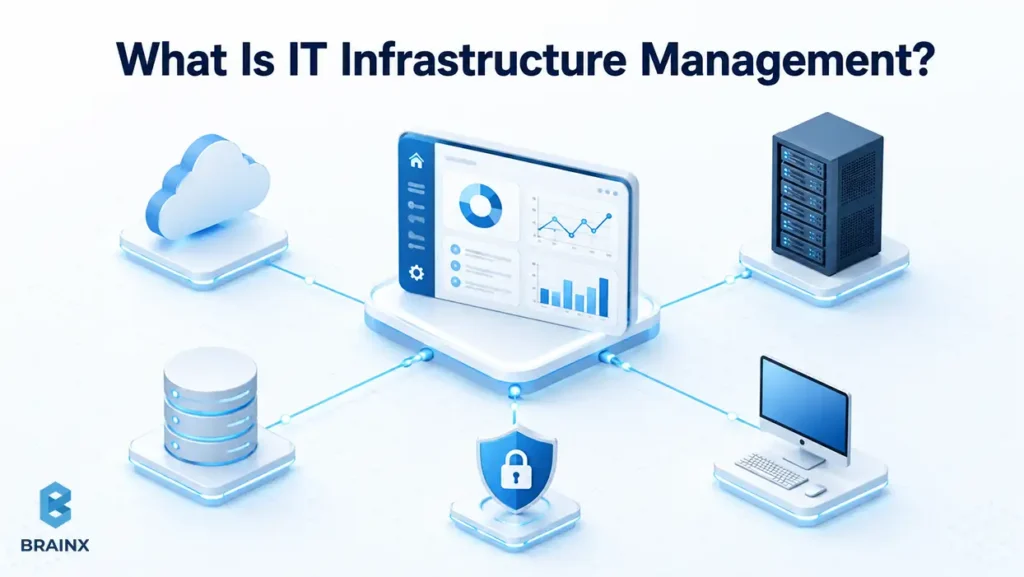
IT infrastructure management is the discipline of coordinating the technology foundation so that business services remain available, secure, performant, recoverable, efficient, and capable of scaling. IBM’s ITOM guidance similarly centers operational management on provisioning, capacity, performance, and availability across on-premises and cloud resources.
It is the business service that is important, not the individual device. A server may appear to have healthy CPU and memory, and users might not be able to sign in due to a DNS, identity, certificate, network path, or database failure.
Consider an ecommerce checkout. One transaction may rely on load balancing, compute, container orchestration, DNS, TLS certificates, authentication, networking, a database, queues, monitoring, backups, and a payment API. Managing only the servers covers a small part of that operational reality.
Key Objectives of IT Infrastructure Management
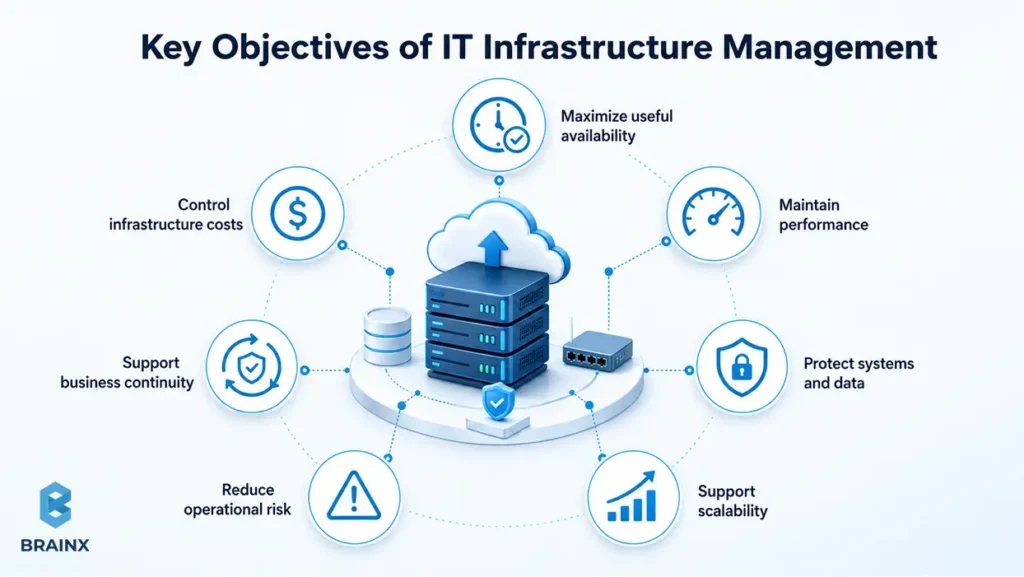
The primary objectives are straightforward:
- Maximize useful availability: Keep critical services accessible when users need them.
- Maintain performance: Prevent infrastructure constraints from degrading applications.
- Protect systems and data: Apply secure configurations, access controls, patching, and monitoring.
- Use resources efficiently: Avoid unnecessary capacity without creating performance risk.
- Support scalability: Prepare infrastructure for changing demand.
- Reduce operational risk: Standardize changes, ownership, and recovery procedures.
- Support business continuity: Maintain tested recovery options for critical services.
- Control infrastructure costs: Connect spending with ownership, usage, and business value.
These goals need context. Engineering extremely high availability for an internal test system may waste resources. Underinvesting in a revenue-generating service can expose the business to far greater losses.
The Different Types of Infrastructure Management
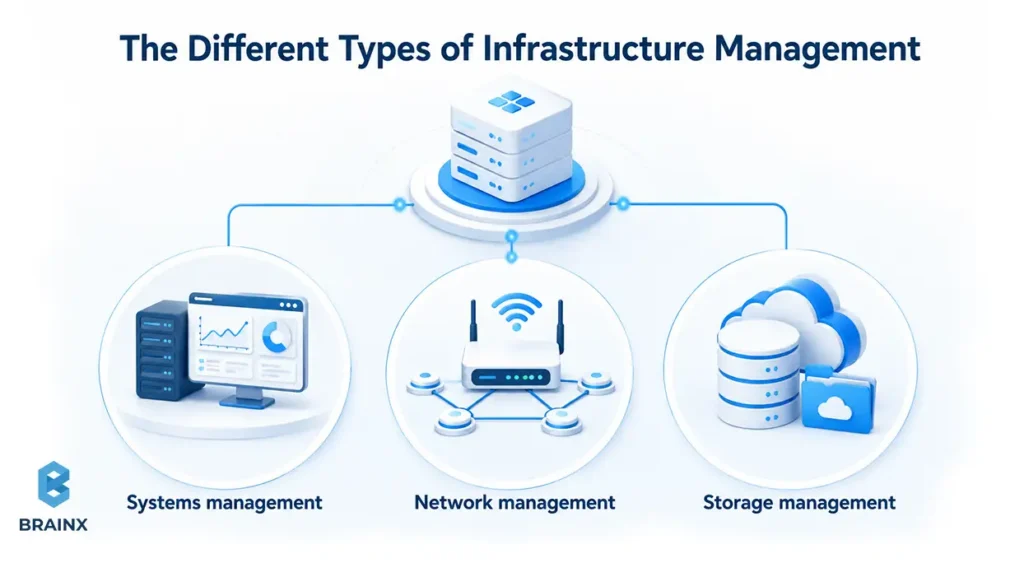
Three traditional domains remain useful:
Systems management includes the server, operating systems, virtual machines, configurations, patching, compute capacity, among other related system software.
Network management includes connectivity, switching, routing, firewall, DNS, VPN, load balancing, segmentation, bandwidth and network performance.
Storage management includes storage for blocks, files and objects, database persistence, capacity, replication, retention, backup, and recovery.
Modern teams may also separate cloud operations, database administration, endpoint management, identity operations, and platform engineering. Those specialties overlap heavily in distributed architectures, so clear ownership matters more than rigid organizational boundaries.
What Are the Key Components of a Modern IT Environment?
A modern environment is a network of technical dependencies. Effective IT infrastructure management requires teams to understand not only what exists, but which business services depend on each component.
Hardware and Compute Resources
Compute resources execute workloads. These can be physical servers, virtual machines, cloud instances, GPUs, serverless runtimes, and edge devices.
Teams should track ownership, lifecycle status, utilization, capacity limits, support status, and service dependencies. Just because an unidentified server is old doesn't mean it is harmless. Until its purpose is understood, it's an unknown operational risk.
Operating Systems and Core Software
Operating systems form the base layer for applications, security agents, packages, drivers, and system services.
Management includes version support, patching, hardening, package control, privilege management, logging, and end-of-life planning. Operating systems that aren't supported grow increasingly difficult to secure and incorporate properly.
Networks and Connectivity
Networks connect people, applications, sites, cloud environments and outside services.
The scope includes routers, switches, firewalls, wireless infrastructure, VPNs, virtual networks, gateways, load balancers, DNS, internet connectivity, and private links.
Track user relevant signals (i.e. latency, packet loss, dns resolution, service reachability) besides the network appliance responding to a health check.
Storage, Databases, and Backup Systems
Persistent data can be stored on local disks, SANs, file systems, object stores, relational databases, NoSQLs, caches, data warehouses, or managed cloud services.
Mere capacity cannot be enough. Teams should also keep an eye on latency, throughput, replication, retention, encryption, integrity, backup coverage, and restore capability.
Cloud, Virtualization, and Containers
Cloud platforms and virtualization separate workloads from individual physical systems. Containers add another abstraction layer, while orchestration platforms coordinate scheduling, networking, storage, and service discovery.
This flexibility means configuration becomes an infrastructure state. All policies, infrastructure-as-code modules, cluster definitions, access roles and cloud settings should be governed as if they are physical servers.
Endpoints and Connected Devices
Laptops, desktops, smartphones, kiosks, specialist equipment are directly connected to business systems most of the time.
Their lifecycle typically includes enrollment, configuration, patching, encryption, endpoint protection, identity, remote access, software distribution, and secure decommissioning.
Identity, Security, and Access Controls
Identity is now a foundational dependency.
Users and workloads rely on identity providers, directories, service accounts, roles, privileged credentials, certificates, keys, and secrets. Strong operations therefore require least privilege, secure authentication, access lifecycle management, audit trails, and emergency-access procedures.
APIs, DNS, Certificates, Queues, and External Services
Some of the most disruptive dependencies do not look like traditional infrastructure.
A service can fail because:
- A DNS record is changed incorrectly.
- A TLS certificate expires.
- An API secret rotates without the application receiving the new value.
- A queue backlog grows until processing stops.
- A payment, identity, or email provider becomes unavailable.
- A third-party API changes its behavior.
- A webhook or SaaS integration loses permission.
A mature inventory tracks these service dependencies alongside owned assets.
For a deeper look at how application architecture and observability support reliable infrastructure, see BrainX's production-ready backend architecture and observability guide.
Infrastructure Management vs. IT Operations: What’s the Difference?
Infrastructure management focuses on the technology foundation. IT operations has a broader responsibility for delivering and supporting technology services.
The two overlap, but the difference in scope helps organizations assign ownership correctly. IBM’s ITOM overview describes IT operations management as the processes and tools used to maintain technology resources within the broader IT service-management lifecycle.
Infrastructure Management Focuses on the Technology Foundation
Infrastructure management questions the health, security, provisioning, control, recovery of the underlying environment.
Typical activities include:
- Server and cloud administration
- Network operations
- Storage management
- Patching
- Monitoring
- Capacity planning
- Configuration management
- Backup and recovery
- Infrastructure automation
IT Operations Covers the Broader Delivery of IT Services
IT operations asks whether users and business processes can reliably consume technology services.
Its scope can cover the infrastructure, service-desk activities, application operations, incident management, change coordination, request fulfilment, supplier coordination, and operational security.
Where ITSM, ITOM, ITAM, SRE, and DevOps Fit
| Discipline | Primary Goal | Scope | Typical Activities | Common Owner |
| Infrastructure management | Keep technology foundations reliable | Compute, network, storage, cloud, platform dependencies | Monitoring, patching, configuration, capacity, recovery | Infrastructure/platform team |
| ITOM | Operate technology services | Infrastructure and operational workflows | Events, incidents, service health, automation | IT operations |
| ITSM | Manage IT services around user and business needs | Service-management lifecycle | Incidents, requests, changes, problems, SLAs | IT service management |
| ITAM | Govern technology assets through their lifecycle | Hardware, software, cloud, licensing | Inventory, lifecycle, ownership, cost, compliance | Asset management |
| SRE | Engineer reliable production services | Production systems and reliability | SLOs, incident response, automation, toil reduction | SRE team |
| DevOps | Improve software delivery and operational collaboration | Development through production | CI/CD, IaC, automation, feedback loops | Product/platform engineering |
The software-delivery side of this model is covered in BrainX's DevOps practices for modern engineering teams, including CI/CD, Infrastructure as Code, observability, and production reliability.
Why Does Effective Infrastructure Management Matter to Businesses?
The value appears when technical improvements translate into business outcomes. Better visibility, security, capacity planning, and recovery should reduce disruption, control spending, and give teams a more dependable platform for growth.
Higher Availability and Less Disruption
Availability improves when teams can detect degradation early, understand dependencies, maintain sufficient capacity, and follow tested recovery procedures.
According to Uptime Institute’s 2026 outage analysis, approximately one in ten respondents still described their latest outage as having serious or severe impact, while outage costs continued to edge upward.
Measure availability at the service level. A group of healthy servers does not matter if customers cannot complete the transaction they came to perform.
Stronger Security and Risk Control
Infrastructure operations and cybersecurity are closely linked.
Patching, identity configuration, secret management, network controls, logging, access review, and secure configuration all depend on operational discipline. IBM’s 2026 breach study reports a $4.99 million global average breach cost and says organizations using AI and automation extensively in security operations cut breach costs by almost $2 million on average.
Technology cannot protect systems that the organization does not know exist.
Better Employee and Customer Experiences
Infrastructure performance often appears to users as application performance.
Slow authentication, saturated network links, overloaded databases, unreliable Wi-Fi, storage latency, or constrained compute can make well-written software feel broken.
This is why service-oriented monitoring matters. Technical metrics should help explain what users are actually experiencing.
More Efficient Technology Spending
Visibility turns infrastructure spending into something teams can actively manage.
Respondents in the latest Flexera 2026 State of the Cloud report estimated 29% of cloud spending in IaaS and PaaS is wasted. So, ownership, tagging, rightsizing, storage policies, commitments, licensing, data transfer and unit economics are part of cost optimization.
The goal is not simply to spend less. It is to know what the organization receives for what it spends.
Greater Scalability and Flexibility
Well-managed environments expose constraints before they become outages.
Capacity planning connects expected demand with compute, database throughput, storage, networking, API quotas, and supporting services.
Cloud elasticity can accelerate scaling, but only when teams understand both architectural limits and financial consequences.
Better Decisions Through Operational Visibility
Operational visibility replaces assumptions with evidence.
The OpenTelemetry observability primer defines the concept in practical terms: “Observability lets you understand a system from the outside.” It relies on properly instrumented signals such as traces, metrics, and logs to diagnose system behavior.
“Database latency increased” is useful. “Checkout latency increased after a deployment and is affecting a critical service” is actionable.
Stronger Compliance and Business Continuity
Repeatable operations also support audits and continuity planning.
Access reviews, logging, documented configurations, patching, supplier controls, backup policies, and recovery testing provide both operational value and stronger evidence for governance requirements.
What Does an IT Infrastructure Manager Do?
An infrastructure manager is the person who is responsible for owning and coordinating the reliability, capacity, security, lifecycle, and governance of the technology foundation.
The exact role depends on scale. For a smaller company, you could have one guy covering systems, networking, cloud, endpoints, vendors and recovery. In an enterprise, those responsibilities may be divided among a number of specialist teams.
Monitor Performance and Coordinate Incident Response
The manager ensures the critical services are all monitored and alerts result in clear action.
In major incidents, the role usually revolves around making sure that experts are coordinated, the incident is escalated, the impact of the incident is communicated, and the learning is translated into proper improvements.
Plan Capacity and Technology Investments
Infrastructure leaders translate business growth into technology needs.
They review utilization, forecast workload changes, identify end-of-life systems, evaluate cloud demand, and prioritize modernization.
Capacity planning needs to consider the peak demands and failure states, not just average demand.
Maintain Security and Compliance Controls
Infrastructure managers assist with the implementation of patching, privileged access, logging, configuration standards, vulnerability remediation and backup procedures according to policy.
Security teams may define controls, but infrastructure teams often operate the platforms that enforce them.
Manage Vendors, Upgrades, and Technology Changes
Modern environments rely on cloud providers, telecom carriers, SaaS suppliers, hardware vendors, managed services, and software partners.
The manager coordinates contracts, lifecycle changes, maintenance windows, escalations, dependencies, and technical change risk.
Maintain Standards, Documentation, and Reporting
Good documentation reduces dependence on tribal knowledge.
Useful artifacts include:
- Architecture diagrams
- Service ownership records
- Asset inventories
- Dependency maps
- Configuration standards
- Backup policies
- Escalation paths
- Change procedures
- Recovery runbooks
Coordinate Technical Teams With Business Stakeholders
The manager turns technical signals into decisions.
Instead of saying “storage utilization is 82%,” a strong infrastructure manager explains whether that trend threatens a critical service, when action is required, what options exist, and what each option costs.
What Challenges Make Modern Infrastructure Hard to Manage?
The hardest infrastructure problems usually come from complexity, poor visibility, inconsistent control, or fragmented ownership.
Hybrid and Multicloud Complexity
Hybrid environments may combine private systems, public clouds, managed databases, SaaS platforms, Kubernetes clusters, remote endpoints, and third-party services.
Different permissions, billing models, failure modes and telemetry are present for each environment. Flexera’s 2026 cloud research confirms that hybrid estates are widespread and that cloud-cost complexity remains a material management issue.
The challenge is maintaining consistent governance across those boundaries.
Legacy Systems and Technical Debt
Older systems can continue to be business critical for a long period of time after the original assumptions have become irrelevant.
Common issues are unsupported operating systems, undocumented integrations, weak scripts, proprietary protocols, and manually maintained configurations.
Migration requires dependency analysis. Replacing the visible server while missing the scheduled job, firewall rule, or downstream consumer can create a larger outage.
Visibility Gaps Across Distributed Environments
Many organizations have multiple dashboards but no single operating picture.
The practical test is whether the team can answer:
- Which business service is affected?
- Which dependency is failing?
- Who owns it?
- What recently changed?
- What action is safe?
If not, the monitoring estate still lacks usable context.
Cybersecurity and Access Risk
Every service, administrative interface, identity, API, credential, and permission increases the attack surface.
Secure configuration, identity management, vulnerability remediation, secrets, and telemetry should therefore be routine infrastructure work, not disconnected security projects.
Cost Control and Resource Sprawl
Cloud resources are easy to create and easy to forget.
Old snapshots accumulate. Development instances remain active. Teams purchase overlapping tools. SaaS subscriptions outlive their users.
Flexera’s 29% estimated cloud-waste figure shows why ownership, tagging, usage measurement, and regular optimization need to become operating practices.
Capacity and Scaling Uncertainty
Capacity risk is not limited to CPU and memory.
An application tier may scale automatically while overwhelming a fixed database connection pool, storage system, queue, API quota, or downstream service.
Capacity planning should therefore focus on the complete service path.
Skills and Staffing Constraints
A good understanding of networking, cloud, identity, automation, containers, security, observability, databases and incident response is required to run modern operations.
Not all skills need to be permanently in-house for businesses. They do need a clear plan for how those skills become available during major incidents, migrations, or modernization programs.
Shadow IT and Undocumented Dependencies
Some of the hardest incidents begin with small undocumented details:
- An expired certificate
- An unowned DNS record
- A backup that has never been restored
- Configuration drift between environments
- A forgotten cloud workload
- An undocumented SaaS dependency
These are failures of discovery, ownership, documentation, and lifecycle control more than failures of technology.
Which Strategies Help Organizations Manage Infrastructure Effectively?
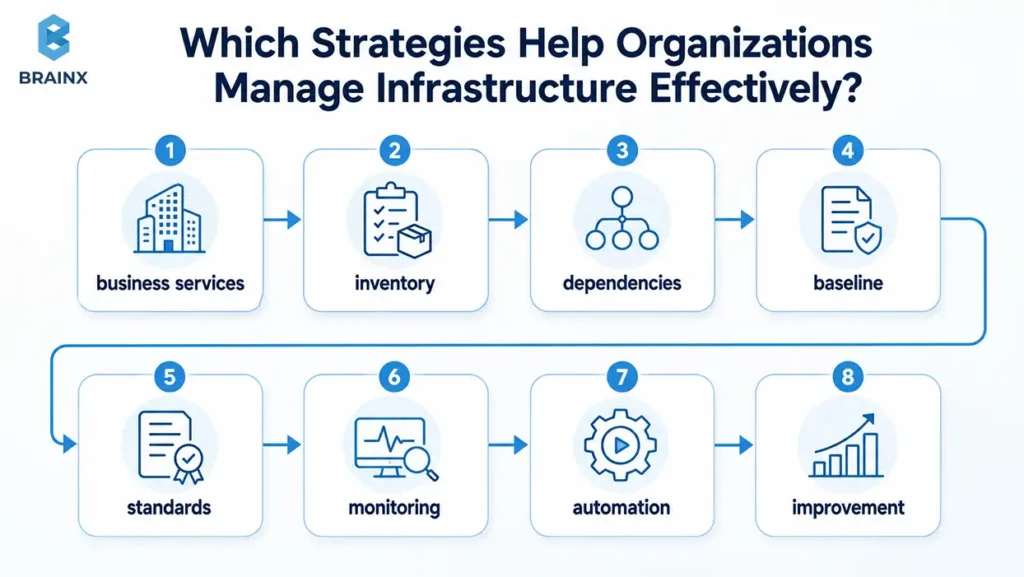
A strong operating model follows a logical sequence:
business services → inventory → dependencies → baseline → standards → monitoring → automation → improvement
Starting with tooling often produces dashboards and scripts without fixing ownership or process gaps.
This sequence also follows the NIST Cybersecurity Framework 2.0, which groups risk management activities under the five categories of Govern, Identify, Protect, Detect, Respond, and Recover, and CIS Control 1, which calls for an inventory of enterprise assets that's accurate and kept up-to-date.
Step 1 — Define Critical Business Services and Owners
Start with business services rather than devices.
For each important service, document:
- Purpose
- Users
- Business impact
- Technical and business owner
- Critical dependencies
- Operating hours
- Availability expectations
- Security requirements
- Escalation path
Deliverable: A service catalog with named owners.
Step 2 — Discover Assets and Map Dependencies
Build an inventory covering physical, virtual, cloud, network, storage, identity, SaaS, and external dependencies.
While automated discovery helps, it doesn't always give a reason why something exists or the customer journey that relies on it.
Deliverables: Asset inventory and dependency map.
Step 3 — Establish Performance, Risk, and Cost Baselines
Measure the current state before setting improvement goals.
Useful baselines include:
- Availability
- Incident volume
- Latency
- Utilization
- Patch status
- Vulnerability exposure
- Backup and recovery performance
- Configuration drift
- Infrastructure spending
Deliverable: Baseline report with priority gaps.
Step 4 — Standardize Configurations and Procedures
Standardization reduces unnecessary variation.
Define supported operating systems, cloud patterns, naming conventions, tagging, access roles, backup policies, patch windows, monitoring requirements, logging, and recovery procedures.
Infrastructure as Code makes many of those standards reviewable and version-controlled. HashiCorp’s IaC guidance describes configuration files as a way to build, change, and manage infrastructure in a safe, consistent, and repeatable manner.
Deliverable: Approved configuration and operating standards.
Step 5 — Establish Monitoring and Actionable Alerting
Collect telemetry that explains service health.
Metrics, logs, traces, configuration changes, security events, cloud events, and synthetic checks should converge around important services.
OpenTelemetry identifies traces, metrics, and logs as core telemetry signals for observability.
Every alert needs an owner, severity, escalation path, and expected response.
Deliverables: Service dashboards and actionable alerts.
Step 6 — Automate Stable, Repeatable Processes
Automate work that is understood, standardized, testable, and reversible.
Good candidates include:
- Infrastructure provisioning
- Configuration deployment
- Patch orchestration
- Certificate renewal
- Backup validation
- Routine health checks
- Environment creation
- Low-risk remediation
Ansible, for example, supports repeatable configuration and deployment through reusable playbooks. Its documentation also explains idempotent behavior and recommends testing playbooks before repeated production use.
Production automation should always answer four questions:
- How is success validated?
- What is the rollback?
- What happens when telemetry is incomplete?
- Who can stop the process?
Deliverable: Tested automation playbooks and runbooks.
Step 7 — Measure, Document, Review, and Improve
Infrastructure maturity is continuous.
Review KPIs, incidents, failed changes, costs, security findings, capacity trends, recovery tests, undocumented assets, and repetitive manual work on a defined cadence.
Post-incident reviews should create accountable improvement work, not just documentation.
Deliverable: Prioritized improvement backlog.
Best Practices for Optimizing Your IT Environment
Keep the operating model simple:
- Standardize before automating.
- Store configurations in version control where practical.
- Keep asset and dependency data current.
- Apply least privilege to users and machine identities.
- Patch according to risk and business constraints.
- Test restoration and failover.
- Review capacity and cost together.
- Keep runbooks executable and accessible.
- Feed post-incident findings into planned engineering work.
A mature IT infrastructure management program also recognizes caveats. Maintenance windows may limit changes. Legacy systems may constrain patching. Data residency may restrict architecture options. Vendor access needs controls. Automation needs rollback. Monitoring gaps may make automated remediation unsafe.
For a related phased modernization approach, BrainX's DevOps implementation roadmap from legacy to cloud shows how assessment, automation, and cloud adoption can be sequenced safely.
How Can Businesses Build Resilience Into Their IT Infrastructure?
Resilience is the ability to withstand disruption or recover while keeping business impact within acceptable limits.
It is broader than having backups. Microsoft’s Well-Architected reliability guidance treats resilience, availability, and recoverability as related but distinct workload qualities.
Identify Critical Services and Failure Domains
Start by identifying what must keep working and what could stop it.
A critical service might depend on:
- One cloud region
- An identity provider
- DNS
- A database
- A network carrier
- A queue
- A third-party payment provider
Ask a direct question for every dependency: What happens if this disappears completely?
Design Redundancy Without Creating Unnecessary Complexity
Redundancy can reduce risk, but every extra component adds cost, configuration, monitoring, and operational complexity.
Two regions do not solve resilience if they depend on the same failing identity system. Multiple cloud providers can reduce concentration risk while increasing operational burden.
Design redundancy around credible business-impact scenarios.
Define RTOs and RPOs Based on Business Impact
Recovery Time Objective (RTO) defines how quickly a service must recover.
Recovery Point Objective (RPO) defines how much data loss the business can tolerate.
Microsoft recommends deriving reliability and recovery targets from business requirements and validating them through monitoring and testing.
Lower recovery targets usually require more investment in replication, redundancy, automation, capacity, monitoring, and testing.
Protect Backups From the Same Failures as Production
A backup is useful only if it survives the failure affecting production.
Use separate failure domains, controlled credentials, encryption, appropriate retention, and independent recovery access.
AWS recommends periodic recovery testing to verify backup integrity and confirm that restoration can meet established RTO and RPO requirements.
Test Failover and Disaster Recovery Regularly
An untested disaster-recovery plan is an assumption.
Testing should cover:
- Failover
- Failback
- Credentials
- DNS
- Dependencies
- Data integrity
- Communications
- Recovery automation
- Actual RTO and RPO performance
The AWS Well-Architected Reliability Pillar explicitly recommends testing disaster-recovery implementation to validate that the chosen strategy meets recovery objectives.
Maintain Incident and Continuity Runbooks
Runbooks reduce uncertainty during incidents.
They should document prerequisites, owners, decisions, procedures, validation steps, rollback instructions, and escalation paths.
Store them somewhere that remains accessible during the outage they are meant to resolve.
Learn From Failures Through Post-Incident Reviews
Failures provide evidence about weak assumptions.
Review:
- Why the failure was possible
- Why detection took as long as it did
- Why recovery depended on specific people
- Which control or dependency was missing
- What engineering work will prevent recurrence
The result should become prioritized improvement work with an owner.
Which Tools and Platform Features Matter Most?
Tools should support the operating model, not define it.
One common failure pattern is buying separate tools for each problem without deciding which source owns inventory, alerts, service context, or configuration truth.
Tools for Monitoring and Observability
Common options include:
- Prometheus
- Grafana
- Datadog
- New Relic
- OpenTelemetry-based architectures
- AWS, Azure, and Google Cloud native monitoring services
OpenTelemetry provides vendor-neutral observability instrumentation around signals such as metrics, logs, and traces.
Selection should focus on whether the stack helps teams connect service health, changes, dependencies, and ownership without producing excessive alert noise.
Tools for Configuration and Infrastructure Automation
Terraform manages infrastructure through declarative configuration and a write, plan, and apply workflow that lets teams preview changes before provisioning them.
Ansible supports configuration management, deployment, orchestration, and repeatable administrative workflows through playbooks.
Puppet and Chef can remain appropriate where mature environments already depend on them. Replacing functioning automation solely because another tool is newer can create unnecessary risk.
Tools for Cloud and Container Management
Native cloud consoles and APIs provide direct control over cloud services.
Container environments may add Kubernetes and provider-managed Kubernetes platforms to coordinate workloads.
The important question is whether another management platform reduces fragmentation or merely creates an additional control plane.
Tools for Asset, Service, and Configuration Management
Different platforms solve different problems:
- ITAM systems track asset lifecycle and ownership.
- ITSM platforms manage incidents, changes, requests, and service workflows.
- CMDBs model configuration items and their relationships.
These systems become more valuable when they receive reliable data from cloud discovery, endpoints, observability, identity, and deployment systems.
A manually maintained CMDB with stale records is not a dependable source of truth.
Key Features to Look for in an Infrastructure Management Platform
Prioritize capabilities that improve operational decisions:
- Unified visibility
- Real-time service health
- Dependency and service mapping
- Automation with approval controls
- Alert correlation
- APIs and integrations
- Configuration tracking
- Role-based access
- Security controls
- Cloud and hybrid coverage
- Scalable reporting
- Data portability
Also evaluate implementation effort, telemetry costs, access requirements, ownership, retention, and vendor lock-in.
Which KPIs Show Whether Infrastructure Is Performing Well?
The strongest KPI set measures reliability, recovery, performance, security hygiene, efficiency, change quality, and cost together.
Uptime alone can hide repeated incidents, poor recovery, slow performance, security gaps, or excessive spending.
Availability and Service Uptime
Measure the percentage of time a business service is usable within its agreed operating window.
Prefer service availability over individual-host uptime.
MTTD and MTTR
Mean Time to Detect measures how quickly meaningful failures become known.
Mean Time to Restore or Recover measures how quickly acceptable service returns.
Segment these metrics by service and incident severity rather than averaging unrelated incidents.
Incident Frequency and Recurrence
Track how often incidents happen and how often the same failure mechanism returns.
Improving MTTR while incident frequency doubles is not a healthy trend.
Latency and Performance
Measure user-relevant performance.
Depending on the service, this might include:
- API latency
- Database query time
- Page-response time
- Queue delay
- Storage I/O
- Network latency
Percentiles such as p95 or p99 often reveal problems that averages conceal.
Capacity and Resource Utilization
Measure constrained resources such as:
- CPU
- Memory
- Storage
- Database connections
- Network bandwidth
- Queue depth
- Service quotas
High utilization is not automatically good. Permanent saturation can leave no headroom for spikes or failures.
Patch and Vulnerability Coverage
Track:
- Percentage of relevant assets within patch policy
- Age of unresolved critical vulnerabilities
- Unsupported systems
- Exposure of internet-facing components
Always verify the denominator. A high patch percentage is meaningless if asset discovery misses part of the estate.
Backup and Recovery Success
Measure more than backup-job completion.
Track:
- Backup success
- Restore-test success
- Actual recovery time
- Actual recovery point
- Percentage of critical services tested
AWS specifically warns against assuming that a backup exists or is recoverable without periodic recovery testing.
Change Failure Rate and Configuration Drift
Track changes that cause degradation, rollback, or remediation.
Also compare approved configuration against actual state. Drift reveals where manual changes or inconsistent automation are weakening control.
Cost per Service, User, or Workload
Total infrastructure spend is useful for finance, but unit economics are more actionable.
Examples include:
- Cost per active user
- Cost per tenant
- Cost per transaction
- Cost per workload
- Cost per environment
Flexera reports that 49% of respondents use unit economics to connect cloud spending with services and business outcomes.
Every KPI should have an owner, target, reporting cadence, and expected action.
What Affects Infrastructure Costs and Implementation Timelines?
There is no responsible universal price or timeline for implementing mature infrastructure operations.
Scope, complexity, service criticality, legacy constraints, security requirements, tooling, staffing, coverage, and recovery targets all change the effort.
Environment Size and Complexity
A 50-person SaaS business with one cloud environment differs fundamentally from a multinational company operating data centers, multiple clouds, thousands of endpoints, legacy systems, and hundreds of applications.
Count dependencies and ownership boundaries, not only servers.
Users, Locations, and Coverage Hours
More users and sites increase endpoint, network, identity, and operational requirements.
Twenty-four-hour services may also require shift coverage, on-call engineering, or external monitoring.
Cloud Accounts and Workload Distribution
Complexity increases with:
- Cloud providers
- Accounts and subscriptions
- Regions
- Kubernetes clusters
- Network boundaries
- Data volumes
- Managed services
- Workload diversity
One consolidated bill can still hide many ownership and optimization problems.
Security and Compliance Requirements
Higher assurance requires more controls, evidence, access governance, testing, documentation, logging, and specialist involvement.
Cost comes from operating those controls consistently, not just buying a security platform.
Recovery Objectives and Availability Targets
Tighter RTOs, RPOs, and availability targets usually require more:
- Redundancy
- Replication
- Automation
- Capacity headroom
- Monitoring
- Testing
- Operational coverage
Microsoft recommends setting realistic reliability targets with business stakeholders and using those targets to guide architecture decisions instead of overengineering every workload.
Legacy Systems and Technical Debt
Legacy dependencies increase discovery and change risk.
Teams may need reverse engineering, staged modernization, additional testing, bridging systems, or vendor support before automation becomes safe.
Staffing, Licensing, and Tooling
Budget may include:
- Engineering labor
- On-call coverage
- Managed services
- Monitoring ingestion
- ITSM and asset platforms
- Security tools
- Backup systems
- Cloud-management tooling
- Training
Tool consolidation can reduce spending, but replacing mature systems also creates migration cost and risk.
Why One Universal Cost Estimate Is Misleading
A credible estimate should follow this sequence:
scope → service criticality → inventory → dependencies → maturity → target controls → operating model → roadmap
That separates one-time modernization work from recurring operations and makes tradeoffs explicit.
Which Emerging Trends Are Changing Infrastructure Operations?
Infrastructure teams in 2026 are operating more distributed environments while adopting platform engineering, software-defined configuration, broader FinOps practices, richer observability, and new edge workloads.
Hybrid and Distributed Infrastructure Becomes the Default Operating Reality
Flexera reports 73% hybrid cloud adoption in 2026.
For many established organizations, infrastructure now spans cloud services, SaaS applications, private systems, branch locations, endpoints, and external providers.
That requires common identity, policy, telemetry, ownership, and service context across boundaries.
Platform Engineering Brings Standardized Self-Service
Platform engineering packages repeatable infrastructure and delivery patterns into reusable internal capabilities.
Instead of every team independently building environments, monitoring, security, and pipelines, a platform team can provide approved paths and templates.
The goal is not another ticketing layer. It is self-service with guardrails.
Observability Moves Toward Service-Level Context
Collecting more logs is not enough.
Teams need telemetry connected to services, customers, deployments, dependencies, and ownership. OpenTelemetry’s vendor-neutral approach supports consistent instrumentation across distributed environments.
Infrastructure Becomes Increasingly Software-Defined
Cloud APIs, Infrastructure as Code, containers, and policy-driven configuration make infrastructure state machine-readable.
Terraform’s core workflow reflects this model by letting teams write, review, plan, and apply infrastructure changes through code.
The benefit is repeatability. The risk is blast radius, since a flawed template can consistently misconfigure many resources.
FinOps Expands Beyond Public Cloud Costs
FinOps is broadening beyond cloud-billing optimization.
The State of FinOps 2026 reports that 98% of respondents manage AI spend, 90% manage SaaS or plan to, 57% manage private cloud, and 48% manage data center costs.
That shift connects architecture, usage, procurement, and business value across a wider technology portfolio.
Edge Computing Adds New Management Boundaries
Edge workloads move compute closer to stores, factories, clinics, devices, or other points where data is generated.
The tradeoff is more distributed assets, physical locations, network dependencies, security boundaries, and occasionally unreliable connectivity.
Sustainability and Resource Efficiency Gain Importance
Resource efficiency increasingly overlaps with cost and sustainability.
Practical actions include:
- Retiring idle infrastructure
- Improving utilization
- Selecting appropriate workload locations
- Reducing unnecessary data movement
- Managing hardware lifecycle
- Evaluating energy requirements alongside performance
How Are AI and Automation Reshaping Infrastructure Operations?
AI is most useful when it helps teams detect, correlate, prioritize, predict, recommend, or automate bounded operational work.
It is least useful when organizations expect it to compensate for missing telemetry or unclear processes.
The DORA 2025 report puts the principle clearly: “AI’s primary role is as an amplifier, magnifying an organization’s existing strengths and weaknesses.”
Anomaly Detection and Predictive Monitoring
Machine-learning systems can identify behavior that differs from historical patterns.
Potential signals include:
- Unexpected latency
- Memory growth
- Storage consumption
- Failure rates
- Traffic patterns
- Resource combinations
Context still matters. A traffic spike during a scheduled campaign may be normal. The same behavior on a critical database connection pool may indicate an approaching failure.
Event Correlation and Faster Incident Triage
One underlying problem can trigger dozens or hundreds of alerts.
AI-assisted correlation can group related events, summarize timelines, surface recent changes, and identify likely affected dependencies.
The goal should be reducing cognitive load, not automatically closing incidents based on a confidence score.
Predictive Capacity Planning
Historical telemetry can help forecast storage, compute, network, or database demand.
Predictions become more useful when combined with known business events such as product launches, migrations, growth, or seasonal demand.
Resource and Cost Optimization
AI can surface:
- Idle resources
- Unusual spending
- Rightsizing candidates
- Usage anomalies
- Resource trends
Recommendations still need service context. Low average utilization does not always mean a resource is unnecessary. It may provide failover headroom or serve periodic peaks.
Automated Remediation and Self-Healing Workflows
Safe remediation can follow a controlled sequence:
detect → validate → correlate → execute approved action → verify → roll back or escalate
Low-risk examples include restarting a stateless process, replacing an unhealthy instance, renewing a certificate, or scaling capacity within approved limits.
Automation should be tested and observable.
Configuration Recommendations and Drift Detection
AI can help compare actual configurations against approved standards, summarize differences, and identify suspicious changes.
The approved source of truth must remain explicit. Otherwise, an AI system may recommend adapting standards to accidental production drift instead of correcting production.
Where Human Approval Should Remain Mandatory
Keep human approval for actions with high uncertainty, privilege, regulatory impact, or blast radius.
Examples include:
- Destructive database changes
- Identity-policy changes
- Production network changes
- Cross-region failover with data implications
- Resource deletion
- Security exceptions
- Changes affecting regulated data
Practical guardrails include:
- Reliable telemetry
- Explicit service ownership
- Least-privilege automation identities
- Pre-execution validation
- Audit logs
- Rollback procedures
- Blast-radius limits
- Human approval for high-risk changes
- Post-change verification
AI can accelerate strong infrastructure operations. It should not substitute for them.
When Should You Use IT Infrastructure Management Services?
Organizations should consider IT infrastructure management services when internal teams cannot consistently provide the coverage, expertise, operational discipline, or modernization capacity their environment requires.
External support often becomes useful when infrastructure grows faster than the operating model around it. Recurring incidents, slow patching, incomplete monitoring, cloud sprawl, weak recovery testing, or dependence on one employee are common warning signs.
The strongest engagements define responsibilities clearly. A provider can perform operational work, but the business still provides service priorities, risk thresholds, governance, and accountable owners.
What IT Infrastructure Management Services Typically Include
Depending on scope, IT infrastructure management services may include:
- Infrastructure assessment
- Architecture review
- Monitoring and alerting
- Server, network, and cloud administration
- Configuration and patch management
- Backup and recovery support
- Security operations support
- Capacity planning
- Incident response
- Infrastructure automation
- Performance optimization
- Cost optimization
- Reporting and documentation
The contract should define coverage hours, response expectations, access boundaries, change authority, escalation, tooling, documentation, and handover requirements.
Should You Outsource or Keep Management In-House?
There are three common models:
| Model | Control | Skill Access | Coverage | Best Fit |
| In-house | Highest direct control | Internal expertise | Depends on staffing | Organizations with mature internal capability |
| Co-managed | Shared | Internal plus external specialists | Can extend internal coverage | Teams needing targeted skills or 24/7 support |
| Fully managed | Operational execution largely delegated | Broad provider capability | Often widest | Businesses wanting substantial operational delegation |
Co-managed models work well when internal teams understand the product and business context but need additional cloud, network, automation, or support capacity.
Signs Your Internal Team Needs External Support
Consider external help when you see:
- Recurring outages
- Patch backlogs
- No sustainable 24/7 response
- Backups that are rarely restore-tested
- Rapid cloud or Kubernetes expansion
- Major modernization work
- Poor asset visibility
- Key-person dependency
- Automation repeatedly postponed because of firefighting
What Responsibilities Should Stay Inside the Business?
Even with extensive outsourcing, retain accountability for:
- Business-service ownership
- Risk acceptance
- Architecture priorities
- Privileged-access approval
- Regulatory accountability
- Data governance
- Supplier governance
- Budget and service priorities
A provider can execute. The business remains responsible for deciding what acceptable risk and service performance mean.
Teams that need external engineering support can use BrainX's DevOps consulting and implementation services for infrastructure assessment, cloud architecture, automation, monitoring, and modernization.
How Should You Compare IT Infrastructure Management Companies?
Businesses should compare IT infrastructure management companies on operating maturity, environment fit, security, resilience, transparency, documentation, and knowledge portability.
A provider should be able to explain how it discovers an environment, controls privileged access, handles incidents, authorizes changes, validates recovery, reports performance, and transfers knowledge.
This is also a governance issue. NIST CSF 2.0 places cybersecurity supply-chain risk within the Govern function, reinforcing the need to define provider roles, access, requirements, and accountability before outsourcing operational control.
What Separates Reliable IT Infrastructure Management Companies From Basic Vendors
Reliable IT infrastructure management companies operate around business services and documented controls, not just device alerts.
Ask providers to demonstrate:
- Service-oriented monitoring
- Escalation procedures
- Change governance
- Recovery testing
- Configuration standards
- Documentation practices
- Improvement processes
Ask for evidence instead of reassurance.
Technical Expertise and Environment Fit
Validate expertise against the technologies you actually operate.
A provider strong in Microsoft infrastructure may not have equivalent Kubernetes experience. A cloud-native team may not be appropriate for a heavily regulated legacy estate.
Look for relevant architecture, scale, constraints, and modernization experience.
Monitoring Coverage, SLAs, and Escalation
Clarify:
- What is monitored?
- What counts as an incident?
- When does a human become involved?
- How is severity determined?
- Who owns resolution?
- What happens when monitoring itself fails?
SLAs should define measurement and exclusions, not just display a percentage.
Security and Access Governance
Providers may require powerful privileges.
Evaluate:
- Identity federation
- MFA
- Least privilege
- Privileged-access workflows
- Logging
- Employee offboarding
- Emergency access
- Subcontractor access
- Customer approval requirements
Recovery and Business-Continuity Capabilities
“Managing backups” does not prove recoverability.
Ask for recent recovery-test evidence:
- What was restored?
- Were dependencies included?
- How long did recovery take?
- What RPO was achieved?
- What problems were found?
- What changed afterward?
Documentation and Knowledge Transfer
A managed environment should become more understandable over time.
The provider should maintain appropriate:
- Architecture diagrams
- Inventories
- Runbooks
- Access models
- Configuration records
- Incident history
- Recovery documentation
The customer should not become dependent on knowledge stored only inside the provider's systems.
Tool Ownership and Integration
Clarify who owns:
- Monitoring platforms
- IaC repositories
- Automation
- Dashboards
- Licenses
- Cloud-management platforms
- Configuration data
Provider-owned tooling can simplify onboarding but increase switching cost. Customer-owned tooling improves portability but requires stronger governance.
Exit Planning and Data Portability
Discuss exit before signing.
Define how the provider will transfer:
- Infrastructure definitions
- Inventory data
- Documentation
- Monitoring configuration
- Dashboards
- Scripts
- Runbooks
- Incident history
- Architecture diagrams
- Credentials or access ownership
- Open improvement work
Red Flags to Watch Before Signing
Be cautious when a provider:
- Cannot explain its methodology
- Uses shared administrator accounts
- Refuses to provide sample documentation
- Cannot demonstrate recovery testing
- Provides vague SLA definitions
- Avoids knowledge-transfer commitments
- Has no clear exit process
- Creates unnecessary proprietary lock-in
These details reveal more about operating maturity than a long services checklist.
How BrainX Helps Modernize and Manage IT Environments
BrainX Technologies helps organizations improve cloud, DevOps, automation, observability, and infrastructure architecture through assessment-led engineering engagements.
Our DevOps implementation process begins with an assessment of existing infrastructure, workflows, and development processes, followed by a tailored roadmap. The same service page covers cloud-provider evaluation, architecture design, automation, monitoring, fault tolerance, and performance considerations.
Infrastructure Assessment and Architecture Review
A strong engagement starts by understanding the current environment.
BrainX can assess infrastructure and workflows to identify architecture concerns, operational gaps, dependencies, and modernization priorities.
Typical outputs can include:
- Architecture findings
- Priority risks
- Dependency concerns
- Modernization roadmap
- Recommended next actions
Cloud and Hybrid Modernization
BrainX’s DevOps services include cloud-provider evaluation across AWS, Azure, GCP, and DigitalOcean using factors such as security, scalability, pricing, and workload requirements.
Modernization may involve migration, re-platforming, cloud-native services, containers, or retaining hybrid components where business constraints justify them.
The goal should be the right operating model, not cloud migration for its own sake.
Infrastructure as Code and Automation
BrainX’s DevOps work includes infrastructure automation and Infrastructure as Code practices.
Depending on scope, deliverables may include reusable IaC modules, environment provisioning, deployment automation, configuration standards, and controlled infrastructure-change workflows.
Monitoring and Observability
BrainX’s DevOps offering includes monitoring and analytics as part of infrastructure and application delivery.
Useful outputs may include service dashboards, alerting strategies, observability foundations, log and metric integration, and operational runbooks.
Security and Reliability Improvements
Architecture decisions should consider security and reliability together.
BrainX’s published architecture-design process references fault tolerance, performance, security, scalability, and resource allocation as core considerations.
Improvement work may therefore address access, monitoring, deployment controls, resilience gaps, secure configuration, and operational risk.
Documentation and Knowledge Transfer
Modernization should leave the internal team able to understand and evolve the environment.
Useful handover artifacts can include:
- Architecture diagrams
- Infrastructure definitions
- Deployment procedures
- Monitoring context
- Runbooks
- Recovery documentation
- Known limitations
Documentation scope should be defined explicitly rather than assumed.
Continuous Performance and Cost Optimization
Infrastructure changes after launch.
Traffic grows, dependencies evolve, cloud services change, and previously reasonable resource decisions become inefficient.
BrainX’s DevOps practices guide emphasizes continued monitoring, observability, feedback loops, infrastructure consistency, and operational improvement.
A relevant BrainX example is the Visitoors AWS-hosted visitor analytics platform case study, which features a multi-tenant platform with an AWS-hosted backend, role-based access, connected-device activity, and real-time data visualization.
Conclusion: Build Infrastructure Around Business Priorities
Strong infrastructure starts with understanding which business services matter and what they depend on.
From there, effective IT infrastructure management follows a deliberate progression: discover the environment, define objectives, assign ownership, map dependencies, establish baselines, standardize configurations, improve security, build resilience, monitor service health, automate stable work, and measure outcomes.
The sequence matters. Automation cannot compensate for undocumented dependencies. Redundancy cannot protect a service when its real failure domains are unknown. Monitoring tools cannot create ownership. Outsourcing cannot transfer the organization's responsibility for architecture, risk, and continuity.
The objective is not more tooling. It is a technology foundation that behaves predictably enough for the business to grow, recover, change, and make informed tradeoffs.
BrainX Technologies can support organizations that need to assess, modernize, automate, and improve cloud or hybrid environments without turning the engagement into long-term operational dependency.
For a tailored roadmap based on your current environment, you can discuss your infrastructure requirements with BrainX and identify the highest-priority modernization steps.
Frequently Asked Questions
What is IT infrastructure management, and what does it include?
IT infrastructure management is the coordinated operation, monitoring, security, maintenance, recovery, capacity planning, and optimization of the technology foundation supporting business services. It covers compute, networks, storage, databases, cloud resources, endpoints, identity, security controls, backups, observability, and external dependencies. Modern environments should also account for DNS, certificates, APIs, queues, SaaS platforms, and third-party providers because those services can directly affect availability.
What are the three main types of infrastructure management?
The three traditional categories are systems management, network management, and storage management. Systems management covers compute, operating systems, and configurations. Network management focuses on connectivity, routing, firewalls, DNS, and traffic. Storage management covers persistent data, capacity, backup, performance, and recovery. Modern teams may also have separate cloud, platform, database, identity, and endpoint functions.
What is the difference between infrastructure management and IT operations?
Infrastructure management focuses on the technology foundation, including compute, networking, storage, cloud services, monitoring, capacity, configuration, and recovery. IT operations has a broader scope and may also include service support, application operations, incident coordination, user services, and service-management processes. Infrastructure management is therefore an important part of the broader operational model.
What do IT infrastructure management services typically include?
IT infrastructure management services can include infrastructure assessments, monitoring, server and network administration, cloud operations, patching, backup and recovery, capacity planning, incident response, automation, security support, optimization, and reporting. Exact scope varies by provider and contract. Businesses should define service hours, access boundaries, SLAs, escalation, change authority, recovery obligations, documentation, and handover requirements before engagement.
Which KPIs should businesses track for infrastructure performance?
A balanced KPI set includes availability, MTTD, MTTR, incident frequency, recurrence, latency, capacity, patch coverage, vulnerability exposure, backup and restore success, configuration drift, change failure, and cost per service or workload. Every metric should connect to a business service, owner, target, reporting cadence, and corrective action. Uptime alone cannot show whether recovery is weak, costs are excessive, or users are experiencing degraded performance.
Should a business manage its infrastructure in-house or outsource it?
The right model depends on the environment's complexity, internal skills, operating hours, regulatory obligations, and strategic importance. In-house management provides the greatest direct control. Co-management combines internal context with external expertise, while a fully managed model delegates more day-to-day execution. In every case, the organization should retain responsibility for service ownership, architecture direction, risk acceptance, access approval, compliance, and supplier governance.